Energy-aware Video Streaming with QoS Control for
Portable Computing Devices
Morihiko Tamai, Tao Sun, Keiichi Yasumoto, Naoki Shibata
†and Minoru Ito
Grad. Sch. of Info. Sci., Nara Inst. Sci. and Tech. Ikoma, Nara 630-0192, Japan
{morihi-t,song-t,yasumoto,ito}@is.naist.jp
†Dept. of Info. Proc. and Man., Shiga Univ. Hikone, Shiga 522-8522, Japan
ABSTRACT
We propose an energy-aware video streaming system for portable computing devices, in which the video can be played back for the specified duration within the remaining battery amount. To save power, we introduce techniques (i) to reduce playback quality of a video at an intermediate proxy and (ii) to shorten working time of the network I/F card using periodic bulk transfer of the video data on the wireless LAN. To enable playback for the specified dura-tion, we have developed a power consumption model for portable devices using parameters on playback quality, playback duration, battery amount, and so on. We have also developed an algorithm to assign different playback quality among multiple video segments based on the user’s preference. Our experiments using PDAs and laptop PCs on 802.11b WLAN show that our system achieves less than 6 % prediction error in playback duration while adapting play-back quality among video segments.
Categories and Subject Descriptors: C.3 [Computer Systems
Organization]: Special-purpose and application-based systems
General Terms: Experimentation
Keywords: Energy-aware Systems, Video Streaming, QoS,
Wire-less LANs
1.
INTRODUCTION
Owing to recent innovations in portable computing devices (such as PDAs and smart phones) and wireless communication infrastruc-ture (such as WLAN and wideband CDMA), we can watch video contents using those devices every time and everywhere. In such an on-demand video streaming and playback, however, the portable computing device consumes much more battery amount than other business applications, due mainly to video decoding and wireless communication. Consequently, there will be a demand to control battery life depending on user requirements or situations so that the battery is not exhausted until the video playback finishes or the specified amount of battery (e.g., 50%) is left after playing back the video content.
In general, we can extend video playback duration by reducing video quality. However, it is difficult to estimate how long the
bat-tery lasts for each playback quality, since the batbat-tery consumption depends on not only video playback but also other factors such as OS, LCD, and so on. Besides it, these factors are device depen-dent. Moreover, when the remaining battery amount is small and the playback quality is reduced over the whole playback duration, users may get frustrated. In order to mitigate such a situation, some fragments of a video important for a user should be played back with higher quality than others. Also, to each fragment, a user should be able to specify playback preferences such as balance of motion speed and vividness.
In this paper, we propose a method for energy-aware video stream-ing and playback which consists of (1) power-savstream-ing techniques for streaming video playback in portable computing devices on the wireless LAN, (2) a technique to estimate the suitable parameter values (such as picture size, frame rate and bitrate) which enable playback for the specified duration within the remaining battery amount, and (3) a QoS control mechanism which enables playback of multiple video segments with different playback quality based on the user’s preference.
For (1), we introduce two techniques: (i) reduction of video qual-ity with a transcoder; and (ii) periodic bulk transfer of the video data on the wireless LAN. For (i), we execute a proxy on an inter-mediate node (or on the content server) in the network so that the proxy receives the stream and forwards the transcoded stream to the user terminal. For (ii), the user terminal receives each fragment of the stream data at transmission rate as high as possible, stores the data in the local buffer, and stops supplying power to its WNIC (wireless LAN I/F card) until the buffer becomes empty.
For (2), we have developed a power consumption model for the user terminal, in which the parameter values can automatically be decided from the desired playback duration, the remaining battery amount, and device specific information.
For (3), we have developed an algorithm to distribute the bat-tery amount among multiple video segments based on each user’s preference. When a user specifies relative importance among video segments and preferred video property (proportion among picture size, frame rate and bitrate) for each segment, our algorithm deter-mines the playback quality of each video segment so that the video playback can last for the specified duration within the remaining battery amount.
We have implemented the energy-aware video streaming system based on the proposed method. From experiments using a PDA and a laptop PC on IEEE 802.11b WLAN, we have confirmed that the proposed power saving method is effective, and that the esti-mation of playback quality based on the proposed model is accu-rate enough. Moreover, we have confirmed that the proposed QoS control method improves the playback quality of important video segments much better than flattening the quality over the playback duration.
In the following Sect. 2, we briefly survey related work. Sect. 3 presents the power saving techniques in playback of streaming video and the power consumption model to derive parameter val-ues to satisfy the playback duration and the battery amount. In Sect. 4, we introduce our energy-aware QoS control technique based on relative importance among video segments. In Sect. 5, we show evaluation of the proposed method through experiments and analy-sis. Finally, we conclude the paper in Sect. 6.
2.
RELATED WORK
Power consumption when playing back streaming video on portable computing devices via WLAN consists mainly of (i) decoding and drawing video frames and (ii) packet transmission on WLAN.
For (i), we can use a transcoding technique. For example, [1] proposes a power saving technique which reduces the total data size of the video by selectively dropping I, P and B frames when streaming MPEG videos. For (ii), there are several approaches. [9] proposes a power saving technique by regulating power for radio wave output in IEEE 802.11b WLAN. [8] proposes another power saving technique which reduces power consumption by shortening time for communication using data compression.
These existing researches focus mainly on power saving tech-niques, but do not propose battery control depending on user re-quirements such as the playback duration within the battery amount. In recent years, semantic transcoding techniques are paid much attention. Here, the user’s satisfaction is improved by transcoding a video according to the contents and semantics of each fragment of a video[2, 4]. In previous transcoding techniques which simply reduce the picture size, objects in each picture frames becomes too small and difficult to identify. [4] copes with this problem by spec-ifying the user’s interesting area in the picture with the MPEG-21 DIA framework so that only the area is trimmed off and transcoded. In [2], a video in MPEG-4 format is divided into objects of sev-eral categories such as foreground objects and background objects. Here, playback qualities of important objects are maintained while qualities of other objects are degraded.
The objectives of these existing researches are to satisfy restric-tions of portable devices w.r.t. picture size and available bandwidth. However, they do not treat restrictions on the battery amount.
3.
METHOD FOR ENERGY-AWARE VIDEO
STREAMING AND PLAYBACK
In this section, we present two power saving techniques for play-back of streaming videos on portable computing devices, and then introduce the power consumption model to determine the parame-ter values which enable playback for the specified duration within the battery amount.
3.1
Power Saving Techniques
When playing back a streaming video on a portable computing device (called the user terminal, hereafter), the consumed power consists of (i) power consumed by wireless transmission of packets, (ii) power consumed by decoding and drawing video frames, and (iii) power consumed by other factors such as operating systems, LCD back-light and so on
When playing back an MPEG1 stream (288×216 pixels, 24 frames per second, 327 Kbps bitrate) on a PDA via IEEE 802.11b WLAN (the device names are shown in Table 2), the power consumed by (i) and (ii) was more than 78 % of the whole power. So, it will be effective to save the power for (i) and (ii).
0 20 40 60 80 100 120 140 0 0.5 1 1.5 2 2.5
Battery life (min)
Transmission rate (Mbps) battery life
when turning off WNIC: 440 min
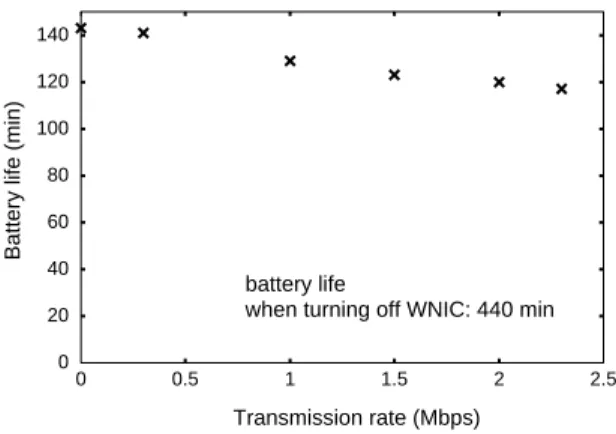
Figure 1: Battery Life vs. Transmission Rate on WLAN
Power saving for decoding/drawing video frames
Since power consumed by video playback depends on the picture size, the frame rate and the bitrate, it is possible to save power by reducing the values of those parameters. In the proposed sys-tem, we adopt to use a transcoder called the transcoding proxy which receives the video stream from the content server, converts the stream to the stream with the lower parameter values in real time and forwards the new stream to the user terminal (see Fig. 3). The transcoding proxy can be executed on any node (including the content server) reachable from the user terminal in the network.Power saving for wireless communication
We have investigated how the battery life changes depending on the transmission rate on the IEEE 802.11b WLAN. In the experiment, we used the PDA and the WNIC in Table 2. The result is shown in Fig. 1. Fig. 1 suggests us that power consumed by wireless communication increases in proportional to the transmission rate, but the minimum power consumed by the WNIC is much larger than the difference by transmission rate. So, if we can shorten the time to supply power to the WNIC, we can save the power.
In general, when playing back a video stream whose bitrate is
b, the user terminal should receive the stream at transmission rate b and its WNIC should be always turned on during the playback.
From the result in Fig. 1, we adopt the following periodic bulk transfer to save the power: the user terminal (1) receives each frag-ment of the stream data at the maximum available bandwidth more than b, (2) stores it in the local buffer and (3) turns off the WNIC while playing back the data in the buffer until the buffer becomes empty. We call this scheme the buffered playback.
For push type video sources which transmit video streams at their bitrates, say, b, the buffered playback cannot be applied as is even when the available bandwidth is much larger than b. So, we let the transcoding proxy to store the transcoded data in its buffer until the buffer is filled, and transmit the data at the available transmission rate (denoted by bmax) to the user terminal. In this case, playback
of the video is delayed for (M/b1) − (M/bmax) which means the
time until the buffer with M bit is filled. If the user specifies the maximum tolerable delay, buffer size M can be determined.
3.2
Power Consumption Model
We should be able to estimate the parameter values satisfying the specified playback duration and the remaining battery amount, for any combination of portable computing devices and WNICs. So, we construct an equation which represents the relation among the above parameters and device specific constants for user terminals.
Let us denote the powers consumed by playing back video and receiving video data by Pv and PN, respectively. Let S denote
the power consumed by other factors (operating system, back-light, memory and so on). Here, S is the device specific constant. Thus, power P consumed by the user terminal is represented by the fol-lowing equation.
P = S + Pv+ PN (1)
3.2.1
Power consumed by video processing
Playback of MPEG-1 videos needs two operations: decoding and drawing picture frames. The power consumed by drawing each frame is proportional to the number of pixels. The decoding op-eration consists of Huffman decoding, dequantization and inverse discrete cosine transformation. The power consumed by Huffman decoding is proportional to the bitrate of the video, and the power consumed by other processes is proportional to the number of pix-els. Accordingly, the total power Pvto play back a video is
repre-sented by the following equation.
Pv(r, f, b) = αrf + βb
where r, f and b denote the picture size (number of pixels), the frame rate and the bitrate, respectively, and α and β are device specific constants. Finally, we obtain a power consumption model for playback of a video
E0= (S + αrf + βb)T (3)
where T and E0 are the expected battery life and the remaining
battery amount.
Here, the actual values of S, α and β can be calculated by mea-suring the battery lives when playing back n videos with different parameters {(r1, f1, b1), . . . , (rn, fn, bn)}, and using multiple
re-gression. Since we have 3 variables, we should use n ≥ 3.
3.2.2
Power consumed by communication
From the result in Fig. 1, we assume that power PN consumed
by communication is represented by
PN(b) = N + γb
where γ and N are device specific constants. From equation (1), we can derive
E0= (S + N + γb)T (5)
representing a relation among battery life T , battery amount E0
and transmission rate b when the user terminal receives the video stream at b (without decoding and drawing video frames). The val-ues of N and γ can be calculated by measuring battery lives when data are received at different transmission rates b1, ..., bm, and
us-ing multiple regression.
3.2.3
Power consumed by buffered playback
Let bmaxdenote the maximum available bandwidth at the user
terminal. Let Tondenote the time interval to fill up the buffer since
the buffer is empty. During this time interval, the WNIC is turned on. Let Tof fdenote the time interval to consume all of the data in
the buffer since the buffer is full. During this interval, the WNIC is turned off. Let τonand τof fdenote the time intervals to resume the
WNIC and to suspend it respectively. Let τ denote τon+ τof f. τ
is a device specific constant and can be easily obtained (the actual value of τ in our environment was about 3sec).
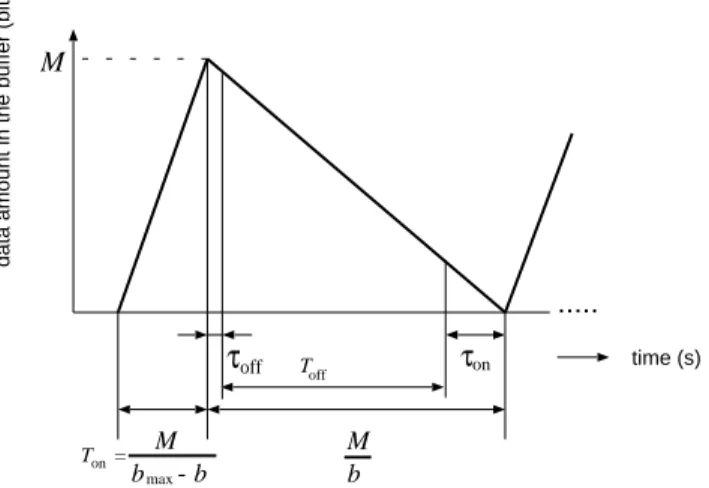
Fig. 2 depicts the time chart of how the stream data is filled and consumed in the buffer when using the buffered playback, where
M and b denote the buffer size and the bitrate of the video,
respec-tively. ... time (s)
τ
onτ
off M M bmax- b M bdata amount in the buffer (bit)
T =on
Toff
Figure 2: Time Chart of Buffered Playback
From Fig. 2, we obtain Ton= b M
max−b, Tof f = M
b − τ .
The power consumed by receiving the stream data is equal to
PN(bmax) while the WNIC is turned on, and 0 while turned off.
So, the average power Pbufconsumed by receiving the stream data
(whose bitrate is b) is represented by
Pbuf(b) = Ton
Ton+ Tof f+ τPN(bmax) = b
bmax(N + γbmax)
During time interval τ , the WNIC does not receive any data but consumes power to negotiate with the WLAN access point for au-thentication and address assignment by DHCP if necessary.
The average power Pohconsumed during time interval τ is
rep-resented by
Poh(b) = τ
Ton+ Tof f+ τPN(0) =
b(bmax− b)τ
M bmax N
Finally, we can derive a power consumption model when using the buffered playback.
E0= (S + αrf + βb + Pbuf(b) + Poh(b))T (6)
3.3
Algorithm for Deciding Parameter Values
Let (r0, f0, b0) denote parameter values of the original video transmitted from the content server.
We assume that the desirable proportion among picture size r, frame rate f and bitrate b is given as follows.
r/r0 : f /f0: b/b0= x : y : z (7)
Equation (7) means that for example, if (x, y, z) are set to be (1, 2, 1) and the picture size is reduced to 1/3 by the transcoding proxy, frame rate and bitrate are reduced to 2/3 and 1/3, respec-tively.
From equation (7), b and f can be represented by expression consisting of r and constants.
Consequently, when desirable playback duration T , remaining battery amount E0and the above proportion among r, f and b are
given, we can calculate the values of r, f and b by solving equa-tion (6). In our implementaequa-tion, we have used Newton’s Method to solve the equation.
Calculation of appropriate bitrate
When we specify the ratio among r, f and b by hand, the value of b may not be adequate due to quantization noise. We assume
that the bitrate is linear to the picture size when the frame rate is fixed, and that the bitrate is linear to the frame rate when the picture size is fixed. From these assumptions, we can derive the following equation to obtain the appropriate bitrate from r and f .
b = c0rf + c1r + c2f + c3, (8)
where c0, c1, c2 and c3are constants, and can be calculated using
multiple regression.
We have prepared 64 videos with different parameter values which have similar balances of playback quality, and obtained the above constants using multiple regression. As a result, we got c0=
7.9e-5, c1= 4.2e-4, c2= 13, c3= −16.
4.
ENERGY-AWARE QOS CONTROL
In this section, we propose an algorithm to assign different play-back quality among multiple video segments based on the user’s preference, satisfying the specified playback duration within the remaining battery amount. Here, we assume that a video consists of multiple segments and those segments are classified into some predefined categories C = {c1, ..., cn}, e.g., by using MPEG-7
labeling tools [5].
4.1
Specifying Importance among Categories
It is desirable for users to be able to specify what part of a video will be played back with higher quality. So, we allow users to spec-ify relative importance among categories as importance degrees. Let pidenote the importance degree specified to category ciwhere piis an integer number such that pi≥ 1.
The playback property of a video is decided by the balance of its picture size, frame rate and bitrate. In general, users may have dif-ferent preferences for the playback property among categories. So, we allow users to specify a preference to the playback property of each category by the proportion among the picture size, the frame rate and the bitrate r/r0 : f /f0 : b/b0= x : y : z as explained in
Sect. 3.3. An integer number 1 or more than 1 can be specified to
x, y and z. When we use equation (8), we need not specify b/b0. For example, suppose that a video of a soccer game consists of video segments classified into three categories {shoot, play, other}. A user may want to play back the video segments of category shoot at as high quality as possible, and the segments of category play at the medium quality, while reducing the playback quality of the seg-ments of category other. The user may have the preference for play-back property such that both the motion speed and the vividness are similarly important in category shoot, that the motion speed is more important in category play, and that the vividness is more impor-tant in category other. In such a case, the user gives the following preference.
category importance degree r/r0 f /f0 b/b0
shoot 4 1 1 –
play 2 1 2 –
other 1 2 1 –
4.2
Algorithm for Determining Playback
Qual-ity among Categories
For each category ci∈ C, the product of its importance degree piand playback duration Tiis called the virtual playback time of ci. We denote it by Ti0(= piTi). Also, the total sum of the virtual
time of all categories is denoted by T0(=Pc
i∈CT 0 i).
In our algorithm, we distribute the battery amount E = E0 − SP|C|i=1Tiamong categories according to the proportion of each
category’s virtual time Ti0/T0. That is, Ei(= ETi0/T0) is allocated
for playback of each category ci.
However, the above algorithm may result in over/under assign-ment of battery amount to some categories. We denote the proper-ties of videos with the maximum quality and with the minimum quality by (rmax, fmax, bmax) and (rmin, fmin, bmin),
respec-tively. Here, the maximum quality’s video might be the video with satisfactory quality or the maximum video which the device can play back. The minimum quality’s video can similarly be de-fined. So, we let our algorithm to adjust battery amounts in some categories so that restrictions of the maximum/minimum battery amount can be kept.
As explained in Sect. 3.3, battery amount E consumed by video playback is represented by equation (6) including parameters r,
f , b and T . Consequently, if Ei > (αrmaxfmax+ βbmax+ Pbuf(bmax)+Poh(bmax))Ti(
def
= Emax), Eiis too much for
play-back of ci. Similarly, if Ei< (αrminfmin+βbmin+Pbuf(bmin)+ Poh(bmin))Ti(def= Emin), Eiis too small for playing back ci. In
those cases, we fix Ei = Emax or Ei = Emin and distribute
remaining battery E0(= E − Ei) among remaining categories C − {ci}. Consequently, we can obtain battery amount Ei for
playback of category cias a constant value.
Using battery amount Ei, playback duration Ti, and the
propor-tion (ri/r0 : fi/f0 : bi/b0) and algorithm in Sect. 3.3, we can
calculate parameter values ri, fiand bifor each category ci.
4.3
Bitrate Extension Algorithm for Low
Band-width Environment
When available network bandwidth bmax at the user terminal
is low (e.g., 128Kbps), playback quality cannot be improved bet-ter than this value even if its remaining batbet-tery amount is sufficient. To cope with this problem, we propose an algorithm to enable play-back of some video segments with higher bitrates than bmax.
The proposed algorithm delays the start time of the video play-back where the user terminal buffers enough amount of data before starting video playback.
We assume that we play back video segments v1, ..., and vmin
this order. Let piand Tidenote the importance degree and the
play-back duration of segment vi. Let Pmindenote the power consumed
by the playback of video segments with the minimum importance degree. Let D denote the delay time to start the playback. Then the following equation holds.
E0− S · (D + m X i=1 Ti) − D · PN(bmax) = m X i=1 Pmin· pi· Ti (9)
When battery amount assigned to segment vi (represented by Pmin· pi· Ti) is determined, then we can obtain the corresponding ri, fiand biusing the algorithm in Sect. 3.3. On the other hand, D
can be calculated by D = M ax( i−1 X j=1 bj· Tj/bmax− i−1 X j=1 Tj), i = 2, ..., n + 1 (10)
Consequently, we can represent D as the function of Pmin. From
equation (9), we can calculate the value of Pminby using the
New-ton’s Method.
We have applied the proposed algorithm to a video (640×480, 1150Kbps, 30fps, 2300sec) using E0as 50% of fully charged
bat-tery amount in the laptop PC environment in Table 2, where we set bmaxto be 384Kbps. The result is shown in Table 1. We see
that bitrates much higher than bmaxare assigned to video segments
3 and 8 whose importance degrees are 4, while the delay time is reasonable (59sec).
Table 1: Quality Improvement When Using Bitrate Extension Algorithm
video With bitrate extension (delay time=59sec) Without bitrate extension segment duration priority picture size frame rate bit rate picture size frame rate bit rate
(No.) (sec) (pixel) (fps) (Kbps) (pixel) (fps) (Kbps)
1 217 1 354×265 9.2 210 419×314 12.8 338.4 2 136 2 432×324 13.6 369.8 437×328 14 384 3 231 4 524×393 20.1 655.3 437×328 14 384 4 132 2 432×324 13.6 369.8 437×328 14 384 5 530 1 354×265 9.2 210 419×314 12.8 338.4 6 276 1 354×265 9.2 210 419×314 12.8 338.4 7 232 2 432×324 13.6 369.8 437×328 14 384 8 138 4 524×393 20.1 655.3 437×328 14 384 9 408 2 432×324 13.6 369.8 437×328 14 384 Decision Mechanism of Playback Quality Transcoding Proxy Transcoder Original Stream Transcoded Stream User Terminal (1) URL of the video (2) Desirable playback duration (3) Terminal information (4) Pref. of playback quality
Figure 3: Energy aware video streaming system
Table 2: Experimental Environments
device type/ name/ setting
WNIC type/ name/ setting CPU/OS PDA/ Sharp Zaurus SL-C700/ brightness small CF/ WN-B11/CF (I/O Data)/
low power mode off
XScale PXA250/Linux (Embedix) laptop PC/ Toshiba SS S4/275PNHW brightness small PCMCIA/ GW-NS11S (Planex)/
low power mode off
PentiumIII 750MHz/Linux Kernel 2.4.24
5.
EXPERIMENTAL RESULTS
We have implemented an energy aware video streaming system as shown in Fig. 3. In the system, the user specifies the location of the video, the playback duration and the preference including importance degrees to categories and the proportion r/r0: f /f0 : b/b0 to each category. The information is sent to the transcoding proxy with the terminal information including the remaining bat-tery amount and so on. The transcoding proxy calculates the ap-propriate playback quality from the received information, receives the video stream from the content server, transcodes it to the stream with the playback quality obtained with algorithms in Sect. 3.3 and Sect. 4 and forwards the new stream to the user terminal.
In order to evaluate the effectiveness of the proposed method, we have carried out several experiments using two different envi-ronments in Table 2. For both envienvi-ronments, we have used IEEE 802.11b WLAN. To restrain the power consumption due to rotation of HDD, we usednoflushdfor the laptop PC environment.
We obtained device specific constants S, N, α, β and γ using four videos with different quality and two different available band-width for each environment as explained in Sect. 3.2. In the PDA
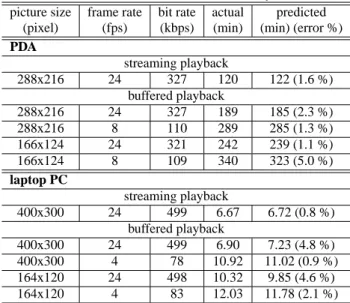
Table 3: Actual and Predicted Battery Life
picture size frame rate bit rate actual predicted (pixel) (fps) (kbps) (min) (min) (error %)
PDA streaming playback 288x216 24 327 120 122 (1.6 %) buffered playback 288x216 24 327 189 185 (2.3 %) 288x216 8 110 289 285 (1.3 %) 166x124 24 321 242 239 (1.1 %) 166x124 8 109 340 323 (5.0 %) laptop PC streaming playback 400x300 24 499 6.67 6.72 (0.8 %) buffered playback 400x300 24 499 6.90 7.23 (4.8 %) 400x300 4 78 10.92 11.02 (0.9 %) 164x120 24 498 10.32 9.85 (4.6 %) 164x120 4 83 12.03 11.78 (2.1 %)
environment, we have used the fully charged battery amount as E0.
In the laptop PC environment, we have used the 10 % of the fully charged battery amount as E0to shorten measurement time.
5.1
Effectiveness of Power Saving Techniques
and Power Consumption Model
In order to show effectiveness of our power saving techniques and validity of our power consumption model, we have measured the actual playback durations when using the buffered playback, and calculated errors from predicted durations. We used 2.3 Mbps and 1.6 Mbps as the average transmission rates for the PDA and the laptop PC, respectively, and used a buffer with 5 Mbyte. The experimental results are shown in Table 3. In table 3, prediction error defined as |te − t|/t is a difference between the predicted
battery life teand the actual battery life t.
Table 3 shows that the buffered playback could extend the bat-tery life up to about 1.5 times in the PDA environment. On the other hand, in the laptop PC environment, the effect of the buffered playback is not so much. This is because the ratio of the power consumed by the WNIC to the whole consumed power is small in the laptop PC environment. When using the transcoding with the buffered playback, the battery lives could be extended up to about 2.8 times (PDA) and 1.7 times (laptop PC), respectively. The pre-diction errors were within 5% in both environments.
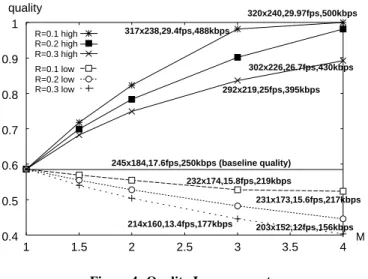
0.4 0.5 0.6 0.7 0.8 0.9 1 1 1.5 2 2.5 3 3.5 4 R=0.1 high R=0.1 low R=0.2 high R=0.2 low R=0.3 high R=0.3 low quality M 232x174,15.8fps,219kbps 231x173,15.6fps,217kbps 245x184,17.6fps,250kbps (baseline quality) 317x238,29.4fps,488kbps 320x240,29.97fps,500kbps 214x160,13.4fps,177kbps 203x152,12fps,156kbps 292x219,25fps,395kbps 302x226,26.7fps,430kbps
Figure 4: Quality Improvement
5.2
Effectiveness of QoS Control
In this section, we assume that the laptop PC environment is used and that 30% of the fully charged battery amount is used as E0. An
MPEG1 video with 320×240, 29.97fps, 500Kbps and 1800 sec is used as the original video denoted by v0= (r0, f0, b0, T0).
Playback quality in important categories
Using the algorithm in Sect. 4.2, we have investigated to what extent the playback quality of important categories is improved and the quality of the other categories is degraded.
We assume that video segments in v0are classified into two
cat-egories: important category c1and less-important category c2. We
assume that the preference to each category is r/r0: f /f0= 1 : 1
(b is automatically calculated using equation (8)).
Let R denote the ratio of playback duration T1 of c1 to total
playback duration T1+ T2 (i.e., R def
= T1/(T1+ T2)). Let p1
and p2 denote the importance degrees for c1 and c2, respectively.
Let M denote the ratio of p1to p2(i.e., M def
= p1/p2). Using our algorithm in Sect. 4.2, we have calculated the playback quality in
c1and c2by changing R from 0.1 to 0.3 by step 0.1 and M from 1
to 4 by step 0.5.
The resulting graphs are depicted in Fig. 4, where the horizontal axis and the vertical axis represent M and playback quality r/r0,
respectively. Here, r/r0becomes 0.58, if all categories have the
same priorities, that is, p1= p2(baseline quality).
Fig. 4 shows that when R is small (e.g., 0.1) and we specify
M ≥ 3, the playback quality in important categories can be
im-proved significantly by slightly reducing the playback quality of less-important categories.
Prediction Errors When using QoS Control
To investigate the prediction errors of the actual playback dura-tion within battery amount E0from its original playback duration
1800sec, we played back video v0at different playback quality
cal-culated from four different preferences as shown in Table 4. For pref1, pref2, pref3 and pref4, actual playback durations until
E0was exhausted were 1710sec, 1696sec, 1692sec, and 1727sec, respectively. The prediction errors are less than 6%.
6.
CONCLUSION
In this paper, we proposed an energy-aware video streaming sys-tem for streaming video playback on portable computing devices,
Table 4: Preferences and Playback Qualities
cat. (Ti, pi, fi, ri) (r, f, b) pref1 c1 (678, 1, 1, 1) (245 × 184, 17.60, 250K) c2 (662, 1, 1, 1) (245 × 184, 17.60, 250K) c3 (460, 1, 1, 1) (245 × 184, 17.60, 250K) c1 (678, 1, 1, 1) (196 × 147, 11.26, 143K) pref2 c2 (662, 2, 1, 1) (240 × 180, 16.91, 238K) c3 (460, 4, 1, 1) (293 × 219, 25.06, 395K) c1 (678, 1, 1, 1) (196 × 147, 11.26, 143K) pref3 c2 (662, 2, 1, 2) (292 × 219, 12.47, 201K) c3 (460, 4, 2, 3) (320 × 240, 21.61, 365K) c1 (678, 1, 1, 1) (196 × 147, 11.26, 143K) pref4 c2 (662, 2, 2, 1) (196 × 147, 22.48, 288K) c3 (460, 4, 3, 2) (261 × 196, 29.97, 439K)
based on the user requirement including the battery amount, the de-sirable playback duration and the relative importance among video segments. We have implemented the system and carried out some experiments using a PDA and a laptop PC on IEEE 802.11b WLAN. Through experiments, it is confirmed that (1) our system can control the playback duration within 6% error even when control-ling QoS dynamically, and that (2) the proposed algorithm can be applied to various portable computing devices by obtaining several device specific constants. We believe that our model is accurate enough since some part of prediction errors is caused by the inac-curacy of the APM mechanism.
In this paper, we assumed that the available bandwidth at the user terminal is much larger than the bitrate of the video and that the fluctuation of the bandwidth is small. However, when applying the proposed method to the cellular phone environment, we must consider the fluctuation of the available bandwidth and the dynamic change of radio wave output depending on the location. In our future system, those problems will be treated.
7.
REFERENCES
[1] Agrawal, P., Chen, J-C, Kishore, S., Ramanathan, P. and Sivalingam, K.: Battery power sensitive video processing in wireless networks,
Proc. IEEE PIMRC’98, Vol. 1, pp.116–120 (1998).
[2] Cavallaro, A., Steiger, O. and Ebrahimi, T.: Semantic Segmentation and Description for Video Transcoding, Proc. of the 2003 IEEE Int’l.
Conf. on Multimedia and Expo. (ICME2003), Vol. 3, pp. 597–600
(2003).
[3] Lahiri, K., Raghunathan, A. and Dey, S.: Battery-Efficient Architecture for an 802.11 MAC Processor, Proc. of the 2002 IEEE
Int’l Conf. on Communications (ICC2002), pp.669–674 (2002).
[4] Lim, J., Kim, M., Kim, J and Kim, K.: Semantic Transcoding of Video based on Regions of Interest, Proc. of Visual Communications
and Image Processing 2003 (VCIP2003) (2003).
[5] Lin, C.-Y., Tseng, B. L., Naphade, M., Natsev, A. and Smith, J. R.: MPEG-7 Video Automatic Labeling System, Proc. of the 11th ACM
Int’l. Conf. on Multimedia, pp. 98–99 (2003).
[6] Pering, T., Burd, T. and Brodersen, R.: Dynamic Voltage Scaling and the Design of a Low-Power Microprocessor System, Proc. of Driven
Microarchitecture Workshop, pp.107–112 (1998).
[7] Simunic, T., Benini, L., Acquaviva, A., Glynn, P. and Micheli, G. D.: Dynamic voltage scaling for portable systems, Proc. of the 38th
Design Automation Conf. (DAC2001), pp.524–529 (2001).
[8] Xu, R., Li, Z., Wang, C. and Ni, P.: Impact of Data Compression on Energy Consumption of Wireless-Networked Handheld Devices,
Proc. of the 23rd Int’l. Conf. on Distributed Computing Systems (ICDCS’03), pp.302–311 (2003).
[9] Yip, K.W. and Ng, T.S.: Fast Power Control, Transmit Power Reduction and Multimedia Communications over WLANs, Proc. of
First Int’l Conf. on Information Technology and Applications (ICITA2002) (2002).