169
A STUDY OF ENGLISH PHONOLOGY LEARNING :
A CROSS SECTIONAL STUDY IN THE JAPANESE
SETTINGS
TOSHIAKI OZASA
Summary
The aim of this study was to describe and explain the process of the learning of English phonology by Japanese learners who are learning English in the Japanese formal education settings. To ful丘11 this goal, we designed a cross-sectional experiment involving 3 variables ! lin貞uistic features, time and degree of attentiveness. Thd 丘ndings are as follows '.
C 1 ) The learners developed various kinds of interlanguage performance rules as a transitional strategy, which included not only Li-based but also more advanced transitional rules.
(2) The improvement of pronunciation over time was accounted for in terms of `wave theory.
C3> The eだect of the time factor on performance was found to be strong. C4) The degree of attentiveness had no effect on performance.
1. Background of the study
It has long been empirically evident that the phonological system is one of the
most di氏cult areas for Japanese learners of English and this recognition has led many applied linguists as well as English teachers to attempt the description and explana tion of this phenomenon. Among many attempts made in the past, the most produc-tive analysis as well as scientific in approach was contrasproduc-tive analysis of the structures of Lt and Li.
The contrastive analysis, which was most influential, roughly, during 1959's and 1960's in Japan, was methodologically based on CAmericarO structural linguistics and its aim was to pinpoint the difficult parts of the Lt structure and predict their relative di氏culty for the learners.、 As a procedure for this aim, first, the structures of Lt aud Li were analysed and compared and, based on this comparison the patterns which were most obviously different from each other were extracted. The underlying assump-tion of this approach was that the learners'di氏culty with pattern can be accounted
for in terms of the difference between the two systems. In other words it was assum-ed that the learners'difficulty is a function of the structural difference between the
170 A study of English phonology learning: a cross-sectional study in the Japanese settings
two systems.
This assumption was to so甲e extent proved to be valid by experiment! some contrastive analysis was found to be successful in predicting di氏cult points for the learners. Kleinjans (1959), for exai亘pie, succeeded in predicting the di氏cult patterns of the noun modification structure of English. He compared the noun-head
modifica-tion structure of English (I_O a^d Japanese (LO and, based on the comparison,
classified the patterns into four groups, according to the predicted di氏culty for Japanese learners. Then, he gave a test on these patterns to Japanese students and checked its predictability against the test results. It was found that the prediction highly correlated with the test results. Kleinjans'study can be taken as an example of
the predicted success of contrastive analysis in language learning.
Another welLknown contrastive study of English and Japanese, this time, in phonology, was done by Kohmoto C1969). Kohmoto, after a comprehensive contrastive study of English and Japanese phonological structures, predicted vocalic intrusion/ad-dition in the pronunciation of English consonant clusters and final consonants by Japanese learners, and checked its explanatory potential against the results of the test he gave to the subjects. (There seem to be some de丘ciencies in the sampling method and number of the subjects in this test. The number of the subjects was only 5 and their proficiency level varied from undergraduate to graduate level.) The test items consisted of 16丘nal consonants and 7 CC patterns. The test results showed that all the error performances can be accounted for in terms of vocalic intrusion/addition, as predicted, except for /sn/ and /sk/ patterns, where 3 cases of lengthening /s/ was observ ed for /sri/ and 2 cases for /sk/.
Kohmoto's results almost perfectly support the transfer hypothesis based on the Lt - Li contrastive analysis. His study was generally taken as an example of the explan-atdry power of contrastive studies in language learning. However, there may be some experimenter's 'bias' involved here as well as the bias caused by the small,
heterogeneous subjects. Generally, we terd to see what we want to see. Since tran-scription of phonetic performance is an essentially subjective matter, it is likely that their transcription was in且uenced by this basic assumption Cthe transcription was done by two people, including Kohmoto). However, it should be noted that even in the
contrastive analysis-favoured experiment, some transitional performances between the transfer of Japanese structure and the target performance, were observed, i. e.,
length-ening a consonant. This means that contrastive analysis cannot perfectly predict and explain the learner's performance rules, and, further, it suggests there is room for an alternative approach.
Corder (1967) was perhaps the丘rst to introduce a new dimension of transitional competence and set up a new framework for the study of this phenomenon. This includes in its framework not only learner's transfer errors (explainable on contrastive analysis assumptions) but also other various interlanguage strategies. In this framework,
a ォ
T. Ozasa 〔研究紀要 第30巻〕 171
the main concern is the transitional nature of the learner's interlanguages which approximate gradually to the target linguistic system. A learner's errors were taken as evidence of the system of the language that he is using at a particular point in the course,* and now, attempts are made to classify the nature and stiicture of the learn-er's transitional process of language learning/acquisition.
One of the interesting studies made under the framework o士`interlanguage'wasI Dickerson's C1975) longitudinal studies of the acquisition of the English phonology system by Japanese learners in an intensive course.
Dickerson, under the influence of a biological assumption, "ontogeny recapitu-lates phylogeny" , was interested in the relationship between the way a second language is acquired and the way language changes in society and found that both processes
have something in common. Dickerson studied the <⊂ 1〕> variability of Japanese learners of English in an intensive course in U, S. A. and he concluded that one can apply the same wave theory- Labov proposed in his analysis of language (pronuncia-tion) change in a society to this process of learning / I/ phoneme pronunciation.
Further, he claimed that the wave mechanism applied to the acquisition of / 1. /蝣蝣is
not unique to Japanese learners nor to the Cl) word class, but it has proved to be the case in other word classes and in the case of learners from other language backgrounds.
Another important point he makes is that the learner's phonological system is a system of variable rules. Sound system learning proceeds byぬe systematic application of modi鮎ation rules which gradually approximate to the target rules. Thus, Dickerson
claims that the learner's phonological system is not an interlanguage as it is defined in static terms CcoinPetence rules) and rejects the notion of `error analysis'in favour
of `variability analysis'.
2. The aims of the study
With this approach as backgro叩d, we aimed in the present study, to describe
and explain the process of the learning of features of English phonology by Japanese learners who have received their formal English language teaching in Japan. To state
it more specifically, our aims were
Cl}.. To describe and explain the process by which Japanese learners learn the pronunciation of selected consonant cluster patterns and simple final
consonants.
C 2) To describe and explain the transitional strategies employed by learners to approximate their pronunciation to the target performance.
C3) To examine the variability of performance related to the degree of
1. S. P. Corder. "The Significance of Learner's Errors" Error Analysis Ed. J; C. Richards (London : Longman, 1974), p. 25.
172 A study of English phonolc唱y learning: a cross-sectional study in the Japanese settings
attentiveness.
In this study our main concern was in the transitional nature of the interlang uage performances of Japanese students.
3. Method
3.1 Three factors involved in the experiment
To ful丘11 the aforementioned aims, we designed an experiment which 、 involved three factors, C 1 ) linguistic features; C2) degree of attentiveness, and C3) develop-mental stages. In designing an experiment, basically, we followed Dickerson's study, but some important modi丘cations were made to achieve our own goals.
First, the testing area was changed from <X. 13> to initial and final consonant clusters (including single final consonants). Then, the settings of L2 learning were changed : in Dickerson's study, the subjects were Japanese students attending an English course in U. S. A. not in Japan. It is generally agreed that there are great differences in learning conditions between Japanese learners in U. S. A. and Japanese learners in Japan, in the quality and quantity of the teachers/models, the student's motivation, etc. Consequently, Dickerson's丘nding could not simply be extended to Japanese EFL settings. In this sense, it is worth trying the same kind of follow-up study in Japanese EFL settings. The signi丘cance of the present study lies in its attempt to check the relevance of Dickerson's assumption for Japanese settings.
The last important modi鮎ation was the addition of a new factor, the degree of attentiveness. In his experiment, Dickerson used dialogues、 and word lists as a test format and asked the subjects to read for recording. In don噛this he assumed their
reading to be inattentive performance without making any distinction between dialogue reading and word reading. In the present study, we wanted to test the learner's attentive performance rules and inattentive performance rules for the same linguistic features. By so doing we hoped to see the difference between these rules, and also their relative relevance to the study of phonology acquisition/learning.
In analysing the data, we followed basically Dickerson's quantitative method for Analysing the process of Japanese students'acduisition of/ 1 / phoneme, we expected that Labov's wave theory hypothesis would help to explain the acquisition process of
the English consonant cluster patterns. We expected ontogeny to recapitulate phylogeny.
In the following three sections, the three factors of this experiment will be described in detail, with examples.
3. 1. 1 Linguistic features
We are here concerned only with the pronunciation of consonants, in particular
the pronunciation of certain Englislトinitial and final consonant clusters and final single consonants. Syllable structure is one of the areas in which English and Japanese
T. Ozasa 〔研究紀要 第30巻〕 173
differmoststrikingly.TheJapanesephonologicalsystemallowsonlyaCVsyllable structureCexcep**nthecaseof-/n/),.whereasEnglishphonologicalrulesallowa rangeofstructuresuchas: c cc ccc巨From among many possible cdnsonant combination structures, we selected at random three realisations of consonant clusters for each of the four possible consonant patterns, C, CC, CCC and CCCC. All the four patterns occur in the final position and furthermore, the CC and CCC patterns also occur in the initial position. Thus we had three examples of the realisations for each of the 4丘nal consonant cluster pa-tterris and 2 initial patterns, in total 6 patterns. The following are the linguistic rea-lisations of consdnant clusters randomly selected for the purpose of the present study.
CIO Final position
-c # /p/ /d/ /tJ′/ -cc s /Is/ /pt/ /ft/ -CCC jJ /kst/ /ipt/ /spt/ -CCCG ft /kses/ /if es/ /ksts/ (2) Initial position ォccc 価胤^&% acO.W㈲ part 1 map card church pulse stepped sniffed next helped grasped sixths twelfths texts span cream plus spray splinter straigh t linguistic realisation part 2 Cap sand match else stopped laughed text helped clasped sixths twelfths texts spin Christmas play ● spri ng split stray
174 A study of English phonology learning: a cross-sectional study in the Japanese settings
3.1.2 Difference in attention
In dealing with the analysis of.lea-rne了Ian嘗uage, Widdowson proposes a distinction between expression rules and reference ru一es. Expression rules characteTise
what the learner does while reference rules characte-ise what a learner knows.2 In other words the former rules govern communicative use when the speaker's attention is on the content of speech and the latter govern linguistic usage when his attention
is on the linguistic form. Richards Q973) makes a similar distinction between
compe-tence errors and performance errors, as does Dickerson between variability analysis and error analysis.
In this experiment we wanted to see the difference between the two rules with
regard to the same linguistic features. We found, however, that it was not easy to test the sp甲ker's expression rule? in the language by controlled test. So we had to content ourselves with attempting to test the fryo types of rules革overning attentive and inattentive performance. Inattentive performance is observed when the subject's
attention′ is distracted by a special testing technique. These are not, strictly
speak-ing, real communキcation situations, but we hoped that the results would give some
in-●
I .I
sight into the attentive/inattentive performance rules.
In order to test the subject's inattentive performance and to compare it with
his attentive perforr甲nee, we devised a 〟guised test",3 in which the real testing points are guised by underlining the feigned, dummy word. For example, when we wanted to see the inattentive performance rule of /p% j we put it into a sentence like "Tom, here's your cap" and underlined here's thus guising the real testing point, cap. By underlining the dummy words, we hoped and assumed that the subject would pay attention to it and thus his pronunciation of cap would reveal the subject's in-attentive performance rule. Although this is not a natural communication situation, we
think that in practical terms this is one of the best methods of eliciting the controlled response of inattentive performance under experimental conditions.
In order to see the difference between the two distinct performance rules, we divided the test into two parts, one for the attentive performance rules and the other for inattentive performance rules. In the former test the testing points were explicitly
= I - - - ■ ■ . . .. ■ . - __ __-___ l■_
2. H. G. Widdowson. ``The Signi丘cance of Simpli丘cation", (mimeographed paper), p. 3.
3. `'Guised test" is a technique employed by Gardner & Lambert (1972)_in thteir study on
bilingualism to elicit the subject's stereotypes t〇ward French and English-speaking people.
\
For this test recordings were made of the four月uent English-French bilinguals who read the
same passage once in English and again in French. Then the subjects were asked to rate the personality of the speakers. In this test it was hoped that the student was thinking that he
was evaluating the speaker's personality but was evaluatin写the guises of accents. The significance of this technique lies in the fact that it can test the testing points without being detected by the subject. (The technique of `guised test' is fully explained in Gardner & Lambert (1972, pp. 97-104).
T. Ozasa
〔研究紀要 第30巻〕 175
shown to the subject while in the latter, they were `guisecP by intentionally under-lining the dummy testing points. In part 1, the subject was asked to pronounce a list of 18 isolated words each containing one testing point. Here we expected that the subject would pay the maximum attention to those words and thus pronounce them with most care. In part 2, the same testing points were tested, hut this time, by the guised technique, the testing point was obscured. To do this, we needed two words which contain the same testing points Consonant cluster pattern) in almost the same phonological environment Thus, we asked the subject to pronounce map in part 1 , and, in part 2, "Tom, here's your cap" Qcap is testing point) for C% pattern.4 The following are the list of words and sentences used for the test of attentive performance rules (part 1 ) and inattentive performance rules (part2 ).
Part 1 Test of attentive performance Part 2 Test of inattentive performance
1 -Cft(F) 2 JCC-(I)
3 -CCKF)
4 SCCC-CI) 5 -CCCS(F) 6 -CCCC %(F)I I map card church span cream plus pulse stepped sniffed /spr/ spray /spl/ splinter /str/ straight /kst/ next /lpt/ helped /spt/ grasped /ksGs/ sixths /ltGs/ twelfths /ksts/ texts Keys'. C*. Consonant Final position I : Initial positionTom, here's your (cap}.
You can't build a house on the (sand). He lit a (match).
The car書聖吐into a (spin}. (Christmas) is里_9二重些!_ Shall we (play) volleyball? What Celse) do you.竺竺聖旦
The car Chopped) at the posトOffice.
He (laughed) a lot. (Spring) is coming soon.
The聖竺旦(split) into two parts.
The Cstray) dog was塾生
He read the (text}.
He (helped) her mother with the work. He (clasped) the ball in his hand. Five-(sixths) is greater than one-third. He changed the fraction into (twelfths). The required (texts) were on the reading list.
(cap) indicates a testing point in the guised test.
4. In the British tradition, the underlining of a word of a sentence is conventionally taken as a
l
mark for a stress contrast. In Japan, however, there is not such a tradition a也d therefore it is unlikely that an underlined word is pronounced as a tonic word with sentence stress.
召 - -A -コ い H u ヨ 。 ・ 韻 d H J 7 -へ 1 -1 r ・ い 1 一 ・ . 1 1 」 ヨ ー Z さ 台 H J H リ , I
176 A study of English phonology learning: a cross-sectional study in the Japanese settings
3,lw3 Time
・ The third factor involved in the experimental iS time. In・ order to investigate the developmental process of language acquisition, it is best to employ a longitudinal approach. In other words, ideally, we have to observe the、 linguistic development of the learner ove去 a period of time long enough to check differences in the learner's
linguistic-performance. One of the main disadvantages of this approach, however, is that it takes a long time, at least several years.
To overcome this di氏culty,正e employed a cross-sectional approach in which
w占sample・ the performance datat of different groups of individuals at several levels of English language learning and took the sequence to represent the development of one individual learner. A cross-sectional approach will best fit the study of pronuciation, since it can reasonably be considered as similar across individual learners within same Li community, due to the predictable nature of pronunciation and the strong in且uence of Li on 山e Lt sound system, However, this approach, although convenient for handling the problem in a limited time, has the inherent `danger of taking an irrelevant sequence as if it were the ``natural" sequence. In this sense, sampling of the popula -tion is crucially important for the success of the experiment. In sampling the data, we tried to take recordin岳s of 、six pronunciation performよiriCes for eAch of the three
different levels of English蝣蝣Ianguage" ability,' (1) theノelementary stage, (2") the
intermediate stage and C3) the advanced stage. The subjects for each of the three
stages are as follows
:-Time 1 (Elementary stage) : 2両year students of a senior high school in Kagoshima
CTi)
(17 year old,. 5th year of formal English language education). They are students of Kinkowan High School, Kagoshima.
Time 2 (Intermediate stage) : 3rd year university students (21 years old, 9th year (T2)
of formal English language education). They are students of University of Kagoshima, School of Education.
Time 3 (Advanced stage) '. Japanese students at the University of Edinburgh. The
(T3)
subjects'、 age varies between 20⊥40, and their specialisation from applied
linguis-tics′・ tO 畠dciology.ノ AH of them experienced their forma卜English language
education in Japan up to at least university level.
As for the quality bf tHe sd‥bjects, we tried to secure students at a level slightly
above the average in each case.
3.1.4 Matrix for the analysis of data
The present experimental design consisting′ of the three factors c印be
T. Ozasa
〔研究紀要 第30巻〕 177
3 times (stages) × 6 featuresx 2 styles-36 components
3.2 Administration of the test
General instructions for the administrators wer占as follows !
Cl) Select 6 homogeneous students in the lower half of the top third of the
class.
(2) Hand the lest sheets to the subjects beforehand and give them a chance
to practice once or twice silently.
( 3) Ask the subjects to read Cpronounce) the test items and record their
performance.
(4、) When any of them has difficulty in reading the items, please tell them
how to read them but never give them a pronunciation drill on them. You may find the test item difficult to read for some of the subjects. In that case, you may teach the meaning of the words and sentences and
how to read.
( 5) After conducting the test, please send back the recorded cassette tape. The administration of the test was the most di氏cult part of the experiment. Since all the tests except for the advanced learners had to be administered in Japan it was extremely difficult to control the experimental conditions. In particular, the
sampling of the subjects rested solely upon the cooperation of the administrators in Japan. To get the maximum out of their cooperation, I explained in my -personal letter to them the aims of the experiment and asked their help, but I did not mention anything about the technique of the guised test, Cpart 2 of the test) since I was afraid it would affect the administrators and tempt them to give、 the subjects hints about the testing points.
4∴∴Results and dis¢ussion
4. 1 Phonetic transcription of the performances
Each of the pronunciation performances was transcribed by the experimenter
178 A study of English phono一ogy learning: a cross-sectional study in the Japanese settings
Kemp, a phonetician of Edinburgh University, this time using a repeater-combined
tape-・recorder. 5
In making phonetic transcriptions of the subjects' performance, we employed a broad notation system when it was a standard one and when it was considered to be transitional performance worth noticing, we adopted a narrow notation system, thus
trying to describe the nature of 山e transitional performance in detail. For example,
plus is usually pronounced by a native speaker as 〔plAs〕 with an aspiration. When
O
the subject's performance was a standard one with an aspiration, we transcribed it as 〔piAS〕 witllout any diacritic mark of aspiration while, when a performance was a transitional one with voiced 〔1〕 we added a diacritic 〔 〕 for voicedness as 〔1〕. Since
V V
〔1〕 is a voiced consonant in itself, this is redundant. However, we employed this system to show explicitly the deviant transitional character of the performance. The
main diacritics used in transcribing transitional performances are as the following.
Diacrii′ics
en
〔(1)〕置く力
〔r〕 Ven
〔1:〕 〔1●〕 Indication Voiceless 〔i〕Weakened & shortened 〔1〕
Omission of the expected consonant Voiced 〔r〕 where assimilated voiceless ⊂r〕 is expected as standard
Excessive, more aspiration lnan is expected in the standard performance
More lengthened CD than in standard
performance (this mark is also used when a performance is standard")
Slightly more lengthened than in the standard performance
The phonetic transcriptions of the Ti, T2. and T3 performances, are shown in Table 1, Table 2 and Table 3, respectively.
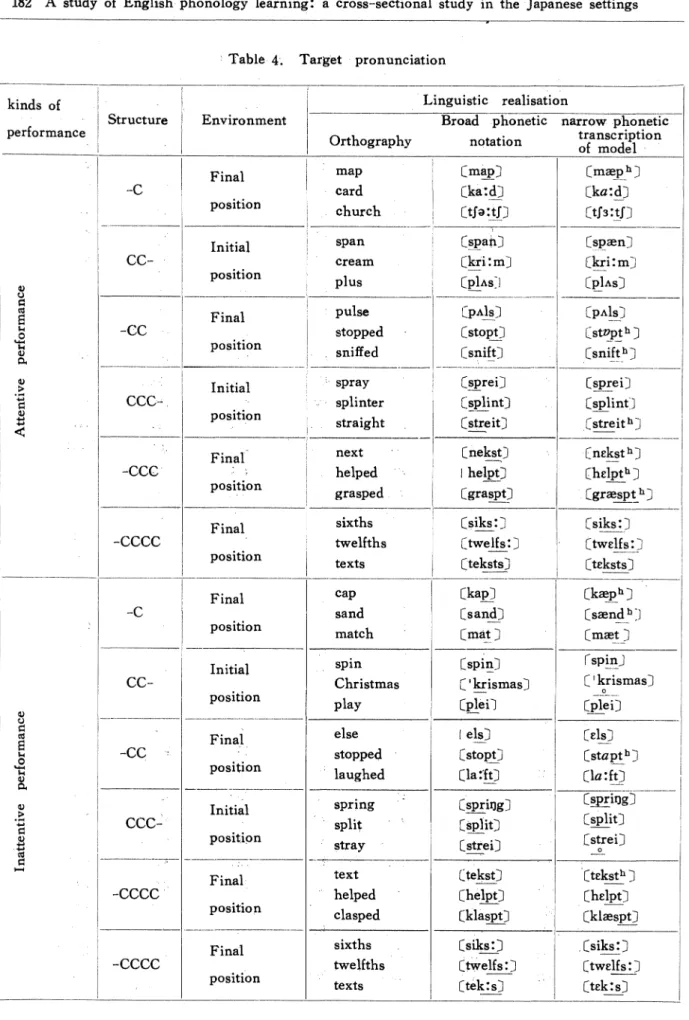
In evaluating and classifying the pronunciation performances, we used Mr. Kemp s pronunciation as the target pronunciation/ We asked him to pronounce the test
items himself and to transcribe them in narrow transcription. In our evaluation, the
nearer the subject's performance approximates to Mr. Kemp's, the nearer his pronun-ciation is to the target. The target performance is shown in Table 4 in both broad notation and narrow notation. The transcribed data was then analysed from the
5. Acknowledgements are due to Mr. A. Kemp for his invaluable assistance in the phonetic transcription required for the present study.
T. Ozasa ⊂研究紀要 第30巻〕 179
Table 1. Performance of Ti learners
、、-、一・・、.㌔ subjects IiZ■ ーヽ.. features \一、---Part 1
け
&
J
3
3 4 5 6 p1 7 ls 8 pt ft 10 spr ll sp1 12 str 13 kst 14 lpt 15 spt 16 ksGs 17 If9s 18 ksts a -* a p d け & n r( N CO Tf lf) N 00 05 10 spr ll spl 12 str 13 kst 14 lpt 15 spt 16 ks6s 17 1的S 18 ksts p a oh rvU
%
X
v
1
S
p I p d 吋 &>J p d 郎 &JS l! 5? pt pt pt ft f:t spr sp f spr spr str # str * kst kst lpt lpt s(p)t spt ku9 kus9 1fe lfe -ksts kusts ¢ p d 小 ^ v p l V ^ a t ∫,1 rt 軌か㈲kS tか&M \-ノ t。
r
v
&
>
A
托
恥
即
打
-0
4
J
t
r
曾
恢
無
4 -サ e ^ 1 . C O p d け w r * p d け 叩 k r I V s p 1 put O ft Sp l・ 3ア stur kst lpt 32 kus! Ks:u kst( ) p d蛸
。
&
J
2
5
*
a
p p p d(〔san〕) (〔san〕) -tJ -tJ Q- U ,-i a x 托 Sp f SPf spw spl - spl SPCD str ' str * (s)tr ' kat kst lpt lpt ヽ-ノ ー V C i%
J
2
v
(
O,js a ォE 印 . 郎 仰 a a r% a ho
u
^
O
,
叫
印
&
S
J
か
叫
聖
幣
k
S
●p
d
肌
&
M
3
-
叩
k
r
が
c
x
"
*
-*
恥
, u 0 f t 」 snts=
c
h
叫
J
c
-J
2
180 A study of English phonology learning: a cross-sectional study in the Japanese settings
Table 2. Performance of T2 learners
subjebts features ●●pd打s p聖o?A托かかかs pt聖Ifら ● ● ● ●
p d 吋 -a** a a 印 &%M
I I a t3 P ft J ft ^ a sfi spl Stn kst lpt Ipt spt spt ke: a ● ● tc
u
ォ
」
印
印
s
J
S
A
a
。
S
c
や
a -o a J i -* 蝣 * . 9 f -9 C , < p d 里 a h s p r か 如 J 8 5 -。 3 C 。 脚 p d 吋 ^>'a>JZ pt,cE ● ● a-t3叩krI ajsa」 SDp SDp spit spl: str str , k^st kst lpt lpt spt spt `■ ks lfec ) kist O kisB 0 lfec 〕 kists O 3 . J t . * p d 吋 & J 2 H W C O ^ W 10 spr ll spl : 12 str 〟 13 kst 14 lpt 15 spt 16 ksGs ∴ 17 lfGs 18 ksts p d 吋 & J 2 m m r ¥ * 蝣 * い り v r s o h r % a h Q . Q . ^ J * U i サ ォ t a ^ 1 蜘 -ォ 撤 , 脚 p d け & j a u l l〆
v
a
*
&
」
J
S
A
a
臨
地
pd吋ft-∨"a * a」 spr spl : str:一 kst lpt spt kOs uec ): kust O ^ _ Mf
t
^
a
i
l
恥
如
拙
J
S
*
>
叫
J
S
J
p
*
s
ーVp
d
吋
%
J
s
〆
c u " " -" ' c u f t " O " = S l u 1 2 3 4 5 6 7 8 9 10 spr ll spl 12 str 13 kst. 14 1pt 15 spt: 16 ks8軒 17 HOs 18 ksts Part 1 Part 2T. Ozasa 〔研究縛要 第30巻コ.・ 181
Table‥3. _ Performance of Ta learners
、、;:;tures、デ三笠二N。.1 N。.2 N。.3 N。.4 N。.5 N。.6
o a m ^ 1 0 < r > t - o o o ^ Part 2 a ^ O . p d げ & J 2 10 spr ll sp1 12 str 13 kst 14 lpt 15 sot 16 ksOs 17 1紬S 18 ksts p d 小。&J2: -a &蝣-X が托 ● ∫ I p p / / ^ 蝣 I 7 /c o
' i
- =
G *
- 醐
聖 C
。 聖
p d 吋 印 k r が V , ォ 5 . ^ ) ーV p d げ & J 2 a ' a x &<」 spr spr spl sp l ● l∫l p d ぴ M %*A S.a 印 C )tr -, str !stt kst kst kst 1 lpt lp t lpt spt spt spt - 1 ks: Its lf : If: ksts kst( ) . ksts ヽ-ノヽ-ノ pd吋&Ma*x:印s p武kS tかs pt幣<x> rI ∫ as C )st as HUp
d
小
。
&
J
2
a r 2 s , ォ t s 321 spls(>
kist lpt ヽ 、 ノ O , * 5 0 ォ182 A study of E血glish phonology learning! a cross-sectional study in the Japanese settings
T. Ozasa
〔研究紀要 第30巻〕 183
viewpoint of (1) time effect on performances, (2) relative di氏cully of linguistic
features, ( 3) the effects 。f the difference of attentiveness on the pronunciation (var-lability analysis), and oihers.
4.2 Basic viewpoints for data analysis : classificadon and weighing of transitional
●
strategies
In order to see the change/improvement of performance over a certain period of time, we examined all the performances and classi丘ed them into 3 types on the
scale of approximation 亡o the target. The first type of pronunciation was the one
which is most heavily influenced by the phonological structure of Lx, i.e., vocalic intrusion/addition. Since Japanese phonological structure does not allow consonant cluster patterns or a consonant without a following vowel, it is very likely that the Japanese learners introduce the Japanese phonological structure into the English one using vocalic intrusion/addition. One example of this is 〔-put〕 instead of 〔pt〕.
0
The second type of performance is a transitional performance between the Li -based pronunciation and target performance.
C 1 ) Consonant lengthening, C2 ) Consonant weakening, C 3) Consonant omission. (4) Consonant addition. C5) Failure of devoicing, C6 ) Excessive assimilation, e.g. 〔S:p〕 for 〔sp〕
e.g. 〔apCO〕 for 〔spl〕
e-g- Cs( X) f-r Cs^O
e.g. 〔p¢〕 for 〔p〕 e.g. 〔pl〕 for 〔pl〕
V o
e.g. 〔S?〕 for 〔spt〕
C7) Substitution of a similar consonant, e.g. 〔kst"〕 for 〔ksts〕
These are performances which are closer to the target pronunciation than the丘rst type (with vocalic intrusion/addition). In this sense, they are transitional performances based on the rules of the interlanguage system, located between the target performance and Li-based performance. They are the substitute strategies devised by the learners
to approach the target.
The third type is the target pronunciation. This is native-speaker performance and needs no further comment
Several examples of combinations of the above features were observed, such as lengthening and a failure of devoicing of a consonant. Clearly these examples are located between the丘rst type, and the second type : they are more improved than Li-based performance but less improved than the second type. However, since there were so few examples observed, we classified them under the category of type 1
(Ll-based type). We noted also that there are combinations of type 1 and type 2
features. These cases are de丘ni-ely the least desirable performances and so we sorted them into type 1 category.
In addition to the classification and weighing of the performance, we computed
184 A study of English phonology learning: a cross-sectional study in the Japanese settings
following values to the three types of variants, and computed the error score二
Type 1 2 Target Value 2 1 0
This means that the higher the score, the more difficult the pattern is.
4.3 Analysis of performance change and transitibnal strategies
First we looked fof evidence of the learners improvement in pronunciation performance as he goes up the learning stages noting also the nature of any such
improvement. It is a widel少shared belief among FL teachers that the遠is an optimal
age for FL learning and the critical period is the time of puberty (about the age of 13) after which FL learning becomes extremely di氏cult or impossible.′ This critical period-by-puberty hypothesis which originates from Pen field, a neuro-physiologist in conjunction with a habit formation hypothesis, has had a strong in且uence on language leaching. The FLES movement, a movement for introducing FL at elementary school level, could be viewed as an outcome of these hypothese岳which if true, would mean that it is almost impossible for adult learners to improve・ their pronunciation since
this is the aspect of language performance which can mo岳t easily be controlled by
habit formation. In this analysis we are concerned with the process of performance change or improvement during a certain period of time after puberty・fthe time covered in this analysis is roughly 12 years from 17 to 29 (average),
4.3.1 -Ci pattern
(a) Frequency distribution Type 1 /-Pi / ノ/ E 州 山 1n i i Z ' r H < N C O r -t H H h H 2 e yp 1 T O ォ o O r -1 蝣 ォ
H
.
H
H
H
/ EH山 nu 川 川 u / T3 < 」 > L O ^ t e喝
O
N
W
-O
N
(
N
J
T 6 7 8(tO Transitional strategies
Cl") Consonanとomission : 〔san( )〕 for 〔sand〕 C2) Consonant addition : 〔p¢〕 for 〔p〕
/-p♯/
T, Ozasa
/-d♯/
〔研究紀要 第30巻〕 185
/-tj#/
Type! Type2 Target /0 Typel Type2 Target/u Typel Type2 Target
1くeys: ⊂ T, T2 囚 T3
Generally,thepronunciationofaconsonantwi血outafollowingvoweldoesnotseem tobeadifficult′problemforthelearnerswhohavepassedtheinitialstage.Butthis musfbeatroublespotforbeginners,sincethephonologicalrulesofJapanesedonot allowit.However,itseemsthatthiscanbeovercomeinashorttime.Theanalysis ofthedatashowsthatwithfewexceptionsthe/-p%Iand/-d%/pat†ernsarealmost perfectlymasteredbythelearners.Consequentlyitgivesusverylittleideaofthe ・alternativetransitionalperformancesforthispattern.Theonlytransitionalperformances observedwere: Cl" )蝣theomissionoftheconsonantinquestionlike〔san()〕for〔sand〕and(2) additionofanotherconsonantlike〔-p¢〕for〔-p〕.Thelatterstrategycouldbeunder-Stbodasavarietyoflengtheningofaconsonantsincetheaddedsoundisphonetically closetothatwhichprecedesit. Thepatternof/-tJJf/is,however,differentfromthecasesof/-p滋/and/-djf/. 50%ofTiperformancesareLi-basedones,i.e.,vocalicaddition.Eventhemost advancedlearnershavenotcompletelymasteredthis!30%oftheirperformancesare ☆ithvocalicintrbsion;Here,therewerenotransitionalperformancesobserved.Ifwe notethisfactalongwiththefactthattherewerefewtransitionalperformancesfor/-p 蝣ォ/arid/-d#/,示emightsupposethattherewouldnotbeatransitionalstage!血the learningofthe/-c#/pattern.ThelearnerseemstoproceeddirectlyfromLx-based performancetothetargetperformance.Thisconclusionseemsalsotobeintuitiやely correct.4.3.2 JCO
pattern-The analysis of the pronunciation of consonant clusters in the initial position revealed a range of variation. This is especially the case in the realisation of / ‡kr-/ and/ J pト/.
186 A study of English phonology learning! a cross-sectional study in the Japanese settings
CO /‡sp-/
CO Frequency Distribution
Type 1 Type 2 Target
f H C * C O T T T 1 5 1 (b) Transitional strategies Cl) Consonant lengthening '. Cs ! p^l /♯sp-/
The pronunciation of the/ % sp-/ pattern is almost mastered by learners, especiaレ Iy at Ti and T3. There was no I-I-based pronunciation and only a few examples of transitional performance strategies. All of these were lengthening of consonants (like 〔S : p〕 for 〔sp〕}. The high frequency of Type 2 errors in T2 performance remains unexplained. Generally this may not be a di氏cult pattern.
GO /‡kr-∫/
(a) Frequency distribution
Type 1 Type 2 Target T, T。 3 2 7 T。 .1 2 9 (10 Transitional strategies C 1 ) Failure of devoicing:〔kr〕 ∨ ( 2 ) Consonant lengthening: ⊂kr●〕
( 3) Consonant weakening: 〔kCO〕
C4) Combination of 2 features: 〔kCO〕
∨
/♯kr-/
Typel Type2 Target
This is a difficult pattern for Japanese learners and the figures indicate lack of mastery, especially by Ti learners. The frequency distribution of the performances generally indicates a normal process of phonology acquisition; the frequency of the target performance increases as the stage goes up. The frequency of Type 1 errors is higher in Ti than in T3 and that of Type 2 errors lower in T3 than in Tx but the error scores indicate that performances are slightly nearer to the target than the Ti ones Terror scores were 8 for T2 and 9 for TO.
Quite a few interesting interlanguage performance features were observed in this pattern. Failure to devoice /r/ is one of them. The target pronunciation of /kr/ is CkO with devoiced CO as a result of the assimilation caused by the preceding
voice-c o
T∴Ozasa・ 〔研究紀要 第30巻〕 187
result of which they sounded unnatural, although there was no vocalic intrusion.
Other transitional features were lengthening of /r/l Ckr'J, weakening of /r/-I Ck(rX). There were no errors of vocalic intrusion. However, there were examples of the Combination of Type 2 features in one performance, like 〔k(r)〕 in this case 〔r) being
V
weakened as吋ell as voiced. Devoicing /r/ seems here, to be the last step before the native-speaker performance for this pattern.
CuO /‡pト/
(a) Frequency distribution
r H < N c O
T T T Type 1 Type 2 Target 2 6 4 3 5 4 3 6 3
00 Transitional strategies
Cl) Failure of devoicing: 〔pD
∨ (2 ) Consonant lengthening: 〔pl●〕C 3) Consonant weakening: 〔pCO〕
C4) Combination of the above two features!
CpC D}
/♯pi-/
% Tvpel Type2 Target
This seems to be one of the most difficult patterns for Japanese learners. The frequency of the target performance is relatively low compared with other patterns and the frequency of Type 2 errors is higher than 、for the target performances. Further, there is no evidence of progressive improvement over time. In fact, the error scores are 12 for T3, ll for T2 and 10 for Tx.
The difficulty of the pronunciation in this pattern seems to have caused the learner
to develop a variety of transitional strat毎ies. The most striking transitional
perform-ance is the lack of devoicing. As is the case of /ftkr-/ the target performperform-ance of /Spi-/ must be 〔pl〕 with an assimilated, devoiced 〔1〕 However, many, of the 〔1〕
0 0,
were substituted by the usual voiced 〔1〕 This failure of devoicing accounts for nearly
V
90% of the transitional errors. Among the other approximative strategies are
lengthen-ing of 〔l〕 ike 〔plO> weakenlengthen-ing of 〔l〕 like 〔pCD〕, and the combination of the
above-mentioned features in one performance, like
CpCIX)-V
The example of combination are classi丘ed into type 1.
4.3.3 -CC葬 pattern
CO /-Is*;/
(a) Frequency distribution
Type 1 Type 2 Target
Tl 12
(d) Transitional strategies C 1 ) Vocalic intrusion'.〔put〕0
188 A study of En官li払、phonolo葺y learning: a cross-sectional study in the Japanese settings
T2 -. 12 ( 3) Consonant weakening:⊂CDs〕
10GO /-pt#/
(a) Frequency distribution
Type1 - Type2 Target T, 10
12
T3 12
OiO /-ft♯/
(a) Frequency distribution
Type 1 Type 2 Target
l q 一 n O T T T (b) Transitional strategies C 1 3 Vocalic intrusion:∈put∋ 0 Cb) Transitional strategies
C 1 ) Consonant lengthening: (jE:O
I-pt#/
Fypel I ype2 Target Typel Fype2 Target
/-ft♯/
Typel Type2 Target
The CC consonant cluster in the final position is clearly easy for the learners at these stages, although it must be a source of di氏culty to the beginners due to thef、 i
difference of phonological structure between Lx and Lt. For all of the three patterns, /-Is % /, /-pt # /, /-ft } /, all pronunciations attained the target performance with the
exception of 5 errors. Most of these were Li-based
and the rest transitional, i.e., ′
】
lengthening and weakening of a consonant.
4.3.4 *CCC-pattern
CO /#spr-/
fa) Frequency distribution
Type 1 Type 2 Target i H < N C O T T T 1 11 4 8 0 12 /♯spr-7 T叩el Type2 Target
m
T. Ozasa
〔研究紀要 第30巻〕 189
(b) Transitional strategies
(i) Consonant lengthening:⊂spr#〕
This pattern is easy for Japanese learners at Time 1 and Time 3. The learners
at Ti and Ts pronounced it almost′ perfectly: in the performance of T2 learners,
however, we noticed 4 transitional features. In fact, the error score is the highest for T2. (4 ), which is.counter. to our expectation and to the general tendency of responses for all linguistic features. There were no Type 1 performances, neither Li-based, norI
combinations of Type 2.
●
GO /♯spト/ .
(a) Frequency distributionType 1 Type 2 Target Ti T。 1 7 4 ㌔ Ts 5 (tO Transition^Lstrategies ( 1 ) Consonant lengthening: 〔spl〕 ( 2 ). Consonant weakening: 〔spCl)〕 C30 Failure of devoicing: ⊂spl⊃ V
CO Combination of the above two features:
CspC O:
/♯spl-/
Tvpel Type2 Target
This pattern can be ranked as dimcult since as the figures and graph show, this linguistic feature has not been mastered by the learners. They also indicate that the Ti learner's performance is the best of the three groups; the frequency of the target performance is highest for Ty and there are no Li-based errors. The performances of T2 learners are worst: the lowest in the target performance and highest in the Type 2
transitional errors. This is as in the case of/ ‡spr-/, counter lo our expectation and to the performer's general tendency.
The approximate performances for this pattern consist of ( 1 ) lengthening of /I/ like CsplO, C2) weakening of a consonant like CspOX)> C3) failure of devoicing
Ill like 〔spl〕 and C4) the combinations of the
V
above features in one performance. No vocalic intrusions were noted.
CHO /♯str-/
(a) Frequency distribution
Type 1 Type 2 Target
r H O ォ 0 0 T T T 5 5 6 (b} Transitional strategies C 1 ) Vocalic intrusion!〔stur〕 /♯stトソ ′Fypel Type2 ′Parget
190 A study or English phonology learning: a cross一一sectional study in the Japanese settings
( 2 ) Consonant lengthening! Cstr*^
( 3 ) Consonant weakening! CsCOiO
. ("4") Consonant omission! 〔sC >〕
( 5) Combination of the two features*. CCs)trO
This pattern can be ranked as very difficultニ The proportion of the target
ヽ
proムunciation is 50% for Ti and T壬i, and 16%、 for T2、 The distribution of perform-ance clearly supports the wave theory although to a lesser extent than in Dickerson's case. Progressively more performances take on progressively more advanced variants as
the stage goes up. As for the Ti group, 42% of the performances were Li-based
(Type 1), 42% transitional (Type 2) and 17% were the target performance. On the
other hand, in T3 performances, 50% were transitional (Type 2) and 50% the target
performance (No Li-based performances were observed). As for T2 groups, there
were 8% of Lx-based errors, 33% of transitional and 50% of the target performances.
There were 5 kinds of errors, i.e. (1) lengthening of 〔r〕 like 〔str〕, (2)
weakening of a consonant like 〔s(Or〕, C3) omission of a consonant like 〔s< >〕,
(4) the combination of the above features and C5) vocalic intrusion. The learners,
faced with the di氏culty of pronouncing this pattern, developed an interesting strategy!
they weakened and in extreme cases, omitted one of the consonants in the cluster and thus lightened their burden.
4.3.5 -CCCJ pattern co 7-kstサy
(a) Frequency distribution
Type 1 Type 2 Target T1 4 T2 0 T8 1 0 8 1 11 0 11
Cii)古lpt♯/.
(a) Frequency distribution
Type 1 Type 2 Target TI 0 T2 0 TV 0 12 0 12 0 11 (lii) /-spt♯/
(a) Frequency distribution
Type 1 Type 2 Target Tx
12
T3 11
」kO Transitional strategies ( 1 ") Vocalic intrusion:〔kust〕
0
( 2 ) Excessive aspiration: 〔kust〕
(b) Transitional strategies Cl ) Vocalic intrusion: QiiptQ
(fcO Transitional strategies ( 1 ) Vocalic intrusion: 〔sptii〕
C 2 ) Consonant weakening:∴〔sCp)t〕
T. Ozasa 〔研究紀要 第30巻〕 191
/ -kst ♯ノ′/ /-lot#/ ′′′′ -sot♯/
Typel TyPe2 Target /u Typel Type2 Tこirget Typel Type2 Target
As with CC consonant clusters in the final position, this pattern is ranked as very easy. With tll exception of a few error performances, most of the pronunciations
reach the target perfor.nanっe. Compared with the CCC pattern in the initial position, it is clear that the final position is far easier and the same comment applies to the CC patterns.
The interlanguage strategies for -CCC % patterns include4. C 1 ) Vocalic intrusion: Ckust〕
0
C 2 ) Consonant weakening'. ⊂<p>〕
( 3 ) Excessive aspiration*. 〔k*st〕 (4 ) Excessive assimilation! 〔S?〕Among them, ( 3 ) excessive aspiration is an interesting interlanguage strategy used to overcome vocalic intrusion. For example, instead of using vocalic intrusion to make it easy to pronounce 〔kst〕, the learner employs a more advanced transitional strategy by excessively aspirating 〔k〕 sound like 〔khst〕 This is not target performance but it is more improved than vocalic intrusion・ Another interesting interlanguage strategy is
C4) excessive assimilation. This is the strategy used by one of the best learners at Ts. Instead of pronouncing /-spt葬/ as. 〔sptn〕 he pronounced it 〔S?〕 with a sound like glottal stop. This could be used in normal, hasty conversation by native speakers. Nonetheless, we classi丘ed it as an example of transitiona卜performance, since we thought its frequency in the native speaker's utterance is lower) we look at it as a strategy to shorten the consonant cluster pattern and thus to lighten the burden.
4.3.6 -CCCC8 pattern
Classi五cation and evaluation of the performance of this pattern was complicated, since we thought there was more than one target performance for this pattern. The target pronunciations of the patterns for this structure, especially when pronounced in a hurry, necessarily involve contextual assimilation since some constituent consonants are phonetically similar. In fact some performances of this pattern can only be classified as a CC structure. In /-ks9s/ we judged 〔-ks:〕, 〔ks〕 and 〔ks:〕 as a standard
192 A study of English phonology learning: a cross-sectional study in the Japanese settings
ance (Xs^J indicates dental CsJ)- In the case of Cks]], the four-consonant pattern is
n n
reduced in the actual performance, to two consonant patterns. In /-If9s♯/,, ☆e decided 〔lfs‥〕 and ⊂lfs⊃ asや碑如performance. In the caヲet of /-ksts ♯ /, we took 〔ksts)'.- - . . n
aiid Jk:s〕 (long ⊂k) plus 〔S〕)・ as standard performance.
ヽ、l
(・i) /-ks9s*/
Target'. 〔ks:〕, 〔ks〕, 〔ks・:〕.
∩
(a) Frequency distribution
Type 1 Type 2 Target T, 3 ヽ T2 2 ...蝣8 2 Ts (b〕 Transitional strategies (1 C2 ヽ-ノ ヽlノ
Vocalic intrusion! 〔kus:〕 Consonant omission: 〔kstec )〕l 一 _C 3 )...-.Neatr vowel.substitute; 〔kht〕
◆ ∼ 、 ∨
(4) Combination of the two features'.
〔ku早ec X)
十-kses♯/
Type l Type2 ′parget
The figures indicate that this is a very difficult pattern for the learner ・at these stages. The frequency of the target performance occurrences is very low, this being the case especially for Tl and T2 learners. The distribution of performances indicates that the wave motion underlies the acquisLion process for this pattern. As is clear from
the;主graph, the frequency of Type 1 errors is highest for Tx, the frequency of Type 2,
transitional performance¥ highest for T2 and the frequency of the target performance highest- for Ts. This means that, the higher the stage, the more, advanced variants. i・t has..
The transitional performance includes*. ( 1 ) vocalic intrustion (Type 1), (2)
om主ssion*、 of consonants (Type 2), I ( 30 near-vowel substitute (Type 2), (4) combト
nation of:the two in one performance (Type l}..Among these, it is worth noting that the, near-vowel substitute is a strategy employed by the learner to avoid vocalic
intrusion. Instead of pronouncing Cs} with vocalic
intrusion, the learner developed a way to pronounce 100
as 〔h〕, a voiced.〔h・〕,‥ which is ・a vowel二 ike V
consonant, thus facilitating easier pronunciation.
00 /-If8s‡/
Target '. 〔lfs:〕 〔lfs〕
∩
(a) Frequency distribution Type ! Type 2 - T1 1 5 T2 0 T8 0 4 8 et P P c 」 > O o x * < a T /-Ifes♯/
T. Ozasa∴ す
〔研究紀要 第30巻〕 193
(b) Transitional strategies
( Ⅰ )′ Consonant omission ⊂lfec }⊃ (2) Replacement: 〔lf二〕
C3) Vbwel addition: 〔lfs'u〕
The figures` indicate that this is a difficult pattern '. 6・nly 50% of the'-perl formances were the target pronunciation. However, they seeiri to have p由畠edl三■`the stage of Li-based performance! there wa岳only one Type 1 performance.I About 50%- of
・the performances were substitute strategies for Li -based performance, vocal'ic mtrusidii. This means that they are at the Intermediate ・stage between the Li-based performance and the target pro血unciation.
The frequency of performance distributions ran ・counter to the general tendency and our expectation. The T3 group marked the highest frequency for Type 2 errors And the lowest frequency for the target p占rformance. Indeed, the T3 group mArked thfe highest error score of 8 while the error scof占of the Ti and T2 groups were 7, 4 respectively. Perhaps from their experience of communication in English, they tried to simplify the cluster in their own way while Tx and T2 learners tended to pronounce it as they had been taught. Four transitional performances Clf'D by T3 learners could be understood in this context. Although it is very likely that 〔8〕 sound will be replaced by 〔f〕 in the English speaking environment, this is not the case in Japan. It will
account at least partly for the high error score of the advanced learners.
Other transitional strategies found for this pattern are omission of consonants,
◆like 〔ifec )〕, and vocalic addition like ⊂lfs-.u〕.
(iii) /-ksts♯/
Target: 〔ksts〕 ⊂k:S〕
(a) Frequency distribution
Type 1 Type 2 Target
^ < N 0 0 T T T 4 3 5 4 2 2 (b)一Transitio.nal strategies
C 10 Vocalic intrusion: 〔kists〕 ・
0
( 2 ) Consonant omission! CkstC.O〕 ( 3 ) 一蝣Excessive assimilation: 〔kstn
(4) Combination of two features 〔 〕
/Tksts♯/
′Fype_1. Type2 Target
As the ′figures show, this is a very di氏cult pattern. More than half of the
performances showed transitional features. Yet, the T3 group's performances were∫
outstanding among the、 three groups. The T? and Ti groups are still at the transitional stage. This is especially the case for the T2 group which marked the highest frequen-cy for both Type 1 and Type 2 performance.
194 A study of English phonology learning: a cross-sectional study in the Japanese settings
linguistic realisation form, texts. This word is directly borrowed from English into Japanese and its pronunciation is adjusted into Japanese phonological structure. Thus, in Japanese texts is pronounced 〔tekusto〕 Therefore, it is easy for Japanese to introduce Japanese phonological structure into English for these words. The high frequency of Type 1 performances could be accounted for by this explanation. The interference from a particular word is certainly undesirable in assessing the general di氏culty of the pattern. This type of undesirable interference would be avoided by using a word which is not borrowed into Japanese. However, since this pattern allows a very limited number of Hnguistic realisations, it was impossible to find such a word.
The transitional strategies for this pattern include C l ) vocalic intrusion, C2) consonant omission, C3) excessive assimilation and C4) combination of more than one feature. Excessive application is an interesting transitional strategy. Instead of employing vocalic additional strategy, the learner used a more advanced strategy of excessive aspiration of the丘nal consonants.
4.4 Time effect across linguistic features and difference of attentiveness.
Table 5 Time effect
-> .ォ CO
T T T
Type l Type 2 Target
36(17%) 39(18%〕 141(65%)
20C 9%) 45(21%) 151(70%;
15C 7%; 36C17%; 165C76%;
So far we have examined the time effect on performance for each linguistic feature and the
Perfornlance for all features
transitional performances for the target pronunciation. Next, we will examine the effect of the three factors involved in this experiment. First, we shall consider the quantitative change of those performance features over apparent 12 years.
Table 5 shows the effect of time for each type of performance. As is clear from the figures and graphs, pronunciation improves as learning develops.
Typel T>′pe2 Target
The proportion of target performances increases as the learning stage goes up*. 65% for Ti, 70% for T2 and 76% for Ts. (The proportion increases by about 5% in each case.) On the other hand,血e Li,-based (Type 1) pronunciation features progressively decrease as the stage rises: the proportion of Type 1 performance is 17% for Ti, 9% for T2, and 7% for Ts. Further, the proportion of Type 2 performance was highest for the T2 stage, indicating their transitional nature. All these indicate the general tendency that progressively more performances take on progressively more advanced variants approaching the target performance. In this sense we could conclude that the
T.ノOzasa
〔研究紀要 第30巻⊃ 195
匂
.ユ
wave mechanism generally underlies Japanese learners'learning behaviour when they learn English phonology. This means that Dickerson's finding was confirmed in
Japanese settings.
However, when we examine the learning behaviour for each pattern, the learning
behaviour for 10 out of 18 patterns cannot be explained by wave theory. They are\:
/ftsp-A /Spi-/, /-Is*,/, /Jspl-/, /#spr-/, /-kst#/, /-iptJA /-spt#A /-lfOsS/>
/-ksts 8 /. The error score for these patterns does not decrease as stage rises. This means their performances did not take on the advanced variants as stage rose. One of theI possible reasons for this is faulty sampling technique. As is stated in 3. 1. 4, sampling
/
of the population is crucially important for cross-sectional experiment. In this experi-ment, the pronunciation level of T¥ subjects was slightly higher while that of T2 slightly
lower than we had expected. As the result, T2 performanc占 tended to be more
IJi-based (less advanced) than Tx performances. (In 5 out of the above 10 patterns, the error score was higher for T2 than for Tx・) Thi三means that pronunciation abili-y does not correlate one hundred per cent with general English ability, for the general
I .
English ability of T2 group was certainly higher than that of Ti group.
i
Another possible reason is the small size of samples used for this experiment. The number of subjects is very small for such an experiment, only 6 for each learning stage. In a small scale experiment, it is very likely that one deviant performance can
∫
aだect the total performance more than in a large-scale experiment. In this sense it would have been more desirable if we could have secured larger samples.
4.5 Effect of linguistic features on performance across time and degree of
l ●
attentiveness
Table 6. Effect of linguistic features
I Type 1 Type 2 Target 1 0 1 34 2 34 21 7 6 8 1 2 l 1 2 6 Score Mean 3 2 12 30 29 21 17 11 1 I 1 5 7 6 日L HU 、 7 21 20 33 3 4 1 5 1 8 2 2 3
196 A study of English phonology learning: a cross-sectional study in the Japanese settings 5 1 3 9 1 1 1 1 0 2 0 5 1 3 3 3 H N O O r= 5 7 9 1 1 2 8 6 1 1 1 3 9 1 3 1 3
In order to 、get an indicator of di氏culty of each pattern, we calculated the
error scores (ES) for each pattern. (As for e汀or score, see 4.2). As is shown in
Table 6, the error score varies,一pattern to pattern, from 2 to 33, which indicates that
the effect of this factor on performance was stron革 Based on this error score, the
consonant patterns are classified in three categories, (1) very di氏cult, (2) di鮎ult
and (3) easy. Patterns whose error scores are more tha† 15 are ranked as verydifficult, patterns whose error scores are from 14 to 10 are ranked as difficulty and patterns whose scores are lower than 10 are ranked as easy. The classification of patterns is as follows.
(1) Very difficult pattern (ES ≧ 15)
/tJ8/, /8pi/, /Sstr/, /kses#/, /ksts#/
(2) Di缶cult pattern (14 ≧ ES ≧ 10)
/サkr/, /‡spi/, /kstォ/, /ifesft/
(3) Easy pattern (9 ≧ ES)
/P8/, /d♯/, /港sp/ /Is‡A /ptサ/, /"サ/ /‡spr/, /lpt#/, /spt%I
As for the environment of these patterns, the patterns in the initial posラtion are
more di氏cul=han those in the丘nal possition. The mean error score for consonant clusters in the initial position was 19, while the mean for the丘nal position patterns was 12.5. Further, if we compare the two environments for the same pattern, it is more evident that the initial position is more di氏cult than the final position. For example, for the CC pattern, the error score for the initial position was 20 0^ean) while that for the final position was 3. For the CCC pattern, the error score for the initial position was 18 while that for the final position was 17.
The length of the pattern (the number of consonants).does not seem to affect the di氏culty of performance. The mean error scores for C, CC, CCC and CCCC pattern
are, 12, ll.5, 12.5 and 28 respectively.
4.6 Effects of degree of atteniiveness on performance
The factors of attentiveness/inattentiveness, counter to our expectation* had no effect on performance. Table 7 shows the error score of attentive performance and inattentive performance for each pattern and the mean score for each performance. The mean values for attentive performance and inattentive performance are both 7, showing no diだerence.
T. Ozasa
〔研究紀要 第30巻〕 197
There are several possible reasons for this. Firstly, although we hoped and assumed in this test design that the testing point was understood by the subjects.-In'part 1 and not in part 2, it is quite possible that this was not the ease. In part one, the test items are shown in citation form, but this does not necessarily mean that the testing points are clear to the subjects. They might have taken the vowels as the testing point and concentrated on them since vowels are the usual testing points in the Japanese entrance examination.
Strictly speaking what we did by using citation forms was only to narrow the possibility of testing areas. Possibly this might have affected the performances of the subject.
Secondly, there was a difference in testing conditions between part 1 and part 2 of the test. In part 1, the subject was asked to pronounce the words in isolation, while in part 2 he was asked to pronounce the sentence in which the word for testing was embedded. It is quite possible that the pronunciation of a single word is different from that of a word in the sentence. This difference of testing conditions migh have
Table 7. Effect of degree of attentiveness on performance
Attentive performance Target Score Inattentive performance /-pS/ I-Ail /-t;ォ/ / Ssp-/ / Skr-/ /‡pト/ /-Ist / /-ot S.7 /-ftS / / Sspr-/ l%mト/ / * str-/ /-kstォ/ /-lotS / /-sptォ/ /-ksGsL‡ / /-lfes S / /-kstsj -/ o o t -o 1 0 c o r -f O c D 1 Type2 Target 0 0 0 5 5 0 0 0 0 r H C O 0 0 i -I t -I i -i r -H 0 0 14 5 15 15 17 17 17 14 10 t * -c O t サ C O C O 0 0 O f t l 1 1 Type 1 蝣 O O O O r H I O O O O O r H C O -' T f C O C O O c D error 2 Target Score 16 16 0 2 4 分 o r H t -h c > r H < j i o o o o o < r > o o i n 10 16 16 2 13 l O t > - h o O : N o O r -4 t -H t -4 t H l > ^ o o L f 5 1 1 1 6 0 7 1 ォ D O O r H r H O T H T -H -r J サ 0 0 0 < 」 ) L f D O O t > r -i . 蝣 1 -H i -4 サ H ' - t H
198 A study・ of English phonology learning: a cross-sectional study in the Japanese settings
affected the test performances.
Thirdlダ although it is an almost- unavoidable aspect of an experiment, the testing situation itself possibly forced the subjects to be attentive to their whole performance. Therefore, their performance was never inattentive. To elicit inattentive performance under testing conditions is extremely di氏cult, almost impossible、 because
the subjects are aware of- >em宮assessed.
Il would be extremely difficult to overcome the third problem, but it is possible to overcome the first two problems and to improve the experiment. Our suggestion is to try another similar experiment by using in part 1 the same sentence form in whichI
the testing point is embedded and underlined with an explicit description of the
testing point.
5. Conclusion
一The aim oトthis study was to describe and explain the ・process of the learning of English phonology by Japanese learners. To fulfill this goal, we made various analyses of tape-recorded pronunciation performance from various viewpoints. To conclude, we will summarise the main丘ndings.
(1) The learners at every stage of learning developed various kinds of in-terlanguage performance rules as a transitional strategy to the target performance. They are! ( 1 ) vocalic intrusion/addition, (2) consonant lengthening, ( 3) consonant
weakening, (4) consonant omission, (5) consonant addition, (6) failure of devoic-ing, C7 ) excessive assimilation, ( 8) substitution of similar consonant (^replacement} and( 9) combination of two features. This result is strikingly different from Kohmoto's
(1969) result, and supports Dickersons (1975) view that language learning is not controlled by a theory of positive and negative transfer.
C 2 ) The pronunciation performance showed improvement as learning develops and this improvement/change was generally accounted for in terms of wave theory. This generally means that Dickerson's view of the wave mechanism as an explanatory power in language learning was veri丘ed in Japanese settings. However, there were
more than half of the patterns the pronunciation of which could not be explained by the wave mechanism. This was ascribed to a small sample size and sampling error
inherent in the cross-sectional methed.
(3) The effect of the time factor on performance was found to be quite strong. It was also found that the difficulty of consonant cluster patterns was not determined by the length of cluster C*he number of consonants) but by the
environ-ment of the pattern (anal/initial position) and also by the inherent structure of the patt甲n itself.
(4) The factor of the degree of attentiveness, counter to our expectation, had no eだect on performance. This was ascribed to the de丘cient response-eliciting
紳r要 蝣't
T. Ozasa 〔研究紀要 第30巻〕 199
technique and based on this judgement, a suggestion was made to improve the experiment.
(5) It was found that general English ability does not perfectly correlate with pronunciation ability.
6. References
Adjemian, Christian. "On the Nature of Interlanguage Systems," LLy 26, No. 2(1976), 297-320. Bertkau. Tana Svoboda. 〟An Analysis of English Learner Speech,"エ上, 24, No. 2(1974)279-286. Cohen, Andrew D. "Forgetting a Second Language," LL, 25, No. 1 (1975), 127-138.
Cohen, Andrew D. ``Toward Assessing Interlanguage Performance : The Relationship Between Selected Errors, Learners'Characteristics and Learnes'Explanations," LLy 26, No. 1 (1976), 45-66.
Corder, S. Pit. ``The Significance of Learner's Errors," IRAL, 5, No. 4(1967), 161-70. Corder, S. Pit. "Idiosyncratic Dialects and Error Analysis," IRAL, 9, No. 2(1971), 147-160.
Corder, S. Pit. ``Error Analysis." Techniques in AメゆIied Linguistics. Ed. J. P. B. Allen & S, Pit Corder. London: O. U. P., 1974, 122-154.
D*Anglejan, Alison & G. Richard Tucker. 〟The Acquisition of Complex English Structures by
Adult Learners," LL% 25, No. 2(1975). 281-296.
Dickerson, Wane B. ``The Psycholingustic Unity of Language Learning and Language Change."
}
LLy 26, No. 2(1976), 215-31.
Dommergues, Jean-Yves & Harlan Lane. "On Two Independent Sources of Error in Learning the Syntax of a Second Language," LLy 26, No. 1(1976), 11ト123.
Gardner, R. C. & W. Lambert. Attitude and Motivation in Second Language Learning. Rowley, Mass! Newbury House, 1972.
Gillis, Mary 7 Rose-Marie Weber. "The Emergence of Sentence Modalities in the English of JapaneserSpeaking Children," LL, 26, No. 1(1976), 77-94.
Gimson, A. C. An Introdution to the Pronunciation of English. London: Edward Arnold 1962. Hakuta, Kenji. ``A Case Study of a Japanese Child Learning English as a Second Language," LL,
26, No. 2(1976), 32ト51.
I. P. A. The Principles of the International Associations. London: I. P. A., 1949.
Jakobovits, I.A. Foreign Language Learningl: A Psycholinguistic Analysis of the Issues. Rowley, Masst Newbury House, 1972
Kleinjans, E. A Descriptive Comparative Study Predicting Interference for Japanese in Leannng English Noun Head Modification Patterns. Tokyo : Taishukan, 1959. (With Japanese translation by Tadashi Ito.)
Kohmoto, S.New English Phonology: A Contrastive Study of English and Japanese Pronunciation. Tokyo: Nan'un-do, 1969.
Krashen, Stephen D., Victoria Sferlazza. Lorna Feldman & Ann K. Fathman. "Adult Performance on me SLOPE Test: More Evidence for a Natural Sequence in Adult Second Language Acquisition," LLy 26, No. 1(1976), 145-51.
Labov, William. Sociolinguistic Patterns. Phila: Univ. of Pennsylvania Press. 1972.
200
No. 1(1978), 27-44.
Nemser, W. "Approximative Systems of Foreign Language Learners." IRAL, 9, No. 2(1971), 115-23. 、
Oiler, John W., Jr. & Jack C. Richards. Focus on the Learner: Pragmatic Perspectives for the Language Teacher. Rowley, Mass: Newbury House, 1973.
Richards, Jack C. ``Error Analysis and Second Language Strategies/' Focus on the Learner'. pragmatic Perspectives for the Language Teacher. Ed. John W. Oiler, Jr. & Jack C. Richards. Rowley, Mass: Newbury House, 1973, 114-35・
∫
Richards, Jack C. Error Analysis'. Perspectives on Second Language Acquisition. London: Long-man, 1974.
Richards, Jack. "Simplification: A Strategy in the Adult Acquisition df a Foreign Language: An Example from Indonesian Malay," LU 25, No. 1(1975), 115-26.
Schumann, John H. ``Second Language Acquisition: The Pidginization Hypothesis," LL% 26, No. 2(1976), 394-408.
Scott, Margaret Sue & G. Richard Tucker.以Error Analysis and English-Language Strategies of
Arab Students,"LL, 24, No. 1(1974), 69-97.
Selinker, Larry. "Interlanguage" IRAL, 10, No.3(1972), 209-31.
Selinker, Larry, Merrill Swain, & Guy Dumas. ``The Interlanguage Hypothesis Extended to Children, "エ工, 25, No. 1(1975), 139-52.
Taylor, Barry. ``The Use of Overgeneralization and Transfer Learning Strategies by Elementary
and Intermediate Students ′of ESL." LLy 25, No.1(1975), 73-107.
Valdman, A. ``Error Analysis and the Nature of Simplification in Second-L盆nguage Acquisition."
Bulletin CILA, No. 23(1976), 45-73.
Vigil, Neddy A & John W. Oiler. "Rule Fossilization: A Tentative Model," LL, 26, No. 2(1976), 281-95.
Widclowson, H. G. ``Discourse Analysis, Interpretive Procedures ond Communicative Language Teaching." Bulletin CILA. No. 23(1976), 57-63.
Widdowson, H. G. The Significance of Simplification. (Mimeographed). Widdowson, H. G. Pidgin and Babu. (Mimeographed)!