value chains: an overview
権利
Copyright IDE-JETRO
journal or
publication title
Global value chain development report 2017 :
measuring and analyzing the impact of GVCs on
economic development
page range
15-35
year
2017
章番号
Chapter 1
15
CHAPTER
1
Analytical frameworks for global
value chains: An overview
SATOSHI INOMATA
I
n a keynote speech at a seminar on global value chains (GVCs), Richard Baldwin delivered wittily, with his mischie-vous smile, a rather provocative statement: “The term ‘global value chains’ doesn’t describe what we see today in the world economy”1 because:• The world economy is not global; it remains regionally seg-regated, such as Factory Asia, Factory Europe, and Factory North America.
• What matters is not value (added) but jobs, especially good jobs.
• Production systems are not configured as a linear sequence of production stages like chains but consist of complex networks of hubs and spokes.
This is alarming. However, it is also true that many people now use the term “GVCs” —often inconsistently across contexts.
With that as the backdrop, this chapter cultivates some common ground for approaching this new area of academic inter-est by tracing the development of relevant studies. This is not an encyclopedic literature survey; it focuses only on the strands of research that explicitly consider vertical (supply–use) relations of cross-border production sharing and their impact on distributing value among the parties — which is at the heart of GVC studies.2
The first section of the chapter considers why GVC studies are important from the viewpoint of their contribution to the history
of international trade theories. The second traces the develop-ment of the GVC concept, with some reference to the evolution of global production networks. The third introduces the main theoretical achievement in GVC studies. The fourth summarizes the challenges for a quantitative description of GVCs, particularly for the innovative use of multicountry input- output tables. The fifth addresses pressing issues for advancing GVC research. The last section presents some meta- methodological considerations on the development of GVC analyses.3
The global value chain paradigm:
New-New-New Trade Theory?
Since David Ricardo established the foundation of international trade theory two centuries ago, mainstream thought, from Heckscher-Ohlin to Samuelson, has hinged on three classic premises (figure 1.1):
• Markets are perfectly competitive, and producers operate at constant returns to scale.
• An industry consists of homogeneous producers.
• Countries trade only final products — traditionally phrased as Portuguese wine for English cloth — and each product is made using the production factors of only the exporting country.
The author would like to express his sincere gratitude to Laura Alfaro, Pol Antràs, Richard Baldwin, Rudolfs Bems, Juan Blyde, Gaaitzen de Vries, Gary Ger-effi, Robert Johnson, Robert Koopman, Manfred Lenzen, Kiyoyasu Tanaka, Zhigang Tao, Marcel Timmer, Zhi Wang, and Deborah Winkler for their highly valuable comments and suggestions. He is also grateful to the Economic Research Center of Graduate School of Economics, Nagoya University, for its support by offering him a position as a domestic visiting scholar from April 1 to September 30, 2015.
The first premise was shaken in the 1970s and 1980s when a new school of thought, New Trade Theory, emerged. Its key feature, pioneered by Krugman (1979, 1980) and generalized by Helpman and Krugman (1985), was the theoretical scope for con-sidering production technology with increasing returns to scale (paired with the love of variety), which underpins the analytical frameworks of international trade under imperfect competition. The models provided a plausible explanation for the prevalence of intra-industrial trade between countries with similar technol-ogy and resource endowments — a phenomenon that cannot be explained by the orthodox notion of comparative advantage.4
The evolution of theoretical frameworks is generally driven by the need to fill a gap between a newly discovered stylized fact and the predictions of prevailing models. Just as the empir-ical findings on intra-industry trade, notably those of Grubel and Lloyd (1975), were followed by New Trade Theory, so too was the second classic premise of homogeneous producers reconsidered following evidence in the late 1990s. Bernard and Jensen’s (1995, 1999) detailed examination of firm-level microdata revealed sub-stantial heterogeneity in firm productivity between exporters and nonexporters in a given industry. Melitz (2003) pioneered
an explanation for these observations, advancing in the quest for what was later called New-New Trade Theory. By assuming a fixed cost of entering export activities, the model considers the mechanism of a firm’s endogenous selection on market entry or exit and thereby provides a powerful explanation for the coexis-tence of heterogeneous firms within an industry.5
A third wave of reconstructing classical theory is now under way, and the literature on GVCs is generally linked to this development strand. With the dramatic advance of transportation modes and information and communication technology, production processes can now be “sliced” into several production segments, each corre-sponding to a particular task — such as design, parts procurement, assembly, and distribution. These segments are relocated, often across national borders, to the places where the tasks can be per-formed most efficiently. Thus the core subject of the literature today is not only the movement of final products, as classical theories have focused on (under the third premise), but also the cross-national transfer of tasks, or the value added generated by these tasks.
The main characteristic of the GVC paradigm is the vari-ety of its intellectual origins. The initial theory of production fragmentation (Jones and Kierzkowski 1990) was followed by FIGURE 1.1 Genealogical map of analytical frameworks for global value chains
Input-output table by firm characteristics
Ma, Wang, & Zhu
1970
1980
1990
2000
Product-level empirics Dedrick, Kraemer, & Linden
Xing & Detert Sturgeon, Nielsen, Linden,
Gereffi, & Brown
Paradigm shift Strong association Weak association
(Neo) classical theory of international trade
Ricardo, Heckscher-Ohlin (Vanek), Samuelson
-Homogeneous producers
Global value chains
Gereffi, Humphrey, & Sturgeon
Firm-level microdata Tomiura Bernard, Jensen,
Redding, & Schott decompositionGross export
Koopman, Wang, & Wei Impact of offshoring
on domestic incomes Feenstra & Hanson
Firm’s choice of GVC governance Antràs & Helpman
GVC sequentiality Antràs & Chor Contract theory Theory of firms Trade in tasks Firm heterogeneity Melitz Fragmentation Jones & Kierzkowski
Deardorff Constant returns
to scale Portuguese winefor English cloth
Heterogeneous producers Intra-industry trade
Gruben & Lloyd
Increasing returns to scale Heterogeneous producers Unbundling Baldwin Impact of task trade on
factor productivity Grossman & Rossi-Hansberg Trade in intermediates
Feenstra & Hanson Campa & Goldberg
Yeats Global
commodity chains Gereffi & Korzeniewicz
New Trade Theory Helpman & Krugman
Firm-level microdata Bernard & Jensen
Supply chain length Dietzenbacher, Romero, & Bosma
Fally
Vertical specialization Hummels, Ishii, & Yi
Trade in value added Johnson & Noguera
Value-added export Chen, Cheng, Fung, & Lau
Koopman, Wang, & Wei Heterogeneous
production factors Timmer, Erumban, Los, Stehrer & deVries
increasing observations of trade in intermediate goods (Feens-tra and Hanson 1996b; Campa and Goldberg 1997; Yeats 1998), which brought about further elaboration of key concepts such as unbundling (Baldwin 2006) and trade in tasks (Grossman and Rossi-Hansberg 2008a).
In parallel, methodological frameworks also advanced in sociology. Drawing on analytical scopes of academic fields, from business management to industrial organization theory, a com-prehensive study on the structure and mechanism of value dis-tribution among countries led to the term “global value chains” (Gereffi, Humphrey, and Sturgeon 2005).
The empirical aspect of GVC studies is newer. Earlier value-added analyses based on firms’ business records (Dedrick, Krae-mer, and Linden 2008; Xing and Detert 2010) are now comple-mented by input- output analysis, in which various GVC metrics were devised using multicountry input- output databases, such as trade in value added (Johnson and Noguera 2012) and supply chain length (Dietzenbacher, Romero, and Bosma 2005; Fally 2011).
One of the key integrating forces was Antràs and Helpman (2004), who featured the legacies of both the New Trade Theory (increasing returns to scale) and the New-New Trade Theory (firm heterogeneity) in a study based on the frameworks of contract theory, while contract theory can be associated with sociolo-gists’ approaches to GVCs. The properties of the model were carried over to Antràs and Chor (2013), who further incorporated the methodological progress in input- output economics.
The interdisciplinary characteristic of the GVC paradigm allows for large-scale research collaboration across the social sci-ences, as demonstrated in this report. Topics in the GVC litera-ture, some of which are highly politically relevant, include:6 • Industrialization strategy (full-set versus GVC-driven
industri-alization).
• Labor issues (impact of globalization on employment and income distribution).
• Regional development (trickle-down effect through domestic production linkages).
• Innovation and technological spillovers (learning through GVC participation).
• Economic crisis (propagation of external shocks on produc-tion and trade).
• Supply chain resilience (impact of natural or human-caused disasters on supply chains).
• Environmental protection (carbon footprints and global governance).
• Consumer protection (food safety and certification).
• Poverty alleviation (fair trade and corporate social responsibility). • Trade regimes (World Trade Organization and regional trade
agreements).
• National accounts (statistical bias of gross trade data).
Concept development
The concept of GVCs did not follow a linear development path. The basic images of the term were conceived and fostered in
various scientific subfields in different ways at different times. The ideas only recently started to cross over academic borders, and they continue to evolve along dynamic interactions of theo-ries and empirics.
Unbundling economies: Baldwin’s historical perspective
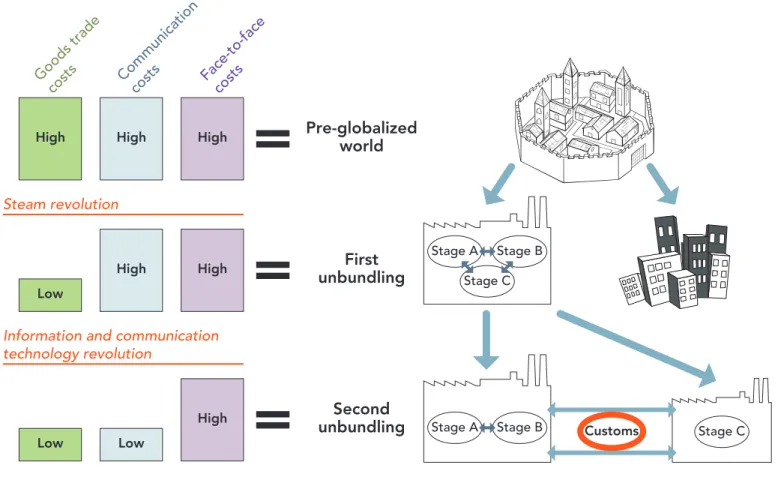
When the movement of goods, people, and ideas was not as frictionless as it is today, economic activities were organized mostly within the boundaries of a small-scale community (figure 1.2).7 Farmers harvested wheat and milled flour for a bakery a few blocks away, and the baker baked loaves of bread for the neighbors who walked into the shop every morning. Economic self-sufficiency was achieved with the points of production and consumption in close proximity. Extraterritorial business was rare, except perhaps for the merchant voyages of a sailing ship or the Silk Road caravans. And those cross-border trades dealt only with a handful of luxury items such as spices and silk products, sold at high prices to compensate for the risk incurred and the time spent during the journey.
International trade began to develop at the beginning of the 19th century when steam engines rapidly improved land trans-port (by locomotives) and water transtrans-port (by steamships), trig-gering unprecedented expansion of trade activities beyond local communities. The economies of scale from mass logistics further lowered transportation costs. The point of consumption was unbundled from the point of production, and goods travelled all over the world in search of the most profitable markets.
Paradoxically, the geographical unbundling of economies between production and consumption coincided with the agglomeration of production activities in large-scale factories in industrial zones. Because of the increase in potential custom-ers created by international trade, the mass production system became an appropriate manufacturing mode at the time. The key to high productivity in manufacturing is the division of labor, as seen in Adam Smith’s classic example of pin-making,8 where workers specialize in a particular task to raise their competencies through intensive learning of a specific routine. However, division of labor entails delicate coordination among the different stages because the variety of tasks must collectively produce a homo-geneous product. Accordingly, the different productive func-tions were brought together under the same roof (a factory) to facilitate communication and create harmony among the various tasks.
The information technology revolution in the 1980s completely changed this picture. With telexes, facsimiles, and the Internet — along with high-speed international communication networks — it became cheaper and easier to coordinate production units in different locations. Sales forecasts and procurement schedules could be instantly delivered to production lines, and the elec-tronic profiles of minute product designs and specifications could be shared with and adjusted by every production site. Productive functions no longer had to be confined within proximate spaces. The technological unbundling of production activities has accel-erated, with some segments relocated across borders to exploit the cost differentials of production factors in various countries.
Vertical integration
Richard Baldwin’s unbundling concept captures one important aspect of the dynamics of the world economy. But there is another critical dimension of the analytical perspective for the development of GVCs.
In the beginning of the 20th century Henry Ford devised and implemented a business model that aimed to integrate various segments (functions) of a production process under a single capital and management umbrella through the acquisition of a variety of companies. The model, later known as a vertical inte-gration strategy, became a modus operandi in the era of mass production.9
Early studies of vertical integration focused on market imper-fections. A firm integrates other entities to redress pre- existing market power distortions, such as double marginalization, free-riding, or entry foreclosure (Tirole 1989).
Another strand of thought considers the preclusion of trans-action costs as a main motive for vertical integration, where inter-nalizing production activities is a measure to avoid the potential costs of establishing formal business relations at arm’s length.
Given these benefits of integration, why then do some firms not choose to integrate? Because the internal arrangement of
activities involves nontrivial administrative and bureaucratic costs. Accordingly, the governance schemes are chosen to minimize the production inefficiencies attributed to a trading relationship by weighing the transaction costs of spot-market dealings against the bureaucratic costs of unified hierarchical organizations (firms).10
From the viewpoint of transaction cost economics the costs of concern include not only the direct costs of writing, monitoring, and enforcing contracts, but also the ex post performance inef-ficiencies caused by contractual hazards within the relationship. One of the basic tenets of transaction cost economics is that con-tracts are incomplete — in that the terms of exchange between the parties cannot be disciplined ex ante because of information asymmetry.11 When the parties are locked in to the transaction, the incompleteness of contracts evokes contractual hazards of various types, yet vertical integration pre-empts these hazards by internalizing ex post quasi-rents into the unified objective function of the integrated firm. So vertical integration becomes a preferred mode of organizing value chains when the benefit of attenuating the opportunistic behavior of parties within the rela-tionship outweighs the cost of inefficiently allocating resources associated with bureaucratic arrangements (Joskow 2003). FIGURE 1.2 Three cascading constraints of globalization
High High High
Low Low Low High High High
Pre-globalized
world
First
unbundling
Second
unbundling
Information and communication
technology revolution
Steam revolution
Goods trade
costs
Communication
costs
Face-to-face
costs
Stage A Stage B Stage C
Stage A Stage B Customs Stage C
And today vertical integration in the multicountry dimen-sion refers to the emergence of business entities called multi-national corporations. Foreign direct investment by multimulti-national corporations is the main driver of global production networks, decisively influencing the distribution of value added across countries.12
Accordingly, there are four modes of organizing value chains, along the axes of whether the task is done in-house or out-sourced and of whether it is carried out domestically or across national borders (figure 1.3).
Value chains and global value chains
The term “value chains” was conceived in business management studies. Porter (1985) tailored the concept as a basic framework for developing a corporate strategy to promote firm competi-tiveness by directing attention to the entire system of activities involved in producing and consuming a product. A corporate entity is first decomposed into a set of business activities with individual functions that constitute analytical units for diagnos-ing the firm’s competitive advantage. When a firm has a relatively atomized organizational structure, the task of each unit (business activity) — such as product design, materials procurement, mar-keting, and distribution — tends to be defined in a way to pursue the individual objective of that particular unit, which may or may not conflict with the objective of other units. However, in the value chain perspective all activities should be collectively organized to ensure the optimal functioning of the corporate entity as a whole. To this end, the nature of linkages between activities (value chains) is carefully examined — just as if drawing an anatomical chart of a firm — to internalize potential externali-ties through cross-functional coordination, which is an important source of the firm’s competitive advantage.13
In contrast, GVC studies originated in sociology. Unlike Por-ter’s value chain concept, which is concerned primarily with how firm strategies can be renovated by shifting the focus to the con-figuration of business activities, GVC studies consider the gener-ation and transfer of value within the system as a consequence of firm efforts to optimize production networks and, conversely, the mechanism of how the value distribution structure affects the firm’s choice of the organizational form of international produc-tion networks. GVC analysis is not a global extension of Porter’s value chain approach because the scope and motivation differ, as described below.14
Typology of global value chains
The main objective of GVC studies is to explore the interplay between value distribution mechanisms and organization of the cross-border production–consumption nexus. The concept was first collectively framed in the discussions of the Global Value Chains Initiative (2000–05), sponsored by the Rockefeller Founda-tion,15 and further crystallized by Gereffi, Humphrey, and Sturgeon (2005), whose analytical focus rests on the governance structure of organizing international production networks. Who are the players in the game? What kinds of rules exist? Is it a competitive or a cooperative play? What generates the winning opportunities? In
answering these questions, GVC studies pay attention to the forms of transactions, codified or otherwise, between stakeholders. This is because the way transactions are made reflects the structure of power relations between the parties, which ultimately determines the scope and magnitude of value distributions within the game.
The vertical integration type of GVC is based on the hierarchi-cal structure that assumes an absolute and unidirectional control of the parent company over its subsidiaries. The activities and performance of subsidiaries are strictly monitored and assessed in line with their headquarter management strategies. In con-trast, outsourcing options tend to generate leveled relationships between clients (buyers) and subcontractors (service suppliers), and the power exercise is more or less mutual, unlike the vertical integration type.
Within this dichotomy, Gereffi, Humphrey, and Sturgeon (2005) set out a GVC typology in a higher resolution spectrum in accord with power relations between the contracting parties. Figure 1.4 illustrates five variants of GVC governance. The rect-angles represent the firm’s boundary, and their size indicates the strength of bargaining power in relation to the other party. The arrows show the direction and extent of business intervention in the partners’ activities, which can be supportive, such as to draw “win-win” scenarios in the long-term perspective, or predatory, by focusing on uptakes of quick profits in the short run. Toward the right of the diagram, the clients (the headquarters in the case of the “hierarchy” type) possess greater bargaining powers and so are considered to exert a strong influence over the distribu-tion of value added. (See annex 1.1 for a detailed descripdistribu-tion.)
Gereffi, Humphrey, and Sturgeon (2005) also considered the dynamics of the GVC configuration by factoring out three param-eters: complexity of transactions, ability to codify transactions, and capabilities in the supply base (known as the “3 C’s model”– Complexity, Codifiability, and Capabilities). For example, the FIGURE 1.3 Modes of organizing value chains
Arm’s length offshoring Domestic outsourcing Domestic in-house procurement Foreign direct investment Firm boundaries National boundaries VE RT IC A L IN TE G RA TI O N UNBUNDLING
shift in the type of value chains from market to relational is asso-ciated with an increase in the complexity of transactions. The shift from relational to modular assumes an increase in the abil-ity to codify transactions. And the improving capabilities in the supply base, other things equal, drive value chains from the cap-tive type toward the market type. And so on.16
By probing the mechanism of GVC configurations, the model helps identify the policy instruments to facilitate the transfor-mation of value chains from one type to another, especially in the light of industrial upgrading and the GVC-driven growth of developing countries.17
Economic modeling
In principle, economists’ analytical focus on GVCs has been on three issues: the mechanism of the fragmentation of production processes,18 the impacts of offshoring on domestic factor incomes and welfare, and the firm’s choice of an organizational form of GVCs.
Mechanism of the fragmentation of production processes
Jones and Kierzkowski (1990) provide a model of outsourcing and set out the factors that affect the degree and form of the fragmen-tation of production activities. Figure 1.5a illustrates the relation between output level (market size) and total cost of production for
a firm whose production technology contains elements of increas-ing returns to scale. The line Fd1 represents the cost schedule of the traditional method, with all production stages concentrated in one location. When a part of the production process is outsourced to a domestic partner, two things occur, as shown in the move-ment of the cost curve from Fd1 to Fd2. First, the curve becomes flatter, indicating an improvement in productivity caused by the division of labor. Second, the curve shifts upward, indicating an increase in fixed costs (from c1 to c2) because of the need for coor-dination between the production units in different locations.19 Here, the least costly form of production will switch from the tradi-tional method to outsourcing at the output level q1.
When outsourcing options are enlarged to include the inter-national context, two other aspects are also taken into account. • Production factor costs are considered to be more diverse
between countries than within a country, so productivity will rise more when outsourcing takes place across borders in accord with comparative advantage.
• Connecting production units in different countries is more costly than connecting production units within the same country. International logistics is generally more expensive, marked up by import duties and costs for clearing customs and the like. There also are nontrivial communication costs for coordinating production units in countries with different lan-guages, legal systems, and business ethics.
FIGURE 1.4 Typology of global value chains
Complexity of transactions Ability to codify transactions Capabilities in the supply base Degree of power asymmetry and
extent of explicit coordination with partner’s production activities
High Low
Low High High High High High High Low High Low High High High Low Low
Market type Modular type Relational type Captive type Hierarchy type
Parent company (headquarters) Subsidiary Supplier Client Supplier Client MARKETS Suppliers Customers Supplier Client
These features are represented by line Fw1, which has a flat-ter slope for increased productivity and a higher inflat-tercept for an extra top-up of the fixed cost (from c2 to c3). Then, the opti-mal form of production will switch from domestic outsourcing to cross-border outsourcing (offshoring) at the output level q2.
In this light, it is possible to consider where multiple countries are involved in the production process (Fw2, Fw3, …). Different schedules can be drawn for various outsourcing options, as in figure 1.5b, and the shaded boundary defines the optimal form of production arrangement at each level of output.
The model’s implications for a global production arrange-ment are threefold. Other things being equal, the production process will be more prone to international fragmentation when: • The targeted market is larger, so that it has more room to
absorb the increased supply of goods from the organization of more efficient divisions of labor across borders.
• The costs of connecting the production activities in different countries are less inhibitive.
• The countries in the production networks are more diverse in their factor costs, so there is a better chance for offshoring firms to exploit comparative advantage.
Impacts of offshoring on domestic factor incomes and welfare
The offshoring model was further developed to address income distribution and welfare — a natural response to mounting politi-cal concerns about the potentially detrimental effect of offshor-ing on the domestic labor market (the industrial hollowoffshor-ing- out problem).20
Traditionally, the effect of international trade on the labor market has been considered in regard to a resource shift between industrial sectors caused by import competition, with-out much attention to the change in the within-sector compo-sition of different types of labor. Newer globalization literature seizes on this point, recognizing that offshoring is a cross-border movement of a production activity corresponding to a task for a particular type and skill of labor.21
Feenstra and Hanson (1996a, 1996b) considered the impact of offshoring that follows the liberalization of foreign ownership in developing countries. Substantial movements of capital from developed countries to developing countries are accompanied by transfers of some segments of production processes that are considered more skill-intensive by the standard of developing countries but less skill-intensive by the standard for developed countries. Accordingly, the demand for labor becomes skewed toward higher skilled labor in the light of the respective skill stan-dard of each economy, so the relative wages of low-skilled labor fall in both developed and developing countries.22
Grossman and Rossi-Hansberg (2008a) then introduced a “trade in tasks” concept to explain how an increase in offshoring feasibility affects the productivity and factor incomes of the off-shoring country. They emphasized the need to shift the analytical focus from goods, as in the conventional trade theory (Portu-guese wine for English cloth), to tasks that line up in a production process, in order to capture the rising prevalence of offshoring activities in a firm’s business strategies.
In the model the offshoring feasibility is parameterized as an improvement in the coordination capability between the firm’s FIGURE 1.5 Optimal form of outsourcing options
Total cost Output level 0 q1 q2 c1 c2 c3 Fw1 Total cost Output level 0 Fd1 Fw1 Fw2 Fw3 … Fd2 Fd1 Fd2 (a) (b)
headquarters and its foreign suppliers through transportation and communication technologies. The sensitivity to the change in offshoring feasibility is assumed to vary across different types of tasks. Some tasks (such as those akin to codified description) are easy to offshore, while others (such as those relying on per-sonal tacit knowledge) are not.23
The impact of the improved prospect for offshoring is consid-ered through three channels:
• A labor-supply effect. Moving some tasks to foreign coun-tries frees up the domestic labor that would otherwise carry out these tasks, so it has an effect analogous to increasing the supply of labor in the market. Such an implication, widely discussed in the mass media and political circles, generally evokes opinions against a firm’s offshoring activities for fear of lowering the real wages of offshored labor or losing domestic jobs when wages are sticky.
• A relative-price effect. A country offshores low-skilled labor when its cross-country comparative advantage is weaker in that type of task than in the tasks of high-skilled labor. The country would then specialize in exporting goods that are intensive in high-skilled labor, as conventional trade theory predicts. Accordingly, if an increase in exports leads to a deterioration in the country’s terms of trade, it would create a negative impact on the welfare of its high-skilled labor through the Stolper–Samuelson mechanism. (However, this effect comes into play only when the country is large enough to affect the international relative prices of goods.)
• A productivity effect. This effect is a unique feature of the model that is not fully considered in other studies on the topic. When the prospect for offshoring improves — say, by an increase in communication capabilities — an offshoring firm’s profitability will rise in proportion to the extent that the firm relies on the offshoring business. Such a productivity effect is equivalent to the consequence of factor-augmenting techno-logical progress, so it is able to bring a positive impact on the employment of domestic workers (across all industries) whose task levels are similar to those of offshored labor.
The net impact of offshoring on factor incomes is the sum of these three effects. And in most cases the empirical consider-ation is reduced to whether the productivity effect will dominate the other two effects — if so, the argument turns in favor of off-shoring activities.24
Firm’s choice of an organizational form of global value chains
The factors that determine whether a transaction is mediated through markets or within firm boundaries have long been a sub-ject of inquiry in industrial organizational theory. The question has been addressed in many ways since Ronald Coase docu-mented his insights on the nature of the firm,25 and it has been brought into the international context in studies on intrafirm trade and multinational corporations.
Antràs (2003), one of the earliest efforts in pursuing this direction, synthesized firm theory under incomplete contracts (Grossman and Hart 1986) and international trade theory under
imperfect competition (Helpman and Krugman 1985) to explain the asymmetric prevalence of intrafirm trade in capital-inten-sive industries and between capital-abundant countries. The firm’s dual motives for minimizing transaction costs (by assign-ing property rights) and factor costs (by exploitassign-ing comparative advantages) are analyzed in the unified theoretical framework. The model expands the margins of analytical scope in figure 1.3 to cover the range of value chain variations for both spatial and organizational dimensions.
Antràs and Helpman (2004) introduced another dimension to the analysis: firm heterogeneity. Drawing on Melitz (2003), Antràs and Helpman investigated the impact of within-sector hetero-geneity in firm productivity on the firm’s globalization decision. The model predicts that different degrees of entry cost to global activities bring about the productivity ranking among firms on the choice of globalization modes. The most productive firms would choose to undertake foreign direct investment, the next most productive firms would choose to engage in arm’s length offshoring, and so on down to the least productive firms, which would choose to engage only in domestic procurement.
Further to these approaches, Antràs and Chor (2013) shed new light on the line of analyses by considering a technological order-ing of production stages — a crucial attribute of value chains — to address the traditional make-or-buy question for each segment of a production process along a value chain. Incompleteness of contract, as previously defined, entails strategic consideration by a lead firm (final good producer) in choosing the form of value chain governance. And the key prediction of the model is that the lead firm should differentiate the governance forms between upstream and downstream suppliers for optimizing the gains from the set of transactions.
The model identifies two types of value chains, determined by the nature of the final product: sequential complements and sequential substitutes. The type of sequentiality that character-izes the production process affects the lead firm’s decision on the governance arrangements along that value chain (figure 1.6). For sequential complements the lead firm chooses to integrate downstream suppliers while outsourcing its upstream produc-tion stages. For sequential substitutes upstream suppliers are vertically integrated, while the transactions with downstream suppliers are carried out at arm’s length. (See annex 1.2 for a brief description of the argument.)26
The property-rights theory on the firm’s choice of an organi-zational form is highly resonant with the sociologists’ analytical insights about value chain governance because, broadly speak-ing, both approaches engage the contractibility of transactions as a core parameter of the models. The topic is thus one of the most promising areas for extensive interdisciplinary dialogue on synergetic development of the GVC analysis.
Empirical challenges
The rapid progress of empirical analysis on GVCs has been backed up by two substantial changes in the research environment. One
is the increasing availability of relevant data and statistics, espe-cially multicountry input-output tables and firm- level micro data. The other is the advance in data- processing capacity of per-sonal computers for handling these massive datasets as well as the information and communications infrastructure that allows for efficient shared use of the databases. What was impossible 20 years ago is common practice today, and the empirical chal-lenges of GVC analysis are entering a new phase of development.
Mapping global value chains by firm business records
The initial efforts to quantitatively describe GVCs can be found in studies that use firm-specific business records. These studies typically aim to identify the composition of inputs procurement or the sales networks of a product on the basis of data provided by the manufacturers themselves or from the teardown reports of private consulting companies — or, for the average breakdown of an industry’s generic product type, the information from the relevant industry associations (Sturgeon and others 2013).
Earlier studies of this kind include Dedrick, Kraemer, and Linden (2008), who analyzed the value-added structure of four representative products — Apple’s iPod and video iPod and Hew-lett Packard’s and Lenovo’s laptop personal computers — using information from business reports.27 They found that a video iPod with a retail price of $299 in 2005 was associated with a breakdown of $144 for the product’s factory cost, $75 for dis-tribution margins and $80 for the profit of the lead firm (Apple), while within the factory cost only $3.86 was estimated for the assembly services in China. The original motivation of the study was to investigate how firms benefit from technological innova-tion through producinnova-tion sharing, but it came to elucidate a sepa-rate and even more alarming question about the validity of con-ventional trade statistics based on gross values.
In this context, Xing and Detert (2010) addressed U.S.–China trade imbalances. iPhones were not sold in China in 2009, which implies that China’s exports of iPhones to the United States were
equivalent to the U.S. trade deficit of the product in relation to China. The study shows that the U.S. deficit of $1.9 billion for iPhone trades is reduced to $73 million if viewed in value- added terms and broken down to include the deficits with other countries such as Japan and Germany, which are the core parts suppliers.
These product-level approaches are useful in drawing the actual structure of production chains because they directly use data provided by individual firms rather than resorting to statisti-cal inference. But the weakness is apparent in the flipside.28
First, these approaches have limited applicability when con-sidering macroeconomic issues such as trade policies, because the analytical focus is cast only on a particular product or on the activity of a few firms. This is far from sufficient to capture the entire value flows in the national context.
Second, as Dedrick, Kraemer, and Linden (2008) pointed out, most firm data do not explicitly present compensation of employees, an important component of value-added items in the national accounting framework, but merge it with other types of production costs.
Third, because values are generated at every point of the production process, the value-added analysis should be able to trace all the production stages along the entire supply chain. However, the product-level approach considers only the value-added structure of direct input suppliers (the first tier), leaving the rest of the value-added stream untracked. For example, a hard-disk drive in an iPhone contains subparts produced in dif-ferent countries and thereby requires further decomposition of the value-added sources.
Mapping global value chains by input- output tables
Given the limitations of the conventional approach, multicountry input- output tables have received increased attention. A multi-country input- output table provides a comprehensive map of international transactions of goods and services in a massive dataset that combines the national input- output tables of vari-ous countries at a given point of time. Because the tables con-tain information on supply–use relations between industries and across countries — which are totally absent from foreign trade statistics — it is possible to identify the vertical structure of international production sharing. And unlike the product-level approach, input- output analysis covers an entire set of industries that make up an economic system, thus enabling the measure-ment of cross-border value flows for a country or region. Theo-retically, such analysis has the capacity to track the value-added generation process of every product in every country at every production stage.
The input- output approach has weaknesses as well. Sturgeon and others (2013) pointed out the limitations of (multicountry) input- output analyses arising from the statistical characteris-tics of input- output tables. First, the table’s sectoral classifica-tion is based on industrial categories so that the value-added of a specific task such as product design or assembly cannot be identified. Second, transactions are recorded on a domestic basis, so production activities are circumscribed by territorial borders rather than by the nationality that the produced goods FIGURE 1.6 Sequential choices for organizing value chains
Outsourcing Integration Sequential complements Outsourcing Integration Sequential substitutes UPSTREAM
SUPPLIERS DOWNSTREAMSUPPLIERS
Cu stome r se rvices Distrib ution M ark eting Assem bly Parts p roc ureme nt M ate rial pro curem ent Re search an d d eve lop ment Produ ct d esign
are associated with, which may cause (analytically) inappropriate attribution of value added among countries.29 Third, information on the nature of specific transactions is totally absent from input- output statistics, making qualitative analyses of value chains dif-ficult, if not impossible.
In a nutshell the product-level approach is relevant for ana-lyzing qualitative aspects of individual value chains, such as the form of governance arrangement or the mode of technological transfer between parties, while the multicountry input- output approach captures a general picture of value chain configuration in the larger context from a systematic point of view. They are not exclusive substitutes but must be employed in a complemen-tary manner, depending on the type of research questions.
GVC studies using input- output tables have become increas-ingly common in the last decade. Their origin can be traced back to Hummels, Ishii, and Yi (2001), who introduced the concept of vertical specialization — defined as the amount of imported inter-mediate inputs used to produce an exported good or, put dif-ferently, the import content of exports, which is presented as a measure of international production sharing.
Chen and others (2004) first brought the idea into the value-added context in relation to the statistical distortion caused by ignoring the presence of processing trade and by measuring international trade in terms of gross exports. Here the long-de-bated issue of U.S.–China trade imbalances was fully consid-ered in the value-added perspective. Koopman, Wang, and Wei (2012) further developed and methodologically formalized the approach for separating China’s national input- output matrices into two components, one for the export processing sectors and one for the rest of the economy.30 They showed that the foreign content of value added in China’s manufacturing exports was
about 50% in 2002, more than double what would have been obtained by a straightforward application of the vertical special-ization metric. It quantitatively demonstrates the importance of measuring trade in value added terms, as well as the significant analytical impact of overlooking processing trade.
While these empirical exercises rely on the national input- output tables of individual countries, Daudin, Rifflart, and Sch-weisguth (2006) used the database of the Global Trade Analy-sis Project to construct a multicountry input- output table of 70 countries and their composite regions in order to calculate the domestic value-added content of exports, alongside indices of vertical specialization and regionalization. Johnson and Nogu-era (2012) calculated the ratio of value-added exports to gross exports as a metric of international production sharing, again using the Global Trade Analysis Project database.31 They exten-sively discussed the impact of production sharing on the scale of bilateral trade balances with respect to multiple countries, not to mention the U.S. trade deficit with China, which shows a 30–40% drop in value added terms from the traditional calcula-tion (figure 1.7).32
Bems and Johnson (2012) present an interesting extension of the trade in value added approach to international macro-economics by proposing the concept of the value-added real effective exchange rate. Real effective exchange rates are com-monly used to measure country export competitiveness by eval-uating the magnitude of price adjustments necessary to clear the external imbalances or, put differently, the extent of nominal exchange rate misalignments.
Conventional real effective exchange rates are often calcu-lated from a weighted basket of consumer price indices, where weights are based on bilateral gross trade flows. However, with
FIGURE 1.7 Bilateral trade and value-added balances for the United States, by partner, 2004
$ (billions) –150 –125 –100 –75 –50 –25 0 25 Austr alia Singa pore Spain Belg ium Fran ce Russ ian Fe dera tion Braz il Irelan d Kore a, Re p. Mex ico Unite d King dom Chine se T aipei Italy Mala ysia Germ any Cana da Japa n China Trade deficit Value-added deficit
Value-added deficit (adjusted) Source: Author’s drawing, based on Johnson and Noguera 2012.
rapid globalization, conventional rates became an inappro-priate measure in two respects. First, because real effective exchange rates are used to assess country export competitive-ness in the world market, approximating price developments with consumer price indices is not ideal because consumer price indices summarize the prices of products whose value-added origins could be fragmented across different countries. Second, using the same line of logic, the values of gross trade flows cannot serve as unbiased weights because they do not represent today’s economic reality of increasing production sharing among countries.
The value-added real effective exchange rate overcomes these problems by using gross domestic product (value-added) deflators, instead of consumer price indices, to mea-sure price changes, and bases its weights on value-added bilateral trade flows, instead of gross trade flows. Figure 1.8 shows that the gap between China’s conventional and value-added real effective exchange rates increased substantially from 2000 onward.33
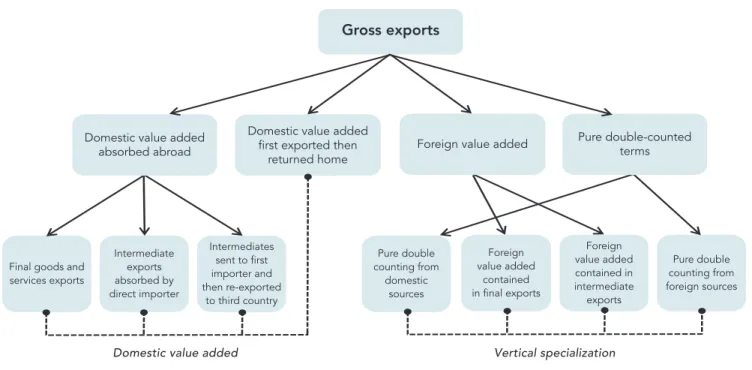
One of the most recent achievements in this strand of analy-ses is from Koopman, Wang, and Wei (2014), who devised a full decomposition method of gross exports into various sources of value added. Gross exports are first decomposed into four cate-gories: domestic value added absorbed abroad, domestic value added first exported then returned home, foreign value added, and pure double-counted terms; each category is then further decomposed by trading mode (figure 1.9). The result is a com-plete picture of the value-added generation process, in which
various preceding formulas for measuring value-added trade are systematically integrated into a single accounting framework. In particular, the method enables the isolation of double-counting elements in gross exports, which have long haunted trade econ-omists conducting empirical analyses.
FIGURE 1.9 Gross trade accounting framework
Pure double counting from foreign sources Foreign value added contained in intermediate exports Foreign value added contained in final exports Pure double counting from domestic sources Intermediates sent to first importer and then re-exported to third country Intermediate exports absorbed by direct importer Final goods and
services exports
Domestic value added first exported then
returned home
Domestic value added Vertical specialization
Pure double-counted terms
Gross exports
Domestic value added
absorbed abroad Foreign value added
Source: Author’s drawing, based on Koopman and others 2016.
Note: This figure is a revised version from the one presented in Koopman, Wang, and Wei 2014 in response to the comment by Los, Timmer, and de Vries 2016. FIGURE 1.8 China’s real effective exchange rates
Change from 1995 value (%)
0.0 0.1 0.2 0.3 0.4
Conventional real effective exchange rate Value-added real effective exchange rate
2010 2005
2000 1995
For trade policies the channels of domestic value added first exported then returned home have important implications. For example, the antidumping measure that the European Commis-sion imposed on the import of footwear from China and Viet Nam in 2006 is known to have had a detrimental impact on service industries in the European Union because these imported items contained considerable value added originating in the European design and distribution sectors. Such consequences could have been avoided by due reference to a detailed presentation of the value-added sources of traded products.34
Heterogeneity considered
Another important development in the quantitative analyses of GVCs, with a theoretical foundation in Melitz (2003), is account-ing for within-sector heterogeneity in firm characteristics when constructing input- output tables. Conventional input- output tables do not differentiate the input structure of different types of producers in the same industry. However, export- oriented firms, especially those in the processing trade, generally have higher import intensity in sourcing intermediate inputs than do domestic- oriented producers. This implies that conventional input- output tables, which provide information only on the aver-age input structure across all types of producers, may bias ana-lytical results for countries where processing trade is prevalent (notably China and Mexico).
As stated earlier, Koopman, Wang, and Wei (2012) were first to formally address this problem, by presenting a method to split the Chinese input- output tables into subaccounts that align export processing activities with the rest of the sector. Tang, Wang, and Wang (2014) further elaborated the approach, by considering variation in such firm characteristics as size (large scale or small to medium scale) and ownership structure (domestic or foreign, private or state-owned). They also used the Chinese input- output tables but combined them with data from China’s industrial census and trade statistics by firm type. Importantly, the information on ownership structure allows the impact of China’s privatization pro-gram on domestic value-chain upgrading to be assessed.
Ma, Wang, and Zhu (2015) integrated these approaches by considering firm heterogeneity in dual dimensions — trading mode (processing exporters or normal exporters plus nonexport-ers) and firm characteristics (domestic-owned or foreign-owned). Using the information of ownership structure, they worked out the distribution of domestic value added according to factor ownership, which contributes to the conversion of measurement from gross domestic product to gross national income by taking into account firm heterogeneity.35
Heterogeneity can also be considered from a geographic per-spective. The current setup of multicountry input- output tables regards a country as a point of transaction in global production networks. However, a national economy has a spatial dimension. Brazil and China cannot be treated the same way in the input- output matrices that Costa Rica and Singapore are. Inomata and Meng (2013) introduced the Transnational Inter regional Input- Output Table for China, Japan, and Korea, constructed by the Institute of Developing Economies, which links the interregional
input- output tables of respective countries into a single matrix to account for regional heterogeneity within a country in a multi-country input- output framework. The table allows for economic linkages across borders to be studied on a region-to-region basis — say, between Huanan in China and Kyushu in Japan.36
Domestic linkages between regions are particularly relevant when considering regional (within- country) development. For example, China built strong economic linkages with neighboring countries after the launch of the Reform and Open-Door Policy in 1978, but the benefit of economic globalization was not equally shared within the country. Income disparities immediately wid-ened between coastal and inland regions, and it took time for the positive impact from abroad to trickle down to inner China through domestic linkage effects. In this sense, regional aspects are crucial in accounting for the process of economic develop-ment, especially for spacious and less integrated economies.37
Finally, consider heterogeneity in labor markets. The impact of GVCs on employment has been the subject of heated discus-sion, especially around the industrial hollowing out problem. Ear-lier globalization debates addressed the issue primarily in terms of the industrial structural change brought about by opening the domestic economy to global competition (leading to iden-tification of declining, stagnant, and expanding industries). The current arguments from the GVC perspective engage in more microscopic analysis by looking into the wealth distribution at the task level within production chains, often epitomized by the so-called “smiley curve.”
Along these lines, Timmer and others (2014) conducted empirical research on value-added distribution among heteroge-neous labor markets with different types of skill (upon recogniz-ing that each task in the production processes can be associated with a particular level of labor skill). They employed the European Commission– funded World Input- Output Database augmented by the EU KLEMS database for information on factor inputs, in which three types of labor (low skilled, medium skilled, and high skilled) were identified on the basis of educational attainment. For most of the countries in the database the value-added share of high-skilled labor increased substantially from 1995 to 2008, while that of less-skilled labor declined. The results agree with the findings of Feenstra and Hanson (1996a, 1996b) and have important implications for recent political events in Europe and the United States.38
Distance matters: “length” analyses of value chains
The theory of fragmentation predicts that if the production pro-cess of a good has the potential for further segmentation by the change in production technologies or consumption markets, then there is an opportunity for a finer division of labor that will lead to better allocation of resources and lower marginal cost of production. This is especially true with access to international markets, because the differences in factor endowments (and thus comparative advantage) are even more salient across borders.39
Accordingly, the study on fragmentation concerns the number of production stages in a production process — comparing alter-native technologies that produce the same good, one with few
production stages and another with many. Empirical research requires an overall perspective for the entire structure of the pro-duction sequence. What matters is not only the strength (magni-tude) of production linkages, but also the length of the linkages, determined by the number of production stages.
The traditional input- output approach to analyzing produc-tion networks is generally concerned with the interconnected-ness or strength of linkages between industries. The “length” dimension of production linkages was first addressed by the input- output model of average propagation length developed by Dietzenbacher, Romero, and Bosma (2005). The average propagation length model represents the average number of production stages lining up in every branch of production net-works, so it effectively measures an industry’s fragmentation.40 Dietzenbacher and Romero (2007) further applied the model to the international context by analyzing the cross-national linkages of major European economies using the 1985 European multi-country input- output table.
Fally (2011) developed a model for measuring fragmentation that was based on a philosophy similar to that of the average propagation length model. The major difference is that Fally’s model, as well as Antràs and others’ (2012) variation, captures the average number of production stages by pegging the endpoint of the sequence at final consumption, which enables measuring the distance to final demand of a product along the production chains. Those studies rely on national input- output tables of the United States and other selected countries, but De Backer and Miroudot (2012) later applied Fally’s (2011) model to the inter-country input- output tables of the Organisation for Economic Co-operation and Development covering 56 countries for 1995, 2000, and 2005.41
One application of the “length” model in the GVC context is to identify countries’ (or industries’) relative position within the global production system. If a country’s representative produc-tion chains toward final products are longer than those toward primary products, the country is considered to operate in a rela-tively upstream position (and conversely if a country’s represen-tative production chains toward final products are shorter than those toward primary products, the country operates in a rela-tively downstream position). Because the average propagation length can be measured both in forward (cost-push) and back-ward (demand-pull) directions along production lines, it is possi-ble to identify the relative position of a country within the global production networks by comparing the pairs of forward- length and backward- length values.
Inomata (2008) and Escaith and Inomata (2013) are among the earliest efforts to develop the idea of measuring the rela-tive production positions of countries. They elucidated the struc-tural change of the regional production system in two dimen-sions, using data for East Asia (figure 1.10). With the horizontal axis for backward average propagation length and the vertical axis for forward average propagation length, the bottom-left to top-right direction presents the changes in the entire length of the supply chains that countries participate in, and the top-left to bottom-right direction draws the relative line position of each
country within the regional production networks (as determined by the ratio of forward and backward average propagation lengths). For example, China moved along the path that is far-thest from the bottom-left to top-right diagonal, indicating that it stayed in the most downstream segment of the regional supply chains throughout the period, which reflects the country’s domi-nant role as a final assembler of regional products.42
The line position of industries and countries within a produc-tion system is particularly important for considering the varia-tions in sectoral characteristics along value chains — for example, value-added ratios as signified by the “smiley curve” (Baldwin, Forslid, and Ito 2016; Ye, Meng, and Wei 2015) or the mode of value chain governance (Antràs and Chor 2013).
So, what’s next?
Perhaps the most pressing issue for the GVC research community is to accelerate the development of relevant data. Until now, a large share of empirical work for testing GVC governance models of firm theory has relied on data from official merchandise trade statistics.43 Some country databases (such as the Related Party Trade Database from the U.S. Census Bureau) contain informa-tion on whether shipping involves transacinforma-tions between related or nonrelated parties, which can be used to sketch out the pres-ence of multinational firms in international trade.44
Despite the observable advantages of the data (notably accessibility and availability), researchers face several challenges to using it appropriately. Antràs (2011) set out four of them. First, the product-level information aggregates the sourcing decisions FIGURE 1.10 Relative line position of countries in the regional production networks of East Asia, 1985, 2005
Forward average propagation length
2.7 2.9 3.1 3.3 3.5 3.7 3.9 2.7 2.9 3.1 3.3 3.5 3.7 3.9 Upstreamness Downstreamness Longer supply chains
Shorter supply chains
Backward average propagation length
China Indonesia Japan Rep. of Korea Malaysia Chinese Taipei Philippines Singapore Thailand United States 1985 2005
of multiple firms, so some approximation is imposed for testing the model of firm-level sourcing behavior. Second, the data do not provide information about the users of the products being shipped, so it is impossible to identify which sector of the econ-omy has absorbed the imported product (or even whether it is for intermediate use or final consumption). Third, as for the ship-ping between related parties, the data tell neither which party is owned by whom, nor the degree of control or ownership share of the parent company. The second and third points pose a practical problem when relating observations in intrafirm trade with the characteristics of importers (headquarters, in the case of backward integration), as modeled in Antràs (2003). Fourth, the data report only the information on incoming and outgo-ing shipments from the viewpoint of a home country. But multi-national firms often engage in global sourcing, involving ship-ments between third countries (for example, Apple headquarters in the United States may source Korean Samsung’s inputs being shipped to Foxconn factories in China for assembly).
Firm-level microdata, which have become increasingly avail-able in recent years, may provide the information needed to develop empirical tools that overcome these problems.45 The benefit of the datasets rests on their representativeness of var-ious aspects of firm operations. For example, the Basic Survey of Japanese Business Structure and Activities (Kigyo-katsudou kihon chosa toukei) by Japan’s Ministry of Economy, Trade, and Industry, has annual survey data (mandatory under the Statistics Act of Japan) that cover multiple types of information on firms, such as sales, costs, employment, capital expenditures, exports, imports, and foreign direct investment.46
Even so, unlike those Japanese data, many firm-level micro-data come from one-shot industrial surveys and thus are avail-able only for particular countries in particular years. The datasets also differ in the dimensions of representativeness. Accordingly, in order to apply these datasets to a general equilibrium setup like the input- output system, they should be used, for example, to provide combined structural information for estimating the relevant coefficients along with appropriate constraints and a balancing algorithm.
Another aspect to consider is the integration of databases, especially of multicountry input-output tables. Currently, various institutions construct competing tables, each designed for a spe-cific analytical objective, so their presentation format, sectoral classification, and types of ancillary information (such as environ-mental accounts) differ.47
A team at the University of Sydney recently launched the Global Multi-Region Input- Output Lab, which aims to build a cloud-computing platform that allows participants to use each other’s individually developed statistical resources. The infor-mation from the aforementioned multicountry input- output databases, together with national accounts and foreign trade statistics, are expected to be input in the platform. Then, a highly detailed regional-sectoral taxonomy (the root classifica-tion) linked to the data pool will serve as a feedstock from which
researchers can choose any combination of regions or sectors to assemble the multicountry input- output tables most suited to their research interests. By developing a Wikipedia -like common e-infrastructure, the lab’s setup optimizes the use of available information, enhances flexibility in data construction, and saves resources by avoiding duplication of work among different insti-tutions (Lenzen and others 2017).
Meta-methodological considerations
GVC studies have evolved along three distinctive modes of analyses: spot analysis, sequence analysis, and network analysis. Gary Gereffi’s earlier model, global commodity chains, consid-ered the power relation between a lead firm and a set of multiple subcontractors that operate at different tiers along production chains (Gereffi and Korzeniewicz 1994). “One versus many” was thus the basic setup for analyzing the nature of governance. In contrast, Gereffi, Humphrey, and Sturgeon (2005) and later studies moved the analytical target to one-to-one transactions within a particular pair of a lead firm and a supplier (Bair 2008). So the modal shift in GVC studies among sociologists was from sequence (that is, one versus many) to spot (that is, one versus one) analysis — or, in the Euclidean sense of the word, from one- dimensional to zero-dimensional spatiality.
In international trade theories the analytical focus of GVC studies has been primarily on a particular supply–use relation between trading partners, especially for a firm’s “make-or-buy” choice of intermediate inputs. The dominant mode of analysis has thus been spot analysis, yet Antràs and Chor (2013) have opened a new path toward sequence analysis by considering a techno-logical ordering of production stages (from zero- dimensional to one-dimensional spatiality).
Input- output economics has by its nature always been con-cerned with a sequence, whether in the traditional Leontief impact models or in the latest supply chain length models. How-ever, recent work engages network theory by applying the con-cept of network centralities to input- output matrices (Carvalho 2012; Escaith 2014) and thereby shows some movement from sequence to network analysis (from one-dimensional to two- dimensional spatiality).
These observations suggest that the analytical frameworks of GVC studies are diverging rather than converging over time — and that the prospect for overall consolidation of methodologies is limited in the near future. However, this is not necessarily bad news. The diversity and multiplicity of methodological frame-works imply that a wider scope of analysis is available. It is only a matter of how best to combine the relevant frameworks in an appropriate way for each research question, just as with inte-grating various tasks into an optimal configuration of production chains. Keeping and facilitating interdisciplinary dialogues are essential, and the Global Value Chain Development Report will serve as a core platform for this end.
ANNEX 1.1
Typology of global value chains
Gereffi, Humphrey, and Sturgeon (2005) set out a typology of five global value chains (GVCs) on the basis of the structure of power relations between the contracting parties.
Market-type global value chain
Producing a commodity of a generic nature does not require any specific investment in production facilities for a particular trans-action, so both customers and suppliers have countless choices for alternative partners. They are connected mainly through open spot-market transactions in a shoulder-to-shoulder relationship. Also, the procurement of a generic commodity will not neces-sitate an exchange of detailed product specification between contractors because the key information is mostly reduced to the preset price of the product that can be found in a book of catalogs. The transaction cost for changing business partners is almost negligible, leaving the value chains in a constant state of flux because of their high price elasticity.
Modular-type global value chain
In business management or industrial engineering the word “module” generally refers to a composite of subcomponents grouped by the types of functions that are assumed in making up the final product.48 The possibility of different combinations of differentiated modules enables producers to design multiple variants of a product. By the same token, if a complex transaction can be accommodated in the supply base by adjusting the com-bination of multipurpose equipment, the supplier will not have to incur transaction-specific investment (no hold-up problem) and is thus able to spread the equipment’s use across a wide range of potential clients. Even though the information to be delivered between the contractors may be considerable (say, for produc-ing a complex product), the relative codifiability of transactions, as presumed in this type of GVC governance, compresses the volume of interventions, and the supplier is able to take overall control of its own production process. This implies that the trans-action cost for changing business partners remains relatively low.
Relational-type global value chain
When the manufacturing process involves specialized equip-ment (for example, the mold for a product of a particular shape), transactions become asset-specific, and the contracting par-ties become mutually dependent. The equipment for a specific purpose has limited scope for alternative uses, so its productiv-ity will drop considerably when it is applied in other contexts. Accordingly, the service suppliers (the holders of the specialized equipment) are not motivated to look for other potential clients. But it is also difficult, or at least costly, for the client to expect the same level of performance from other third suppliers with-out these specialized facilities. As a result, both parties have little incentive to search for alternative business relations. Further, reinvestment in the specialized equipment for raising productiv-ity deepens the asset-specificproductiv-ity of the transaction, thus trapping the parties in even more mutually dependent relationships.
Captive-type global value chain
This type of transaction assumes an overwhelming disparity in power exercise among the parties, as seen in the business rela-tions between a lead firm of global brands and its subcontracting local small companies. Service suppliers are expected to follow the client’s instructions word for word and are subject to strict surveillance on product quality and delivery times. Unlike suppli-ers in the market-type GVC, captive service supplisuppli-ers have nei-ther sufficient productive capacity to enjoy the scale of mass pro-duction, nor the specialized production facilities needed to claim its uniqueness, as attributed to the suppliers in the relational- type GVC. The availability of only mediocre production capabil-ity greatly narrows their opportunities to look for alternative busi-ness relations, imposing a captive position toward their clients.
Hierarchy-type global value chain
As stated earlier, this type of GVC generally refers to the rela-tions within a vertically integrated firm, as with multinational corporations.