The asset/liability structure of the
Philippine banks and non-bank financial
institutions in 2000s : a preliminary study
for financial access analyses
著者
Kashiwabara Chie
権利
Copyrights 日本貿易振興機構(ジェトロ)アジア
経済研究所 / Institute of Developing
Economies, Japan External Trade Organization
(IDE-JETRO) http://www.ide.go.jp
journal or
publication title
IDE Discussion Paper
volume
468
year
2014-04-01
INSTITUTE OF DEVELOPING ECONOMIES
IDE Discussion Papers are preliminary materials circulated
to stimulate discussions and critical comments
Keywords: credit channel, financial intermediaries, non-bank financial institutions JEL classification: E42, E52, G38
* Director, Fiscal and Financial Policy Study Group, Development Studies Center, IDE. ([email protected])
IDE DISCUSSION PAPER No. 468
The Asset/Liability Structure of the Philippine
Banks and Non-Bank Financial Institutions in
2000s: A Preliminary Study for Financial Access
Analyses
Chie KASHIWABARA*
April 2014
Abstract:
Based on the consolidated statements data of the universal/commercial banks (UKbank) and non-bank financial institutions with quasi-non-banking licenses, this paper presents a keen necessity of obtaining data in detail on both sides (assets and liabilities) of their financial conditions and further analyses. Those would bring more adequate assessments on the Philippine financial system, especially with regard to each financial subsector’s financing/lending preferences and behavior.
The paper also presents a possibility that the skewed locational and operational distribution exists in the non-UKbank financial subsectors. It suggests there may be a significant deviation from the authorities’ (the BSP, SEC and others) intended/anticipated financial system in the banking/non-bank financial institutions’ real operations.
The Institute of Developing Economies (IDE) is a semigovernmental, nonpartisan, nonprofit research institute, founded in 1958. The Institute merged with the Japan External Trade Organization (JETRO) on July 1, 1998. The Institute conducts basic and comprehensive studies on economic and related affairs in all developing countries and regions, including Asia, the Middle East, Africa, Latin America, Oceania, and Eastern Europe.
The views expressed in this publication are those of the author(s). Publication does not imply endorsement by the Institute of Developing Economies of any of the views expressed within.
INSTITUTE OF DEVELOPING ECONOMIES (IDE), JETRO 3-2-2, WAKABA, MIHAMA-KU, CHIBA-SHI
CHIBA 261-8545, JAPAN
©2014 by Institute of Developing Economies, JETRO
IDE Discussion Paper No. 468
Asset/Liability Structure of the Philippine Banks and Non-Bank Financial Institutions in the 2000s: A Preliminary Study for Financial Access Analyses 1
Chie Kashiwabara
Abstract:
Based on the consolidated statements data of the universal/commercial banks (UKbank) and non-bank financial institutions with quasi-non-banking licenses, this paper presents a keen necessity of obtaining data in detail on both sides (assets and liabilities) of their financial conditions and further analyses. Those would bring more adequate assessments on the Philippine financial system, especially with regard to each financial subsector’s financing/lending preferences and behavior.
The paper also presents a possibility that the skewed locational and operational distribution exists in the non-UKbank financial subsectors. It suggests there may be a significant deviation from the authorities’ (the BSP, SEC and others) intended/anticipated financial system in the banking/non-bank financial institutions’ real operations.
Keywords: credit channel, bank loan, non-bank financial institutions JEL classification: E42, E52, G38
1
The paper is prepared as an interim/preliminary study for the research project “Monetary Policy Infrastructure and the Policy Responses in the Southeast Asian Developing Countries,” for the FY 2012-2014 supported by the Grant-in-Aid for Scientific Research of Japan Society for Promotion of Science.
Asset/Liability Structure of the Philippine Banks and Non-Bank Financial
Institutions in the 2000s: A Preliminary Study for Financial Access Analyses
Chie KASHIWABARA
1. Introduction
During the first half of 2000, the Philippine financial sector was under its reforms after the late-1990s financial crisis. The central government and regulatory authorities introduced the measures of: (1) temporarily allowing further foreign entries and their business expansion, thus enhancing competition in the financial sector; (2) improving local financial institutions’ operational strength, competitiveness and profitability based on the international accounting and soundness standards; and (3) encouraging mergers and acquisitions among local institutions as well as with foreign ones as an outcome of (1) and (2). The measures aimed to promote corporate finance especially to the manufacturing sector and to alleviate financial access disparities among the regions in the medium term.
In addition, as the policy measures against the 2008 Lehman shock, the Bangko Sentral ng Pilipinas (the central bank, the BSP hereafter) took the following in 2009 under the then Arroyo administration’s “Economic Resiliency Plan”: (1) decreasing short-term rates by 2 percentage points in total, (2) providing large amount of liquidity by the reverse repurchase arrangements (RRPs) and raising BSP’s rediscounting limits, (3) decreasing the Special Deposit Account (SDA, an inter-BSP-and-banks account other than the interbank accounts in BSP) rates for local banks not to pool the liquidity and monitoring the SDA outstanding. Those unprecedentedly active measures of financial easing showed BSP’s strong intention to prevent the sluggish financial intermediaries nationwide and lead the financial sector continue to provide or increase funds to the industries.
However, the domestic financial intermediaries do not provide the above expected circumstances at present. Only 40-50% of the universal and commercial banks’ (UKbanks, hereafter) assets have been allocated to lending, and the manufacturing sector’s share in UKbanks’ total loan portfolio has been declined throughout the 2000s. In terms of the geographical allocation, around ninety percent (90%) of the total bank loans outstanding is under contract to the industries and other clients in the National Capital Region (the NCR, hereafter). Considering these situations, the BSP conducted “Consumer Financer Survey” in 2009 and “Financial Inclusion Studies” in 2011, then commenced “Financial Inclusion Initiatives” in 2012 to build a more inclusive financial system responsive to the local industries’ and households’ needs2.
Therefore, some questions rise: Why the rural, saving and thrift banks have been underdeveloped while the UKbanks mainly concentrate on operating in the NCR?; Are there other non-bank financial institutions (the NBFIs hereafter) replacing the banking sector in corporate/household lending in the non-NCR regions?; If so, what are they?; How is the lending competition/ demarcation among the local financial intermediaries including the NBFIs in the NCR? Is the situation in the non-NCR areas different from that in the NCR?, etc. This paper aims to overview and discuss about the financial system in the 2000s – mostly in the NCR due to the data availability at present – in view of the possibilities of the UKbanks-NFBIs complementality in the credit market as a preliminary study to deliver findings to the questions above. This study would compose a part of future empirical studies on the financial access disparities in the country and policy implications for alleviating the situation.
The following sections contain: in Section 2, we briefly overview the country’s financial intermediaries, assets/liabilities structure of the UKbanks and NBFIs and their profitability; Section 3 discusses the findings based on the compiled data in Section 2 and the hypotheses and direction of further researdhes/analyses; and Section 4 sums up.
2
BSP started to publish a quarterly named “Financial Inclusion in the Philippines” in 2013, which aims to increase public awareness and appreciation of the state of financial inclusion, the BSP’s initiatives as well as the new developments and emerging issues in both domestic and global contexts.
2. The Philippine Financial Intermediaries in the 2000s
2.1 Brief Overview of the Credit Market
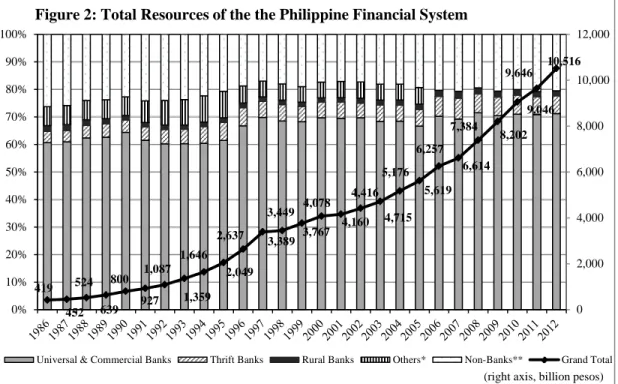
The UKbanks’ loans outstanding and the total resources of the Philippine financial system3 are shown in Figures 1 and 2.
[Note] Financial Intermediation includes: interbank loans receivable, loans to BSP, certificates of assignment/ participation with recourse, and securities lending/borrowing transactions.
[Source] BSP website.
As already described in the Introduction, in the Philippines’ credit market the bank-loan outstanding had been stagnant from the late 1990s to the mid-2000s. During that period, loans provided to the manufacturing sector – the Philippines’ main source of trade earnings with the shares of 60-80% of its exports – was stuck at the level of 300-400 billion pesos a year, whose relative share in the total loans outstanding continued to decrease. An upward trend started in
3 Total Resources of the Philippine Financial System refer to total assets of universal/commercial banks, thrift banks, specialized government banks, rural banks and non-bank financial intermediaries, net of interbank transactions but gross of provision for probable losses, accumulated bond discounts, accumulated market gains/losses (BSP [2011: xviii]).
0 500 1,000 1,500 2,000 2,500 3,000 3,500 4,000 2001 2002 2003 2004 2005 2006 2007 2008 2009 2010 2011 2012
Agriculture, Hunting, Forestry & Fishing Mining and Quarrying
Manufacturing Electricity, Gas & Water
Construction Wholesale & Retail Trade
Transportation, Storage & Communication Financial Intermediation Real Estate, Renting & Bus. Services Others
For Household Consumption Under RRPs Arrangement Non-Resident
2008 due to increases in loans provided to the properties development and agriculture industries as well as those to the households, and the outstanding shows clear increases – including loans provided to the manufacturing sector – since 2011, ironically after the BSP turned its monetary stance to raising the rates in March 2011 (Figure 1).
But on the contrary, when we observe the country’s total financial resources (i.e., total assets of the banks and non-bank financial institutions) the data shows a continuous increase since the late 1990s and the trend became clearer in the latter 2000s (Figure 2). The financial authorities, the BSP and the Securities and Exchange Commission (SEC) explained that a major reason for this trend can be attributed to a continuous increase of the deposit outstanding in the financial sector.
[Note] *“Others” included non-stock loans and credit associations, pawnshops and private/government insurance companies until 2005. Data from 2006 onwards those institutions are included in “Non-Banks.”
**“Non-Banks” includes investment houses, finance companies, investment companies, lending investors, securities brokers/dealers and credit card companies as well as the institutions listed above. [Source] BSP website.
Two characteristics of the Philippine financial system can be pointed out with Figures 1 and 2. Firstly, in the past 25 years the sector’s structure has not markedly changed in terms of each sub-sector’s share in the total resources (assets). The market has been dominated by the UKbanks with their share slightly increased from 60% in the mid-1980s to 70% in the early-2010s. On the other
419 452 524 639 800 927 1,087 1,359 1,646 2,049 2,637 3,389 3,449 3,767 4,078 4,160 4,416 4,715 5,176 5,619 6,257 6,614 7,384 8,202 9,046 9,646 10,516 0 2,000 4,000 6,000 8,000 10,000 12,000 0% 10% 20% 30% 40% 50% 60% 70% 80% 90% 100%
Universal & Commercial Banks Thrift Banks Rural Banks Others* Non-Banks** Grand Total Figure 2: Total Resources of the the Philippine Financial System
hand, developments of rural and thrift banks cannot be clearly observed, and the non-bank financial sector has slightly lost its shares by several percentage points. Secondly, the loans to assets ratios have been quite low, suppressed at around 30-35% to UKbanks’ total financial resources. It is easily observed that throughout the 2000s, the UKbanks had a tendency to avoid the turnover/ borrower risks, thus put their resources in the interbank and with-the-BSP transactions and other capital market instruments4.
In the next subsection, we further look into the similarities and/or differences in the consolidated statements of conditions of the UKbanks and NBFIs.
2.2 Comparisons of the Asset/Liability Structure of the UKbanks vs. the QB-NBFIs
In this subsection, due to the availability of data5 which covers the whole 2000s, “the NBFIs” refer to those with “quasi-banking licenses/functions” (the QB-NBFIs) authorized and supervised by the BSP. The QB-NBFIs consist of 12-23 institutions in this period, most of which have some sort of capital ties with market leaders of the UKbanks6. Also note that the QB-NBFIs are allowed to contract deposits and/or deposit substitutes of funding from more than 20 individuals/corporations (for the NBFIs without QB licenses should raise their financing needs from not more than 19 persons/corporations).
As of the end-2012, the number of the QB-NBFIs was 14 (7 investment houses, 6 financing companies and 1 other non-bank), and all QB-NBFIs but except for one (in Cebu)7 set their head offices and operate manly in the NCR. Although the number of the QB-NBFIs is small, their share in the total resources of the Philippine financial system constantly ranges around 20-25% (BSP [various issues] “Status Reports of the Philippine Financial System”).
4
In the annual reports titled “Philippine Flow of Funds” the BSP also confirms that the private UKbanks started to increase investing in foreign assets (stocks and bonds) in the latter 2000s.
5
Based on BSP [various issues] “Status Report of the Philippine Financial System,” which provides the semi-annual data and analyses on the QB-NBFIs sub-sector.
6
A QB-NBFI without capital ties with private banking institutions is Philippine Depository and Trust Corporation (PDTC), a subsidiary of the Philippines Dealing System (PDS) Group. PDTC provides depository, custody and registry services to the local capital markets and supports multiple asset classes such as equities, government securities and private debt securities.
7
2.2.1 Asset Side of the UKbanks and QB-NBFIs
In Figures 3 and 4, the UKbanks’ and QB-NBFIs’ asset mix are shown. In Figure 3 due to BSP’s category classifications applied until 2002, the ROPA (“Real and Other Properties Acquired” for the recovery of lending, included in “Other Assets”)8 and “Interbank Loans Receivable and RRP (reverse repurchase) Arrangements with the BSP and Other Banks” (included in “Loans – net”) are not independently identified.
[Note] *Inclusive of Interbank Loans Receivable and RRP (reverse repurchase) Arrangements with BSP and Other Banks in the data 2001-2002.
**Inclusive of Equity Investments in Subsidiaries, Associates and Joint Ventures, net. The average share of those investments is 2.0-2.4 percentage point to Total Assets in each year.
ROPA: real and other properties acquired.
[Source] BSP [various issues] “Status Report of the Philippine Financial System.”
It is clear that the investments in non-lending financial instruments (those in the private-issued stocks and bonds and government securities for holding to maturity, and/or those in the foreign capital markets) and the interbank (including the BSP) transactions have been one of the major
8
In 2003, it became possible for the banking institutions to separate and transfer the distressed assets to asset-management corporations (special-purpose vehicles, SPVs) for improving/cleaning up of their financial statement of conditions. The law administering the SPVs was amended to allow more entrants to the asset-management business and more clarify their functions in 2006, thus improvements in the banking sector’s financial conditions was accelerated thereafter.
0 1,000 2,000 3,000 4,000 5,000 6,000 7,000 8,000 0% 10% 20% 30% 40% 50% 60% 70% 80% 90% 100% 2001 2002 2003 2004 2005 2006 2007 2008 2009 2010 2011 2012
Other Assets ROPA-Net
Financial Assets (Other than Loans)-net** Interbank Loans Receivable and RRP w/BSP & Other Banks Loans-Net* Cash & Due from Banks
Total Assets (billion pesos, right axis)
financial items compatible to the loans in their financial statements. As well, the loans outstanding evidently increased since 2011 accompanied with the decrease in the interbank and with-BSP arrangements. Although the reason(s) for the UKbanks’ began to increase the cash ratio in the asset should be identified in the future analyses, it deemed that the UKbanks regarded the lending-related risks are lessen only recently even though their major clients are larger corporations in the NCR.
[Note] ROPOA: real and other assets owned and acquired.
[Source] BSP [various issues] “Status Report of the Philippine Financial System,” and Annual Report.
For the part of the QB-NBFIs, their situation seems more complex. The loan portfolio ratios in their total assets fluctuate during the 2000s, which may suggest their sensitivity to the country’s economic situation and profitability in their lending operations. On the contrary, the rapid increase in the total assets started earlier than that in the UKbanks but with changes in the asset structure: in 2004-2007, the loans outstanding decreased to less than half of the 2003 level, and in 2008-2012 the “Investments” shrank replaced by the increase of “Loan Portfolio” accompanied with a gradual increase in “Cash & Due from Banks,” similar to the trend among the UKbanks. One probable reason for this is a complementary demarcation between the UKbanks and QB-NBFIs in providing loans to non-large firms in the NCR.
0 20 40 60 80 100 120 140 160 180 200 0% 10% 20% 30% 40% 50% 60% 70% 80% 90% 100% 2001 2002 2003 2004 2005 2006 2007 2008 2009 2010 2011 2012
Cash & Due from Banks Loan Portfolio Investments (net)
ROPOA (net) Other Assets Total (billion pesos, right axis) Figure 4: Assets of the QB-NFBIs
2.2.2 Liability Side of the UKbanks and QB-NBFIs
Liabilities mix of the UKbanks and QB-NBFIs are shown in Figures 5 and 6.
In Figure 5, what we can observe is that the UK banks have not notably changed their liability composition in the past decade, but financing by issuing unsecured subordinated debt started in 20029. Of twelve (12) local UKbanks, it seems that several UKbanks found external financing measures, other than absorbing savings from the general public, were to some extent instrumental and have replaced part of their intra-group financing (represented by “Net Due to Head Office Branches/Agencies).
[Source] BSP website and BSP [various issues] Annual Report.
9
In 2003, the Philippine Dealing and Exchange Corporation (PDEx) commenced its operation as the electronic platform for secondary trading of government securities and private corporations’ bonds and notes. As of the end-2013, 24 corporations including three (3) domestic UKbanks listed their bonds and long-term notes, with the total outstanding of a little bit over 400 billion pesos.
0 1,000 2,000 3,000 4,000 5,000 6,000 7,000 8,000 0% 10% 20% 30% 40% 50% 60% 70% 80% 90% 100% 2001 2002 2003 2004 2005 2006 2007 2008 2009 2010 2011 2012
Deposit Liabilities Bills Payable
Special Financing Unsecrured Subordinated Debt
Other Liabilities Capital Stock & Assinged Capital
Net Due to Head Office Branches/Agencies Surplus, Surplus Reserves & Undivided Profits Total Liabilities (billion pesos, right axis)
[Source] BSP [various issues] “Status Report of the Philippine Financial System,” and Annual Report.
On the contrary, QB-NBFIs’ liabilities composition has been changed more dynamically. As they increase their liabilities base, it is clear that they actively utilize the external resources (represented by “Bills Payable”), which have made the Capital Stock, Surplus and Undivided Profits gradually less important as internal resources for financing their investing/lending activities since the mid-2000s (also see Figure 4). However, because the BSP data does not provide the details of “Bills Payable” – the composition of short- and long-term financing as well as “Other Liabilities” – it is necessary for the future studies to consult with each QB-NBFI’s financial statements and resolve the above two categories into more informative ones.
2.2.3 Profitability of the UKbanks and QB-NBFIs
Based on the above asset/liability structures, how are the profitability of the UKbanks and QB-NBFIs? Their earning asset yield and funding costs are shown in Figure 7, and their ROE and ROA in Figure 8 as some clues to compare and discuss the similarities and/or differences in their operations. 0 20 40 60 80 100 120 140 160 180 200 0% 10% 20% 30% 40% 50% 60% 70% 80% 90% 100% 2001 2002 2003 2004 2005 2006 2007 2008 2009 2010 2011 2012
Bills Payable Other Liabilities
Capital Stock Surplus, Surplus Reserves & Undivided Profits Total (billion pesos, right axis)
(1) Earning/Cost Yields of the UKbanks and QB-NBFIs
The most interesting point we can identify is that UKbanks’ cost/earning margin have been stable irrelevant of the country’s political/economic situation as well as the external influences such as the Lehman shock. The rigidity of margins – being stuck at the 3.5-4% level and a little shrunk to 3% in the recent past (2011-2012) – implies severe lending competitions in the UKbank sector and the NCR, thus they need to invest in financial/other instruments other than loans when they seek higher profitability ratios, e.g. the return on equity (ROE) or return on assets (ROA).
On the contrary, the cost-earning margins of the QB-NBFIs might be more influenced by the number and/or relationship with their clients and the local economic/political situation. Although QB-NBFIs’ cost-earning margins are generally wider than those of UKbanks’, the former rapidly shrunk in 2003-2004 from as large as 8% in 2001 to 2.2% in 2004 until the margin in 2008 was doubled compared with the previous year. Regarding the mid-2000s data, the reason is generally described such as: The political hiatus before and after the 2004 national elections and the country’s lagging-behind financial reform outcomes, which became apparent compared with the neighboring ASEAN member countries, resulted in the lower credibility in the country’s sovereign
0 2 4 6 8 10 12 14 16 18 20 1999 2000 2001 2002 2003 2004 2005 2006 2007 2008 2009 2010 2011 2012
Earning Asset Yield, NBFIs w/QB Funding Cost, NFBIs w/QB
T-Bill (91-day) Earning Asset Yield, Univ.&Comm. Banks Funding Cost, Univ.&Comm. Banks
[Source] BSP [various issues] "Status Report of the Philippine Financial System."
(%)
Figure 7: Earning Asset Yield and Funding Cost of the UKbanks and QB-NBFIs vs. 91-day T-bill Rates
rating (below the investable level by all three major credit rating companies)10, the stagnant foreign direct and portfolio investments, and the country’s lower economic growth. However, is it a sole possible explanation? When we observe the profitability indicators on the assets and equities, the data may imply necessities of further analyses.
(2) The ROA/ROE Trends of the UKbanks and QB-NBFIs
The conventional explanation in the previous section complicates understanding of the data shown in Figure 8.
[Source] BSP [various issues] “Status Report of the Philippine Financial System.”
The sharp drops in both UKbanks’ and QB-NBFIs’ ROE/ROA data in 2008 may imply losses from the investments in the foreign-denominated instruments or markets due to the Lehman shock influences on their assets. However, the domestic political/economic situation did not seemingly affect in terms of the profitability indicators: if the local political/economic situation affects both UKbanks’ and QB-NBFIs profitability, why do their ROEs show continuous upward trends while the ROAs do not show any obvious improvements? For the part of the QB-NBFIs, the combination
10
The Philippines recovered an “investable” sovereign rating by all major credit rating agencies in 2013.
0 5 10 15 20 25 1999 2000 2001 2002 2003 2004 2005 2006 2007 2008 2009 2010 2011 2012
NBFIs w/QB ROA NBFIs w/QB ROE
Univ. & Comm. Banks ROA Univ. & Comm. Banks ROE
of their narrow and unchanged capital base (clearly observed with the decreasing share of “Capital Stock” in the total liabilities), the increasing external resources and the wider margins between the funding cost/earning asset yields may have brought higher ROEs compared with the UKbanks’, as the QB-NBFIs’ reserves regained more-than-10% shares in their liabilities. For clarifying if the same explanation applicable to the UKbanks, we need to identify the sources (or changes in the sources) of their profits and the importance/contribution to their profitability.
3. Findings and Discussions
3.1 Findings and Further Questions
The followings can be described based on the understanding of Figures in the previous sections:
(1) Both of QB-NBFIs’ ROA and ROE figures have generally surpassed those of UKbanks’. One explanation might be as follows: As most of the QB-NBFIs do not have either of a large corporate or operational scale compared with the UKbanks, the operational expenses (investing in their system maintenance/development and information costs regarding the clients, etc.) account less than those of the UKbanks’. Thus, it is assumed that a QB-NBFI can turn or allocate larger part of its income into the profit. In addition to it, the QB-NBFIs’ operational base -- their main borrowers are deemed to be small- and medium-sized enterprises and their stakeholders in the NCR -- enables larger lending margins than the UKbanks, which are severely competing for lending in the NCR.
(2) In terms of the funding cost, QB-NFBIs’ average is higher than that of UKbanks’. This is because most of their funding resources come from borrowing, which can be clearly observed in the composition of their liabilities side. On the other hand, UKbanks’ resources mostly (about 70% of their liabilities) come from general corporate and household deposits, thus their funding cost shows less than the short-term index rate. As the trend of QB-NFBIs’ funding cost shows a clear proximity to the 91-day T-bill rate trend, the following points can be presumed: (a) the QB-NBFIs’ main financing resource is short-term credits from the investors; and (b) the average interest premium for their financing is smaller than that of usual (corporate and individual/household) loans.
As well, some further questions rise:
(3) All QB-NBFIs (investment houses and financing companies) that the BSP compiles data released in the semi-annual Status Report are UKbank’s subsidiaries/affiliates. If other “independent” NBFIs (at least those operating in the NCR) show different figures in terms of the funding cost/earning asset margins and/or profitability indicators, it can be a fact which indirectly implies the intra-group financing across the financial subsectors and thus portfolio management including lending preferences vary depending on a QB-NBFI’s capital structure.
3.2 Possible Hypotheses for Future Researches/Analyses
Although the analytical scope and the applied data are limited, this paper shows that there are still some information to be filled in the existing (periodical) publicly released data for a more detailed and persuasive understanding on the Philippine financial system and its inclusiveness of the local industries and people.
As described in the Sections 1 and 2, the country’s credit market has been dominated by the UKbanks, thus it is estimated that other banking institutions and the NBFIs (see the Appendix) split the rest of local credit demands. Therefore, in the context to assess the accessibility for the financial sector, a two-tire hypothesis is necessary.
Firstly, clarifying non-UKbanks’ and NBFIs’ locational disparities among the regions, their lending behaviors and profitability. If the above conditions present similarities with those of the UKbanks, it represents the skewed locational and operational distribution in the non-UKbank and NBFI subsectors. As well it means there exists some deviation from the regulator’s supposed industry design, which aims to supplement and/or lead in lending activities to SMEs in general and the industries with more needs to the external (but not in a large scale) working capital.
Secondary, if the non-UKbank institutions got concentrated in the NCR similar to the UKbanks, it can be estimated that for them having any form of capital/business ties with the UKbanks would improve fulfilling their financing needs for lending activities. As observed in Figures 6 and 7, the QB-NBFIs (subsidiaries or affiliates of the UKbanks) showed changes in their asset/liability structure with rapidly introducing external resources earlier than their parent companies. Although
the comparisons with non-affiliated NBFIs need to be conducted, certain changes in shareholder composition may be a solution to the non-UKbank subsectors’ underdevelopment. Their presence in the total financial system is small, however, their role as the lenders in the regions (the non-NCR areas) and to some industries may not be negligible since providing necessary credits to this part of the economy requires higher responsiveness to BSP’s monetary policies, especially in the quantitative terms and during the period of economic distress.
4. Summing-Up
The very origin of this preliminary study was a relatively simple question: Why the previous studies on the quantitative policy responsiveness of the Philippine financial intermediaries have not accumulated so far? Since the BSP, formally adopting the inflation targeting as its main objective, puts importance on the price/interest rate changes stimulated by the measures, the present situation may seem natural. On the other hand, the possibility that the skewed locational and operational distribution also exists in the non-UKbank financial subsectors suggests there may be a significant deviation from the authorities’ (the BSP, SEC and others) intended/anticipated financial system in the banking/non-bank financial institutions’ real operations. It can be pointed out that the deviation may be a cause of under-effectiveness of BSP’s monetary policy measures taken under the 2009 Economic Resiliency Plan.
Based on the consolidated statements data of the UKbanks and QB-NBFIs, this paper presents a keen necessity of obtaining data in detail on both sides (assets and liabilities) of their financial conditions and capital structure. Further analyses using those data would bring more adequate assessments on the Philippine financial system, especially with regard to each subsector’s financing/lending preferences and behavior. As a result, a direction for improving the non-UKbank and NBFI subsectors’ underdevelopment and the financial accessibility can be drawn for alleviating the country’s locational and operational deviations.
Appendix
The Segmented Philippine NBFI Sector
When we compare with other ASEAN members, one of the characteristics of the Philippine financial sector since the late-1990s is that the sub-categories of the NBFIs have not been rationalized (not explicitly included in the focus of the post-Asian crisis financial sector reform) and has been kept fragmented. Based on BSP’s definitions in its Annual Report (Statistical Bulletin), the banking sector and NBFI categories are summarized as below.
The Banking Sector
Universal and Commercial Banks -Representing the largest single group, resource-wise, of financial institutions in the country;
-Offering the widest variety of banking services;
-Universal banks being authorized to engage in underwriting and other functions of investment houses, and to invest in equities of non-allied undertakings.
Rural and Cooperative Banks -More popular types of banks in the rural communities;
-To promote and expand the rural economy by providing people in the rural communities with basic financial services;
-Rural banks are privately owned and managed;
-Cooperative banks are organized/owned by cooperatives or federation of cooperatives.
Thrift Banks
(included: savings and mortgage banks, private development banks, stock savings and loan
associations, microfinance thrift banks)
-Engaged in accumulating savings of depositors and investing them;
-Also engaged in providing short-term working capital and medium- and long-term financing to businesses engaged in agriculture, services, industry and housing, especially small- and medium-enterprises and individuals.
Microfinance Banks -Newest type of banks offering broad range of financial services (deposits, loans, payment services and money transfer) to the poor and low income households for their micro-enterprises and small businesses.
The NBFIs
(of which authorized to engage in lending activities and similar businesses, i.e., excluding the securities market participants without lending functions)
Investment Houses -Enterprises engaged in guaranteed underwriting of securities of other persons or enterprises, including securities issued by the government and its instrumentalities.
Financing Companies
(included: credit card companies, leasing and finance companies, etc.)
-Corporations or partnerships primarily organized for the purpose of extending credit facilities to consumers and to agricultural enterprises;
-Applicable measures include discounting or factoring commercial papers or account receivables or other evidences of indebtedness or by leasing motor vehicles, heavy equipment, industrial machinery and equipment, appliances, etc.
Investment Companies -Entities primarily engaged in investing, re-investing or trading in securities.
Lending Investors (Companies) -Persons who lend money for themselves and others;
-Using their own capital for the purpose of extending all types of loans, oftentimes without collateral (e.g., privately-issued commercial papers).
Non-Stock Savings and Loan Associations
-Corporations organized primarily for the mutual self-help and common interest of its members who must belong to a well-defined group;
-Shall not transact business with the general public. Mutual Building and Loan
Associations
-Corporations whose capital stock is required or is permitted to be paid in the stockholders in regular, equal periodic payments to repay said stockholders their accumulated savings and profits upon surrender of their shares;
-To encourage industry, frugality and home building among the stockholders on the security of unencumbered real estate pledge of shares of the capital stock owned by such stockholders as collateral security.
Private Insurance Companies -Carrying all kinds such as life, fire, marine, accident, health, title, financial obligations, casualty, fidelity and surety;
-Servicing insurance carriers, consultants for policy holders, adjusting agencies, independently organized pension funds.
Government Non-Bank Financial* Institutions
-Consist of the Government Service Insurance System (GSIS), Social Security System (SSS), Trade and Investment Development Corporation of the Philippines (TIDCORP) and Small Business Guarantee and Finance Corporations (SBGFC). Venture Capital Corporations -Authorized by the appropriate authority, with the primary
purpose of which is to develop, promote and assist, through debt or equity financing or any other means, any small- and medium-scale enterprises in the country;
-Any entity organized jointly by private banks, the National Development Corporation (NDC) and/or such other government agencies.
Pawnshops -Business establishments engaged in lending money on personal property delivered as security or pledge.
References
Bangko Sentral ng Pilipinas (BSP) [various issues] “Financial Inclusion in the Philippines,” Manila City, Metro Manila (MM): BSP. (http://www.bsp.gov.ph/publications/regular_fip.asp)
BSP [various issues] “Philippine Flow of Funds,” Manila City, MM: BSP. (http://www.bsp.gov.ph/publications/regular_fof.asp)
BSP [various issues] Status Report on the Philippines Financial System, Manila City, MM: BSP. (http://www.bsp.gov.ph/publications/regular_status.asp)
BSP [2011] “Glossary and Abbreviations of Selected Philippine Economic Indicators,” Manila City, MM: BSP. (http://www.bsp.gov.ph/statistics/spei/glossary.pdf)
Insurance Commission of the Philippines (IC) [various issues] Annual Report, Malate City, MM: IC. (http://www.insurance.gov.ph/htm/_reports_annual.asp)
Kashiwabara, C. [2013] “Policy Responses to the Global Recession and Its Impact in the Philippines,” (in Japanese) in K. Kunimune ed., The Global Financial Crisis and Policy Response in Developing Countries, Kenkyu Sosho (IDE Research Series) No. 603, Chiba: Institute of Developing Economies.
Llanto, G.M. [2005] Rural Finance in the Philippines: Issues and Policy Challenges, Makati City, MM: Philippine Institute for Development Studies (PIDS).
Philippine Dealing and Exchange Corporation (PDEx) [various issues] PDS Annual Report, Makati City, MM: PDEx. (http://www.pds.com.ph/index.html%3Fpage_id.-1136.html)
Securities and Exchange Commission of the Philippines (SEC) [2011] “Consolidation of Financial Data of Financing Companies for the Period of Ending December 31, 2010,” Mandaluyong City, MM: SEC.
(http://www.sec.gov.ph/investorinfo/registeredentity/financing/consolidated%20financial%20 data%20fo%20financing%20companies%20year%20end%202010.pdf)
SEC [various issues] Annual Report, Mandaruyong City, MM: SEC. (http://www.sec.gov.ph/aboutsec/annualreport/annualreport.html)
Websites
Bangko Sentral ng Pilipinas (BSP): www.bsp.gov.ph
Insurance Commission of the Philippines: www.insurance.gov.ph
Philippine Dealing and Exchange Corporation (PDEx): www.pds.com.ph, www.pdex.cpm .ph Securities and Exchange Commission (SEC): www.sec.gov.ph