The Regional Development Policy of Thailand
and Its Economic Cooperation with Neighboring
Countries
著者
Tsuneishi Takao
権利
Copyrights 日本貿易振興機構(ジェトロ)アジア
経済研究所 / Institute of Developing
Economies, Japan External Trade Organization
(IDE-JETRO) http://www.ide.go.jp
journal or
publication title
IDE Discussion Paper
volume
32
year
2005-07-01
INSTITUTE OF DEVELOPING ECONOMIES
Discussion Papers are preliminary materials circulated
to stimulate discussions and critical comments.
Keywords: industrial estates, GMS-EC, ECS, economic corridors, border zones
JEL classification: O53, R11
* This paper is partly based on the author’s study in “The Research Project Contributing to Japan’s Economic Cooperation: The Case of Mekong Sub-region” organized by Dr. M. Ishida for FY 2004/2005 at the IDE. † Senior Officer, Research Promotion Department, IDE-JETRO ([email protected])
DISCUSSION PAPER No. 32
The Regional Development Policy of
Thailand and Its Economic Cooperation
with Neighboring Countries*
Takao TSUNEISHI
†
July 2005
Abstract
Thailand has recently strengthened its economic policy toward its neighboring countries in coordination with domestic regional development. It is widely recognized that economic cooperation with neighboring countries is essential in preventing the inflow of illegal labor and effectively utilizing labor and resources through the relocation of production bases. This direction is strengthened by elaborating the GMS-EC and the ECS (Economic Cooperation Strategy). In addition, economic dependency of the neighboring countries on Thailand is generally high. In this report, firstly, Thai regional development policy will be made clear in relation to its economic policy toward neighboring countries as well as the status quo of the industrial estates. Secondly, Thai policy toward the neighboring countries is examined referring to the concept of wide-ranging economic zones, regional economic cooperation and special border economic zones. Thirdly, the paper will discuss how closely the economies between Thailand and the neighboring countries are related through trade and investment. Lastly, some implications on Japan’s economic cooperation will also be explored.
The Institute of Developing Economies (IDE) is a semigovernmental,
nonpartisan, nonprofit research institute, founded in 1958. The Institute
merged with the Japan External Trade Organization (JETRO) on July 1,
1998.
The Institute conducts basic and comprehensive studies on economic
and related affairs in all developing countries and regions, including Asia,
Middle East, Africa, Latin America, Oceania, and East Europe.
The views expressed in this publication are those of the author. Publication does not imply endorsement by the Institute of Developing Economies of any of the views expressed.
INSTITUTE OF DEVELOPING ECONOMIES (IDE), JETRO
3-2-2, WAKABA,MIHAMA-KU,CHIBA-SHI
CHIBA 261-8545, JAPAN
1. Introduction
In the globalizing economic circumstances, Thailand faced an economic crisis in 1997. In the 9th socio-economic development plan (2002-2006) based on that experience, Thailand has
been deploying development policy under the vision advocated by the King to realize “a sufficient economy”1. A sufficient economy is defined here as a moderate, steady and
sustainable economy without seeking an impatient physical expansion. Even with reference to economic policy toward neighboring countries, cooperation with them is strongly recognized as indispensable.
Thailand cannot help thinking of economic development in neighboring countries as an extension of its own domestic regional development since it shares borders with Myanmar, Laos, Cambodia and Malaysia and has a close relationship with them, ethnically and historically. Because the countries around Thailand have repeatedly suffered from political and social unrest, Thailand as a result has seen the inflow of refugees that work illegally and also the importation of illicit drugs.
Thailand commenced regional development from the central area initially and gradually expanded out to the periphery where they have close relationships with neighboring countries. Hence the regional development policy of Thailand has now been deployed along with the framework for wide-ranging regional development plans under the idea of cross-country economic zones in the wake of Indochina’s transition to market economies.
In addition, border economic zones based on the Economic Cooperation Program of the Greater Mekong Sub-region (GMS) and the idea of a provincial industrial cluster from the viewpoint of strengthening international competitiveness within industries is also involved. It is feasible that economic influence integrating these policies would expand and affect the neighboring countries through the economic development of these border regions.
Thailand has deployed a regional and local development policy attracting foreign direct investment to industrial estates. Thailand intends to expand industrial estates to local and border areas so that their economic effects would reach the neighboring countries. Especially, the current Thaksin administration has been carrying out the strategy following the GMS program and the Economic Cooperation Strategy (ECS) focusing on the idea that the interests of
1 This idea is based on the words “Seetthakit Phoohieŋ [sufficient economy]” in a speech by the King on
December 5, 1997 in front of a nation discouraged by the economic crisis. It referred not only to such human virtues as the spirit of moderation admonishing to go to the extreme, adaptation to a new environment and self reliance but also to refrain from being too dependent on the market economy and the importance of international cooperation. This was the basic idea shared in drafting the 9th development plan (Bangkok Japanese Chamber of Commerce [2003, pp.122-123 ].
Thailand and the neighboring countries will be mutually beneficial. The concept is to relocate production bases to border areas where relative advantages such as cheap labor and raw materials are available while developing consumer markets. Moreover, The Thai government started economic cooperation for building infrastructure such as roads and bridges between Thailand and neighboring countries. The effects of these dynamic projects should be seen after 2006-2007 when these series of projects will start completion.
Accordingly, in this report, the following matters will be made clear firstly; the relevance between Thai regional development and economic policy toward the neighboring countries (hereafter, the neighboring countries mainly means CLMV, that is, Cambodia, Laos, Myanmar and Vietnam) as well as status quo of the industrial estate and the industrial cluster formation. Secondly, Thai policy toward the neighboring countries is analyzed referring to the concept of wide-ranging economic zones such as the ECS, regional economic cooperation and special border economic zones. Thirdly, the paper will discuss how closely the economies between Thailand and the neighboring countries are related through trade and investment. Lastly, based on the above survey, the role and direction that Thailand has been playing for the neighboring countries will be summarized and some possible implications and recommendations on Japan’s economic cooperation will also be proposed.
2. Regional Development Policy in Thailand
2.1. Close Relationship between Thai Regional Development Policy and Its Economic Policy toward Neighboring Countries
Like other developing countries, an economic gap between urban areas and local ones is observed also in Thailand. The gap between the Bangkok urban area and the Northeast, where is said to be the poorest region, expanded from 7.1 times in 1985 to 9.6 times in 1993 in terms of per capita GRP (Gross Regional Product). After that, the gap shows a tendency to narrow at 7.5 times in 2003. The expansion of the gap in the past is due to the difference of economic structure such as the metropolitan area which is endowed with industrialization through foreign direct investment and the local economy which depends on agriculture2.
The issue of the economic gap between urban areas and rural areas or the center and the local area was recognized from an earlier time in Thailand and regional development policy actually started from the 3rd socio-economic plan (1971-76). So far the policies focused on the
two strategies such as decentralization of industries and the development of growth centers or cores in local regions. Although various policies such as employment creation in rural areas were taken to alleviate poverty in local areas, sufficient results could not be attained. Especially after the later half of the 1980s when Thailand succeeded in industrialization by attracting foreign direct investment, development policy focusing on industrialization has become main stream even in local regions.3
Regarding decentralization of industry, the Board of Investment (BOI) enacted the Investment Promotion Act in 1977 and promoted inducement of foreign direct investment. Later, in the revision of the act in 1987, the whole of Thailand was divided into three zones specifying industries to be established in each zone and giving high tax incentives to zone 2 and zone 3 which are remote from the metropolitan area. And as will be mentioned later, since its establishment in 1972, the Industrial Estate Authority of Thailand (IEAT) has also been endeavoring to establish industrial estates in the other regions outside Bangkok.
While the concept of “regional urban center” progressed, it specified nine cities as “regional urban growth centers” in the 4th development plan (NESDB [1977, pp.224-228])4, six
cities within five provinces in the 5th development plan, and five major regional urban centers in
addition to 19 sub-centers in the second phase in the 6th development plan (NESDB [1987,
pp.307-317]). Moreover, during the 5th development plan period, the Eastern Seaboard
Development Plan was proposed to make a growth center substituting for the Bangkok metropolis and to collaborate with the Northeast region.
In the 7th development plan, nine provinces were specified as “industrial development
centers” in succession of “regional urban growth centers” concept while a vision of wide ranging development was added to designate “new economic zones” in such four regions as the North, the Northeast, the West and the South. At the same time, the provision of infrastructure was targeted as the important task (NESDB [1992, pp.119-123]). In the 8th development plan, it
was mentioned clearly that “regional industrial centers” should be developed in nine provinces by setting up industrial estates.
3 Prasert [1995, pp.68-73]. Although the effect of agricultural development is moot, Prasert is one of the executive scholars who emphasizes the effect of industrialization realizing the limitations of agricultural development in local areas in Thailand.
As the result, both the numbers of registered factories and the BOI promoting investments showed a gradual increase since the latter half of the 1980’s even in the Northeast and the North. For example, Nakhon Ratchasima, which is a gateway to the Northeast of Thailand, developed to become the second city following Bangkok with the growth of the Suranaree industrial zone founded in 1989. But, there is also the view that these two strategies were not effective and regional development remained just rhetoric in terms of a development plan while the government policy actually emphasized the development of the metropolitan area. The main reasons are as follows; the BOI’s emphasis on investment scale than regional allocation on the approval of investments, insufficient investment in infrastructure due to financial insufficiency, poor coordination among such public organization as the BOI and the IEAT. From the investors’ viewpoint, tax incentives given to local regions were not larger than the merit attained from the industrial clusters in the metropolitan areas.5
On the other hand, as the early 1980’s is the period that trade with Indochina was promoted, expansion of the concept from the regional urban centers to the boarder economic zones could be observed. In the 7th development plan, promotion of boarder trade was referred to concerning
the New Economic Zone in the North and the Northeast over such provinces as Chaing Rai, Tak, Nogng Kai, Mukdahan and Ubon Ratchathani (NESDB[1992,pp.122-123]). In the 8th
development plan, it is mentioned that opportunity of industrial development should be created by setting up special economic zones and tax-free zones along the borders to promote trade and investment both inside Thailand and with neighboring countries (NESDB[1997, pp.67-68).
Also in the 9th development plan, the development using the potentiality of each region for
balanced regional development is targeted and the strengthening of economic relations and mutual prosperity in regions are emphasized. It is also shown that reinforcement of regional competitiveness through expanding markets and bargaining power over trade, investment and economic cooperation is necessary6. With reference to the North, it is clearly mentioned that
Chiangmai, Chaing Rai, Lamphun, and Lampang should be developed in close relationship with the GMS countries. In the Northeast, the following are pointed out; Nong Kai, Mukdahan and Nakhon Phanom should be facilitated as the gateways to Indochina, making Ubon Ratchathani the center of the region, making Nakhon Ratchasima and Khon Kaen a center to connect the North and the Eastern Seaboard, promoting tourism linking with Indochina. It is also emphasized that border provinces along the East-West Economic Corridor and the North-South
5 For the details, refer to “Income Distribution, Poverty and Spatial Inequality”, Dixon [1999, pp.214-238].
6 NESDB [2002]. Regarding reinforcement of cooperation with neighboring countries, refer to “National Positioning” (p.14) in Chapter 1 and “Competitiveness and Capability Enhancement Strategy” (p.85, p.91) in Chapter 7.
Economic Corridor should be developed as the gateways to the GMS countries (NESDB[2002, PP.55-56]).
Since the Thai economy has developed far more rapidly compared with the neighboring countries, economic gaps have arisen. In terms of the share of industry in the Gross Domestic Product (GDP) in 2003, Thailand and Vietnam account for 44.0% and 40.0% respectively while Myanmar, Laos and Cambodia are still agricultural countries. The GDP index is 0.27 in Vietnam and less than 0.04 in Myanmar, Cambodia and Laos when the GDP of Thailand is counted as 1. In addition, the annual per capita income of Thailand is 4.5, 5.9, 7.1 and 14.3 times larger than Vietnam, Laos, Cambodia and Myanmar respectively7.
This economic gap, especially income gap between Thailand and the neighboring countries, results in the inflow of illegal foreign workers into Thailand and becomes the main causes of drug inflow and various crimes. For example, the number of arrested foreign workers in 2002 was149,506 persons. Of those, Myanmarese, Cambodian and Laotian accounted for 87,536 persons, 46,586 persons and 13,373 persons respectively. It is estimated that more than one million illicit workers stay in Thailand most of whom are from Myanmar, Laos and Cambodia8.
In order to solve these issues, the Thai government is now planning to set up special economic zones in border areas to relocate agriculture and labor intensive industries from the center to there and to utilize the cheap labor and resources of the neighboring countries and finally to stop the inflow of the illegal migrants and the relevant problems.
Thus, from both the viewpoint of domestic regional development and economic policy toward the neighboring countries, the development of border areas has become significant issues to tackle. And regional development policy in Thailand has been undertaking a new phase of regional development in crossing borders and expanding to the neighboring countries.
2. 2. Development of Industrial Estates (1) Decentralization Policy
It is external development by attracting foreign capital into industrial estates that plays a consistent and significant role and the effect is remarkable in the development of Thailand. Since the IEAT was established in 1972, development of industrial estates has been carried out dispersedly not only in metropolitan Bangkok but also in other provinces. The first
7 Author’s calculation is based on each country’s statistics in ADB [2004].Myanmar is compared with GDP in 2001. 8 Recently, the Thai government started adopting a policy to utilize these illegal immigrants by giving working permits if they comply with registration. In July, 2004 when the Labor Department requested registration of these illegal immigrants, 1,269,074 persons completed registration, of whom the majority were 905,881 Myanmarese.
industrial estate was completed in 1985 after starting construction in 1982 in Lamphun in Northern Thailand. Before the time of the Plaze agreement due to which a foreign investment boom occurred, there were only five estates all over Thailand. However, the development of industrial estates has aggressively been made jointly with private developers in the wake of increasing foreign investment to Thailand. 17 out of the current 30 industrial estates were established after the 1990s (Figure 1). Both the industrial estates in Map Ta Phut and Leam Chabang and the related Map Ta Phut Port, which were implemented in the early 1980s and started full fledged operation from the early 1990s, have become the largest industrial areas in Thailand exporting the majority of exports by creating industrial clusters of automobiles, electric and electronics, and petrochemical products. This Eastern Seaboard Development Project is the plan that the Thai government, especially the NESDB, aimed at industrializing centering on heavy and chemical industries and at the same time decentralizing and moving to local areas to avoid concentration in the metropolitan area.
As of August 2004, the industrial estates administered by the IEAT are located in 30 places over 13 provinces which are composed of nine estates developed by the IEAT and the rest jointly developed with private developers. These estates account for 2600 factories, capital investment of 1.2 trillion baht (2.7 billion US dollars), 400,000 employees (equivalent to 7.9% of 5,050,000 manufacturing employees in 2002) and a total of 76,269 Rai (12,203 ha). In terms of the nationality of invested capital, Japan accounts for a majority of 46% followed by US, England, Germany, South Korea, and Singapore at 17%, 12%, 8%, 3% and 3% respectively9.
The 30 industrial estates are located in zone 1 which is the Bangkok metropolis, in zone 2 in the vicinity of the zone 1 and the central area, and zone 3 which are outside remote-areas respectively 7, 12 and 11 places (Figure 1). Although zone 3 holds 11 places, the really remote regions such as the North and the Northeast hold only one or two each while seven places are located in Rayon in the Eastern Seaboard area which is relatively close to the metropolitan area. According to a plan of the IEAT, they are planning to establish an additional 26 estates all over Thailand by 2007. These include new estates to be made in the boarder areas following the wide-ranging economic zone plan based on the GMS-EC and ECS, and new ones in the North and the Northeast in addition to the expansion of the existing ones and the new ones in the central area. Especially in the Northeast, there are new plans to set up in Nongkai, Udonthani, Nakhon Phanom, Chaiyaphum and Buriram. Also in the North, there is a plan in Nan province.
9 Reference to IEAT [2003, p.25] and the web page of the IEAT. But these figures are based on the data of 29 estates in 2003.
With reference to establishment in border areas, there are plans in Chiang Rai, the Myanmar boarder (between Mae Sot and Miyawaddy), the Laotian border (between Mukdahan and Savannakhet) and the Cambodian boarder (between Trat and Koh Kong). Presently, seven industrial estates are under construction or about to be according to the IETA action plan (Figure 1).
In addition to these industrial estates under the IEAT, there are about 30 estates developed by private developers, which are not authorized by the IEAT and thus not referred to as industrial estates, but are generally called industrial parks, and tax incentives by the IEAT and the BOI are not automatically applicable. Application of the tax incentives at the BOI should be made by individual advanced industry.
The IEAT and the BOI have in collaboration promoted investment in zones 2 and 3. It was stipulated to specify and guide an industry to a specified zone while tax incentives such as exemption and reduction were provided to promote investment to zone 2 and zone 3 compared with zone 1. For example, there is a full exempted period of corporate tax of three years, seven years and eight years in zone 1, zone 2 and zone 3 respectively while 50% exemption is added for five years in zone 3. A 50% import tax on imported capital goods is imposed in the General Industrial Zone (GIZ) in zones 1 and 2 while there is no import tax in zone 3. Also with reference to capital possession, the foreign industries located in zone 3 were approved to have 100% ownership10.
But, the BOI has recently reviewed the zoning system which made a base of the investment act by emphasizing formation of industrial clusters to enhance industrial competitiveness. The BOI decided in January 2002 that automobile industries so far specified in zone 3 would be exempted from this zoning in cases where investment exceeded ten billion yen. The BOI converted to the direction that any industries except for ones needing environmental consideration could invest anywhere to gain relative advantage. Although the zoning system specifying industries to a certain zone was abolished, tax incentives given to the industries located in remote areas principally remained. On the other hand, exemption of import tax on imported goods and the maxim eight year-exemption of corporate tax are provided regardless the zones in the case of such industries as Skill, Technology and Innovation (STI), hard disk drives, software, films and agro-industries that Thailand emphasizes. Thus, keeping the balance
10 The current act was stipulated in 1977, and the zoning system was introduced in the revision in 1987(decree). Regarding incentives of zones refer to Japanese Chamber of Commerce [2003, p.152].
of viewpoints between international industrial competitiveness and the decentralization has become a significant and sensitive issue.
(2) Industrial Cluster Policy
Since the economic crisis in 1997, the Thai government has been paying strong interest in the policy to recover and reinforce industrial competitiveness. The Thaksin administration established a committee on improvement of industrial competitiveness in the NESDB to aim at building up Thai relative advantage designating such five targeted industries as agro-industries, automobiles, fashion, information technology and services. As a part of the policy, the government has recently put emphasis on creating industrial clusters. From 2002 through 2003, Dr.Michael Porter was sometimes invited to make surveys and seminars on industrial clusters11.
On the other hand, this policy to create industrial clusters has been influencing regional development in Thailand. The Thai government has been making development policies in which the formation of industrial clusters is included in regional development, that is, making up relatively advantageous industrial clusters in each region while considering characteristics of each region.
In June 2004, the NESDB revealed that a total 8 industrial clusters would be built up within 3 years, that is, 2 clusters in each 4 regions such as the North, the Northeast, the Central and the South, based on their research. It is reported that these industrial clusters would be built based on locally existing 33 core industries such as foods, garments, automobiles, chemicals, plastics, electric appliances, electronics, architecture, household wares, etc. The central region, concentrated with industrial estates, is reportedly conceptualized to become an economic hub of the Southeast Asia12.
The BOI also made public the strategy that provincial clusters should be made from the viewpoint of improving industrial competitiveness in the new investment policy released in December 200313. Prime Minister Thaksin, who comes from an industrial circle and declared
himself as the CEO (Chief Executive Officer) of his government, has executed administrative reforms. As one of the reforms, Thaksin appointed the CEO Governors over 75 provinces who had to implement and to be evaluated based on provisional development plan. The provincial
11 One of the outcomes commissioned by the NESDB is Michael E. Porter, Thailand’s Competitiveness: Creating the Foundations for Higher Productivity, May, 2003.
12 “NESDB’s 3 year plan for industrial clusters”, Nation, June 4, 2004. Regarding the hub concept of the central region is referred to Nation, May 18, 2004.
industrial cluster strategy of the BOI is to support the provincial development plan of CEO Governors. The strategy has the plan to set up 19 clusters in 4 regions of Thailand as follows;
i) The North (16 provinces, 3 clusters) should be composed of IT cities and software parks by means of foreign direct investment from US, Japan and India.
ii) The Northeast (19 provinces, 5 clusters) should be composed of OTOP (One Tambon One Product) movement related R&D and supporting industries related with investment from US and Japan.
iii) The Central and the East should be composed of bio-technology, agro-related R&D, automobiles, electronics, tourism and distribution related industries by way of investment from Japan, South Korea, U.S. and EU.
iv) The South (14 provinces, 5 clusters) should be composed of tourism, distribution, rubber, halal food for Moslem considering the linkage with Malaysian and Singapore.
The IEAT has also proceeded with the planning and construction specialized in specific industrial clusters following national policy. According to the National Industrial Estate Strategic Plan of the Authority, specialization of regions and industries are made as follows (IEAT [2003, p.26]);
i) Automobile industries in the Eastern Seaboard which is now called the “Detroit in Asia”. ii) Fashion industries in the Gemopolis industrial estate and textile-garment related industries
in Ratchaburi and Kanchanaburi.
3. Thai Economic Policy toward Neighboring Countries
3.1. Concept of Wide-Ranging Economic Zones
In compliance with the movement of liberalization in the Indo-china after the mid 1980s, the Thai government started showing interest in economic association with Indochina. Prime Minister Chatchai, who was inaugurated in August, 1988 under these circumstances, launched a new Thai policy toward Indochina with an impressive slogan “convert Indochina from the battle field to the market”14. This is the beginning of the so-called “Baht Economic Zone” which
became a volatile topic in Japan at that time.
Since Chatchai’s progressive economic policy toward Indochina, the Thai government has continuously supported and led neighboring countries especially the countries along Mekong
river basin with the concepts of wide-ranging economic zones. Among these concepts, there are the following ones; GMS-EC (Greater Mekong Sub-region Economic Cooperation, formulated in February 1992) advocated by the ADB (Asian Development Bank), concept on the Financial Center in the South Asian Continent (in December 1992), the ECR (Economic Cooperation Rectangle) between the Northern Thailand and the neighboring countries ( in May, 1993), ITM-GT (Indonesia-Thailand-Malaysia Growth Triangle, in 1993), ACMECS (Ayeyarwady-Chao Phraya-Mekong Economic Cooperation Strategy, November, 2003, this is also called : Economic Cooperation Strategy: ECS) and the BIMST-EC (Bangladesh, India, Myanmar, Sri Lanka, Thailand Economic Cooperation in June, 1997. The name was changed in July, 2004 to the Bay of Bengal Initiative for Multi-Sectoral Technical and Economic Cooperation).
Herewith, review should be made on the concept “ Financial Center in the Southeast Asian Continent” which is the concept to make up “Baht Economic Zone” based on the idea of Chatchai as well as on “ACMECS” which was developed by Thaksin following the same stream of idea. Especially ACMECS (=ECS) concept is the most significant to pursue the direction of Thai policy toward the neighboring countries and its regional development policy because the concept is to implement the decisions and ideas made in the GMS-EC by Thai initiatives.
(1) Concept of a Financial Center in the Southeast Asian Continent
The Central Bank of Thailand in October1992 made public “the concept of a financial center in the Southeast Asian continent”, which theorized that the transaction of trade and investment in Indochina should be made in Baht. Behind this, there were economic revival programs in Indochina and monetary liberalization policy in Thailand at this time. The central bank of Thailand was estimating in around 1990 that trade between Thailand and Laos, Cambodia and Vietnam would triple in five years from 1988 and the amount of investment with them would reach 1.2 billion U.S. dollars during the same period. It was planned that Bangkok would grow to an international financial center equivalent to Hong Kong and Singapore by procuring the enormous amount of money necessary for the above demand (Suehiro [2001, p.16]).
On the other hand, since Thailand transferred to the countries applicable to the IMF article 8 in May, 1990, it started liberalization of foreign exchanges, capital transaction, and domestic interest rates. Although this was targeted at introducing foreign capital aiming at the difference of interest rates between Thailand and outside, the main purpose was to open an account so that trade transaction with Indochina and Myanmar could be done in baht. In March 1993, the Thai
Ministry of Finance set up the BIBF (Bangkok International Banking Facilities) and approved 47 domestic and foreign banks to undertake offshore transactions. The intention was to introduce to Thailand the funds of Singapore and Hong Kong to utilize them for trade and investment toward Indochina. In short, this intended to ensure the supply of funds from outside financial markets to Indochina (OUT-OUT). However, Thailand in parallel approved the transaction of inducing foreign funds to Thailand (OUT-IN). At that time, capital demand was so high in Thailand that foreign fund mostly flew into Thai domestic economy while the OUT-OUT transactions were very scarce. The flown-in funds were used for speculation in real estate and stocks resulting in Thailand`s economic crisis in 1997 from speculation boom and the resultant breakdown of a bubble economy.
(2) ACMECS Plan
Thai Prime Minister Thaksin revealed clearly and positively an outward policy toward the neighboring countries in 2003, though until then he was paying much more attention to domestic policy such as support for local farmers, urban small and medium scale entrepreneurs and the poor for the recovery of the Thai economy after the economic crisis even while showing interest in foreign policies with neighboring countries. At the special ASEAN Summit regarding SARS (Severe Acute Respiratory Syndrome) held in Bangkok in April 2003, Thaksin advocated the ECS (Economic Cooperation Strategy) plan. After having a ministerial-level meeting among the related countries and relevant workshops, the plan was made public as the “Pagan Declaration” at the ECS summit held in Pagan, Myanmar by the representatives from Thailand, Myanmar, Cambodia and Laos on November 12, 2003. The agreement among these four countries is formally named the ACMECS (Ayeyarwady-Chao Phraya-Mekong Economic Cooperation Strategy) after the name of the main rivers running in this region.
As a background to promote this plan, economic and socio-political factors are pointed out (Kondo [2004,pp.14-16]). The economic factor is that there are such big differences of incomes as the Thai GDP is 4 times that of Vietnam, 68 times that of Laos while per capita income is one fifth and one fourteenth that of Vietnam and Myanmar respectively. Thus, Thailand intends to utilize the cheap labor and resources of neighboring countries by relocating its production bases to border areas to maintain its international competitiveness. Regarding socio-political factors, since Thailand has been suffering from an inflow of illegal immigrants and resultant crimes such as drug trafficking from the neighboring countries, it aims to resolve these problems by supporting economic development in the neighboring countries.
This ECS plan has the ECSPA (ECS Plan of Action) to carry out 46 projects related with all countries as well as 224 bilateral-country projects, both of which are categorized in the short term (2003-2005), the medium term (2006-2008) and the long term (2009-2012) during a period of 10 years (2003-2012). It was decided that Ministerial-level and high ranking official-level meetings should be held once each year and the summit meeting of Prime Minister-official-level is to be held biannually15.
The main contents of the agreement intends to convert the region to a peaceful and prosperous one by making full use of various economic strategies by the four countries, namely Thailand, Myanmar, Laos and Cambodia which share a similar heritage of history, culture and
religion.
i) To bring improvement of competitiveness and growth along borders
ii) To promote relocations of agriculture and manufacturing to the places with relative advantage
iii) To diminish income gaps among the four countries and to create opportunities of employment
iv) To improve peace and stability and to accomplish sustainable prosperity And, the concrete fields of cooperation are the following five:
i) Promotion of trade and investment: Utilization of relative advantages of the related countries, effective distribution system of goods and to promote investment for employment creation, to increase income and to decrease socio-economic disparity. ii) Cooperation in agriculture and manufacturing: to promote cooperation through improving
infrastructure, cooperative production, institution on marketing and purchasing. iii) Cooperation in transportation linkage: development and utilization of transportation
linkage between the related countries, and promotion of trade, investment, agricultural production and tourism through the transportation linkage.
iv) Cooperation in tourism: promotion of joint strategies on cooperation for tourism among the related countries and the promotion of tourism within or outside of the four countries. v) HRD (Human Resource Development): The development of people and institutions in the
region and the implementation of measures to develop strategies for HRD.
In the ECS action plan, Thailand in terms of bilateral base plans in the above five fields proposed respectively 65, 50, 58 projects within Cambodia, Laos and Myanmar. Among the bilateral projects, there are many projects which were decided as the ADB-GMS related projects. The main idea is to make sister city agreements among the cities in border areas which have
strong linkage in transportation, and to set up special border economic zones including industrial estates and agricultural concentrated areas. This idea is exemplified by the border areas between Trat in Thailand and Kok Kong in Cambodia, Mukdahan in Thailand and Savannakhet in Laos as well as Mae Sot in Thailand and Miyawaddy in Myanmar.
Thai Prime Minister Thaksin is highly respected by the leaders of the related countries on the leadership advocating ECS plan among Myanmar, Laos, Cambodia and Thailand. Although Vietnam did not participate in this agreement at first, it became a member of the plan on May 10, 2004 following the announcement of its intention to participate by the Foreign Minister of Vietnam in April 200416.
Though at present, it is of the utmost importance to bring up a feeling of trust among the related countries and finalize the financial procurement to realize this plan.
3.2. Regional Economic Cooperation of Thailand
Thailand has now launched economic cooperation toward neighboring countries based on the GMS program to convert this underdeveloped area to an active economic one. Hereafter, Thai regional economic cooperation should be examined with special reference to traffic infrastructure, which are the basic projects in the GMS and the ECS program to build roads, to set up economic zones in the vicinities along the roads, and to cooperate across borders over trade, investment, tourism, etc.
Prime Minister Thaksin revealed that ten billion baht would be provided annually in the ECS plan for the construction and renovation of four lane roads to connect the targeted cities among Thailand, Myanmar, Cambodia and Laos. The foundation for this program was already established at the Fiscal Policy Office, Ministry of Finance in 1996 as the NECF (Neighboring Countries Economic Development Cooperation Fund) in compliance with fund demand to build infrastructure in Cambodia, Laos, Myanmar and Vietnam (Shimomura [2004], p.31). Based on this, the provision of 300 million baht was decided as a soft loan in February 1997 at the Cabinet for the construction of the 164 km road between Kengtung and Shan state in the Northern Myanmar. This is the first project of the NECF. At that time, the Thai Export and Import Bank had played a leading role in injecting funds to development projects in neighboring countries such as the construction of the Mandalay airport in Myanmar. But, these development projects were suspended due to the economic crisis in 1997 in Thailand.
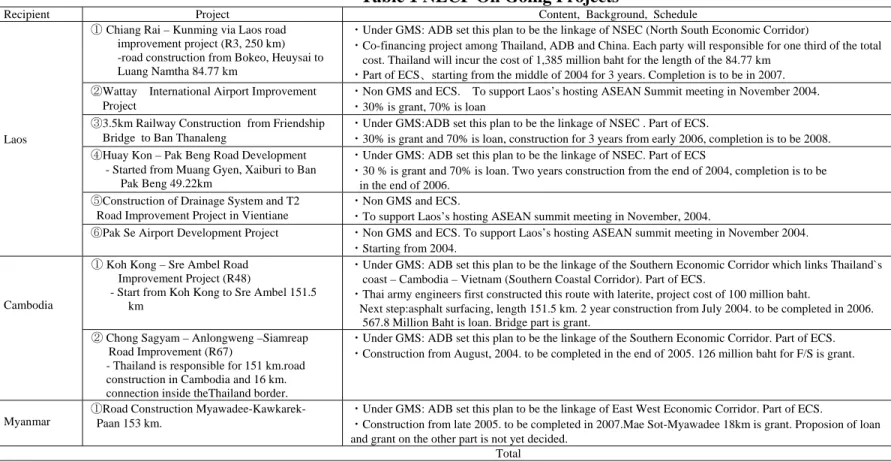
As of August 2004, the total on-going projects by the NECF are as shown in Table 1 and amounted to 6.5 billion baht. There are six projects involving road construction which were already decided related with the North-South Economic Corridor, the East-West Economic Corridor and the South Economic Corridor in the GMS program and backed up again as the ECS program. There are three projects on Laos, two projects on Cambodia and one project in Myanmar as follows;
i) A part of the North-South Economic Corridor from Chaing Rai via Myanmar to Kunming, China.
Thailand and Laos in January 2002 made agreement to construct the road connecting through to Chian Rung and Kunming in China via HuayXai and Luan Nam Tha in Laos by constructing a pier in Chiang Khong in Chaing Rai17. Thailand in October 2002 made an
agreement to provide Laos with a soft loan of 1,300 million baht. It is a loan which is over 30 years with a ten year-exemption on interest and 1.5% interest over the rest of the period. With regard to this route there is a plan to construct a third Mekong bridge between Chiang Khong in Thailand and HuayXai in Laos. Also on this route, the second Mae Sai bridge was completed in April2004 and one-stop-service check points are to be built in the both sides of the border bridge within 2004. The building of this infrastructure for transportation is indispensable for the plan of Chiang Rai special economic zone to strengthen the
relation over trades and investments among Kunming, Myanmar and Laos.
ii) A plan to build the 3.5 km railway (197 million baht) between Nongkai in Thailand and Thanaleng in Vienchian by using the first friendship bridge completed by Australian Aid in 1994. A loan agreement was made at the end of 2003 and 30% of the fund is to be provided as a grant while the rest is to be made in a 30 year-loan with 1.5% interest and the construction is to be for three years from early 2006.. It is a condition that Thai corporations should be mainly utilized in the construction.
iii) The 49 km road construction between Houi Kon and Pakbeng in the Northern Laos (840 million baht).
iv) The 151 km road construction between Trat in Thailand, Koh Kong and Sre Ambel in Cambodia.
v) The road renovation between Chong Sagyam, Anlongweng and Siem Reap in Cambodia. Construction is to be from August 2004 and to be completed by the end of 2005.
vi) The road construction connecting Mae Sot and Hpa-an in Myanmar by the request of Myanmar in April, 2003. The construction is a part of the East-West Economic Corridor from Moulmein in Myanmar via Mukdahan and Savannakhet in Laos to Dan Nang in Vietnam. This 153 km construction is an ambitious plan for Thailand in order to become a pivotal place along the East-West Economic Corridor to transport goods from India to Vietnam. Thailand is scheduled to grant 80 million baht to improve the 18 km road from the Thai border and the rest is to be given as a grant and a loan of which the amount has not been decided. Also there is a plan to renovate Tavoy Harbor located in the South of Myanmar in order to improve transportation to Thailand through the Andaman Sea.
Thus, although the development of infrastructure in the GMS region is being carried out partly by Thailand, it is not affordable for the member countries. They strongly expect aid from the other countries, regions and international organizations. Accordingly, Thailand initiated and decided in the 3rd ECS Ministerial level meeting held in Yangon in August 2004 that not only
the representatives of the ACMECS member countries but also advanced countries and the international organizations would be invited. As a result, at the ministerial level meeting in Kurabi, Thailand on November 2 representatives of Australia, France, Germany and Japan attended and examined the feasibilities of the 12 projects. Among them, Japan proposed the economic aid for Savannakhet Airport renovation while Thailand and Germany agreed to sign the MOU to support the third country, as well as France revealed support of the ACMECS projects18. Economic aide by Thailand is to be given in baht not in dollars and more than half of
the aid is earmarked for Thai corporations. That is the so called “tied aids” which is intended to prosper Thai industries. Although this aid has been carried so far by the Export-Import Bank of Thailand, the Thai government decided in November 2003 to establish a comprehensive organization to undertake a wide range of functions and practices over loans like the JBIC (Japan Bank of International Cooperation). However, before establishment the Thai EXIM bank will continue to perform this role.
3.3. Special Border Economic Zones
The ADB in early 2000 carried out a survey on the GMS economic corridors by the requests of the GMS countries. At the GMS Summit held in November 2002 to commemorate the 10th anniversary after the establishment, the framework of the GMS strategy for the next ten
years and the flagship program were approved. Here also it was confirmed that the economic corridors would not only result in the building of roads and bridges but would also set up economic development areas along them. The following development projects are now going on.
(1) Chaing Rai Border Economic Zone
Thailand has a plan to set up the “Chaing Rai Border Economic Zone” as a business hub centering on Chaing Rai province where there is linkage with Yunnan of China, Laos and Myanmar along the North-South Economic Corridor. This is based on the plan of the NESDB of Thailand that 35 programs and 112 projects( a total investment of 475.8 million dollars) is to be made for human resource development, urban development, industrial development, trade, tourism, infrastructure, environment, public health, and institutional improvement in Mae Sai, Chiang Saen and Chieng Kong in Chaing Rai province (JETRO[2004, p.101]).
The NESDB sees this Chaing Rai development plan as a pilot project and recognizes that the outcome of the project would have great influence on the fate of other border economic zones19. This project is a long project over the period from 2006 through 2014 in which the
following projects are being carried out by 2006.
i) Mae Sai: In order to promote border trade with Myanmar, a custom office in Mae Sai was improved to a one-stop-service, and another custom office is to open in a different place within 2005, following completion of the second Mae Sai bridge in March 2004 along with a temporary custom office beside the bridge.
ii) Chiang Saen: Renovation of pier I was completed and the related custom office was improved to a one-stop-service. Pier II is scheduled to be built by 2007 and the industrial estate is to be constructed. Since the signing of the FTA (Free Trade Agreement) with China in 2003, inflow of Chinese commodities into Chiang Saen port seems to be increasing recently.
iii) Chieng Kong: The pier of the Chien Kong port was renovated and the custom office is being changed to a one-stop-service. The third Mekong bridge is to be built and the new custom office is also to be built by 2007.
The establishment of an industrial estate in Chian Saen is thought to be especially crucial as a core of this regional development. The IEAT in an action plan of 2004 launched the project
19 Based on a hearing at the NESDB and the sites (August, 2004). Progressive situation of the projects are referred to the NESDB’s internal document “Chiang Rai Border Economic Zone Conceptual Framework” 2004.
to set up an industrial estate along with an ICD ( Interland Container Depot) procured 3100 Rai (512 ha) in Sri Don Moon in Chien Saen20. The IEAT already made a MOU in 2003 with KNTZ
(Kunming National New and High Tech Industrial Development Zone) to develop an industrial estate and to invite about 100 investors from China. The initial cost of the industrial estate is estimated to amount to four billion baht and to be shared jointly by Thailand and China. In September 2004, about 40 investors from Yunnan reportedly visited the expected area to have meetings with the Governor of Chaing Rai province, executive members of the IEAT, the NESDB and the BOI and showed interest in investment in pharmaceutical, electric and electronics industries. It is also reported that the Thai side takes one month to conduct a socio-environmental survey and the China side takes six months to make surveys on technical, marketing and regal aspects21. After finishing a feasibility study started from March 2004, it is
scheduled to make a formal contract with the Chinese government within 2004 and to start construction in 2005. According to the IEAT, they are targeting such six fields of industries as agro-processing, jewelry, garment, distribution, motorcycle parts and electric-electronics. The Yunnan state reportedly so far accepted about 150 investments from Thailand for electrical plants, animal feeds, plastics, hotel, wood processing and agriculture22. With the construction of
this industrial estate, after this, it is thought that investment from China to Thailand will be reversely made along the North-South Economic Corridor. There is an observation that China has a clear strategy to make Chien Saen a place to link exports for ASEAN, Europe and the U.S.
(2) Mukdahan-Savannakhet Border Economic Zone
On January 21, 2002 Laos issued a proclamation by Prime Minister that a special economic zone should be set up in Seno district of Savannakhet State. At present, renovation of national highway No.9 (208 km) has been progressing following the GMS plan by the Japanese grant and the ADB loan. The second Mekong bridge which started from the ground breaking ceremony in March 2004 to connect Mukdahan to Savannakhet over the Mekong River is scheduled to be completed in 2006. For the fund, Japanese yen loan was decided in 2001 to provide Thailand with 4.079 billion yen and Laos with 4.011 billion yen respectively. Completion of the bridge will make it possible for transportation time to be reduced to 4-5 hours (without time for custom clearance) between Mukdahan and Danan port in Vietnam although at
20 Based on a hearing at the IEAT (August 2004) and IEAT [2003, p19]. 21 “Chinese team to join talks today”, Bangkok Post, Septemer 24, 2004. 22 Nation, October 22, 2003.
present it takes a few days by sea between Thailand and Vietnam. This means that Mukdahan would become closer to Danan than to Leam Chaban port in Thailand23.
With reference to the development of the special economic zone in Savannakhet, the JICA (Japan International Cooperation Agency) proposed to set up a complex special economic zone furnished with such functions as free passing zone, export processing zone and free trade zone, based on a survey carried out from July 2000 through January 2001 with a Japanese consulting agency, KRI (Koei Research Institute) International24. Based on this proposal, it is planed to
build a total of 325 ha. industrial estates including site A composed of factories, residential areas, hotels, duty-free commercial areas and entertainment facilities and site B composed of factories, logistic center and warehouse. Although the estate is planned to be set up gradually in three stages from 2003 to 2011, it has not yet started as of 2004. The Laotian government is expecting investment from Thailand after deciding to provide the leasing of land without time limits along with exemption of corporate tax for five years. Although the IEAT wants to have an industrial estate on the Mukdahan side, there is a request from Laos to refrain from doing so. Thus, the IEAT reportedly for the time being has been giving technical cooperation in the aspect of development and management to establish an industrial estate in Savannakhet.
(3) Trat- Koh Kong Border Economic Zone
Also underway is an IEAT action plan for 2004 that Thailand will establish an industrial estate with 200 Rai (320 ha.) in Koh Kong in Cambodia along the framework of establishing border economic zones based on the ECS initiated by Thaksin administration from 2003. Since Koh Kong is close to the Khlong Yai area of Trad province of Thailand, there is expected to be provision of cheap labor and raw materials. The estate is to be completed in 2006 targeting such industries as food, fishery related, glass, textiles, electronics, motorcycle and parts. By realizing this, Cambodia will make it possible to create employment, technology transfer, and to secure foreign money by exports.
(4) Myanmar Border Economic Zone
With reference to the economic zones in the border area between Thailand and Myanmar, Thailand has since the beginning of 2004 conducted feasibility studies on Mea Sot in Tak province and the area near the border checking point in Kanchanaburi province as candidates for
23 Development of Mukdahan and Savannakhet is referred to Mukdahan Chamber of Commerce [2003]and Takeuchi [2002].
development. Since the Thai government was planning to set up an industrial estate in Tak province, it made public on October 19, 2004 the plan to develop the three places such as Mae Sot, Phob Phra and Mae Ramat with 400 million baht25. Mae Sot is to be developed as the
center for industry, commerce and tourism while Phob Phra and Mae Ramat are to be the center for the agriculturally related enterprises. This development plan includes expansion of Mae Sot Airport, expansion of roads, as well as construction of anti-flood facilities, distribution centers, employment coordination facilities for labor from neighboring countries and hotels. The government is also planning to improve infrastructure in the border area with cooperation of Myanmar by 2006. In this economic zone, it is planned to make up such incentives for investors as various tax exemption, liberalization for employing foreign laborers including Myanmarese and others by the IEAT, BOI and the custom offices. It is planned to exempt tariff completely on border trades. Thailand is also planning to examine the construction of an industrial estate inside Myanmar, that is, in the opposite side of Mae Sot so that a feasibility study was to be conducted from the mid 2004 for seven to eight months. Myanmar is reportedly expecting to invite investments from Thailand in such fields as agriculture- related and textiles.
4. Economic Relationship with Neighboring Countries 4.1. Trade
Change of trade between Thailand and the CLMV is as shown in Table 2, Table 3, Figure 2 and Figure 3. Total exports from Thailand to the CLMV expanded by 47 times (annual average rate 32%) from 3.2 billion baht (US$ 127 million) in 1990 to 152.2 billion baht (US$ 3,792 million) in 2004. This rate is more than double of the total Thai exports during the same period. On the other hand, the exports from the CLMV to Thailand expanded only by 10 times (annual average rate 18%) from 7.2 billion bath (US$ 281 million) in 1990 to 75.6 billion baht (US$ 1,866 million) in 2004 and the CLMV has since 1992 shown over imports. Since 1995 Thai trade with Vietnam has been expanding and especially export to Vietnam shows a significant growth. Although trade with Myanmar has since 2001 been expanding rapidly, this is because Thailand started imports of natural gas from Myanmar. However, since the Thai economy has expanded, proportion of CLMV shared in Thai total exports and imports in 2004 is not as high as 3.9% and 2.0% respectively.
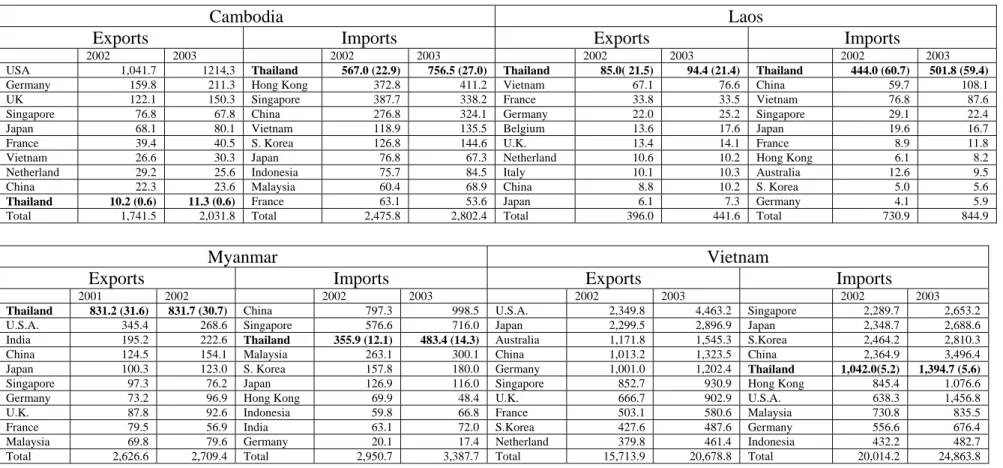
On the other hand, when it comes to the positions of Thailand occupied in the trades of the CLMV, the imports from Thailand in 2002 and 2003 accounts for a high position in each country. Cambodia, Laos and Myanmar account for 23-27%, 61-59% and 12-14% respectively in terms of the Thai ratio occupied in total import of each country (Table 4). This means that Thailand ranks first in Cambodia and Laos as well as the third in Myanmar, showing their significant dependence on Thailand. The Thai position in the exports from the CLMV to Thailand is rather high in Myanmar and Laos respectively at 32-31% and 21% which means Thailand is the first country while the ratio is not high in Cambodia and Vietnam. After all, as a whole, trade of the CLMV with Thailand accounts for a significant position and their dependency on Thailand is high.
When it comes to major trade commodities between Thailand and the CLMV, Thailand imports such raw materials and agro-fishery products as wood and wood processed goods, animal, leather, mineral and slug, natural gas, cereal, vegetable and fish. While Thailand exports refined oil, motorcycles, automobiles, electrical machines, plastic products and cotton cloth for raw materials for textile industries. However, there is still an enormous amount of exports of daily goods for Cambodia, Laos and Myanmar.
Since Thailand has borders with the neighboring countries on the land, it naturally has border trade with them. The border trade includes not only regular trade through custom offices and checking points but also illegal trade, so-called, smuggling. Table 5 shows formal border trade between Thailand and Myanmar, Laos, and Yunnang in China. Myanmar brings in daily commodities through six custom offices such as in Chiang Rai, Tak, Mae Hong Song and Chiang Mai in the north Thailand and these account for 30-40% of Myanmar’s total imports from Thailand. On the other hand, recent Thai imports from Myanmar through these border customs in the North is less than 10% of the Thai total imports from the country. And, the border trades with Laos are made through four custom offices such as in Chiang Rai, Phayao, Nan and Utaradit in the Northeast Thailand and these account for 90% of the total trade between Thailand and Laos. Although the border trade between Thailand and Cambodia is not shown in Table 5, it is also increasing. It is reported that the border trade increased to 18.72 billion baht in 2002 by an annual rate of 18.8% compared with the previous year, of which Thai exports was 8 billion baht and imports were 350 million baht in the border between Aranya Prathet and Poipet26.
The border trade has been increasing27 even with effect of the GMS economic cooperation
program and has high potentiality, though it also has many obstacles. For example, although Myanmar is an important supplier of raw materials such as gem stones and wood, there are problems over, frequent closing of the border, exchange rates, minority races, state monopoly of commercial banks, etc. One example is that a checking point in Pa Wok Narrow near the Myanmar border had been closed since April 9, 2002 due to a riot incident related to drug issues and an appeal to open the border was made in June2004 in accordance with stabilization28. At
present, in the wake of the GMS program and the ECS, Thailand is scheduled to open one-stop-services to transact immigration, quarantine and tax clearance in five major checking points: Mae Sot, Mae Sai, Aranya Prathet, Mukdahan and Sadao. For example, as of August, 2004, the Thai side completed the second checking point in Mae Sai, though Myanmar has not yet done so.
Besides these formal trade agreements, there is informal trade or smuggling, the exact proportion of which is not clear although it is maybe more than legal border trade. According to a survey of the Bank of Thailand, illegal trade between Thailand and Myanmar and Laos in 1994 was equivalent to respectively 50% and 80% of the legal trade29. However, it is said that
the proportion of the illegal trade is diminishing because of tariff deduction under trade liberalization, rationalization of custom clearance in the borders, and the strengthening of border control.
4.2. Foreign Direct Investment
According to statistics of the Bank of Thailand, the direct investment (net equity investment) from Thailand to the CLMV accounts for 12.3 billion bath (US$ 350 million) in terms of the accumulated amount from 1990 to 2004 (Table 6). About half of the above investment is the investment in Vietnam followed by Cambodia, Laos and Myanmar respectively at 22%, 15% and 12%. As shown in Figure 4, Thai investment to the CLMV began an increasing trend from 1992 and peaked in 1997, declining sharply from the financial crisis in 1997 to 2001 and started recovery in 2002. The early 1990s is the period that Thailand actually promoted investment in Indochina following Chatchai’s policy with such ideas or concepts as the Financial Center of the Southeast Asian Continent (December 1992), Conference of the
27 According to an internal report, NESDB [2004b, p87], the border trade between Thailand and the neighboring countries increased from 1993 by an annual average rate of 61% and reached US$ 1,494 million.
28 Nation, June 23, 2004.
GMS-EC (October 1992), formulation of Economic Cooperation Rectangle (May 1993). The Thai BOI established an Indochinese unit specialized to provide Thai entrepreneurs with related information. It is pointed out from that time up until now as the major reasons for Thai investment is to procure cheap resources and to develop markets.
Among the CLMV, the proportion of Thai investment is rather high in Laos and Myanmar (Table 7). Especially in Laos, Thailand is the largest investor. In terms of the number of projects and the amount of money, although the Thai investment in Vietnam occupies the largest share in absolute figures of money compared with the other countries such as to Cambodia, Laos and Myanmar, the Thai share in total investment in Vietnam is not so high as to rank 10th in 2001
and 11th in 2002 because Vietnam receives much investment from other countries. Thai
investment was made in hotels, construction, and the procurement of raw materials such as petroleum, mining and wood in the early period while it is made even to manufacturing sector in Laos and Vietnam (Table 9 and Table 11).
(1) Cambodia
In terms of the accumulated investment (fixed asset) from Thailand to Cambodia from August, 1994 to September, 2004, hotels-tourism, manufacturing, transportation-communication and agro-industry account for 48.4%, 24.4%, 19.5% and 7.0% respectively of the total US$ 255 million (Table 8).
With regard to the building of hotels, there was a great deal of investment by foreign funds, initiated from Hotel Cambodiana by Singapore in 1990. The advancement by Thailand was approved for nine projects from 1994 to 2004, of which four projects were approved in 1996 (Table 8). Thai hotels advanced not only to Phnom Penh but also to local cities such as Battanbang, Koh Kong and Siem Reap.
In the early 1990s, transportation, hotels and construction accounted for the majority while recently Thailand has also invested in manufacturing such as garments and plastics. The major fields in the 31 manufacturing projects approved are food processing (9), textile-garments (6), chemicals (5) and wood processing (3) (Table 8). Especially for food processing industries, Thailand invested in manufacturing-sales of water, noodles, liquor, fish-processing, and dry-foods.
Considering the developmental stage of Cambodia, potentiality of agro-industry is high. A representative Thai agro-industry, CP (Charoen Pokphand) has since 1996 carried out
production of animal food, broiler farming, breeding of chickens and running the related fast food restaurants in Cambodia.
Even in communication industries, such important infrastructure as aviation control systems, the broadcasting operations of radio and TV (Channel 3) and mobile telephones are supported by the Thai industries. The Shinawatra group owned by Prime Minister Thaksin entered Cambodia in 1999.
In June 2004, a high class official of the Cambodian Ministry of Commerce visited Thailand and recommended the use of the GSP (Generalised System of Preference) quota which Cambodia is allocated in Europe and the U.S. by Thai investments in the manufacturing sectors. And Cambodia also recommends that Thailand invests in agriculture and food processing in which Thailand can profit from the procurement of raw materials while Cambodia can gain from the benefit of technology transfer.
(2) Laos
Especially in 2001, investment from Thailand to Laos declined rapidly30. This is due to the
following facts; a check point in Laos was attacked by the anti-government rebels in July, 2000, and the issues to confirm the boundaries had not been solved and a feeling of distrust among Laotians increased toward 2001.
As shown in the accumulated investment from 1988 to early 2004, Thai investments are the majority in manufacturing, trade-commerce, textile-garments, services, wood processing, and hotels in terms of the number of approvals while in terms of amount of money, electric generation, transportation-communication, hotels and manufacturing are the majority. Especially in recent years, the Thai investment in telecommunication is increasing. From the point of view of how much Laos secures foreign currency reserves, electric generation, tourism and textile-garments are significant fields.
With reference to investment in electric generation, the most important factor is that it is sold to Thailand. In the wake of Thai economic development, demand for electricity increased in Thailand and new plans for setting up hydro-plants were made one by one, but they resulted in stagnation due to the Thai economic crisis. However, the investment in electric generation accounted for 60% of the total investment (Table 9). In Laos it is said that there are about 40 foreign affiliated tourist companies, of which more than half are Thai affiliated ones. And by the
30 According to the author’s observation at the Bank of Thailand (August, 2004), the return of Thai equity amounted to 530 million baht from Laos was shown. However the cause is not clear.
early 2004, the 12 hotel projects advanced from Thailand were approved. For instance, Champasak Palace Hotel Company had been approved in 1993 and renovated the old Champasak Palace in Chapasak province into a hotel.
Although Thai investment in the textile-garment industry by early 2004 consisted of 38 projects in terms of the approval base, it accounted for less than 2% of total Thai investments because the scale of each investment is small. This is especially true for investments in the garment industries, which aim to get the vested benefit of the GSP as well as cheap labor and employed more than 20,000 women workers. Also in the other manufacturing sectors, Thai industries invested in 79 projects, which accounts for less than 3% of the total Thai investment because of its small scale. They are mostly such food processing areas as canned fruits, drinking water, sugar, fish sauce, ice cream and distilled liquor, and such light industries as bamboo-rattan products, leather footwear and tobacco.
Although Thai investment in transportation and communication is rather scarce as only 8, this accounts for 20% of the total Thai investment in terms of the amount of money. For Thai investment in this sector has been increasing recently. For instance, the Shinawatra group which is composed of enterprises owned by Prime Minister Thaksin established the Lao Telecommunication Corp. in 1996 as a joint venture with the Laotian government.
Following the government’s ECS concept, Thai private industries have shown a positive posture by tackling with investment in Laos. For example, the FTI (Federation of Thai Industries) has undertaken to set up international trade firms and investment alliances to promote investments in local areas of Thailand, Laos and Cambodia31.
(3) Myanmar
According to the Survey that JETRO commissioned a private agency, the foreign affiliated companies operating in Myanmar as of February 2004 is 244 of which Singapore as the first accounts for 49 projects followed by 31 projects of Thailand as the second. The third is Japan which has 28 projects. Thai investments are in terms of number hotels-tourism (10 projects), manufacturing (8), transportation-communication (4), agriculture-fishery (3), mining (2), construction (2), petroleum-gas (19) and development of industrial estates (1). On the other hand, in terms of amount of money, manufacturing, hotels-tourism, transportation-communication, and construction Thailand accounts for respectively 55%, 25%, 10.6%, and
3.7% (Table 10). On both numbers and amount of money, Thai investment has so far centered on hotels-tourism, and manufacturing, transportation-communication.
In the manufacturing sector, Thai investments were made in wood processing such as furniture production such as of teak (two projects), sugar, transformer, cement, gloves for industry, tin plate and jewelry (one each). With regard to production of cement, the Italian-Thai International Co. Ltd is along with supplementary electric generation making production and the amount of this investment by one company occupies more than half of the total Thai investment.
In transportation-communication, Thai investment has been supporting such important infrastructure sectors as operations of limousine buses at airports and domestic air flights as well as construction-operation of harbor for freight and container terminals. Here also the Italian-Thai International Co. Ltd. is carrying on the construction and operation of harbors for freight.
Thai industries are engaged in infrastructure development such as the construction of roads and bridges (2 projects) as well as the development of industrial estates (1 project). An industrial estate was developed in 1996 jointly with the Myanmar government by the Rojana Industrial Park which had been conducting industrial estate development in Thailand. Exploration of petroleum-gas, of which 80% is exported to Thailand, was made by a joint company established in 2003 between a Myanmar petroleum-gas company and the PTT Exploration and Production Corp related with the PTT (Petroleum Authority of Thailand).
Even in agriculture and fishery sectors, Thai investment can be seen, though the amount is small, in cultivating lobsters and pearls as well as contract farming. The CP group that is famous as a representative of Thai agro-business groups has since 1996 been conducting broadly such production as animal foods, breeding farms, hatching of chicken eggs and contract farming. Since the potentiality of Thai investment into agriculture and food processing is high, Myanmar Ministry of Agriculture and Irrigation and the NRCT (National Research Council of Thailand) have been jointly conducting a research to probe the possibility of cooperation in agriculture in Myanmar.
(4) Vietnam
As shown in the accumulated Thai investment in Vietnam approved from 1988 to June 2004, manufacturing, tourism-services, agriculture-fishery, real estate and construction accounts for 59.0%, 9.8%, 9.4% and 4.4% respectively of the total 134 projects. While in terms of amount of money, manufacturing, agriculture-fishery, real estate and construction account for
54.4%, 9.8%, 9.4% and 4.4% respectively (Table 11). Although tourism-services are relatively large at 22, the amount of investment is small at 1.8% of the total Thai investment.
It is characteristics of Thai investment in Vietnam that the investment in the manufacturing sector is larger compared with the cases in the other neighboring countries and it is made broadly over food processing, textile, metals-nonmetals, electric-electronics, machines-transportation machines, chemicals, petro-products, jewelry, construction materials and footwear. In terms of project numbers, food processing, chemicals, and transportation machinery are many while in terms of the amount of money, machinery-transportation machinery, chemicals, and food processing are larger. With reference to food processing, there are several projects in tapioca powder and drinking water. The investment in machinery and transportation machinery is closely related to the production of motorcycle parts. In chemical products, there are investments in the production of plastics, paints, and cosmetics.
In the field of agriculture and fishery, production of animal feed is made by the CP while fishery and production of seeds are also done by Thai industries. With reference to investment in real estate, there are investments in hotels, operation of golf courses and rental offices respectively at six projects, two projects, and two projects. Although there are many investments in tourism-services (22), they consist of four projects in tourism and 18 projects in services. Among the other services, rather new investment fields such as computer software development and consulting reflecting rapid economic growth in Vietnam which is different from the other neighboring countries.
Thai BOI and the Ministry of Planning and Investment made the MOU in March 2003 to promote investment opportunities through exchanges of information, regular meetings, and training of related staff and the relationship has been strengthened32.
4.3. Task over Trade and Investment
With reference to the trade and investment between Thailand and the CLMV, the following issues are pointed out by the Thai side (NESDB [2004b, p.85]).
i) Trade barrier: the CLMV has tariff and non-tariff barriers to protect their own markets. For instance, although Cambodia has fewer tariff barriers, there are many ineffective checking procedures on imports. Myanmar has an embargo list from Thailand and at the same time procedures on exports are also complicated.