Parallel Synthesis and Biological Evaluation
of Destruxin E Analogs Modified with a Side
Chain in the α‐Hydroxycarboxylic Acid Moiety
著者
Masahito Yoshida, Kenta Adachi, Hayato Murase,
Hiroshi Nakagawa, Takayuki Doi
journal or
publication title
European Journal of Organic Chemistry
volume
2019
number
7
page range
1669-1676
year
2019-01-02
URL
http://hdl.handle.net/10097/00128367
doi: 10.1002/ejoc.201801826
FULL PAPER
Parallel Synthesis and Biological Evaluation of Destruxin E
Analogs Modified with a Side Chain in the αα-Hydroxycarboxylic
Acid Moiety
Masahito Yoshida,
[a, §]Kenta Adachi,
[a]Hayato Murase,
[b]Hiroshi Nakagawa,
[b]and Takayuki Doi*
[a]Abstract: This study demonstrates the synthesis and biological
evaluation of destruxin E analogs possessing various functional groups in the α-hydroxycarboxylic acid moiety. Parallel synthesis of eleven analogs was successfully achieved through solution-phase peptide synthesis and macrolactonization. Biological evaluation of the synthetic analogs using osteoclast-like multi nuclear cells (OCLs) revealed that the epoxide group in the side chain of α-hydroxycarboxylic acid and the orientation of the oxygen atom are essential factors in the desired potent activity that induces morphological changes in OCLs for the inhibition of bone-resorbing activity.
Introduction
19-Membered cyclodepsipeptide destruxin E (1) was isolated
from Metarhidium anisopliae by Päis et al. in 1981 and is composed of five amino acids (β-Ala, MeAla, MeVal, Ile, and Pro), and an α-hydroxycarboxylic acid with a terminal epoxide-containing a C3 side chain.1 Thus far, various natural and
synthetic analogs have been reported2; in particular, 1 exhibits
the most potent vacuolar (H+)-ATPase (V-ATPase) inhibitory
activity.3 We recently achieved the total synthesis of 1 and have
determined that the (S)-epoxide moiety is important for inducing
the potent V-ATPase inhibitory activity, whereas the presence of (R)-epoxide significantly decreases the activity of analog 2.4 In
addition, destruxin E (1) reversibly inhibits the bone-resorbing
activity by inducing morphological changes in osteoclasts-like multinuclear cells (OCLs) at an even lower dose level without affecting cell viability,5 indicating that 1 and its analogs could be
promising candidates for the development of novel anti-resorptive agents for therapeutics used to treat osteoporosis. Although the structure-activity relationships (SARs) have been studied by altering the amino acid moieties, a SAR study focusing on the epoxide-containing C3 side chain in the α-hydroxycarboxylic acid moiety has not yet been carried out,
except for a study on the hydrophobic allyl and isobutyl groups shown in destruxins A (3a) and B (3b), which exhibit a potent
activity that is 20-fold less than that found in destruxin E (1). In
addition, destruxin E diol (3c) is inactive against OCLs,
indicating that a hydrophilic moiety such as a hydroxy group could be prohibited for the biological activity (Figure 1).6 In this
study, we achieved the synthesis of destruxin E analogs with modification of the epoxide side chain on the α-hydroxycarboxylic acid and evaluated their biological activity to elucidate the effect of the epoxide moiety.
Figure 1. Destruxin E (1), epi-destruxin E (2), destruxin A (3a), B (3b), and
diol derivative 3c.
Results and Discussion
To explain the structure–activity relationship of the α-hydroxycarboxylic acid moiety, we designed various analogs possessing different functional groups on the side chain, such as a methyl ether 4a, methyl ketone 4b, difluoromethylene 4c,
cyclopropanes 4d–4f, and oxetanes 4g–4i. In addition, we also
designed the synthesis of epoxide homologs 4j–4k to determine
the role of the epoxide moiety in the biological activity. Retrosynthesis of the analogs is shown in Scheme 1. According to the total synthesis of destruxin E (1),4, 7 the desired analogs 4
would be afforded through macrolactonization of the linear precursors 5, this can be prepared by amidation of acid 6,
containing various functional groups in the side chain and the known tetrapeptide 7 that we reported previously.
N H N N N O H N O O OOO R O O Destruxin E (1): R = epi-Destruxin E (2): R = O Destruxin A (3a): R = Destruxin B (3b): R = Destruxin E diol (3c): R = OH OH
[a] Prof.Dr. M. Yoshida, K. Adachi, Prof.Dr. T. Doi
Graduate School of Pharmaceutical Sciences, Tohoku University 6-3 Aza-Aoba, Aramaki, Sendai 980-8578 (Japan)
E-mail: [email protected] [b] H. Murase, Prof.Dr. H. Nakagawa
Department of Applied Biological Chemistry, Chubu University 1200 Matsumoto-cho, Kasugai, Aichi 487-8501 (Japan) § Current address:
Faculty of Pure and Applied Sciences, University of Tsukuba 1-1-1 Tennoudai, Tsukuba, Ibaraki 305-8571 (Japan)
Supporting information for this article is given via a link at the end of the document.
FULL PAPER
Scheme 1. Retrosynthesis of destruxin E analogs.
As detailed in the retrosynthesis described above, we initially attempted the preparation of the methyl ether 9a and the
cyclopropyl derivatives 9d–9f (Scheme 2). The oxidative
cleavage of the alkene moiety in 87 afforded aldehyde and
reduction of the resulting aldehyde followed by O-methylation using Me3OBF4 provided the desired methyl ether 9a in 82%
yield. The cyclopropyl derivatives 9d–9f were prepared as
follows: the Simmons–Smith reaction of 8 using CH2I2/Et2Zn
afforded 9d in 83% yield. However, the preparation of
difluorocyclopropane moiety in dipeptide 8 using difluorocarbene
generated from trimethylsilyl fluorosulfonyldifluoroacetate (TFDA)/NaF8 failed, and a complex mixture including a
desilylated product was obtained. Fortunately, the difluoromethylenation of the alkene 107 using
(bromodifluoromethyl)trimethylsilane/tetrabutylammonium
bromide (TBAB)9 proceeded smoothly to afford
difluorocyclopropane 11 in 59% yield as a 1:1 diastereomer
mixture. After hydrolysis of the methyl ester in 11, amidation of
the resulting acid with H-Pro-OBn was performed using PyBrop10/DIEA, gave the less polar 9e (27% yield) and polar 9f
(29% yield), respectively, isolated by silica gel column chromatography. The absolute configurations of the newly formed stereocenters in 9e and 9f are not determined.
Scheme 2. Synthesis of methyl ester 9a and cyclopropyl derivatives 9d–9f.
Oxetane derivatives of 9g–9i were prepared from commercially
available (±)-glycidol (12), and the details of the reaction are
illustrated in Schemes 3 and 4. A hydrolytic kinetic resolution of the racemic epoxide 13 was carried out using the (S,
S)-Salen-Co complex as a catalyst, and an enantio-enriched epoxide
(R)-13was afforded in 47% yield concomitantly with diol (S)-14,
obtained in 48% yield.11,12 Alkenylation of (R)-13 using
vinylcuprate provided alkene 15 that was converted to a 1:1
diastereomeric mixture of epoxide 16 in 97% yield via
epoxidation with m-CPBA and by protecting the resulting alcohol with a TBS group. A hydrolytic kinetic resolution of the epoxide moiety in 16 using the (S, S)-Salen-Co complex resulted in the
formation of the diol (2R, 4S)-1713 (48% yield) and the remaining
epoxide (2S, 4S)-16a (41% yield) as a single diastereomer. The
obtained diol (2R, 4S)-17 was converted via two steps into the
corresponding epoxide (2S, 4R)-16b in 72% yield.
Scheme 3. Preparation of epoxides (2S, 4S)-16a and (2S, 4R)-16b.
After synthesizing the desired epoxides, 16a and 16b, formation
of oxetane was carried out by treatment with trimethylsulfonium iodide14 under basic conditions to afford (2S, 4R)-18a and (2S,
4S)-18b, respectively (Scheme 4). THP group was removed,
and the resulting alcohol was oxidized to acid, followed by amidation with H-Pro-OBn to produce the oxetane-containing acylproline derivatives 9g and 9h in moderate yields. In addition,
we also attempted to prepare the oxetane derivative 9i from (S)-14. Protection of the diol in (S)-14 with TBS groups, followed by
removal of the THP group using Et2AlCl afforded alcohol 19 in
92% yield.12 After conversion of the resulting alcohol to mesylate,
substitution with dimethyl malonate under basic conditions afforded dimethyl ester 20 in 90% yield. Treatment of dimethyl
ester 20 with LiAlH4 afforded diol 21, and formation of an
oxetane moiety was achieved smoothly using TsCl/BuLi15 to N H N N N O H N O O O OO R O O F * b c O * F F O * O a e, f d i g, h j, k 4 N H N N N TBSO H N O O O OO 5 O OTMSE R NH2 N N H N O O O 7 O OTMSE HO N TBSO OO 6 R O F BnO N TBSO OO
1) OsO4, NaIO4, 2,6-lutidine
dioxane-H2O, rt ,10 h, 78%
2) NaBH4, MeOH, 0 °C, 30 min
3) Me3OBF4, Protone-sponge® MS4Å, CH2Cl2, rt, 18 h 2 steps 82% 8 BnO N TBSO OO O 9a BnO N TBSO OO 9d (83%) CH2I2, Et2Zn MeO TBSO O TMSCF2Br TBAB toluene 110 °C, 24 h 59% 10 MeO TBSO O * 11 F F 1) LiOH•H THF-MeOH-H2O 2O rt, 2 h 2) H-Pro-OBn•HCl PyBroP, DIEA CH2Cl2, rt, 20 h 9e (27%) 9f (29%) CH2Cl2 rt, 46 h, 82% VinylMgBr CuBr•Me2S THF 0 °C, 30 min 97% 1) m-CPBA, CH2Cl2 rt, 20 h 2) TBSCl, imidazole DMF, rt, 5 h 2 steps 97% (S,S)-Salen-Co Complex AcOH, H2O THPO TBSO O THF, rt, 9 h THPO TBSO OH OH + (2S, 4S)-16a (41%) (2R, 4S)-17 (48%) HO O (±)-Glycidol (12) DHP, p-TsOH CH2Cl2 rt, 10 min, 80% THPO O 13 (S,S)-Salen-Co Complex AcOH, H2O THF, 0 °C, 9 h THPO O (R)-13 (47%, 98%ee) THPO (S)-14 (48%) OH OH (R)-13 THPO 15 OH THPO 16 TBSO O 1) TsCl, NEt3, DMAP CH2Cl2, rt, 9 h THPO TBSO O 2) K2CO3, MeOH 0 °C, 2 h 2 steps 72% (2S, 4R)-16b (2R, 4S)-17 2 4 4 2 2 4
FULL PAPER
provide 22 in 81% yield. Finally, the selective removal of the
TBS group on the primary alcohol lead to 23, this was then
followed by coupling with H-Pro-OBn via three steps to produce
9i, which possessed a symmetrical oxetane moiety.
Scheme 4. Synthesis of oxetane derivatives 9g–9i.
Next, we investigated the synthesis of acylproline derivatives 9b, 9c, 9l, and 9m, side-chains of which were elongated with
one-carbon unit when compared with natural product 1 (Scheme 5).
Nucleophilic addition of allyl copper reagent to epoxide (R)-13
provided 24, which was converted via two steps to afford
primary alcohol 25. Methyl ester 26 was prepared from 25 via
three steps in 60% yield. Wacker oxidation of terminal alkene in
26 proceeded smoothly, leading to methyl ketone 27, which was
treated with diethylaminosulfur trifluoride (DAST) at room temperature to afford 28 in 34% yield. To achieve the synthesis
of epoxide-containing analogs 4j and 4k, diol-containing
acylprolines 9l and 9m were prepared from methyl hexenoate
derivative 26. Dihydroxylation of the terminal alkene 26 was
performed by treatment with OsO4/N-methylmorpholine N-oxide
(NMO) to provide diols as a 1:1 mixture of diastereomers. The resulting mixture was subsequently subjected to basic conditions, and the primary alcohol in the resulting lactone was acylated with benzoyl chloride to afford benzoates (2S, 5S)-29a and (2S,
5R)-29b, respectively.16 After separation of the above
diastereomers by column chromatography, solvolysis was carried out under basic conditions, followed by protection of the
resulting diol that provided methyl esters (2S, 5S)-30a and (2S,
5R)-30b. Finally, acylprolines 9 were synthesized as follows;
hydrolysis of the methyl esters in 27, 28, and 30 using LiOH in
the mixed solvents afforded the corresponding acids that were subsequently amidated with H-Pro-OBn using PyBroP/DIEA to provide the desired 9b, 9c, 9l, and 9m in moderate yields.
Scheme 5. Preparation of the acylprolines 9b, 9c, 9l, and 9m.
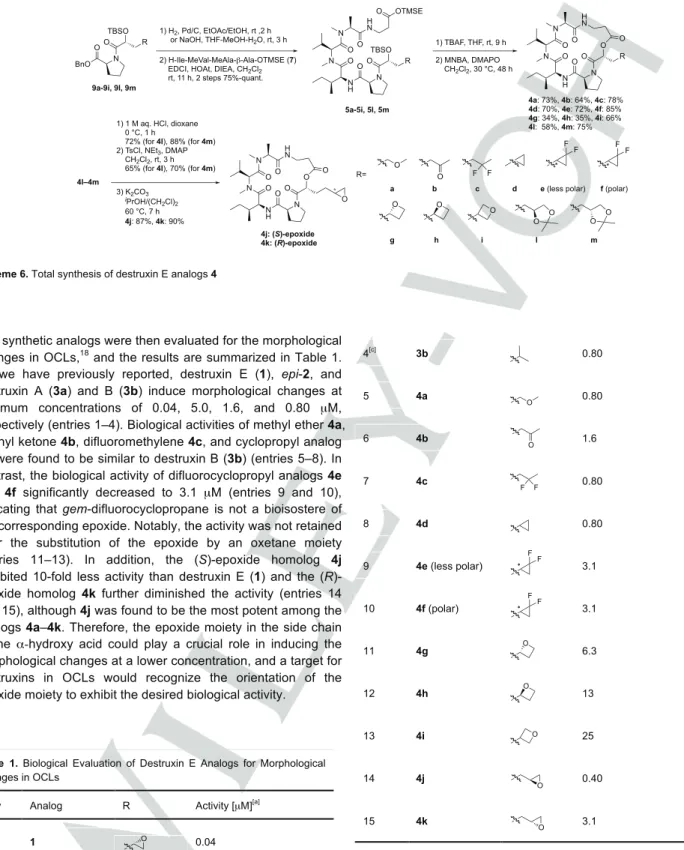
Successfully having the desired 9, we synthesized destruxin E
analogs 4, details of which are illustrated in Scheme 6.
Hydrogenolysis or hydrolysis of benzyl ester in 9a–9i, 9l, and 9m were performed leading to the corresponding acids, which
were subsequently amidated with the tetrapeptide 77 using
N-(3-dimethylaminopropyl)-N'-ethylcarbodiimide
(EDCI)/1-hydroxy-7-azabenzotriazole
(HOAt) to afford hexapeptides 5a–5i, 5l,and 5m in good to excellent yields. After removal of the
protecting groups at the N- and C-terminus, macrolactonization of the resulting precursors was successfully achieved using 2-methyl-6-nitrobenzoic anhydride (MNBA)/4-(dimethylamino)pyridine N-oxide (DMAPO)17 to provide the
desired analogs 4a–4i, 4l, and 4m in moderate yields (34–85%).
In addition, the formation of epoxide from 4l and 4m, as well as
the previously reported procedure,4,7 furnished 4j and 4k,
respectively. THPO TBSO O (2S, 4S)-16a (2S, 4R)-16b [Me3S(O)]I tBuOK tBuOH 60 °C, 16 h (S)-14 * THPO TBSO (2S, 4R)-18a (58%) (2S, 4S)-18b (46%) * O 1) Mg, (CH2Br)2 Et2O, rt, 4 h 1) TBSCl, imidazole DMF, rt, 5 h, 96% 2) Et2AlCl, CH2Cl2 rt, 1 h, 92% 19 OH TBSO TBSO 1) MsCl, NEt3 CH2Cl2, rt, 1 h 2) dimethyl malonate NaH, KI, DMF-THF rt, 22 h, 2 steps 90% 20 TBSO TBSO OMe O OMe O THF 0 °C, 20 min, 78% LiAlH4 21 TBSO TBSO OH OH BuLi, 60 °C, 20 h 81% 22 TBSO TBSO O TsCl, BuLi THF, 0 °C; THF 0 °C, 6 h, 64% 23 TBSO HO O HF•Py. N TBSO OO BnO O 1) (COCl)2, DMSO, NEt3
CH2Cl2, –78 °C, 1 h 2) NaClO2, NaH2PO4 2-methyl-2-butene tBuOH-H2O, rt, 1 h 3) H-Pro-OBn•HCl, PyBroP DIEA, CH2Cl2, rt, 15 h 9i N TBSO OO BnO O 4) H-Pro-OBn•HCl, PyBroP DIEA, CH2Cl2, rt, 15 h (2S, 4R)-9g (51%) (2S, 4S)-9h (41%) *
2) (COCl)2, DMSO, NEt3
CH2Cl2, –78 °C, 1 h 3) NaClO2, NaH2PO4 2-methyl-2-butene tBuOH-H 2O, rt, 1 h N TBSO OO BnO 1) LiOH•H2O THF-MeOH-H2O, rt ,3 h 3) H-Pro-OBn•HCl, PyBroP DIEA, CH2Cl2, rt, 11 h 9b, 9c, 9l, 9m AllyllMgBr CuBr•Me2S THF-Et2O 0 °C, 2 h 62% 2) Et2AlCl, CH2Cl2 rt, 1 h, 87% THPO O (R)-13 THPO 24 OH 1) TBSCl, imidazole DMF, rt, 3 h, 88% HO 25 OTBS
1) (COCl)2, DMSO, NEt3
CH2Cl2, –78 °C, 1 h 2) NaClO2, NaH2PO4 2-methyl-2-butene tBuOH-H2O, rt, 1 h 3) MeI, K2CO3, DMF rt, 15 h, 3 steps 60% O 26 OTBS MeO PdCl2, CuCl O2 (balloon) DMF-H2O rt, 15 h, 92% O OTBS MeO X 3) BzCl, NEt3, CH2Cl2 rt, 2 h 1) cat. OsO4, NMO
THF-H2O, rt, 3 h, quant 2) DBU, MS3Å, MeCN rt, 2 h, 74% O * O BzO OTBS (2S, 5S)-29a (38%) (2S, 5R)-29b (43%) 2) 2,2-DMP, p-TsOH CH2Cl2, rt, 10 min 1) K2CO3, MeOH 0 °C, 2 h (2S, 5S)-30a (86%) (2S, 5R)-30b (87%) O OTBS * MeO O O R O F F O O O O R= 9b (68%) 9c (55%) 9l (77%) 9m (75%) 27, 28, 30 DAST, CH2Cl2 rt, 16 h, 34% 27 (X = O) 28 (X =F, F) 26 2 2
FULL PAPER
Scheme 6. Total synthesis of destruxin E analogs 4
The synthetic analogs were then evaluated for the morphological changes in OCLs,18 and the results are summarized in Table 1.
As we have previously reported, destruxin E (1), epi-2, and
destruxin A (3a) and B (3b) induce morphological changes at
minimum concentrations of 0.04, 5.0, 1.6, and 0.80 µM, respectively (entries 1–4). Biological activities of methyl ether 4a,
methyl ketone 4b, difluoromethylene 4c, and cyclopropyl analog 4d were found to be similar to destruxin B (3b) (entries 5–8). In
contrast, the biological activity of difluorocyclopropyl analogs 4e
and 4f significantly decreased to 3.1 µM (entries 9 and 10),
indicating that gem-difluorocyclopropane is not a bioisostere of the corresponding epoxide. Notably, the activity was not retained after the substitution of the epoxide by an oxetane moiety (entries 11–13). In addition, the (S)-epoxide homolog 4j
exhibited 10-fold less activity than destruxin E (1) and the
(R)-epoxide homolog 4k further diminished the activity (entries 14
and 15), although 4j was found to be the most potent among the
analogs 4a–4k. Therefore, the epoxide moiety in the side chain
of the α-hydroxy acid could play a crucial role in inducing the morphological changes at a lower concentration, and a target for destruxins in OCLs would recognize the orientation of the epoxide moiety to exhibit the desired biological activity.
Table 1. Biological Evaluation of Destruxin E Analogs for Morphological
Changes in OCLs
Entry Analog R Activity [µM][a]
1[b] 1 0.04 2[b] 2 5.0 3[c] 3a 1.6 4[c] 3b 0.80 5 4a 0.80 6 4b 1.6 7 4c 0.80 8 4d 0.80 9 4e (less polar) 3.1 10 4f (polar) 3.1 11 4g 6.3 12 4h 13 13 4i 25 14 4j 0.40 15 4k 3.1
aMinimum concentration for morphological changes. b See ref 5b. c See ref
6. N TBSO OO BnO 1) H2, Pd/C, EtOAc/EtOH, rt ,2 h or NaOH, THF-MeOH-H2O, rt, 3 h 2) H-Ile-MeVal-MeAla-β-Ala-OTMSE (7)
EDCI, HOAt, DIEA, CH2Cl2
rt, 11 h, 2 steps 75%-quant. 9a-9i, 9l, 9m R O F F O O O O R= b c N H N N N TBSO H N O O OOO 5a-5i, 5l, 5m O OTMSE R 1) TBAF, THF, rt, 9 h 2) MNBA, DMAPO CH2Cl2, 30 °C, 48 h 4a: 73%, 4b: 64%, 4c: 78% 4d: 70%, 4e: 72%, 4f: 85% 4g: 34%, 4h: 35%, 4i: 66% 4l: 58%, 4m: 75% N H N N N O H N O O O OO R O 1) 1 M aq. HCl, dioxane 0 °C, 1 h 72% (for 4l), 88% (for 4m) 2) TsCl, NEt3, DMAP CH2Cl2, rt, 3 h 65% (for 4l), 70% (for 4m) 3) K2CO3 iPrOH/(CH2Cl)2 60 °C, 7 h 4j: 87%, 4k: 90% 4j: (S)-epoxide 4k: (R)-epoxide N H N N N O H N O O OOO O * O O F F * F F * O O O
a d e (less polar) f (polar)
h i g l m 4l–4m O O O O F F ∗∗ F F ∗∗ F F O O O O O
FULL PAPER
Conclusions
In conclusion, we investigated the synthesis and biological evaluation of destruxin E analogs that were replaced with various α-hydroxycarboxylic acid derivatives. Acylproline derivatives 9, key components for the synthesis of the analog,
were successfully prepared, and amidation of the resulting 9
with tetrapeptide, followed by macrolactonization in parallel furnished eleven analogs 4a–4k, each possessed different
functional groups in the side chain of α-hydroxycarboxylic acid moiety. Biological evaluation of the synthetic analogs against OCLs indicated that the modification of the side chain did not allow the biological activity of the parent destruxin E to be retained. Although, (S)-epoxide homolog 4j was the most potent
among the synthetic analogs, meaning that the (S)-epoxide moiety in the side chain of α-hydroxycarboxylic acid could be an essential factor for the induction of morphological changes of OCLs at a lower concentration. Destruxin E reversibly inhibits the bone-resorbing activity of OCLs, therefore elucidation of the mode of action could be interesting, in particular, to determine whether destruxin E binds to a target molecule in OCLs by a covalent linkage or not. Further investigation of the mode of action is underway by a chemical biology approach using a molecular probe of the destruxin E analogs.
Experimental Section
General
All commercially available reagents were used as received. Dry THF and CH2Cl2 (Kanto Chemical Co.) were obtained through commercially
available pre-dried, oxygen-free formulations, and through activated alumina columns. MeOH was distilled from iodide and magnesium turnings. DMF was purchased from Wako (for peptide synthesis, grade: 99.5%). All reactions in the solution-phase were monitored by thin-layer chromatography carried out on 0.2 mm E. Merck silica gel plates (60F-254) with UV light, and visualized with anisaldehyde, or 10% ethanolic phosphomolybdic acid. Silica gel 60N (Kanto Chemical Co. 100–210 µm) was used for column chromatography. 1H NMR spectra (400 or 600 MHz)
and 13C spectra (100 or 150 MHz) were recorded on JEOL JNM-AL400
or JEOL JNM-ECA600 spectrometers in the indicated solvent. Chemical shifts (δ) are reported in units parts per million (ppm), relative to the signal for the internal standard tetramethylsilane (0 ppm for 1H) for
solutions in CDCl3. NMR spectral data are reported as follows:
chloroform (7.26 ppm for 1H) or chloroform-d (77.0 ppm for 13C), DMSO
(2.49 ppm for 1H), DMSO-d
6 (39.5 ppm for 13C) when the internal
standard is not indicated. Multiplicities are reported by the following abbreviations: s (singlet), d (doublet), t (triplet), q (quartet), quin (quintet), m (multiplet) dd (double doublet), dt (double triplet), ddd (double double doublet), br (broad singlet), and J (coupling constants in Herts). IR spectra were recorded on a JASCO FT/IR-4100. Only the strongest and/or structurally important absorption are recorded as the IR data afforded in cm−1. Optical rotations were measured on a JASCO P-1000
polarimeter. Melting points were recorded on a Round Science RFS-10 instrument and are uncorrected. Mass spectra and high-resolution mass spectra were measured on ThermoScienificTM ExactiveTM Plus Orbitrap
Mass Spectrometer (for ESI), JEOL JMS-DX303 (for EI) and JMS-700 (for FAB).
General procedure I: Macrolactonization Using MNBA/DMAPO
To a solution of hexapeptide 5 (1.00 equiv) in THF (5 mL/mmol) was
slowly added a solution of TBAF (1 M in THF solution, 3 equiv) in THF at 0 ºC under an argon atmosphere. After the mixture was stirred at room temperature for 9 h, DOWEX 80WX8-400 (1 mg/µmol) was added at 0 ºC. The reaction mixture was filtered through a pad of Celite®, and the filtrate
was concentrated in vacuo. The crude cyclization precursor was used for next reaction after short pass silica gel column chromatography. To a solution of the crude cyclization precursor and DMAPO (2.00 equiv) in dry CH2Cl2 (330 mL/mmol) was added MNBA (3.00 equiv) at 0 ºC
under an argon atmosphere. After being stirred 30 ºC for 48 h, the reaction mixture was poured into saturated aqueous NaHCO3 and the
aqueous layer was extracted with CHCl3. The organic layer was washed
with brine, dried over MgSO4 and filtered. The filtrate was concentrated in
vacuo, and the resulting residue was purified by silica gel column chromatography (eluted with CHCl3/MeOH = 100/1) to afford
macrolactone 4 as a yellow oil.
4a: Yield (2 steps): 73% (19.3 mg, 0.0324 mmol); 1H NMR (600 MHz,
CDCl3) δ 8.21 (1H, d, J = 8.5 Hz), 7.18 (1H, d, J = 9.2 Hz), 5.18 (1H, q, J = 6.7 Hz), 5.05 (1H, dd, J = 5.1, 8.5 Hz). 4.96 (1H, d, J = 10.9 Hz), 4.89 (1H, dd, J = 6.7, 9.2 Hz), 4.68 (1H, d, J = 7.5 Hz), 4.02–4.08 (1H, m), 3.90 (1H, brt, J = 9.2 Hz), 3.52–3.58 (2H, m), 3.42–3.46 (1H, m), 3.33 (3H, s), 3.23 (3H, s, j), 3.08 (1H, brt, J = 12.1 Hz), 2.73 (3H, s), 2.67 (1H, ddd, J = 1.9, 11.5, 18.4 Hz), 2.57 (1H, dd, J = 4.3, 18.4 Hz), 2.44–2.49 (1H, m), 2.28–2.35 (1H, m), 1.88–2.14 (6H, m), 1.39–1.45 (1H, m), 1.27– 1.35 (4H, m), 0.93 (3H, d, J = 6.5 Hz), 0.89 (3H, d, J = 6.5 Hz), 0.84–0.87 (6H, m); 13C NMR (150 MHz, CDCl 3) δ 173.6, 173.5, 171.1, 170.9, 169.7, 169.4, 70.6, 67.6, 60.7, 58.7, 58.0, 55.5, 53.6, 46.4, 37.5, 34.4, 33.2, 30.9, 30.8, 29.1, 28.1, 27.2, 24.4, 24.0, 20.0, 19.6, 15.4, 15.2, 11.4; IR (neat) 2965, 1731, 1668, 1631, 1517, 1444, 1180, 1120, 752 cm−1; [α]24 D
–211 (c 0.634, CHCl3); HRMS [ESI] calcd for C29H49N5O8Na [M+Na]+
618.3473, found 618.3466.
4b: Yield (2 steps): 64% (23.1 mg, 0.0378 mmol); 1H NMR (600 MHz,
CDCl3) δ 8.17 (1H, d, J = 8.2 Hz), 7.16 (1H, d, J = 9.2 Hz), 5.20 (1H, q, J = 6.8 Hz), 4.93–4.95 (2H, m), 4.86 (1H, dd, J = 6.7, 9.2 Hz), 4.63 (1H, d, J = 7.2 Hz), 4.03–4.08 (1H, m), 3.85 (1H, dd, J = 1.8, 9.3 Hz), 3.65–3.70 (1H, m), 3.22 (3H, s), 3.04–3.09 (1H, m), 2.64–2.78 (6H, m), 2.56 (1H, m), 2.47–2.50 (1H, m), 2.28–2.36 (1H, m), 2.16 (3H, s), 1.89–2.11 (6H, m), 1.39–1.44 (1H, m), 1.26–1.32 (4H, m), 0.93 (3H, d, J = 6.5 Hz), 0.89 (3H, d, J = 6.5 Hz), 0.83–0.86 (6H, m); 13C NMR (150 MHz, CDCl 3) δ 207.7, 173.7, 173.5, 171.1, 171.0, 169.8, 169.0, 72.0, 60.7, 58.1, 55.5, 53.7, 46.6, 37.7, 37.5, 34.4, 33.2, 30.9, 30.1, 28.9, 28.1, 27.3, 24.5, 24.1, 23.5, 20.1, 19.6, 15.4, 15.3, 11.4; IR (neat) 3385, 3296, 2966, 1731, 1667, 1630, 1519, 1443 cm−1; [α]28 D –191 (c 0.426, CHCl3); HRMS [ESI] calcd
for C30H49N5O8Na [M+Na]+ 630.3473, found 630.3468.
4c: Yield (2 steps): 78% (13.6 mg, 0.0216 mmol); 1H NMR (600 MHz,
CDCl3) δ 8.18 (1H, d, J = 8.2 Hz), 7.16 (1H, d, J = 9.2 Hz), 5.19 (1H, q, J = 6.8 Hz), 4.94–4.96 (2H, m), 4.87 (1H, dd, J = 6.7, 9.2 Hz), 4.67 (1H, d, J = 7.9 Hz), 4.03–4.08 (1H, m), 3.90 (1H, brt, J = 8.2 Hz), 3.44–3.49 (1H, m), 3.25 (3H, s), 3.08 (1H, brt, J = 13.0 Hz), 2.73 (3H, s), 2.67 (1H, ddd, J = 2.0, 11.5, 18.5 Hz), 2.58 (1H, dd, J = 3.8, 18.5 Hz), 2.49–2.52 (1H, m), 2.29–2.35 (1H, m), 1.90–2.14 (8H, m), 1.63 (3H, t, J = 18.5 Hz), 1.40– 1.44 (1H, m), 1.27–1.31 (4H, m), 0.93 (3H, d, J = 6.5 Hz), 0.89 (3H, d, J = 6.5 Hz), 0.84–0.88 (6H, m); 13C NMR (150 MHz, CDCl 3) δ 173.6, 173.5, 171.1, 170.8, 169.7, 168.8, 123.8 (t, J = 238.1 Hz), 72.3, 60.8, 58.1, 55.5, 53.7, 46.6, 37.5, 34.4, 33.2, 32.9 (t, J = 25.1 Hz), 30.9, 28.9, 28.1, 27.2, 24.5, 24.1, 23.8 (t, J = 28.0 Hz), 23.2, 20.0, 19.6, 15.4, 15.2, 11.4; IR (neat) 3385, 3297, 2964, 2931, 1732, 1668, 1630, 1441, 1181 cm−1;
FULL PAPER
[α]29
D –184 (c 0.381, CHCl3); HRMS [ESI] calcd for C30H49F2N5O7Na
[M+Na]+ 652.3492, found 652.3468.
4d: Yield (2 steps): 70% (17.6 mg, 0.0297 mmol); 1H NMR (600 MHz,
CDCl3) δ 8.21 (1H, d, J = 8.5 Hz), 7.19 (1H, d, J = 9.2 Hz), 5.17 (1H, q, J = 6.8 Hz), 4.96 (1H, d, J = 10.9 Hz), 4.92 (1H, t, J = 7.2 Hz), 4.89 (1H, dd, J = 6.7, 9.2 Hz), 4.67 (1H, d, J = 6.8 Hz), 4.02–4.06 (1H, m), 3.96 (1H, t, J =8.4 Hz), 3.55–3.39 (1H, m), 3.22 (3H, s), 3.09 (1H, m), 2.73 (3H, s), 2.67 (1H, ddd, J = 1.7, 11.8, 18.2 Hz), 2.56 (1H, dd, J = 4.8, 18.2 Hz), 2.48 (1H, d, J = 6.5 Hz), 2.29–2.34 (1H, m), 1.89–2.07 (5H, m), 1.53– 1.58 (1H, m), 1.40–1.46 (1H, m), 1.28–1.34 (4H, m), 0.93 (3H, d, J = 6.5 Hz), 0.89 (3H, d, J = 6.5 Hz), 0.85–0.87 (6H, m), 0.75–0.81 (1H, m), 0.51–0.56 (1H, m), 0.44–0.48 (1H, m), 0.16–0.20 (1H, m), 0.08–0.12 (1H, m); 13C NMR (150 MHz, CDCl 3) δ 173.64, 173.56, 171.1, 171.0, 169.7, 169.6, 73.6, 60.9, 58.1, 55.5, 53.7, 46.6, 37.5, 35.8, 34.5, 33.3, 30.9, 29.1, 28.1, 27.3, 24.4, 24.1, 20.0, 19.7, 15.4, 15.2, 11.4, 6.7, 4.8, 4.3; IR (neat) 2965, 1730, 1668, 1631, 1516, 1447, 1181, 753 cm−1; [α]26 D –216
(c 0.712, CHCl3); HRMS [ESI] calcd for C30H49N5O7Na [M+Na]+ 614.3524,
found 614.3518.
4e: Yield (2 steps): 72% (7.8 mg, 0.0124 mmol); 1H NMR (600 MHz,
CDCl3) δ 8.18 (1H, d, J = 8.2 Hz), 7.15 (1H, d, J = 8.9 Hz), 5.17 (1H, q, J = 6.8 Hz), 4.96 (1H, d, J = 10.9 Hz), 4.88–4.93 (2H, m), 4.68 (1H, d, J = 7.2 Hz), 4.03–4.08 (1H, m), 3.95 (1H, t, J = 8.2 Hz), 3.47–3.51 (1H, m), 3.23 (3H, s), 3.06–3.11 (1H, m), 2.66–2.72 (4H, m), 2.57 (1H, dd, J = 3.8, 18.5 Hz), 2.50 (1H, d, J = 6.5 Hz), 2.29–2.35 (1H, m), 1.88–2.01 (5H, m), 1.60–1.68 (1H, m), 1.43–1.46 (1H, m), 1.48–1.42 (1H, m), 1.27–1.33 (4H, m), 0.99–1.14 (1H, m), 0.93 (3H, d, J = 6.5 Hz), 0.89 (3H, d, J = 6.8 Hz), 0.84–0.87 (6H, m); 13C NMR (150 MHz, CDCl 3) δ 173.5, 173.4, 171.0, 170.7, 169.7, 168.4, 113.4 (t, J = 284 Hz), 71.8, 60.9, 58.1, 55.5, 53.6, 46.6, 37.5, 34.4, 33.2, 30.8, 29.0, 28.10, 28.07, 27.2, 24.3, 24.0, 20.0, 19.6, 18.0 (t, J = 11.5 Hz), 16.0 (t, J = 10.8 Hz), 15.4, 15.2, 11.3; IR (neat) 2965, 1732, 1668, 1632, 1475, 1446, 1179, 754 cm−1; [α]32 D –183
(c 0.451, CHCl3); HRMS [ESI] calcd for C30H47F2N5O7Na [M+Na]+
650.3336, found 650.3317.
4f: Yield (2 steps): 85% (5.6 mg, 8.92 µmol); 1H NMR (600 MHz, CDCl 3) δ 8.19 (1H, d, J = 8.2 Hz), 7.15 (1H, d, J = 9.2 Hz), 5.18 (1H, q, J = 6.8 Hz), 4.95 (1H, d, J = 10.9 Hz), 4.91 (1H, dd, J = 3.8, 9.2 Hz), 4.88 (1H, dd, J = 6.7, 9.2 Hz), 4.66 (1H, d, J = 7.5 Hz), 4.04–4.09 (1H, m), 3.92 (1H, t, J = 8.9 Hz), 3.44–3.48 (1H, m), 3.23 (3H, s), 3.09 (1H, m), 2.67–2.73 (4H, m), 2.60 (1H, dd, J = 4.4, 17.8 Hz), 2.49–2.52 (1H, m), 2.26–2.35 (2H, m), 2.04–2.08 (1H, m), 1.90–2.00 (3H, m), 1.75–1.83 (1H, m), 1.64– 1.69 (1H, m), 1.51–1.57 (1H, m), 1.38–1.46 (1H, m), 1.26–1.32 (4H, m), 1.03–1.08 (1H, m), 0.93 (3H, d, J = 6.5 Hz), 0.89 (3H, d, J = 6.8 Hz), 0.85–0.87 (6H, m); 13C NMR (150 MHz, CDCl 3) δ 173.6, 173.5, 171.1, 170.8, 169.7, 168.5, 113.7 (t, J = 284 Hz), 72.9, 60.8, 58.1, 55.5, 53.7, 46.6, 37.5, 34.4, 33.2, 30.8, 28.9, 28.6, 28.1, 27.2, 24.4, 24.0, 20.0, 19.6, 18.5 (t, J = 10.0 Hz), 16.5 (t, J = 10.8 Hz), 15.4, 15.2, 11.4; IR (neat) 2966, 1732, 1668, 1632, 1474, 1447, 1180, 754 cm−1; [α]31 D –177 (c
0.287, CHCl3); HRMS [ESI] calcd for C30H47F2N5O7Na [M+Na]+ 650.3336,
found 650.3320.
4g: Yield (2 steps): 34% (6.5 mg, 0.0107 mmol); 1H NMR (600 MHz,
CDCl3) δ 8.21 (1H, d, J = 7.9 Hz), 7.13 Hz, d, J = 9.2 Hz), 5.15 (1H, q, J = 6.8 Hz), 5.03 (1H, dd, J = 5.6, 8.4 Hz), 4.97 (1H, d, J = 10.9 Hz), 4.90 (1H, dd, J = 6.2, 9.2 Hz), 4.80–4.85 (1H, m), 4.66–4.71 (2H, m), 4.55 (1H, dt, J = 4.5, 11.2 Hz), 4.01–4.07 (1H, m), 3.88 (1H, brt, J = 8.4 Hz), 3.57– 3.62 (1H, m), 3.22 (3H, s), 3.08 (1H, brt, J =13.3 Hz), 2.74–2.79 (1H, m), 2.72 (3H, s), 2.67 (1H, ddd, J = 1.7, 11.3, 18.4 Hz), 2.56 (1H, dd, J = 3.9, 18.4 Hz), 2.38–2.47 (3H, m), 2.29–2.35 (1H, m), 2.21 (1H, ddd, J = 4.1, 8.4, 14.0 Hz), 1.87–2.07 (4H, m), 1.39–1.43 (1H, m), 1.28–1.31 (4H, m), 0.93 (3H, d, J = 6.8 Hz), 0.89 (3H, d, J = 6.8 Hz), 0.84–0.87 (6H, m); 13C NMR (150 MHz, CDCl3) δ 173.57, 173.55, 171.1, 170.9, 169.7, 169.0, 78.1, 69.0, 68.6, 60.9, 58.0, 55.5, 53.6, 46.5, 38.7, 37.4, 34.5, 33.2, 30.8, 29.3, 28.1, 27.4, 27.2, 24.3, 24.0, 20.0, 19.6, 15.4, 15.2, 11.4; IR (neat) 2963, 2926, 1732, 1667, 1632, 1519, 1446, 1180 cm−1; [α]31 D –171 (c
0.344, CHCl3); HRMS [ESI] calcd for C30H49N5O8Na [M+Na]+ 630.3473,
found 630.3458.
4h: Yield (2 steps) : 35% (3.2 mg, 5.27 µmol); 1H NMR (600 MHz, CDCl 3) δ 8.18 (1H, d, J = 8.5 Hz), 7.17 (1H, d, J = 9.2 Hz), 5.18 (1H, q, J = 6.8 Hz), 5.00–5.05 (1H, m), 4.94–4.97 (2H, m), 4.87 (1H, dd, J = 6.7, 9.2 Hz), 4.67–4.72 (2H, m), 4.55 (1H, dt, J = 4.6, 11.1 Hz), 4.01–4.06 (1H, m), 3.89 (1H, brt, J = 8.2 Hz), 3.52–3.56 (1H, m), 3.22 (3H, s), 3.06 (1H, brt, J = 13.0 Hz), 2.77–2.83 (1H, m), 2.72 (3H, s), 2.65 (1H, ddd, J = 2.0, 11.5, 18.4 Hz), 2.55 (1H, dd, J = 3.9, 18.4 Hz), 2.47–2.50 (1H, m), 2.28– 2.40 (2H, m), 2.22 (1H, ddd, J = 3.1, 10.7, 14.4 Hz), 2.14 (1H, ddd, J = 2.4, 9.7, 14.4 Hz), 2.05–2.09 (1H, m), 1.89–2.02 (3H, m), 1.38–1.45 (1H, m), 1.27–1.31 (4H, m), 0.93 (3H, d, J = 6.5 Hz), 0.89 (3H, d, J = 6.5 Hz), 0.83–0.86 (6H, m; 13C NMR (150 MHz, CDCl 3) δ 173.6, 173.4, 171.1, 170.9, 169.8, 169.1, 78.2, 69.5, 68.4, 60.8, 58.1, 55.5, 53.7, 46.6, 38.8, 37.5, 34.4, 33.2, 30.9, 29.0, 28.1, 27.5, 27.3, 24.5, 24.0, 20.1, 19.7, 15.4, 15.3, 11.4; IR (neat) 2964, 2932, 1732, 1669, 1632, 1519, 1443, 1178 cm−1; [α]27
D –174 (c 0.163, CHCl3); HRMS [ESI] calcd for C30H49N5O8Na
[M+Na]+ 630.3473, found 630.3456.
4i: Yield (2 steps): 66% (5.3 mg, 8.72 µmol); 1H NMR (600 MHz, CDCl 3) δ 8.14 (1H, d, J = 7.9 Hz), 7.13 (1H, d, J = 9.2 Hz), 5.19 (1H, q, J = 6.8 Hz), 4.95 (1H, d, J = 10.9 Hz), 4.87 (1H, dd, J = 6.7, 9.2 Hz), 4.80–4.83 (3H, m), 4.65 (1H, d, J = 7.5 Hz), 4.39–4.42 (2H, m), 4.02–4.07 (1H, m), 3.89 (1H, brt, J = 8.0 Hz), 3.42 (1H, m), 3.24–3.30 (1H, m), 3.22 (3H, s), 3.60 (1H, brt, J = 12.5 Hz), 2.72 (3H, s), 2.64 (1H, ddd, J = 1.9, 11.5, 18.6 Hz), 2.52–2.56 (2H, m), 2.27–2.34 (2H, m), 2.17 (1H, ddd, J = 4.0, 7.8, 14.4 Hz), 1.89–2.09 (4H, m), 1.38–1.42 (1H, m), 1.27–1.31 (4H, m), 0.93 (3H, d, J = 6.5 Hz), 0,89 (3H, d, J = 6.5 Hz), 0.83–0.85 (6H, m); 13C NMR (150 MHz, CDCl3) δ 173.6, 173.5, 171.1, 170.7, 169.8, 168.6, 77.5, 76.8, 71.8, 60.9, 58.1, 55.5, 53.8, 46.6, .37.5, 34.4, 33.9, 33.2, 31.7, 30.9, 28.9, 28.1, 27.3, 24.5, 24.1, 20.1, 19.6, 15.4, 15.2, 11.4; IR (neat) 2964, 2931, 1731, 1667, 1631, 1445, 1180 cm−1; [α]28 D –210 (c 0.137, CHCl3);
HRMS [ESI] calcd for C30H49N5O8Na [M+Na]+ 630.3473, found 630.3455.
4l: Yield (2 steps): 58% (29.0 mg, 0.0436 mmol); 1H NMR (600 MHz,
CDCl3) δ 8.19 (1H, d, J = 8.2 Hz), 7.17 (1H, d, J = 9.2 Hz), 5.19 (1H, q, J = 6.7 Hz), 4.95 (1H, d, J = 10.9 Hz), 4.92 (1H, dd, J = 4.3, 8.7 Hz), 4.87 (1H, dd, J = 6.8, 9.2 Hz), 4.65 (1H, d, J = 7.5 Hz), 4.03–4.12 (3H, m), 3.91 (1H, brt, J = 8.9 Hz), 3.54 (1H, t, J = 7.2 Hz), 3.45–3.50 (1H, m), 3.22 (3H, s), 3.08 (1H, brt, J = 12.1 Hz), 2.73 (3H, s), 2.67 (1H, ddd, J = 1.9, 11.5, 18.4 Hz), 2.56 (1H, dd, J = 4.4, 18.4 Hz), 2.49–2.51 (1H, m), 2.29–2.36 (1H, m), 2.04–2.08 (1H, m), 1.87–2.00 (6H, m), 1.79–1.84 (1H, m), 1.60–1.68 (1H, m), 1.27–1.45 (11H, m), 0.93 (3H, d, J = 6.5 Hz), 0.89 (3H, d, J = 6.5 Hz), 0.84–0.87 (6H, m); 13C NMR (150 MHz, CDCl 3) δ 173.6, 173.5, 171.0, 170.9, 169.7, 169.2, 109.0, 75.8, 73.1, 69.2, 60.8, 58.1, 55.4, 53.6, 46.6, 37.5, 34.4, 33.2, 30.8, 29.1, 28.9, 28.1, 27.2, 27.0, 26.9, 25.6, 24.4, 24.1, 20.0, 19.6, 15.4, 15.2, 11.3; IR (neat) 3384, 3298, 2966, 1730, 1670, 1630, 1442, 1181 cm−1; [α]19 D –184 (c 1.00, CHCl3);
HRMS [ESI] calcd for C33H55N5O9Na [M+Na]+ 688.3892, found 688.3882.
4m: Yield (2 steps): 75% (47.0 mg, 0.0706 mmol); 1H NMR (600 MHz,
CDCl3) δ 8.19 (1H, d, J = 9.9 Hz), 7.17 (1H, d, J = 6.8 Hz), 5.18 (1H, q, J = 6.8 Hz), 4,95 (1H, d, J = 11.3 Hz), 4.90 (1H, dd, J = 5.0, 8.4 Hz), 4.88 (1H, dd, J = 6.8, 9.2 Hz), 4.67 (1H, d, J = 7.2 Hz), 4.11–4.15 (1H, m), 4.03–4.07 (2H, m), 3.90 (1H, brt, J = 8.4 Hz), 3.49–3.55 (2H, m), 3.22 (3H, s), 3.08 (1H, brt, J = 12.6 Hz), 2.72 (3H, s), 2.67 (1H, ddd, J = 1.7, 11.5, 18.0 Hz), 2.56 (1H, dd. J = 4.6, 18.0 Hz), 2.49–2.51 (1H, m), 2.29– 2.36 (1H, m), 1.84–2.06 (6H, m), 1.66–1.79 (2H, m), 1.27–1.44 (11H, m), 0.93 (3H, d, J = 6.5 Hz), 0.89 (3H, d, J = 6.5 Hz), 0.84–0.87 (6H, m); 13C NMR (150 MHz, CDCl3) δ 173.61, 173.60, 171.1, 170.9, 169.7, 169.1,
FULL PAPER
109.0, 74.9, 72.7, 69.1, 60.8, 58.1, 55.5, 53.7, 46.6, 37.5, 34.5, 33.2, 30.9, 29.0, 28.5, 28.1, 27.3, 27.0, 26.3, 25.6, 24.5, 24.1, 20.1, 19.7, 15.4, 15.3, 11.4; IR (neat) 3384, 3299, 2966, 1730, 1670, 1629, 1442, 1180 cm−1; [α]25
D –176 (c 0.969, CHCl3); HRMS [ESI] calcd for C33H55N5O9Na
[M+Na]+ 688.3892, found 688.3883.
General procedure II: Formation of the Epoxide
To a solution of the macrolactones 4l and 4m (1.00 equiv) in dioxane (1.0
mL) was added 1 M aqueous HCl (2.00 mL) at 0 °C. After being stirred at the same temperature for 1 h, the reaction mixture was poured into saturated aqueous NaHCO3 and the aqueous layer was extracted with
EtOAc. The organic layer was washed with brine, and dried over MgSO4
and filtered. The filtrate was concentrated in vacuo, and the resulting residue was purified by silica gel flash column chromatography (eluted with CHCl3/MeOH = 30:1) to afford the diols S6 as a colorless oil. (Data
for S6 are shown in the Supporting Information.)
To a solution of the diol S6 (1.00 equiv), triethylamine (1.50 equiv) and
DMAP (0.100 equiv) in dry CH2Cl2 (15 mL/mmol) was added
p-toluenesulfonyl chloride (1.20 equiv) at 0 °C under argon. After being stirred at room temperature for 3 h, the reaction mixture was poured into saturated aqueous NH4Cl and the aqueous layer was extracted with
CHCl3. The organic layer was washed with saturated aqueous NaHCO3
and brine, and dried over MgSO4 and filtered. The filtrate was
concentrated in vacuo, and the resulting residue was purified by silica gel flash column chromatography (eluted with CHCl3/MeOH = 50:1) to afford
tosylate S7 as a colorless oil. (Data for S7 are shown in the Supporting
Information.)
To a solution of tosylate S7 (1.00 equiv) in i-PrOH (100 mL/mmol) and
1,2-DCE (10 mL/mmol) was added K2CO3 (4.00 equiv) at 0 °C under
argon. After being stirred at 60 °C for 7 h, the reaction mixture was poured into saturated aqueous NH4Cl and the aqueous layer was
extracted with CHCl3. The organic layer was washed with saturated
aqueous NaHCO3 and brine, dried over MgSO4 and filtered. The filtrate
was concentrated in vacuo, and the resulting residue was purified by silica gel flash column chromatography (eluted with CHCl3/MeOH = 70:1)
to afford destruxin E derivative 4j-k as a colorless oil.
4j: Yield 87% (8.1 mg, 0.0133 mmol); 1H NMR (600 MHz, CDCl 3) δ 8.19 (1H, d, J = 8.2 Hz), 7.17 (1H, d, J = 9.0 Hz), 5.19 (1H, q, J = 6.8 Hz), 4.92–4.96 (2H, m), 4.88 (1H, dd, J = 6.5, 9.0 Hz), 4.68 (1H, d, J = 7.5 Hz), 4.02–4.07 (1H, m), 3.92 (1H, brt, J = 9.1 Hz), 3.46–3.51 (1H, m), 3.22 (3H, s), 3.07 (1H, brt, J = 12.7 Hz), 2.93–2.96 (1H, m), 2.78 (1H, t, J = 4.4 Hz), 2.72 (3H, s), 2.66 (1H, ddd, J = 2.1, 11.6, 18.5 Hz), 2.56 (1H, d, J = 4.1, 18.5 Hz), 2.46–2.51 (2H, m), 2.29–2.35 (1H, m), 1.90–2.10 (7H, m), 1.39–1.51 (2H, m), 1.27–1.36 (4H, m), 0.93 (3H, d, J = 6.5 Hz), 0.89 (3H, d, J = 6.5 Hz), 0.84–0.86 (6H, m); 13C NMR (150 MHz, CDCl 3) δ 173.60, 173.58, 171.1, 170.9, 169.7, 169.1, 72.9, 60.8, 58.1, 55.5, 53.7, 51.9, 46.7, 46.6, 37.5, 34.4, 33.2, 30.8, 29.0, 28.2, 28.1, 27.24, 27.22, 24.4, 24.1, 20.0, 19.6, 15.3, 15.2, 11.4; IR (neat) 2965, 2935, 1732, 1668, 1634, 1520, 1441, 1180, 752 cm−1; [α]25 D –193 (c 0.456, CHCl3); HRMS
[ESI] calcd for C30H49N5O8Na [M+Na]+ 630.3473, found 630.3468.
4k: Yield 90% (18.1 mg, 0.0298 mmol); 1H NMR (600 MHz, CDCl 3) δ 8.19 (1H, d, J = 8.2 Hz), 7.16 (1H, d, J = 9.0 Hz), 5.19 (1H, q, J = 6.8 Hz), 4.96 (1H, d, J = 10.9 Hz), 4.93 (1H, dd, J = 4.1, 8.5 Hz), 4.87 (1H, dd, J = 6.7, 9.0 Hz), 4.66 (1H, d, J = 7.5 Hz), 4.03–4.08 (1H, m), 3.91 (1H, brt, J = 9.1 Hz), 3.48–3.52 (1H, m), 3.22 (3H, s), 3.08 (1H, brt, J = 13.1 Hz), 2.98–3.00 (1H, m), 2.79 (1H, dd, J = 4.1, 4.8 Hz), 2.72 (3H, s), 3.08 (1H, ddd, J = 1.9, 11.5, 18.0 Hz), 2.58 (1H, dd, J = 4.8, 18.0 Hz), 2.47–2.52 (2H, m), 2.29–2.35 (1H, m), 1.87–2.07 (7H, m), 1.61–1.66 (1H, m), 1.39– 1.46 (1H, m), 1.27–1.36 (4H, m), 0.93 (3H, d, J = 6.5 Hz), 0.89 (3H, d, J = 6.8 Hz), 0.84–0.86 (6H, m); 13C NMR (150 MHz, CDCl 3) δ 173.6, 171.0, 170.9, 169.7, 168.9, 72.6, 60.8, 58.1, 55.5, 53.7, 51.2, 46.8, 46.6, 37.5, 34.4, 33.2, 30.8, 28.9, 28.1, 27.3 27.2, 26.2, 24.4, 24.1, 20.0, 19.6, 15.4, 15.2, 11.3; IR (neat) 2966, 1732, 1668, 1631, 1441, 1179, 752 cm−1; [α]26
D –193 (c 0.905, CHCl3); HRMS [ESI] calcd for C30H49N5O8Na
[M+Na]+ 630.3473, found 630.3464.
Acknowledgments
This work was supported by JSPS KAKENHI, Grant no. JP15H05837 (Grant-in-Aid for Scientific Research on Innovative Areas: Middle Molecular Strategy), the Uehara Memorial Foundation, and Takeda Science Foundation. This work was partially supported by the Platform Project for Supporting Drug Discovery and Life Science Research from AMED under Grant Number JP18am0101095 and JP18am0101100.
Keywords: Cyclodepsipeptide • Natural Product • Total
Synthesis • Osteoclasts
[1] M. Païs, B. C. Das, P. Ferron, Phytochemistry 1981, 20, 715–723.
[2] a) S. Kuyama, S. Tamura, Agric. Biol. Chem. 1965, 29, 168−169. b) S.
Lee, N. Izumiya, A. Suzuki, S. Tamura, Tetrahedron Lett. 1975, 16,
883−886. c) M. Calmes, F. Cavelier-Frontin, R. Jacquier, J.–L. Mercadier, S. Sabil, J. Verducci, J.–M. Qciot, A. Vey, Int. J. Pept.
Protein Res. 1993, 41, 528− 535. d) F. Cavelier, R. Jacquier, J.–L.
Mercadier, J. Verducci, Tetrahedron 1996, 52, 6173−6186. e) D. E.
Ward, R. Lazny, M. S. C. Pedras, Tetrahedron Lett. 1997, 38, 339−342.
f) F. Cavelier, R. Jacquier, J.–L. Mercadier, J. Verducci, M. Traris, A. Vey, J. Pept. Res. 1997, 50, 94−101. g) F. Cavelier, J. Verducci, F.
Andre, F. Haraux, C. Sigalat, M. Traris, A. Vey, Pestic. Sci. 1998, 52,
81−89. h) D. E. Ward, Y. Gai, R. Lazny, M. S. C. Pedras, J. Org. Chem.
2001, 66, 7832−7840. i) T. Ast, E. Barron, L. Kinne, M. Schmidt, L.
Germeroth, K. Simmons, H. Wenschuh, J. Pept. Res. 2001, 58, 1− 11.
[3] M. J. Vázquez, M. I. Albarrán, A. Espada, A. Rivera-Sagredo, E. Díaz, J. A. Hueso-Rodríguez, Chem. Biodiversity 2005, 2, 123–130.
[4] M. Yoshida, H. Takeuchi, Y. Ishida, Y. Yashiroda, M. Yoshida, M. Takagi, K. Shin-ya, T. Doi, Org. Lett. 2010, 12, 3792–3795.
[5] a) H. Nakagawa, M. Takami, N. Udagawa, Y. Sawae, K. Suda, T. Sasaki, N. Takahashi, M. Wachi, K. Nagai, J. T. Woo, Bone 2003, 33,
443–455. b) M. Yoshida, Y. Ishida, K. Adachi, H. Murase, H. Nakagawa, T. Doi, Chem. Eur. J. 2015, 21, 18417–18430.
[6] H. Sato, M. Yoshida, H. Murase, H. Nakagawa, T. Doi, ACS Combi. Sci.
2016, 18, 590–595.
[7] M. Yoshida, H. Sato, Y. Ishida, H. Nakagawa, T. Doi, J. Org. Chem.
2014, 79, 296–306.
[8] F. Tian, V. Kruger, O. Bautista, J.–X. Duan, A.–R. Li, W. R. Dolbier Jr, Q.–Y. Chen, Org. Lett. 2000, 2, 563–564.
[9] L. Li, F. Wang, C. Ni, J. Hu, Angew. Chem. Int. Ed. 2013, 52, 12390–
12394.
[10] PyBroP (Bromotripyrrolidinophosphonium hexafluorophosphate); E. Frérot, J. Coste, A. Pantaloni, M. N. Dufour, P. Jouin, Tetrahedron 1991, 47, 259–270.
[11] a) S. E. Schaus, B. D. Brandes, J. F. Larrow, M. Tokunaga, K. L. Hansen, A. E. Gould, M. E. Furrow, E. N. Jacobsen, J. Am. Chem. Soc.
2002, 124, 1307–1315. b) I. O’Doherty, J. J. Yim, E. A. Schmelz, F. C.
Schroeder, Org. Lett. 2011, 13, 5900–5903.
[12] The stereochemistry of (S)-14 was confirmed through conversion to the
FULL PAPER
Ruysschaert, l. linderoth, T. L. Andresen, F. Melander, O. G. Mouritsen, R. Madsen, M. H. Clausen, J. Med. Chem. 2009, 52, 3408–3415.
[13] Removal of the protecting groups in 17 afforded the corresponding
tetraol, whose analytical data including specific optical rotation were in good agreement with the reported one; A. J. Boydell, M. J. Jeffery, E. Bürkstümmer, B. Linclau, J. Org. Chem. 2003, 68, 8252–8255.
[14] A. O. Fitton, J. Hill, D. E. Jane, R. Millar, Synthesis 1987, 1140–1142.
[15] R. N. Loy, E. N. Jacobsen, J. Am. Chem. Soc. 2009, 131, 2786–2787.
[16] Stereochemistry of 29a and 29b was determined through conversion to
the known compound, see supporting information.
[17] a) I. Shiina, R. Ibuka, M. Kubota, Chem. Lett. 2002, 286−287. b) I.
Shiina, M. Kubota, R. Ibuka, Tetrahedron Lett. 2002, 43, 7535−7539. c)
I. Shiina, M. Kubota, H. Oshiumi, M. Hashizume, J. Org. Chem. 2004, 69, 1822−1830. d) I. Shiina, M. Hashizume, Y. Yamai, H. Oshiumi, T.
Shimazaki, Y. Takasuna, R. Ibuka, Chem. - Eur. J. 2005, 11,
6601−6608. e) I. Shiina, Bull. Chem. Soc. Jpn. 2014, 87, 196−233.
[18] Biological Evaluation of the synthetic analogs was performed as previously reported. See refs 5 and 6. This experimental animal study was approved by and conducted in accordance with the guidelines of the Animal Experiment Committee of Chubu University (2910047).
FULL PAPER
Layout 2:
FULL PAPER
Synthesis and biological evaluation of destruxin E analogs possessing various functional groups in the α-hydroxycarboxylic acid moiety have been achieved. The (S)-epoxide moiety in the side chain of α-hydroxycarboxylic acid could be an essential factor for the induction of morphological changes in OCLs at a lower concentration.
M. Yoshida, K. Adachi, H. Murase, H. Nakagawa, and T. Doi*
Page No.–Page No.
Parallel Synthesis and Biological Evaluation of Destruxin E Analogs Modified with a Side Chain in the αα-Hydroxycarboxylic Acid Moiety
N H N N N O H N O O OOO R O O O F F * FF O O O O O 0.78 µM 1.56 µM 0.78 µM 0.78 µM 6.25 µM 3.13 µM 12.5 µM 25.0 µM 0.39 µM 3.1 µM O 0.04 µM Destruxin E O 5.00 µM