Significance of Learning Process in BSC
Introducing Process in Japanese Small and
Medium Enterprises
著者
Aoki Masaaki, Hasebe Mitsuya
journal or
publication title
Discussion Papers (Tohoku Management &
Accounting Research Group)
year
2012-01
TOHOKU MANAGEMENT
&
ACCOUNTING RESEARCH GROUP
GRADUATE SCHOOL OF ECONOMICS AND
MANAGEMENT TOHOKU UNIVERSITY
KAWAUCHI, AOBA-KU, SENDAI
980-8576 JAPAN
Discussion Paper No. 102
Significance of Learning Process in BSC
Introducing Process in Japanese Small and
Medium Enterprises
Masaaki Aoki
Mitsuya Hasebe
Significance of Learning Process in BSC
Introducing Process in Japanese Small and
Medium Enterprises
Masaaki Aoki
∗and Mitsuya Hasebe
†January 2012
Abstract
There are many small and medium enterprises(SMEs) in Japan and they support Japanese economy.1 Though many researchers about
bal-anced scorecard(BSC) focus on large companies’ case not on SMEs.We have introduced BSC into Japanese SMEs for six years. Referring to sev-eral cases, we would like to clarify the difficulties encountered in the BSC introduction process and propose a way to overcome these difficulties.
1
Introduction
There are about 4.2 million small and medium enterprises(SMEs) in Japan and the ratio of SMEs to total number of companies is more than ninety-nine per-cent.1 It is not too much to say that SMEs support Japanese economy. They compete against companies all over the world in severe markets as the global-ization of economy pervades. SMEs have to develop the excellent strategies and increase the corporate value in order to survive in competitive markets. But we have observed that many SMEs run a business without the strategy adaptive to environment.
We have introduced BSC into Japanese SMEs for six years. We find that many SMEs’ top managements are eager to introduce new management tools, including BSC, to win severe competitions. But many researchers in balanced scorecard(BSC) focus on large companies2 and it is difficult for us to get cases
about BSC in SMEs.
∗Professor of Tohoku University Accounting School. This research is supported by The
Melco Foundation.
†President of Arcept Consulting Co.Ltd.
1See http://www.chusho.meti.go.jp/koukai/chousa/faq/index.html# Q 101, the small and
medium enterprise agency of Japan.
2For example, see Kaplan and Norton[1996], Kaplan and Norton[2001], Kaplan and
We encountered the common difficulties when we introduced BSC into SMEs. The serious difficulty arises at the beginning of the introduction process, namely, strategy development process. We should overcome this difficulty to introduce BSC into SMEs. Referring to several cases, we would like to describe our diffi-culty and clarify the cause of this diffidiffi-culty. Furthermore, we will show the way to resolve the problems we encountered in our consulting process.
Finally, we describe the composition of this paper. In the next section, we explain our research approach. This research approach enables us to carry out collaborative research of academic researchers and practitioners. In section three, we explain closed loop strategy management system(CLSMS) proposed by Kaplan and Norton[2008] because we regard this management system as an effective tool to introduce BSC into SMEs. In section four, we describe the outline of the case company. In section five, we pick up three cases and examine these cases in detail. In the last section, we summarize our discussion and mention about our future research topics.
2
Research Approach
We begin to describe each role of us in this research. Aoki is an accounting researcher and a professor of accounting school. Coauthor Hasebe is a practi-tioner, tax accountant and president of consulting company. Hasebe can get internal information of the client company and observe BSC introducing and executing processes. Because he learned BSC at accounting school and doc-toral course of Tohoku University, he knows BSC well. So he can identify the problems appropriately in his consulting process.
We designed a research approach that enables us to examine the business processes together. Our research approach is depicted by Figure 1.
We repeat the loop described in Figure 1 several times in our research. First loop is a process to find some problems and second or later loops are process to find the way for solving the problems. Thus we explain these loops separately.
First Loop
Step 1: Hesebe collects data from his client companies and tells me some
in-teresting cases.
Step 2: We pick up the case to be examined. We discuss and examine the case
in detail to clarify the problems to be solved.
Step 3: We conceive the ideas to solve the problems and develop the method
to put our ideas into practice.
Step 4: Hasebe explains our ideas to client company and proposes to
imple-ment our new practices. He monitors impleimple-mentation processes as a con-sultant.
Step 1.
Observe Phenomena
Step 2.
Discuss and Examine the Cases
Step 3.
Develop or Modify the Practices
Step 4.
Implement New or Modified Practices
Hasebe Hasebe and Aoki
Hasebe and Aoki Hasebe
・Lecture at Accounting School
・Give a Presentation at Academic Meeting ・Write Articles
Figure 1: Research Approach
Step 1: Hasebe reports the result of the proposed practice to me and tells
difficulties and problems he observed at his consulting process.
Step 2: We examine the solutions suggested before. We verify whether our
new practice works well or not. If we find some problems, we examine the causes of the problems. Aoki comments on the problems referring to the new ideas published in recent academic journals and books.
Step 3: We modify our solutions or sometimes may develop new alternatives. Step 4: Hasebe explains our modified or new ideas to client company and
pro-poses to implement our new or modified practices. He monitors imple-mentation processes as a consultant.
After we repeat several loops, we summarize the results and have a presen-tation at academic meeting or write articles. We sometimes use cases discussed by us as teaching materials in accounting school.
Kaplan[1998] proposes the innovation action research in which researchers join the firm’s decision processes directly and change the practices actively. This approach is effective to understand practices correctly and devise some new practices but it is difficult to execute it because many Japanese account-ing researchers have little chances to collaborate with practitioners. Usaccount-ing our approach, we can acquire valuable information about BSC introduction and implementation through practitioner(Hasebe). Researcher(Aoki) can join in-directly the decision processes of SME. Our research is a little different from Kaplan’s innovation action research but is similar to one.
Many researchers have devoted their energy into BSC research and proposed new applications of BSC into practice for about twenty years.3 We can apply the outcome of research and our new idea into our client companies through our research approach. Because we can observe the execution process of our pro-posals by ourselves, we can scrutinize why our idea is successful or unsuccessful. If there are some problems in our proposals, we can modify them adaptive to environment in the next loop. Therefore we may produce practically applicable results on our research approach.
3
Strategy Management System
Hasebe has engaged in BSC consulting for six years and took charge of about twenty small and medium enterprises. We find that Japanese SMEs cannot manage strategy well. We have applied the strategy management system pro-posed by Kaplan and Norton[2008] into the client companies. We describe the essence of this system because it is significant to our research.
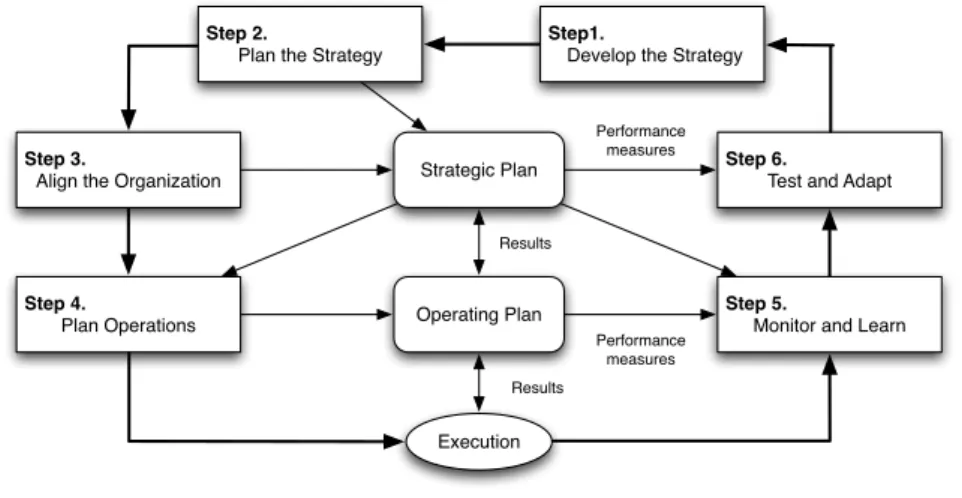
The strategy management system (Kaplan and Norton[2008]) is illustrated by:4
Step1.
Develop the Strategy
Step 2.
Plan the Strategy
Step 3.
Align the Organization
Step 4.
Plan Operations
Step 5.
Monitor and Learn
Step 6.
Test and Adapt
Execution Strategic Plan
Operating Plan
(Kaplan and Norton[2008],p.36. modified by authors)
Performance measures Results Results Performance measures
Figure 2: Closed Loop Strategy Management System (CLSMS)
The above system manages the strategy through Plan-Do-Check-Act(PDCA) cycle and is a closed loop system. We refer to this management system as Closed Loop Strategy Management System (CLSMS) thereafter. CLSMS is repeated every year. When a company introduces BSC into its business, it organizes BSC
3BSC is proposed by Kaplan and Norton[1992]. 4Kaplan and Norton[2008],p.36.
project team, which is responsible for BSC planning and execution. This team develops and plans the strategy in Step 1 and 2, executes the plan after Step 4, reviews the strategy in Step 5, and analyzes the profitability and adapts the strategy to the environment in Step 6.
Referring to the large company case, Kaplan and Norton[2008] says that top managements should always consider the changes of the strategy. For exam-ple, they execute minor changes of strategy every year, middle-scale changes of the strategy within three years, and drastic strategy changes once in five years.5Because the environment surrounding SMEs is likely to fluctuate rapidly,
it is necessary for top management of SME to consider the transformational strategy every year. Therefore we regard CLSMS as the effective tools for SMEs’ strategies and BSC.
When we introduced BSC into SMEs, we faced the serious difficulties in Step 1. Namely, we observed that many SMEs could not develop strategies appropriately. Analyzing some cases, we would like to look for the reason why it is difficult for SMEs to develop strategies.
4
Cases
We examine Company A whose business area is around Akita city in Japan.6This
company has introduced BSC since 2006. We describe the outline of this com-pany.
Outline of Company A
• Company A was established at 1973.
• Company A sales in 2010 is about 900 million yen($11.25 million).7
• The number of employees is about two hundred-fifty and the number of
executives is six.
• Company A is a franchise of Company D, which is a large company and
has many franchises all over Japan.
• Company A has two kinds of business, namely, one is a franchise business
and the other is non-franchise business. The former includes mop rental business for household and office, cleaning office, exterminating harmful insects, supporting housework, and so on. The latter includes temporary personnel service, sale of teaching materials and books, dispose of waste oil for restaurant, and so on.
5Kaplan and Norton[2008], pp.64-65.
6Akita city is at north-east of Japan. Its population is about 300 thousand and its local
market is relatively small.
• There are fourteen departments in Company A. Each department is
re-sponsible for one business described above and is evaluated as a profit center.
We would like to mention why we select the above case to make our analysis plausible. First, top managements of Company A are eager to introduce BSC. We often hear that BSC is failed because of the lack of top management initia-tive. We can exclude this reason from BSC failure reasons. It means that we can identify the causes of BSC failure clearly.
Second, Company A introduces BSC into fourteen departments and has executed BSC for about five years. Effectiveness of BSC should be evaluated from mid- or long-term perspective. It seems that five years execution of BSC is enough for our evaluation and examination. As each department has different BSCs and faces up to different market conditions, we can examine various kinds of BSC in our analysis at the same time.
Last, Company A had an excellent accounting system before BSC introduc-tion. So it has evaluated departmental performance based on the department monthly income statement and balance sheet. It implies that we can identify the results of BSC on internal financial data. Additionally, we can obtain non-financial data in consulting process. It will be beneficial to our future BSC research.
5
Case Analysis
We will pick up three departments cases and analyze these cases respectively in this section.
5.1
Case 1: Department X
Outline of Department X
• Business of this department is leasing mops for household. It is one of the
oldest departments in Company A and has operated for 40 years. It has been a main business of Company A but its performance has been not good for these years.
• Department X sales in 2010 is about 200 million yen($2.5 million). • The number of employee is seventy-five (four managers and seventy-one
salespersons).
• Economic conditions are changing. Main clients of this department are
housewives who use mops for their houses cleaning. Salespersons visit households periodically and sell products and service. Recently, house-wives tend to have jobs in Japan and are not always at their home. House-wives also can buy substitutes for mops at shopping center easily.
• We introduced BSC into this department but its performance has not been
improved.
Analysis of Department X
This case is an example of failure. We examine the reason why BSC does not work well here.
This department follows the parent company’s strategy. This strategy does not accommodate to the change of local market condition. We often see such a case. It is necessary for Department X to modify the parent company’s strategy to increase its profit but this department could not develop the effective strategy. It has been enough for departmental managers to operate their business based on the parent company’s strategy. They do not regard the strategy de-velopment as their job. Thus they had not had any opportunity to master the strategy development. As a result, they cannot develop a strategy even if they want to.
If they want to modify and develop the strategy, they have to get market research data. But they don’t have sufficient ability to collect data and cannot purchase the market research data because of shortage of fund. As a result, they plan the departmental budget under the inadequate strategy and they cannot accommodate to the environmental change.
This case shows the typical difficulty common to Japanese SMEs. Depart-ment X cannot develop strategy because it lacks human, informational, and organizational capital. Especially, the lack of competency for developing strat-egy is serious. It is difficult for this department to draw up effective BSC and annual budget. It implies that this department cannot cope with changes of local market.
5.2
Case 2: Department Y
Outline of Department Y
• Business of this department is cleaning of small offices and newly-built
houses. This department has been in business for 25 years.
• Department Y sales in 2010 is about 50 million yen($625 thousand). • The number of employee is twenty-two (two salespersons and twenty
work-ers).
• This department targeted at the market into which major building
mainte-nance companies have not made inroads. This is a niche market and this department had increased sales several years ago. But the orders from small offices and the number of newly-built houses decreased because of a long recession in Japanese economy. Sales of this department decreases and the departmental manager is interested in short-term profit.
• This department has three strategies, namely, “Cooperate with other
de-partments,” “Improve sales skills,” and ”Develop the original sales tools.” The first strategy denotes that every department exchanges its customer information with other departments. This strategy is effective in short-run. In fact, this department could obtain new clients and its profit had increased at the first year of BSC introduction. The second and third strategies are not effective in short-run but are significant for securing mid- or long-term profit. This department could not devote its resource to these strategies sufficiently at the first year of BSC introduction.
Analysis of Department Y
The serious problem of this department is that the departmental managers do not understand the role of BSC, namely, they regard BSC as the tool for obtaining short-term profit not as a tool for securing mid- or long-term profit. Thus they do not understand the significance of strategy development.
Though this department increased its profit by the strategy ”Cooperate with other departments” at the first year of BSC introduction, its profit declined drastically at second year. We identified two reasons for its low performance. First, the effect of ”Cooperate with other departments” is not sustainable. Other departments could introduce their customers to Department Y at the first year but they do not have new customers to be introduced at the second year. Second, the service quality of Department Y is poor. In fact, many clients made a complaint about the service provided by Department Y. If this department had supplied excellent service to new clients, this department might not lose new and existing clients and might obtain new clients. The departmental managers are prone to eager to achieve the short-term profit target and are satisfied with the first year result. Thus, they did not improve their service quality and seek new clients by themselves.
The basic cause of the second year’s slump is that departmental managers do not recognize the significance of the strategies though they have well-articulated two strategies. We had a in-house training for studying what is strategy and BSC at the beginning of the third year. In other words, we added ”Learning process” before Step 1 on CLSMS.
We observed that the departmental managers understood the purpose of BSC and the importance of strategy. They executed the two effective strategies, namely, ”Improve sales skills” and ”Develop the original sales tools.” Addition-ally, they developed a new strategy ”Improve the quality service by educating employees.” As a result, this department could recover performance at the third year.
This case shows that a department cannot develop appropriate strategy and BSC does not work well because of lack of human resource. We have often encountered the similar cases in our consulting process. We propose to add ”Learning process” to the beginning of CLSMS to overcome this difficulty and observe that our proposal is successful. It implies that addition of ”Learning process” may be effective to resolve the insufficiency of human capital in SMEs.
5.3
Case 3: Department Z
Outline of Department Z• Business of this department is exterminating harmful insects. It has
op-erated for about 15 years. Recently, Company A regard this department as promising business.
• Department Z sales in 2010 is about 20 million yen($250 thousand). • The number of employee is three. It is a small department. Everyone does
sales and exterminating jobs. One of them is a departmental manager.
• The market of this business is competitive and major companies have large
market share. The performance of this department has not been good for a long time.
• The departmental manager could not cope effectively with this difficulty.
Top management decided to replace this departmental manager with a young manager.
• We taught a new manager the importance of strategy and the purpose
of BSC at the beginning of the third year. Namely, we added ”Learning process” before Step 1 on CLSMS.
• A new manager devised a strategy of specializing in exterminating bees.
Special knowledge and skill is necessary to exterminate bees. As this department has such knowledge and skill, it could supply differentiated service to its clients. A new manager also found that there is a seasonal demand for exterminating bees from a local marketing research and it is effective to advertise before bee season.
• This business grows rapidly. The parent company D pays attention to
the growth rate of this department though it was notorious for its low performance.
Analysis of Department Z
The lack of human resource is also a problem in this case. We resolve this problem by replacing an existing manager with a new manager and educating a new manager. A new manager is a highly motivated person and learned a lot in our “Learning process.” As a result, he understands the importance of strategy and proposes a new strategy.
This is a special case because this department is very small but it tells us implication relevant to BSC introduction and execution. When the scale of de-partment is small, success of the dede-partment depends largely on the competence of a manager. As this case denotes, drastic organizational change, replacement of the manager, may be effective to complement the insufficiency of human re-source. This case also shows that educating a manager at the beginning of CLSMS is effective to the execution of BSC.
6
Summary and Conclusion
Examining several cases, we clarify difficulty with which many SMEs in Japan are confronted in this paper. Japanese SMEs do not have sufficient resources of human, information, and organization, which relate to “Learning and Growth” perspective of BSC. Thus SMEs cannot develop the strategies adaptive to their environment.
We also find that CLSMS proposed by Kaplan and Norton[2008] is useful for introducing and executing BSC in SMEs. Because SMEs have to compete against large enterprises and their rivals with insufficient resources and it is necessary for them to review and modify their strategies continuously depending on changes of environment.
We make a proposal to Company A to get rid of the above difficulty in our BSC consulting process. Our solution is simple, namely, adding “Learning process” at the beginning of CLSMS cycle. We observe that our proposal is effective to several cases, especially effective to small size department. Our findings show that managements and employees of SMEs are not incompetent but they have not had any opportunity to learn about strategy and BSC.
We have adopted a peculiar research approach in this study. Our research approach is similar to “innovation action research” proposed by Kaplan[1998] but is different in that a researcher does not participate in the process of chang-ing the practice. Though an academic researcher cannot involve in the decision processes of SMEs directly, researcher can give SMEs’ top managements sug-gestive ideas based on the recent academic research and receive the results of our proposals through practitioner. Thus we can propose practically applicable solutions to SMEs by our research approach. Our research results are robust because both academic and practical knowledge are reflected in our proposals.
Though CLSMS is an effective management tool of BSC for SMEs, we ob-serve that it is difficult for SMEs to execute CLSMS by the same procedure as Kaplan and Norton[2008] describes. Many SMEs compete in severe markets and not only long-term or mid-term results but also short-term results are impera-tive for them. It is difficult to change the mind of SMEs’ top managements and employees from short-term profit oriented to long-term profit oriented rapidly. Thus it is necessary to provide them with a procedure that enable us them to introduce BSC into SMEs step-by-step. We are now tackling this problem and will present the results in the future.
References
[1] Kaplan, R.S. 1998. Innovation Action Research: Creating New Management Theory and Practice. Journal of Management Accounting Research 10: 89-118.
[2] Kaplan, R.S. 2011. Accounting Scholarship that Advances Professional Knowledge and Practice. The Accounting Review 86(2): 367-383.
[3] Kaplan, R.S. and D.P. Norton. 1992. The Balanced Scorecard - Measures That Drive Performance, Harvard Business Review 70(2): 71-79.
[4] Kaplan, R.S. and D.P. Norton. 1996. The Balanced Scorecard: Translating
strategy into Action. Harvard Business School Publishing.
[5] Kaplan, R.S. and D.P. Norton. 2001. The Strategy-Focused Organization:
How Balanced Scorecard Companies Thrive in the New Business Environ-ment. Harvard Business School Publishing.
[6] Kaplan, R.S. and D.P. Norton. 2004. Strategy Maps. Harvard Business School Publishing.
[7] Kaplan, R.S. and D.P. Norton. 2006. Alignment. Harvard Business School Publishing.
[8] Kaplan, R.S. and D.P. Norton. 2008. The Execution Premium: Linking
Strategy to Operations for Competitive Advantage. Harvard Business School