at the Real Alto Site in Coastal Ecuador
著者
Kanomata Yoshitaka, Tabarev Andrey V., Popov
Alexander N., Lazin Boris V., Marcos Jorge G.
journal or
publication title
Bulletin of the Tohoku University Museum
volume
18
page range
11-29
year
2019-03
Flake Tool Functions in Early Ceramic Culture at the Real
Alto Site in Coastal Ecuador
Yoshitaka Kanomata
1), Andrey V. Tabarev
2), Alexander N. Popov
3), Boris V. Lazin
3)and
Jorge G. Marcos
4)1) Tohoku University, Japan
2) Institute of Archaeology and Ethnography, Novosibirsk, Russia 3) Fareastern Federal University, Vladivostok, Russia
4) Escuela Superior Politécnica del Litoral, Guayaquil, Ecuador
Introduction
The tropical forest environment sustained ancient occupants in coastal Ecuador in South America. Called “Las Vegas,” the first such culture has been thoroughly studied based on archaeological artifacts, natural remains, and features such as burials and shell mounds. Based on radiocarbon dating from Las Vegas site OGSE-80 on the Santa Elena Peninsula, the culture first developed around 10,800 BP (un-calibrated) and ended around 6,600 BP (Stothert et al. 2003). The local subsistence system was efficiently adapted to an ecologically complex environment along the tropical coast after occupants transitioned to a sedentary lifestyle. A nearby preceramic midden contained shells, animal bones, artifacts, charcoal, phytoliths, and pollen. This indicates that subsistence was generally based on hunting, gathering, and fishing with later developments exhibiting experimental plant domestication. Stothert (1985) concluded that early Las Vegas inhabitants concentrated on finding land animals such as deer before later integrating fishing activities. Locals were also using bottle gourds (Lagebaria siceraria) as early as 10,000 BP. The bony remains of fish and mammals from the early and late Las Vegas periods found at Site 80 indicate that occupants consumed both large and small mammals (e.g., deer, rodents, and opossum) in addition to fish during the early phase, but later consumed more fish (Stothert et al. 2003). Further, the composition of molluscan remains provides evidence of an increase in the use rock-subsisting species and a decrease in the gathering of estuarine and mangrove species. These strategic changes were likely adaptations based on environmental changes during the Terminal Pleistocene and Early Holocene.
The earliest known ceramic culture, Valdivia, was discovered at one of the most famous sites in Formative
Ecuador (Estrada 1956). B. J. Meggers and C. Evans conducted extensive scientific investigations in this area. They determined that the Valdivia culture existed from approximately 5,000 to 3,500 BP. There thus appears to be a period of inactivity in the archaeological sequence between the Las Vegas and Valdivia settlements. The Valdivian people have been interpreted as agriculturalists that arranged a larger village with an open central plaza, monumental architecture on a mound, and peripheral domestic dwellings. Drastic village developments occurred during phase III of the Valdivia pottery chronology. We thus posit that there were several epochs in the Early Formative period in coastal Ecuador.
This paper precisely compares lithic tool functions from the preceramic and early ceramic periods according to changes in settlement and subsistence strategies at the Real Alto site. The authors excavated many lithic materials at Real Alto from 2014 to 2017. These were dated to the preceramic and early ceramic periods. This collection was therefore the most suitable for use in this study.
Background to the Preceramic and Early Ceramic
Periods in Coastal Ecuador
Practical investigations at the Valdivia, Loma Alta, and Real Alto sites have revealed physical evidence about the settlement and subsistence processes of the Valdivia culture. Starch and phytolith analyses on stone grinding tools and potteries at the Real Alto and Loma Alta sites revealed a high relative frequency of plant foods (e.g., maize, jack beans, and chili peppers), thus indicating the common domestic use of cultivated plants during the early Valdivia phase (Pearsall et al. 2004, Zarillo et al. 2008). This is sufficient information for interpreting the functions of local potteries and stone grinding tools.
Although archaeological investigations have found significant evidence of numerous fruits in prehistoric coastal Ecuador, there are several problems concerning the related settlement and subsistence strategies. The first is the gap between the Las Vegas and Valdivia periods. The authors also discovered an earlier settlement at the Real Alto site in 2014 (Tabarev et al. 2016). Preceramic sediment was recognized below the early Valdivia cultural layer containing Valdivia I-II potteries. Charcoal from this layer was radiocarbon dated to 5800 +/-30 BP (Table 1). We must therefore reconsider whether items older than 5,000 BP at the Real Alto site can be attributed to preceramic sediments or if pottery was introduced at Real Alto later than at other sites.
The second problem is the lack of a precise date for the emergence of pottery in Ecuador. Three radiocarbon dates were determined based on charred ceramic residues at Loma Alta from 4470 +/-40 to 4460 +/-40 BP (Zarillo et al. 2008), while three dates were determined from a charcoal and two charred inner-ceramic residues at Real Alto from 4620 +/-30 to 4450 +/-30 BP (Tabarev et al. 2016). Thus, there are no known dates from charred ceramic residue older than 5,000 BP. This makes it necessary to determine a precise date for the emergence of pottery in Ecuador.
The third problem is related to pottery function. That is, starch analyses from potteries contradict stable isotope measurements from food residues (the 13C/12C ratios of charred inner-ceramic residues containing maize starch at Loma Alta range from -24.8 to -25.0). These values indicate that residues were basically composed of C3 plants other than maize and/or land animals (Hart et al. 2007). Any evaluations must be based on starch and phytolith analyses as well as stable isotopic measurements of pottery residues. The fourth problem involves stone tool function. Starch/ phytolith analyses of stone grinding tools (i.e., metate and
mano) were conducted at the Valdivia, Real Alto, and Loma Alta sites. Results indicated that the systematic cultivation of maize emerged around 5300 – 4950 cal BP. However, the functional analysis of local flake tools was insufficient. The
authors analyzed lithic function using a high power approach (Keely 1980) and presented primary results (Kanomata et al. 2014, Tabarev and Kanomata 2016). In this paper, we provide new information based on a use-wear analysis of flake tools excavated from the Real Alto site in 2015 and 2017 and summarize the functional tendencies of the early ceramic period.
Archaeological Research from 2014 to 2017
at the Real Alto site
New excavations were conducted at the Real Alto site by Russian, Ecuadorian, and Japanese archaeologists in 2014, 2015, and 2017. The first goal was to discover the oldest cultural layer from the early ceramic period. New trenches were thus established near trench C, where the oldest radiocarbon dates were recorded and the earliest potteries were unearthed (Figure 1). The investigations involved a multidimensional approach that included GIS mapping, paleogeography and landscape modeling, geo-radar scanning, physical anthropology and DNA analyses, lithic functional analyses, experimental archaeology, AMS dating, and paleofaunal analyses. A preceramic cultural layer was recognized for the first time at Real Alto in 2014. Two elongated trenches were established in the north and east in 2015. Since there were no traces of preceramic sediments (level 4), it was evident that the stratigraphy of the section most distant to the central unit was quite different from that of the central unit itself, which was enlarged in 2017. Finally, more than 5,000 pottery fragments were unearthed from a 104 square-meter section. Artifacts from Valdivia I-II comprised more than 80% of the total (Popov et al. 2017). However, pottery fragments from the fourth cultural level comprised less than 5% of the total. This implies that the fourth cultural level belonged to the preceramic period, but was contaminated by pottery fragments. In addition, more than 50% of the San Pedro pottery was found in the upper part of the fourth cultural level, while only 0.5% of the total pottery was found in the lower part. More than 16,000 lithic
Tab.1 Radiocarbon datermination of charcoal in preceramic layer at the Real Alto
IAAA-151361 5,790 ± 30 48.63 ± 0.17 5,798 ± 29 6655calBP - 6563calBP(68.2%) 6668calBP - 6504calBP(95.4%) Lab Number Data without δ13C Correction Age for Calibration(yrBP) Calibrated Age ( 1σ) Calibrated Age (2σ)
Age (yrBP) pMC (%)
Material Type
IAAA-151361 no.2
Real Alto site, Unit 1, N291W145 grid、Cleaning 3, Depth
-95cm 3rd layer charcoal AAA 69 -24.54 ± 0.56 5,800 ± 30 48.58 ± 0.18 Data with δ13C Correction Libby Age pMC (%) Lab
Number SampleCode Sample Provenance treatmentPre- recovery δCarbon 13C (‰) (AMS) Tab.1 Radiocarbon datermination of charcoal in preceramic layer at the Real Alto
tools were also unearthed from these trenches (the preceramic level contained more than 4,000).
Our excavations also found reamers made of sand stone (Figure 2) next to the Valdivia I-II potteries. Such tools had previously been referred to as “reamers for the manufacture of shell fishhooks” in previous studies at the Valdivia site (Meggers et al. 1965). Shell fishhooks were unearthed with reamers at this site, and were thus assumed to have a functional relationship. The reamers found in our excavation pits ranged from 74.2 to 42.6 mm in length and were between 25.6 and 25 mm wide. Since the diameters of the areas that contacted the worked material ranged from 24 to 31 mm, the diameters of all worked material holes were smaller. These items were manufactured by flaking/ knocking with a hummer stone before grinding was performed with a sanding stone. They were likely used with handles. There are now known items with morphologically similar characteristics to the reamers (i.e., stone rotary bearings from Neolithic Asia) (Tang eds. 2015). Rotary bearings were used to make nephrite rings beginning around 7,500 - 7,000 cal BP in northern China. Such tools spread to the south between 7,000 - 5,000 cal BP. They were then distributed more widely to the south and east between 4,000 - 2,500 cal BP. Rotary bearings are thought to have been used on the axes pipes of turn-tables with liquid lubricant. Such morphological similarities muse be examined from a functional perspective.
The authors also found four stone figurines that could be reconstructed to original size and forms (Figure 3). These figures were made from rectangular siltstone and mudstone before slits were placed on their shorter sides. There was no evidence of facial or female elements despite the existence of elaborate surface polishing. Sizes varied greatly, ranging from 72.5 to 15.5 mm in length (as if to reflect family members). While the morphological characteristics are known, precise manufacturing techniques must be determined using a microscope.
Although we found many important materials, this paper focuses on use-wear analyses of the flake tools excavated between 2015 and 2017 at the Real Alto site. This study was based on a functional investigation conducted by Kanomata at the Archaeological Museum of Real Alto (Museo
Arquelogico Real Alto) from October to November of 2017.
Fig.1 Excavation treches, glids and stratigraphy at the Real Alto site.
2014-2017
culturel level
Fig.3 Stone figurines at the Real Alto site .
1
2
3
4
5
6
Scale=2/3
Fig.3 Stone figurines at the Real Alto site . 1
Scale=2/3 2
3
4
Fig.2 “Reamer for the manufacture of shell fishhooks” at the Real Alto site.
Use-Wear Analysis of Lithic Tools at Real Alto in 2017
1) MethodsSince all materials were excavated by the authors in 2014, 2015, and 2017, the items of study were carefully selected just after discovery and cleaning (fig. 4, 5 and 6). The lithic flake tools found at the Real Alto site were made of chalcedony, chert, and quartzite. The authors examined these lithic artifacts for evidence of retouching, micro-flaking, and abrasion. The materials (N=46, Table 2) were then carefully examined under a metallurgical microscope (OLYMPUS BH). Smaller sections of the selected materials were excluded from functional analyses because of unsuitable conditions. Because most lithic artifacts showed no apparent traces of wear, only seven flake tools with relatively distinct and diagnostic signs of use-wear polish were found (Table 4). A polished tool and two stone figurines were also subjected to use-wear analyses. Micro-wear polishing was determined based on a standard microscopic investigation using 100, 200 and 400X magnification power. Systematic analyses of lithic function were then conducted using the Keely method or the high power approach to identify worked materials and operations (Keely 1980, Akoshima 1989).
2) Results
Morphological reamers for the manufacture of shell fishhooks were made of rough sand stones except for one instance of basalt (no.1). Since sand stone tools are unsuitable for use-wear analysis, the basalt reamer was observed under a microscope. Flat polishing marks with parallel striations were identified on both sides of the reamer. Although the parallel striations were detectable with the naked eye, the polished zones were limited (Figure 8, no.1). The polished areas were characterized by limited distributions at higher elevations, flat/smooth reflections, clear borders, and apparent striations (fig.8-1, 2, 3 and 4). These characteristics indicate that these areas were worked with harder materials such as shell, bone, antler, or wood. A relatively curved and domed polish was present as seen in Figure 8-3. In contrast, flatter surfaces were in areas such as those seen in Figure 8-4. The material of the former is assumed to have been wood, while the latter seems to have been bone, antler, or shell. Shell polishing is typically flatter than bone or antler polishing and produces many severe striations and occasionally results in surface cracking. Such cracking is absent from the polish seen on this tool. Harder materials (e.g., stone) would have resulted in flatter and wider polished areas. My experiments indicate that a very similar type of polish can be produced using hard wood in wet conditions. If these artifacts were used for wood workings, then it is inaccurate to refer to them as “reamers for the manufacture of shell fishhooks.” Rather, rotated tools
of this type would make continuous contact with wooden objects in 20 mm diameter holes. However, it is impossible to precisely classify this polish on unusual raw material based on such experimentation.
The stone figurines exhibited abraded surfaces with linear striations (Figure 8-5, 6, and 7). Although the striations were observed in random formations, those on the inner legs of the figurines were in parallel configurations because of the carved slit (Figure 8-8).
Unretouched flake no. 23 exhibited traces of use such as those seen in Figure 9-1 and 2. It contained a polish characterized by a bright, smooth, curved, and domed surface. We classified this as a B-type polish, which is strongly connected with woodworking. A wider polishing was distributed on the edge of the dorsal surface. The dorsal face of this flake tool was thus in continuous contact with wood during use. Vertical striations and polishing were produced by whittling or scraping in a transverse motion. Wear can easily be seen on this flake tool because a higher quality of chert was used.
Flake no. 38 has extremely rounded and abrasive edges on both sides (Figure 9-3, 4, 5, and 6). The used surface is relatively rough due to micropitting that appears to have resulted from sandstone/siltstone cutting/sawing activities in longitudinal motions. This flake thus appears to have been used to make the slit in the stone figurine shown in Figure 3. The raw material is very hard chalcedony that was suitable for cutting hard materials such as siltstone.
Typological end scraper no. 22 contains three independent use zones on its distal end. Each polished area is situated independently at the center of a concave edge formed by a removal stroke. Three concave edges thus constitutes a denticulate edge. Such polishing is characterized by bright/ smooth/flat/pitted surfaces and limited distributions on the higher relative elevations (Figure 9-7 and 8). This typological end scraper is thus regarded as denticulate from a functional viewpoint.
Perforator no. 50 exhibits a bright, flat, and smoothly polished tip. The manufacturer retouched the tool to form a drilling tip, which was efficiently simplified using the original flake form. A polished area is distributed along the ridges between removal faces (Figure 10-1, 2, 3, and 4). The polished surfaces were very flat and smooth except for occasional cracking and intense striations. These elements indicate that a hard working material was applied, such as ivory, shell, or stone. The nature of the polishing implies that it was conducted in wet conditions.
B-type wood polishing was recognized on two flake tools (nos. 58 and 31) (Figure 10-5, 6, 7, and 8). Primitive use-wear formations reflect a lower degree of usage. No. 31 was likely used for cutting/sawing, while no. 58 was likely used for scraping/whittling.
Tab.2 Object of use-wear analysis
Trench No. Grid Layer Tool type Length (mm) Width (mm) Thickness (mm) Raw material
1 N305/W146 1 reamer 5 2.5 2.24 basalt
8 N302/W146 1 retouched flake 4.25 2.6 1.32 chert
10 N293/W146 1 drill 4.45 1.41 0.79 charcedony
14 N294/W146 2 retouched flake 3.25 2.04 0.64 charcedony
15 N308/W146 2 retouched flake 3.56 2.84 1.11 charcedony
16 N308/W146 2 retouched flake 1.81 1.85 0.85 charcedony
17 N308/W146 2 flake 3.38 1.9 0.98 charcedony
18 N295/W146 2 flake 4.06 3.54 1 charcedony
19 N298/W146 2 flake 4.14 3.04 1.58 charcedony
21 N305/W146 2 core 4.11 3.73 2.87 charcedony
22 N296/W146 2 end scraper 4.29 3.09 1.14 charcedony
23 N298/W146 2 flake 5.88 2.99 1.47 chert
24 N309/W146 2 flake 3.33 5.3 0.85 charcedony
25 N299/W146 2 retouched flake 3.05 2.93 0.82 charcedony
27 N307/W146 3 flake 3 2.33 1.33 charcedony
28 W299/W146 3 flake 3.06 2.43 0.98 charcedony
29 W309/W146 3 flake 3.17 3.47 0.78 chert
30 N288/W127 1 retouched flake 3.96 3.06 1.29 charcedony
31 N288/W127 1 flake 3.76 2.93 1.18 charcedony
32 N288/W132 1 drill 4.67 2.43 0.97 charcedony
33 N288/W132 1 flake 2.75 1.73 0.88 chert
34 N288/W129 bank1 flake 2.39 2.87 0.56 chert
35 N288/W124 1 drill 3.1 1.61 0.81 charcedony
36 N288/W124 1 piece esquie 4.73 4.01 1.93 charcedony
37 N288/W134 1 hummer stone 4.65 2.54 1.8 charcedony
38 N288/W126 2 flake 4.53 3.32 0.86 charcedony
39 N288/W126 2 notch 2.22 2.38 1.69 chert
40 N288/W126 2 piece esquie 2.63 1.33 0.53 charcedony
41 N288/W133 2 drill 2.41 0.75 0.53 charcedony
42 N289/W133 2 drill 2.28 0.78 0.45 charcedony
43 N288/W135 2 axe 4.83 4.26 1.45 diorite
44 N288/W135 2 grinding stone 2.1 5.36 0.68 sand stone
45 N288/W140 2 flake 2.17 2.26 0.77 charcedony
46 N289/W132 2 drill 2.92 0.87 0.5 charcedony
47 N289/W132 2 drill 2.44 0.75 0.37 charcedony
49 N288/W140 2 denticulate 3.86 3.43 1.75 charcedony
50 N288/W132 2 drill 4.03 2.54 1.15 charcedony
52 N288/W127 2 end scraper 2.17 2.24 0.79 chert
53 N288/W125 2 scraper 3.13 2.27 1.25 chert
54 N288/W132 2 piece esquie 3.17 1.36 0.46 charcedony
55 N288/W133 2 flake 4.93 4.04 1.28 charcedony
56 N288/W133 2 flake 3.87 3.1 1.38 chert
57 N288/W137 2 hummer stone 6.4 5.91 2.86 charcedony
58 N288/W138 2 drill 4.18 1.7 0.46 charcedony
59 N288/W140 3 flake 4.39 4.15 0.95 charcedony
2017unit 60 N294/W195 bank3 flake 4.39 3.81 1.06 charcedony
East North
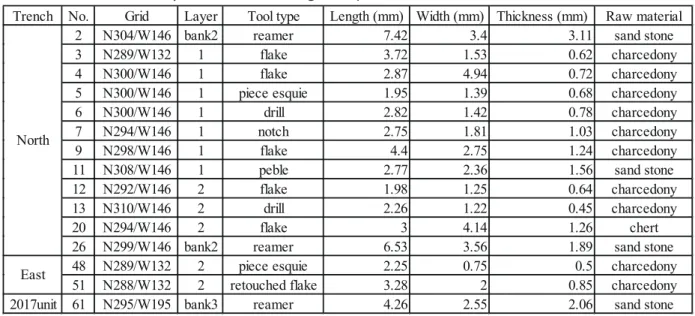
Tab.3 Other artifacts analyzed from technological aspect.
Trench No. Grid Layer Tool type Length (mm) Width (mm) Thickness (mm) Raw material
2 N304/W146 bank2 reamer 7.42 3.4 3.11 sand stone
3 N289/W132 1 flake 3.72 1.53 0.62 charcedony
4 N300/W146 1 flake 2.87 4.94 0.72 charcedony
5 N300/W146 1 piece esquie 1.95 1.39 0.68 charcedony
6 N300/W146 1 drill 2.82 1.42 0.78 charcedony
7 N294/W146 1 notch 2.75 1.81 1.03 charcedony
9 N298/W146 1 flake 4.4 2.75 1.24 charcedony
11 N308/W146 1 peble 2.77 2.36 1.56 sand stone
12 N292/W146 2 flake 1.98 1.25 0.64 charcedony
13 N310/W146 2 drill 2.26 1.22 0.45 charcedony
20 N294/W146 2 flake 3 4.14 1.26 chert
26 N299/W146 bank2 reamer 6.53 3.56 1.89 sand stone
48 N289/W132 2 piece esquie 2.25 0.75 0.5 charcedony
51 N288/W132 2 retouched flake 3.28 2 0.85 charcedony
2017unit 61 N295/W195 bank3 reamer 4.26 2.55 2.06 sand stone
North
East
Tab.3 Other artifacts analyzed from technological aspect.
Layer No.
Lithic
type
Material
type
position
polish type
material
worked
Striation identification
degree
Usage
1 reamer fine stone
both tips
B (or D1)
wood
vertical perforating heavy
31
flake charcedony
ventral, right,
low
B
wood
parallel
cutting
middle
35
drill
charcedony
tip
B or D1
bone/horn
wood or
vertical perforating
light
22
scraper
end
charcedony
notched areas
on distal end
D1
shell
vertical
whittling
light
23
flake
chert
edge, middle
dorsal, right
B
wood
vertical
scraping/
whittling
heavy
24
flake charcedony
-
not used
25
flake charcedony
-
not used
38
flake charcedony
both sides
stone
soft stone parallel
cutting
heavy
50
drill
charcedony
pit
D1
ivory/shell
or stone
vertical perforating heavy
55
flake charcedony
-
not used
58
flake charcedony
flat edge on
distal end
B or D1
bone/horn
wood or
?
scraping/
whittling
light
2
1
Tab. 4 Use traces on lithic tools at the Real Alto site in 2015 and 2017.
Fig.4 Lithic artifacts from the 1st layer at the Real Alto site in 2015. Trench E:1-10, trench N: 30-37
1
2
3
4
5
6
7
8
9
10
30
31
32
33
34
35
36
37
Scale=2/3
Fig.5 Lithic artifacts from the 2nd layer at the Real Alto site in 2015. Trench N: 12-26
12
13
14
15
16
17
18
19
20
21
22
23
24
25
26
Scale=2/3
Fig.6 Lithic artifacts from the 2nd layer at the Real Alto site in 2015. Trench E: 38-58
38
45
39
40
41
42
43
44
46
47
48
50
49
53
54
52
55
56
57
58
Scale=2/3
Fig.7 Lithic artifacts at the Real Alto site. 31 Scale=2/3 34 35 22 23 24 25 38 50 55 58
1 wood polish and parallel striation (x200)
6 abrasion and parallel striation (x200)
7 abrasion and vertical striation (x200)
8 abrasion and parallel striation (x200) △
7
△8
△1
△3
△4
△2
2 wood polish and parallel striation (x200)
3 wood polish and parallel striation (x200)
4 wood polish and parallel striation (x200)
△
5
△
6
5 abrasion and parallel striation (x200)
Fig.8 Use-wear on lithic artifacts at the Real Alto site in 2015 and 2017. no. 1
SF. 2
SF. 1 Scale=50%
1 wood polish and vertical striation (x200)
6 abrasion and parallel striation (x100)
7 abrasion and vertical striation (x200)
8 abrasion and vertical striation (x200)
△
7
△8
△
1
△2
2 wood polish and vertical striation (x200)
3 abrasionand parallel striation (x200)
4 abrasion and parallel striation (x200)
5 abrasion and parallel striation (x200) △
6
△4
△3
△5
Fig.9 Use-wear on lithic artifacts at the Real Alto site in 2015. no. 23
no. 38
no. 22 Scale=50%
1 Polish and vertical striation (x200)
6 wood polish and parallel striation (x200)
7 wood polish and parallel striation (x200)
8 wood polish and parallel striation (x200)
2 Polish and vertical striation (x200)
3 Polish and vertical striation (x200) 4 Polish and vertical striation (x200)
5 wood polish and parallel striation (x200) △
4
△3
△2
△1
△5
△6
△7
△8
Fig.10 Use-wear on lithic artifacts at the Real Alto site in 2015. no. 50
no. 58
no. 31 Scale=50%
Summary and Further Prospects
The authors previously discussed functional analysis results from the Las Vegas (Kanomata et al. 2014) and Real Alto (Tabarev and Kanomata 2015) sites. The lithic materials at the Las Vegas and fourth-level Real Alto sites can be attributed to the preceramic period based on non-apparent use-wear caused by light activities involving bone/antler, hide, and shell. On the other hand, apparent wear patterns were observed on the early ceramic period lithic tools at the Real Alto site. Developed use-wear was observed on 50% of all utilized stone tools. Furthermore, worked material diversity was formed due to the additions of wood and stone.
Since this timing is parallel to the emergence/actual existence of pottery in coastal Ecuador, these aspects likely indicate that many craftworks were simultaneously developed according to changes in economic/social systems during the formation of bigger settlement villages in the area. We therefore reemphasize the efficient technology of the “Tropical Package” (Tabarev and Kanomata 2016). Although lithic manufacturing technology was not very developed despite the social and economic changes seen during the Las Vegas and Valdivia cultures, the produced lithic tools were sufficient for coping with increasing applications and use. They were manufactured for a short time using direct percussion. This was due to a lack of complex flaking strategies. Several tools without elaborate secondary retouching were used to produce a variety of distinct craftworks (e.g., wood, shell, bone, antler, and stone works) over a long-term working cycle during the early ceramic period at Real Alto. This evidence implies that a wide range of materials were used as raw materials to create practical tools in the early Valdivia culture.
Acknowledgement
Researches were supported by Grants-in-Aid for Scientific Research from the Japan Society for the Promotion of Science (No. 16K03149 and 16KK0020).
References
Akoshima, K. 阿子島香 (1989) 『石器の使用痕』ニューサイ エンス社
Binford, L. R. (1979) Organization and formation processes: Looking at curated technologies. Journal of
Anthropological Research, vol. 35(3), pp. 255-273. Estrada, E. (1956) Valdivia, un sitio arqueológico formative
en la costa de la Provincia del Guayas, Ecuador.
Publicación del Museo Victor Emilio Estrada, no. 1. Estrada, E., B. J. Meggers and C. Evans. (1962) Possible
transpacific contact on the coast of Ecuador. Science,
vol. 135 (3501), pp. 371-372
Feldman, R. A. and Moseley, M. E. (1983) The Northern Andes. Ancient South Americans. Edited by Jennings, J. D. pp.139-177
Hart, P. J., W. A. Lovis, J. K. Schulenberg and G. R. Urquhart (2007) Paleodietary implications from stable carbon isotope analysis of experimental cooking residues.
Journal of archaeological science, 34, pp. 804-813 Kajiwara K. and K. Akoshima 梶原洋・阿子島香 (1981)「頁
岩製石器の実験使用痕研究-ポリッシュを中心とした 機能推定の試み-(東北大学使用痕研究チームによる 研究報告 その2)」『考古学雑誌』67(1)pp. 1-36 Kanomata, Y., Tabarev, A. V., Tabareva, J. V. and Stothert,
K. E. (2014) Functional analysis of prehistoric artifacts from coastal Ecuador. Bulletin of the Tohoku University
Museum, No.13, pp.31-42
Keeley, L. H. (1980) Experimental Determination of stone
tool Uses. University of Chicago Press.
Marcos, G. J. (1988) Real Alto: La Historia de un Centro
Ceremonial Valdivia (Primera parte, Segunda parte).
ESPOL.
Meggers, B. J. and C. Evans. (1966) A transpacific contact in 3000 B.C. Scientific American, vol. 214-1, pp.28-35. Meggers, B. J., C. Evans and E. Estrada. (1965) Early
formative period of coastal Ecuador: the Valdivia and Machalilla phases. (Smithsonian Contributions to Anthropology vol.1.)
Pearsall, D. M., K. Chandler-Ezell and J. A. Zeidler (2004) Maize in ancient Ecuador: results of residue analysis of stone tools from the Real Alto site. Journal of
Archaeological Science, 31, pp. 423-442.
Popov, A., A. Tabarev, B. Lazin and M. Rudenko (2017) Real
Alto-Old and New Questions, Excavations of 2014-2015, 2017- Various Models of Neolithization. (Handbook at Real Alto 2017.)
Stothert, K. E. (1985) The preceramic Las Vegas culture of coastal Ecuador. American Antiquity. vol. 50, pp.613-637.
Stothert, K. E. (2011) Coastal resources and the early Holocene Las Vegas adaptation of Ecuador. In: Trekking
the Shore. Changing Coastlines and the Antiquity of Coastal Settlement. New York: Springer, pp.355-383. Stothert, K. E., D. R. Piperno, and T. C. Andres (2003)
Terminal Pleistocene/Early Holocene human adaptation in coastal Ecuador: the Las Vegas evidence. Quaternary
International, vol.109-110, pp.23-43.
Tabarev A.V., Kanomata Y. 2015. “Tropical package”: Peculiarities of the lithic industries of the most ancient cultures, coastal Ecuador, Pacific basin. Archaeology,
Ethnology & Anthropology of Eurasia, 43 (3): 64-76. Tabarev A.V., Kanomata Y., Marcos J.G., Popov A.N. Lazin
coastal Ecuador: New evidence and radiocarbon dates from the Real Alto site // Radiocarbon, DOI: 10.1017/ RDC.2015.23, Published online: 13 January 2016. Tang C. eds. 鄧 聰 編 (2015) 『澳門黒沙史前輪軸機械
国際会議論文集』
Vaughan, P. C. (1985) Use-wear analysis of flaked stone
tools. The University of Arizona Press.
Zarrillo S. et al. (2008) Directly dated starch residues document early formative maize (Zea mays l.) in tropical Ecuador. PNAS, April 1, 2008, vol. 105 no. 3, pp. 5006-5011
エクアドル沿岸部のレアルアルト遺跡における前期土器時代
の剥片石器の機能
鹿又喜隆
1)・アンドレイ V. タバレフ
2)・アレクサンダー N. ポポフ
3)・ボリス V. ラジン
3)・
ホルヘ G. マルコス
4) 1) 東北大学 2) ロシア科学アカデミーシベリア支部考古学民族学研究所 3) ロシア・極東連邦大学 4) エクアドル・沿岸工科大学導入
熱帯林環境はエクアドル沿岸部の古代人を育んだ。「ラス ベガス」と呼ばれるその最初の文化は、考古学的な人工遺 物や自然遺物、埋葬、貝塚などの遺構から再構築された。 この文化は、ラスベガス OGSE-80 遺跡の放射性炭素年代に 基づくと、約 10,800 年14C BP(非較正 ) に始まり、 約 6,600 BP に終わる(Stothert et al. 2003)。人々が定住的な生活ス タイルに移る過程で、その地域の生業システムは熱帯沿岸 部の生態的に複雑な環境に効果的に適応していった。貝や 動物骨、遺物、炭化物、プラントオパール、花粉を含む先 土器時代のマウンドは、彼らの生業が狩猟、採集、漁労によっ て基本的に構成され、後に初期的農耕の発達を伴うことを 示している。K. Stothert(1985)は、前期ラスベガスの人々 がシカなどの陸棲動物の探索に集中し、後に漁労活動がよ り多く行われるようになったと結論付けた。さらに、ヒョ ウタン(Lagebaria siceraria)は、約 10,000 BP には早くも 利用されていた。80 遺跡のラスベガスの前期から後期にか けての堆積物における魚や哺乳類の骨資料によれば、居住 者は前期には大型・小型哺乳動物(シカ、げっ歯類、フク ロネズミなど)と魚類が共に消費され、後期にはより多く の魚を獲るようになった(Stothert et al. 2003)。ラスベガ ス期における軟体動物遺体(貝類など)の構成は、岩礁性 種の利用の増加と河口・マングローブ棲種の採集の減少の 証拠を提示した。これらの戦略の変化は、更新世末期と完 新世初頭の間の環境変化への適応行動とみなされる。 バルディビア遺跡で発見された最初の土器文化「バル ディビア」は、エクアドル形成期の遺跡の中でも最も有名 な文化のひとつである(Estrada 1956)。B. J. Meggers と C. Evans は科学的調査を実行し、約 5,000BP から約 3,500 BP までがバルディビア文化であることを明らかにした。した がって、ラスベガスからバルディビアへの考古学的連続性 において一つの断絶が認められる。バルディビアの人々は、 中央広場とその周辺の家庭的住居を伴うより大きな村落を 整備した農耕民であると解釈されてきた。集落の急激な発 展がバルディビア土器編年の 3 期に生じた。したがって、 我々はエクアドル沿岸部の形成期前期に幾つかの画期を認 めることができる。 本論は、レアルアルト遺跡における居住・生業戦略の変 化に応じた、先土器時代と前期土器時代の間の石器の機能 の正確な比較を目的とする。筆者らは、2014 ~ 2017 年に レアルアルト遺跡の発掘調査区において膨大な石器を発掘 した。さらに、それらは基本的に先土器時代と前期土器時 代の年代である。したがって、この資料は本研究に最も適 したものである。 和文要旨エクアドル沿岸部の先土器時代と前期土器時代
に関する背景
バルディビア、ロマアルタ、レアルアルト遺跡における 実践的研究は、バルディビア文化における居住・生業戦略 の発展に関する具体的な証拠を明らかにした。レアルアル トとロマアルタ遺跡の磨製石器と土器のデンプンとプラ ントオパールの分析によれば、植物食料(トウモロコシや ジャック豆、チリペッパーなど)の高い相対頻度は、前期 バルディビア期における栽培植物の一般化した家庭的利用 を示している(Pearsall et al. 2004, Zarillo et al. 2008)。そして、 これは土器と磨製石器の機能を解釈するための十分な情報 である。 先史時代のエクアドル沿岸部での考古学的調査のたくさ んの成果があるけれども、居住・生業戦略に関する幾つか の問題がある。ひとつめは、ラスベガス期とバルディビア 期のギャップである。筆者らは、レアルアルト遺跡でより 古い居住痕跡を発見した(Tabarev et al. 2016)。その先土器 時代の居住は、バルディビア 1 - 2 期の土器を含む前期バ ルディビア文化層の下位に認められた。この層から出土し た炭化物が放射性炭素年代測定の対象となり、その年代が 5800 ± 30 BP と測定された(表 1)。したがって、レアルア ルト遺跡の 5000BP よりも古い年代が先土器時代の堆積物に 属するのか、あるいはレアルアルトへの土器の導入が他の 遺跡の場合よりもより新しいのかどうかを、我々は考慮し なければならない。 二つ目は、エクアドルの土器出現に関する正確な年代の 不足である。我々はロマアルタ遺跡の土器付着炭化物 3 点 の放射性炭素年代(4470 ± 40 ~ 4460 ± 40 BP)を知って おり(Zarillo et al. 2008)、レアルアルト遺跡では 2 点の土 器付着炭化物の年代(4620 ± 30、4450 ± 30 BP)を得た (Tabarev et al. 2016)。つまり我々は 5,000 BP より古い土器 付着炭化物の年代を未だ知らない。そのため、共伴炭化物 の場合にはコンタミのおそれや、同時性の保証の問題があ る可能性があるので、我々はエクアドルにおける土器出現 の正確な年代を把握する必要がある。 土器の食料残滓を対象としたデンプン分析と安定同位体 比分析の間には矛盾があるため、3 つ目の課題は土器の機 能の解明である。ロマアルタにおけるトウモロコシのデン プン粒を含む土器内面付着残滓は、13C/12C 比で -24.8 ~ -25.0 であった。これらの値は、その残滓がトウモロコシで はなく、C3 植物や陸棲動物から基本的に成ることを表して いる(Hart et al. 2007)。我々は、土器残滓のデンプンやプ ラントオパール分析だけでなく、安定同位体比測定も利用 して総合的に評価しなければならない。 4 つ目は、石器の機能である。バルディビアやレアルアル ト、ロマアルタ遺跡のメタテやマノなどの磨製石器のデン プン・プラントオパール分析が実施された。これらの研究 は、トウモロコシのシステマティックな農耕が少なくとも 5,300 ~ 4,950 年前までに出現したことを表している。それ に対して、剥片石器の機能分析が十分に実践されていない。 筆者らは、高倍率法(Keely 1980)を使った石器機能分析 を行い、初期的な結果を示している(Kanomata et al. 2014, Tabarev and Kanomata 2016)。我々は、今回、レアルアル トの 2015 年と 2017 年の調査で出土した剥片石器を分析し、 前期土器時代における剥片石器の機能について、総括する。2014 ~ 2017 年のレアルアルト遺跡における
考古学的調査
2014、2015、2017 年にレアルアルト遺跡における新たな 発掘がロシア・エクアドル・日本の考古学者によって実行 された。最初の目的は、前期土器時代の最古の文化層を発 見することである。したがって、新たなトレンチは、最古 の放射性炭素年代が記録され、70 年代の調査で最古段階の 土器が出土したトレンチ C の近くに設けた(図 1)。調査に は GIS マッピングや景観モデリングなどの古地形学、地下 探査、形質人類学と DNA 分析、実験考古学、使用痕分析、 AMS 年代測定、古生物学分析などの多面的な分析が導入さ れた。2014 年には本遺跡で初めて先土器文化層の存在が認 識された。2015 年には 2 つのトレンチが北と東へと延長さ れた。中央の調査区から離れた所では、先土器時代の堆積 物(level 4)の痕跡がなかったので、そのような場所の地 層が中央調査区のそれとは異なっていることを我々は理解 した。2017 年には、この中央調査区が拡張された。最終的 に、5000 点以上の土器片が 104㎡から出土し、バルディビ ア 1-2 期のものが全体の 80% 以上を占めている(Popov et al. 2017)。さらに、第 4 文化層からの土器片は、全体の数 の 5% 未満である。それは、わずかなコンタミがあるもの の、第 4 文化層が先土器時代に属する可能性を示唆してい る。さらに、サンペドロ土器の 50% 以上は、第 4 文化層上 半に含まれている。土器全体の 0.5% しか第 4 文化層の下半 には含まれていない。石器に関しては、16000 点以上が我々 の調査区から出土し、先土器文化層には 4000 点以上が含ま れている。 我々の調査は、バルディビア 1-2 期の土器に伴う、砂岩 製の穿孔具など新たな遺物を提供した(図 3)。これらの 道具は、バルディビア遺跡における先行研究によって「貝 製釣針製作のための穿孔具」と呼ばれた(Meggers et al. 1965)。貝製釣針は穿孔具と一緒に出土し、機能的関係をも つと考えられた。我々の調査区から出土した穿孔具の長さ は、74.2 ~ 42.6 mm であり、その幅は 35.6 ~ 25 mm である。 被加工物との接触範囲の直径が 24 ~ 31㎜なので、被加工 物の穴の直径はそれより小さかった。それらは、石のハン マーを使った剥離と敲打の後、砂岩を用いた研磨で作られ た。それらは、柄をつけて使われたに違いない。現在、我々は、これらの穿孔具について形態的な類品を知っている。例え ば、アジア新石器時代の石製ロクロ軸である(鄧編 2015)。 ネフライトのリングを作るために使われたロクロ軸は、約 7500 ~ 7000 年前に中国北部に出現した。この種の道具は、 7000 ~ 5000 年前にかけて、南方へ広がり、その後、4000 ~ 2500 年前にかけて、南や東へより分布を拡大した。ロク ロ軸は回転テーブルとの間に潤滑油を介在させ、中軸パイ プの中で軸芯として使われたと推定される。このような形 態的な類似性については、機能的観点から検討されなけれ ばならない。 筆者らはまた元々のサイズと形を復元できる 4 点の石偶 を発見した(図 3)。長方形のシルト岩や泥岩がその製作の ために選ばれ、短辺の中央に 1 つの切れ込みが入れられた。 表面の入念な研磨にも関わらず、顔や女性要素の表現が無 い。そのサイズは長さ 72.5 ~ 15.5mm とバラエティーがあ り、まるで一家族の構成員を反映しているかのようだ。 上記のように、我々は多くの重要な資料を見つけたけれ ど、本論は 2015 年と 2017 年に発掘された剥片石器の使用 痕分析に特に焦点を当てている。この研究は、筆者のひと り(鹿又)が 2017 年 10 ~ 11 月にレアルアルト考古学博 物館(Museo Arquelogico Real Alto)で実施した石器機能 研究の結果である。
2017 年のレアルアルトでの石器使用痕分析
1) 方法 資料の全てが筆者らによって 2014、2015、2017 年に発 掘されたので、対象資料は発見され、洗浄された直後に、 注意深く選択された(図 4~6)。筆者らは石器を観察し、 二次加工や微小剥離痕、摩滅がある石器を探すよう努め た。その後、これらの資料(46 点、表 2~3)が金属顕微鏡 (OLYMPUS BH) 下で注意深く観察された。選択された資料の うちの一部は、表面状態が適さないため、使用痕分析の対 象から外された。レアルアルトの剥片石器は、玉髄、チャー ト、石英岩製である。石器の殆どには明らかな使用痕がみ られなかったが、比較的明瞭な使用痕光沢がある 7 点の剥 片石器が最終的に抽出された(表 4)。さらに、磨製石器 1 点と石偶 2 点を使用痕分析の対象に加えた。100 ~ 400 倍 の倍率をもつ顕微鏡が使用痕光沢を分類するために用いら れた。「キーリーメソッド」または、「高倍率法」を用いた システマティックな使用痕分析が、被加工物と操作法を識 別するために応用された(Keely 1980, 阿子島 1989)。 2) 結果 形態学的穿孔具は、1 点の玄武岩製(No.1)を除き、粗 い砂岩で作られた。砂岩製の道具は、使用痕分析の対象に は適していないので、玄武岩製の穿孔具 1 点を顕微鏡下で 観察した。平行の線状痕を伴った平坦なポリッシュが穿孔 具の両側に認められる。平行の線状痕は、肉眼でも認識で きるが、光沢の範囲は図 8(no.1)に示されるように限定的 である。光沢の範囲は、より高い標高の場所への限定的な 分布や、平坦で滑らかな反射面、明瞭な境界、明らかな線 状痕で特徴付けられる(図 8-1 ~ 4)。これらの特徴は、被 加工物が貝や骨、角、木などの硬いものである可能性を示す。 図 8-3 のように、相対的に湾曲し、ドーム状になったポリッ シュが形成されている。それとは対照的に、より平坦な表 面が図 8-4 のように形成された。前者の被加工物は木と推 定され、後者は骨角または貝と推定される。貝の光沢は、 骨や角よりも基本的に平坦で、多数の鋭い線状痕と時おり 表面のクラックを伴う。そのようなクラックは、この石器 のポリッシュには認められない。石のようなより硬い物質 は、より平坦で、広い光沢域を形成するだろう。私自身の 実験によれば、最も類似するポリッシュタイプは、水漬け 状態での硬い木に対する作業によって生じる。被加工物が 木の場合、機能的観点から、「貝製釣針の穿孔具」という名 称はふさわしくない。この回転する道具は、木製の物の直 径約 20㎜の穴の中で連続的に接触しただろう。この原材料 は標準的ではなく、私の実験には見られないものなので、 現段階では、被加工物をより正確に分類することは不可能 である。 石偶の表面は、直線的な線状痕をもった摩耗面である(図 8-5 ~ 7)。線状痕の方向は基本的にランダムで、不明瞭で あるが、石偶の脚部の間の線状痕は、脚間の溝を彫り込む ので、一方向で平行である(図 8-8)。 二次加工のない剥片 1 点(no.23)は、図 9-1 ~ 2 のよう な使用痕を示す。このポリッシュは、明るく、滑らかで、 湾曲したドーム状の表面によって特徴付けられる。B タイプ と分類され、木の作業と強く結びつく。縁辺の腹面側によ り広くポリッシュが分布するので、この剥片石器の腹面は 使用時には、木と長時間接触していた。垂直の線状痕とポ リッシュの分布は、直交の操作であるホイットリングやス クレイピングで生じる。この剥片の原材料は、非常に質の 良いチャートなので、発達した使用痕が形成された。 no.38 の剥片 1 点は、極めて丸く、摩耗した縁辺を両側に もつ(図 9-3 ~ 6)。使用された表面は、微小な窪みを伴い、 相対的に粗く、平行運動となる砂岩やシルト岩の切断行為 で生じたのだろう。図 7-8 に示されるように、そのような 剥片は石偶の溝を彫るために使用されたに違いないと推定 される。原材料は、とても硬い玉髄であり、シルト岩のよ うな硬い物質を切るのに適している。 型式学的なエンドスクレイパー(no. 22)は 3 つの独立し た使用域をその遠位端にもつ。それぞれのポリッシュ域は、 鋸歯縁を構成する剥離の一撃で作られた、内湾した縁辺の 中央に独立して位置する。これらのポリッシュの特徴は、 明るく、滑らかで、平坦で、ピットの多い表面であり、標 高の高い場所に限定した分布である(図 9-7 ~ 8)。したがって、この型式学的エンドスクレイパーは、機能的観点では 鋸歯縁石器とみなされる。 ドリル 1 点(no.50)は、とても明るく、平坦で、滑らか なポリッシュをその端部にもっている。錐部を作るための 二次加工は簡略化され、元々の剥片の形態を効率的に利用 している。ポリッシュ域は、剥離面の間の稜線上に分布す る(図 10-1 ~ 4)。光沢面は、時おりのクラックと高密度の 線状痕を伴い、とても平坦で滑らかである。これらの要素 は、被加工物が牙や貝、石のような、とても硬い物質であっ たことを示している。このポリッシュの特徴は、その活動 が潤滑下で実施されたことを示唆している。 平行の線状痕を伴う B タイプの木のポリッシュが、2 点 の剥片石器(no. 58、31)に認められた(図 10-5 ~ 8)。使 用痕形成過程における初期的様相は、それらが使用度が低 かったことを反映する。No. 31 は切断作業に、no.58 はスク レイピングやホイットリングに使われた。