New Urban Poverty in the Chinese Transitional
Economy : Evidence from Beijing and Nanjing
著者
Gu Chaolin, Chen Guo, Wu Fulong
journal or
publication title
The science reports of the Tohoku University.
7th series, Geography
volume
57
number
1/2
page range
1-23
year
2010-03
URL
http://hdl.handle.net/10097/48556
New Urban Povert
y
i
n t
he
Chi
nes
e
Trans
i
t
i
onal
Economy:
Evi
dence
f
rom Bei
j
i
ng and
Nanj
i
ng
Chaolin GU ,Guo CHEN and Fulong WU
Abstract This article discusses new urban poverty under market transitions and economic transformation in China and stresses the persistency of urban poverty in current China. Transitional systems,economic reconstruction,and the entry of the floating population into the urban labor market have resulted in the rise of new urban poverty in China. First,we discuss the concept of new urban poverty and the research on new urban poverty,focusing on the statistics, characteristics,and causes of new Chinese urban poverty. Then,we argue that social equity has disappeared since the policy of economic reform and opening the door was launched in 1978,especially during the period of urban reform from the 1980s to the 1990s. New urban poverty in China can be attributed to a variety of factors,such as:(1)the rise of laid-off workers and unemployment due to economic reforms and transitions;(2)low-paying jobs created in the private sector,small-scale enterprises,and the service industry;and(3)the impact of the floating population on the urban labor market,which has made the problem of new urban poverty more acute. Finally,the paper suggests several policy solutions to be pursued in employment,social security,and public services sectors to alleviate urban poverty in China.
Key words:new urban poverty,urban problems,urban China
1. Introduction
In 1990,400 million people in the world lived under the poverty line,which accounted for 16.7% of the worlds urban population. In 2000,one billion,or approxi -mately 31.2% of the world population lived in poverty. According to the UN-Habitat report(2006),half of the worlds poor live in urban areas,and one third of the worlds poor are settled in slums. As a social problem,urban poverty has been gaining wide attention in various countries. With institutional transitions,economic reconstr uc-tions,and the floating population moving into the urban labor market,the problem of new urban poverty has emerged,and it will become more severe with further
eco-School of Architecture,Tsinghua University,Beijing,CHINA Department of Geography,Michigan State University,USA
School of City and Regional Planning,Cardiff University,Cardiff,CF10 3WA,UK Science Reports of Tohoku University,7th Series(Geography)Vol.57,Nos.1/2,2010,1-23
nomic,political,and cultural reforms.
Great economic and social changes have occurred in the developed European and American countries after the Second World War. Taking the Beveradge Plan as their blueprint,most countries established the social security system of welfare states,and as a result,the problem of urban poverty was under control for a long time. The post -WWII urban poor in the U.S.A were comprised of the elderly,blacks,and women who suffered from racism,sexism,and the lack of social security. However,the problem of urban poverty was greatly relieved in the 1960s,due to the antipoverty movement, the civil rights movement,the womens rights movement,and large-scale reforms to the social security system.
Room (1990)has described the characteristics of the new urban poverty in the western developed countries as follows:(1)the proportion of families with single parents and receiving social assistance has increased greatly;(2)the number of families living upon social assistance has increased;(3)the unemployment rate has risen,and the unsteady,temporary,or security-less positions which affect the voca-tions of the middle-class have increased;(4)the number of people living under the poverty line has increased;and(5)the number of homeless people has increased. In the meantime,as Mingione(1993)has described,the new urban poverty implies that many big cities in the world are suffering in the same way as the American ones―they are separated into many fragmented social regions,including rich areas,slum areas, and socially disordered areas with frequent violence. Despite unspecific definitions of the new urban poverty offered by researchers lately,the concept of the new urban poverty can be defined as the urban poverty problems of unemployment,low incomes for those who are employed,being without social security,racial separation,and new immigrants,all caused by the Post-Fordist economic restructuring and the reconstr uc-tion of the welfare system (Mingione,1993;Gans,1992).
In China,social science researchers began to notice the phenomenon of social stratification in the early 1990s(Lu,1991;Li,1993;Li,1995;2000). Scholars have depicted the emerging urban poor as the poor population in the town,the group of people with low incomes (Fan,1996;Ma,1997;Xu,1999;Gu et al.,2005),or the socially fragile group (Zhu,1995;Chen,2000). Poverty research in China had previ -ously focused mainly on poverty in rural areas(Tong et al.,1993;Shen,2000). Recently,however,discussion on conceptions of urban poverty has increased(Zhong, 1996;Zhang et al.,1996;Urban Poverty Research Group of DRCSC,1997;Xiao, 1997;Ci,1998;Tang,1998;Jiang,1998;Yin,1998;Tang et al.,1999;Lin,1999; Dong,2000;Tong et al.,2000;Tong et al.,2002),and has stimulated further research on new urban poverty in China.
A number of studies have focused on new urban poverty in China. Gu(1997)found in his case study of Beijing that in the context of an underdeveloped social welfare
system,social groups similar to the underclass in western societies existed in China. New urban poverty groups are composed of the laid-off,unemployed,those employed with low reward,and the increasing floating population(Gu et al.,1998a). Gu(1998b) also studied the phenomenon and causes of the new urban poverty in China. Li(2002), a researcher from Development Research Center of the State Council,addressed this topic in Research on the Urban Poverty Problem in China in the same year. Yin (2001)related the concept of new urban poverty to the concept of old urban poverty in his report titled Perspective on the new urban poor population. He considers new urban poverty to be one problem stemming from the social transitions, economic system transitions,industrial adjustments,and state-owned enterprise reform in Chinese cities.
Western social scientists have also contributed to the study of urban poverty, focusing on the floating population or migrant poor as an emerging urban under -class. Chinas massive rural-urban migrant population was a result of initial rural and urban reforms,and further institutional reform. However,state policies,urban bureaucracies,and urban welfare provisions have either excluded migrants as non-citizens or barred them from becoming full citizens(Solinger,1999a;1999b).
Recently,there have been extensive studies on Chinas emerging urban poverty. Solinger(2002)focuses on the change in the labor market and its impact on laid-off workers. She refers to these laid-off workers as Chinas new proletariatwho are forming a new underclass(Solinger,2006)in addition to the bottom class of peasant migrants(Chan,1996). Wang (2005)examines poverty through changing housing policies. He studied new urban poverty and its relation to commodity housing development. Chen et al. (2006)discussed the impacts of market transformations, welfare changes,and socio-spatial restructuring on the geographical characteristics of the poor on the basis of an empirical study of urban poverty incidences. Wu(2004) proposes a framework for studying Chinas new urban poverty through the notion of the poverty of transition;namely,the new poor are caused by the joint forces of institutional inequality and new market re-orientation. He also proposes a spatial typology of the new urban poor,namely the poor inner neighborhoods,the workers villages,and migrant enclaves in Chengzhongcun(rural villages encroached by the growing city). This framework has been further developed into a series of empirical studies,including a detailed study of the neighborhoods of Nanjing(Liu and Wu,2006), where the spatial concentration is evident,and a detailed case study of a transitional industrial area as a poor community(Wu,2007). The diversity of social groups can be examined further by the notion of theinsider of the state system versus theoutsider of the state system (Wu and Huang,2007),and analyzed in detail as differentpoverty incidents(He et al.,2008). Liu et al. (2008)provide a detailed account of fieldwork interviews about poverty experiences. Economists have also conducted poverty
studies,mainly drawing data from national surveys,such as the Chinese Income Distribution Project by the Chinese Academy of Social Sciences(CASS)(Li and Sato, 2006). General social surveys tend to under-estimate poverty situations,for there are diverse poverty experiences in different small-scale neighborhoods.
This paper follows previous definitions of new urban poverty and defines the new urban poor as a heterogeneous group including migrants. However,this paper is primarily focused on non-migrant poor urban citizens,whose life has been dramati -cally changed due to urban economic transitions in the 1990s. After laying out the characteristics of new urban poverty in China,this paper addresses the dynamics and causes of poverty in urban China. These analyses are based on empirical data about Beijings lowest income families from multiple sources and on Nanjing urban poverty sampling data collected by the authors in 2000 and 2004. A brief policy discussion and summary is provided in the concluding section.
2. Characteristics of new urban poverty
The estimated numbers for the present population in urban poverty varies due to the factors of the sampling scope,and definitions and measures of poverty. According to research findings from multiple sources,the characteristics of the new urban poor in China can be generalized as follows.
2.1 Complex social components of urban poor
Traditional urban poverty problems originated from individual and family factors, including family members who were receiving social assistance and social pensions,or who were working with low incomes. The new urban poor,however,include workers in difficult enterprises,laid-off workers,retired workers,workers on sojourn,people living on the urban fringes who have converted from being rural peasants to non-rural workers,and the floating population living in the cities since 1990s. Among all of the groups mentioned above,the numbers of poor workers in difficult enterprises,the lai d-off workers,and retired workers have increased the fastest. So the present urban poor groups include mainly six types,as follows:(1)the workers with a steady job and adequate income,but supporting too many family members or too many sick or handicapped people;(2)jobless families who have labor abilities but no posts,who were released from their former posts(receiving the basic living allowance),or are unemployed (receiving welfare);(3)families with low incomes,comprising those employed with low rewards,the retired(receiving a pension or allowance),and families with the average income per capita below the Minimum Living Standard(MLSS)or poverty line,such as non-rural workers;(4)families with persons needing social assistance and relief,including those without labor abilities,without income resources,
or without legal supporters,some of the intellective youths returning back to the cities, and people with amnesty from labor punishment,who are all qualified for social relief according to national policies;(5)families headed by single parents,criminals,or those punished because of illegal newborns;and(6)vagrants,beggars,and homeless people. Among this population,the fourth type are the traditional urban poor,so civil administrative departments have to help and support them over the long duration. The remaining five types are the new urban poor populations who have formed gradually in recent times.
2.2 Rapid increase in gross numbers
Concerning the absolute data,it can be seen that widows,widowers,the sick,the handicapped,and poor families receiving assistance from civil administrative depart -ments made up the 16.6 million urban poor in the whole country,comprising 5.4% of the whole urban population in 1991. According to the data offered by the All China Federation of Trade Union,poor worker families numbered over 20 million,account -ing for 6.2% of the entire urban population in 1992. In 1994,the total number of poor workers amounted to 11.2 million;adding their dependant family members,the total number of poor amounted to about 33 million,accounting for 9.7% of the total urban population in 1995. According to research implemented by Zhu Qingfang of the Chinese Academy of Social Science,10 million workers were delayed in wage pay-ments,and 1.51 million stopped receiving wage payments or received reduced wage payments(Zhu,1995). Many of these workers had to accept layoff or early retirement settlements and became temporarily unemployed. According to the data from the Ministry of Labor,the number of registered unemployed people amounted to 5.2 million in the mid 1990s. The total number of people mentioned above amounted to 16.71 million. This number would reach 28.9 million if their dependant families were added,and it would reach 30.8 million if widows,widowers,the sick,the handicapped, and the poor families helped by the civil administrative departments in the cities were added(Li,2000). Most researchers believe that 30 million urban poor lived in China in 2006,which makes up 6.5% of the total urban population. It is obvious that the total amount of the urban poor population has increased very quickly due to further reforms and global industrial restructuring. A relatively low national poverty line that ignores the real purchasing power of the poor in education and medical care is also argued to have contributed to underestimating the numbers.
2.3 High degree of poverty
In 1989,the urban poverty problem research group from the National Bureau of Statistics(NBS)of China(1991)showed that the incomes of poor urban families (including wages,welfare income and other income through labor activities of family
members,pensions,subsidies for the poor,price allowances,etc.,and excluding income through support,donations or savings)were 28.3% lower than the national poverty level,and were 60.1% lower than the average income level of urban residents thr ough-out the whole country. The actual consumption of poor residents was 13.7% lower than that of those at the national poverty level,and 52.3% lower than the average consumption level of urban residents in the country. But in 1998,according to the data from the National Bureau of Statistics(NBS)of China(1999)based on a sample investigation of 39,080 urban families,the average disposable income of the bottom 5% of the total urban population was 2,198.9 RMB,147% lower than the average level of the whole country,and 400% lower than the average level of the top 10% highest income group. The proportion of food expenditures to total consumption expendi -tures,e.g.Engels coefficient,for poor families was 55%,11% higher than the average level of the whole country,and 20% higher than that of the highest income group. The average individual expense on clothing in poor families was 220% lower than the average level of the whole country,and 490% lower than that of the highest income group. The average individual expense on durable consumer items(goods)in poor families was 560% lower than the average level of the whole country;and 21.5 times lower than that of the highest income group(NBS of China,1999). The depth of urban poverty in terms of the income gap has continued to expand in a consistent manner. In 2006,the average disposable income of the bottom 5% of the total urban population in China reached 2,838.87 RMB. This income level was 314% lower than the average level of the country,and 1,026% lower than the top 10% highest income group(NSB of China,2007).
The research investigation on poverty in Beijing conducted by Yin(2001)reported that 41% of all poor families have no income at all(from either full-time or part-time jobs). Among the remaining 51% of poor families with incomes,the average indivi d-ual income was 223 Yuan per month. 90% of poor families had no business activities, and 12.8% were in debt. The poor families spent 53.8% of their total income on food every month,and then spent an average of 146 Yuan a month on everyday necessities, such as housing rent,tap water,electricity,and coal gas fees. Besides necessities, they spent 11.9% on education and training,11.5% on medical services and health care, and 1.7% on durable consumer items(goods)and leisure activities.
2.4 Workers constituting a significant part of new urban poor
The five following categories of the poor altogether accounted for 72.6% of the total poor population:workers from state-owned and collectively-owned enterprises (33% and 3% of the entire poor population respectively),retired workers(18.6% of the poor population),laid-off workers(8.4% of the poor population)and the unemployed (9.6% of the poor population)(Yin,2001). According to research performed in
Nanjing,laid-off workers,the unemployed,and the retired combined constituted the second largest group of the poor who seek welfare support,next only to the long-term jobless(Table 1). It is therefore reasonable to argue that a significant proportion of the urban poor population in present China is comprised of workers from failed, bankrupt,and quasi-bankrupt state-owned or collectively owned enterprises,including employed,laid-off or sojourning,recently unemployed,and retired individuals and their family members.
2.5 Significant lifestyle differences among different industries
The investigation conducted by the Institute of Geography at the Chinese Acad-emy of Science on urban Beijing and 4 nearby suburban street offices(the Chongwai office of the Chongwen District;the Hujialou and Heping Street offices of the Chaoyang District,the Dahongmen office of the Fengtai District)from July 1998 to August 1998 indicates that all of the MLSS recipients amounted to 296 families(Ma et al.,1999). The results show that 60,500 workers never took another job again after leaving their former posts. Taking the average dependency ratio of 1.43,the poor population would be 86,500. If social security recipients were added,the number would be 110,000. These people come mainly from traditional industries such as mining,manufacturing,architecture,and commerce. The data from the National Bureau of Statistics(NBS)of China showed that the poverty occurring rate was 6.01% in the social services industry,5.52% in the architecture industry,3.52% in wholesale,retail,commerce and meal industries,3.51% in mining industries such as coal mining,and 3.32% in manufacturing industries such as textile and military enterprises. But the poverty occurring rates were almost zero in industries such as
Table 1 Composition of Social Assistance Recipients in Nanjing by City District(2003)
District(in city core) Total number of recipients Share of non-agriculture population as recipients ‰ Classification Three No person % Jobless % Unemployed% -Laid-of and on sojourn f% Retired % Empld% oye-Gulou 6,867 11.3 0.6 30.2 11.6 12.3 3.8 1.5 Xuanwu 4,605 11.0 0.4 30.6 8.0 14.4 3.4 1.7 Baixia 8,825 20.1 0.2 29.0 12.5 17.4 3.5 2.3 Qinhuai 7,399 32.3 0.5 37.7 6.6 15.8 2.6 2.1 Jianye 6,348 49.9 0.1 36.1 6.2 13.0 2.9 1.5 Xiaguan 8,945 31.7 0.5 39.1 6.5 12.0 3.0 2.1 Source:Calculations by the authors based on interviews with the Civil Administrative
financial,insurance,scientific and technological comprehensive services,and the production and supply industries of electric power,gas and water.
In short,the new urban poor can live on without suffering starvation and coldness, but they can not live honorable,respectful lives. Being the group at the bottom of the social ladder and power structure,lacking financial or social networks and resources, often in bad health and vulnerable situations,they have been deprived of the possibil -ities of social interactions with honor and respect. As a result,they have been on the border of exclusion from mainstream society.
3. Dynamics of urban poverty
In this section,we analyze the dynamics of the urban poor from the perspective of their income and consumption patterns. These patterns are important in underst and-ing the multiple causes of urban poverty in China.
3.1 Income
The per capita income of the urban poor varies significantly from the levels of the total population. Data from the NBS of China(2002)shows that in 2001,the annual disposable income per capita was 6,860 Yuan,four times more than what it was in 1989. Taking into consideration the 2.3 times of actual price increases during this period,the average annual income per capita increased by 7.1% from 1989 to 2001,far greater than the increase of 5.6% from 1978 to 1989. But the per capita income for the poor in 2000 was only 1,477 Yuan,comprising 23% of the total average income level,11% of that for the top 10% highest income,and about 400 Yuan less than the national average poverty line,which was set at 1,875 Yuan per capita(NBS of China,2002).
The employed have low incomes but high dependency rates. The urban poor population in Chinese cities is comprised mainly of those with low incomes or no incomes,and the unemployed. On one hand,poor families have low incomes. Research data from Beijing(Ma,1999)indicates that the average annual income spent by poor families was 62.4% of the income of average families. Self-employed laborers,collectively-owned enterprise workers,and workers from other sectors earned even less;their incomes were 85%,74.2%,and 73.3% less than the income of average families. On the other hand,poor families had more people to feed. The average number of members in a poor family is 3.3,0.3 more than that in an average family. On average,an employed person in a poor family has to support 1.61 persons, which is 0.21% higher than that for an average individual in an average family. Recent data from Beijing shows that the income gap between the lowest-income groups and average people has increased dramatically from the mid 1990s to 2004 (Table 2). The bottom 20% of individuals earned slightly less than half of what
average individuals earned in 1995,but in 2004,the bottom 20% earned almost one fourth of what average individuals earned.
There have been multiple income sources for Chinese urban residents in recent years. The income from wages,over-time,property ownership,transfer payments, and other sources have all increased,despite the increasing proportion of wage-related income and transfer income that makes up an individuals total income(Table 3). But employed workers from poor families usually work in enterprises with low efficiency and poor administration,so they have limited access to bonuses,allowances,and non-wage incomes. In the meantime,poor families with a weak economic foundation can barely get property incomes such as interest from their savings,income from bonus stocks,shareholding or property administration,and rents from lease-holding. Table 4 shows that all types of income in poor families were lower than the average levels, except business income and insurance(as a result of a greater dependence on self employment and government transfer payments among the poor). For example,the annual gross income per capita for the poorest 20% of families in Beijing was 8,241 Yuan and 11,130 Yuan in 2004 and 2006 respectively,consistently below 50% of the average level.
3.2 Consumption
Consumption by urban poor families includes daily expenses on meals,clothing,
Table 2 Income Comparisons between Poor and Average Employed Indivi d-uals in Beijing(Yuan/month),1995-2004
Group 1995 1998 2001 2004 Bottom 20% of Income Individuals 320.6 417.7 532.5 618.6 Average Individual Level 795.0 1,229.6 1,817.7 2,312.7
Source:Beijing Area Study : Data Report (1995 -2004) ,2007,p.190.
Table 3 Changing Sources of Employed Individuals Income in Beijing,1995-2004
ITEM 1995 1998 2001 2004 Total(Yuan) 795 1229.6 1817.7 2312.7 Wages(%) 57.98 60.78 66.98 68.07 Pension(%) 15.79 15.53 12.36 19.58 Job-related Bonus(%) 22.13 16.49 14.45 9.68 Investment(%) 4.10 7.19 6.21 2.67
Source:Calculated by the authors based on Beijing Area Study : Data Report (1995 -2004) ,2007,p.190,p.192.
and other necessary expenses on medical services,education,and housing.
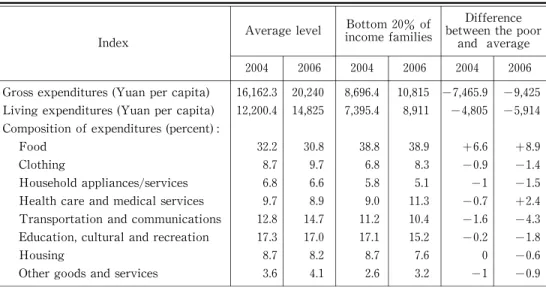
First,poor families have a low expenditure level. The annual consumption expenditure of Chinese urban residents increased from 673.20 Yuan RMB in 1985 to 5,309 in 2001,an eight-fold increase on average. Annual consumption expenditures on meals,clothing,house equipment and services,medical services and health care, transportation and communication,entertainment,education and cultural services,and housing increased by 6,5,7,20,30,12,and 17 times respectively(NBS of China,2002). But the data from the 2000 survey(Beijing Statistics Bureau,2001)shows that the average income per capita in urban poor families was 1,722 Yuan,245 Yuan less than what is needed for necessary expenditures. These families had a 50% Engels coeffi -cient,which was 11% higher than the average level. Recent data from Beijing suggests that the annual living expenditure among poor families was 7,395 Yuan and 8,911 Yuan in 2004 and 2006 respectively,4,805 Yuan and 5,914 Yuan less than the average levels for the city of Beijing in those two years(Table 5). In further detail, food expenditures in poor families were consistently lower than the average levels in Beijing;however,it took up a higher percentage of total living expenditures than for average families. Expenditures on clothing,household appliances,transportation and communication,and education and recreation were not only lower than the average levels,but also accounted for smaller shares of the total living expenditures compared
Table 4 Comparison of Annual Cash Income between Poor and Average Households in Beijing,2004 and 2006
Index
Average level (Yuan/per capita) Bottom 20% of income families (Yuan/per capita) Income of poor families as a percentage of the average level(%) 2004 2006 2004 2006 2004 2006 Gross income 17,116.5 22,417 8,241.1 11,130 48.15 49.65 Disposable income 15,637.8 19,978 7400.9 9,798 47.33 49.04 Employment income(wage) 11,590.4 16,284 5,538.0 8,035 47.78 49.34 Business income 177.5 236 186.7 123 105.18 52.12 Property income 146.4 271 26.2 56 17.90 20.66 Savings interests 36.5 40 5.2 9 14.25 22.50 Housing lease 65.3 137 10.9 28 16.69 20.44 Transfer income 5,202.2 5,626 2,490.2 2,916 47.87 51.83 Pension 4,575.0 4,909 2,185.5 2,612 47.77 53.21 Insurance 26.4 22 31.6 24 119.70 109.09 Gifts and family support 365.7 349 140.0 111 38.28 31.81 Sources:Calculations by the authors based on the Beijing Statistical Yearbook, 2005 and
to average families. Between 2004 and 2006,the share of the poors living expendi -tures spent on food actually increased,while the shares of their expenditures on clothing,appliances,education,recreation,and housing had dropped. Apparently,an increasing expenditure on health care and medical services seems to be strongly associated with the worsening of the poors expenditure structure(Table 5).
Second,poor families had poor meals,clothing,and household equipment. The data from Beijing in 2000 shows that the proportion of expenditures on meals,out of total expenses(Engels coefficient)was 48.8%,at which the share of expenditures on staple foods was about the same level as for the average population,but expenditures on fish,poultry and relevant products,and fresh vegetable were 61.9%,54.8%,and 22.6% lower than average levels,respectively (Beijing Statistics Bureau,2001). Durable consumer products in poor families were scarce;the annual per capita expenditure on family equipment and services was only 264.71 Yuan,which was only 24.1% of the average level. In terms of the quality of durable consumer products, poor families enjoyed mainly low-quality products,such as bikes and electric fans. For commonly-used family equipment such as washing machines,refrigerators,and shower water heaters,every 100 poor families had 22,26.5,and 17 of these items respectively. For air-conditioners,color TVs,computers and mobile phones,every 100 poor families had 58.1,114,27.1,and 23.1 of these items respectively,fewer than average levels. 55.9% of poor families had no washing machines,33.4% had no
Table 5 Annual Expenditures of Average and Poor Urban Households in Beijing,2004 and 2006
Index Average level
Bottom 20% of income families
Difference between the poor
and average 2004 2006 2004 2006 2004 2006 Gross expenditures(Yuan per capita) 16,162.3 20,240 8,696.4 10,815 −7,465.9 −9,425 Living expenditures(Yuan per capita) 12,200.4 14,825 7,395.4 8,911 −4,805 −5,914 Composition of expenditures(percent):
Food 32.2 30.8 38.8 38.9 +6.6 +8.9 Clothing 8.7 9.7 6.8 8.3 −0.9 −1.4 Household appliances/services 6.8 6.6 5.8 5.1 −1 −1.5 Health care and medical services 9.7 8.9 9.0 11.3 −0.7 +2.4 Transportation and communications 12.8 14.7 11.2 10.4 −1.6 −4.3 Education,cultural and recreation 17.3 17.0 17.1 15.2 −0.2 −1.8 Housing 8.7 8.2 8.7 7.6 0 −0.6 Other goods and services 3.6 4.1 2.6 3.2 −1 −0.9
Sources:Calculations by the authors based on the Beijing Statistical Yearbook, 2005 and Beijing Statistical Yearbook, 2007.
refrigerators,and 20.9% had no color TVs. Although some poor families had this kind of electrical equipment,they had used the equipment for more than 10 years,with a use period almost near or past the products duration period. An investigation in Nanjing shows that the average monthly income of poor families was 642 Yuan,71.8% of which went to daily meal expenses. 43.6% of the poor families expressed that they had no savings;if they had a little savings,they would use 4.5% of their total income on their childrens education and 12.7% of it on medical services,and would only put 5.5% of it into savings(Chen et al.,2006).
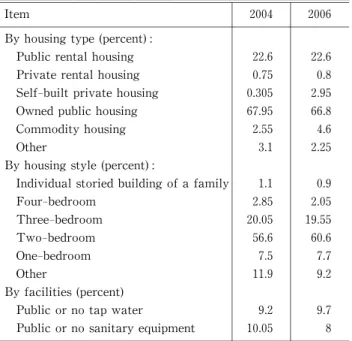
Third,housing is one of the most striking problems for poor urban families. Poor families live in apartments with small floor space. With Chinas housing system reforms in recent years,the space and quality of housing for Chinese urban residents have improved greatly. In 2005,floor space per capita was already 19.5 square meters on average,but it was only 10.45 square meters for poor families. In Nanjing,the average floor space for groups in housing poverty and dual poverty were both below 10.4 square meters per person,which was the average level of the whole city in 2001. In addition,housing facilities for the poor were in poor condition. Families suffering from dual poverty only had an average floor space of 6.85 square meters per person (Table 6). Interviews with the offices of Beijing city conducted by the Geography Institute of the Chinese Academy of Science(Ma et al.,1999)discovered that 36.8% of poor families in Beijing lived with an average floor area lower than 9 square meters, and 49.4% of them lived in worn bungalows with rough inner establishments and almost no in-house toilets,heating equipment,or tap water. Only 16.7% of poor families had piped coal gas,and only 20% had in-house toilets. The housing condi -tions in Beijing have improved,but still around 10 percent of families lived in apart -ments without in-house or any type of tap water or sanitary equipment in 2006(Table 7). Research on Nanjing showed that houses in the traditional south and west s ub-districts included rows of sheds(Chen et al.,2006). In both cities,the housing for the poor was mostly from the public stocks of local housing administrative departments or passed down by parent owners. Both types of housing were generally run-down,
Table 6 Housing Conditions of Poor Urban Hous e-holds in Nanjing,2001
Group (squarAvere metage ferloors per s capipaceta) Income poverty group 10.19
Housing poverty group 6.79 Dual poverty group 6.86
Source:A sample survey on poor households in Nanj -ing City conducted by the authors,2001.
because housing administrative departments were unwilling to repair them and hous e-holders could not afford repair fees.
Fourth,medical expenses in poor families have become a heavy burden,given their limited incomes. In Beijing,25.2% of the poor families had members who were generally healthy,33.8% were weak,ill or badly ill,and 19.8% were handicapped (Beijing Statistics Bureau,2001). Recent medical system reforms have increased the proportion of the individuals share of medical expenses,which has increased the burden poor families. Data from Beijing showed that the average annual individual medical expenses in 2000 reached 131.73 Yuan,which was almost the upper-limit of poor familiesabilities to afford(Beijing Statistics Bureau,2001). As a result,some postponed or skipped doctor visits and examinations when suffering minor illness.
The expenses for childrens education have increased rapidly. Poor families regard childrens education as very important,and so they try to maintain it by saving on food and clothing. The data on Beijing showed that the proportion of education expenditures on tuition and fees for poor families was 33 percent higher than that of average families,while the percent for the proportion of education expenditures on
Table 7 Housing Conditions of Urban Households in Beijing,2004 and 2006
Item 2004 2006
By housing type(percent):
Public rental housing 22.6 22.6 Private rental housing 0.75 0.8 Self-built private housing 0.305 2.95 Owned public housing 67.95 66.8 Commodity housing 2.55 4.6
Other 3.1 2.25
By housing style(percent):
Individual storied building of a family 1.1 0.9 Four-bedroom 2.85 2.05 Three-bedroom 20.05 19.55 Two-bedroom 56.6 60.6
One-bedroom 7.5 7.7
Other 11.9 9.2
By facilities(percent)
Public or no tap water 9.2 9.7 Public or no sanitary equipment 10.05 8 Sources:Calculations by the authors based on the
Beijing Statistical Yearbook, 2005 and Beij-ing Statistical Yearbook, 2007.
textbooks and reference books,other types of education,and infant education were 99.7%,99.8%,and 100% lower than those in average families(Beijing Statistics Bureau,2001). The average individual expenditure on re-employment or other trai n-ing in poor families was only 3.47 Yuan per year,99.9% lower than that in average families.
4. Causes of new urban poverty
China has entered a transitional economic period since it launched its open and reform policies. The major causes of new urban poverty in China can be related to the economic transition and institutional reform in the context of Chinas economic liberalization.
4.1 Economic transition
First,layoffs and unemployment contribute to the rise of new urban poverty. The urban industrial structure has changed tremendously since the 1980s. In particular, secondary industries have declined,while the proportion of tertiary industries such as commerce,service,finance,information and high-tech industries has increased drasti -cally in the whole economic structure since the 1990s. According to the data from the white book The Present State of the Labor and Social Security in China published by State Council Information Office of the PRC in 2002,the total head counts of workers who left their former posts between 1998 and the end of 2002 amounted to 26 million,among whom more than 17 million had been re-employed. Workers em-ployed in state-owned enterprises dropped from 75 to 50 million. In summary,the new urban poverty in China originated from the restructuring of the national economy, which led to the drastic increase of workers in state-owned enterprises,who were later laid off,unemployed,or forced to retire early at a time when the Chinese economy was growing continuously.
Second,low wages are also a factor in creating new urban poverty during the transitional period of the Chinese economy. The average annual wage of urban workers reached 10,870 Yuan in 2001,5 times more than what it was in 1990,and the actual average annual increase was 8.1%,adjusted for inflation. However,the wage levels of workers from industries of agriculture,forest,herding,fishing,manufactur -ing,commerce,and food and beverage production have continued decreasing in recent years,and the wages of industries such as finance,insurance,real estate,social services,sanitation,gyms,welfare,culture,education,and the arts have also started to decline since 1995. Wage increases in industries such as mining,manufacturing, architecture,commerce,and food and beverage production were below the average increase rate for all industries.
Third,the rush of the floating population into urban labor markets has made it more difficult for the workers who had been unemployed or who had left former posts to be employed again. The urban employment pattern has gradually changed into a market-based pattern since the economic reforms. It is estimated that the floating population in the present labor market was over 80 million in 2006. Dominated by rural floating labor,industries such as architecture,food and beverage industries,cloth and apparel,and environmental sanitation have developed quickly and yet unsteadily, often accompanied by problems such as high labor intensity and bad working condi -tions. A survey in Nanjing city showed that the total number of the floating popul a-tion was only 100,000 in the early 1980s,but had increased to 270,000 in 1987,adding an astonishing number of 40,000 each year. The floating population of Nanjing city reached 0.5 million in 1990,and 0.7 million in 1999(Hu et al.,2000). The survey focused on the floating population who had received certificates of permanent resi -dence in the city after they had lived there for more than 7 years. However,with little education and no formal occupations,they actually became part of the new urban poor population(Hu et al.,2000).
4.2 Institutional reform
During the process of the officially announced transition from a planned economic system to a market-oriented economic system,the lag of an overall institutional reform,including reforms of multiple economic and social systems worsened the new urban poverty problem.
Commodity supply system. The Certificate Economy was one of the characteris -tics of the planned economy. The urban commodity supply bill has been gradually cancelled since 1980s,which suggests that the supply of urban basic living necessities has changed from a welfare-based pattern to one that is driven by market circulation. In a welfare-based system,the government decided the prices of all basic living necessities,which was significantly lower than the prices in a market-based system. This means that poor urban families have undoubtedly lost some sense of security,due to the rising expenses of items needed to maintain basic living standards such as water, electricity,rent,and medical services.
The urban employment system. The system of low wages and high empl oy-ment had maintained a living standard that was neither too high nor too low before the 1990s,which led to a low incidence of urban poverty. The economic system reforms since the early 1990s have thoroughly broken the former employment system of low wages and high employment . Surplus workers in the enterprises were thrown into society,making the hidden unemployment public and resulting in a mass of people unemployed or leaving from their former posts. At the same time,the reformed urban enterprises had independent employment rights,capable of employing
rural workers with low costs(low wages,no welfare such as housing,and no pensions). So rural workers can now compete with urban workers in the urban labor market. In this way,on one hand,urban enterprises need to cut a lot of surplus workers;on the other hand,a large number of rural workers want to enter the cities. Both trends result in the drastic increase of urban unemployment and layoffs,and the problem of urban poverty.
Social welfare system. Under the planned economic system,as part of the national social welfare,public health services,old-age pensions,the employment system,and the housing distribution system were shared by state-owned enterprises or urban governments. But after the economic reforms,during the period of gradual transition from the planned economic system to the socialist market economic system, the former economic systems and welfare systems gradually became diversified. So the former economic systems gradually lost the functions of welfare,and began to work according to the principles of the market economy. At the same time,urban social welfare systems were undergoing a process of reforms and system transitions, during which they showed a tendency to weaken the social welfare level as a whole. For example,the proportion of welfare distributed decreased throughout the whole social distribution system. As a whole,this tendency contributed to a lower sense of protection for the urban poor.
Social insurance system. All state-owned department workers were covered by nation-paid insurance before the economic reforms. The system made it possible for enterprises and individuals never to worry about losing benefits such as pensions due to the failure to pay premiums. But after launching reforms and open-door policies, the labor insurance systems in enterprises have gradually broken away from gover n-mental finance,and as a result,the large cost of premiums became a serious headache for enterprises. Some enterprises with low economic efficiency were incapable of offering pensions to retired workers. Some opted for delayed payments and managed to keep the insurance system existing in name. Those retired workers unable to receive their pensions became a part of urban poverty.
Urban housing system. The reform of the housing system was aimed at solving the problem of urban resident housing. Housing is distributed,on a precondition that urban residents must have the ability to pay for the purchase or rent of the commercial housing. At present,average urban residents have gradually gained the ability to buy housing that fits in with their needs. But,for poor families,the purchase of housing not only deprives them of the chance to enjoy better housing,but also deprives them of former income subsidies in the form of low rents and low maintenance fees. All of these factors have continually diminished the housing conditions of poor families.
Public service system. The former welfare-oriented public service system in China provided public services to urban residents at no or low cost,such as urban
transportation services,medical services,health care,and basic education. But the urban welfare-oriented service system has incorporated more elements of the market economy recently. First,rising prices for medical services and prescriptions has made it difficult for workers from bad enterprises or poor families to access medical services. Second,rising educational expenses have also affected the living conditions of some poor families with school-age children. The impact is even greater when children of poor families are receiving higher education. Third,the commercializing tendencies in industries such as urban transportation,house repairing,cultural ser -vices,and daily services have resulted in poor familiesdecreased consumption of these services,which has greatly affected their living standards.If the tendency towards commercialization in urban social services continues,without subsidies to the poor,the quality of life for the poor will further deteriorate,and the poor and their children will face greater obstacles to lift themselves of poverty due to insufficient education and medical care.
Social security system. The concept of urban social security in China has changed since the 1980s. First,state-owned enterprises have gradually assumed the role of business organizations with independent administration and sole responsibility for their own profits or losses,while shedding their former function of providing welfare and security to the workers. This function is now shared by the enterprises, individuals and society. Second,some enterprises with poor economic efficiency have discharged a large number of surplus workers into society,causing some workers with skills to lose their jobs. The decline in social welfare standards has greatly influenced the lives of workers who used to depend greatly on former systems or who have fewer chances in the market economy. Although three security lines,including the Basic Living Security Line for laid-off workers,unemployment insurance,and the MLSS for urban residents,have been gradually established,they currently have weak impacts on the poor. A new group of urban poor has come into being during the transitional period from the planned economy to the market economy.
The present problem of new urban poverty in China obviously relates to industrial inefficiency and enterprise bankruptcy. Industry-related poverty is due to the decline of some traditional industries,such as textile and coal industries,due to the changes of supply and demand. With a low level of economic efficiency,the employed workers in these industries always received lower wages than those in other industries;in addition,some enterprises had to dismiss surplus workers to increase their economic efficiency. As a result,massive number of workers became unemployed or left their former posts. Enterprise-related poverty refers to the rise of poverty due to the reconsolidation of enterprises,especially the old ones(in sunset industries)going bankrupt during economic restructuring,or having to dismiss some employed workers to increase their economic efficiency. The dismissals and temporary unemployment
resulted in the rise of new urban poverty. It is important to note that the poverty of this sub-group of new urban poor is attributed mainly to the industries or enterprises, rather than to individuals. This has created an urgent need to construct a social security system and social relief networks that compensate for their losses and guarantee a basic living standard to reduce their dissatisfaction.
In addition,social polarization,the uneven distribution of wealth,and social injustice aggravates the problem of new urban poverty during the process of economic transition and institutional reform. For example,regarding the polarization of wealth,data from the State Statistics Bureau(2001)showed that the higher the income of urban families,the more rapid was the increase of their incomes between 1991 and 2000. In 1991,the average income per capita for the top 10% of the richest urban families was 2.94 and 3.19 times greater that of the bottom 10% of poor urban families and the bottom 5% of the poorest urban families. These ratios increased to 3.78 and 4.15 in 1995,and 5.0 and 5.7 in 2000. If the disparity between the rich and poor increases and the condition of the social security system and MLSS are not improved, the problem of new urban poverty may become worse or more acute.
In this paper,we emphasize that new urban poverty is a persistent problem in Chinese cities. The Chinese government will face a challenging task to cope with new situations. Since 2008,coastal cities have faced an accelerated pace of industrial restructuring. Many export-oriented medium-and small-sized firms were closed down in the Pearl River delta and in the Yangtze River delta during the Chinese currency Renminbi appreciation against the dollar and rising labor costs. This would have a negative impact on the job market and may reduce the availability of informal work and contracted jobs. On the other hand,China has shifted from deflation to the problem of inflation. In a period of high oil prices and international food crises,the living conditions of lower-income families may be adversely affected. Rising expendi -tures on crucial living materials will squeeze household budgets. The Chinese gover n-ment is said to monitor closely the rising cost-of-living,so as to adjust the MLSS accordingly.
5. Conclusion
This paper started with an introduction to Chinese new urban poverty based on evidence from Nanjing and Beijing and on statistics about Chinese cities in general. We analyzed the characteristics and multiple dynamics of urban poverty in China earlier this decade. The dynamics of urban poverty illustrated by the income and consumption patterns of the poor indicates that(1)The urban poor population is comprised mainly of the people with low incomes or no incomes and the unemployed in all Chinese cities,and(2)The consumption of urban poor families is primarily
comprised of daily expenses on meals and clothing,and their expenses on education and housing are minimized due to rising expenditures on medical care. However,we then focused on the causes of new urban poverty,such as the economic transition and institutional/system reforms. Finally we conclude with several policy r ecommenda-tions.
The institutional transformations,the economic restructuring,and the floating population entering the urban labor market have resulted in the rise of new urban poverty problems in China. The causes for new urban poverty relate to lay-offs and unemployment due to economic reform and transition,including the low income groups employed in the industries such as the private economy,small-scale enterprises,and the service sector. In the context of such a market economy,the basic measures undertaken by urban governments to solve the problems should include guiding economic development by offering various kinds of policies,remedying the deficiency of the market with respect to social functions through various social policies,and preventing non-market elements such as social discrimination in the labor market.
The central and local city governments of China have developed a new phase of the urban antipoverty movement in many respects,such as by adjusting industrial structures,increasing employment rates with multiple approaches,and accelerating the construction of the poverty statistics survey system. It is necessary to pay more attention to other countermeasures such as encouraging re-employment,improving the urban social security system,and developing the public service systems. The devel op-ment of the individual and private economy in the forms of small and medium-sized labor-intensive enterprises,supported by labor employment and recruitment services, appears to be effective in solving the conflict of unemployment and re-employment of dismissed workers.
On the other hand,the poor should be encouraged to engage in informal sectors in the cities. Part of the present urban poor are those unemployed with labor abilities, and those employed but with low incomes. With comparatively old ages,under -developed labor skills,and low levels of education,the poor are basically in a weak position in the labor market. The informal employment sector has become a social and economic buffer zone by absorbing the low-paid labor force and decreasing the unemployment crisis under different social economic development conditions and at different stages of urban development.
The minimum living-standard scheme has been employed by Chinese local city governments as a prototype for social assistance to citizens whose income cannot meet basic demands. Although it is considered the last safety net for the urban poor, compared to other policies in the entire social security system,other types of social assistance should be offered to the poor regarding medical care,housing,education, and legal consultation.
Acknowledgement
This research was funded by the National Natural Science Foundation of China(Grant No. 40435013)and the Ministry of Education Foundation of China(No.20040284012).
Note
1) The traditional urban poverty groups refer to the aged,weak,sick,handicapped,widows, widowers,etc;all these people were called the Three No people―they had no labor ability,resources,or legal support,and some were victims of natural disasters.
2) According to a survey on surplus labor in enterprises conducted jointly by the International Labor Organization and the Chinese Ministry of Labor in 1995.
3) According to Shangquan Gao,president of the China Society of Economic Reform,at a conference on urban poverty organized by the China Development Institute in Shenzhen on January 7,2006,about 30 million poor lived in urban China.
4) According to an article published on people.com.cn titled The new poverty line on April 13,2008,the State Council Leading Group Office of Poverty Alleviation and Reduction is drafting new anti-poverty solutions,which will be based on raising the national income poverty line from 1,067 Yuan per year in 2007 to 1,300 Yuan per year.
5) According to a sample survey of 17,000 urban households in 2000 by the National Bureau of Statistics of China.
6) According to the 2005 Annual Report on the National Economy and Social Development in Beijing during the Tenth Five-year Plan,published by the Survey Office of the National Bureau of Statistics on January 24,2006,average housing space per capital increased to 19.5 square meters.
7) The government has gradually abandoned the control of labor allocation in enterprises since 1980. First,given the rights to recruit employees,enterprises are no longer responsible to absorb newly-created surplus labor for the whole society. Second,the government has lost the ability of settling social labor forces through instructive plans.
8) Nation-paid insurance means that the country (governments)will pay social premiums directly or be responsible for paying the social premiums for the workers.
References
Beijing Statistics Bureau(2007):Beijing Statistical Yearbook, 2007. Beijing:China Statistics Press.
Beijing Statistics Bureau(2005):Beijing Statistical Yearbook, 2005. Beijing:China Statistics Press.
Beijing Statistics Bureau(2001):Beijing Statistical Yearbook, 2001. Beijing:China Statistics Press.
Chan,K.W.(1996): Post-Mao China:A Two-class urban society in the making,International Journal of Urban and Regional Research,20-1,134- .
Chen,C.(2000):Shehui Ruozhe Lun-Tizhi Zhuanhuan Shiqi Shehui Ruozhe de Shenghuo Zhuangkuang yu Shehui Zhichi (On the social weak group : the living state and social help of the social weak group in the time of system transition). Beijing:Shishi Chubanshe (Current Events Press).
Nanjing,China, Habitat International ,30-1,1-26.
Ci,Q.(1998): Shehui Jingbu yu Chengshi Pinkun Gainian de Fazhan(Social advancement and the development of the concept of urban poverty),Hubei Daxue Xuebao (Journal of Hubei University) ,5,90-92
Dong,S.(2000): Jiushi Niandai Zhongguo Chengzhen Pinkun Wenti Yanjiu(Research on the urban poor of China in 1990s),Shehui Kexue Dongtai (The Development of Social Science) , No.1,39-40.
Fan,P.(1996): Zhongguo Chengzhen de Dishouru Qunti(The low paid groups in Chinese towns), Zhongguo Shehui Kexue (China Social Science) ,4,64-77.
Gans,H.J.(1992): Fighting the Biases Embedded in Social Concepts of the Poor, The Chronicle for Higher Education,A56,January 8.
Gu,C.,Wang,F.,and Liu,G.(2005): The Structure of Space in Beijing in 1998:A socialist city in Transition, Urban Geography ,26-2,167-192.
Gu,C.and Kestloot,C.(1998): The spatial structure of the urban society in transitional Beijing, in Xueqiang Xu(ed.)The rural -urban transitions and the harmonized develop-ments in China. Beijing:Science Publisher,31-38.
Gu,C.(2007): Chengshihua(Urbanization), in Chuanjun Wu(ed.)Zhongguo Jingji Dili (China Economic Geography). Beijing:Science Press,222-261.
Gu,C.and Kestloot,C.(1997): Beijing Shehui Jihua yu Kongjian Fenyi Yanjiu(Research of the social polarization and the differences of spatial distribution in Beijing), Dili Xuebao (Acta Geographica Sinica) ,52-5,385-393.
He,S.,Li,Y.,Wu,F.,and Webster,C.(2008): Poverty incidence and concentration in different social groups in urban China,a case study of Nanjing, Cities ,25-3,121-132.
Hu,X.,Zhou,Y.,and Gu,C.(2000):Zhongguo Yanhai Chengzhen Miji Diqu Kongjian Jiju yu Kuosan Yanjiu (Studies on the Spatial Agglomeration and Dispersion in China s Coastal City -and -Town Concentrated Areas). Beijing:Science Press.
Jiang,R.(1998): Guanyu Woguo Chengzhen Jumin Pinkun Zhuangkuang de Yanjiu(Research on the poor state of the urban residents in China),Xindongfang (New Oriental) ,1,66-67. Li,P.,and Zhang,Y.(2000): Xiaofei Fenceng:Qidong Jingji de Yige Zhongyao Shidian
(Consumption stratification:An important view of starting economy),Zhongguo Shehui Kexue (Chinese Social Science) ,1,52-61.
Li,P.(1995):Zhongguo Xinshiqi Jieji Jieceng Baogao (Report of the classes and stratum in the new time of China). Shenyang:Liaoning People Publisher.
Li,Q.(1993):Dangdai Zhongguo Shehui Fenceng yu Liudong (The social stratification and social flow in contemporary China). Beijing:China Economy Publisher,1993.
Li,S.,Feng,J.,and Hou,Y.(2002):Zhongguo Chengshi Pinkun Wenti Yanjiu (Research on the problem of urban poverty in China) ,Development Research Center of the State Council, Report No.2002-137,2002-8-30.
Li,S.and Sato,H.eds.(2006):Unemployment, Inequality and Poverty in Urban China. Abingdon. Oxon:Routledge.
Lin,C.(1999):Zhongguo : Zouchu Pinkun (China : out of poverty). Kunming:Yunnan Educa-tion Publisher.
Liu,Y.T.,He,S.J.,and Wu,F.L.(2008): Urban pauperization under Chinas social exclusion: A case study of Nanjing, Journal of Urban Affairs ,30-1,21-36.
Liu,Y.T.and Wu,F.L.(2006): Urban low-income neighbourhoods:Typology and spatial concentration under Chinas market transition,a case study of Nanjing,Geoforum ,37-4, 610-626.
Lu,X.(1991):Shehuixue (Sociology). Beijing:Knowledge Publisher.
contemporary China), Shehui (Society) ,No.5,4-5.
Ma,Q.,Chen,T.,Niu,Y.,and Qian,Z.(1999): Beijing Chengshi Pinkun Renkou Tezheng, Chengyin ji Jiekun Duice(The characteristics and dynamics of the urban poor population and its counter-measures in Beijing),Dili Yanjiu (Geographical Research) ,18-4,400-406. Mingione,E.(1993): Introduction:The New Urban Poverty and the Underclass, Inter
na-tional Journal of Urban and Region Research,17-3,324-326.
National Bureau of Statistics(NBS)of China(2007):China Statistical Yearbook 2007. Beij -ing:National Statistics Press.
National Bureau of Statistics(NBS)of China(2002):China Statistical Yearbook 2002. Beij -ing:National Statistics Press.
National Bureau of Statistics(NBS)of China(1999):China Statistical Yearbook 1999. Beij -ing:National Statistics Press.
Room,G.(1990):New poverty in the European community. London:Macmillan.
Shen,H.(2000): Zhongguo Pinkun Yanjiu de Shehuixue Pingshu(Sociological explanation to the poverty research in China), Shehuixue Yanjiu (Sociological Research) ,2,91-103. Solinger,D.(2006): The creation of a new underclass in China and its implications,Envir
on-ment and Urbanization,18-1,177-193.
Solinger,D.(2002): Labour market reform and the plight of the laid-off proletariat, The China Quarterly ,158,304-326.
Solinger,D.(1999a): Chinas Floating Population,in Merle Goldman and Roderick MacFar qu-har(eds.)The Paradox of China s Post -Mao Reforms. Cambridge,Mass.:Harvard University Press,220-240.
Solinger,D.(1999b):Contesting Citizenship in Urban China : Peasant Migrants, the State and the Logic of the Market. Berkeley.
Tang,J.(1999):Zhongguo Chengshi Jumin Pinkunxian Yanjiu (Research on the poverty line of the urban residents in China). Shanghai:Shanghai Academy of Social Science Press. Tang,J.,Zhu,Y.,and Ren,Z.(1998): Chengshi Pinkun Jiating de Shehui Baozhang he Shehui
Zhichi Wangluo(The social security and social assistance networks in the urban poor families), Shehuixue Yanjiu (Sociological Research) ,5,105-118.
Tong,X.and Lin,M.(1993): Woguo Nongchun Pinkunxian Yanjiu(Research on the poverty standard line in rural China), Zhongguo Shehuikexue (China Social Science) ,3,86-98. Tong,X.and Liu,S.(2000): Chengshi Jumin Zuidi Shenghuo Baozhangxian de Ceding(
Mea-surement of the Lowest Security Line Standard for Urban Residents),Shehuixue Yanjiu (Sociological Research) ,4,42-54.
Tong,X.and Liu,S.(2002): Chengshi Jumin Zuidi Shenghuo Baozhang Biaozhun de Shuli Ceding Fangfa(Mathematical Determination of Guaranteed Living Expenses for Urban Residents),Shanghai Xingzheng Xueyuan Xuebao (The Journal of Shanghai Administr a-tion Institute) ,1,74-84.
UN-Habitat(2006):State of the World s Cities 2006 /7 : The Millennium Development Goals and Urban Sustainability. London:Earthscan.
Urban Poverty Research Group,Development Research Center of the State Council(DRCSC) (1997): Chengzhen Pinkun ji Youguan Tizhi Jianshe Wenti(The urban poverty and relevant system constructions), Guanli Shijie (Management World) ,3,192-200. Urban Poverty Problem Research Group,The National Bureau of Statistics(NBS)of China
(1991): Zhonguo Chengzhen Jumin Pinkun Wenti(Urban Poverty Problem for City and Town Residents), Tongji Yanjiu (Statistical Research) ,1991,no.6,12-18.
Wang,Y.P.(2005):Urban Poverty, Housing, and Social Change in China. London:Routledge. Wu,F.L.(2007): The poverty of transition:from industrial district to poor neighbourhood in
Wu,F.L.and Huang,N.Y.(2007): New urban poverty in China:economic restructuring and transformation of welfare provision, Asia Pacific Viewpoint ,48-2,168-185.
Wu,F.L.(2004): Urban poverty and marginalization under market transition:the case of Chinese cities, International Journal of Urban and Regional Research,28-2,401-423. Xiao,W.(1997): Woguo Shehui Zhuanxingqi de Chengshi Pinkun Yanjiu(Research on urban
poverty in the transitional society of China),Shehuixue Yanjiu (Sociological Research) ,3-5,40-47.
Xu,X.(1999): Zhongguo Chengzhen Jumin Pinfu Chaju Yanbian Qushi(Evolvement tendency of the differences between the rich and poor urban residents in China),Shehuixue Yanjiu (Sociological research) ,5-5,66-74.
Yang,M. (2007):Beijing Area Study : Data Report (1995 -2004). Beijing:Beijing Publishing House.
Yin,Z.(2001): Toushi Zhongguo Chengshi Xinpinkun Renqun(Perspective on the new urban poor population), Baike Zhishi (Encyclopedia knowledge) ,No.9,41-44,No.10,44-47. Zhang,M.and Cheng,Y.(1996): Shehui Zhuanxing Shiqi Chengzhen Pinkun Renkou Tezheng,
Chengyin ji Cedu(Characteristics,causes and determinations for the urban poverty in period of social transitions),Renkou Yanjiu (Population research) ,vol.20,no.3,pp.7-16. Zhong,Y.(1996): Chengshi zhong de Pinkun Wenti Tantao(Discussion on urban poverty),
Tansuo (Exploration) ,4,71-72,82.
Zhu,L.(1995): Cuiruo Qunti yu Shehui Zhichi(The fragile groups and social assistance), Jiangsu Shehui Kexue (Jiangsu Social Science) ,no.6,130-134.
Zhu,Q.(1995): 1994-1995 Nian Renmin Shenghuo Zhuangkuang(Peoples Living Condition, 1994-1995), in Zhu,Q.(ed.)1995 Nian Shehui Lanpishu (1995 Social Blue Book). Beijing:China Social Science Press.