A Method of Earth' Structure Inferred from
Eigenperiods of Torsional Oscillation (Part 1)
著者
Oda Hitoshi
雑誌名
Science reports of the Tohoku University. Ser.
5, Geophysics
巻
25
号
4
ページ
235-254
発行年
1979-03
URL
http://hdl.handle.net/10097/44761
Sci. Rep. TOhoku Univ., Ser. 5, Geophysics, Vol. 25, No. 4, pp. 235-254.
A Model of Earth's Structure Inferred from Eigenperiods
of Torsional Oscillation (Part 1)
HITOSHI ODA
Geophysical Institute, Faculty of Science, TOhoku University,
Sendai, 980, Japan
(Received December 22, 1978)
Abstract: A study is made on the shf it in eigenperiods of torsional oscillation
due to some properties of the earth such as anelasticity, rotation, ellipticity, lateral
heterogeneity, and physical dispersion of shear wave. The main prupose is the
comparison of magnitude of each shfit and to discuss the necessity of simultaneous
inversion of torsional oscillation periods into attenuation structure as well as shear
wave velocity and density structures.
Fractional shift in torsional oscillation periods due to physical dispersion of shear
wave amounts to 1.3%-0.6%. On the other hand, total fractional shift due to other
properties is estimated to be less than 0.2% in the period range from 300 sec to 2700
sec. The eigenperiods of torsional oscillation, therefore, provide important
informa-tions concerning attenuation structure as well as shear wave velocity and density
structures.
1. Introduction
Since the great Chilean earthquake in 1960, long and ultra-long geophysical instruments have provided an extensive set of normal mode data such as surface wave dispersions and eigenperiods of the earth's free oscillations, and the study on the eigenperiod has been developed by many investigators. The eigenfrequency is represented by ncoim in which n, 1, and m denote radial, angular and azimuthal order numbers repsectively, n and 1 being positive value from 0 to 00 and m an integer between -1 and 1. If the earth is non-rotational, spherical, and laterally homogeneous elastic body, the eigenfrequencies are degenerated. However, the actual earth has the properties such as anelasticity, rotation, ellipticity, and laterally heterogeneous structure. Therefore, the eigenfrequency is expected to be affected by such properties of the earth.
Benioff et al. (1961) found the splitting of eigenfrequency of lower order free oscilla-tions. Backus and Gilbert (1961), MacDonald and Ness (1961), and Pekeris et al. (1961) indicated theoretically that rotation of the earth produces the symmetrical splitt-ing with respect to the frequency of m=0 from degenerated eigenfrequency.
On the other hand, Usami and Satel (1962) studied the torsional oscillation of a homogeneous, elastic, and non-rotational spheroidal earth. They pointed out that the ellipticity also produces the splitting of degenerated eigenfrequency. Dahlen (1968) investigated in detail the effects of ellipticity and rotation of the earth upon the splitting
236 H. ODA
of eigenfrequency, and showed that the ellipticity destroys the symmetrical splitting produced by rotation.
Lateral heterogeneity of the earth's structure has been investigated by the dispersion of long period surface waves along the great circle paths. ToksOz and Ben-Menahem (1963), Toksaz and Anderson (1966), and Kanamori (1970) have discussed phase velocities of mantle Love and Rayleigh waves and detected small variations in dispersions of different paths. The variations are considered to be attributed to lateral differences in structures under oceanic and continental regions. On the other hand, the effect of lateral heterogeneity upon the torsional oscillation periods was theoretically studied by Usami (1971), Saito (1971), and Madariaga (1972). Madariaga and Aki
(1972) made a study on the effect of lateral heterogeneity upon the splitting width from degenerated eigenfrequency for torsional modes of free oscillation of the earth.
The anelasticity of the earth causes physical dispersion of body waves. Although the existence of the dispersion due to anelasticity has been recognized in seismology and discussed by many investigators (e.g., Futterman, 1962; Carpenter and Davies, 1966; Jeffreys, 1965; and Strick, 1970), it has been either ignored or assumed to be negligible in most surface wave and free oscillation studies. Recently, Liu et al. (1976) and Randall (1976) showed that the dispersion produces the shift in eigenperiods of the free oscillations, and emphasized the importance of the physical dispersion for the inversion study of normal mode data into the earth's structure.
It has been indicated that rotation and ellipticity of the earth and lateral hetero-geneity of the earth's structure cause the splitting of degenerated eigenfrequency. It is actually difficult to identify the splitted peaks, especially those corresponding to azimuthal order number for higher angular modes. In this study, therefore, the effect of some properties of the earth upon eigenperiods of free oscillation will be discussed only for m=0 mode.
It is the main purpose of this study to investigate, in addition to results by other investigators, the magnitude of effects of anelasticity, rotation, ellipticity, lateral heterogeneity, and physical dispersion of shear wave upon eigenperiods of torsional oscillation for azimuthal order number of zero. The second objective is to show that simultaneous inversion of the eigenperiods into intrinsic Q structure as well as shear wave velocity and density structures is necessary for inversion study of normal mode data.
2. Evaluations of Fractional Shift in Torsional Oscillation Period due to Some Properites of the Earth.
Let us review the basic properties of torsional oscillation of a non-rotational, spherically symmetric earth. This problem was studied in detail by Love (1911) and numerical solutions for laterally homogeneous earth model were first obtained by Alterman et al. (1959). MacDonald and Ness (1961) made a trough analysis of torsional oscillation and computed eigenperiods, eigenfunctions, and energies for many theoreti-cal models of the earth. When rotation, ellipticity, and laterally heterogeneous
A MODEL OF EARTH'S STRUCTURE INFERRED FROM EIGNEPERIODS 237
structure are introduced, it is difficult to obtain the exact solutions of the equation of motion of the earth's free oscillations. Therefore, the solutions are approximated by means of application of perturbation theory to the equation. In the study of perturba-tion, the oscillation of spherically symmetric, laterally homogeneous, and non-rotational earth is described in terms of the zeroth order perturbation. Hereafter the physical variables of the zeroth order perturbation are designated by superscript (0).
The problem of the zeroth order perturbation had been studied by several investiga-tors (e.g., Alterman et al., 1959; Kovach and Anderson, 1967; Saito, 1967; and Gilbert, 1970). In the present study, we follow the theory developed by Saito (1971). The equation of motion of self-gravitating body for torsional oscillation can be obtained by conventional procedure. Because the torsional oscillation is not affected by gravita-tion, the general equation of motion to be solved is written in the form of
p62U/i62/ = H(U) , (2.1)
where p and H are density of the body and a linear operator which generates the displacement vector field U, respectively. In this case of the zeroth order perturbation, the linear operator in orthogonal curvilinear coordinate (a, y) is defined by Saito (1971) as
[H(U)],a div.+0..p1(1t.k3)•ak,1313+a,„1(k,k,)•Modby
—appl(kghfi)•aholacc—a„1(k,k,)•akjacx (2.2)
Here [ ]a denotes the a component of vector and a. is the stress acting across a surface whose normal is in direction of a, and kg, k3, and by are scale factors of the
coordinate. For spherical coordinates, the scale factors are expressed by
{h.
= r=
1
(2.3) hY= r sin 0 ..Since the displacement field has the form of U (r, 9, 9S) exp (icot), eq. (2.1) is rewritten as —pco2U = H(U) . (2.4) For an elastic body with rigidity ti(r) and density p(r), in which r is the distance from the earth's center, since eq. (2.4) is separable in spherical coordinates, eigenvector can be written by
nut"= ..Y1 (r) •
where n, 1, and m are integer constants correspond order numbers, respectively. Here n and / are in integral value from —1 to 1. Yen (0, 0) is a compt
Yere(0, 0) = Pen(cos 0) ) where Pim(cos 0) denotes the associated Legendre
o 1 a Yen(0 , 0)14 sin 0 —alrim(0, 0)160 , corresponding to ra and / are integers fr
is a complex spheri Pen(cos 0) exp (intsb) ,
Leaendre unction.
(2.5)
g to radial, angular, and azimuthal gers from 0 to co and m takes an
spherical harmonics defined by (img9 , (2.6) iction. The function nyi(r) can be
238 H. ODA
determined under the boundary conditions that the stresses on the earth's surface vanish and that the stresses and displacements are continuous within the earth . The eigenvectors should satisfy the orthogonality relation,
J Ptal T(,,,Urmi)* dV = 47c1(1+ e„,(21-1-1)(/—m)! 1)(1±m)!r J PLY1)2dr.8n.'311',(2.7) where, 1 for m , Em = 2 for m 0 .
When perturbations corresponding to anelasticity , rotation, ellipticity, and lateral heterogeneity are introduced into the equation of motion , the linear operator H may be written by
H H°±Hrot ± Hell + Hhet ±Hdis Hq
H°±H' , (2.8)
in which,
Hq+ H rot+ H ell+ Hhet+ H dis •
Here Hg, H„t, Hat, and Hhet are linear operators corresponding to anelasticity , rota-tion, ellipticity, and lateral heterogeneity, resectively. I di, denotes a linear operator corresponding to perturbation arising from dispersion of shear wave due to anelasticity , and will be discussed in section 3 in detail. H° is Hamiltonian of the zeroth order perturbation and is identical with eq. (2.2). Substituting eq. (2.8) into eq. (2.4), the equation to be solved is given by
p(noilm)2 nUen (.11 en) (2.9) In order to solve the equation, we apply perturbation theory to the present problem under the assumption that the effect of H' on eigenperiod is sufficiently smaller than that of H°.
The perturbation expansions of the angular frequency and the eigenvector are described as
ncot" = E ncoen ,
k
(2.10) „Ulm = E nuen(k) ,
k in which „co/m(1) and „Ufn(1) are the i-th order perturbation of angular frequency and
eigenvector. Putting eq. (2.10) into eq. (2.9), the zeroth order equation is
(0) )2 nue% Ho(nuim (0)) (2.11) which is the same as eq. (2.4), in which tpi"(0) implies the degenerated angular eigen-frequency. The equation of the first order perturbation is given by
T en (1)) H' („UP(0)) — p(ncle (0)) 2 nU im (1)
A MODEL OF EARTH'S STRUCTURE INFERRED FROM EIGENPERIODS 239
The first order eigenvector can be also expanded in terms of the zeroth order eigenvectors
as
,Fiffs(1) E A „„, • ,,,ET en (0) +E Ai, • ,,U (°)
+E CM,' • HUI (°) (2.13)
When we insert eq. (2.13) into eq. (2.12) multiplied by the conjugate eigenvector Wen (0))* and integrate over the volume of the earth, using the orthogonality relation of eq. (2.7), the fractional shift in eigenfrequency due to the first order perturbations is expressed as
—
swim (1)/ntoim (0)(2.14) 2(
„coitu(0)2 <n, 1,1111 Pin, 1, m>
where
<n, 1,
m(11111,
1,
m> means
j(„Uim(0))*H(nUimM)
dV. Inserting
eq.
(2.8)
into
eq. (2.14), the fractional shfit in eigenfrequency is rewritten as
swim (1 )incoito___ 2( —1 ,(0/"(0))2 <n, /, pl m> • [<n ,l,m1Hiln,l, + m>+<n,l, millhetin, m> <n, 1, ntlH disin, 1, m>3 . (2.15) Each term of right hand side of eq. (2.15) represents the effects of anelasticity, rotation, ellipticity, lateral heterogeneity, and the dispersion of shear wave upon torsional oscillation period. The evaluation of each term is made according to the following procedures.
i) Effect of anelasticity.
Assuming the anelasticity of the earth is a function only of distance, r, from the earth's center and is independent of frequency, the linear operator Hq is represented by pure imaginary itc(r)fQ(r) where Q(r) denotes the quality factor of attenuation for shear wave. The fractional shift in eigenfrequency due to the first order perturbation of anelasticity is expressed as <n, /, m I itt(r)1Q(r) I n,1, m> ( n(-01") I .0)es (°))q — 2( „coit's(0))2 < n, 1, mI Pi n, 1,m>
if 72
[(012111)2
± .1-
2) 1)
(nhir)21
,u(r)1Q(r)
dr
2( nw 1m (°))2 PG Yirr dr (2.16) where, ..y2fr) igr) [d240 H. ODA
and QL is quality factor of attenuation for torsional oscillation. Eq. (2.16) consists with the expression of attenuation for torsional oscillation by Anderson et al. (1965). The above equation implies that the first order perturbation due to anelasticity does not affect angular frequency but does amplitude. Therefore, the first order shift in eigenperiods due to anelasticity is not taken into consideration.
The second order perturbation is expected to affect the angulr frequency because it includes the factor of (ip(r)IQ(r) )2. Therefore, this effect differs from that of physical dispersion due to anelasticity discussed in chapter 3. The study of the second order shift in torsional oscillation period was made for several models of shear wave velocity and attenuation by Liu and Archambeau (1975). Fig. 1 shows the variation of DT/T with respect to T according to Liu and Archambeau (1975), where T and DT denote the zeroth and second order perturbations of eigenperiod at n=0 and m=0. They concluded that the fractional shift in torsional oscillation periods for fundamental modes from 0T2 to 0T99 less than 0.1%.
Fig. -10-3 -5x10⁻⁴ -I 0-4 -5x10⁻⁵ BASIN AND BASIN AND OCEANIC OCEANIC BASIN AND BAS IN AND 0(w)3 .... .. RANGE RANGE RANGE RANGE \ • N Calculated -by DAHLEN -Icr51 7 1\ N, ... , 1 1 102 5x10² le 5x10³ 104 PERIOD. sec
1 Shift in fundamental torsional free oscillation periods due to anelasticity calculted for
various models of elastic constants and intrinsic Q. The values naieE,,, indicated by solid
circle are the shift in torsional oscillation periods due to ellipticity calculated by DahIen
A MODEL OF EARTH'S STRUCTURE INFERRED FROM EIGENPERIODS 241
ii) Effect of rotation.
Let us introduce an angular velocity of steady rotation of the earth. Consider-ing the form of displacement field of U (r , 0 .9) exp (iwt), application of a linear operator H„, to displacement field U gives the form of 2 pwi(..Q x U) in which a symbol x denotes the vector product. From the second term of right hand side of eq. (2.15), the fractional shift in torsional eigenfrequency in this case is given by
<n, 1, mlp..QX n, 1, m> (
ncoim(1)Ino)"(°)) rot—(2.17) (
nce (°)) <n , 1, nil Pin , 1, In>
If we take the rotation axis in the direction of angular rotation axis of the earth, the fractional shift reduces to the form as
inS2 (0)1m (1).cot")) rot =
nWlm(°)1(1+1)
= 431 , (2.18) which is identical with the expressions derived by Backus and Gilbert (1961), MacDonald and Ness (1961), and Pekeris et al. (1961). Table 1 after Dahlen (1968) lists the numerical values of the splitting parameter „(31 of the first order effect due to rota-tion upon torsional eigenperiod. The first order effect of the rotarota-tion is to remove the degeneration of eigenfrequency owing to symmetrical splitting of the Zeeman type.
Table 1 Ellipitical and rotational splitting parameters for SENRI earth model 1.
flco/ is the angular eigenfrequency of the degenerated multiplet 5ea/m(0) without perturbation. (After Dahlen (1968) ).
Mode Angular frequency (rad s-') nwl Elliptical splitting parameters 1000x nal e Ea 1000x nYle Ea OT2 OT, „T„ oT, °TB OT7 0T, oTo 0T10 2. 3779E-03 3. 6762E-03 4. 8037E-03 5. 8266E-03 6. 7752E-03 7. 6698E -03 8. 5240E-03 9. 3474E-03 1. 0146E-02 1.998 1.407 I.181 1.063 0.990 0. 939 0.903 0.877 0.857 1 — 0. 999 — 0 . 352 — 0.177 — 0 .106 — 0.071 — 0 .050 — 0.038 — 0 .029 — 0.023
Second order rotational splitting parameters
1000 x
nair(S2inw1) 2
1000 X
tlYdr(Dinwl) 2
Total splitting parameters
— 3.037 — 0 .840 — 0.329 — 0 .142 — 0.059 — 0 .001 0.074 0.209 0.494 1000 x nfl
1
0.697 0.072 0.015 0.004 0.001 0.000 — 0. 001 — 0 .003 — 0.005 I i 5.111 1. 653 0. 759 0.417 0.256 0.170 0.119 0. 087 0.065 1000 x ftai 1000 X n?1 —1 .039 0.567 0.852 0.921 0.931 0.938 0.977 1.086 1.351 — 0.302 — 0 .280 — 0.162 — 0 .102 — 0.007 — 0 . 050 — 0. 039 — 0.032 — 0 .028Dahlen (1968) investigated the second order effect of the rotation upon eigen-frequency of torsional oscillation, and showed that the second effect was
(ncoe4(2)/scoz m ")rot = (noetr+ mnY1r)(21nco1 m (0) )2 , (2.19) in which nOilr and nyi' are splitting parameters shown in Table 1. It is seen from eqs. (2.18) and (2.19) that the second order perturbation of the rotation produces the shift in eigenfrequency at m=0, while the first order one does not. Therefore, the first
242 H. ODA
order perturbation of eigenfrequency is not taken into consideration in the present study. Addition of eq. (2.8) to eq. (2.19) gives the total splitting due to the rotation
as
(AC°I nWim (°))rot = nal? (12InWlm (°))2M 49 +1112 nY Ir (2 I n6-) lm (°))2 • (2.20) The fractional shift in eigenfrequency at m=0 is expressed by the first term of right hand side of eq. (2.20). As seen in Table 1, except for the lower angular modes, the fractional shift is less than 0.1% and that for the higher radial and angular modes is safely thought to be significant small because the amount of 121(„(w1m(0) decreases rapidly with increasing n and 1.
iii) Effect of ellipticity.
The effect of ellipticity of the earth upon torsional oscillation period was studied by Usami and SatO (1962) and Dahlen (1968). The small differences .5ye(r, 0) and .3pe(r, 0) in rigidity and density between spherical and spheroidal earth models are written as Sp 2 diu . e(r, 0) — 3 d re,P2(cos 0) (2.21) 3 2 drdP f/(r, 0) =641)2 (cos 0) .
Here E. denotes the ellipticity of the earth's surface and P20 (cos 0) is the Legendre polynomial of the second order. Application of a linear operator corresponding to the ellipticity to displacement field gives
[Hell(U)].— diV 8cr„e+80.„pelk,h/3•6kda,3+8a,ellic,hy•ahc,16),
--Sappelk,hp•ahplbot—Sanelk,hy•gt,16ce , (2.22) in which 3a.6 denotes the deviatric stress field due to the differences in rigidity and density. The fractional shift in eigenfrequency can be written in the form of
(Woe' (1)incolm (0))011 = ec,(noi1e+lin2nY1e) (2.23) where and and nye are the elliptical splitting parameters which are dependent on n and 1. It can be understood that the ellipticity of the earth acts so as to split the degenerated eigenfrequency (21+1 lines) into 1+1 lines and that the eigenfrequency at m=0 shifts by the amount of ea 016.
Elliptical splitting parameters are shown in Table 1 according to Dahlen (1968), which indicates that the correction to the eigenfrequencies of m=0 up to 0T10 is as small as the order of 0.1%. The fractional shift in eigenfrequency for very large 1 is 0.05% at the most.
iv) Effect of lateral heterogeneity.
The most obvious lateral heterogeneity of the earth's structure is the difference between oceanic and continental structures. The lateral heterogeneity is mathematically
A MODEL OF EARTH'S STRUCTURE INFERRED FROM EIGENPERIODS 243 represented by the ocean function as
0 in continental region,
F(0, 96) (2.24)
1 in oceanic region,
by Munk and MacDonald (1960). The lateral heterogeneity of earth's structure is expressed by
a -4(r, 0, 0) = [tio(r)— Pc(r)] F(0, 0) ,
(2.25) 0, 0) = [Po(r) Mr)] F(0, 0) ,
where po(r) and µo(r) are distributions of density and rigidity in oceanic rigion and Mr) and Mr) those in continental region. Since the ocean function can be expanded in terms of surface spherical harmonics, eq. (2.25) is rewritten as
81,t(r, , 0, 0) = Dio(r)— N(r)] EE asi Ysl (0, 0) ,
Et
(2.26) p(r, , 0, 0) = [po(r) — pc(r)] EE as' Ysl (0 , ,
t where at is coefficient for surface spherical harmonics expansion of ocean function, the numerical values of as' being calculated by Munk and MacDonald (1960). The application of the linear operator Hhet to the displacement field gives the form of
[Hhet(U)]„ = div a c, + 0.41k,his• dhdf d fl+Saay111,611, • dhafay
—3a Aplitchp• ahsfacx-50.„Ikhy • Otylace (2.27)
where 8a,, denotes the deviatric stress field due to lateral heterogeneity.
Substituting eq. (2.27) into the forth term of right hand side of eq. (2.15), the fractional shift in torsional eigenfrequency is expressed as
1(1+1) (ntolm(1)incoim(Nhet — 2(
„wim(0))2 <n, 1, ml 19111,1, m>
• EE f r2
K(s,
1,
r)
dr
if
Ylm
Ysi
(Y
en)*
sin
ed
0
dO
,
(2.28)
s t where,
K(s, 1, r) 1)2(s,1) as' 3 p,(r)(ny,lr)2 + bi(s , 1) as' 5 ,u(r)(„y21,u,)2 —bi(s, 1) 4 8P(r)(ntolm(°))2 (n.Y2)2
s(s+ 1) b i(s, 1) = 1 — 21(1+ 1) b2(s, 1) = bl(s , 1) [21(1+ 1) —s(s+ 1) —2] —1(1+ 1) , 3itz tio(r)— , (2.29) SP Po(r) —Po(r)•
The integration of product of three spherical harmonics in eq. (2.28) can be described by 3-j symbol of Wigner (1951) as
244 H. ODA
(1
s 1(1 s
if Ylm
yse
(Y
el)*
sin
0
d0
d9S
=
0 0 0 m t --m(2.30)
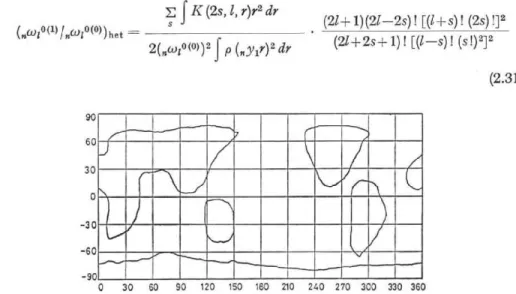
From the property of 3-j symbol, the first order perturbations of eigenfrequency for opposite sign of m are equal to each other. Therefore, the lateral heterogeneity of the earth's structure produces 1+1 lines from one degenerated eigenfrequency. For m=0 mode, the fractional shift is expressed as
E K(2s,l, r)r2 dr (21+ 1)(2/-2s)! [(I+ s)! (2s) !]2 (nwio (1) inc4)io (o) ) het
dr (21+2s+1)! [(1—s)! (s!)92
2(0)10(0)2
f p
(ny,r)2
(2.31)131111•0"""1111111,'"IlE
"IIIMMINIIII^11•11111
am.:11011111111^11111.12.10.
-31
NIMMINE•11111111111111
1111111111111111•111111E1
-6°
imemmo
..simmommvalmm
-9011111=
0 30 60 90 120 150 160 210 240 270 300 330 360Fig. 2. The ocean function reconstructed from its spherical harmonics up to the 8-th order.
In order to express an approximation of the lateral heterogeneity of the earth's structure, the series of spherical harmonics up to the 8-th term is used for the ocean function as shown in Fig. 2. We assume that distributions of shear wave velocity and
density in CANST model by Brune and
Dorman (1963) and 8099 model by Dorman
DENSITY (g/cm3)
1 2 345 6et al.(1960),whichare showninFig. 3,are
100 ?200 a_ 1–300 A 400 500 1 2 3 4 5 6
SHEAR VELOCITY (km/sec)
Fig. 3. Shear velocity and density
tributions of CANST (by Brune and
Dorman (1963) ) and 8099 (Dolman
et al. (1960) ) models.
valid as the continental and oceanic
struc-tures to the depth of 400 km from the
earth's surface. CANST model is used for
the structure beneath 400 km irrespective
of oceanic or continental structure. The
lateral heterogeneity, therefore, is assumed
to exist only in the depth interval from
0 km to 400 km, and the structure is
laterally homogeneous below 400 km.
Table 2 shows the variation of the
fractional shift in eigenfrequency of m=0
mode. It is seen in Table 2 that the shift
A MODEL OF EARTH'S STRUCTURE INFERRED FROM EIGENPERIODS 245
0.05% and that the shift is maximum for 0T21 mode which corresponds to 350 sec. This existence of the maximum shift may be an apparent result due to expansion of the ocean function up to the 8-th term, and the shift is probablly higher for shorter period range of eigenperiod than 350 sec. In this study, therefore, the values of the shift extrapolated from those for longer period than 350 sec are used as the shifts in eigenperiods from 350 sec to 300 sec. Even when the error by the extrapolation is taken into consideration, the shift in eigenperiods for modes from 0T2 to 0T25 is reason-ablly thought to be less than 0.1%.
Table 2 Shift in fundamental torsional oscillation periods due to laterally heterogeneous model calculated from CANST and 8099 models.
Mode 0'1'2 oT, oT, oT, 0T6 0T7 oTp OT9 OT10 0T11 0T12 Period (sec) Shift 1000 x 2610.44 1066.86 917.98 811.33 730.35 666.30 614.06 570.45 533.37 0.033 0.231 0.261 0.289 0.313 0.335 0.355 0.372 0.387 Mode oTi a 0T14 0T15 0T16 0T17 0T18 °T" 0T20 20 0T21 01.22 0T23 Period Shift (sec) 1000 x Mode 501.36 473.39 448.69 426.67 406.89 372.73 357.85 344.18 331.57 319.89 i t I i I 0. 399 0. 410 0. 419 0. 426 0.431 0.437 0.438 0.438 0. 436 0.433 0T24 O1.26 0T26 OT27 0T28 01'29 OT30 OT31 0T32 0T33 OT34 Period (sec) 309. 04 298.94 289.49 280. 63 272.32 264.50 250.16 243.57 237.33 231.39 Shift 1000 x 0.429 0.424 0.419 0, 412 0.403 0.395 0.375 0.364 0.352 0.339
3. Importance of Physical Dispersion of Body Waves for Inversion Study. Let us review the physical dispersion of the body waves due to anelasticity of the medium. The real and imaginary parts of the complex and frequency-dependent velocity are related to each other by either Kramers-KrOnig relation in the frequency domain (e.g., Futterman, 1962), or Boltzman's aftereffect equation in the time domain (e.g., Lomnitz, 1957). If absorption coefficient of seismic waves is given as a function of frequency, the Kramers-KrOnig theory provides the dispersion relation. On the other hand, if the time dependent strain at constant stress is given for a solid, the Boltzman's aftereffect equation gives the complex elastic constant and dispersion relation.
Such a dispersion relation also provides the frequency-dependent attenuation. Futterman (1962) indicated that attenuation is independent of frequency within a finite frequency band on an assumption that the absorption coefficient is linearly proportional to frequency. On the other hand, Lomnitz (1957) introduced a logalithmic creep law to construct a constant Q model. Although this empirical law has a defect in the static limit, it explains fairly well the constant Q in seismic frequency band when Q-I is small. Recently, Liu et al. (1976) demonstrated that frequency-independent Q can be also explained by the superposition of a continuous distribution of relaxation corresponding to mechanism of attenuation. In any case, attenuation of shear wave is safely assumed to be independent of frequency in the seismic frequency band.
The frequency-independent Q gives the following dispersion relation,
246 H. ODA
1
7 V(w2)IV(co,) = 1 +12w2ict)i(3.1)
where V (co,) and V (o)2) are phase velocities of shear wave at frequencies of and co,. If we consider an earth model derived from shear wave data with the period of 1 sec, the shear velocity at torsional frequency o is given by
1 7T V (co)1V (27c) = 1 +QInwf2rr, (3.2) which is rewritten as V (r,co) = V (r) +V (r) In col2n- Q (3.2)' rr
in which V (r) is distribution of shear wave velocity within the earth, which is obtained from body wave data. The second term of right hand side of eq. (3.2) represents the contribution from physical dispersion due to anelasticity. For example, the change in shear wave velocity in the peiod range from 300 sec to 2700 sec is estimated from eq. (3.2) to be between 3% and 4% for Q=60 and between 0.2% and 0.3% for Q----750. Therefore, the dispersion factor due to low Q in the upper mantle gives a considerable effect on torsional oscillation periods.
The large effect of the dispersion upon eigenfrequency of torsional oscillation can be evaluated by replacing the operator II di, in eq. (2.15) in section 2 by V (r) Q-1(r)7r-iIn (,)/27r. The fractional shift in eigenfrequency of torsional oscillation is expressed by
1 (
swim (1) incol "Mis —Q
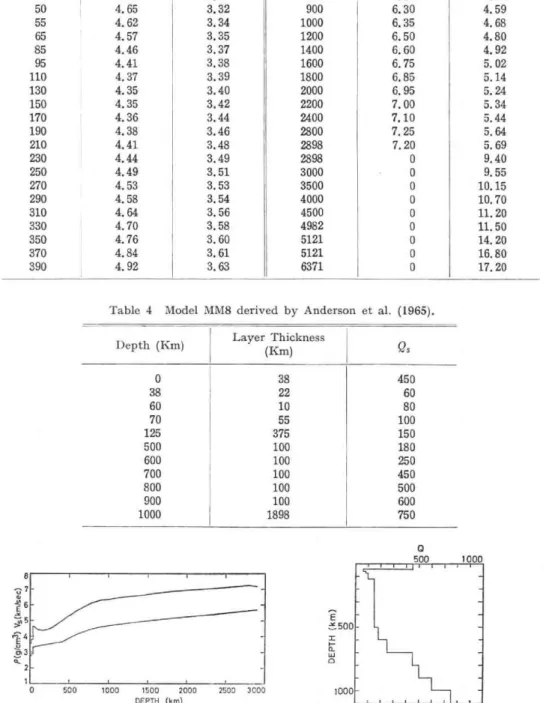
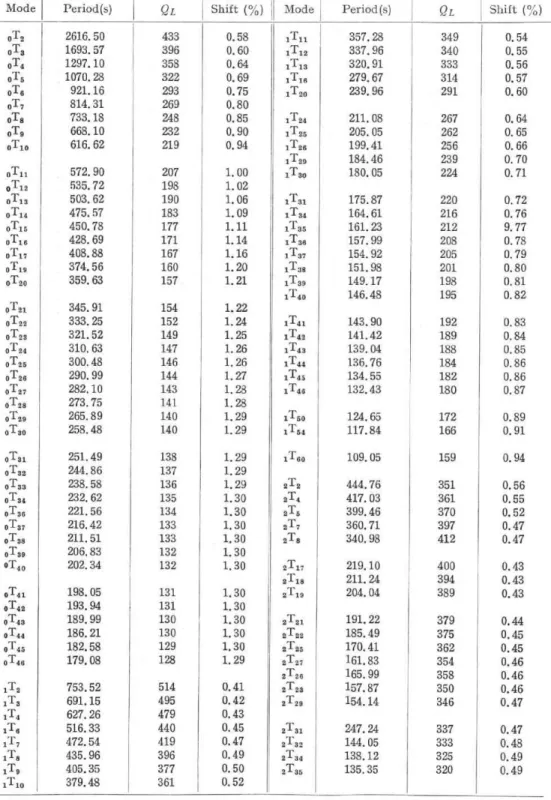
L7Inco12n-, (3.3) in which QL is the attenuation of torsional oscillation defined by eq. (2.16) in section 2. In order to compute the shift, we adopted MM8 model (Table 4) by Anderson et al. (1965) as a Q model for shear wave. We also used Gutenberg and Bullen A model (called G.B.A model hereafter in this paper and shown in Table 3) as shear wave velocity and density distributions. The torsional oscillation Q calculated for G.B.A and MM8 models is shown in Table 5 and is illustrated in Fig. 6. G.B.A and MM8 models are illustrated in Figs. 4 and 5, respectively. The fractional shift in eigenfrequencies of torsional oscillation is also shown in Table 5. Fig. 7 depicts the fractional shift due to the dispersion of shear wave as well as those due to rotation, ellipticity, and lateral heterogeneity of the earth. In this figure, the shifts due to the dispersion, rotation, ellipiticity, and lateral heterogeneity are represented by open circle, open square, solid square, and solid circle, respectively.
As seen in Fig. 7, the shift due to the dispersion for fundamental modes amounts to 0.6%-1.3%. The maximum shifts is in the period range from 230 sec to 180 sec corresponding to 07.34-0T „. For the first and second radial modes, the shift is from 0.5% to 1.0%. As seen in Fig. 7, the total fractional shfit due to some properties of the earth except for the physical dispersion is less than 0.2%. Therefore, the effect of the dispersion of shear wave upon the torsional oscillation periods is very significant in
A MODEL OF EARTH'S STRUCTURE INFERRED FROM EIGENPERIODS 247
Table 3 Layer parameters of G.B.A model.
Depth (Km) Vs (Km/sec) 0 19 19 38 38 50 55 65 85 95 110 130 150 170 190 210 230 250 270 290 310 330 350 370 390 3.55 3.55 3.80 3.80 4.65 4.65 4.62 4.57 4.46 4.41 4.37 4.35 4.35 4.36 4.38 4.41 4.44 4.49 4.53 4.58 4.64 4.70 4.76 4.84 4.92 p (g/cm3) i 2.75 2.75 2.90 2.90 3.32 3.32 3.34 3.35 3.37 3.38 3.39 3.40 3.42 3.44 3.46 3.48 3.49 3.51 3.53 3.54 3.56 3.58 3.60 3.61 3.63 Depth (Km) 410 500 600 700 800 900 1000 1200 1400 1600 1800 2000 2200 2400 2800 2898 2898 3000 3500 4000 4500 4982 5121 5121 6371 V, (Km/sec) 4. 98 5. 30 5. 60 5. 90 6.15 6.30 6.35 6.50 6.60 6.75 6.85 6.95 7.00 7.10 7, 25 7.20 0 0 0 0 0 0 0 0 0 p (g /cms) 3. 64 3. 89 4. 13 4. 31 4.49 4.59 4.68 4.80 4.92 5.02 5.14 5.24 5.34 5.44 5.64 5.69 9.40 9.55 10.15 10.70 11. 20 11.50 14.20 16.80 17.20
Table 4 Model MM8 derived by Anderson et al. (1965).
Depth (Km) 0 38 60 70 125 500 600 700 800 900 1000 Layer Thickness (Km) 38 22 10 55 375 100 100 100 100 100 1898 Qs iI 450 60 80 100 150 180 250 450 500 600 750 a 7 6 5 4 In 3 2 0 500 Fig. 4. 1000 1500 2000 DEPTH (km) Illustration of G.B.A. 2500 model. 3000 Fig. 5 et -- z'_` 500 I )- cL W c) 1000 0 500 1000 Model MM8 al. (1965). derived by Anderson
248 H. ODA
Table 5 Eigenperiods and Q values fractional shift due to physical
of torsional oscillation for G.B.A and MM8 dispersion calculated for MM8 model by Eq.
models, (3.3). and Mode 0T, 0T3 0T4 0T5 01.6 0T7 0T8 0T9 0T10 OT11 01'12 OT13 0T14 0T15 0T16 0T17 DT19 OT20 0T21 0T22 0T23 0T24 0T25 OT26 0T27 0T28 0T29 0T30 0T31 0T32 0T33 0T34 OT3, °Tv 0T38 0;9 0'1'40 0T41 0T42 0T43 0T44 0T45 OT46 1T2 1T3 1T4 1Te 1T7 iTs 1T, 1T10 Period (s) 2616.50 1693.57 1297.10 1070.28 921.16 814.31 733.18 668.10 616.62 572.90 535.72 503.62 475.57 450.78 428.69 408.88 374.56 359.63 345.91 333.25 321.52 310.63 300.48 290.99 282.10 273.75 265.89 258.48 251.49 244.86 238.58 232.62 221.56 216.42 211.51 206.83 202.34 198.05 193.94 189.99 186.21 182.58 179.08 753.52 691.15 627.26 516.33 472.54 435.96 405.35 379.48 QL 433 396 358 322 293 269 248 232 219 207 198 190 183 177 171 167 160 157 154 152 149 147 146 144 143 141 140 140 138 137 136 135 134 133 133 132 132 131 131 130 130 129 128 514 495 479 440 419 396 377 361 Shift (0/0) Mode 0.58 0.60 0.64 0.69 0.75 0.80 0.85 0.90 0.94 1. 00 1. 02 1. 06 1. 09 1.11 1.14 1.16 1.20 1.21 1. 22 1. 24 1. 25 1. 26 1.26 1.27 1.28 1.28 1.29 1.29 1. 29 1. 29 1. 29 1. 30 1.30 1.30 1.30 1.30 1.30 1. 30 1. 30 1. 30 1. 30 1.30 1.29 0.41 0.42 0.43 0.45 0. 47 0.49 0.50 0.52 1T11 1T12 1T13 1T18 1T20 1T34 1T25 1T36 1T39 1T30 1T31 1T" 11'33 1T36 1T37 1T38 11'33 1T40 1T41 1T42 314, 1T44 11.45 1T46 1T50 1T54 1T60 2T2 2T4 2.1'6 2T7 21'2 2T17 2T18 2T19 2T21 2T22 2'1'23 2T27 21'26 2T23 2T29 2T31 2T32 2T34 2T35 Period (s) QL 357.28 337.96 320.91 279.67 239.96 211.08 205.05 199.41 184.46 180.05 175.87 164.61 161.23 157.99 154.92 151.98 149.17 146.48 143.90 141.42 139.04 136.76 134.55 132.43 124.65 117.84 109.05 444.76 417.03 399.46 360.71 340.98 219.10 211.24 204.04 191.22 185.49 170.41 161.83 165.99 157.87 154.14 247.24 144.05 138.12 135.35 349 340 333 314 291 267 262 256 239 224 220 216 212 208 205 201 198 195 192 189 188 184 182 180 172 166 159 351 361 370 397 412 400 394 389 379 375 362 354 358 350 346 337 333 325 320 Shift (0/0) 0.54 0.55 0.56 0.57 0.60 0. 64 0. 65 0. 66 0. 70 0.71 0.72 0.76 9.77 0.78 0.79 0.80 0.81 0.82 0. 83 0. 84 0. 85 0. 86 0.86 0.87 0. 89 0. 91 0. 94 0. 56 0. 55 0. 52 0.47 0.47 0.43 0.43 0.43 0. 44 0. 45 0. 45 0. 46 0.46 0.46 0.47 0. 47 0. 48 0. 49 0. 49
A MODEL OF EARTH'S STRUCTURE INFERRED FROM EIGENPERIODS 249
comparison with the total effect due to other properties of the earth. This suggests
that the eigenfrequencies of torsional oscillation provide the important information
concerning attenuation structure as well as shear wave velocity and density structures
and also attenuation of torsional oscillation. In other words, the correction of the
effect of the dispersion is required for inversion of eigenperiods into velocity and density
structures. 1 1,-,0 1.2 -000°-0000 O° 1.0 - 0° - 600 1 1 1 1 1 1 1 1 1 1 111111 00 o - FIRST HIGHR MODo° E- 3 ROTATION
oo° • ELLIPTICITY 400 - o PHYSICAL DISPERSION 0.4 - • LATERAL 0 2 - ^ 200 FUNDAMENTAL _••4!_tilg• ****** 0 I I 1 f I I I I f 11111111 -0.2 - 100 500 1000 500010 20 30 PERIOD (SEC) ORDER NUMBER
Fig. 6. Variation of torsional oscillation Q Fig. 7. Variations of fractional shift in versus period. torsional oscillation eigenfrequency due
to physical dispersion, rotation,
city, and lateral heterogeneity with
respect to angular order number of
fundamental mode.
It has been shown that the torsional eigenperiods are useful for the study on attenuation structure or torsional oscillation Q. Since the shift in torsional oscillation periods is larger than total shift due to other properties of the earth, the observed angular eigenfrequency w° or eigenperiod T° of torsional oscillation should be approxi-mately expressed as 1 7
w°(Q
L1
+inwe/27r)
,
(3.4)
orT°
=
T'
(1
+1 ln
Te)
,
(3.4)'
Qr..- rwhere we and P are angular eigenfrequency and eigenperiod of torsional oscillation expected for the model structure of which the shear wave velocity and density are determined at a reference frequency of 1 Hz. It is seen in eq. (3.4)' that the observed eigenperiod must be longer than that expected for the model structure defined at the reference frequency, because the torsional oscillation Q must be positive. The torsional oscillation Q derived from eq. (3.4)' is shown for different angular modes of fundamental mode in Fig. 8 by open circle. We adopted G.B.A model as the earth model at the reference frequency and used eigenperiods reported by Anderson and Hart
250 H. ODA
(1976) as the observed data. For comparison, the torsional oscillation Q for MM8 and G.B.A models is also shown by solid circle in Fig. 8. This figure indicates that attenuation QC1 of torsional oscillation systematically decreases with increasing order number and becomes negative at shorter period than 300 sec corresponding to 0T25. This suggests that the earth model at the reference frequency is inadequate, and there-fore, it is necessary to invert eigenperiods simultaneously into structures of shear wave velocity, density, and attenuation for shear wave.
6 4 r)- 2 0 — 0 -2 -4 -6 — 150 e--"s•—• — 200 o — 300 — 400 o — 500 00000 — 1000 C 0 0-0 0 --1000 o— -500 0 0 —400 o — -300 0 0 —200 0 5 10 15 20 25 3 0 35 40 ORDER NUMBER
Fig. 8. Torsional oscillation Q versus angular order number of fundamental mode. Open and solid circles represent apparent Q values of trosional oscillation obtained by Eq. (3.4) and
that calculated for MM8 and G.B.A models, respectively.
To invert eigenperiods into the earth's structure, we introduce initial models of shear wave velocity, density and attenuation for shear wave. Assuming that intrinsic Q for shear wave is independent of frequency and that shear wave velocity, density, and Q are function of distance, r, from the earth's center, the structures to be determined are expressed from eq. (3.2)' as
In (Tste+4Te)
V
(r
, T6)
= (V
st+
dV)
[1 —(Qsi—I-F4Q-1)j
7r Pfr) --- Psi+ ziP (3.5) Q-1(r) = Qsrl+ AQ-1 T6 = Tste+ ifTewhere Vst, psi, and Qs,---1 are initial models for shear wave velocity defined at the reference frequency of 1 Hz, density, and intrinsic Q for shear wave, respectively. AV, tip, and 4Q-1 denote the differences between the initial model and actual earth's structure to be estimated. Tsie and ATe are eigenperiod for the initial models of shear wave velocity and density and the change in eigenperiod due to AV and tip, respectively. Since [1n. (Ts,' + AP)-ln Ts$1/1n T ste is of the order of 0.1% even when ifT6 IT,16 amounts to 1%, In (Tsle d - AP) is approximately equal to In T,(. Then, the shear velocity has the form,
A MODEL OF EARTH'S STRUCTURE INFERRED FROM EIGENPERIODS 251
s
V
(r
,
P)(Ka+ AV)
[1 —in
T-cipsi_i+4Q-1)]
(3.6)
7T
Neglecting higher order term of 417 and AQ -1 than the second order term, eq. (3.6) reduces to Vsg in ToeVst In TsieIn T V ( r , Te) = V si— Q 4-1+ AV —4Q-1—Qst-1 7T 7T 7T (3.7) As the fifth term in right hand side of eq. (3.7) is sufficiently smaller than the other terms, the shear wav e velocity at the torsional oscillation period P is written as
VstinT steV stT ste
V (
r , P)VQ ir7r st-1 + 417 —AQ-3.(3.8)
The difference 4w between observed and theoretical angular eigenfrequencies is expressed as
dco = [(at si) AV +(ac.,16 pst) zip+ Ow faQ ,c-1) 4Q-1] r2 dr . (3.9)
The partial differentials of angular eigenfrequency with respect to shear wave velocity, density, and Q-1 are given by
acomvPsg Vst [1 (1+ 1)f3—f2] s, = 1 1r2 co ,te 2/ 1+ Vsi2 [1 (1+ 1).4— f2.] acola psi—(3.10) 2472 co st'
PsiVst2 [1 (1+1) is— f2] in7' ste at 0laQ 51-1 = 71- 1,1'2 Ctlste where, r2(n.Y1) 2
f2 = (nyi) 2 + 2r nyi (d yi/dr) —r2(d y dr) 2 , (3.11) /3 = (011)2
fiu(r)
fi
(r)
dr
cost' 27rIT ste .
Since three partial differentials and Aw in eq. (3.9) are calculated from initial model using eqs. (3.10) and (3.11), to solve eq. (3.9) for several modes with respect to AV, Ap, and AQ-1 results in inverse problem. Once the perturbations for the initial model are obtained by the inversion process, we can estimate the attenuation structure and density and shear wave velocity distributions at 1 Hz adding the perturbations to the initial model. Consequently, the torsional oscillation Q for the obtained earth model is calculated by Eq. (2.16).
252 H. ODA
4. Discussions and Conclusions
We have elucidated the effects of anelasticity, rotation, ellipiticity, lateral heterogeneity, and physical dispersion upon eigenperiods of torsional oscillation of azimuthal order number of zero. Such properties of the earth produce the shift in eigenperiods of torsional oscillation.
Anelasticity of the earth produces the shift in the eigenperiods. The effect arises from the term of the second order perturbation of anelasticity, and therefore, it differs from the effect of anelasticity which causes physical dispersion of shear wave. The fractional shift in eigenperiods for fundamental modes from 0T2 to 0T99 less than 0.1% at the most. For higher radial modes, the shfit is reasonablly expected to be smaller than that for fundamental modes because QL-1 for fundamental modes, which is defined by eq. (2.16), is larger than that for higher radial modes. The shift due to anelasticity is the smallest among those due to some properties of the earth mentioned above.
Since the first order perturbation of rotation produces split from degenerated eigenfrequency, which is symmetrical with respect to m=0 mode, the first order shfit is not necessary to be taken into consideration. The second order perturbation gives the shift in eigenperiods for m=0. As seen in Table 1, except for lower angular modes, the fractional shift is less than 0.1%. The shift for higher radial and angular modes is expected to be significantly small because the amount of (2/„cotm(0)) rapidly decreases with increasing ,,coim (0).
Ellipiticity of the earth also produces the fractional shift with the absolute value less than 0.1% for 07-2-07'10 with m=0. The shfit for higher angular order oscilla-tions is of the order of 0.05%. The total shift due to ellipticity and rotation is less than 0.1% because the shifts due to ellipticity and rotation have the opposite sign to each other, as seen in Table 1.
The effect of lateral heterogeneity of the earth's structure upon the eigenfrequency of m=0 for 0T2 -0T„ is significantly small. The fractional shift due to this effect is of the order of 0.1%. Therefore, the total shift in eigenperiods for azimuthal order number of zero due to other properties than physical dispersion of shear wave is estimated to be less than 0.2% in the period range from 300 sec to 2700 sec.
For frequency-independent Q model, the fractional shift in eigenperiods due to physical dispersion of shear wave amounts to 0.6%-1.3%. Since the total fractional shift in torsional eigenperoids due to other properties than the dispersion is less than 0.2%, the shift due to the dispersion is significantly large in comparison with total shift due to other properties. The eigenperiods of torsional oscillation, therefore, can provide the important information concerning attenuation structure as well as shear wave velocity and density structures.
The eigenperiods can be calculated based on the perfect elastic model of the earth, which is velocity and density model based on short period (say 1 Hz) seismic waves. Therefore, the difference between these calculated and observed eigenperiods can be provide the information about the torsional oscillation Q. The result of calculation in
A MODEL OF EARTH'S STRUCTURE INFERRED FROM EIGENPERIODS 253
Fig. 8, however, indicates that the earth model defined is inadequate because the calculation gives the negative value for apparent Q of the oscillation. Consequently, it is necessary to invert the eigenperiods simultaneously into distributions of shear wave velocity, density, and intrinsic Q for shear wave. The earth's structure is estimated by solving eq. (3.9) with respect to 417 , hip, and ziQ-1. The torsional oscillation Q for the obtained structure can be estimated by eq. (2.16).
Hart et al. (1976, 1977) presented velocity and density structures by means of inversion of normal mode data with correction of the effect of dispersion of body waves arising from anelasticity. In their study, they assumed an attenuation structure in order to correct the dispersion effect. On the other hand, Lee and Solomon (1978)
demonstrated that inversion of phase velocity of surface waves to obtain an elasticity-density structure is not distinct problem from inversion of surface wave attenuation to obtain Q structure, because the intrinsic velocity is affected by anelastic property.
Furthermore, they showed that the resolution in depth of attenuation structure is higher than that by inversion only of attenuation data for surface wave when the phase
velo-cities and attenuations are simultaneously inverted into Q-1 structure with velocity-density structure. Since the torsional oscillation Q estimated so far has large variance, attenuation structure is not expected to be accurately determined according to this method. Therefore, it is necessary that the eigenperiods of torsional oscillation are inverted simultaneously into shear wave velocity, density, and intrsinic Q structures, as will be shown in a later paper. (to be continued)
Acknowledgements: The author would like to express his thanks to Prof. Z. Suzuki for his invariable guidance throughout the course of this study, and Profs. A. Takagi and T. Hirasawa for their useful suggestions and dicussions. He also expresses his gratitude to Prof. Z. Suzuki for his critical reading of the manuscript. Kind suggestions and discussions by Drs. H. Hamagichi and K. Yamamoto and Mr. M. Takemura are greatly benefitted throughout the present study.
References
Alsop, L.E., G.H. Sutton, and M. Ewing, 1961: Measurement Q for very long free oscillations, J. Geophys. Res., 66, 2911-2915.
Alterman, Z., H. Jarosch, and C.L. Pekeris, 1959: Oscillations of the earth, Proc. Ror. Soc. London, A252, 80-95.
Anderson, D.L., A. Ben-Menahem, and C.B. Archambeau, 1965: Attenuation of seismic energy in the upper mantle, J. Geophys. Res., 70, 1441-1448.
Anderson D.L., and R.S. Hart, 1976: An earth model based on free oscillations and body waves, J. Geophys. Res., 81, 1461-1475.
Backus, G., and F. Gilbert, 1961: The rotational splitting of the free oscillations of the earth, Proc. Natn. Acad. Sci., 47, 362-371.
Benioff, H., F. Press, and S. Smith, 1961: Excitation of the free oscillations of the earth by earthquakes, J. Geophys. Res., 66, 605-619.
Brune, J., and J. Dorman, 1963: Seismic waves and earth's structure in the Canadian shield, Bull. Seim. Soc. Am., 53, 167-209.
Carpenter, E.W., and D. Davies, 1966: Frequency dependent seismic phase velocity: An attempted reconciliation between the Jeffreys/Bullen and Gutenberg models of the
upper mantle, Nature, 212, 134-135.
254 H. ODA
Dahlen, F.A., 1968: The normal modes of a rotating, ellipitical earth, Geophys . J., 16, 329-367.
Dorman, J., M. Ewing, and J. Oliver, 1960: Study of shear velocity distribution in the upper
mantle by Rayleigh waves, Bull. Seism. Soc. Am. , 50, 87-115.
Futterman, W.I., 1962: Dispersive body waves , J. Geophys. Res., 67, 5279-5291.
Gilbert, F., 1970: Excitations of the normal modes of the earthquake sources, Geophys. J., 22,
223-226.
Hart, R.S., D.L. Anderson, and H. Kanamori, 1976: Shear velocity and density of an attenuating
earth, Earth Planet. Sci. Lett., 32, 25-34.
Hart, R.S., D.L. Anderson, and H. Kanamori, 1977: The effect of attenuation on gross earth
models, J. Geophys. Res., 82, 1674-1654.
Jeffreys, H., 1965: Damping of S waves, Nature (London), 208, 675.
Kanamori, H., 1970: Velocity and Q of mantle waves, Phys. Earth Planet . Interiors, 2, 259-275.
Kovach, R.L., and D.L. Anderson, 1967: Study of the energy of the free oscillations of the earth,
J. Geophys. Res., 72, 2155-2168.
Lee. W.B., and S.C. Solomon, 1978: Simultaneous inversion of shear wave phase velocity and
attenuation: Love waves in western north America, J. Geophys. Res., 83, 3389-3400.
Liu, H. -P., and C.B. Archambeau 1975: The effect of anelasticity on periods of the earth's
free oscillations (Toroidal modes), Geophys. J., 43, 795-814.
Liu, H. -P., D.L. Anderson, and H. Kanamori, 1976: Velocity dispersion due to anelasticity:
Imprications for seismology and mantle composition, Geophys. J., 47, 41-58.
Lomnitz, C., 1957: Linear dissipation in solids, J. Appl. Phys. , 57, 201-205. Love, A.E.H., 1911: Some problems in geodynamics, Cambridge.
MacDonald, G., and N. Ness, 1961: A study of the free oscillations of the earth, J. Geophys.
Res., 66, 1865-1911.
Madariaga, R., 1972: Toroidal free oscillations of the laterally heterogeneous earth, Geophys. J.,
27, 81-100.
Madariaga, R., and K.Aki, 1972: Spectral splitting of toroidal free oscillations due to lateral
heterogeneity of the earth's structure, J. Geophys. Res., 23, 4421-4431.
Munk, W.H., and G. MacDonald, 1960: The rotation of the earth, Cambridge University Press,
London.
Pekeris, C.L., Z. Alterman, and H. Jarosch, 1961: Rotation multiplets in the spectrum of the
earth, Phys. Rev., 122, 1692-1700.
Randall, M.T., 1976: Attenuative dispersion and frequency shifts of the earth's free oscillations,
Phys. Earth Planet. Interiors, 12, 1-4.
Saito, M., 1967: Excitation of free oscillations and surface waves by a point source in a verically
heterogeneous earth, J. Geophys. Res., 72, 3689-3699.
Saito, M., 1971: Theory for the elastic-gravitational oscillation of a laterally heterogeneous
earth, J. Phys. Earth, 19, 259-270.
Strick, E., 1970: A predicted pedestal effect for pulse propagation in constant-Q solids,
Geophysics, 35, 387-402.
Tokseoz, M.N., and A. Ben-Menahem. 1963: Velocities of mantle Love and Rayleigh waves over
multiplet paths, Bull. Seism. Soc. Am., 53, 741-746.
ToksOz, M.N., and D.L. Anderson, 1966:P Phase velocities of long period surface waves and
structure of the upper mantle, J. Geophys. Res., 71, 1649-1658.
Usami, T., 1971: Effect of horizontal heterogeneity on the torsional oscillation of an elastic
sphere, J. Phys. Earth, 19, 175-180.
Usami, T., and Y. Sat& 1962: Torsional oscillation of a homogeneous elastic spheroid, Bull.
Seism. Soc. Am., 52, 469-484.