Optimal timing of clopidogrel discontinuation
in Japanese patients : platelet aggregation
test using the VerifyNow(R) system
著者
滝内 宏樹
著者(英)
Takiuchi Hiroki
学位名
博士(医学)
学位授与機関
川崎医科大学
学位授与年度
平成27年度
学位授与年月日
2016-03-17
学位授与番号
35303甲第630号
URL
http://doi.org/10.15111/00000048
Original Article
Optimal Timing of Clopidogrel Discontinuation in Japanese patients: Platelet Aggregation Test
Using the VerifyNow® system
Hiroki Takiuchi, MD; Kazuo Tanemoto, MD, PhD
Department of Cardiovascular Surgery, Kawasaki Medical School, Kurashiki, Okayama, Japan
Correspondence to: Hiroki Takiuchi, MD, Department of Cardiovascular Surgery, Kawasaki
Medical School, 577 Matsushima, Kurashiki, Okayama 701-0192, Japan
Tel: +81-86-462-1111, Fax: +81-86-464-1189
E-mail: [email protected]
ABSTRACT Objective
The Japanese Circulation Society recommends discontinuation of antiplatelet therapy 7–14 days before major surgery. However, reports on the relationship between the timing of clopidogrel discontinuation and the risk of postoperative bleeding in Japanese subjects are lacking. We assessed the optimal timing of clopidogrel discontinuation before elective surgery using the VerifyNow® P2Y12 assay. Additionally, the relationship between preoperative platelet function and risk of postoperative bleeding was evaluated.
Methods
Study 1: Between June 2012 and December 2014, Platelet function was examined by the VerifyNow P2Y12 assay in patients scheduled for cardiac surgery, every other day after clopidogrel cessation.
Study 2: We compared the preoperative platelet function, measured by the Verify Now, with the postoperative bleeding.
Results
Study 1: Twenty-four patients were included in this study. The mean P2Y12 reaction units (PRU) on Day-0 was 186, and increased significantly to 283 PRU on Day-7 in a time-dependent manner after clopidogrel discontinuation (p=0.001). The mean PRU value significantly exceeded the cutoff of 230 on Day-5.
Study 2: Correlation between the preoperative aspirin reaction units (ARU) and postoperative bleeding showed a slight inverse correlation in patients undergoing aortic valve replacement (rS= – 0.363, p= 0.013), mitral valve plasty (rS= –0.300, p= 0.085) and off-pump coronary artery bypass (rS= –0.176, p= not significant).
Conclusion
Platelet aggregation had already recovered at 5 days after clopidogrel cessation. Surgeons could consider decreasing the interval from clopidogrel discontinuation to surgery from the recommended 7–14 days. The VerifyNow assay can be used to predict the risk of perioperative bleeding.
INTRODUCTION
The antiplatelet agent clopidogrel is used widely for the prevention and treatment of peripheral, coronary and cerebrovascular arterial thrombotic diseases. With the spread of percutaneous coronary interventions using drug-eluting stents, cardiac surgeons increasingly encounter patients on long-term clopidogrel therapy.
The American College of Cardiology and American Heart Association recommends ≥5 days from clopidogrel discontinuation to cardiac surgery because clopidogrel has been shown to increase the risk of peri-procedural bleeding and surgical re-exploration, transfusion frequency, and resource utilization in patients undergoing surgery. In the USA, patients on maintenance clopidogrel scheduled for a surgical procedure are, in general, instructed to discontinue the drug 5–7 days before the procedure.[1-6]
In Japan, discontinuation of clopidogrel is recommended >14 days before the surgical procedure. It is mentioned that if a sufficient period between clopidogrel discontinuation and surgery is not possible, special care is essential because of the increased risk of severe bleeding. However, reports on the relationship between the timing of clopidogrel discontinuation before surgery and bleeding risk in Japanese subjects are lacking.
Historically, platelet reactivity has been measured by light-transmittance aggregometry (LTA) but this method is technically complex and time-consuming. Several more practical, point-of-care tests are being used to assess platelet reactivity to clopidogrel. VerifyNow® (Accumetrics, San Diego, CA, USA) is a reliable point-of-care assay that measures platelet aggregation. Results are expressed in platelet P2Y12 reaction units (PRU) and aspirin reaction units (ARU). VerifyNow has been reported to be easy to use and rapid to measure.[7-9] The VerifyNow P2Y12 Test is designed to measure the platelet P2Y12 receptor, which is blocked by clopidogrel. PRU detects platelet aggregation with adenosine-5-diphosphate, and does not influence the arachidonic acid cascade. VerifyNow is a point-of-care, rapid, cartridge-based, platelet-function assay that is used to measure platelet aggregation in a system containing fibrinogen-coated beads. The instrument measures the rate of platelet aggregation based on changes in light transmission through whole blood. Results of the VerifyNow P2Y12 assay are expressed in PRU, with higher PRU values indicating a lower degree of inhibition of the platelet P2Y12 receptor by clopidogrel, and thus less platelet inhibition. Residual platelet reactivity as measured by the VerifyNow P2Y12 assay has been reported to be correlated with that measured by LTA, which is considered to be the “gold standard” for determination of the effects of antiplatelet therapy upon platelet function. [10,11]
The aim of this prospective observational study is to assess the optimal timing of discontinuation of clopidogrel before elective cardiovascular surgery by examining recovery of platelet function after clopidogrel cessation using the VerifyNow P2Y12 assay. Additionally, we investigated the relationship between the preoperative platelet function, assessed by Verify Now assay system, and the risk of the postoperative bleeding.
METHODS
Study 1: We undertook this prospective, observational study to determine the optimal timing of discontinuation of clopidogrel before cardiovascular surgery by monitoring changes in platelet reactivity after clopidogrel discontinuation using the VerifyNow P2Y12 assay. This study was conducted in patients scheduled to undergo surgery at Kawasaki Medical School in Okayama, Japan between June 2012 and December 2014.
After providing written informed consent, 24 patients were enrolled. Fourteen patients (58.3%) received dual-antiplatelet therapy with clopidogrel (75 mg) and aspirin (100 mg) daily. Low-dose aspirin was not discontinued for coronary artery bypass surgeries. The demographic data reviewed comprised the age, body mass index, sex, history of smoking, and comorbidities (diabetes mellitus, hypertension, hyperlipidemia, coronary artery disease, peripheral vascular disease).
A whole-blood sample (designated as the Day-0 sample) was obtained from each patient immediately before clopidogrel discontinuation, and tested by the VerifyNow P2Y12 assay to determine the degree of platelet inhibition. Then, clopidogrel was discontinued on the same day (Day-0), about 7 days before the scheduled surgical procedure. Whole-blood samples were obtained on Days 1, 3 and 5 or 2, 4 and 6, followed by collection of a pre-procedural blood sample on Day-7. To observe changes in the activity of platelet aggregation, we measured changes in percent inhibition of the P2Y12 receptor relative to that at baseline. This measurement was based on the PRU values at the time-point of determination and the BASE PRU (BASE), which is an independent measurement based on the rate and extent of platelet aggregation in the BASE channel, using the following equation:
(BASE – PRU)/BASE × 100.
The BASE PRU result serves as an estimate of platelet function at baseline, and is independent of inhibition of the P2Y12 receptor.
Study 2:
We measured preoperative PRU and ARU by the VerifyNow and postoperative amount of bleeding over 24 hours after admission to the intensive care unit (ICU) undergoing the cardiac surgery between November 2011 and December 2014. Then, the correlation between the preoperative platelet aggregation and postoperative bleeding was examined.
Statistical analyses
Results of the VerifyNow P2Y12 assay for individual patients were plotted over time. Descriptive statistics (mean, median, quartiles, mean ± standard error, ranges) were used to construct summary plots covering all subjects. Statistical analyses were carried out using Stat Flex v6.0 (Artech, Osaka, Japan). Two-specimen Student’s t-test was carried out to determine the significance of changes over
time of VerifyNow P2Y12 assay results and percent inhibition in subjects with data for all periods. p<0.05 was considered significant. Spearman's rank correlation coefficient was calculated for the preoperative platelet function and risk of postoperative bleeding. P values of less than 0.05 were considered to denote statistical significance.
RESULTS Study 1 Demographics
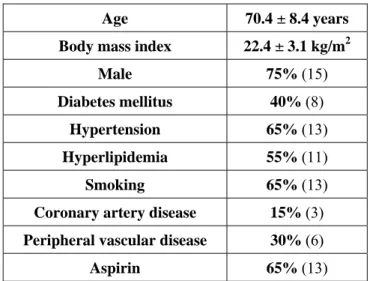
Twenty-four patients on long-term clopidogrel therapy were enrolled. However, four patients were excluded because Day-0 PRU was >230. Table 1 shows the baseline demographic data of study subjects. Mean age of patients was 70.4±8.4 years, and 15 (75%) patients were male. Comorbidities comprised diabetes mellitus (40%), hyperlipidemia (55%), hypertension (65%), coronary artery disease (15%), and peripheral vascular disease (30%); 65% of patients had a history of smoking.
VerifyNow Assay
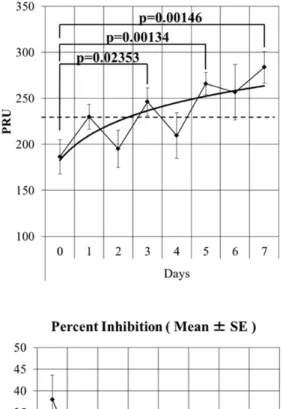
After discontinuation of clopidogrel, the PRU returned to baseline level in a time-dependent manner (Fig. 1). Mean platelet reactivity in subjects on Day-0 (immediately before clopidogrel discontinuation) was 186 (range, 83–256) PRU, which increased to 283 (range, 187–364) PRU on Day-7. Thus, significant differences recognized between Day-0 vs Day-3 (p=0.02353), Day-0 vs Day-5 (p=0.00134) and Day-0 vs Day-7 (p=0.00146) were recorded using the Student’s t-test. The mean PRU value exceeded the cutoff value of 230 at 5 days after clopidogrel cessation. Figure 2 shows the percent inhibition of the platelet receptor P2Y12 after clopidogrel discontinuation. Mean percent inhibition (standard error) on Day-0 was 38% (16.7%) and decreased to 6.5% (9.7%) on Day-7. Thus, percent inhibition decreased significantly in a time-dependent manner after clopidogrel discontinuation. We considered that the activity of platelet aggregation had already recovered by Day-5.
Study 2: Demographics
Table 2 shows the clinical characteristics of the cardiac surgery patients. The proportion of females
was relatively higher among patients undergoing aortic valve replacement (AVR), and several of these patients were not taking antiplatelet agents. The proportion of males was relatively higher among patients undergoing mitral valve plasty (MVP), and these patients were taking neither antiplatelet agents nor warfarin. Several patients were taking aspirin in the off-pump coronary artery bypass (OPCAB) group.
VerifyNow Assay
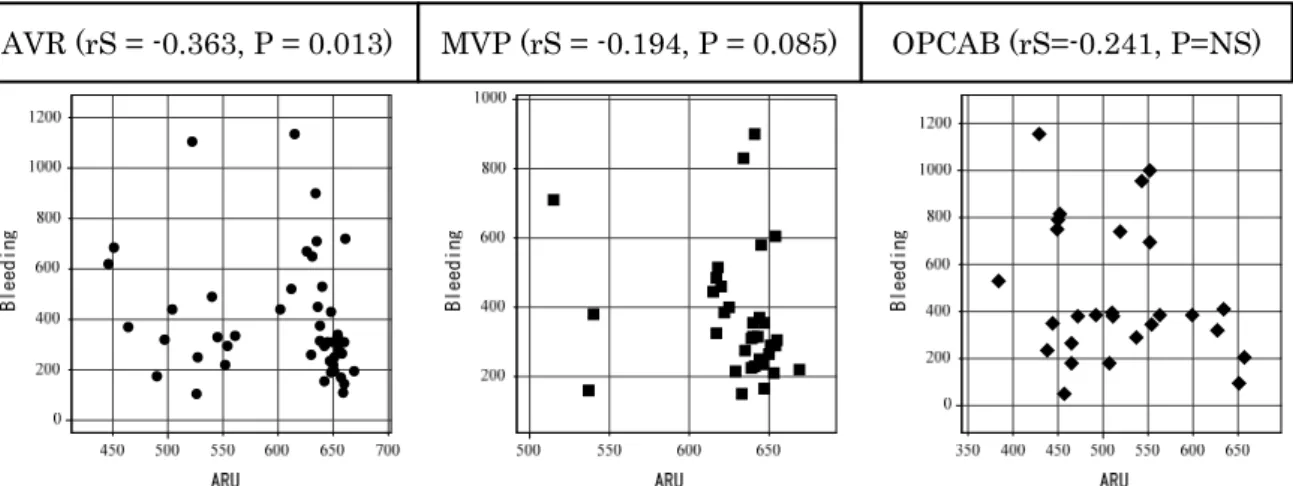
While a slight correlation was observed between the ARU value and the amount of bleeding showed inverse correlation in the patients undergoing AVR (rS= −0.363, p= 0.0131), MVP (rS=
−0.300, p= 0.0851) and OPCAB (rS= −0.176, p= not significant) groups (Fig.3). Furthermore, no correlation was observed between the PRU and the amount of bleeding in AVR (rS= −0.044, p= 0.7638), MVP (rS= –0.008, p= 0.9630) and OPCAB (rS= 0.074, p= not significant) groups (Fig. 4).
DISCUSSION
Several guidelines focus on the care of patients taking antiplatelet medications in the perioperative period, with variations in perioperative antiplatelet management evident for cardiac, peripheral vascular, coronary intervention, and other types of surgery. The guideline of the Japanese Circulation Society recommends discontinuation of antiplatelet therapy 7–14 days before major surgery (class IIa′). However, the evidence level for the optimal timing of discontinuation before surgery is very low (level C).[12] Use of a simple point-of-care test, such as the VerifyNow P2Y12 assay, to monitor the platelet response to clopidogrel discontinuation may provide useful information for making therapeutic decisions relating to management of antiplatelet drugs in the perioperative period, and for prediction of adverse events. Thus, we undertook this study to evaluate prospectively the interval to recovery of platelet function after clopidogrel discontinuation before elective surgery.
In our study, 80% of subjects showed PRU values >230 PRU and percent inhibition of the P2Y12 receptor <20% by 5 days after discontinuation of clopidogrel. Furthermore, mean platelet inhibition was only 8.3% by Day-5. These findings may allow surgeons to consider reducing the interval from clopidogrel discontinuation to surgery from the generally accepted interval of 7–14 days between withdrawal of antiplatelet drug and carrying out surgery. Further prospective studies are required to determine the optimal threshold at which bleeding and thrombotic complications can be minimized.
Median interval from the final clopidogrel dose to coronary artery bypass graft (CABG) was 4 (range, 1–9) days. Patients who withheld clopidogrel intake <4 days before surgery had lower PRU values at the time of the CABG than those who withheld the drug ≥4 days (622 ± 220 vs. 1028 ± 676 mL; p=0.026) before surgery in Transcatheter Cardiovascular Therapeutics 2012. Thresholds of ≥208 PRU and ≥275 PRU were correlated with a lower amount of bleeding but the differences did not reach significance (p=0.20 and p=0.39, respectively). Patients with PRU values ≥230 had significantly less chest-tube drainage over the 24 h after CABG than those with PRU values of <230 (622 ± 220 vs. 1028 ± 676 mL; p=0.026).[13]
We expected to observe an inverse correlation between preoperative platelet function and the amount of bleeding, but the inverse correlation was small. This observation could be explained by the small number of study subjects. Our study was conducted in patients scheduled to undergo surgical procedures; each patient had a different comorbidity, different primary disease that necessitated initiation of clopidogrel administration, and underwent a distinct surgical procedure. Each of the comorbidities may have had a different effect on platelet reactivity as measured by the VerifyNow P2Y12 assay. In addition, concomitant drugs, genetics, and the time of day at which
platelet function is measured may have different effects on the rate of production of new platelets, their activity, the rate of platelet turnover, and residual activity of platelets as measured by the VerifyNow P2Y12 assay. Further studies are needed to better define the relationship between the level of platelet inhibition measured by the VerifyNow P2Y12 assay and clinical endpoints such as bleeding and thrombotic complications.
Study Limitations
Our study had several limitations. First, there was a small number of cases in the study of clopidogrel cessation. Hence, we could not examine the relationship between the amount of bleeding and period of clopidogrel discontinuation before surgery. In future studies by our research team, the number of patients will increase, so we will review the correlation between discontinuation dates and amount of postoperative bleeding. Second, the relationship between the amount of bleeding and ARU platelet function on the day of surgery had a slight inverse correlation. Because of the small number of cases and various influencing factors that affect the extent of postoperative bleeding, the correlation did not reach significance. With a larger study cohort, it may be possible to reach a significant inverse correlation.
CONCLUSIONS
Useful information for making therapeutic decisions related to management of antiplatelet drugs during the perioperative period may be obtained by monitoring the platelet response to discontinuation of clopidogrel using the VerifyNow P2Y12 assay.
We conclude that platelet aggregation had already recovered 5 days after clopidogrel cessation, and that surgeons could shorten the period from the recommended 7–14 days after clopidogrel discontinuation before the surgical procedure. The VerifyNow platelet-function assay can also be used to predict the risk of perioperative bleeding.
Acknowledgements
We gratefully acknowledge the participants and supporting staff for enabling us to conduct this study. This study was supported in part by a Grant-in-Aid for Scientific Research from the Ministry of Education, Culture, Sports, Science and Technology, Tokyo, Japan and the project study of Kawasaki Medical School from 2012 to 2015.
References
1. Hillis LD, Smith PK, Anderson JL, Bittl JA, Bridges CR, Byrne JG, et al. 2011 ACCF/AHA Guideline for Coronary Artery Bypass Graft Surgery: Executive Summary. Journal of the American College of Cardiology 2011;58:2584-614.
2. Kapetanakis EI, Medlam DA, Boyce SW, Haile E, Hill PC, Dullum MK, et al. Clopidogrel administration prior to coronary artery bypass grafting surgery: the cardiologist's panacea or the surgeon's headache? Eur Heart J 2005;26:576-83.
3. Fox KA, Mehta SR, Peters R, Zhao F, Lakkis N, Gersh BJ, et al. Benefits and risks of the combination of clopidogrel and aspirin in patients undergoing surgical revascularization for non-ST-elevation acute coronary syndrome: the Clopidogrel in Unstable angina to prevent Recurrent ischemic Events (CURE) Trial. Circulation 2004;110:1202-8.
4. Leong JY, Baker RA, Shah PJ, Cherian VK, Knight JL. Clopidogrel and bleeding after coronary artery bypass graft surgery. The Annals of thoracic surgery 2005;80:928-33.
5. Yusuf S, Zhao F, Mehta SR, Chrolavicius S, Tognoni G, Fox KK, et al. Effects of clopidogrel in addition to aspirin in patients with acute coronary syndromes without ST-segment elevation. The New England journal of medicine 2001;345:494-502.
6. Grujic D, Martin D. Perioperative Clopidogrel Is Seven Days Enough? Am Surgeon 2009;75:909-13.
7. Malinin A, Pokov A, Swaim L, Kotob M, Serebruany V. Validation of a VerifyNow-P2Y12 cartridge for monitoring platelet inhibition with clopidogrel. Methods Find Exp Clin Pharmacol 2006;28:315-22.
8. Breet NJ, van Werkum JW, Bouman HJ, Kelder JC, Ruven HJT, Bal ET, et al. Comparison of Platelet Function Tests in Predicting Clinical Outcome in Patients Undergoing Coronary Stent Implantation. Jama-J Am Med Assoc 2010;303:754-62.
9. Malinin A, Pokov A, Spergling M, Defranco A, Schwartz K, Schwartz D, et al. Monitoring platelet inhibition after clopidogrel with the VerifyNow-P2Y12(R) rapid analyzer: the VERIfy Thrombosis risk ASsessment (VERITAS) study. Thrombosis research 2007;119:277-84.
10. Paniccia R, Antonucci E, Gori AM, Marcucci R, Giglioli C, Antoniucci D, et al. Different methodologies for evaluating the effect of clopidogrel on platelet function in high-risk coronary artery disease patients. J Thromb Haemost 2007;5:1839-47.
11. van Werkum JW, van der Stelt CAK, Seesing TH, Hackeng CM, ten Berg JM. A head-to-head comparison between the VerifyNow (R) P2Y12 assay and light transmittance aggregometry for monitoring the individual platelet response to clopidogrel in patients undergoing elective percutaneous coronary intervention. J Thromb Haemost 2006;4:2516-8.
12. Guidelines for management of anticoagulant and antiplatelet therapy in cardiovascular disease (JCS 2009).
13. Reed G, Hoffman E, Kumar A, Maree A, McLean D, Buros J, et al. Platelet Function Testing Predicts Bleeding In Patients Exposed To Clopidogrel Undergoing Coronary Artery Bypass Grafting. Journal of the American College of Cardiology 2012;60:B210-B1.
Table 1. Baseline Demographic Data of
Patients on Long-term Clopidogrel Therapy (n = 20)
Table 2. Clinical characteristics of cardiac surgery patients (n=114)
Age 70.4 ± 8.4 years Body mass index 22.4 ± 3.1 kg/m2
Male 75% (15) Diabetes mellitus 40% (8)
Hypertension 65% (13) Hyperlipidemia 55% (11) Smoking 65% (13) Coronary artery disease 15% (3) Peripheral vascular disease 30% (6)
Fig 1. Distribution of PRU values after clopidogrel
discontinuation. The dotted line represents the PRU cutoff point (230). Significant differences were observed between Day-0 vs Day-3, Day-0 vs Day-5 and Day-0 vs Day-7 (Student’s t test).
Fig 2. Percent inhibition over time after
clopidogrel discontinuation. Data are the mean ± standard error.
Fig 3. Correlation between preoperative platelet function (ARU) and amount of bleeding (mL) after
AVR, MVP and OPCAB.
Fig 4. Correlation between preoperative platelet function (PRU) and the amount of bleeding (mL)
after AVR, MVP and OPCAB.
AVR (rS = -0.363, P = 0.013) MVP (rS = -0.194, P = 0.085) OPCAB (rS=-0.241, P=NS)