Quantization
Methods
in
Filtering
and
Applications
to
Partially
Observed Stochastic
Volatility
Models
Huyen
PHAM
Laboratoire de Probabiliteset ModelesAl\’eatoires CNRS, UMR 7599 Universite Paris 7 e-mail: [email protected] and CRESTOctober
12,2005
AbstractWe presentsomerecentdevelopmentsonoptimalquantizationmethods for
discrete-time nonlinear filtering, Weanalyse first the quantization algorithm for the filter given
a fixed observation, and then the quantization of the filter process. This last study
is motivated by dynamic optimization problems under partial information arising for
example in finance in the pricing of American options under partiallyobserved
stochas-tic volatility models. Several numerical illustrations are carried out, emphasizing the
convergenceand the stability of the approximatefilter.
Key words :Nonlinearfiltering, Markovchain, quantization, stochastic gradient descent,
optimal stopping.
80
1
Introduction
Optimal quantization of randomvectors consists in finding the best approximationin $L^{p}-$
norm
ofa
random vector bya
discrete random vector taking at most $N$ values. Thiswas
originally developed in the 50’s in the context of information theorywhere the basicmotivationwas to transmit efficiently
a
continuous stationary signal bymeans
ofa
finitenumber ofcodes (or quantizers)
.
More recently,thequantization approachwas
applied tovariousfields, andnotablyto numerical probability, whereit appears
as an
efficient spatialdiscretization method forsolving multi-dimensionalproblems arisingtypically in finance.
In this article, wepresentrecentdevelopments of optimal quantizationmethodsapplied
to thenonlinearfiltering problem. Thisisform allythe situation where
we
facea stochasticsystem whose evolution is governed by
a
hidden process that we observe only throughsome
noise. Filtering is a traditional problem in probability and statistics, andoccurs
inparticular in a financial context where we can observe stock price but not its volatility.
Mathematically, theproblem is to
recover
the optimal filter, i.e. the conditionallawofthehidden process (the signal) given the past observations. For instance, standard filtering
problems in finance
are
the estimation of the law of the volatility given the past priceobservations, and then the pricing ofderivatives and portfolio optimization in a partially
observedstochasticvolatilitymodel. Except
some
very specificcases
like theKalman-Bucymodel, thereisnoexplicitsolutionforthe filterandone has to resort on numerical methods.
The various approaches proposed in the literature (particle methods, grid methods) rely
basically on the principle of finding a finite-dimensinal representation of the filter. We
presentherethe quantization approach for filtering introduced in [7],whichis
a
grid method,and where
one
searchs for grids that fit optimally accordingto$L^{2}$-norm
to the distributionof the sign al. In these numerical methods, the filter is approximated for
a
given fixedset ofobservations. However, inmany applications arising in dynamic optimization under
partial observation,
one
need to approxim ate the filter process where randomness is dueto past observation process. We thenpresent
a
quantization approach ofthe filterprocessintroducedin [9] and give
a
numericalapplicationto theproblemofoptimalstopping underpartialobservation.
The paper is organized
as
follows.Section 2 formulates and
recallssome
preliminarieson the filtering problem. In Section 3,
we
present the quantization method forapproxi-matingthe filtergiven a fixedxobservation. Section
4
illustrates theresults with numericalexperiments. In Section 5, we introduce the quantization approachfor the approximation
of the filter
process,
andwe
deal in the last Section 6 with a numerical application to theoptimal stopping problem in
a
partiallyobserved stochastic volatility model.2
Filtering
problem
for
discrete observations
2.1
General
framework
We consider a discrete time, partially observable process $(X, Y)$ where $X$ represents the
state or signal process that
may
not be observable, while $Y$ isthe observation,The
signalprobability transition (Pk) (i.e. the transition from time $k-1$ to time $k$), andinitial law
$\mu$. The observation sequence (Yk) is valued in
$\mathbb{R}^{q}$, suchthat thepair $(Xk, Yk)$ is
a
Markovchain onthe probabilityspace $(\Omega \mathrm{P})\}$ and
(H) Thelaw of$Y_{k}$conditional
on
(Xk-U$Yk-1,$$Xk$),$k\geq 1_{7}$denoted$qk$(Xk-U,$Y_{k-1},$$Xk,$$dy’$),admits a bounded density (calledsometimes local likelihood function) :
$y’$ $\mapsto$ $g_{k}(X_{k-1}, Y_{k-1}, X_{k}, y’)$
.
For simplicity,
we assume
that $Y_{0}$ isa
known deterministic constant equal to yo-No-tice that the probability transition of the Markov chain $(Xk, Yk)_{k\in \mathrm{N}}$ is then given by
$Pk$ ,$dx’)gk(x, y_{2}x’, y’)dy’$ with initial law$\mu(dx)\delta_{y0}(dy)$.
We denoteby $(F_{k}^{Y})$ the filtration generated bythe observation process $(Y_{k})$ and by $\Pi_{k}$
the filter conditional law of$X_{k}$ given$\mathcal{F}_{k}^{Y}$
:
$\Pi_{k}(dx)$ $=$ $\mathrm{P}$$[Xk\in dx| F_{k}^{Y}]$ , $k\in \mathrm{N}$
.
A typical caseof signal-observation model isgivenby the following scheme :
$X_{k}$ $=$ $F_{k}(X_{k-1\mathrm{t}}\epsilon_{k})$,
$Y_{k}$ $=$ $G_{k}(X_{k-1}, Y_{k-1},X_{k}, \eta_{k})$,
for
some
measurable functions F&, $G_{k}$, andwhere (ek) and $(\eta k)$ are two white noises. Forexample infinance, $(X_{k})_{k}$isthe unobservable return$\mathrm{a}\mathrm{n}\mathrm{d}/\mathrm{o}\mathrm{r}$volatility ofstockprice$S$while
$Y_{k}=$ In$S_{k}$ isthelogarithm oftheobserved priceprocess $Y_{k}$ $=$ $Y_{k-1}+b(X_{k-1})+\sigma(X_{k-1})\eta_{k}$,
andgk is explicit once thedensityofthe white noise $\eta k$ is specified.
2.2
Filter evolution
We denote by $\mathrm{A}l(E)$ the set of finite nonnegative
measures
on
$(E, \mathcal{E})$ and by $\mathcal{P}(E)$ thesubset of probability
measures on
$(E, \mathcal{E})$. Itis known that$\lambda 4(E)$ isa
Polishspace
equippedwith the weak topology, hence
a
measurable spaceendowed
with the Borel $\mathrm{c}\mathrm{r}$-field. FromMarkov property and Bayes formula, the filter
process
$\mathrm{I}\mathrm{I}k$ valued in $\mathcal{P}(E)$ satisfies thefilteringforward equation :
$\Pi_{0}$ $=$ $\mu$,
$\Pi_{k}(dx’)$ $=$ $\frac{\Pi_{k-1}H_{k}(dx’)}{\Pi_{k-}{}_{1}H_{k}(E)}$ $.= \frac{\int_{B}\Pi_{k-1}(dx)H_{k}(X_{\}}dx’)}{\int_{B}\Pi_{k-1}H_{k}(dx’)}$ (2.1)
where $H_{k}$ istheprediction-updating transition kernel given by :
$H_{k}(x, dx’)$ $=$ $gk$($x$, Xk ,$x’,$$Y_{k}$)$P_{k}(x, dx’)$.
Hence, thecalculation from$\Pi_{k-1}$to$\Pi_{k}$is doneintwo steps:
a
first step of prediction, which82
correction andupdating,which
uses
thea
posterioriinform ation given bytheobservation attime$k$viathe locallikelihoodfunction g%. We denote the relation (2.1) (whichisnonlinear
due the norm alization) from $\Pi_{k-1}$ to $\Pi_{k}$ by :
$\Pi_{k}$ $=$ $\overline{G}_{k}(\Pi_{k-1}, Y_{k-1}, Y_{k})$
.
Given afixed setofobservations,the filtering problem consistsin solvingorsimulating
by approximation this filtering equation valued in the infinite dimensional space $\mathcal{P}(E)$
(whenthestatespace$E$is continuous). We distinguish essentially three typesof methods:
-Analytical methods where
one
tries tosolve analytically theforwardequation. This isexplicitly possiblewhen$X$and$Y$
are
Gaussianprocesses
leadingto the well-knownKalmanfilter,which is
a
finite-dimensionalfilter completelycharacterizedbyitsmean
and variance.Someextensionsarederived withthe so-called extended Kalm an filter. Wealso citerecent
work in [3], which derives
an
explicit filter of infinite dimension.-Monte-Carlo methods :this approach consists basically in approximating $\mathrm{I}\mathrm{I}k$ by a
sequence of empirical
measures
associated to $\overline{N}$ interacting particles at each time $k$ andsimulate according to the $\mathrm{p}\mathrm{r}\mathrm{e}\mathrm{d}\mathrm{i}\mathrm{c}\mathrm{t}\mathrm{i}\mathrm{o}\mathrm{n}/\mathrm{u}\mathrm{p}\mathrm{d}\mathrm{a}\mathrm{t}\mathrm{i}\mathrm{n}\mathrm{g}$ mechanism given by the transition kernel
$H_{k}$.
-Grid methods$\sim$
. this consistsin approxirnatingthetransition kernel$H_{k}$bya transition
matrix $\hat{H}_{k}$, which leads in turn to an approximate forward equation valued in
a
finitedimensional space
We developin thetwo next sectionsoptimal quantizationmethods that belongtogrid
methods. It isalso of interest to approximate not only the filter for a given set of
obser-vations, but
more
generallythe filter process viewedas
a
randommeasure
function of theuncertainty of the observationprocess. This willbe developedinthetwolast sectionswhere
aquantization approach isintroduced forapproximatingthefilter processwithapplications
to partial observation problems.
3
Approximate filter by optimal
quantization
(Fixed
obser-vation)
3.1
Short background
on
optimal
vector
quantization
The basic ideaof (quadratic) quantizationis to replace an $\mathbb{R}^{d}$-valued random
vector $X\in$
$L^{2}(\mathrm{P}, \mathbb{R}^{d})$, with probabilitylaw$\mathrm{p}_{X}$, by
a
randomvector taking at most $N$values in ordertominimizethe induced$L^{2}$-error. For this, consider agrid$x=\{x^{1}, . , . , x^{N}\}$ of
$N$pointsin
$\mathbb{R}^{d}$ (we shalloftenidentify such
a
grid with a$N$-tuple in$\mathbb{R}^{d}$),
and its Voronoi tesselations, that is Borel partitions $C_{1}(x)$, ,.., $C_{N}(x)$ of$\mathbb{R}^{d}$
satisfying :
$C_{i}(x)$ $\subset$ $\{u\in \mathbb{R}^{d}$ :
$|u-x^{\iota}|= \min j=1,$
. $,N|u-x^{j}|\}$, $\mathrm{i}=1$,$\ldots$,$N$.
Then,
one
defines the $x$-Voronoi
quantization of$X$as
the closest neighbour projection of$X$
on
thegrid $x$:
$\hat{X}^{x}$
whose discrete probability law$\mathrm{P}_{\hat{X}}$ is characterized by :
$\hat{p}i|.=\mathrm{P}_{\hat{X}}(x^{i})=\mathrm{P}x$(Ci (x)), $\mathrm{i}=1$,
.. .
’$N$.Inthe sequel, we often dropthe exponent $x$in $\hat{X}^{x}$ when there is
no
ambiguity, andwe
saythat$\hat{X}$
is
a
quantizer of$X$. The$L^{2}$-error inducedbythisprojection, called$L^{2}$-quantizationerror, is $||X-\hat{X}||_{2}$
.
As
a function of the $N$-tuple (grid) $x=(x^{1}, \ldots x^{N})\}\in(\mathbb{R}^{d})^{N}$, thesquareofthe $L^{2}$-quantization error, calleddistorsion, iswritten as :
$D_{N}^{X}(x)=||X-\hat{X}||_{2}^{2}$ $=$ $\int\iota=1\mathrm{m},\acute{.}1..\mathrm{n},N|u-x^{\mathrm{i}}|^{2}\mathrm{P}_{X}$(du). (3.2)
First, notice bydefinitionof theclosestneighbourprojection thatthe$L^{2}$-quantization
error
is the minimum of$L^{2}$
error
$||X-Y||_{2}$ among all random variables $Y$ taking values in thegrid$x$. Then, twoquestionsarise naturally: forfixed $N$, isthere
an
optimal grid$x^{*}$ whichminimizes the $L^{2}$-quantization
error
(or equivalently the distorsion), and how does thisminim um behave when $N$goes toinfinity7 The latter question isansweredby the so-called
Zadortheorem :
Theorem 3.1 (see [4])
Assume that$X\in L^{2+\epsilon}(\mathrm{P}, \mathbb{R}^{d})$
for
some
$\epsilon$ $>0$ andset $f$ the Radon-Nykodim densityof
$\mathrm{P}_{X}$in its decomposition with respect to the Lebesgue
measure
$\lambda_{d}$on
$\mathbb{R}^{d}$
. Then,
$\lim_{N}N^{\frac{2}{d}}\min_{x}$ $||X-\hat{X}^{x}||_{2}^{2}$ $=$
$J_{d}||f||_{\phi+}$,
where $||f||_{r}=$ $(f |f|^{r}d\lambda d)^{1/r}$
for
$r>0$, and$J_{d}$ is aconstant depending on$d_{f}$ correspondingto the
uniform
distributionon
$[0, 1]^{d}$.Remark 3.1 In dimensions d $=1$ and2, $J_{1}= \frac{1}{12}$ aaand $\mathrm{J}_{2}=\frac{5}{18\sqrt{3}}$. forr d $\geq 3$, $J_{d} \sim\frac{d}{2\pi e}$
as
dgoes to infinity.
The optimal$N$-quantization problem thatconsistsindeterm ining
a
grid$x^{*}$, whichmin-imizes the $L^{2}$-quantization error, relies
on
the property that the distorsion is continuouslydiflerentiable atany$N$-tuplehaving pairwise distinct components, with
a
gradientobtainedby formal differentiation in (3.2)
:
$\nabla D_{N}^{X}(x)$ $=$
2
$( \int_{C,(x)}(x^{i}-u)Px(du))1\leq i\leq N$ (3.3)A quantizer $\hat{X}=\hat{X}^{x}$ issaid stationaryif the associated $N$-tuple $ satisfies
$\nabla D_{N}^{X}(x)$ $=$ 0.
Anoptimalquantizer is astationary quantizer. From (3.3),
we
have theuseful propertyofstationary quantizers :
84
The integral representation (3.3) of $\nabla D_{N}^{X}$ suggests,
as
soon as independent copies of $X$can be simulated, to implement a stochastic gradient algorithm (descent), in order to get
numerically a stationary quantizer. In our context, this leads to the Kohonen algorithm
or competitive learning vector quantization (CLVQ) algorithm, which also provides
as
abyproduct
an
estimation of the weights $pi$ of the Voronoi tesselations associated to thestationary quantizer. We refer to [8] for
a
description and discussion of the algorithm.Optimal grids andtheircompanion parameters, i.e. weightsof theVoronoi tesselationand
distorsion, for thenormal distribution
are
available and downloadableon
thewebpages ofGilles Pages
or
Jacques Printems.3.2
Filterquantization
approximation
for
a
fixed observation
We
are
in theframework wherethe signalstate space is continuous,say$\mathbb{R}^{d}$.
We showhowone can apply quantization methods for providing anumerical approximationofthe filter,
given afixed set of observations. This is achieved in threesteps.
Step 1. We
assume
that for each time $k_{2}$ the random vector $X_{k}$ is squareintegrable andsimulatable. Then, for each $k$,
we
apply an optimal vector quantization of the randomvector $X_{k}$. Wedenote
$\hat{X}_{k}$ $=$ $\mathrm{P}\mathrm{r}\mathrm{o}\mathrm{j}_{x_{h}}(X_{k}):=\sum_{i=l}^{N\mu}x_{k}^{i}1_{C_{i}(\mathrm{a}_{\mathrm{k}})}(X_{k})$,
the associated quantizer
on
the optimal grid$xk=$ $(x_{k}^{1}$.,.
..
,$x_{k}^{N_{k}}$$)$ of size $N_{k}$ pointsin $\mathbb{R}^{d}$.
Step 2. : Marginal quantization
of
the Markov chain (Xk).This consists in approximating the distribution law of the Markov chain $(Xk)0\leq k\leq n$
as
follows :
approximate law $\mu$of $X0$ by law$\hat{\mu}$of
$\hat{X}_{0}$
approximate law$P_{k}$ of $X_{k}|X_{k-1}$ by law$\hat{P}_{k}$ of $\hat{X}_{k}|\hat{X}$
k-12 A $=1$,$\ldots$}$n$
.
In otherwords, $\hat{\mu}$is theweight vector $(\hat{p}_{0}^{i})$ given by: $\hat{p}_{0}^{i}$ $=$ $\mathrm{P}$ $[\hat{X}_{0}=x_{0}^{i}]$ , $\mathrm{i}=1$,
$\ldots$,$N_{0}$.
andfor $k=1$,$\ldots$)$n$,
$P\wedge k=(\hat{p}_{k}^{ij})$ isthe probabilitytransition matrix :
$\hat{p}_{k}^{ij}$ $=$ $\mathbb{P}[\hat{X}_{k}=x_{k}^{J}|\hat{X}_{k-1}=x_{k-1}^{i}]$ , for $\mathrm{i}=1$
,
$\ldots$
,
Nk-i,$j=1$,
$\ldots$ ,$Nk$. These transition weights $\hat{\mathrm{p}}_{0}^{i}$ $=$ $\mathrm{P}_{X_{0}}[C_{i}(x_{0})]$$\mathrm{P}x_{k-1},x_{\mathrm{k}}[C_{l}(x_{k-1}), C_{j}(x_{k})]$
$\hat{p}_{k}^{ij}$ $=$
$\overline{\mathrm{P}_{X_{k-1}}[C_{l}(x_{k-1})]}$,
are
estimated by Monte Carlo simulationsof$X_{k}$, $k=0$,.
. .’$n$. They
can
also be obtaineStep 3. : Filter approximation
for
a
fixed
observation.We
are
givena setofobservations$(Y\mathit{0}$,.
. .
,$Y_{n})$fixedto$(y\mathit{0}, \ldots, y_{n})$.
Foreach$k=1$, ..
,$n$, weconsidertheapproximationof theprediction-updatingtransition kernel$H_{k}$by thetransition
matrix $\overline{H}_{k}=(\hat{H}_{k}^{i\gamma})$ defined
as
:$\hat{H}_{k}^{\mathrm{o}j}$ $=$ $g_{k}(x_{k-1}^{l}, y_{k-1}, x_{k}^{f}, y_{k})\hat{p}_{k}^{ij}$, $\mathrm{i}=1$,
$\ldots$,$N_{k-1}$, $j=1$,$\ldots$,$N_{k}$.
Wethen approxim ate the filter $\Pi_{k}$ bythediscreteprobability
measure
$\hat{\Pi}_{k}$on
thegrid$xk$ :
$\hat{\mathrm{I}}\mathrm{I}_{k}=\sum_{i=1}^{N_{k\Pi_{k}^{l}\delta_{x_{k}^{i}}}^{\wedge}}$, that is defined bythe approximateforward equation : $\hat{\Pi}_{0}$
$=$ $\hat{\mu}$
$\hat{\Pi}_{k}$
$=$ $\frac{\hat{\Pi}_{k-}{}_{1}\hat{H}_{k}}{(\Pi_{k-1}\hat{H}_{k})(x_{k})\wedge}$
.
The weights $(\hat{\Pi}_{k}^{l})$, $k=0$,
$\ldots$,$n$, $l=1$,$\ldots$,$N_{k}$, arethen computed as : $\Pi_{0}^{i}\wedge$ $=$ $\hat{p}_{0}^{\iota}$, $\mathrm{i}=1$,.
. .
$iN_{0}$,$\Pi_{k}^{j}\wedge$ $=$ $\frac{\sum_{i=1}^{N_{k-1}}\hat{H}_{kk-1}^{ij_{\Pi}^{\wedge}i}}{\sum_{j=1}^{N_{k}}\sum_{i=1}^{N_{k-1}}\hat{H}_{kk-1}^{xj_{\Pi}^{\wedge}i}}$, $k=1$,
$\ldots$,$n$, $j=1$,$\ldots$,$N_{k}$
.
Prom
a
practical viewpoint, the aboveprocedure is implem entedas
follows :Phase1.
Off-line
computations (themost demanding): Optimal quantizationof thesignal.Noticethat thisphase does not depend
on
the observations. We need to:
- Specify the size $N_{k}$ of the grids for $k=1$,$\ldots$,$n$ given a total number of points $N=$
$N_{0}+$ .$..+N_{n}$.
-Processoptimalgrids (byKohonenalgorithm)and theassociated transitionweights $(\hat{p}_{k}^{ij})$
.
A special
case
ofinterest:a
stationarysignal. In this usualcase in filtering model,we
onlyneedto computethe optimal grid$x^{*}=\{x^{1}, \ldots, x^{\overline{N}}\}$ ofthe stationary distribution$\mu$of$X_{0}$, with size $\overline{N}=N/(n+1)$. Then, $xk=x’$, $k=0$,$\ldots$,$n$,
are
the optimal grids foreach$X_{k}$. We estimate the probability $\hat{\mu}$of$\hat{X}0=\mathrm{P}\mathrm{r}\mathrm{o}\mathrm{j}_{x}*(X_{0})$, andweonly have toestimate
one
single transition matrix :$\hat{p}_{k}^{ij}=\hat{p}_{0}^{ij}$ $=$ $\mathrm{P}[\hat{X}_{0}=x^{j}|\hat{X}_{0}=x^{i}]$, $0\leq \mathrm{i},j$ $\leq\overline{N}$, $k=1\}\ldots$,$n$.
From
a
computational viewpoint, the size of the parameters to be stored is divided by afactor $n$ (or the available quantization size for the distribution of $X_{0}$ and the transition
matrix ismultipliedby$n$).
Phase 2. On-line computations :given
an
observation vector $y$ $=$ $(y0, \ldots, y_{n})$,we
com-pute the quantized prediction-updating transition matrix $(\hat{H}k)$, $k=1$,
$\ldots$,$n$. Finally,
we
computethe quantized filter $(\hat{\Pi}k)$, $k=1$,
$\ldots$,$n$, bythe approximate forwardequation, and
for every (needed) test function $\phi$ :
$\hat{\Pi}_{n}\varphi$ $=$ $\sum_{i=1}^{N_{n}}\varphi(x_{n}^{i})\Pi_{n}^{i}\wedge$
gg
3.3
Error
and
convergence
analysis
We denote
$BL_{1}(\mathbb{R}^{d})$ $=$ $\{\phi$ : $\mathbb{R}^{d}arrow \mathbb{R}$,
$\phi$ bounded by 1
and $\phi$ Lipschitz with
$[ \phi]_{Lip}:=\sup_{x\neq x}$,$\frac{|\phi(x)-\phi(x’)|}{|x-x|},\leq 1\}$. For any $\Pi\in \mathcal{P}(\mathbb{R}^{d})$,
we
denote$\Pi\phi$ $=$ $\int\phi(x)\Pi(dx)$, $\forall\phi\in BL_{1}(\mathbb{R}^{d})$
We make essentially two conditions on the signal-observation model. We
assum
$\mathrm{e}$ aLipschitz condition
on
the probability transitions of the signal :(A1) The probability transitions $Pkj$ $k=1$,$\ldots$,$n_{7}$
are
Lipschitz withratio $[Pk]_{Lx\mathrm{p}7}$ i.e.for anyLipschitzfunction $\phi$
on
$\mathbb{R}^{d}$, withratio$[\phi]_{Lip}$,
we
have:$|P_{k}\phi(x)-Pk\phi(\hat{x})|$ $\leq$ $[Pk]_{Lip}[\Phi]_{L\mathrm{z}p}|x-\hat{x}|$, $\forall x,\hat{x}\in \mathbb{R}^{d}$
.
We then set $[P]_{Lip}:= \max_{k=1,\ldots,n}[Pk]_{Li\mathrm{p}}$.
We also
assume
a Lipschitzconditionon
the updating observation functions :(A2)
$-(i)$ Thefunctions$gk$) $k=1$,$\ldots$,$n$,
are
bounded.$||g||_{\infty}:= \max_{k=1,\ldots,n}||g_{k}||_{\infty}$
(ii) There exists $[g_{k}]_{Lip}$, $k=1$,$\ldots$,$n$,
$\mathrm{s}.\mathrm{t}$
.
$\forall x$,$x’,\hat{x},$$x\wedge;\in \mathbb{R}_{1}^{d}y$,$y’\in \mathbb{R}^{q}$ $|gk(x, y, x’, y’)-gk(\hat{x}, y,\hat{x}’, y’)|\leq[g_{k}]_{L\mathrm{i}p}(|x-\hat{x}|+|x’-\hat{x}’|)$.
$\backslash$
$[g]_{L\mathrm{p}}:= \max_{k=1},$.
’ $n[g_{k}]_{Lip}$.
We then have the following
error
boundfor the approximation of the filter byquanti-zation.
Theorem 3.2 Under (A1) and (A2), given
a
fixed
observation$(Y_{0}, \ldots , Y_{n})=(y_{0}, . . " y_{n})$,we
have :$\emptyset(\mathbb{R}^{d})\sup_{\in BL_{1}}|\Pi_{n}\phi-\hat{\Pi}_{n}\emptyset|$ $\leq$ $\frac{||g||_{\infty}^{n}}{\gamma_{n}(y)}\sum_{k=0}^{n}A_{n,k}||X_{k}-\hat{X}_{k}||_{2}$, (3.4)
There $\gamma_{n}(y)$ is the density
of
$(Y_{1}, \ldots, Y_{n})$ at$y=(y_{1}, \ldots, y_{n})$ : $\gamma_{n}(y)$ $=$ $\mathrm{E}$ $\ovalbox{\tt\small REJECT}\prod_{k=1}^{n}g_{k}(X_{k-1,yk-1}, X_{k}, y_{k})]$and
Elements ofproof. Wegive a sketchof the proof of this theorem.
Step 1. Backward representation
of
thefilter
: We consider the unnormalized filter $(\pi k)$given bythe unnormalizedforward linear equation :
$\pi_{0}=\mu$
,
$\pi_{k}$ $=$ $\pi_{k-1}H_{k}$, $k=1$,$\ldots$,$n$,so
that$\Pi_{n}=\frac{\pi_{n}}{\pi_{n}(E)}$ and $\pi_{n}=\mu H_{1}$ ,
.
.
$H_{n}$Rom this symmetric expression, we introducethetransition kernelsgiven bythe backward
equation :
$K_{n}=Id$, $K_{k}$ $=$ $H_{k+1}K_{k+1\prime}$ $k=0$,$\ldots$,$n-1$,
sothat
$\pi_{n}$ $=$ $\mu K_{0}$
Similarly, the quantizedfilteris expressed in
a
backward induction :$\hat{[}\mathrm{h}=\frac{\hat{\pi}_{n}}{\hat{\pi}_{n}(E)}$,
where
$\hat{\pi}_{n}$ $=$ $\hat{\mu}\hat{K}_{0}$
and
$\hat{K}_{n}=Id$, $\hat{K}_{k}$ $=$ $\hat{H}_{k+1}\hat{K}_{k+1}$, $k=0$,
$\ldots$,$n-1$.
Step
2. Error
approximationof
theunnormalized
filter
: We
write$|_{J}\tau_{n}\phi-\hat{\pi}_{n}\phi|=|\mu K_{0}\phi-\hat{\mu}\hat{K}_{0}\phi|$ $=$ $|\mathrm{E}$$[K_{0}\phi(X_{0})]-\mathrm{E}$ $[\hat{K}_{0}\phi(\hat{X}_{0})]|$
$\leq$ $||K_{0}\phi(X_{0})-\hat{K}_{0}\phi(\hat{X}_{0})||_{2}$
Fromthe backward formula on $K_{k}$ and $\hat{K}_{k}$,
we
derivean
estimation of$||K_{k}\phi(X_{k})-\hat{K}_{k}\phi(\hat{X}_{k})||_{2}$
in terms ofthequantization error $||Xk-\hat{X}_{k}.||_{2}$ byabackward induction :this
uses
$arrow$ Lipschitz condition (A1), (A2)
- $L^{2}$-contraction property of conditional expectation and the fact that
$\hat{X}_{h}$ is $\sigma(Xk)-$
measurable
88
Step 3. Errorapproximation
of
the (normalized)filter
: Wewrite$\phi(\mathrm{R}^{d})\sup_{\in BL_{1}}|\Pi_{n}\phi-\hat{\Pi}_{n}\phi|$ $=$ $\emptyset(\mathbb{R}^{d})\sup_{\in BL_{1}}|\frac{\pi_{n}\phi}{\pi_{n}(E)}-\frac{\hat{\pi}_{n}\phi}{\hat{\pi}_{\mathcal{T}l}(E)}|$
$\leq$ $\frac{2\sup_{\phi\in BL_{1}(\mathrm{R}^{d})}|\pi_{n}\phi-\hat{\pi}_{n}\phi|}{\pi_{n}(E)\vee\hat{\pi}_{n}(E)}$,
and wenoticethat $\pi_{n}(E)=\gamma_{n}(y)$is the density of$(Y_{1}, \ldots, Y_{n})$
.
$\square$Remark 3.2 Convergence
of
the quantizedfilter.
If the gridsare
chosen optimally ateach time $k=0$,$\ldots$)$n$, then in view ofZador’s theorem,
we get
a bound for the rate ofconvergence of the quantized filter :
$\emptyset(\mathbb{R}^{d})\sup_{\in BL_{1}}|<\Pi_{n2}\phi>-<\hat{\Pi}_{n}$,$\phi>|$ $\leq$ $\frac{||g||_{\infty}^{n}}{\gamma_{n}(y)}\sum_{k=0}^{n}A_{n},{}_{k}C(\mathrm{P}_{X_{k}}, d)\frac{1}{N^{\frac{1}{k^{d}}}}$
.
(3.5)Consequently :
- Given atotal number ofpoints $N$,
we
may optimally dispatch the number ofpointsfor each time grid, i.e. find (No,.. . ’$N_{k}$)
$\mathrm{s}.\mathrm{t}$. $N0+\cdots+N_{n}=N$ and minimizingthe r.h.s.
of(3.5).
- Fora fixedhorizon$n$,
we
have theconvergenceof thequantizedfilter,$\mathrm{i}.\mathrm{e}.\hat{\Pi}_{\eta}$
converges
to$\Pi_{n}$ as$\mathrm{m}\mathrm{i}\mathrm{n}0\leq k\leq nkN$ goesto infinity.
-When $n$ goes to infinity, the convergenceof the filteris satisfied typically inthe
case
ofdiscretized diffusion
on
[Os$T$] with Euler scheme of step $T/n$ :$X_{k+1}$ $=$ $X_{k}+b(X_{k}) \frac{T}{n}+\sigma(X_{k})\sqrt{\frac{T}{n}}\epsilon_{k+1}$
.
Under Lipschitz condition on $b$ and $\sigma$, wehave :
$[P]_{Lip}$ $=$ $1+ \frac{c}{n}$
for
some
constant $c$. Then ifwe simply assign $N_{k}=\overline{N}=N/(n+1)$ points at each grid,(3.5) provides a rateofconvergence of order
$\frac{||g||_{\infty}^{n}}{\gamma_{n}(y)}\frac{n+1}{\overline{N}^{1/d}}$
This is to be compared with the rate of convergence obtained by
Monte-Carlo
methodsusing $\overline{N}$ interacting particles :
$( \frac{||g||_{\infty}^{n}}{\gamma_{n}(y)})^{n}\frac{1}{\overline{N}^{1/2}}$
Remark 3.3 Extensions
:first-order
schemes. In themethod
described inparagraph 3.2,we
approximated the probability transition $P_{k}$as
follows:forany
Borel function $\phi$This is a piecewise constant approximation of the conditional expectation at the centers
$x_{k+1}^{j}$ and $x_{k}^{i}$ of the tesselations of $\hat{X}_{k+1}$ and
$\hat{X}_{k}$, and is called zero-order scheme. This
suggests to consider linear interpolation based on Taylor expansion around the centers of
the tesselations, which leads to correction terms in the transition weights $\hat{P}_{k}$, and to
so-called first order scheme for quantization. The main interest is that thanks to stationary
propertyof optimal grids : $\mathrm{E}[Xk|\hat{X}k]=\hat{X}k$
,
we
expect to getan
estimationerror
withterms$||X_{k}-\hat{X}_{k}||_{2}^{2}$
instead of $||X_{k}-\hat{X}_{k}||_{2}$ for
zero
order schemeas
in (3.4). Consequently,we
should getan
improved rate of
convergence.
Thesefirst-order schemesare
developedin [11].3.4
Application :Pricing of European options under partial inform option
We give
a
direct application of the above quantization procedure for the calculation ofEuropean options under partial observation. Namely, let
us
consider $(Xk)_{2}k=0$,$\ldots$,$n$,the return$\mathrm{a}\mathrm{n}\mathrm{d}/\mathrm{o}\mathrm{r}$volatilityprocess of thestock price. (Yk), $k=0$
,
$\ldots$,$n$,is the (Logarithm)of the stockprice
process. We
denote$F_{k}=\sigma\langle Xj$,
$Yj$,$0\leq j\leq k$), $k=0$,
. .
.,$n$, thecomplete information and$F_{k-}^{Y}=\sigma(Yj, 0\leq j\leq k)$,
$k=0$,.
.
,,$n$ the partialinformation, $\mathrm{i}.\mathrm{e}$, when
one
does not observe $\mathrm{r}\mathrm{e}\mathrm{t}\mathrm{u}\mathrm{r}\mathrm{n}/\mathrm{v}\mathrm{o}\mathrm{l}\mathrm{a}\mathrm{t}\mathrm{i}\mathrm{l}\mathrm{i}\mathrm{t}\mathrm{y}$ but only price process. In this model, we are given an
European option ofpayoff$h(Y_{n})$ and
more
generally $h(X_{n}, Y_{n})$.
Its price under completeinformation is givenat time $k$ by :
$U_{k}$ $=$ $\mathrm{E}$$[h(X_{n}, Y_{n})|F_{k}]=vkj(X_{k}, Y_{k})$,
for
some
Borel function $vk$ by the Markov property of $(X, Y)$.
(Here, we supposedthat$\mathrm{P}$
is already
a risk-neutral
probability measure). The function $v$ may be easily computed bydifferent methods, e.g. quantization
or
Monte-Carlo. Onthe other hand, the price oftheEuropean option under partial information at time $k$ is given by :
$U_{k}^{Y}$ $=$ $\mathrm{E}[h(X_{n}, Y_{n})|F_{k}^{Y}]$
.
By thelaw of iterated condition expectation, it iswritten
as
:$U_{k}^{Y}=\mathrm{E}$$[h(X_{n}, Y_{n})|F_{k}^{Y}]$ $=$ $\mathrm{E}$ $[v_{k}(\mathrm{x}_{k_{\rangle}}Y_{k})|F_{k}^{Y}]$
$=$ $\int$$v_{k}(x, Y_{k})\Pi_{k}$(Jr) $=:\Pi_{k}v_{k}($.,$Y_{k})$
Given
an
observation $(Y_{0}, \ldots, Y_{k})=(y0, \ldots, yk)$, this is approximatedby the explicitfor-mula :
$\hat{\Omega}_{k}v_{k}($
.,
$y_{k})$ $:=$ $\sum_{i=1}^{N_{k}}v_{k}(x_{k}^{i},y_{k})\hat{\Pi}_{k}^{\mathrm{t}}.$,
so
4
Numerical
experiments (Fixed
observation)
4.1
Kalman-Bucymodel
We first illustratethefiltering quantizationmethodinparagraph3.2 with the KalmanBucy
model. This linear Gaussianmodel for the signal-observationprocess is described by
$X_{k+1}$ $=$ $pX_{k}+\theta\epsilon_{k}$, $X_{0}\sim’\Lambda’(0, \Sigma_{0})$
$Y_{k}$ $=$ $X_{k}+\gamma\eta_{k}$,
where$\rho$ and
$\theta$
are
constant
matricesofappropriate dimensions, and $(\epsilon_{k})_{\mathrm{J}}(\eta_{k})$areindepen-dent Gaussian noises : $\epsilon_{k}\sim \mathrm{N}(\mathrm{Q}, Id)_{2}\eta k\sim$ $N(0, Id)$. In thiscase, the filter is explicit :
$\Pi_{n}$ $\wedge A$ $N(m_{n}, \Sigma_{n})$,
where$m_{n}$ and $\Sigma_{n}$ are computed by forward induction,
see
e.g. [2].Weperformnumericaltests with param eters chosen
so
that thesignal$X_{k}$is stationary,$\mathrm{i}\mathrm{e}$
.
$X_{k}\sim N$(0, So) for all $k$. In that case,we can
work witha
single gridat each time $k$.Actually, we start with the optimal (prestored) grid for$N(0, I_{d})$ and make
an
homothetyof$\Sigma_{0}$
.
We put thesame
number $\overline{N}$ of pointsat eachtime grid.4.1.1 Test 1 :
convergence
ofthe filter at a fixed instantn
when the numberofpoints $\overline{N}$ of each grid goes to infinity
The approximatefilter $\hat{\Pi}_{n}$ is computed
on the test functions $\phi_{i}$, i.e. $\Pi_{n}\phi:$, for $\phi_{1}(x)$ $=$ $x_{d}$, $x=(x_{1}, \ldots, x_{d})$
$\phi_{2}(x)$ $=$ $|x|^{2}$, $\phi_{3}$($) $=$ $\exp(-|x_{d}|)$,
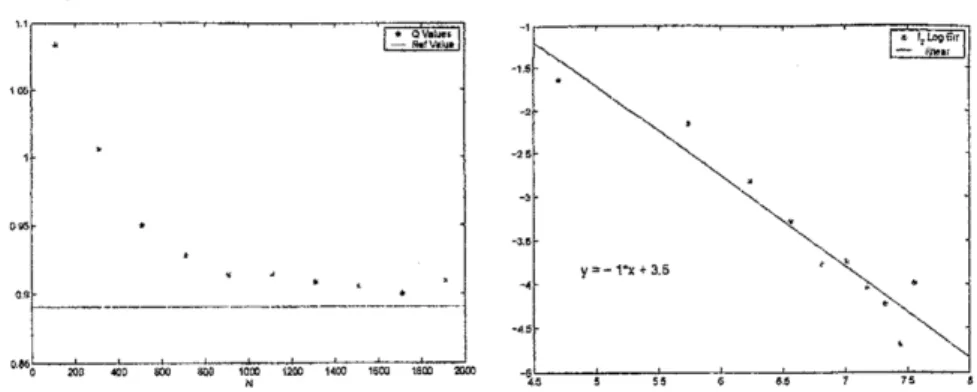
in signal dimension $d=1$ and 3. The following figures showthe
convergence
and the rateof convergence of the approxim ated filter by quantization, when $\overline{N}$ goes to
infinity. The
theoretical convergencerate $\overline{N}^{\frac{1}{d}}$
(seeRemark 3.2) isthen in In-scale 1 in dimension 1 and
1/3in dimension 3, and is consistentto what
we
foundbynumericalexperiments. Actually,we
even
get betterrateofconvergence
with the numerical tests.Figure la: diml-:Convergence and Convergence Rate (ina$\ln$-scale) of$\hat{\Pi}_{n}\phi_{1}$ as$\mathrm{N}$ grows,
Figure lb : diml -: Convergence and Convergence Rate (ina $\ln$-scale) of$\hat{\Pi}_{n}\phi_{2}$ $\mathrm{f}\mathrm{f}\mathrm{i}$ $\mathrm{N}$ grows,
for$n=15$and $\phi_{2}(x)=x^{2}$.
Figure lc : diml -: Convergence and ConvergenceRate (in a$\ln$-scale) of$\dot{\Pi}_{n}\phi_{3}$ as $\mathrm{N}$grows,
for$n=15$ and $\phi_{3}(x)$$=\exp(-|x|)$
.
07 $00$ $-\sim-\mathrm{o}u’\acute{\mathrm{v}}\cdot \mathrm{t}\mathrm{u}\mathrm{v}\cdot\oe\cdot$
.
’ $-\mathrm{r}-\mathrm{i}$.
$
―…
dotarrow–$
02 $0\mathrm{Q}$ $\mathfrak{N}$ $m$ $m$ $m$ {$\mathfrak{M}\mathrm{N}$$\tau \mathrm{m}$ $m 1n leeo rcoo
Figure $2\mathrm{a}$: dim3- : Convergence and Convergence Rate (ina$\ln$-scale) of$\hat{\Pi}_{7l}\phi_{1}$ as$\mathrm{N}$ grows,
92
$\mathrm{t}\infty$ $-\cdot*’ \mathrm{w}^{\mathrm{R}}\dot{\omega}0*|$ $*$.
.
$\wedge$ $\mathrm{s}$ $A$—-.
1.
$\cdot$ —— $\mathrm{m}_{0}$$xo$ $\mathrm{r}\mathrm{o}$ $\mathrm{g}w$ $\prime 0_{\mathrm{N}}oe\mathrm{t}\mathrm{I}\prime 4\infty 76\infty\backslash e\omega$ $\mathrm{m}$
Figure$2\mathrm{b}$ : dim3 -: Convergence and Convergence Rate (inaIn-scale)of$\hat{\Pi}_{n}\phi_{2}$ as$\mathrm{N}$ grows,
for$n=15$ and$\phi_{2}(x)$ $=|x|^{2}$
.
06
05
-$\cdot$
$\mathrm{R}\cdot 1\mathrm{V}*\mathrm{I}*0\cdot \mathrm{w}$
$–$. ——
$–=–.-$
.
$*$ $\mathrm{o}\mathrm{a}$ 0’ $0_{\mathfrak{g}}$ $2\Phi$ $4\infty$ $\epsilon\infty\iota\infty\tau_{\aleph}\mathrm{m}\prime \mathrm{T}\mathfrak{d}$$\prime \mathrm{m}’\infty \mathrm{Q}\{\mathrm{o}\mathrm{m}2\mathrm{R}$
Figure$2\mathrm{c}$ : dim3 -: Convergence and Convergence Rate (in a In-scale) of$\hat{\Pi}_{n}\phi_{3}$ as $\mathrm{N}$grows,
for$n=15$ and$\phi_{3}(x)=\exp(-|x_{3}|)$.
4.1.2 Test 2 : Stability ofthe filterfor
a
fixed grid size $\overline{N}$as
n goesto infinity.
We perform numerical tests for a signal in dimension 2. The following figures show the
stability of the quantized filter when thehorizon$n$ goes to infinity.
Figure3. $\dim 2-$ : Errordependence of$\hat{\Pi}_{n}\emptyset$ as
$n$ grows,
4.2
A
stochastic
volatility
model
We
now
consider theARCH
model :$X_{k+1}$ $=$ $pX_{k}+\epsilon_{k}$, $X_{0}\sim\nu N(0, \Sigma_{0})$
$Y_{k}$ $=$ $\sigma(X_{k})\eta_{k}$, $\sigma(x)=\gamma+|x|$,
where $(\epsilon k)$ are $(\eta_{k})$ independent Gaussian noises. This model is popular in finance, as
a discretization ofstochastic volatility model, where $X$ is the volatility and $Y$ the price
process. Unlike Kalman-Bucy model, there is
no
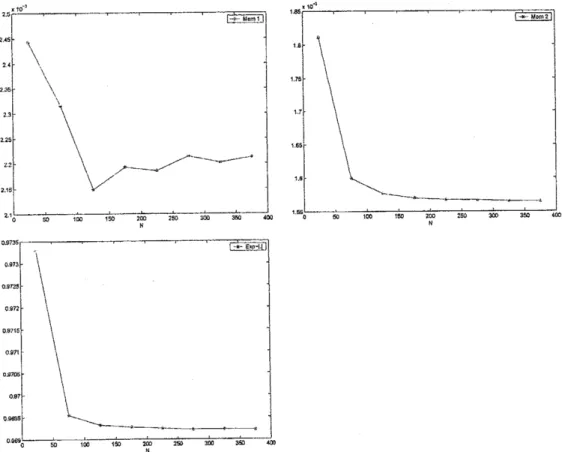
explicit reference formulafor the filter.The following figures show the
convergence
of the quantized filterwhen$\overline{N}$ goes to infinity.$0\theta 735$ $\mathrm{o}\mathrm{s}73$ $\mathrm{o}sr_{-}5$ $0972$ $0\mathrm{B}745$ $0\mathrm{B}7\mathrm{t}$ osm $0\mathrm{B}7$ oma
$\mathrm{o}s\mathrm{a}\mathrm{e}_{0}$ 50 $’\infty$ $\infty$ $2\infty\aleph$
$2\mathfrak{B}$ $3\infty$ $\mathrm{g}$ $\mathrm{m}$
Figure 4:SVmodel:filtervalues of$\hat{\Pi}_{n}\emptyset$ at fixedn
as
$\overline{N}$grows,for$\phi(x)=x$, $|x|^{2}$, and$\exp(-|x|)$.
More numerical illustrations
are
investigated in Sellami’s thesis [12] with in particularcomparison to Monte-Carloparticlemethods.
5Approximation
of the filter
process
by
quantization
In the quantization algorithm
described
in the previous section,we
need for eachnew
84
likelihoodobservationfunction$gk$
.
Thison-linephasemayberem
ovedbyan
off-lineprepro-cessing ofthe observations, assuggested in [6], Onecanthenstoreinadditionto the signal
quantizers, the local likelihood functions precomputed onthesignal-observation grids. This
observation quantization approach is developed in [11],where errorestimation are provided
and numerically illustrated. If
we
stressthe dependence of the filter on the observation :$\Pi_{n}(Y_{0}, \ldots , Y_{n})$, then it is approximatedby $\Pi\wedge n(\hat{Y}0$,.
.
.
,$\hat{Y}_{n})$, where $\hat{Y}_{k}$ is a quantizer of Yk.However, wenoticethat the size ofthelook-up tables forthe filter may be
very
large. Forinstance, if$\hat{Y}_{k}$
takes $M$values, then at time$n$,therandomfilter $\hat{\Pi}_{n}(\hat{Y}_{0}, . ., ,\hat{Y},)$ would take
$M^{n}$ values in $\mathcal{P}(E)$, which may explode for a long horizon $n$
.
This makes computationsuntractable when solving dynamic optimization problems under partialinformation,
even
if$E$ is already afinitestate space
Inorder to
overcome
this numerical difficulty,we
presenta
quantization approachin-troduced in [9] and based
on
the Markov property ofthe pair filter-observation $(\Pi k, Y_{k})$with respect to the observation filtration $(F_{k}^{Y})$
.
Indeed, by denoting $(\mathcal{F}_{k})$ the filtrationgenerated by $(X_{k}, Y_{k})$, and usingthe law ofiterated conditionalexpectations, we have for
any $k$ an$\mathrm{n}\mathrm{d}$ bounded Borelian function
$\varphi$ on $\mathcal{P}(E)\mathrm{x}$ $\mathbb{R}^{q}$ :
$\mathrm{E}[\varphi(\Pi_{k+1}, Y_{k+1})|F_{k}^{Y}]$
$=$ $\mathrm{E}[\mathrm{E}[\varphi(\overline{G}_{k+1}(\Pi k, Yk_{t}.Yk+1), Yk+1)|\mathcal{F}k]|F_{k}^{Y}]$
$=$ $\mathrm{E}$ $[ \int\varphi(\overline{G}_{k+1}(\Pi_{k}, Y_{k},y’), y’)P_{k+1}(X_{k}, dx’)qk+1(X_{k}, Y_{k}, x’, dy’)|F_{k}^{Y}]$
$=$ $\oint\varphi(\overline{G}_{k+1}(\Pi_{k}, Y_{k}, y’), y’)P_{k+1}(x, dx’)qk+1(x, Y_{k}, x’, dy’)\Pi_{k}(dx)$. (5.6)
This shows the Markov property of (Zk) with probability transition $R_{k}$ (from time $k-1$
to $k$) given by :
$R_{k}\varphi(\pi, y)$ $=$ $\int\varphi(\overline{G}_{k}(\pi, y, y^{\mathit{1}}), y’)Q_{k}(\pi,y, dy’)$, (5.7)
where$Qk(\pi, y, dy’)$is the law of$Yk$ conditional
on
$(\Pi k-1_{7}Yk-1)=(\pi, y)$with density :$y’$ $arrow$ $\int gk(x, y, x’, y’)Pk(x, dx’)\pi(dx)$
.
We consider
a
framework with finitestate space : $E=\{x^{1}, \ldots, x^{m}\}$,so
that the filter$\Pi_{k}$is a random discreteprobability
measure
identified witha
random vector$\Pi_{k}=(\Pi_{k}^{\tau})_{1\leq\not\in\leq m}$in the simplex$K_{m}$ of$\mathbb{R}^{m}$ :
$K_{m}$ $=$ $\{\Pi\in \mathbb{R}_{+}^{m}$ : $\sum_{i=1}^{m}\Pi^{i}=1\}\simeq \mathcal{P}(E)$.
The idea is to apply
a
marginal quantization of theMarkov chain $(z_{k})=(\Pi k, Yk)$ valuedin$K_{m}\mathrm{x}$ $\mathbb{R}^{q}$. Hence, foreach $k=0$,
$\ldots$,$n$,
we
denote$\hat{Z}_{k}$
the
associated
quantizer ontheoptimalgrid$zk=$ $(z_{k-}^{1}$,. . .
,$z_{k}^{N_{k}})$ ofsize$N_{k}$points in$K_{m}\mathrm{x}\mathbb{R}^{q}$.
Theprobability transition $R_{k}$ of the Markov chain (Zk) is approximated by the transition
matrix $\hat{R}_{k}=(\hat{r}_{k}^{\mathrm{z}j})$ :
$\hat{r}_{k}^{ij}$ $=$ $\mathrm{P}$ $[\hat{Z}_{k}=z_{k}^{j}|\hat{Z}_{k-1}=z_{k-1}^{i}]$.
The optimal grids $zk$ andtheassociated transition weights$\hat{r}_{k}^{ij}$
are
processed andestimatedbythe Kohonen algorithm. Thisis based
on
theMonte-Carlo simulationsof$(Z_{k})$, whichrelythemselves, from (5.7),
on
the followingsimulation procedure of theprobability transition$R_{k}$ :
.
simulate$X_{k-1}$ with probabilitylaw $\Pi_{k-1}$, and then$X_{k}$ accordingto the probabilitytransition $P_{k}$
.
simulate $Y_{k}$ accordingto theprobability transition $\mathit{9}k(Xk-l, Yk-1, Xk)dy’$.
compute$\Pi_{k}$ by theforward filtering (finite-dim ensional) equation$\Pi_{k}$ $=$ $\overline{G}_{k}(\mathrm{I}\mathrm{I}_{k-1}Y_{k-1}, Y_{k})=\frac{\Pi_{k-}{}_{1}H_{k}}{\Pi_{k-}{}_{1}H_{k}(E)}$.
6
Application
:pricing
of
American options under
partial
observation
6.1
Optimal stopping problem under partial observation
Given
a
bounded measurablefunction $h$on
$E\mathrm{x}$ $\mathbb{R}^{q}$, anda
horizon$n$,
we
denotefor any $k$$=0$,$\ldots$,$n$, $T_{k,n}^{Y}$
as
theset of$(F_{k}^{Y})$-stoppingtimes valuedin $\{k, \ldots, n\}$, and we consider the
following optimalstopping problem under partial observation :
$U_{k}$ $=$
$\mathrm{e}\mathrm{s}\mathrm{s}\sup_{\tau\in T_{\mathrm{t}^{Y}n}}.,\mathrm{E}[h(X_{\tau}, Y_{\tau})|F_{k}^{Y}]$
.
(6.8)By usingthelawof iterated conditional expectation and the definition of thefilter,we notice
that problem (6.8)
may
bereduced to acompleteobservationmodel with state variable the$(F_{k}^{Y})$-adaptedprocess (Zk) :
$U_{k}$ $=$
$\mathrm{e}\mathrm{s}\mathrm{s}\sup_{\tau\in \mathcal{T}_{k,n}^{Y}}\mathrm{E}$
$\ovalbox{\tt\small REJECT}\sum_{j=k}^{n}1_{\tau=j}\mathrm{E}[h(X_{j_{2}j}Y)|F_{j}^{Y}]|\mathcal{F}_{k}^{Y}\ovalbox{\tt\small REJECT}$
$=$ $\mathrm{e}\mathrm{s}\mathrm{s}\sup_{\tau\in \mathcal{T}_{k,n}^{Y}}\mathrm{E}\ovalbox{\tt\small REJECT}\sum_{\mathrm{i}=k}^{n}1_{\tau=j}\Pi_{\mathrm{J}}h(., Yj)|F_{k}^{Y}\ovalbox{\tt\small REJECT}$
$=$
$\mathrm{e}\mathrm{s}\mathrm{s}\sup_{\tau\in T_{k,n}^{Y}}\mathrm{E}$
$[ \Pi_{\tau}h(., Y_{j})|F_{k}^{Y}]=\mathrm{e}\mathrm{s}\mathrm{s}\sup_{\tau\in \mathcal{T}_{k_{J}n}^{Y}}\mathrm{E}[\tilde{h}(Z_{\tau})|F_{k}^{Y}]$,
with the notation :
se
By the $(F_{k}^{Y})$-Markov property of (Zk) and the dynamic programming principle,
we
have$U_{k}=u_{k}(Zk)$ where functions$uk$ arecalculatedinbackward inductionby :
$u_{n}(z)$ $=$ $\tilde{h}(z)$
$u_{k}(z)$ $=$ $\max\{\tilde{h}(z)$ , $\mathrm{E}[u_{k+1}(Z_{k+1})|Z_{k}=z]\}$
.
Following [1],
we
provide a quantization approximation of $U_{k}=uk(Zk)$ by $\hat{U}_{k}$ =\^u$k(\hat{Z}k)$,where $(\hat{Z}k)$ is a marginal quantization of $(Z_{k})$
on
grid $zk$,as
described in the previoussection, andfunctions $\text{\^{u}}_{k}$
are
explicitly computedin
recursive form by :$\hat{u}_{n}(z)$ $=$ $\overline{h}(z)$
$\hat{u}_{k}(z)$ $=$ $\max\{\overline{h}(z))\mathrm{E}[\hat{u}_{k+1}(\hat{Z}k+1)|\hat{Z}_{k}=z]\}$.
Proman algorithmic viewpoint, this reads as :
$\hat{u}_{n}(z_{n}^{i})$ $=$ $\overline{h}(z_{n}^{i})$, $\mathrm{i}=1$,.
.
. ,$N_{n}$$\text{\^{u}}_{k}(z_{k}^{i})$ $=$ $\max\{\overline{h}(z_{k}^{i}),$ $N \sum_{j=1}^{k+1}\hat{r}_{k+1}^{i\gamma}\hat{u}_{k+1}(z_{k+1}^{j})\}$ , $\mathrm{i}=1$,
$\ldots$,$N_{k}$
.
$L^{1}$-error estimation
||Uk--\^U
$k||_{1}$ in terms ofquantizationerror
$||Z_{k}-\hat{Z}\iota.||_{2}$ is stated in [9],6.2
Numerical illustration :
Bermudean options
in
a
partially
observed
stochastic volatility model
We consideran observablestock (logarithm) price $Y_{k}=$ in$s_{k}$, with dynamics given by :
$Y_{k+1}$ $=$ $Y_{k}+(r- \frac{1}{2}X_{k}^{2})\delta$ $+X_{k}\sqrt{\delta}\epsilon_{k+1}$
where $(\epsilon_{k})$ is a sequence ofGaussian whitenoise, and (Xk) is the unobservable volatility
process. $\delta=\frac{T}{n}$ is the time step from
an
Euler scheme.We
assume
that $(X_{k})$ isa
Markovchain approximation
a
la Kushner [5] with spatial stepA
and with $m=3$ states ofa
mean-reverting
process
:$dX_{t}$ $=$ $\lambda(x_{0}-X_{t})dt+\eta dW_{t}$
.
Inthiscontext ofapartially observed stochastic volatility model,
we
considera
Bermudeanput option with payoff$h(y)=(\kappa-e^{y})_{+}$, andwith price :
$u_{0}$ $=$ $\sup \mathrm{E}[e^{-r\tau \mathit{5}}h(Y_{\tau})]$ . (6.9)
$\tau\in \mathcal{T}_{0,n}^{Y}$
We perform numericaltests with :
-Price andputoption parameters : $r=0.05$, $S_{0}=110$
,
ts $=100$,-Volatility param eters : A $=1$, y7 $=0,1_{7}X_{0}=0.15$,
- Spatial step : $\Delta=0,05$.
- Quantization :Grids
are
ofsame
size $\overline{N}$ fixed for each time$E[\Pi_{n}^{1}]$ $E^{\lceil}.\Pi_{n}^{2}]$ $E[\Pi_{n}^{3}]$ Relative
error
(%)Monte Carlo 0.287608
0.422833
0.289558Quant. with $\overline{N}=300$ 0.301651 0.421725 0.276624 $0.89\mathrm{S}$
Quant. with $\overline{N}=600$
0.301604 0.421458
0.276938 0.886Quant. with $\overline{N}=900$
0.301598 0.421316
0.277086
0.881Quant. with $\check{N}=1200$ 0.301618
0.42122
0.2771620.879
Quant. with $\overline{N}=1500$ 0.301605 0.421205 0.27719 0.878
Table 1: Comparison ofquantized filter valueto its
Monte
Carlo estimationWe first compare in Table 1 the filter expectation at the final date computed with
a
time stepsize $\delta$ $=1/5$ andbyusing the optim al quantization method withincreasinggrid
size$\overline{N}$ , andwith 10 Monte Carlo iterations,
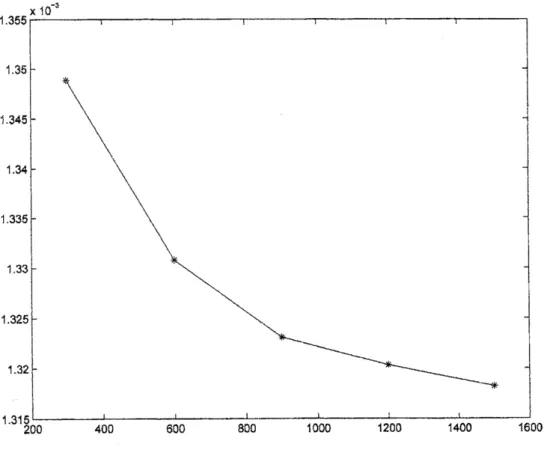
Weobserve that besides the very low error level, the absolute error (plottedin Figure
5) and therelative
error are
decreasingas
the gridsize grows.Figure5: Filtererror convergenceas $\mathrm{N}$ grows
Secondly, in order to illustrate the effect of the time step,
we
compute the Anericanoption price under partial observation when the time step $\delta$ decreases to
zero
(i.e.$n$
98
(Xk,$Y_{k}$). Indeed, in the limit for $\deltaarrow 0$
we
fully observe the volatility, andso
the partialobservationpriceshould converge to the complete observation price.
Moreover, when we have more and more observations, the difference between the two
pricesshould decrease andconvergeto
zero.
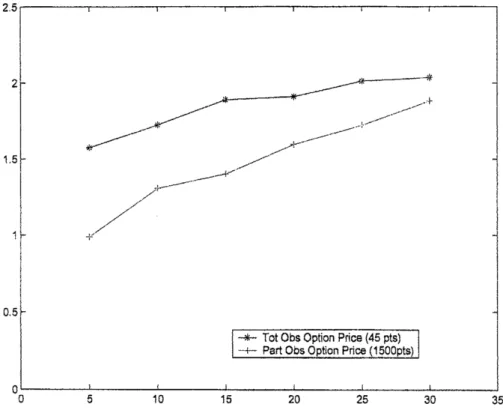
This isshowninfigure6, where we performedoption pricing
over
grids of size $\overline{N}_{\Pi,Y}=1500$ incase
of partial observation. The totalobservation priceis given by the
same
pricing algorithm carried outon
$\overline{N}_{X_{\rangle}Y}=45$ pointsfortheproduct grid of$(Xk, Yk)$
.
For
fixed$n$, the rateofconvergence
for the approximationofthe value function under partial observation is oforder $\tilde{N}_{\Pi,Y}^{1/(m-1+d)}$ where $\overline{N}_{\Pi_{\mathrm{z}}Y}$ is the
number of points used at each time $k$ for the grid of$(\Pi k, Yk)$ valued in $K^{m}\mathrm{x}\mathbb{R}^{d}$
.
Promresults of [1],
we
also know that therate ofconvergence
for the approximation of the valuefunctionunderfull observationisoforder$m\mathrm{x}\overline{N}_{Y}$ where $\overline{N}_{X,Y}=m\mathrm{x}\overline{N}_{Y}$ is the number of
points ateach time$k$, usedforthe grid of$(Xk, Yk)$ valuedin$E\mathrm{x}\mathbb{R}^{d}$
.
This explains why, in order to have comparable results, and with$m=3$ and$d=1$,
we
have chosen $\overline{N}_{Y}\sim\overline{N}_{\Pi_{\mathrm{z}}Y}^{1/3}$Figure6: Partial andtotal observation option pricesas$3arrow 0$
In addition, it is possible to observe the effect of information enrichment
as
the timestep decreases. In fact, if
we
considermultiples of$n$as
the time step parameter,we
noticethatthe
American
option priceincreases forbothtotalandpartial observationmodels (see4 8 16
Tot. Obs. $(\overline{N}_{X}‘ Y=30)$ 1.45863
1.75689 1.77642
Part. Obs. $(\overline{N}_{\mathrm{I}\mathrm{I},Y}=1000)$ 0.921729 1.13898 1.47089
Variation
0.53 0.61 0.30Table 2: Am erican option price for embedded filtrations-First Example
Table 3: American option pricefor embedded filtrations- Second Example
References
[1] Bally V. and G. Pages (2003)
.
“A quantization algorithm for solving discrete timemulti-dimensional optimal stopping problems”, Bernoulli,9, 1003-1049.
[2] Elliott R., Aggoun L. and J. Moore (1995) : Hidden Markov models, estimation and control,
Springer Verlag
[3] Genon CatalotV. (2003) : “A nonlinear explicit filter”, Stat Prob. Lett, 61, 145-154.
[4] Stat S and H Luschgy (2000) : :Foundations
of
quantizationfor
random $uectors_{)}$LectureNotesin Mathem atics$\mathrm{n}^{0}1730$,Springer, Berlin, 230 pp.
[5] Kushner H.J. and P. Dupuis (1992) . Numerical Methods
for
Stochastic Control Problems $m$Continuous Time, Springer, NewYork
[6] Newton N. (2001) : “Approximations for nonlinear filters basedonquantization”, Monte Carlo
Methods and Appl, 7, 311-320.
[7] Pag\‘es G. and H. Pharn (2005) : “Optimal quantization methods for nonlinear filtering with
discrete-time $\mathrm{o}\mathrm{b}\mathrm{s}\mathrm{e}\mathrm{r}\mathrm{v}\mathrm{a}\mathrm{t}\mathrm{i}\mathrm{o}\mathrm{n}\mathrm{s}^{y}’$, Bernoulli, 11.
[8] Pages G,, Pham H. and J. Printems (2004) : “Optimal quantization methods and applications
tonumericalproblemsirrfinance”, Handbook
of
computational andnumericalmethods infinance,ed S. Rachev,Birkhauser.
[9] Pham$\mathrm{H}_{2}$. Runggaldier W. andA.Sellami (2005) : “Approximation by quantization of the filter
process and applications to optimal stopping problemsunderpartialobservation”, Monte Carlo
Methods andApplications, 11, 57-82.
[10] Sellami A. (2004) : “Nonlinear filtering with observation quantization”, Preprint, Laboratoire
deProbabilit\’esetmod\‘eles aleatoires, $\mathrm{U}\mathrm{n}\mathrm{i}\mathrm{v}\mathrm{e}\mathrm{r}\mathrm{s}\mathrm{i}\mathrm{t}\mathrm{e}^{J}\mathrm{s}$ Paris 6
&
7(France).[11] Sellami A. (2005) : “Quantization based filtering method using first order approximation”,
Preprint PM A-1009.
[12] Sellami A. (2005) : Methodes de quantification optimaleen filtrage et appl cationsenfinance,