
11
Conditions for convergence theorems
in non-additive
measure
theory
*東京工業大学 大学院総合理工学研究科 知能システム科学専攻
高橋 誠幸(Masayuki Takahashi), 朝比奈 伸 (Shin Asahina), 室伏 俊明 (Toshiaki Murofushi)
Department ofComputational Intelligence and Systems Sciences,
Tokyo Institute ofTechnology
Abstract:
Thispaperdiscussesconvergence theoremsdescribing implications between sixconver-gence concepts with respect to non-additive
measure:
almost everywhere convergence, pseudo-almosteverywhere convergence, almost uniform convergence, pseudo almost uniform convergence,
conver-gence in measure, and convergence pseudo-in measure. The paper shows several new convergence
theorems and organizes them together with existing convergence theorems by using ordinality and
duality. In addition, it gives a new necessary condition and a newsufficient condition for the Egoroff
theorem to hold.
1 INTRODUCTION
Since Sugeno [15] introduced the concept of non-additive measure, which he called a fuzzy measure,
non-additivemeasuretheoryhas been constructedalongthelines oftheclassical measuretheory [1, 13,
21]. Generally, theorems in the classical
measure
theorynolongerholdinnon-additive measure theory,so that to find necessary $\mathrm{a}\mathrm{n}\mathrm{d}/\mathrm{o}\mathrm{r}$ sufficient conditions for such theorems to hold is very important for
the construction ofnon-additive measure theory.
Intheclassical
measure
theory, thereareseveral different convergencesofasequence ofmeasurablefunctions such as almost everywhere convergence, almost uniform convergence, and convergence in
measure, andtheorems that describe implication relationshipbetween such convergenceconcepts (e.g,
the Egoroff, Lebesgue, and Riesz theorems) are fundamental and important, In non-additive
measure
theory, these theorems do not hold without additional conditions.
This paperdiscussesnecessary and sufficient conditions forthe implications between almost
very-where convergence, pseudo-almost everywhere convergence [20], almost uniform convergence,
pseudo-almost uniform convergence [20], convergence in measure, and convergence pseudo-in measure [20] in
non-additive
measure
theory. So far, most ofthe implications have been established [4, 6, $\mathrm{S}$, 10, 12,14, 17, 19, 20, 21]. Section 4of this paper clarifiesthe remaining ones, that is, necessary and sufficient
conditions for almost uniform convergence to imply pseudo-almost everywhere convergence,
pseudo-almost uniform convergence, and convergence pseudo-in
measure.
Section 5 summarizes necessaryand sufficient conditions for implicationsbetween the sixconvergences intoTables 2 and 3. Section 6
introduces a new notion called condition (M), and show that condition (M) is a necessary condition
for the Egoroff theorem, which asserts that almost everywhere convergence implies almost uniform
convergence, and that the conjunction of condition (M) and null-continuity is a sufficient condition
for thetheorem.
2 DEFINITIONS
Throughout the paper, $(X, \mathrm{S})$ is assumed to be a measurable space. All subsets of$X$ and functions
on$X$ referred to are assumed to be measurable.
Definition 2.1 A non-additive measure on (X,S) is a set function $\mu$ : S $arrow$ [0,$\infty]$ satisfying the
following two conditions:
.
$\mu(\emptyset)=0$,.
$A$,$B\in \mathrm{S}$, $A\subset B$ $\Rightarrow\mu(A)\leq\mu(B)$.*Partialfinancial support fromthe MinistryofEducation, Culture, Sports,Scienceand Technology, Grant-in-Aidfor
12
A non-additive
measure
$\mu$ is said tobefinite
if$\mu(X)<\infty$.
If$\mu$ is a non-additive measure on $(X,\mathrm{S})$,thetriplet $(X,\mathrm{S}, \mu)$ is called a non-additive measure space. For each$A\in \mathrm{S}$, therestriction$\mu\lceil$ $(\mathrm{S}\cap A)$
is a non-additive measureon $(A,\mathrm{S} \cap A)$, where $\mathrm{S}$$\cap A=\{E\cap A|E\in \mathrm{S}\}$, and $(A,\mathrm{S} \cap A, \mu\lceil (\mathrm{S} \cap A))$
is called a subspace of $(X, \mathrm{S}, \mu)$.
Hereinafter, $\mu$ is assumed to be anon-additive measure on $(X,\mathrm{S})$.
Inthe followingdefinitions, eachlabelin boldface stands for the correspondingterm; forexample,
$”\downarrow A$” means “continuity from above at $A$” (Definition 2.2 (i)).
Definition 2.2 (i) $\downarrow A:\mu$is said to be continuous
from
above at Aif$A_{n}\downarrow A$implies$\mu(A_{n})arrow\mu(A)$.$\downarrow:\mu$ is said to be continuous
from
above if$\mu$ iscontinuous from above at every measurable set.(ii)
4
$\emptyset:[2]\mu$ is said to be order continuousif$\mu$ is continuous from above at the empty set.(iii) $\downarrow 0$:[3]
$\mu$ is said to be strongly order continuous if $N_{n}\downarrow N$ and $\mu(N)$ $=0$ together imply $\mu(N_{n})arrow 0$.
(iv) $\mathrm{T}\downarrow \mathrm{O}$:[12]
$\mu$ is said to be strongly order totally continuous if, for every decreasing net
$B$ of
measurablesets such that$\cap B$ ismeasurable and$\mu(\cap B)$ $=0$, itholdsthat$\inf_{B\in B}\mu(B)$$=0$.
(v) $\mathrm{j}A:\mu$ is said to be continuous
from
below at $A$ if$A_{n}\mathrm{j}$$A$ implies $\mu(A_{n})arrow\mu(A)$.
$\mathrm{j}:\mu$ is said to be continuous
from
below if$\mu$ is continuous from below at every measurable set.(vi) $\mathrm{j}\mu(A):[8]$ $\mu$ issaid to be strongly continuous
from
below atAif$B_{n}\uparrow B\subset A$ and $\mu(B)=\mu(A)$
together imply $\mu(B_{n})arrow\mu(B)$.
(vii) $\mathrm{j}0$:[18]
$\mu$ is said to be null-continuous if$N_{n}\uparrow N$ and $\mu(N_{n})=0$ for every $n$ together implies
$\mu(N)=0$.
The value of $\mu(A)$ is not substituted for $\mu(A)$ in $”\uparrow\mu(A)$”; if$\mu(A)$ $=0.5$ for example, we write not
$”\uparrow 0.5$” but $”\uparrow\mu(A)’)$.
Definition 2.3 (i) O-sub. A: $\mu$ issaid tobe null-subtractive at Aif$\mu(N)=0$ implies $\mu(A\backslash N)=$
$\mu(A)$
.
O-add.: [19] $\mu$ issaid to be null-additive if$\mu(N)=0$ implies$\mu(A\cup N)=\mu(A)$ for every
$A\in \mathrm{S}$.
(ii) c.O-add. $A:\mu$ issaidto beconverse-null-additive at$A$if$\mu(A)$ $=\mu(A\backslash N)$implies$\mu(A\cap N)$ $=0$.
c.O-add.: $\mu$is saidtobe converse-null-additiveif$\mu$isconverse-null-additive at every measurable
set.
$\mathrm{N}\mathrm{u}\mathrm{l}\mathrm{l}arrow \mathrm{s}\mathrm{u}\mathrm{b}\mathrm{t}\mathrm{r}\mathrm{a}\mathrm{c}\mathrm{t}\mathrm{i}\mathrm{v}\mathrm{i}\mathrm{t}\mathrm{y}$ateverymeasurable set isequivalenttonull-additivity [21]. Converse-null-additivity
defined above is stronger than the original in [19]: $\mu(A)=\mu(A\backslash N)<\infty$ implies$\mu(A\cap N)$ $=0$
.
Definition 2.4 (i) auto.jA: $\mu$is said tobe autocontinuous
from
below at A if$\mu(N_{n})arrow 0$ implies$\mu(A\backslash N_{n})arrow\mu(A)$.
auto.j: [19] $\mu$is saidto be autocontinuous
from
belowif$\mu$is autocontinuousfrombelowat everymeasurable set.
(ii) c.auto.f$A$:
$\mu$ is said to be converse-autocontinuous
from
below at $A$ if $\mu(A\backslash N_{n})arrow\mu(A)$implies $\mu(A\cap N_{n})arrow 0$
.
c.auto4:
$\mu$ is said to be converse-autocontinuousfrom
below if $\mu$ is converse-autocontinuousfrom below at every measurableset.
{
$\mathrm{i}\mathrm{i}\mathrm{i})$ m.auto.j$A:\mu$ is said to be monotone autocontinuousfrom
below at$A$ if$N_{n}\downarrow$ and$\mu(N_{n})arrow 0$m.auto.j: $\mu$issaid to be monotone autocontinuous
from
belowif$\mu$is monotone autocontinuousfrom below at everymeasurableset,
(iv) c.m.auto.j$A$:
$\mu$ issaid tobe converse-monotone autocontinuous
from
below at$A$if$N_{n}\downarrow$and $\mu(A\backslash N_{n})arrow\mu(A)$ together imply$\mu(A\cap N_{n})arrow 0$.
c.m.auto.j: $\mu$ is said to be converse-monotone autocontinuous
from
below if $\mu$ isconverse-monotone autocontinuous from belowat every measurableset.
(v) s.m.auto.j$A:\mu$ is said to be strongly monotone autocontinuous
from
belowat Aif$N_{n}\downarrow N$and$\mu(N)=0$ together imply$\mu(A\backslash N_{n})arrow\mu(A)$.
s.m.auto.j: $\mu$is said to bestron$\iota gly$monotone autocontinuous
from
below if$\mu$ isstronglymono-toneautocontinuous from below at every measurable set.
(vi) s.c.m.auto.j$A$: $\mu$is saidto be strongly converse-monotone autocontinuous
from
belowat$A$if$N_{n}\downarrow N$ and $\mu(A\backslash N)$$=\mu(A)$ together imply$\mu(A\cap N_{n})arrow 0$.
s.c.m.auto.j: $\mu$ is said to be strongly converse-monotone autocontinuous
from
below if $\mu$ isstrongly converse-monotone autocontinuous from below at every measurable set.
Converse-autocontinuity from below defined above is stronger than the original in [20]: $\mu(A\backslash N_{n})arrow$
$\mu(A)<\infty$ implies $\mu(A\cap N_{n})arrow 0$
.
In [14] strong converse-monotone autocontinuity from below iscalled pseudo-order continuity.
Definition 2.5 (i) (S): [17] $\mu$ said to have property (S) if$\mu(N_{n})arrow 0$ implies that there exists a
subsequence $\{N_{n_{i}}\}$ of $\{N_{n}\}$ suchthat $\mu(\bigcap_{k=1}^{\infty}\bigcup_{i=k}^{\infty}N_{n_{i}})=0$.
(ii) (PS) $A:\mu$ said to have property (PS) at $A$ if $\mu(A\backslash N_{n})arrow\mu(A)$ implies that there exists a
subsequence $\{N_{n_{i}}\}$ of$\{N_{n}\}$ such$\mathrm{t}\mathrm{h}\mathrm{a}^{+}$
.
$\mu$$(A \backslash \mathrm{n}\mathrm{i}_{=1}\bigcup_{i=k}^{\infty}N_{n_{i}})$ $=\mu(A)$
.
(PS): [16] $\mu$ said to have property (PS) if$\mu$has property (PS) at every measurable set.
(iii) (TS) $A:\mu$said tohave proper$rty(TS)$ at$A$ if$\mu(N_{n})arrow 0$impliesthat there exists asubsequence
$\{N_{n_{i}}\}$ of $\{N_{n}\}$ such that $\mu$$(A \backslash \bigcap_{k=1}^{\infty}\bigcup_{i=k}^{\infty}N_{n_{i}})$ $=\mu(A)$.
(TS): $\mu$ said to haveproperty (TS)if$\mu$ has property (TS) at every measurable set.
(iv) (TPS) $A$: $\mu$said to have property (TPS) at$A$ if$\mu(A\backslash N_{n})arrow\mu(A)$ implies that there exists a
subsequence $\{N_{n_{t}}\}$ of$\{N_{n}\}$ suchthat $\mu$$( \mathrm{f}1\mathrm{W}_{=1}\bigcup_{i=k}^{\infty}N_{n_{i}}\cap A)$ $=0$.
((S): $\mu$ said tohave property (TPS)if$\mu$ hasproperty (TPS) at every measurable set.
Definition 2.6 (i) (Si): [10] $\mu$said to have properrty(Sl) if$\mu(N_{n})arrow 0$implies that there exists
a subsequence $\{N_{n_{i}}\}$ of$\{N_{n}\}$ such that $\mu(\bigcup_{i=k}^{\infty}N_{n_{i}})arrow 0$ as $k$ $arrow\infty$.
(ii) (S2) $A:\mu$said to haveproper$rty(S\mathit{2})$ at$A$ if$\mu(N_{n})arrow 0$implies that there exists asubsequence
$\{N_{n_{i}}\}$ of $\{N_{n}\}$ such that $\mu(A\backslash \bigcup_{\mathrm{z}=k}^{\infty}N_{n_{i}})arrow\mu(A)$as $karrow\infty$
.
(PS2): [10] $\mu$ said to have property (S2) if$\mu$ has property (S2) at every measurable set.
(iii) (PS ) $A:\mu$ said to have property (PSi) at $A$ if$\mu(A\backslash N_{n})arrow\mu(A)$ implies that there exists a
subsequence $\{N_{n_{i}}\}$ of$\{N_{n}\}$ such that$\mu(\cup^{\infty}i=kN_{n_{\mathrm{i}}}\cap A)$$arrow 0$ as $karrow\infty$
.
(PS2): [10] $\mu$ said to have property $(S)$ if$\mu$ has property (PSi) at every measurableset.
(iv) (PS2) $A:\mu$ said to have property (PS2) at $A$ if $\mu(A\backslash N_{n})arrow\mu(A)$ implies that there exists a
subsequence $\{N_{n_{i}}\}$ of $\{N_{n}\}$ such that $\mu(A\backslash \bigcup_{\iota=k}^{\infty}N_{n_{i}})arrow\mu(A)$ as $karrow\infty$
.
14
Definition 2.7 (i) (Ec): [12] $\mu$is said to satisfytheEgoroffcondition if, forevery doubly-indexed
sequence$N_{m,n}$suchthat$N_{m,n}\supset N_{m’,n’}$for$m\geq m’$and$n\leq n’$ and$\mu(\bigcup_{m=1}^{\infty}\bigcap_{n=1}^{\infty}N_{m,n})=0$,
and for every positive number$\epsilon$,thereexistsasequence$\{n_{m}\}$ such that$\mu(\bigcup_{m=1}^{\infty}N_{m,n_{m}})<\epsilon$. (ii) (E): [4] $\mu$is said to satisfy condition (E) if$N_{n}^{m}\downarrow N^{m}$ as$narrow$ooforevery$m$and
$\mu(\bigcup_{m=1}^{\infty}N^{m})=0$
together imply that there exist strictly increasing sequences $\{n_{i}\}$ and $\{m_{i}\}$ such that
$\mu(\bigcup_{i=k}^{\infty}N_{n_{i}}^{m_{i}})arrow 0$ as $karrow\infty$.
(iii) (TE) $A$:
$\mu$ is said to satisfy condition (TE) at
$A$ if $N_{n}^{m}\downarrow N^{m}$ as $narrow\infty$ for every $m$ and
$\mu(\bigcup_{m=1}^{\infty}N^{m})=0$ together imply that there exist strictly increasing sequences $\{n_{i}\}$ and $\{m_{\eta}\}$ such that $\mu(A\backslash \bigcup_{i=k}^{\infty}N_{n_{i}}^{m_{i}})arrow\mu(A)$
as
$karrow\infty$.(TE): $\mu$is said to satisfy condition (TE) if$\mu$ satisfies condition (TE) at every measurable set.
(iv) (PE) $A$: $\mu$ is said to satisfy condition (PE) at $A$ if $N_{n}^{m}\downarrow N^{m}$ as $narrow$ oo for every $m$ and
$\mu(A\backslash \mathrm{U}_{m=1}^{\infty}N^{m})=\mu(A)$ together imply that there existstrictly increasingsequences $\{n:\}$
and $\{m_{i}\}$ such that $\mu(A\backslash \bigcup_{i=k}^{\infty}N_{n_{\dot{l}}}^{m_{i}})arrow\mu(A)$as $karrow\infty$
.
(PE): $\mu$ is said tosatisfy condition (PE) if$\mu$satisfies condition (PE) at every measurable set.
(v) (TPE) $A$:
$\mu$ is said to satisfy condition (TPE) at
$A$ if $N_{n}^{m}\downarrow N^{m}$ as $narrow$ oo for every $m$ and $\mu$(A $\langle$$\bigcup_{m=1}^{\infty}N^{m}$) $=\mu(A)$ together imply thatthereexist strictly increasing sequences $\{n_{i}\}$
and $\{m_{i}\}$ such that $\mu(\bigcup_{i=k}^{\infty}N_{n_{i}}^{m_{\mathrm{i}}})arrow 0$ as $karrow\infty$
.
(TPE): $\mu$ is said to satisfy condition (TPE) if$\mu$ satisfies condition (TPE) at every measurable
set.
The Egoroff condition is equivalent to condition (E), and eachis a necessary and sufficient condition
for the Egoroff theorem to hold innon-additive
measure
theory $[4, 12]$. Condition (TE) at $X$is calledpseudo-condition (E) in [8].
Condition (M) below is defined by this research, and it is discussed in Section 6.
Definition 2.8 (M): paissaidto satisfy condition (M)if$\mu(\bigcup_{n=1}^{\infty}\bigcap_{i=n}^{\infty}N:)=0$impliesthat for every
positive number6 there existsastrictly increasingsequence $\{m_{n}\}$suchthat$\mu(\bigcup_{n=1}^{\infty}\bigcap_{i=n}^{\mathit{7}1\tau_{n}}N_{i})<\epsilon$
.
Definition 2.9 a.e.: $\{f_{n}\}$ is said to converge to
f
almost everywhere, written $f_{n}arrow \mathrm{a}.\mathrm{e}$.
f, ifthere
exists $N$ such that $\mu(N)=0$ and $\{f_{n}(x)\}$ converges to $f(x)$ for all$x\in X\backslash N$.
p.a.e.: $[20]\{f_{n}\}$ is said to converge to $f$ pseudo-almost everywhere, written $f_{n}arrow \mathrm{p}\mathrm{a}.\mathrm{e}$
.
$f$, if there exists
$N$ such that $\mu(X\backslash N)=\mu(X)$ and $\{f_{n}(x)\}$ converges to $f(x)$ for all $x\in X\backslash N$
.
$\mathrm{a}.\mathrm{u}.:\{f_{n}\}$ is said to converge to $f$ almost uniformly, written $f_{n}arrow f$}$\mathrm{a}.\mathrm{u}$
if for every $\epsilon>0$there exists
$N_{\epsilon}$ such that $\mu(N_{\epsilon})<\epsilon$ and $\{f_{n}\}$ converges to $f$ uniformly on $X\backslash N_{\epsilon}$
.
p.a.u.: [20] $\{f_{n}\}$ is said to converge to $f$ pseudo-almost uniformly, written $f_{n}\mathrm{p}.\mathrm{a}.\mathrm{u}arrow$
.
$f$, if for every
$\xi<\mu(X)$there exists $N\xi$ such that$\xi<\mu(X\backslash N\xi)$ and $\{f_{n}\}$ convergesto $f$ uniformlyon $X\backslash N\xi$.
in meas.: $\{f_{n}\}$ is said to convergeto $f$ in measure, written $f_{n} \frac{\mu}{r}f.$, if for every$\epsilon>0$ it holds that
$\mu(\{x||f_{n}(x)-f(x)|\geq\epsilon\})arrow 0$.
$\mathrm{p}$
.
in meas.: [20] $\{f_{n}\}$ is said to converge to $f$ pseudo-in measure, written$f_{n}arrow^{\mathrm{p}.\mu}f$, if for every
$\epsilon$ $>0$ it holds that $\mu(\{x||f_{n}(x)-f(x)|<\epsilon\})arrow\mu(X)$
.
Let $A\in \mathrm{S}$. For each convergence defined above, if$\{f_{n}\lceil A\}$convergences to $f\lceil$ $A$onthe subspace $(A, \mathrm{S}\cap A, \mu \mathrm{r} (\mathrm{S} \cap A))$, we say $\{f_{n}\}$ convergences to $f$ on $A$ and write $f_{n} \frac{*_{\backslash }}{A/}f$, where $f\lceil$ $A$ denotes
therestriction of$f$ to A and $*$ stands for $\mathrm{a}.\mathrm{e}.$, p.a.e., $\mathrm{a}.\mathrm{u}.$, p.a.u.,
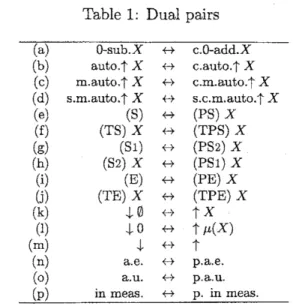
Table 1: Dual pairs
(a) 0sub.X $++$ c.O-add.X
(b) auto.f$X$ $rightarrow$ c.auto.t$X$
(c) $\mathrm{m}$.auto.$\uparrow X$ $\Leftrightarrow$ $\mathrm{c}.\mathrm{m}$.auto.$\uparrow X$
(d) $\mathrm{s}.\mathrm{m}$.auto.j$X$ $\Leftrightarrow$ s.c.m.auto4$X$
(e) (S) $rightarrow$ (S) $X$
(f) (TS) $X$ $rightarrow$ (TPS) $X$
(g) $(\mathrm{S})$ $rightarrow$ (PS2) $X$
(h) (S2) $X$ $rightarrow$ (PS1) $X$
(i) (E) $rightarrow$ (PE) $X$
(j) (TE) $X$ $\mapsto$ (TPE) $X$
(k) $\downarrow\emptyset$ $\Leftrightarrow$ $\uparrow X$ $(\mathrm{m})(1)$ $\downarrow\downarrow 0$ $rightarrow\Leftrightarrow$ $\uparrow\uparrow\mu(X)$
(n) $\mathrm{a}.\mathrm{e}$. $\Leftrightarrow$ $\mathrm{p}.\mathrm{a}.\mathrm{e}$.
(o) $\mathrm{a}.\mathrm{u}$. $\Leftrightarrow$
$\mathrm{p}\mathrm{a}.\mathrm{u}$.
(p) inmeas. $\mapsto$ $\mathrm{p}$. inmeas.
3 DUALITY AND CARDINALITY
Definition 3.1 The conjugate$\overline{\mu}$ ofa finitenon-additive measure $\mu$ on $(X,\mathrm{S})$ is defined by $\overline{\mu}(A)=\mu(X)-\mu(X\backslash A)$ $(A\in \mathrm{S})$.
For every finitenon-additive
measure
$\mu$ on $(X, \mathrm{S})$,
its conjugate$\overline{\mu}$is afinite non-additive measure on
$(X\mathrm{S})\}$ and$\overline{\overline{\mu}}=\mu$
.
We denote the class of all non-additive measure spaces by FMS, and the class of all finite
non-additive
measure
spaces by fFMS. Note that FMS and fFMS are proper classes, i.e., they are notsets.
Definition 3.2 [11] Let P and Q be conditions concerning a non-additive
measure
space. P is saidtobe dualto Q when, for every (X,S,$\mu)\in \mathrm{f}\mathrm{f}\mathrm{M}\mathrm{S},\acute{(}X$,S,$\mu)$ satisfies Piff (X,S,$\overline{\mu})$ satisfies Q. For each $(X,\mathrm{S}, \mu)\in$ FMS, we denote by $\Phi(X,S,\mu)$ the famiiy of continuous, strictly increasing
functions $\varphi$ : $[0, \mu(X)]arrow[0, \infty]$ satisfying $\varphi(0)=0$. If
$(X,\mathrm{S}, \mu)\in$ FMS and $\varphi\in\mathrm{x},\mathrm{s},\mathrm{m})$, then the
composite function $\varphi\circ\mu$is a non-additive
measure
on $(X, \mathrm{S})$.
Definition 3.3 [11] A condition P concerning a non-additive
measure
space is said to be ordinal if(X,$\mathrm{S}_{7}\varphi\circ\mu)$satisfies P for every $\varphi\in\Phi(X,S,\mu)$ whenever (X,S,$\mu)$ satisfies P.
Ordinal Duality Principle [11]:
An ordinal proposition concerning $a$ (not necessarily finite) non-additive measure space holds, then its
dual also holds.
Now we
exam
ine the duality and ordinalityof concepts defined in the previous section.Proposition 3.1 Eachpairin Table 1 is dual.
For example, (a) in Table 1 means that null-subtractivity at the whole set is dual to
converse-null-additivity at the whole set. (k) and (1) are pointed out in [8], (m) is in [$11^{1}\rfloor$, and $(\mathrm{n})-(\mathrm{p})$ arein [9].
Proposition 3.2 Every concept in Table 1 is ordinal.
is
4 RELATIONS FROM (PSEUDO-)ALMOST UNIFORM CONVERGENCE
The following propositionsand corollariesgive implication relations of(pseudo-)almostuniform
conver-genceto otherconvergences. Proposition4.1is obviously derived from [21]. Ineachofthepropositions
(i) and (ii)
are
dual to each other; oneis derived from the other byOrdinal Duality Principle. On theother hand, (i) and (ii) in eachofthecorollaries
are
not dual in the sense of Definition 3.2.Proposition 4.1 (i) Null-subtractivity at the whole set is a necessary and
sufficient
conditionfor
almost
uniform
convergence to irnply pseudo-almost everywhere convergence; that is, $\mu$ isnull-subtractive at$X$
iff
$f_{n}arrow f\mathrm{a}.\mathrm{u}$ implies $f_{n}\mathrm{p}.\mathrm{a}arrow.f\mathrm{e}.$.
(ii) Converse-null-additinityatthe whole set isa necessar$ry$and
sufficient
conditionfor
pseudo-almostuniform
convergence to imply almost everywhere convergence.By Proposition 4.1, we immediately obtain the following corollary.
Corollary 4.1 (i) Null-additivity is a necessary and
sufficient
condition that,for
every measurableset$A_{J}$ almost
unifo
rm convergence on A implies pseudo-almost everywhere convergence on A.(ii) Converse-null-additivity is a necessary and
sufficient
condition that,for
every measurable set$A$,pseudo-almost
uniform
convergence on $A$ implies almost everywhere convergence on $A$.
Proposition 4.2 (i) The following statements are equivalent.
(a) The non-additive measure is monotone autocontinuous
from
below at the whole set.(b) Almost
unifor
$m$ convergence implies pseudo-almostuniform
convergence.(c) Almost
uniform
convergence implies convergence pseudo-in measure.(ii) The following statements are equivalent.
(a) The non-additive measure is converse-monotone autocontinuous
from
below at the wholeset.
(b) Pseudo-almost
uniform
convergence implies almostunifo
$rm$ convergence.(c) Pseulo-almost
uniform
convergence implies convergence inmeasure.
(proof) By Ordinal Duality Principle, it suffices to prove (i).
(a) $\Rightarrow(\mathrm{b})$. If$f_{n}arrow f\mathrm{a}.\mathrm{u}.$, thenfor every mthere exists astrictly increasingsequence $\{n_{k}^{m}\}_{k=1}^{\infty}$ such that
$\mu(_{k=1}^{\infty}\cup\bigcup_{i=n_{k}^{m}}^{\infty}\{x||f_{\mathrm{i}}(x)-f(x)|\geq\frac{1}{k}\})<\frac{1}{m}$
.
(1)Define a doubty-indexed sequence $\{a_{k}^{m}\}$ by $a_{k}^{m}= \max\{n_{k}^{1}$,$n_{k}^{2}$, . . .,$n_{k}^{m}\}$ for each $k$. We put $N_{m}=$ $\bigcup_{k=1}^{\infty}\bigcup_{i=a_{k}^{m}}^{\infty}\{x||f_{i}(x)-f(x)|\geq 1/k\}$. If$l\geq m$, then $a_{k}^{l}\geq a_{k}^{m}$ for all $k$. Hence $\{N_{m}\}$ is adecreasing
sequence, and from (1) it follows that $\mu(N_{m})arrow 0$
as
$marrow\infty$.
By monotone autocontinuity frombelowat $X$, we obtain $\mu(X\backslash N_{m})arrow\mu(X)$ as $marrow\infty$, and obviously $f_{n}$ converges to $f$ uniformlyon $X\backslash N_{m}$. Therefore we have $f_{n}arrow f\mathrm{p}.\mathrm{a}.\mathrm{u}.$.
(b) $\Rightarrow(\mathrm{a})$
.
Let $N_{n}\downarrow N$and$\mu(N_{n})arrow 0$as$narrow\infty$,and define a sequence$\{f_{n}\}$ ofmeasurable functionsby
$f_{n}(x)=\{$0 if
$x\in X\backslash N_{n}$,
1 if$x\in N_{n}$,
$(n\geq 1)$
and a measurablefunction $f$ by
$f(x)=\{$0 if$x\in X\backslash N$,
Then $f_{n}$ converges to $f$ uniformly on $X\backslash N$, and since $\mu(N)=0$
, we
have $f_{n}arrow f\mathrm{a}.\mathrm{u}.$. By hypothesis,it follows that $f_{n}arrow^{\mathfrak{U}}\mathrm{p}.\mathrm{a}.$. $f$
.
Thus, for every $\langle$$<\mu(X)$, there exists $N_{\xi}’$ such that $\xi<\mu(X\backslash N_{\xi}’)$ and $f_{n}$ converges to $f$ uniformly on $X\backslash N_{\xi}’$
.
By the definitions of $f_{n}$ and $f$, there exists $n$ such that $X\backslash N_{\xi}’\subset X\backslash N_{n}$ and hence $\mu(X\backslash N_{\xi}’)\leq\mu(X\backslash N_{n})$. Therefore$\mu(X\backslash N_{n})arrow\mu(X)$ as $narrow\infty$.
(b) $\Rightarrow(\mathrm{c})$
.
Fromthe proof of (a) $\Rightarrow(\mathrm{b})$, if $f_{n}arrow f\mathrm{a}.\mathrm{u}.$, then $f_{n}arrow f\mathrm{p}.\mathrm{a}.\mathrm{u}$. From [21], $\mathrm{i}\mathrm{I}\mathrm{i}$ is obvious that$f_{n}\underline{\mathrm{p}.\mathrm{a}.\mathrm{u}}f$ implies $f_{n}arrow f\mathrm{p}.\mu$
.
$(\mathrm{c})\Rightarrow(\mathrm{a})$. It is similar to the proofof (b) $\Rightarrow(\mathrm{a})$
.
$\blacksquare$ByProposition 4.2, weimmediately obtain the following corollary.
Corollary 4.2 (i) The following statements are equivalent
(a) The non-additive measure is monotone autocontinuous
from
below at every measurable.(b) For every measurble set$A$, almost
uniform
convergence on$A$ implies pseudo-almostuniform
convergence on $A$
.
(c) For every measurble set$A$, almost
uniform
convergence on$A$ implies convergencepseudo-inmeasure on $A$.
(ii) Thefollowing statements are equivalent
(a) The non-additive measure is converse-monotone autocontinuous
from
below at everymea-surable set
(b) For every measurble set$A$, pseudo-almost
uniform
convergenceon$A$ implies almostuniform
convergence on$A$
.
(c) For every measurble set $A$, pseulo-almost
uniform
convergence on$A$ implies convergencein rneaseere on $A$
.
5 RELATIONS BETWEEN CONVERGENCES
The results in the previous section aresummarized together with existingones [4, 6, 8, 10, 14, 17, 19,
20, 21] into Tables 2 and 3.
Table 2 shows necessary and sufficient conditions for implications between the six convergences
on the whole set $X$
.
The cell atrow
$\mathrm{r}$ and column $\mathrm{c}$ indicates a necessary and sufficient condition for $\mathrm{r}$-tyPe convergence to imply$\mathrm{c}$-tyPe convergence; for example, condition (E) is a necessary and
sufficient condition for almost everywhere convergence to imply almost uniform convergence. The
symbol$\emptyset$ indicates the implication holds unconditionally. A cell
$\ovalbox{\tt\small REJECT}\ovalbox{\tt\small REJECT}$shows a condition for the
Riesz-type theorem; for example, property (S) is a necessary and sufficient condition that $f_{n}\underline{\mu}f$ implies
that there exists a subsequence $\{f_{n_{i}}\}$ of $\{f_{n}\}$ such that $f_{n_{i}}arrow f\mathrm{a}.\mathrm{e}$ as $\mathrm{i}arrow\infty$
.
Table 3shows necessary and sufficientconditions forimplications betweenthe sixconvergences on
every measurableset; forexample, condition (E) is a necessary and sufficientcondition that, for every
$A\in \mathrm{S}$, $f_{n} \frac{\mathrm{a}.\mathrm{e}_{\backslash }}{A’}f$implies $f_{n} \frac{\mathrm{a}\mathrm{u}_{1}}{A},f$
.
Table 3is derived from Table 2.The results indicating (TS) $X$ and (TPS) $X$ in Table 2 and (TS) and (TPS) in Table 3 are
derivedfrom [10, Theorem 5 and its proof] by removing theassumption ofcontinuity of non-additive
measures.
Each ofthe other results without referencenumber follows from the result (and its proof) in the corresponding cell ofthe other table. For example, “($\mathrm{a}.\mathrm{e}$. $\Rightarrow \mathrm{p}$. in meas.)\Leftrightarrow s.m$‘ \mathrm{a}\mathrm{u}\mathrm{t}\mathrm{o}.\uparrow X$” in
Table 2 is derived from “$\forall A\in \mathrm{S}$ ($\mathrm{a}.\mathrm{e}$. on $A\Rightarrow \mathrm{p}$. in meas. on A) $\Leftrightarrow$ (O-add. &\uparrow )’’ in Table 3 and its proofin [14]; in this case, the equivalence “(O-add.
&
$\uparrow$) $\Leftrightarrow$ s.m.auto. $\uparrow$” is derived.6 CONDITIONS FOR THE EGOROFF THEOREM
The Egorofftheorem,which assertsthat almost everywhereconvergenceimplies almostuniform
18
Table 2: Necessaryand sufficient conditions for implicationsbetweenconvergences onthe whole set$X$
Table 3: Necessaryand sufficient conditions forimplications betweenconvergences onallmeasurable sets
measure theory, this theorem does not hold without additional conditions. So far, it has beenshown
that theEgoroffcondition [12] and condition (E) [4] eachis a necesaryandsufficient condition for the
Egoroff theorem to hold in non-additive
measure
theory. Both ofthe conditionsare
described by adoubly-indexedsequence of measurable sets, andno necessary and sufficient condition describedby a
single-indexed sequence has been given yet. On the otherhand, the Egorofftheorem has a necessary
condition describedby asingle-indexed sequence (strong order continuity [7, 12]) and sufficient
condi-tions described byasingle-indexed sequence (continuity from above and below [5], the conjunction of
strongorder continuity andproperty (S) $[7, 12])$
.
Inthissectionwegivenewconditionsdescribedby asingle-indexed sequence; condition ($\mathrm{M}\}$ isa necessary condition stronger than strongorder continuity,
and the conjunction of condition (M) and null-continuity is a sufficient condition weaker than the
above-mentioned two sufficient conditions.
In non-additivemeasuretheory, there are four types oftheEgoroff theorem: the original $(” \mathrm{a}.\mathrm{e}.$ $\Rightarrow$ $\mathrm{a}.\mathrm{u}."$,$)$ andits threevariations ($” \mathrm{a}.\mathrm{e}.$ $\Rightarrow \mathrm{p}.\mathrm{a}.\mathrm{u}."$, “
$\mathrm{p}.\mathrm{a}.\mathrm{e}$
.
$\Rightarrow \mathrm{a}.\mathrm{u}."$, and “p.a.e. $\Rightarrow \mathrm{p}.\mathrm{a}.\mathrm{u}$.”). This section
discusses the original only; the correspondingresults onthethree variations
can
be obtainedsimilarly.Lemma 6.1 Condition (M) implies strongly order continuity.
(proof) Let$N_{n}$)$N$and$\mu(N)=0$
.
Then$\mu(\bigcup_{n=1}^{\infty}\bigcap_{i=n}^{\infty}N_{i})=\mu(N)=0$. Itfollows from condition (M)that for every $\epsilon$ $>0$ there exists a strictly increasing sequence $\{m_{n}\}$ such that
$\mu(\bigcup_{n=1}^{\infty}\bigcap_{i=n}^{m_{\hslash}}N_{i})<\epsilon$.
Since $\bigcap_{i=n}^{m_{n}}N_{\mathrm{i}}=N_{m_{n}}$ and $\bigcup_{n=1}^{\infty}N_{m_{n}}=N_{m_{1}}$, it follows that $\epsilon$ $> \mu(\bigcup_{n=1}^{\infty}\bigcap_{i=n}^{m_{n}}N_{i})=\mu(N_{m_{1}})$
.
there fore $\mu$ is strongly order continuous.$\blacksquare$
Proposition 6.1 The conjunction
of
condition (M) and null-continuity is asufficient
conditionfor
the Egoroff theorem.
(proof) If $f_{n}arrow \mathrm{a}\mathrm{e}$ f, then $\mu(\bigcup_{k=1}^{\infty}\bigcap_{n=1}^{\infty}\bigcup_{i=n}^{\infty}\{x||f_{\iota}(x)-f(x)|\geq 1/k\})=0$
.
Thus, for every $k$ $\mu(\bigcap_{n=1}^{\infty}\bigcup_{i=n}^{\infty}\{x||f_{l}(x)-f(x)|\geq 1/k\})=0$. Since $\mu$ is strongly order continuous by Lemma 6.1,it followsthat $\mu(\bigcup_{i=n}^{\infty}\{x||f_{?}(x_{/}^{\backslash }-f(x)|\geq 1/k\})arrow 0$ as$n$$arrow\infty$. Therefore, thereexistsan increasing
sequence $\{n_{k}\}$ such that
$\mu(\bigcup_{i=n_{k}}^{\infty}\{x||f_{\tau}(x)-f(x)|\geq\frac{\rceil}{k}\wedge\})<\frac{1}{k}$ for every $k$
.
(2)Ifwe put $N_{k}= \bigcup_{i=n_{k}}^{\infty}\{x||f_{\iota}(x)-f(x)|\geq 1/k\}$for each $k$, then (2) implies that $\mu(N_{k})arrow 0$. Since
$N_{k}$
.
$\supset\bigcap_{i=l}^{\infty}N_{i}$ for $k\geq l$, it follows that $\mu(\bigcap_{v=l}^{\infty}N_{l})=0$ for every 1. By null-continuity, we have$\mu(\bigcup_{l=1}^{\infty}\bigcap_{i=l}^{\infty}N_{i})=0$. Condition (M) implies that for every positive number $\epsilon$ there exists $\{m_{l}\}$ such that $\mu(\bigcup_{l=1}^{\infty}\bigcap_{k=l}^{m_{l}}N_{k})<\epsilon$. It followsthat
$l=1k=ll=1k=’ li=n_{k} \cup\cap^{l}\cup\cap\cup\infty m_{N_{k}=}\infty m_{l\infty}\{x||f_{i}(x)-f(x)|\geq\frac{1}{k}\}\supset\cup\cup l=1j=n_{m_{l}}\infty\infty\{x||f_{j}(x)-f(x)|\geq\frac{1}{l}\}$ .
Since
$X \backslash \cup\cup l=1j=n_{m_{l}}\infty\infty\{x||f_{j}(x)-f(x)|\geq\frac{1}{l}\}=\cap\bigcap_{jl=1=n_{m_{l}}}^{\infty}\infty\{x||f_{j}(x)-f(x)|<\frac{1}{l}\}\supset X\backslash \cup\cap^{\iota_{N_{k}}}l=1k=l\infty m.$ ,
it follows that $f_{n}$ converges $f$ uniformly on$X \backslash \bigcup_{l=1}^{\infty}\bigcap_{i=l}^{mp}N_{i}$
.
This shows $f_{n}arrow f\mathrm{a}\mathrm{u}$. $\blacksquare$Proposition 6.2 Condition (M) is a necessary condition
for
the Egorofftheorem.(proof) We provethat theEgoroff conditionimplies condition (M).Let$\{N_{n}\}$satisfy$\mu(\bigcup_{m=1}^{\infty}\bigcap_{i=m}^{\infty}N_{i})$
$=0$
.
Define a sequence $\{N_{k,l}\}$ as $N_{k,l}=\{$ $\cup^{k}N_{i}$ if$k>l$, $i=ll$ $i=k\cap N_{i}$ if $k\leq l$.
Then the sequence $\{N_{m,n}\}$ is increasing with respect to $m$ and decreasing with respect to $n$
.
Since$\mu(\mathrm{U}_{m=1}^{\infty}\bigcap_{n=1}^{\infty}N_{m,n})=\mu(\bigcup_{m=1}^{\infty}\bigcap_{i=m}^{\infty}N_{i})=0$, itfollows that forevery positive number
$\epsilon$ thereexistsa sequence $\{n_{m}\}$ such that$\mu(\bigcup_{m=1}^{\infty}N_{m,n_{m}})<\epsilon$. Wecanlet $\{n_{m}\}\mathrm{s}\mathrm{a}\mathrm{t}\mathrm{i}\mathrm{s}\xi_{Y}$$n_{m}\geq m$
.
Then$\bigcup_{m=1}^{\infty}N_{m,n_{m}}=$.
$\bigcup_{m=1}^{\infty}\bigcap_{i=m}^{n_{m}}N_{i}$ andtherefore $\mu(\bigcup_{m=1}^{\infty}\mathrm{r}1_{i}^{n}\^{N_{i}})<\epsilon$.In [12], the implications between condition (E), or the Egoroff theorem, and related conditions
are summarized as Fig. 1. In this diagram, a directed path from A to $\mathrm{B}$ means that condition A
implies condition $\mathrm{B}$, and the absence of such a directed path means that A does not imply B. An
addition ofthe resultsinthis section to Fig. 1 yields Fig. 2, This diagram shows that the conjunction
of condition (M) and null-continuityis strictlyweaker than continuity from above and below and the
conjunction of strongorder continuityand property (S) each, and is independent ofstrong order total
continuity. Since there exists a non-additive
measure
space where condition (E) is satisfied withoutstrongorder total continuity andnull-continuity [12, Example 5],condition (E) is strictly weakerthan
“$\mathrm{T}\downarrow \mathrm{O}$ or ‘(M) &\uparrow 0’ ”
.
In addition, condition (M) is strictly stronger than strong order continuity.The symbol “$?$” indicates that the implication fromcondition (M) tocondition (E) has not been clear
yet.
7 CONCLUDING REMARKS
In this paper, we have summarized the implication relationship between six convergence concepts:
20
Figure 1: Implication relationship without condition (M) [12]
versions. In addition, for the Egoroff theorem we give a
new
necessary condition, condition (M), anda new sufficient condition, the conjunction ofcondition (M) and null-continuity.
Theimplicationfrom condition (M) to condition (E) has not been clear yet. So the investigation of
thisimplication is an important subject to future research. Another subject is astudy of relationship
with other convergenceconcepts such as mean convergence and convergence in distribution.
REFERENCES
[1] D. Denneberg, Non-additive Measure and Integral, 2nd ed., Kluwer, Dordrecht, 1997.
[2] I. Dobrakov, “On submeasures I”, Dissertationes Math., 112 (1974) 1-35.
[3] J. Li, “Order continuous of monotone set function and convergence of measurable functions
sequenc\"e, Appl. Math. Comput., 135 (2003) 211-218.
[4] J. Li, “A further investigation for Egoroff’s theorem with respect to monotone set functions”,
Kybernetika, 39 (2003) 753-760.
[5] J.Li, On Egoroff’s theoremsonfuzzymeasurespaces, Fuzzy SetsandSystems, 135 (2003) 367-375.
[$6_{\rfloor}^{\rceil}$ J. Li, Y. Ouyang, and M. Yasuda, “Pseudo-convergence of measurablefunctions on Sugenofuzzy
measure spaces”, Proc. 7th Joint Conf. Inform. Science (2003) 56-59.
[7] J. Li and M. Yasuda, “Egoroff’s theorem on monotone non-addditive
measure
spaces”, Internat,J, Uncertain. Fuzziness Knowledge-Based Systems, 12 (2004) 61-68.
[8] J. Li and M. Yasuda, “On Egoroff’s theorems on finite monotone non-additive
measure
spaces,,Fuzzy Sets and Systems, toappear.
[9] X. Liu, “Study onthe dual problems in the theoryof fuzzy measureandfuzzy integral” , J. Fuzzy
Math., 2 (1994) 555-563.
[10] Y. Liu and B. Liu, “The relationship between structural characteristics of fuzzy measure and
convergences of sepuence ofmeasurablefunctions”, Fuzzy Sets andSystems, 120 (2001) 511-516.
[11] T. Murofushi, “Duality and ordinality in fuzzy measure theory”, Fuzzy Sets and Systems, 138
(2003) 523-535.
[$12_{\mathrm{J}}^{\rceil}$ T. Murofushi, K. Uchino, and S. Asahina, “Conditions for Egoroff’s theorem in non-additive
measure theory”} Fuzzy Sets and Systems, 146 (2004) 135-146.
[13] E. Pap, Null-additive Set Functions, Kluwer, Dordrecht, 1995.
[14] J. SongandJ. Li, “Lebesgue theorems innon-additivemeasuretheory”, Fuzzy Sets and Systems,
149 (2005) 543-548.
[15] M. Sugeno, Theory ofFuzzy Integrals and Its Applications, Doctoral Thesis, Tokyo Institute of
Technology, 1974.
[16] Q. Sun, “On the pseudo-autocontinuity offuzzy measures”, Fuzzy Sets and Systems, 45 (1992)
59-68.
[17] Q. Sun, “Property (S) offuzzy
measure
andRiesz’s theorem”, FuzzySets andSystems, 62 (1994)117-119.
[18] K. Uchino and T. Murofushi, “Relations between mathematical properties offuzzy measures”,
Proc. 10th Int. Fuzzy Syst. Assoc. World Congr. (2003) 27-30.
[19] Z. Wang, “The autocontinuity ofset function and the fuzzy integral”, J. Math. Anal. Appl., 99
(1984) 195-218.
[20] Z. Wang, “Asymptotic structural characteristicsoffuzzy
measure
and their applications” , FuzzySets and Systems, 16 (1985) 227-290.

![Figure 1: Implication relationship without condition (M) [12]](https://thumb-ap.123doks.com/thumbv2/123deta/6009817.1063623/10.892.97.812.62.1176/figure-implication-relationship-without-condition-m.webp)
