FINITE
GROUPS POSSESSING SMITH
EQUIVALENT,NONISOMORPHIC REPRESENTATIONS
九州大学大学院芸術工学研究院 角 俊雄 (Toshio Sumi) Faculty of Design Kyushu University1.
INTRODUCTIONThroughout this paper,
we assume
thatgroups
are
always finitegroups, group
actions
are
smooth and representationsmean
real representations.In 1960, Paul A. Smith [$63\rfloor$ posted the foll.owing problem:
Problem. Let $G$ be
a
finite
group whlch acts on a homotopy sphere with just twofixed
points. Thenare
the tangential spaces over thefixed
points isomorphicas
representations ornot?
Wecall two
representations
whichare
obtainedas
thetangentialspaces
over
fixed points froma
finitegroup
actionon a
sphere withjust two fixed pointsare
Smith equivalent.Atiyah-Bott [1] proved that Smith equivalent representations
are
always isomor-phic fora
cyclicgroup
of prime order. According to Sanchez [60], theyare
always isomorphic fora
cyclicgroup
of odd primepower
order. By character theory,we
obtain they
are
also always isomorphic for the symmetricgroup
on
three letters anda
cyclicgroup
of order 2,4, 6. On the other hand, Cappell-Shaneson proved that there exist Smith equivalent representations whichare
not isomorphic fora
cyclicgroup
oforder $4q$ for $q\geq 2([6,7,8])$.
For different classes of finitegroups, many
related results about this problem
were
obtained by Petrie, Dovermann, Suh, etc. [37, 57, 58, 59, 17, 19, 21, 64, 9, 10, 22] before1990.
After that, Laitinen and Pawatowski [36] obtained that there existsa
pair of Smith equivalent nonisomor-phic representations fora
perfectgroup
whose Laitinen number is greater thanor
equal to 2. Herea
real conjugacy classmeans
$(g)^{\pm}$ $;=(g)\cup(g^{-1})$ and theLaiti-nen
number $a_{G}$ of$G$ isa
number of all real conjugacy classes of$G$ represented byelements not of prime
power
order. Weassume
that the identity is of primepower
order. Pawatowski and Solomon [54] showed thereexistsa
pair of Smith equivalent,2000MathematicsSubject
Classification.
$57S17,20C15$.
Keywords andphrases. representation, Smithequivalent.
The author was partially supported by Grand-in-Aid for Scientific Research (C) (2)
nonisomorphic representations for
more
groups.
Most recently, Morimoto $[42, 43]$presented theconceming results for groups including $Aut(A_{6})$ and $P\Sigma L(2,27)$.
We show that there exists
a
pair of Smith equivalent, nonisomorphicrepresen-tations for
groups
of the other classes. This report is includinga
joint work with Krzysztof Pawaiowski.Theorem
1.1.
Suppose that $G$ isa
nonsolvable group with $a_{G}\geq 2$. If
two Smithequivalentrepresentations arealways isomorphic, then$G$ is isomorphicto$Aut(A_{6})$
.
Theorem
1.2.
There existsa
solvable Olivergroup
$G$ with $a_{G}\geq 2$ whichpossesses
a
pairof
two Smith equivalent, nonisomorphic representations.2.
$REPRESENTAI’ IONS$ ANDREAL CONJUGACY CLASSESIn this section,
we
recalla
necessary
condition for which two representations become Smith equivalent.Let $G$ be
a
finitegroup
and let$RO(G)$ be the real representation ring of $G$.
Forconvenience,
we
define subgroups of$RO(G)$.
We denote by $PO(G)$ the subgroup of$RO(G)$ of $G$ consisting of the differences $U-V$ of representations $U$ and $V$ such
that dim $U^{G}=\dim V^{G}$ and ${\rm Res}_{P}^{G}(U)\cong{\rm Res}_{P}^{G}(V)$ for
any
subgroup $P$ of $G$ ofprimepower
order. We note that in $|.541,$ $PO(G)$ is denoted by $IO(G,G)$.
Similarly,we
denote by $\overline{PO}(G)$ the subgroup of$RO(G)$ of$G$ consisting of the differences $U-V$
of representations $U$ and $V$ such that dim $U^{G}=$ dim $V^{G}$ and ${\rm Res}_{P}^{G}(U)\cong{\rm Res}_{P}^{G}(V)$
for
any
subgroup $P$of$G$ ofodd primepower
order and order2,4. Bya
theorem ofSanchez [60], the difference oftwo Smith equivalent representations lies in $\overline{PO}(G)$
and the difference of two 2-proper Smith equivalent representations lies in $PO(G)$
.
The concept of 2-proper is considered by Petrie. We will write the definition of
2-proper
Smith equivalence in the section 3.The rank of $PO(G)$ is equal tomaximum of$0$ and the Laitinen number$a_{G}$ minus
1. Moreover the rank of $\overline{PO}(G)$ is equal to the rank of $PO(G)$ plus the number
of all real conjugacy classes represented by 2-elements of order $\geq 8$
.
Now, let$H$ be
a
normal subgroup of $G$.
We denote by $PO(G,H)$ the subgroup of $RO(G)$consisting of the differences $U-V$ofrepresentations $U$ and $V$ such that $U^{H}\underline{\simeq}V^{H}$
as
representationsover
$G/H$, and ${\rm Res}_{P}^{G}(U)\cong{\rm Res}_{P}^{G}(V)$ forany
subgroup $P$ofprimepower
order. Again,we
note that in [54], $PO(G,H)$ is denoted by $IO(G,H)$.
Itholds that $PO(G)=PO(G, G)$. Let $b_{G}$ be the number of all real conjugacy classes
in $G/H$ which
are
sent from real conjugacy classes of $G$ represented by elementsnot of prime
power
order by the surjection $Garrow G/H$.
Then the rank of$PO(G,H)$is equal to $a_{G}-b_{G/H}$ (See [54]).
For each prime $p$, let $O^{p}(G)$ be the minimal subgroup
among
normal subgroups$N$of$G$with index
a power
of$p$.
Let$\mathcal{L}(G)$ bethe setof subgroups $L$of$G$ containingfor
any
$L\in \mathcal{L}(G)$.
We denote by $LO(G)$ the subgroup of $PO(G)$ consisting of thedifferences $U-V$ of representations $U$ and $V$ which
are
both $\mathcal{L}(G)$-free. Then itholds that
$LO(G)\leq PO(G)\leq\overline{PO}(G)\leq RO(G)$
and Pawatowski and Solomon showed
$PO(G, G^{\prime lil})\leq LO(G)$,
where $G^{nil}$ is the minimal subgroup
among
normal subgroups$N$of$G$ such that$G/N$is nilpotent. Note that$G^{nil}= \bigcap_{p}O^{p}(G)$
.
We denote by $QO(G)$ the subgroupof$PO(G)$ consisting ofthe differences $U-V$
ofrepresentations $U$ and $V$ suchthat ${\rm Res}_{H}^{(\grave{r}}U\cong{\rm Res}_{H}^{G}V$for
any proper
subgroup $H$of$G$
.
Lemma
2.1.
$PO(G)\otimes \mathbb{Q}$ isspanned by elementsof
$Ind_{C}^{G}QO(C)$for
allcyclicsub-groups
$C$of
$G$ notofprimepower order.Corollary
2.2.
Let$C_{1}$ and$C_{2}$ be cyclic subgroupsof
$G$ not ofprimepowerorder.If
$C_{1}$ and$C_{2}$are
notconjugate then$Ind_{C_{1}}^{G}QO(C_{1})\cap Ind_{C_{-}}^{G},QO(C_{2})=\{0\}$
.
3.
FINmGROUP ACTIONS ON SPHERES $wrrH$ EXACTLYTWO FIXBD POINTSWe denote by$Sm(G)$ the subset ofRO$(G)$ consistingthedifferences oftwo Smith
equivalent representations. A group action of a sphere$\Sigma$ is
2-proper,
if$\Sigma^{\langle g\rangle}$is
con-nected for
any
2-element$g$ of$G$oforder $\geq 8$.
In accordance with Petrie’sdefinition,two representations $U$ and $V$
are
2-proper
Smith equivalent if there existsa 2-proper
action of$G$
on a
sphere with exactlytwo fixed points at which tangentialspaces
are
isomorphic to $U$ and $V$ respectively. We denote by $LSm(G)$ the subset of $Sm(G)$
consisting the differences oftwo 2-proper Smith equivalent representations. Since
$LSm(G)\subset PO(G),$ $a_{G}\leq 1$ implies $LSm(G)=0$
.
Pawalowski and Solomon showed that if$G$ is
a
gap
Olivergroup
then $LO(G)\subseteq$$LSm(G)$, and
moreover.
if $G$ is a gap nonsolvable group with $a_{G}\geq 2$ and $G\not\cong$$Aut(A_{6}),$ $P\Sigma L(2,27)$ then $PO(G, G^{ni\prime})\neq 0$ and thus $LSm(G)\neq 0$
.
Recentworks byMorimoto
gave
us
that $Sm(Aut(A_{6}))=0$ and $LSm(P\Sigma L(2,27))\neq 0$.
Now
we
recall the weakgap
condition ([41]). A representation $V$ satisfies theweak
gap
condition ifit satisfies the followingproperties.
(1) If $P\in P(G)$ and $H>P$, then 2dim$V^{H}\leq\dim V^{P}$
.
(2) If $P\in \mathcal{P}(G),$ $H>P$ and 2dim $V^{H}=\dim V^{P}$, then $[H : P]=2$, dim $V^{H}>$
dim $V^{K}+1$ for
any
$K>H$.(3) If $P\in \mathcal{P}(G),$ $[H;P]=2$ and 2dim $V^{H}=\dim V^{P}$, then $V^{H}$ is orientable
so
(4) If $P\in \mathcal{P}(G),$ $H>P,$ $K>P$ and
2
dim $V^{H}=2$dim $V^{K}=\dim V^{P}$, then thesmallest subgroup $\langle H, K\rangle$ including $H$and $K$ does not belong to $\mathcal{L}(G)$
.
Here, $\mathcal{P}(G)$ is the setof all subgroups of $G$ of prime
power
order.Wedenote by $Ymo(G)$ the subgroup of$LO(G)$ consistingof the differences $U-V$
ofrepresentations $U$and $V$suchthatboth UeW and VeW
are
$\mathcal{L}(G)$-free andsatisfythe weak
gap
condition. Note that $WLO(G)=LO(G)$ if$G$ is agap group.
Lemma
3.1.
It holds $mo(G)\subseteq LSm(G)$for
an Olivergroup
$G$.
From
now
on,we
investigate
conditions for which Olivergroups
$G$ satisfy that$RO(G)\neq 0$
.
4. A SUFFICIIENTCONDITION
We introduce
a
sufficient condition for Olivergroups
$G$to hold $\iota mo(G)\neq 0$byusing elements of the
groups.
A pair $(x,y)$ of elements $x,y\in G$ is called basic if the following two condition
hold.
(1) $x$ and$y$
are
not ofprime power order, and $x$ and$y$are
not real conjugate in$G$ (and thus $a_{G}\geq 2$).
(2) $x$and$y$
are
in
some
gap
subgroup of $G$,or
the orders $|x|$ and $|y|$are
even
andtheinvolutions of$\langle x\rangle$ and $\langle y\rangle$ areconjugate in $G$
.
Moreover,
we
say
that $(x,y)$ isan
H-pair fora
subgroup $H$of$G$, if$xH=yH$.
Theorem
4.1.
If
an
Oliver group $G$ has a basic $G^{ni\prime}$-pair then $KO(G)\neq 0$ andthus $LSm(G)\neq 0$
.
It is easy to
see
that $G$ hasa
basic $G^{nil}$-pair insome
assumptions. The nexttheorem is obtained by combining Theorem 5.1.
Theorem
4.2.
$lf$an Oliver group $G$ has an elementof
the center whose order isdivisible by atleast
3
distlnctprimes then $G$ hasa
basic $G^{nil}$-pairIn the
case
when $G$ has nontrivial center, if $G$ hasno
basic $G^{\prime\iota il}$-pair then thestructure of$G$ is almost determined. In this
paper we
omit it.5.
OUTLINE OF APROOF OFTHEOREM 1. 1We introduce outline of
a
proof ofTheorem 1.1. The following result isone
of keys.Theorem
5.1.
Let $G$ be an Olivergroup
with $a_{G}\geq 2$.
If
$G/G^{nil}$ is isomorphic tonone
of
the followinggroups
then $lLO(G)\neq 0$.
(1) a
p-group
for
a
prime $p$(3) $P\cross C_{3}$fora2-grouPP suc,hthat any element
ofP
is self-conjugateConversely,
we
obtainProposition5.2. Let$N$ be
a
nilpotentgroup
with$LO(N)=0$.
Then$N$ isisomorphicto (1), (2)
or
(3) in Theorem5.1.Let $G$ be
a
nonsolvablegroup
with $a_{G}\geq 2$.
We point out again thatMo-rimoto obtained $Sm(Aut(A_{6}))=0$ and $Sm(P\Sigma L(2,27))\neq 0$
.
So,suppose
that $G\not\cong Aut(A_{6}),$ $P\Sigma L(2,27)$.
Pawalowski and Solomon obtainedthat$a_{G}>b_{G/G^{nii}}$ and $LO(G)\supset PO(G,G^{nil})\neq$
$0$
.
Clearly theexistence
ofa
basic $G^{nll}$-pair
yields $a_{G}>b_{G/G^{ll}}u$.
If$G$ is isomorphic to (1), (2)
or
(3) inTheorem 5.1, thenwe
can
show that thereexists
a
basic $G^{nil}$-pair by the similar argument of the section 2 in [54] and then$LSm(G)\neq 0$follows.
Remark
5.3.
Fora
nonsolvablegroup
with $a_{G}\geq 2,$ $LO(G)=0$ implies that $G$ isisomorphic to either$Aut(A_{6})$ or$P\Sigma L(2,27)$.
6.
COMPUTATION BY GAPWe computed solvable Oliver
groups
$G$ with $LO(G)=0$ and $a_{G}\geq 2$of orderup
to
2000
by usinga
software GAP $|^{\vee}23$] and foundtwelvegroups
ofwhichtengroups
are
gap
groups
and the othersare
not.Proposition
6.1.
If
$G$ is an Olivergroup
then the orderof
$G$ is divisible by atleast3 distinct primes.
We obtain 4 counterexamples to Laitinen’s Conjecture:
Laitinen’s Conjecture. It might hold $LSm(G)\neq 0$
for
an
Oliver group $G$ with$a_{G}\geq 2$
.
A counterexample is found first by Morimoto for $G=Ant(A_{6})$
.
The key point isnext.
Lemma 6.2 $(|42])$
.
If
$U$ and $V$ are Smith equivalent representations then $U^{N}$ and$V^{N}$
are
isomorphicfor
each subgroup $N$of
$G$ with index 1or
2.This
means
that$Sm(G) \leq\bigcap_{N}\overline{PO}(G,N)$ and $LSm(G) \leq\bigcap_{N}PO(G,N)$
where
$N$runs over
subgroups of$G$ with index 2.Proposition
6.3.
$IfG/G^{nil}$ isanelementaryabelian 2-group then$LSm(G)\subseteq LO(G)$.
$SG(72,44),$ $SG(288, 1025)$ , $SG(432,734),$ $SG(576, 8654)$
are our
counterexam-ples. Here $SG$($ord$,type) is denoted thegroup
SmallGroup($ord$,type) in thesoft-ware
GAP of order $ord$.
Note that $SG(72.44)$ and $SG(288, 1025)$are gap groups
and the others
are
not.TABLE 1. Counterexamples to Laitinen’s Conjecture
For
a
subset $S$ of$RO(G)$,we
define rank$S$ byrank$S= \max$
{
$rankA|A$ isa
subgroup and $A\subseteq S$ }.By definition it holds rank $WLO(G)\leq rankLSm(G)\leq rankPO(G, O^{p}(G))$ foreach
$p\iota\cdot imep$
.
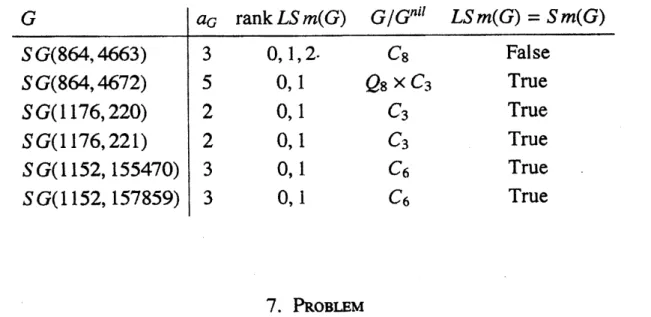
Morimoto shows $LSm(G)\neq 0$for $G=SG(864, 2666)$ ,$SG(864, 4666)$
as
wellas
$P\Sigma L(2,27)$ and then it is unknown whether $LSm(G)=0$
or
not for the followingsix
gap groups
$G$.
7. PROBLBM
In the section
we
posta
problem with respecttoan
approach to show $LO(G)\subseteq$Problem
7.1.
Let $G$ bean
Olivergroup
which is nota
gapgroup
and let $K$ bea
subgroup
of
$G$ with $K>O^{2}(G)$.
Is either $C_{K}(x)$or
$C_{K}(y)$a
$\nabla$ 2-group
for
involutions$x$ and$y$
of
$K$ outsideof
$O^{2}(K)$ whichare
not conjugate in $G$?The author confirmed that this problem is affirmative for all
groups
of order less than 2000.Theorem 7.2. Let$G$ be
an
Olivergroup
which isnota gap group.
Suppose that theproblem is
affirmatlve for
each K. Then it holds $2LO(G)\subseteq lWO(G)\subseteq LO(G)$.
Inpartlcular, itholds that rank $LO(G)\leq rankLSm(G)$
.
Note that$LO(G)=RO(G)$ if $G$
is
a
gap group.
Putting together with Proposition 6.3,
we
obtainCorollary
7.3.
Let $G$ bean
Olivergroup
which is not a gapgroup.
Suppose thatthe problem is
affirmative for
each K.If
$G/G^{\prime il}$ isan
elementary abelian 2-groupthen itholds $KO(G)=LO(G)=LSm(G)$
.
Inparticular, $LSm(G)$ is a group.Finally
we
point out that the problem is affirmative if and only if there exists $U-V\in LO(G)$ such that both two representations $U\oplus W$ and $V\oplus W$ satisfy (1) ofthe weak
gap
condition forany
representation $W$.
Theauthor hope the problem willbe solved affirmative.
REFERENCES
[1] Atiyah, M.F.,Bott, R.,A
Lefschetzfixed
pointformulaforelliptic complexes: II. Applications, Ann. of Math. 88 (1968),451491.$|2.1$ Bak, A., Morimoto, M., K-theoretic groups withpositioning map and equivariant surgery,
Proc.Japan Acad. 70(1994),6-11.
[$3\rfloor$ Bak, A., Morimoto, M.,Equivariant surgery wlth middle dimensional singularsets.
$I$, Forum
Math. 8 (1996),267-302.
[4] Bannuscher, W., Tiedt, G., On a theorem ofDeaconescu, Rostock. Math. Kolloq. 47 (1994),
23-26.
$|5|$ Bredon, G.E., Introduction to compact
transformation
groups, Pure and Applied Math.,Vol.46,AcademicPress, New Yorkand London, 1972.
[6] Cappell, S.E., Shaneson, J.L., Fixedpoints ofperiodic rnaps, Proc. Nat. Acad. Sci. USA 77
(1980), 5052-5054.
[7] Cappell, S.E., Shaneson, J.L., Fixedpoints ofperiodic
differentiable
maps, Invent. Math. 68(1982), 1-19.
$\int 81$ Cappell, S.E., Shaneson, J.L., Representations atfvcedpoints, Group Actions on Manifolds
(ed. R. Schultz), Contemp. Math. 36 (1985), 151-158.
[9] Cho, E.C.,Smith equivalentrepresentationsofgeneralizedquaterniongroups, Group Actions
onManifolds (ed. R. Schultz),Contemp. Math. 36(1985), 317-322.
[10] Cho, E.C., s-Smith equivalent representations ofdihedral group, Pacific J. Math. 135, 1988,
[11] Cho, E.C., Suh, D.Y., lnduction$ln$equivariantK-theoryands-Smith equivalence of
represen-tations, GroupActions on Manifolds(ed. R. Schultz), Contemp. Math. 36 (1985),311-315.
[12] Conway, J.H., Curtis, R.T., Norton, S.P, Parker, R.A., Wilson, R.A., Atlas ofFinite Groups. Clarendon Press,Oxford, 1985.
[13] Curtis, C.W., Reiner, I., Methods ofRepresentation Theory, Vol. $I$. Pure and Applied Math.,
Wiley-Interscience, John Wiley&Sons, Inc., New York, 1981.
$|14J$ Curtis, C.W., Reiner, I., Methods ofRepresentation Theory, Vol. II, Pure and Applied Math.,
Wiley-lnterscience, John Wiley&Sons, Inc.,NewYork, 1987.
[15] Delgado,A., Wu,Y.-F. On locallyfinitegroupsin whicheveryelementhasprimepowerorder,
Preprint, 2000.
$|16]$ tom Dieck, T.,
Transformation
Groups, de Gruyter Studies in Mathematics 8, Walter deGruyter,Berlin
.
New York, 1987.[171 Dovermann, K.H., Even-dimensiotlals-Smith equivalent representations,Algebraic topology, Aarhus 1982 (Berlin), Springer, 1984,587-602. LectureNotes inMath.,Vol. 1051.
$|18^{\cdot}$[ Dovermann, K.H., Herzog, M., Gap conditionsfor representations
ofsymmetric groups, J.
PureAppl.Algebra119(1987), 113-137.
[19] Dovermann, K.H., Petrie, T.,Smithequivalenceofrepresentationsforodd order cyclicgroups,
Topology 24(1985),283-305.
[20] Dovermann, K.H., Petrie, T., Schultz, R., Trairsformation groups andfixedpointdata, Group
Actionson Manifolds (ed. R. Schultz),Contemp. Math. 36(1985), 159-189.
[21] Dovermann,K.H., Suh,D.Y., Smith equivalence
forfinite
abeliangroups, Pacific J. Math. 152(1992),41-78.
[22] Dovermann, K.H., Washington, L.D., Relations between cyclotomic units and Smith
equiva-lence
of
representations,Topology28 (1989),81-89.[23] The GAP Group, GAP –Groups, Algorithnes, and Programming, Version 4.4; 2006,
(http:$//www$
.
gap-system.org).[24] Gorenstein,D..Lyons, R., Solomon, R., TheClassification ofthe Finite Simple Groups,
Num-ber 1, AMS Mathematical Surveysand Monographs 40, 1994.
[25] Gorenstein. D., Lyons, R.. Solomon,R., TheClassification oftheFinite Simple Groups, Num-ber2,AMS Mathematical Surveys and Monographs40, 1996.
[26] Gorenstein,D..Lyons, R., Solomon, R., TheClassification oftheFinite Simple Groups,
Num-ber 3,AMS Mathematical SurveysandMonographs 40, 1998.
[27] Gorenstein,D., Lyons,R., Solomon, R.,The
Classification of
the Finite Simple Groups,Num-ber4,AMS Mathematical Surveys and Monographs$W$, 1999.
[28] Gorenstein, D., Lyons,R., Solomon, R., TheClassffication
of
the FiniteSimple Groups,Num-ber5,AMS Mathematical Surveysand Monographs 40, 202.
[29] Higman, G., Finite groups in which every element has prime power order, J. London Math.
Soc. 32(1957), 335-342.
[30] Huppert, B., Blackbum N., Finite Groups II, Grundlehren der mathematischen Wis-senschaften242, Springer-Verlag,Berlin Heidelberg NewYork, 1982.
[31] Illman,S.,Representationsatfixedpointsofactions
offinite
groupsonspheres,Current TrendsinAlgebraic Topology(ed.M.Kane,S.O.Kochman, P.S.Selick,V.P. Snaith),CMS Conference
[32] James, G., Liebeck, M., Representations atld Characters
of
Groups. 2ndEdition. Cambridge University Press,Cambridge,2001.[33] Kawakubo.K.,The Theory ofTransformationGroups,Oxford University Press, Oxford, 1991. [34] Laitinen, E., Molimoto, M., Pawalowski, K.,Deleting-Inserting Theoremforsmooth actions
offinitenonsolvable groups onspheres,Comment. Math. Helv. 70(1995), 10-38.
[$35J$ Laitinen, E., Morimoto, M., Finite groups with smooth onefixedpoint actions on spheres,
Forum Math. 10(1998),479-520.
[$36j$ Laitinen, E., Pawalowski, K., Smith equivalence ofrepresentationsfor finiteperfectgroups.
Proc. Amer. Math. Soc. 127(1999),297-307.
[37] Masuda,M., Petrie,T., Lectureson
transformation
groupsandSmith equivalence, GroupAc-tionsonManifolds(ed. R. Schultz),Contemp. Math. 36(1985), 191-242. [38] Milnor, J.W., Whiteheadtorsion, Bull.Amer. Math. Soc. 72(1966),358-426.
[39] Morimoto, M., Bakgroupsand equivariantsurgery, K-Theory2(1989),465-483.
[40] Morimoto, M.,Bakgroupsand equivariantsurgeryII,K-Theory3 (1990),505-521.
[41] Morimoto, M., Equivariantsurgery theorv; Deleting-Inserting Theorem offixedpoint
mani-foldsonspheresanddisks,K-Theory 15 (1998), 13-32.
[42] Morimoto, M., Smith equivalent$Aut(A_{6})$-representationsare isomorphic, Proc. Amer. Math.
Soc., 10appear.
[43] Morimoto, M.,ConsrructionofsmoothactionsonspheresforSmithequivalentrepresentations,
Thetheoryof transformationgroupsandits applications, RIMSKokyuroku,KyotoUniversity, 2007.
$\lceil 44]$ Morimoto, M., Pawatowski, K., Equivariant wedge sumconstruction
offinite
contractibleG-$CW$complexes withG-vectorbundles,Osaka J. Math. 36(1999),767-781.
[45] Morimoto, M., Pawatowski, K., TheEquivariantBundleSubtraction Theorem andlts
applica-tions,Fund. Math. 161 (1999),279-303.
$|46$[ Morimoto, M., Pawalowski, K.,Smoothactionsoffinlte Olivergroupsonspheres,toappearin
Topology (2002).
$|47]$ Morimoto,M., Sumi, T.,Yanagihara,M.,Finitegroupspossessinggapmodule$s$,Geometryand
Topology: Aarhus (ed. K. Grove, I.H. Madsen, E.K. Pedersen), Contemp. Math. 258 (2000),
329-342.
[$48J$ Oliver, R., Fixed point sets
of
group actions onfmite
acyclic complexes, Comment. Math.Helv. 50(1975), 155-177.
$|49]$ Oliver, R.,Smooth compactLiegroupactionsondisks,Math. Z. 149 (1976),79-96.
$\lfloor 50\rfloor$ Oliver, B.. Fixedpoint sets and tangent bundles
of
actions on disks and Euclidean spaces,Topology35 (1996),583415.
$\lfloor 51\rfloor$ Pawalowski, K.,Groupactioms with inequivalentrepresentationsatfixedpoints, Math. Z. 187
(1984),29-47.
[52] Pawatowski, K., Fixed point sets ofsmooth group actions on disks and Euclidean spaces,
Topology28 (1989),273-289. Corrections: Ibid. 35 (1996),749-750.
[53] Pawatowski, K., Smith equivalence ofgroup modules and the Laitinen conjecture,
Geome-try andTopology: Aarhus (ed. K. Grove, I.H. Madsen, E.K. Pedersen), Contemp. Math. 258
[$54\rfloor$ Pawatowski, K.,Solomon,R.,Smithequlvalence
andfinite
Olivergroupswith Laitinennumber$0$or 1,AlgebraicandGeometric Topology 2 (2002), 843-895.
[55] Petrie, T., Pseudoequlvalences ofG-manifolds, Algebraic and Geometric Topology, Proc. Symp.in PureMath. 32(1978), 169-210.
$|56|$ Petrie, T., Three theorems in transforrnation groups, Algebraic Topology, Aarhus 1978
(ed. J.L. Dupont and I.H. Madsen), LectureNotesinMath. 763 (1979),549-572.
[57] Petrie, T., The equivariant$Jhomomorp\prime_{l}is\prime n$andSmith equivalenceofrepresentations, Current
Trends in Algebraic Topology (ed. M. Kane, S.O. Kochman, PS. Selick, V.P Snaith), CMS
Conference Proc. Vol. 2, Part2 (1982),223-233.
[$.58\rceil$ Petrie, T.,Smith equivalenceofrepresentations,Math. Proc. Cambridge Philos. Soc.94(1983), 61-99.
[59] Petrie,T., Randall, J.,Spherical isotropy representations, Publ. Math. IHES 62(1985),$5-W$
.
[60] Sanchez, C.U.,Actions ofgroups
of
odd orderon compactorientable ntamfolds, Proc. Amer.Math. Soc. 54(1976),$445-\mathcal{M}8$.
[61] Schultz,R.,ProblemssubmittedtotheA.M.S. SummerResearch ConferenceonGroup Actions.
Collected and editedby R. Schultz, Group Actions on Manifolds (ed. R. Schultz), Conlemp.
Math. 36(1985),513-568.
[62] Serre,J.P. LinearRepresentations ofFinite Groups. GTM42 (1977),SprInger-Verlag.
[63] Smith, PA.,New results and old problems infinitetransformationgroups, Bull. Amer. Math.
Soc. 66(1960),$401A15$.
$|64]$ Suh,D.Y.,s-Smithequlvalent representations
offinite
abeliangroups,Group ActionsonMan-ifolds (ed. R. Schultz), Contemp. Math. 36(1985), 323-329.
[651 Sumi, T., Gap modules
for
directproductgroups,J. Math. Soc. Japan 53 (2001),$975-\mathfrak{M}$.
[66] Sumi, T.,Gap modulesforsemidirect produclgroups,Kyushu Jour. Math. 58,2004, 33-58.
167] Suzuki, M., Onaclassofdoubly transitivegroups,Ann.ofMath.75 (1962), 105-145.
FACULTY OFDESIGN,KyruSHu UNIVERsITY, SHIOBARU4-9-1, FUKUOKA,$815-85\triangleleft 0$,JAPAN