On
graphical
image of the
value
of
payoff
function
for
a
vector matrix
game
Kenji Kimura
Education
Center
Niigata
Insutitute
of Technology
Tamaki Tanaka
Graduate
School of
Science
and Technology
Niigata University
Moon-Hee
Kim
School of
Free
Majors
Tongmyong University
Gue-Myung
Lee
Department
of Applied
Mathematics
College
of Natural
Sciences
Pukyong National University
Abstract
In this paper, weconsider to visualize the set of values ofsomepayofffunction foraspecffic two-personzero-sum gamewith three strategies and two objectives, that is, each payoff functioncanbe represented byonepairof two $3\cross 3$skew symmetric matrices. Moreover,wegiveacharacterization
foreach pair oftwomatricesabove based onthe observation for the image set of the payofffunction
defined by its pair.
1
Introduction
The famous “minimaxtheorem” says,inscalar-valuedtwo-personzero-sumgames, ifthepayofffunction
has a saddle-point then minimax and maximin values coincide and the value attains the saddle-value.
In some vector-valued cases, however, the existence of vectorial saddle-points does not always remain
this property. So, in [1, 2] Tanaka considershow many propertieson minimax and maximinvalues and
saddle-points remains in vector-valued cases. Moreover, [3, 4] give some characterizations for eachpair
of two $2\cross 2$ matrices based on the observation for the image set of the payofffunction defined byits
pair. On the other hand, theequivalence between a vector-valued linear programmingproblem and a
multi-criteria two-person skew symmetric matrixgamehas been shown in [5]. Inconsequence, the study
ofproperties ofpayoff functions for multi-criteria two-person $3\cross 3$or more large size skew symmetric
matrixgames are required.
In the paper, we study shapes ofeach image set of payoff functions for bicriteria two-person skew
symmetricmatrix games. We clarify some relationship between apayoff matrix and the image set, and
classify payoff matricesofthe game bytheshapeofimageset.
Notations
For each$n$, we denote an $n$-dimensional Euclidean space by $\mathbb{R}^{n}$ and the origin of$\mathbb{R}^{n}$ by $\theta$. For $x$ and
$y\in \mathbb{R}^{n}$,we denote the line segment joining$x$ and$y$ by $[x, y].$ $T$stands for the transpose operation. $\mathbb{R}_{+}^{n}$
and$\mathbb{R}_{++}^{n}$ denotethe nonnegative cone and the positive cone in
$\mathbb{R}^{n}$, respectively. $x\geq y$ ffi$x-y\in \mathbb{R}_{+}^{n}.$
$x>y$ ffi$x-y\in \mathbb{R}_{++}^{n}$. Let $X$ be a subset of$\mathbb{R}^{n}$. co$X$ stands for the convex hull ofthe set X.
$x\cross y$
2
Classification of
matrices
for bicriteria
matrix
game with
$3\cross 3$skew
symmetric matrices
Let $X$ and $Y$be thefollowingtwo strategiessets ofPlayer 1 and Player2, respectively:
$X=Y=co\{(1,0,0)^{T}, (0,1,0)^{T}, (0,0,1)^{T}\}.$
Let $A$and $B$ be two$3\cross 3$skew symmetricmatrices and $f$the payofffunction of Player 1 from$X\cross Y$to
$\mathbb{R}^{2}$ defined
by
$f(x, y)=(x^{T}Ay, x^{T}By)$
$and-f$ thepayofffunction ofPlayer 2.
The rest of the paper, let $A=$ $(\begin{array}{lll}0 a_{1} a_{2}-a_{1} 0 a_{3}-a_{2} -a_{3} 0\end{array})$ and $B=(\begin{array}{lll}0 b_{1} b_{2}-b_{1} 0 b_{3}-b_{2} -b_{3} 0\end{array})$
.
Let $P_{1}=$$(a_{1}, b_{1})^{T},$$P_{2}=(a_{2}, b_{2})^{T},$ $P_{3}=(a_{3}, b_{3})^{T}.$
In thissection,we considereachshapeofimagesets ofpayofffunctionsi.e.,theshapeof the following
set:
$S:=f(X, Y)= \bigcup_{(x,y)\in XxY}\{(x^{T}Ay, x^{T}By)^{T}\}.$
Let
$f(X, y):= \bigcup_{x\in X}(x^{T}Ay, x^{T}By)^{T}$ for any fixed$y\in Y$ and $f(x, Y);= \bigcup_{y\in Y}(x^{T}Ay, x^{T}By)^{T}$ for any fixed $x\in X.$
Now,
we see
that every element of$S$ is a convex combination of$\theta,$$\pm P_{i},$$i=1,2,3$.
Sowe have thefollowing proposition.
Proposition 1. $S\subset \mathcal{P}$$:=$co$\{\theta, P_{1}, P_{2}, P_{3}, -P_{1}, -P_{2}, -P_{3}\}.$
Because $A$and $B$ areskew-symmetric matrices, we seethat the following proposition.
Proposition 2. $S$ is oregin symmetry.
2.1
Singleton
When$P_{1}=P_{2}=P_{3}=\theta$, obviously$S=\{\theta\}$, i.e.,singleton.
2.2
Line
segment
When the linear hull of$\mathcal{P}$ is
a
subspaceof$\mathbb{R}^{2}$ withone
dimension, i.e.,$\Vert P_{i}xP_{j}\Vert=0$for all $i,j\in\{1,2,3\}$
and
$\max_{i=1,2,3}\Vert P_{i}\Vert\neq^{J}0,$
$S$is aline segment.
Proof.
Without loss ofgenerality,weassumethat $\Vert P_{1}\Vert=i1,2,3\max_{=}\Vert P_{i}\Vert$.
Rom Proposition1,$S\subset[-P_{1}, P_{1}].$For any $\lambda\in[0,1],$ $\lambda P_{1}=f(x, y)$ when $x^{T}=(1,0,0),$ $y^{T}=((1-\lambda), \lambda, 0)$. Thus, by Proposition 2,
2.3
Hexagonal shape
When $P_{1},$$P_{2}$, and$P_{3}$ are affinelyindependent and there exist $\lambda>0$and
$0<\mu<1$ such that
$P_{2}=\lambda(P_{1}+P_{3})+\mu P_{3}+(1-\mu)P_{1}.$
Then$S$ is hexagonal shape.
Proof.
Weseethat co$\{\pm P_{i}, i=1,2,3\}$ is the hexagonal shapewith vertices $\pm P_{i},$$i=1,2,3$.
Hence$S$ isa
subsetofthehexagon. Conversely, when $x=(1,0,0\rangle^{T}, we see that f(x, Y)=$ co$\{\theta, P_{1}, P_{2}\}$.
Wfien$x=$$(0,1, O)^{T},$ $f(x, Y)=$ co$\{-P_{1},\theta, P_{3}\}$
.
When$x=(0,0,1)^{T},$ $f(x, Y)=$co$\{-P_{2}, -P_{3},\theta\}$.
Similarly, when $y=(1,0,0)^{T},$$(0,1,0)^{\tau}$ and $(0,0,1)^{T},$ $f(X,y)=$ co$\{\theta, -P_{1}, -P_{2}\}$,co$\{P_{1}, \theta, -P_{3}\}$ andco
$\{P_{2}, P_{3}, \theta\},$respectively. Thus$S$
covers
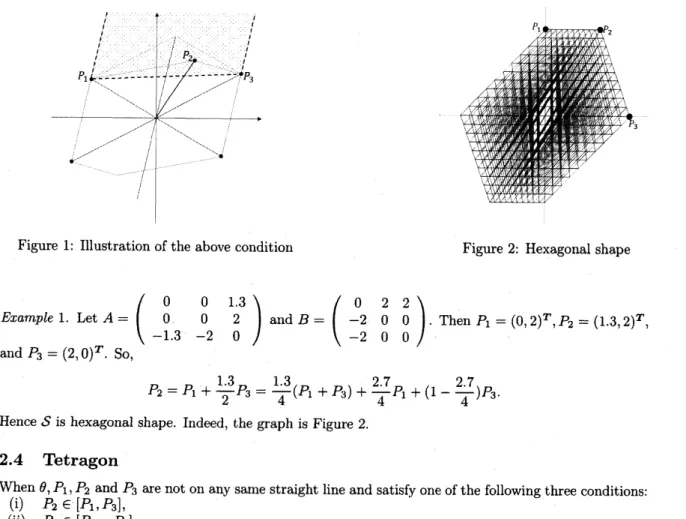
the hexagon $P_{1},$$P_{2},$ $P_{3},$$-P_{1},$ $-P_{2},$$-P_{3}$. Therefore,$S$is hexagonalshape. $\square$Figure 1: mustrationof the above condition Figure2: Hexagonalshape
Example 1. Let$A=(\begin{array}{lll}0 0 1.30 0 2-l.3 -2 0\end{array})$ and $B=(\begin{array}{lll}0 2 2-2 0 0-2 0 0\end{array})$. Then $P_{1}=(0,2)^{T},$ $P_{2}=(1.3,2)^{T},$
and$P_{3}=(2,0)^{T}$
.
So,$P_{2}=P_{1}+ \frac{1.3}{2}P_{3}=\frac{1.3}{4}(P_{1}+P_{3})+\frac{2.7}{4}\mathcal{P}_{1}+(1-\frac{2.7}{4})P_{3}.$
Hence$S$is hexagonal shape. Indeed, the graph isFigure2,
2.4
Tetragon
When$\theta,$$P_{1},$$P_{2}$ and$P_{3}$
are
noton any same straight line andsatisfyone
ofthe followingthreeconditions:
(i) $P_{2}\in[P_{1}, P_{3}],$
$(ii\rangle$ $P_{3}\in[P_{2}, -P_{1}],$
(iii) $P_{1}\in[P_{2}, -P_{3}].$
Then$S$ is square.
Proof.
Wecan
consider Tetragonas
aspecialcase
ofhexagonal shape. Bysimilarargument, wesee
that$S$issquare.
$\square$
Example 2. Let $A=(\begin{array}{lll}0 0 0.50 0 2-0.5 -2 0\end{array})$ and $B=(\begin{array}{lll}0 2 l.5-2 0 0-1.5 0 0\end{array})$. Then $P_{1}=(0,2\rangle^{T},$$P_{2}=$
$(0.5,1.5)^{T},$ $ar\iota dP_{3}=(2,0\rangle^{T}$. So,
$P_{2}= \frac{3}{4}P_{1}+\frac{1}{4}P_{3}$, i.e., $P_{2}\in[P_{1}, P_{3}].$
Figure3: Illustrationof condition (ii) Figure 4: Tetragon
2.5
Envelope
When$\theta,$$P_{1},$$P_{2}$and$P_{3}$
are
noton
anysame
straightline and satisfyone
$oi$the followingthree conditions:(i) $P_{2}\in$
co
$\{P_{1}, P_{3)}\theta, (1-\lambda)(-P_{3}), \lambda(-P_{1})+(1-\lambda)(-P_{2})\}$forsome
$\lambda\in[0,1],$(ii) $-P_{1}\in$
co
$\{P_{3}, -P_{2}, \theta, (1-\lambda)P_{2}, \lambda(-P_{3})+(1-\lambda)P_{1}\}$forsome
$\lambda\in[0,1]$,or
(iii) $-P_{3}\in$
co
$\{-P_{2}, P_{1}, \theta, (1-\lambda)(-P_{1}), \lambda P_{2}+(1-\lambda)P_{3})\}$ forsome
$\lambda\in[0,1].$Then$S$ has envelope.
Proof.
Assume that (i) are satisfied. Let $\overline{S}$be the union of six triangles consisting ofco$\{\theta, P_{1}, P_{2}\},$
co$\{-P_{1}, \theta, P_{3}\}$, co$\{-P_{2}, -P_{3}, \theta\}$, co$\{\theta, -P_{1}, -P_{2}\}$, co$\{P_{1}, \theta, -P_{3}\}$, and co$\{P_{2}, P_{3}, \theta\}$
.
Then $\overline{S}\subset S\subset$co$\{\pm P_{i}, i=1,2,3\}$
.
Ifwe
focus sub-matrices $(\begin{array}{ll}a_{1} a_{2}0 a_{3}\end{array})$ and $(\begin{array}{ll}b_{1} b_{2}0 b_{3}\end{array})$, wesee
that $S$ hasan
envelopecurvein the intersection of twotriangles co$\{\theta, P_{1}, P_{3}\}$ andco$\{P_{1}, P_{2}, P_{3}\}$;
see
[6]. Then$S$hasenvelopecurves. $\square$
$1|\prime 4.-|$
$-\psi_{1}$
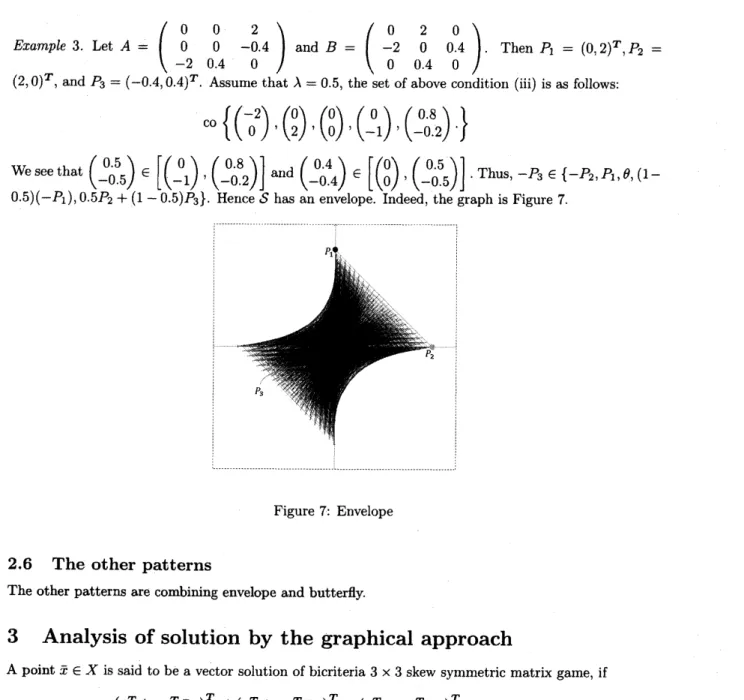
Example 3. Let $A=(\begin{array}{lll}0 0 20 0 -0.4-2 0.4 0\end{array})$ and $B=(\begin{array}{lll}0 2 0-2 0 0.40 0.4 0\end{array})$
.
Then $P_{1}=(0,2)^{T},$$P_{2}=$ $(2,0)^{T}$, and$P_{3}=(-0.4,0.4)^{T}$.
Assume that $\lambda=0.5$, the set ofabove condition (iii) is asfollows:co
$\{(\begin{array}{l}-20\end{array}),$$(\begin{array}{l}02\end{array})$ $(\begin{array}{l}00\end{array})$ $(\begin{array}{l}0-1\end{array})$ $(\begin{array}{l}0.8-0.2\end{array})\cdot\}$We
see
that $(\begin{array}{l}0.5-0.5\end{array})\in[(\begin{array}{l}0-1\end{array}),$ $(\begin{array}{l}0.8-0.2\end{array})]$ and $(\begin{array}{l}0.4-0.4\end{array})\in[(\begin{array}{l}00\end{array}),$ $(\begin{array}{l}0.5-0.5\end{array})]$.
Thus, $-P_{3}\in\{-P_{2},P_{1},$$\theta,$$(1-$ $0.6)(-P_{1}),$$0.5P_{2}+(1-0.5)P_{3}\}$.
Hence$S$ hasan
envelope. Indeed, thegraphis Figure7,Figure 7: Envelope
2.6
The other patterns
The otherpatterns
are
combiningenvelopeand butterfly.3
Analysis
of solution by
the
graphical approach
A point$\overline{x}\in X$is said to be avector solution of bicriteria$3\cross 3$skewsymmetric matrixgame,
if $(\overline{x}^{T}Ax,\overline{x}^{T}Bx)^{T}\not\leq(\overline{x}^{T}A\overline{x},\overline{x}^{T}B\overline{x}\rangle^{T}\not\leq(x^{T}A\overline{x}, x^{T}B\overline{x})^{T}$ for all
$x\in X,$
i.e.,
$\overline{f}(x, Y)\cap(-\mathbb{R}_{++}^{2}\rangle=\emptyset.$
We seethat $x\in X$ isasolution of bicriteria $3\cross 3$skewsymmetric matrix game, ifome ofthe following
threeconditionsaresatisfied:
(i) $P_{1},$ $P_{2}\not\in(-\mathbb{R}_{++}^{2}\}$;
(ii) $-P_{1},P_{3}\not\in(-\mathbb{R}_{++}^{2})$; and
(iii) $-P_{2},$$P_{3}\not\in(-\mathbb{R}_{++}^{2})$
.
Proof.
Assume (i) issatisfied. Then at least oneofthe followingthreeconditionsare
held:(a) the triangle co$\{\theta, P_{1}, P_{2}\}\cap(-\mathbb{R}_{++}^{2})=\emptyset$;
(b) the triangleco$\{\theta, -P_{1}, P_{3}\}\cap(-\mathbb{R}_{++}^{2})=\emptyset$; and
If (a) is held, for $x=(1,0,0)^{T},$ $f(x, Y)\cap(-\mathbb{R}_{++}^{2})=\emptyset$
.
If (b) or (c) is held, for $x=(0,1,0)^{T}$or
$x=(0,0,1)^{T},$ $f(x, Y)\cap(-\mathbb{R}_{++}^{2})=\emptyset$.
When (u) or (iii)are
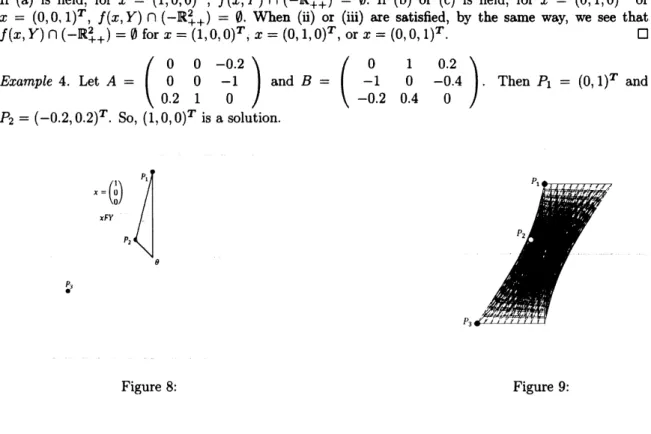
satisfied, by the same way, we see that $f(x, Y)\cap(-\mathbb{R}_{++}^{2})=\emptyset forx=(1,0,0)^{T},$$x=(0,1,0)^{T}$, or$x=(O, 0,1)^{T}.$ $\square$Example 4. Let $A=(\begin{array}{lll}0 0 -0.20 0 -l0.2 l 0\end{array})$ and $B=(\begin{array}{lll}0 l 0.2-1 0 -0.4-0.2 0.4 0\end{array})$. Then $P_{1}=(0,1)^{T}$ and
$P_{2}=(-0.2,0.2)^{T}$
.
So, $(1,0, 0)^{T}$ isasolution.$\rho_{3}$
Figure8: Figure9:
References
[1] T. Tanaka, Some Minimax Problems of Vector-Valued Functions, Joumal
of
optimization Theoryand Applications, vol.59, pp.505-524, 1988.
[2] T. Tanaka, Vector-Valued Minimax Theorems in Multi-Criteria Games, New Frontiers
of
DecisionMaking
for
theInformation
Technology Era,World Scientific, pp.75-99, 2000.[3] M. Higuchi and T. Tanaka, Classification ofMatrices by Means of Envelops for Bicriteria Matrix
Games, International Joumal Mathematics, Game Theory, and Algebra, Nova Science Publishers,
New York, vol.12,pp.371-378, 2002.
[4] M. Higuchi and T. Tanaka, On Minimax and Maximin Values in Multi-Criteria Games,
Multi-Objective Programming and Goal-Programming: Theory andApplications, Springer-Verlag, Berlin,
pp.141-146, 2003.
[5] J. M. Hong, M. H. Kim and G. M. Lee, On Linear Vector Program and Vector Matrix Game
Equivalence, Optim\’ization Letters, vol.6, pp.231-240, 2012.
[6] M. Higuchi, K. Kimura, and T. Tanaka, ClassificationofMatrices for hicriteriaTwo-Person
Zero-Sum Matrix Game, RIMSKokyuroku vol.1821, pp.206-213, 2013.
Kenji Kimura
Education Center
Niigata Institute of Technology
Kashiwazaki 945-1195
Japan
Tamaki Tanaka
Graduate School ofScience andTechnology Niigata University
Niigata 950-2181
Japan
$E$-mail: [email protected]
Moon-Hee Kim Scho$o1$of$\mathbb{R}ee$ Majors Tongmyong University Busan608-711
Republic of Korea
$E$-mail: mooniQtu.ac.kr
Gue Myung Lee
Department of AppliedMathematics
CollegeofNaturalSciences Pukyong National University
Busan 608-737
Republic ofKorea