72
Optimal
$\mathrm{T}\mathrm{e}\mathrm{s}\mathrm{t}\mathrm{i}\mathrm{n}\mathrm{g}/\mathrm{M}\mathrm{a}\mathrm{i}\mathrm{n}\mathrm{t}\mathrm{e}\mathrm{n}\mathrm{a}\mathrm{n}\mathrm{c}\mathrm{e}$Design
in
a
Software
Development Project
林坂弘一郎, 土肥正
Koichiro Rinsaka and Tadashi
Dohi
Department
of
Information
Engineering,
Graduate
School
of Engineering,
Hiroshima
University, Japan
1
Introduction
It is important to determine the optimal time when softwaretesting should be stopped and when the
systemshouldbe deliveredto
a user or
amarket. This problem, called optimalsoftware
releaseproblem, plays a central role for the success orfailure ofa software development project. Okumoto and Goel [1]assumed thatthe numberofsoftware faults detected inthe testingphase is describedby
an
exponentialsoftware reliability model based on a non-homogeneous Poisson process (NHPP) [2], and derived
an
optimal software release timewhich minimizes the total expected software cost. Koch and Kubat [3]
considered the similar problem for theother softwarereliabilitymodel by Jelinski and Moranda [4]. Bai
and Yun [5] calculated the optimal number of faults detected before the release under the Jelinski and
Moranda model. Many authors formulated the optimal software release problems based
on
differentmodel assumptions $\mathrm{a}\mathrm{n}\mathrm{d}/\mathrm{o}\mathrm{r}$several softwarereliability models $[6, 7]$.
It is difficult to detect and
remove
allfaultsremainingina
softwareduringthetesting phase, becauseexhaustivetestingofallexecutable paths in
a
generalprogram isimpossible. Once the software is releasedtousers, howeverthesoftwarefailures may
occur even
in the operational phase. It iscommon
for softwaredevelopers to provide maintenance service during the period when they
are
still responsible for fixingsoftware faults causing failures. In order to carry out the maintenance in the operational phase, the
softwaredeveloper hasto keep
a
software maintenance team. At thesame
time, the management costin the operational phase should be reduced
as
muchas
possible, but the humanresources
should be utilized effectively. Although the problem which determinesthe maintenanceperiod is importantfromthe practical point ofview, only
a
veryfew authors paid theirattention tothis problem.Kimura et al. [8] considered the optimal software release problem in the
case
where the softwarewarranty period is a random variable. Pham and Zhang [9] developed
a
software cost model with bothwarranty and risk. Theyfocused
on
theproblemfor determining when tostopthesoftwaretestingundera
warrantycontract. However,it is
noted that the software developer has to design thewarrantycontractitselfandoftenprovidesthe posteriorservice for
users
after softwarefailures. Dohi et $a/$.
[10]formulatedthe problem for determining the optimalsoftwarewarranty periodwhich minimizes the total expected
software cost under theassumption that the debugging process in the testing phase is described by
an
NHPP. Since the user’s operational environment is not always
same as
that assumed in the softwaredevelopment phase, however, the above literature did not take account ofthe difference between two
different phases.
Several reliability assessment methods during the operational phase have been proposed by
some
authors $[11, 12]$
.
In this paper,we
developa
stochastic model for designing the optimal testing andmaintenanceperiods, where thedifferencebetween thesoftwaretesting environmentand the operational
environment
are
reflected. Basedon
the idea in Okamura et al. [12],we
formulate the total expectedsoftware cost incurred for the software developer, and derive analytically the optimal testing period
(release time) which
minimizes
the total expected software cost. Wecall the time length to completethe operational
maintenance
after the releasea
plannedmaintenance limit, and alsoderive the optimalplanned
maintenance
limit whichminimizes
the total expectedsoftware
cost. Throughoutnumerical
examples,
we
calculate numerically the joint optimal policy combined by testing period and plannedmaintenance limit. Finally, the paper is concluded with
some
remarks.2
Model
Description
First,we make the followingassumptions
on
thesoftware fault-detection process:73
(a) In each time whena
software failure occurs, the software fault causing the failure is detected andremoved immediately.
(b) The number of initial faults contained in the software program, $N_{0}$, is given by the Poisson dis
tributedrandom variablewith
mean
$\omega$ $(>0)$.
(c) The time to detect each software fault is independent and identically distributed nonnegative random variable with (absolutely continuous) probability distribution function $F(t)$ and density
function $f(t)$
.
Let $\{N(t), t\geq 0\}$ be the cumulative number of software faults detected up to time $t$. From the above
assumptions, the probability math function of$N(t)$ is given by
$\mathrm{P}\mathrm{r}\{N(t)=m\}=\frac{[\omega F(t)]^{m}e^{-\omega F(t)}}{m!}$ $m=0,1,2$,$\cdots$
.
(1)Hence, the stochastic process $\{N(t), t\geq 0\}$ isequivalent to
an
NHPP withmean
valuefunction$\omega F(t)$,
where the
fault-detection rate
(debugging rate) perunit
oftime
isgivenby$r(t)= \frac{f(t)}{1-F(t)}$
.
(2)Supposethat
a
software testing isstartedattime0and terminated at time$t_{0}(\geq 0)$.
Thetimelengthofsoftware lifecycle $t_{L}(>0)$ isknown in advance andis assumed to be sufficiently larger than$t_{0}$
.
Moreprecisely, thesoftware life cycle is measured from the time$t_{0}$
.
The software developer is responsible tothe maintenance service for all the software failures that mayoccurduring the software life cycle under
a maintenance contract. We suppose that the project manager decides to break up the maintenance
team at time$t_{0}+t_{W}(0\leq t_{W}\leq t_{L})$for reductionof the operational cost tokeep it, but
a
large amountof debugging cost after the planned maintenance limit if the software failure occurs may be needed. Further,we define the following cost components;
$c_{0}(>0)$: cost to
remove
each fault in thetesting phase,$c_{W}(>0)$: cost to
remove
each fault before the planned maintenancelimit, $cL$ $(>0)$: cost toremove
each fault afterthe planned maintenance limit,$k_{0}(>0)$: testingcost per unit oftime,
$kw$ $(>0)$: operationalcost to keepthe maintenance team per unitof time.
In the following section, we formulate the total expected software cost by introducing the above cost
factorsin testing andoperationalphases. We derive the optimalsoftwaretesting period
or
the optimalplanned maintenancelimit which minimizes the total expected software cost atthe endof the software life cycle. Then,
we
calculate the joint optimal policy combined by both testing period and plannedmaintenance limit.
3
Total Expected Software
Cost
We
formulate
the totalexpected software cost whichcan occur
in both testing and operational phases.In theoperationalphase,
we
consider twocost factors;themaintenancecost due tothesoftware failureand theoperationalcost tokeepthe maintenance team.
From Eq.(l), the probability math
function
of the number of software faults detected during thetestingphase isgiven by
$\mathrm{P}\mathrm{r}\{N(t_{0})=m\}=\frac{[\omega F(t_{0})]^{m}e^{-\omega F(t_{0})}}{m!}$
.
(3)
It should benoted thattheoperationalenvironment afterthe releasemay differ fromthe debugging
environment in thetesting phase. Thisdifference is similar to that between the accelerated life testing
environment and the normal operating
environment
for hardware products. Weintroduce the74
andconsider that the timesinthe testing phaseand theoperationalphasehave a proportional
relation-ship. Namely, the time length $t$ in the operational phase correspondsto at in the testing phase. Under
the aboveassumption, $a=1$
means
theequivalence between the testing and operationalenvironments.
On the other hand, $a>1(a<1)\mathrm{i}$mplies that the operational
environment
issevere
(looser) than thetesting environment. Okamura et al. (2001) applythis technique to model the operational phase of the software, and estimate the software reliability through an example inthe actual software development project. The probability math function ofthe number ofsoftware faults detected before the planned
maintenance limit is given by
$\mathrm{P}\mathrm{r}\{N(t_{0}+t_{W})-N(t_{0})= 72\}$$= \frac{\{\omega[F(t_{0}+at_{W})-F(t_{0})]\}^{m}}{m!}e^{-\omega[F\langle t_{0}+at_{W})-F(t_{0})]}$
.
(4)Similarly, the fault-detectionprocessof thesoftwareafter the planned maintenance limit is expressed by
$\mathrm{P}\mathrm{r}\{N(t_{0}+t_{L})-N(t_{0}+t_{W})=m\}$
$=$ $\frac{\{\omega[F(t_{0}+at_{L})-F(t_{0}+at_{W})]\}^{m}}{m!}e^{-w}$[
$F(t_{0}+at\mathrm{D}-F(t0+\mathrm{a}\mathrm{t}\mathrm{w})$
(5)
FromEqs.(3), (4) and (5), the total expected software cost is given by
$\mathrm{C}(\mathrm{t}0, t_{W})$ $=$ $k_{0}t_{0}+$coU)F(to)$+k_{W}t_{W}+c_{W}\omega$[$F$($t_{0}+$atyy) -N(tO)
1$c_{L}\omega[F(t_{0}+at_{L})-F(t_{0}+atw)$
.
(6)4
Determination of the Optimal Policies
In this section we derive the optimal testing period or the optimal planned maintenance limit which minimizes the total expectedsoftwarecost incurred to thesoftwaredeveloper at the end of software life cycle. Suppose that the time to detect each software fault obeys the exponential distribution [2] with
mean
$1/\lambda$ $(>0)$.
Inthiscase, the total expected softwarecost in Eq.(6) becomes$C(t_{0},t_{W})$ $=$ $\mathrm{k}\mathrm{o}\mathrm{t}0+c_{0}\omega(1-e^{-\lambda t_{0}})$ $+kwtw$
$+c_{W}\omega e^{-\lambda t_{0}}(1-e^{-\lambda at_{W}})+c_{L}\omega e^{-\lambda t_{\mathrm{O}}}(e^{-\lambda at_{W}}-e^{-\lambda at_{L}})$
.
(7)Wemake thefollowing assumptions:
(A-I) $c_{L}>c_{W}>c_{0}$,
(A-II) $c_{W}(1-e^{-\lambda at_{L}})>c_{0}$,
(A-III) $c_{W}(1-e^{-\lambda at_{W}})+c_{L}(e^{-\lambda at_{W}}-e^{-\lambda at_{L}})>c_{0}$
.
Define
$Q(t_{W})=k_{0}+\omega\lambda[c_{0}-c_{W}(1-e^{-\lambda at_{W}})-c_{L}(e^{-\lambda at_{W}}-e^{-\lambda at_{L}})]$
.
(8)Then the following result provides the optimal software testing policy which minimizes the total expected
software cost.
Theorem 1: When the
software fault-detection
time distributionfollows
the exponential distributionwith
mean
$1/\lambda$, under theassumptions (A-I) to (A-III), the optimalsoftware
testingperiod (release time)which minimizes the total expected
software
costis givenas
follows:
(1)
If
$Q(t_{W})<0,$ then there eistsa
finite
and unique optimal $sof$ tware testing period (release time) $t_{0}^{*}(>0)$, and its associated expected cost is given by$C(t_{0}^{*},t_{W})$ $=$ $\mathrm{k}\mathrm{o}\mathrm{t}0+c_{0}\omega(1-e^{-\lambda t_{\mathrm{O}}^{*}}$
)
$1$kwtw$+cw\omega e^{-\lambda}t$
;
$(1-e^{-\lambda at_{W}})+$$c_{L}$
$\mathrm{i}e^{-\lambda t_{\dot{0}}}$
(
$e^{-\lambda a}$t$W_{-e^{-\lambda at}}L$)
\dagger (9)(2)
If
$Q(tw)\geq 0$,
then the optimalpolicy is$t_{0}^{*}=0$ with75
Proof: Forthe total expected cost in Eq.(7),we have$5(0, t_{W})=kwtw$ $+c\iota V\omega$$(1-e^{-\lambda t_{W}})+c_{L}w$ $(e^{-\lambda at_{W}}-e^{-\lambda at_{L}})$ (11)
and
linl $\mathrm{C}$(tO$\mathrm{i}t_{W}$) $=+\mathrm{o}\mathrm{o}$. (12)
$t_{0}arrow+\infty$
Differentiating$C(t_{0}, t_{W})$ with respectto $t_{0}$ yields
$\frac{\partial C(t_{0},t_{W})}{\partial t_{0}}$ $=$ $k_{0}+c_{0}\omega\lambda e^{-\lambda t_{0}}-c_{W}ci\lambda e^{-\lambda}t0(1-e^{-}\lambda at_{1\mathrm{y}})$
$-c_{L}\omega\lambda e^{-\lambda t_{0}}$ $(e^{-\lambda at_{W}}-e^{-\lambda at_{L}})$
.
(13)Let $\delta(t_{0}, tw)$ denote the right-hand-side ofEq.(13). Then it is seenthat
$5(0, t_{W})=k_{0}+\omega\lambda[c_{0}-c_{W}(1-e^{-\lambda at_{W}})-cl (e^{-\lambda at_{W}}-e^{-\lambda at_{L}})]$ (14)
and
$\lim$ $\delta(t_{0}, t_{W})=k_{0}$
.
(15)$t_{0}arrow+\infty$
By taking the differentiation of Eq.(13) with respect to $t_{0}$, we get
$\frac{\partial\delta(t_{0},t_{W})}{\partial t_{0}}=\omega$A$2-e\lambda t_{\mathrm{O}}[-c_{0}+c_{W}(1-e^{-\lambda at_{W}})1c_{L}(e^{-\lambda at_{W}}-e^{-\lambda at_{L}})]$ (16)
Letting$\gamma(t_{0}, t_{W})$ denotethe right-hand-side ofEq.(16),
we
obtain$\mathrm{C}\{0,\mathrm{t}\mathrm{w}$) $=$$\omega$)
$\mathrm{S}^{2}$
$[-c_{0}+c_{W}(1-e^{-\lambda at_{W}})1 c_{L}(e^{-\lambda at_{W}}-e^{-\lambda at_{L}})]$
.
(17)Further, let $A(tw)$ denote the right-hand-sideofEq.(17). Then conditions $A(0)>0$ and $A(t_{L})>0$
are
reduced to
$c_{L}(1-e^{-\lambda at_{L}})>c_{0}$ (18)
and
$c_{W}(1-e^{-\lambda at_{L}})>c_{0}$, (19)
respectively. Since$c_{L}>c_{W}$ from assumption (A-I),
we can
show that $A(0)>A(t_{L})$ and$\frac{\partial A(t_{W})}{\partial t_{W}}=-(c_{L} -c_{W})\omega\lambda^{3}ae^{-\lambda at_{W}}<0.$ (20)
Hence,
we
have $7(0, t_{W})>0.$ Since$\lim$ $\mathrm{C}(\mathrm{t}0,\mathrm{t}\mathrm{w})=0$, (21)
$t_{0}arrow+\infty$
we can
prove that$\partial\gamma(t_{0}, t_{W})/\partial t_{0}<0,$ say,$c_{W}(1-e^{-\lambda at_{W}})+c_{L}(e^{-\lambda at_{W}}-e^{-\lambda at_{L}})>$ $(${$)$
.
(22)The proofiscompleted. Q.E.D.
Furthermore, the following result provides the optimal planned maintenance limit which minimizes
the total expectedsoftware cost.
Theorem 2: hen the$sof$ tware
fault-detection
time distributionfollows
the exponential distributionwith
mean
$1/\lambda$, underthe assumption (A-I), the optimal planned maintenance limit which minimizes thetotal expected
software
costis givenas
follows:
(1)
If
$k_{W}\geq(c_{L}-cw)\omega\lambda ae^{-\lambda t_{0}}$, then the optimalpolicy is$t_{W}^{*}=0$ with$C(t_{0},t_{W}^{*})=$koto $+c_{0}\omega(1-e^{-\lambda t_{0}})+c_{W}\omega\lceil e^{-\lambda t_{0}}-e^{-}\lambda(t\mathrm{g}$$1\mathrm{a}t_{L}1$ (23)
and
A
$1!.\mathrm{m}$
.
$\delta(t_{0}, t_{W})=k0$.
(15)$t_{0}arrow+\infty$
By taking the differentiation of Eq.(13) with respect to $t_{0}$, we get
$\frac{\partial\delta(t_{0},t_{W})}{\partial t_{0}}=\omega\lambda^{2}e^{-\lambda t_{\mathrm{O}}}[-c_{0}+c_{W}(1-e^{-\lambda at_{W}})+c_{L}(e^{-\lambda at_{W}}-e^{-\lambda at_{L}})]$ (16)
Letting$\gamma(t0, tw)$ denotethe right-hand-side ofEq.(16),
we
obtain$\gamma(0,t_{W})=\omega\lambda^{2}[-c_{0}+cw(1-e^{-\lambda at_{W}})+c_{L}(e^{-\lambda at_{W}}-e^{-\lambda at_{L}})]$
.
(17)Further, let $A(tw)$ denote the right-hand-sideofEq.(17). Then conditions $A(0)>0$ and $A(tL)>0$
are
reduced to
$c_{L}(1-e^{-\lambda at_{L}})>c_{0}$ (18)
and
$c_{W}(1-e^{-\lambda at_{L}})>c_{0}$, (19)
respectively. Since$c_{L}>cw$ from assumption (A-I),
we can
show that $A(0)>A(tL)$ and$\frac{\partial A(t_{W})}{\partial t_{W}}=-(c_{L}-c_{W})\omega\lambda^{3}ae^{-\lambda at_{W}}<0.$ (20)
Hence,
we
have $\gamma(0, t_{W})>0.$ Since$\lim$ $\gamma(t_{0},t_{W})=0,$ (21)
$t_{0}arrow+\infty$
we can
prove that$\partial\gamma(t_{0}, \mathrm{t}\mathrm{w})/\mathrm{d}\mathrm{t}0$$<0,$ say,$cw(1-e^{-\lambda at_{W}})+c_{L}(e^{-\lambda at_{W}}-e^{-\lambda at_{L}})>c_{0}$
.
(22)The proofiscompleted. Q.E.D.
Furthermore, the following result provides the optimal planned maintenance limit which minimizes
the total expectedsoftware cost.
Theorem 2: When the
software fault-detection
time distributionfollows
theexponential
distributionwith
mean
$1/\lambda$, underthe assumption (A-I), the optimal planned maintenance limit which minimizes thetotal
expected
software
costis givenas
follows:
(1)
If
$k_{W}\geq(c_{L}-cw)\omega\lambda ae^{-\lambda t_{0}}$, then the optimalpolicy is$t_{W}^{*}=0$ with78
(2)
If
$k_{W}<(c_{L}-c_{W})\omega\lambda ae^{-\lambda t_{0}}$ and$k_{W}>(c_{L}-c_{\mathfrak{l}V})\omega\lambda ae_{l}^{-\lambda(t_{0}+at_{L})}$then thereexists auniqueoptimalplanned maintenance limit$t_{W}^{*}(0<t_{W}<t_{L})$ which minimizes the total expected
software
cost with$C(t_{0}, t_{W}^{*})$ $=$ $ht\mathit{0}+c_{0}\omega(1-e^{-\lambda t_{0}})+k_{W}t_{W}^{*}+c_{W}\omega\lfloor e^{-\lambda t_{0}}-e^{-\lambda(t_{0}+at_{W}}$
.
)$\rfloor$$$c_{W}\omega\lceil_{e^{-\lambda a(t_{0}+t_{W}^{*})}}-e^{-\lambda a(t_{\mathrm{O}}+t_{L})\rceil}$ . (24)
(3)
If
$k_{W}\leq(c_{L}-c_{W})\omega\lambda ae^{-\lambda(t_{0}+at_{L}\rangle}$, thenwe
have $t_{W}^{*}=t_{L}$ with$C(t_{0},t_{W}^{*})=k_{0}t_{0}+c_{0}\omega(1-e^{-\lambda t_{0}})+kwtL$$+c_{W}\omega|e^{-\lambda t_{0}}-e^{-\lambda(}t\mathit{0}+a\mathrm{C}_{L})$
The proof of Theorem 2 is similar to that of Theorem 1, and is omitted
for
brevity.Remark 3: The algorithm for finding the joint optimal policy combined by both the testing period
andthe plannedmaintenance limit is
as
follows:Algorithm
Step 1 Ifthere exists
a
solution $(t_{0}, t_{w})(t_{0}\geq 0,0\leq t_{W}\leq t_{L})$ whichsatisfiesthe following first orderconditionof optimality, thengoto Step 2, otherwise, go to Step3.
$\frac{\partial C(t_{0},t_{W})}{\partial t_{0}}=\frac{\partial C(t_{0},t_{W})}{\partial t_{W}}=0$
.
(26)Step 2 Define the Hessian
matrix
$H(t_{0}, t_{W})$:
$H(t_{0},t_{W})= \frac{\partial^{2}C(t_{0},t_{W})}{\partial t_{0}^{2}}\frac{\partial^{2}C(t_{0},t_{W})}{\partial t_{W}^{2}}-(\frac{\partial^{2}C(t_{0},t_{W})}{\partial t_{0}\partial t_{W}})^{\overline{4}}$ (27)
If$H(t_{0}, t_{W})>0$ and $\partial^{2}C(t_{0},t_{W})/\partial t_{0}^{2}>0,$ thenthe solution $(t_{0}, t_{W})$ found in Step 1 is regarded
as
thejoint optimal policy,otherwise,go
to Step3.
Step 3 Find $t_{W}^{*}(0\leq t_{W}^{*}\leq t_{L})$ by solving$\partial C(0, t_{W})/\partial t_{W}=0.$ Let $C_{1}(t_{0}^{*}, \mathrm{t}\mathrm{w})=C(0,t_{W}^{*})$
.
Step 4 Find $t_{0}^{*}(0\leq t_{0}^{*}<\infty)$ by solving$\partial C(t_{0},0)/\partial t_{0}=0.$ Let $C_{2}(t_{0}^{*}, t_{W}^{*})=C(t_{0}^{*}, 0)$
.
Step 5 Find $t_{0}^{*}(0\leq t_{0}^{*}<\infty)$ by solving$\partial C(t_{0},t_{L})/\partial t_{0}=0.$ Let $C_{3}(t_{0}^{*},t_{W}^{*})=$ (to,$\mathrm{t}\mathrm{w}$).
Step 6 The minimumtotal expectedsoftware cost is$C(t_{0}^{*}, t_{W}^{*})$ $= \min C_{i}(t_{0}^{*}, t_{W}^{*})$ and the
correspond-$i=1,2,3$
ing pair $(t_{0}^{*}, t_{W}^{*})$is the joint optimal policy.
5
Numerical
Examples
Based
on
86 software fault data observedin the realsoftwaretestingprocess[13],we
calculatenumericallythe optimal testing period $t_{0}^{*}$ and the optimal planned maintenancelimit $t_{W}^{*}$ which minimize the total
expected software cost. Further,
we
compute thejoint optimal policy $(t_{0}^{**},t_{W}^{**})$ minimizing $C(t_{0}, t_{W})$.
For thesoftware fault-detection time distribution,
we
applythree distributions; exponential [2],gammaof order 2 [14]and Rayleigh [15] distributions. The probability distribution functions forgammaof order 2 and Rayleigh
are
given by$F(t)=1-(1+At)e$$-\lambda t$
(28)
and
$F(t)=1- \exp\{-\frac{t^{2}}{2\theta^{2}}\}$
,
(29)respectively. For the
gamma
distributioninEq.(28),thetotal expected software cost in Eq.(6) becomes$C(t_{0}, t_{W})$ $=$ $\mathrm{h}\mathrm{t}0+c_{0}\omega[1-(1+\lambda t_{0})e^{-\lambda t_{0}}]$ $+kwtw$
77
$\check{\approx}$
$t$
Figure 1: The actual software failure data and the behaviorof estimated
mean
valuefunctions.$+$CLCJ$\{[1+\lambda(t_{0}+at_{W})]e^{-\lambda(t_{0}+at_{W}\rangle}-[1+\lambda(t_{0}+at_{L})]e^{-\lambda(t_{0}+at_{L})}\}$
.
(30)For the Rayleigh distribution, it becomes
$\mathrm{C}(70, t_{W})$ $=$ $k_{0}t_{0}+c_{0} \omega[1-\exp\{-\frac{t_{0}^{2}}{2\theta^{2}}\}]+k_{W}t_{W}$
$+c_{W}\omega$
$+c_{L}\omega\{$
$[\exp\{-$$\mathrm{z}$$\}-\exp\{-\frac{(t_{0}+at_{W})^{2}}{2\theta^{2}}\}]$
$\exp\{-\frac{(t_{0}+at_{W})^{2}}{2\theta^{2}}\}-\exp\{-\frac{(t_{0}+at_{L})^{2}}{2\theta^{2}}\}]$ ‘ (31)
Supposethattheunknown parameters inthe software reliability models
are
estimated by the methodof maximumlikelihood,when70 faultdata
are
obtained,namely$t=$67.374.
Then,we have theestimates$(\hat{\omega},\hat{\lambda})$
$=$ (98.5188, 1.84e-02) for the exponential model, $(\hat{\omega},\hat{\lambda})$
$=$ (75.1746, 6.46224e-02) for thegamma
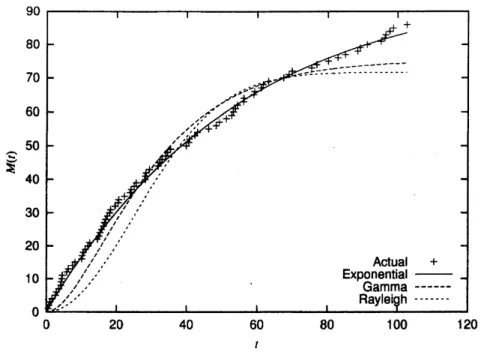
model and $(\hat{\omega},\hat{\theta})=$ $(71.6386, 2.45108\mathrm{e}+01)$ for the Rayleigh model. Figure 1 shows the actual software
fault data and the behavior of estimated
mean
value functions. For the other model parameters,we
assume:
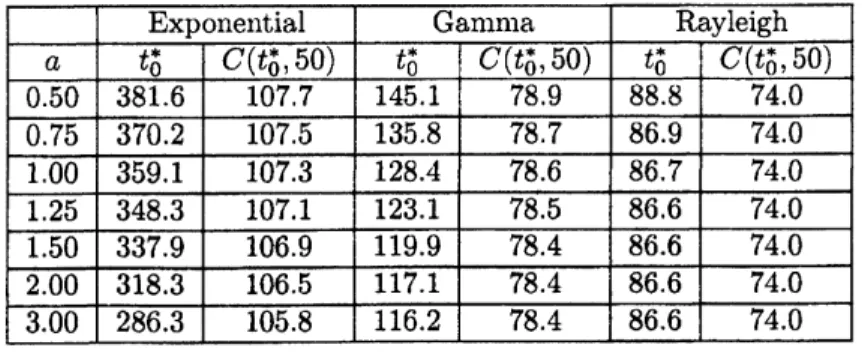
kg $=0.02$, $k_{W}=0.01$,$c_{0}=1.0$, $c_{W}=2.0$, $c_{L}=20.0$ and$t_{L}=$1000.Ihble 1 presentsthe dependence of the environment factor $a$
on
the optimal testing period$t_{0}^{*}$ when$t_{W}=50.$ As the environmentfactormonotonically increases, $i.e.$,the operationalcircumstancetends to
be severe, it is observed that the optimal testing period $t$
;
and itsassociatedminimum
total expectedsoftware cost $C(t_{0}^{*}, 50)$ decrease for both exponential and gamma models. For the Rayleigh model, it
is observed thatthe optimal testing periodis hardlyinfluenced byvarying environment factor. Thisis
becausethe goodnessof-fit of theRayleigh model is quite low.
Table2shows thedependence oftheenvironmentfactor$a$
on
the optimal planned maintenance limit$t\mathrm{i}$ in
case
of$t_{0}=70.$ It is found that the optimal plannedmaintenance
limit $t_{W}^{*}$ and thecorrespond-ing minimum total expected software cost $C(70, t_{W}^{*})$ decrease
as
theenvironment factor monotonicallyincreases. Thistendency
can
be explainedas
follows: The residual faults insoftware are
detected andremoved at the early stage in the operational phaseasthe operationalenvironmentbecomes
more severe.
Then, the possibility that thesoftware failure
occurs
in the latter stageofthe operational phasebecomessmall. Hence, the implication in which the software developer keeps the
maintenance
team becomessmaller toward the end of the life cycle.
Table 3 examines the dependence of the environment factor $a$
on
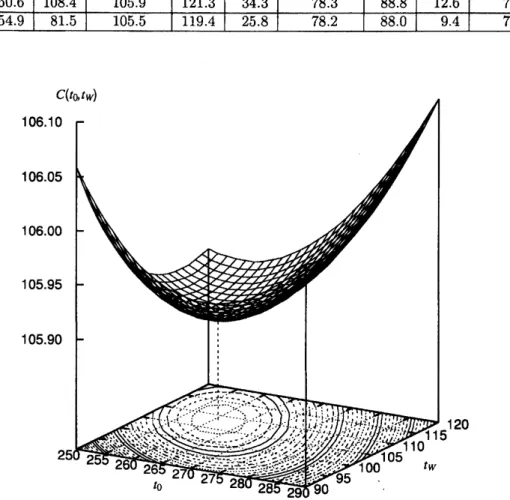
the joint optimal policy $(t_{0}^{*},t_{W}^{*})$combined by testing period and planned maintenance limit. Figure 2 illustrates the behavior of the
78
Table 1: Optimaltesting period for varyingenvironment factor. Exponelltial Gamma $\mathrm{R}^{1}$,ayleigh
$a$ $t_{0}^{*}$ $C(t_{0}^{*}, 50)$ $t_{0}^{*}$ $-C\overline{(}^{-}t_{0}^{*}$,$5\overline{0})^{-}$ $t_{0}^{*}$ $\overline{C(t}_{0}^{*}-$,50)
0.50 381.6
107.7
145.1 78.9 88.8 74.00.75
370.2
107.5
135.8 $78.7^{-}$ 86.9 74.01.00
359.1
107.3
128.478.6-
86.7
74.0
1.25 348.3107.
1 123.178.5
86.674.0
1.50337.9
106.9
119.9 78.4 86.674.0
2.00 318.3106.5
117.1 86.6 74.03.00
286.3
105.8
116.278.4
86.6 74.0Table 2: Optimal planned maintenance limit for varying environment factor. $\overline{\mathrm{E}}\mathrm{x}\mathrm{p}\mathrm{o}\mathrm{n}\mathrm{e}\mathrm{n}\mathrm{t}\mathrm{i}\mathrm{a}\mathrm{l}$ Gamma $\mathrm{R}_{-}*\cdot$$\mathrm{a}^{1}\mathrm{y}1\mathrm{e}\mathrm{i}\mathrm{g}\mathrm{h}$
$a$ $t_{W}^{*}$ $C(70, t_{W}^{*})$ $t_{W}^{*}$ $C(70, t_{W}^{*})$ $t_{W}^{*}$ $C(70, t_{W}^{*})$
0.50
664.0-
134.8
193.0
83.3 111.9 82.8 0.75472.1
132.5
137.9
$8_{-}2.7$77.8
82.41.00
369.7
131.3108.3
82.4
60.0
82.2
1.25305.5
130.6
89.6 $82.\overline{1}^{-}$ $\overline{4}9.0$ 1.50 261.2 130.176.8
82.041.5
82.0
2.00 203.7 129.4 60.0 81.8 32.0 81.9 3.00 143.4128.7
42.3 81.6 22.0 81.8testing period $t_{0}^{*}$ decreases as the environment factor monotonically increases, but, the monotonicity of the optimal planned maintenance limit $t_{W}^{*}$ is not observed. It is also
seen
that the minimum totalexpectedsoftware cost $C(t_{0}^{*}, t_{W}^{*})$ decreases
as
theenvironment
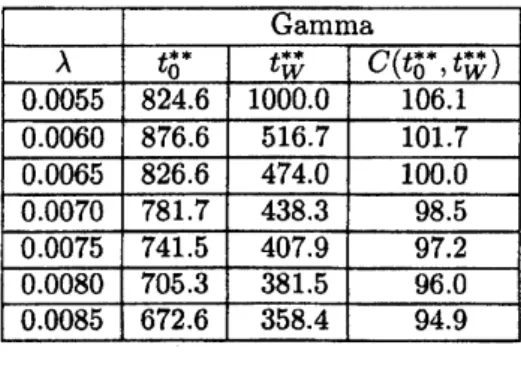
factor monotonically increases.Tables4, 5 and 6 present the dependence of thesoftware reliability model parameter A
or
$\theta$ on thejoint optimalpolicy$(t_{0}^{*}, t_{W}^{*})$
.
Except forA$=$0.0055
in thegammamodel, it isobserved thattheoptimaltesting time, optimal planned maintenance limit and its associated minimumtotalexpectedsoftware cost
decrease
as
the fault detection becomes easier.6
Concluding
Remarks
In this paper,
we
have assumedthat the software developerwas
responsible tothe maintenance servicefor all thesoftware failuresthat
occur
duringthe software life cycle underthe maintenancecontract. In order to carry out the maintenance service in the operational phase, the software developer hasto keepa
software maintenance team. At thesame
time, the management cost inthe operational phase has to be reducedas
muchas possible, but humanresources
should be utilized effectively. We have called the time length to completethe operational maintenance after the release the planned maintenance limit, and have controlled it in termsofcost-benefit analysis. We have developed the modelwhich considersthe difference in the software execution environment during testing and operational phases using the
same
methodas
the reliability assessment modeling in the operational phase proposed byOkamura
et$cd$
.
[12]. Basedon
NHPPwe
haveformulated the totalexpected software cost incurred to the softwaredeveloper until the end of
software
life cycle. The optimal testing period (release time) and optimalplanned maintenance limit which minimize the total expected
software cost
have been derived. Then,throughout the numerical examples,
we
have discussed the joint optimal policy combined by testing$7\theta$
Table 3: Joint optimal policyfor varying environment factor.
Exponential Gamma Rayleigh
a $0**$ $t_{1}^{**}$ $C(\mathrm{o}t_{W}^{**}**,)$ $0**$ ; $C(t_{0}^{**}t_{W}^{**})-,-$ $t_{0}^{**}$ $t_{W}^{**}$ $C(t_{0}^{*},t^{**})$ $0.50$ 405.0 0.0 107.7 167.4 0.0 78.9 106.3 0.0 73.9
0.75
304.6 159.2 107.3 13 .6 50.478.7
94.5 18.473.8
1.00 282.6 157.1-106.8
128.5 49.8 78.691.7
18.3 73.8 1.25 272.7 143.3 106.5 125.2 45. 78. 90.4 16.7 73.7 1.50 267.0 129.8 106.2 123.4 41.2 78.4 89. 15.1 73.7 2.00 260.6 108.4 105.9 121.3 34.3 78.3 88.8 12.6 73.7 3.00 254.9 81.5 105. 119.4 25.8 78.2 88.0 9.4 73.6Figure 2: Behavior of the total expected software costwhen$a=$ 2.00.
Table 4: Jointoptimal policyfor varyingexponentialsoftwarereliability model parameterA.
$\mathrm{E}\mathrm{x}\mathrm{p}\mathrm{o}\mathrm{n}\mathrm{e}\mathrm{n}\underline{\mathrm{t}}\mathrm{i}\mathrm{a}\mathrm{l}$ $\lambda$ $t_{0}^{**}$ $t_{W}^{**}$ $C(t_{0}^{**}, t^{**})$
0.005
735.1
533.6-122.6
0.010
440.8
263.7
112.0-0.015 320.9 175.8 108.0 0.020 255.1 131.8 106.0 $0^{-}.025$ 213.0 $\overline{1}05.5$ 104.6 0.030 183.6 87.9103.7
0.035 $16\overline{1}.7$ 75.3 103.180
Table 5: Joint optimal policy for varyinggamma software reliability model parameter A.
Gamma
$\lambda$ $t_{0}^{**}$ $t_{W}^{**}$ $C(t_{0}^{**}, t_{W}^{**})$0.0055
824.6
1000.0
106.1
0.0060 876.6516.7
101.7
0.0065
826.6474.0
100.0 $0^{-}.0070$781.7
438.3 98.50.0075
741.5407.9
97.2 0.0080705.3
381.596.0-0.0085
672.6 358.4 94.9Table
6:
Joint optimal policy for varying Rayleigh software reliability model parameter $\theta$.
$\mathrm{R}\mathrm{a}\mathrm{y}\overline{\mathrm{l}}\mathrm{e}\mathrm{i}\mathrm{g}\mathrm{h}$ $\theta$ $t_{0}^{**}$ $t_{W}^{**}$ $C(t_{0}^{**}, t^{**})$ 22.5 83.5 15.2
73.6
23.085.2
15.673.6
23.5
87.0 16.073.7
24.088.7
16.373.7
24.5 90.416.7
73.7
25.0 92.1 17.1-73.8
25.593.7
17.473.8
References
[1] K.
Okumoto
and
L. Goel, “Optimum releasetime
for software
systemsbased
on
reliabilityand cost
criteria,” J. Sys. Software, vol. 1, pp. 315 -318, 1980.
[2] $\mathrm{A}.\mathrm{L}$
.
Goel and K. Okumoto, “Time-dependent error-detection rate modelfor
software reliability and other performance measures,” IEEETrans. Reliab., vol. R-28,no.
3, pp. 206-211, 1979.[3] $\mathrm{H}.\mathrm{S}$
.
Koch and P. Kubat, “Optimalreleasetimeofcomputer software,” IEEE Trans. Software Eng., vol. SE 9,no.
3, pp. $32\succ 327$,1983.
[4] Z. Jelinski, and $\mathrm{P}.\mathrm{B}$
.
Moranda, “Software reliability research,” Statistical Computer Performance Evaluation, (W. Freiberger ed.), pp. 465484, Academic Press,New York,1972.
[5] $\mathrm{D}.\mathrm{S}$
.
Bai and$\mathrm{W}.\mathrm{Y}$.
Yun, “Optimum number oferrorscorrected before releasingasoftware system,”IEEE Trans. Reliab., vol. R-37 no. 1, pp. 41-44, 1988.
[6] $\mathrm{W}.\mathrm{Y}$
.
Yun and $\mathrm{D}.\mathrm{S}$.
Bai, “Optimum software release policy with random life cycle,” IEEE Trans.Reliab., vol. R-39,
no.
2, pp. 167-170,1990.
[7] T. Dohi, N. Kaio andS. Osaki, “Optimal software releasepolicieswith debuggingtimelag,”Int. J.
Reliab., QualityandSafety Eng., vol. 4,
no.
3, pp. 241-255,1997.
[8] M. Kimura, T. Toyota, and
S.
Yamada, “Economic analysis of software release problems withwarranty cost and reliability requirement,” Reliab, Eng.
&
Sys. Safe., vol. 66,no.
1, pp. 49-55,1999.
[9] H. Pham and X. Zhang, “A softwarecost modelwith warranty and riskcosts,” IEEETrans.
Com-put., vol. 48,
no.
1, pp. 71-75, 1999.[10] T. Dohi, H. Okamura, N. Kaio and
S.
Osaki, “The age-dependent optimal warranty policyandits
application tosoftware maintenance contract,” Proc. 5th$\mathrm{I}\mathrm{n}\mathrm{t}’ 1$ Conf.
on
Probab. Safe. Assess, andMgmt. (S. Kondo and K. Furuta,$\mathrm{e}\mathrm{d}\mathrm{s}.$),vol. 4, pp. 2547-2552, University Academy