
VISCOUS
SHOCK
PROFILES
FOR
2\times 2
SYSTEMS
OF
HYPERBOLIC
CONSERVATION
LAWS
WITH
QUADRATIC
FLUX FUNCTIONS
大阪電気通信大学・工学部 浅倉 史興 (FUMIOKI ASAKURA)
OSAKA ELECTRO-COMMUNICATION UNIV.
国際基督教大学・教養学部 山崎 満 (MITSURU YAMAZAKI)
INTERNATIONAL CHRISTIAN UNIV.
1. INTRODUCTION
The purpose of this paper is to understand the shock
wave
structure of conservationlaws that
come
from the extraction of petroleum.An oil reservoir is a subsurface pool of hydrocarbons contained in porous rock
foririations. If the underground pressure of in the reservoir is sufficient, tlien the oil is
naturally
forced
to the surface and extracted by valves on the well. This is called theprimary recovery and usually about 20% of the oil in a oil reservoir can be extracted.
Over the lifetime ofthe well, the underground pressure will be insufficient to force
the oil to the surface. Secondary
recovew
techniques increase the reservoir pressure byinjecting water and gas (air
or
CO2). Generally 25% to 35% of the oil ina
oil reservoircan
be extracted by primary and secondary recovery together.OilProducer
Water-Alternating-Gas (WAG) Enhanced Oil Recovery: Although the watcr
injection $\}_{1’\ }$ good sweep cfficiericy, 40 to $60^{(}f_{(}/$ of the original oil on-site is left behind
at the end of the injection. The
gas
injection has good displacement eff\’iciency but isan
expensive operation. Hence the injection ofgas
after water followed by water andgas injection
causes
significant redistribution of fluids in the reservoir and will be moreefficient than injection of water
or
gag alone.Because of the gravity, three $I$)
$\}_{1d6}es^{\backslash }$: oil, gas and water
are
separated froriione
another away from the WAG injector and it is only
near
the injector where three phaseflow actually
occurs.
Mathernatical structure of the three phase flows has beeninves-tigated by many authors (for example, Marchesin-Plohr [7], Medeiros [8],
Schaeffer-Shearer [10]$)$ and, in this paper,
we
shall confine ourselves particularly to their shockwave structure.
Stone’s
Model: Ill order to simplify $t1_{1}etfiree- p1_{1R}e$ flow ina
porous medium,we
neglect the gr\‘avity and
assume
that the inedium is homogeneous and the flow isin-compressible and immiscible. Let us denote:
water gas oil
Volume Fractioiis: $S\eta r$ ニ $u$ $s_{G}=v$ $so=1-u-\prime u$
Permeability Functions: んw んG $k_{O}$
Fluid Viscosity: $\mu_{W}$ $\mu_{G}$ $\mu_{O}$
Fluid Velocity: $v_{W}-$ $v_{G}$ $\uparrow)0$
Pressure: $p_{W}$ $p_{G}$ $p_{O}$
The relationship betweenthe flow rate and the pressure gradient isexpresse$(1$ by Darcy’.s
Law
$v_{i}=- \frac{k_{i}}{\mu_{i}}\nabla p_{i}$, $i=W,$$G,$$O$.
It is usually assumed tbat the water and gas permeability functions depend only
on
the water \‘and gas volume fraction
$k_{W}=k_{W}(u)$, $k_{G}=k_{G}(v)$
which is called Stone’s assumption. We finally $a_{\iota}ssume$ that the flow is
one
dimensionaland the capillary pressure is negligible.
By using relative permeability
functions
$f(u)= \frac{k_{W}(u)}{\mu_{l}w}$, $g(v)= \frac{k_{G}(v)}{\mu_{G}}$ $h(u, v)= \frac{k_{O}(u,v)}{\mu_{W}}$
the mass conservation laws
are
expressed in the formWater: $\frac{\partial’u}{\partial t}+\frac{\partial’}{\partial x}[\frac{f(u)}{f(u)+g(v)+h(u,v)}]$ $=$ $0$, (1)
in $\Omega$ :
$0<u+v<1,$
$u,$ $t)>0$ ([7],[8], [10]). These equations constitutea
system ofconservation laws that is discussed in this paper.
Hyperbolicity: We say that the system of equations (1) and (2) is hyperbolic, when
tlie Jacobian matrix of tfie flux function has real eigenvalues $\lambda_{1}(U),$ $\lambda_{2}(U)$ for any $U\in$
$\zeta)$. If, in particular, tfiese eigenvalues
are
distinct: $\lambda_{1}(U)<\lambda_{2}(U)$, the system is calle$(1$strictly hyperbolic at $U$. Corresponding right eigenvectors
are
denoted by $R_{1}(U),$ $R_{2}(U)$respectively. A state $U^{*}\in\Omega$ is called an umbilic point, if $\lambda_{1}(U^{*})=\lambda_{2}(U^{*})$ and
the Jacobian matrix is diagonalizable, hence a scalar matrix. Marchesin, Paes-Leme,
Schaeffer and Shearer have shown in [10].
Theorem 1 (Existence of Umbilic Point) Assume that
$h(u, v)=h(1-u-v)$
and$f(O)=g(O)=h(O)=0,$ $f”(u),$$g”(v),$ $h”(w)>0$
.
Then the systemof
equations (1), (2)is hyperbolic and has a unique urnbilic point in $\zeta l$.
After the change of unknown functions, we may
assume
that $U^{*}=O$ and $F(O)=O$ .$T\}ius$
we
fiave the Taylor expansion of the flux function $F(U)$ near $U=O$:$F(U)=\lambda^{*}U+Q(U)+O(1)|U|^{3}$
where $\lambda^{*}=\lambda_{1}(U^{*})=\lambda_{2}(U^{*})$ and $Q$ : $R^{2}arrow R^{2}$ is a homogeneous quadratic mapping.
After the Galilean change of variables: $xarrow x-\lambda^{*}t$, we observe that the system of
equations (1) and (2) is reduced to
$U_{t}+Q(U)_{x}=O$, $(x_{t}t)\in R\cross R_{+}$,
modulo Iligfier order terrns. By
a
cliange of unknown fuiictions $V=S^{-1}U$ witha
regular constant matrix $S$,
we
havea new
system of equations $V_{f}+P(V)_{x}=0$ with$P(V)=S^{-1}Q(SV)$ . Hence we say that two quadratic mappings $Q_{1}(U)$ and $Q_{2}(U)$
are
equivalent, if there is
a
constant matrix $S\in GL_{2}(R)$ such$Q_{2}(U)=S^{-1}Q_{1}(SU)$ for all $U\in R^{2}$.
Scliaeffer-Shearer
[10] shows that every hyperbolic quadratic mapping $Q(U)$ withan
isolated umbilic point $U=O$ is equivalent to
$Q(U)= \frac{1}{2}(\begin{array}{l}au^{2}+2buv+v^{2}bu^{2}+2u^{r}\{j\end{array})=\frac{1}{2}\nabla C(U)$, (3)
$C(U)= \frac{1}{3}au^{3}+bu^{2}v+uv^{2}$. (4)
wfiere $a$ and $b$
are
two real parameters satisfying $a\neq 1+b^{2}$. For Stone’s model, eitherCase I: $a< \frac{3}{4}b^{2}$ or Case II: $\frac{3}{4}b^{2}<a<1+b^{2}’$
.
A constant characteristic vector field $\Xi={}^{t}(1,$$\xi)$ exists if and only if
$\xi^{3’}+2b\xi^{2}+(a-2)\xi-b=-\Xi^{\perp}\nabla Q(\Xi)\Xi=0$
Three district (real) roots
are
denoted by $\mu_{1},$$\mu_{2},$ $\mu_{3}$ and Mediansare
defined by $\Lambda l_{j}$ :Gomes’ Paper [4] and
our
aim: M. E. S. Gomcs has proved the existence ofviscous
shock profiles for shockwaves
inCase
I by topological metliods and also sliowiian
exarnple of compressive shockwave
without viscous shock profiles. The airn of thispaper is to complete her results by using both topological and analytical methods:
existence ofviscous profiles in
Case
I and II and general condition for non-existence ofviscous profiles. We shall show in this paper only outline of proof and details will be
published in Asakura-Yarnazaki [2].
2.
UNDERCOMPRESSIVE
ANDOVERCOMPRESSIVE
SHOCK
WAVES
Rankine-Hugoniot condition: A jump discontinuity defined by
$U(x, t)=\{\begin{array}{l}U_{L} for x<st,U_{R} for x>st,\end{array}$ (5)
with a real constant $s$, is a piecewise constant weak solution to the the conservation
laws (3), if and only if these quantities satisfy the Ranんine-Hugoniot condition:
$s(U_{R}-U_{L})=Q(U_{R})-Q(U_{L})$. (6)
The weak solution (5) satisfying (6) is often called a shock wave of speed $s$ joining the
state $U_{L}$,
on
the left, to the state $U_{R}$,on
the right.Compressive shock
wave:
The shockwave
is said to be a j-compressive $(j=1,2)$if tfie speed satisfies the Lax entropy conditions:
$\lambda_{j}(U_{R})<6<\lambda_{j}(U_{L}),$ $\lambda_{j-1}(U_{L})<s<\lambda_{j+1}(U_{R})$
Here
we
adopt the convention $\lambda_{0}=-\infty$ and $\lambda_{3}=\infty$.l-compressive $2- com\rho ressive$
Undercompressive shock
wave:
Undercompressive if $\sigma$.
satisfies$\lambda_{1}(U_{R})<_{(6^{\text{・}}}<\lambda_{2}(U_{R}),$ $\lambda_{1}(U_{L})<_{\iota}s<\lambda_{2}(U_{L})$
Undercompressive
$Fi_{b^{111(}’\backslash }3:\iota\dagger_{11t}1Y..Jt.,|\zeta_{)}^{t}$ wi$\iota ve$
Overcompressive shock
wave:
Overcompressive if.$s$ satisfies$\lambda_{1}(U_{R})<s<\lambda_{1}(U_{L}),$ $\lambda_{2}(U_{R})<s<\lambda_{2}(U_{L})$
Overcompressive
Stability and Admissibility of Shock Waves: It is generally believed
$\bullet$ Compressive shock
waves are
generally stable and admissibility is independent ofdiffusion matrices in a generic class.
$\bullet$ Undercompressive shock
waves are
stable with additional (kinetic) $con(lition$ andadmissibility depends
on
diffusion matrices.$\bullet$ Overcompressive shock
waves are
generally unstable.Admissibility is defined in next section.
3.
VISCOUS
SHOCK
PROFILES
Admissibility: The jump discontinuity is said to be admissible if $tIiere$ exists a
travelling
wave
solution $U_{\epsilon}(x, t)= \hat{U}(\frac{x-st}{\epsilon})$ to $tI_{1}e$ parabolic systeni$U_{t}+Q(U)_{x}=\epsilon U_{x}$
丁’
$\epsilon>0$ (7)
satisfyirig $U_{\epsilon}(+\infty, t)=U_{R},$ $U_{\epsilon}(-\infty, t)=U_{L}$. Tlie vector fuiiction $\hat{U}=\hat{U}(\xi)$ is called a
viscous shock $prof\dot{\ddagger}le$.
Differential Equations and Vector Field: By integrating (7), $\hat{U}(\xi)$ satisfies
a
system of nonlinear differential equations
$\frac{d\hat{U}}{d\xi}$
$=$ $-6^{\backslash }(\hat{U}-U_{L})+F(\hat{U})-F(U_{L})$ $=$ $X_{s}(U, U_{L})$
Note that $U_{L}$ is a critical point of $X_{s}(U, U_{L})$ and by Rankine-Hugoniot condition $U_{R}$
is also a critical point. Since the flux functions has
a
potential $C(U)$, by setting$\phi_{s}(U_{L}, U)=C(U)-\nabla C(U_{L})\cdot(U-U_{L})-s|U-U_{L}|^{2}$,
the differential equations turn out to be
$\frac{d\hat{U}}{d\xi}=\frac{1}{2}\nabla\phi_{\theta}(U_{L},\hat{U})$
.
(8)Hence the adinissibility is equivalent to the existence of solution of this equations
satisfying tfie boundary conditions at infinity:
$\lim_{\xiarrow-\infty}\hat{U}(\xi)=U_{L},\lim_{\xiarrow\infty}\hat{U}(\xi)=U_{R}$
orto finding flow connectingtwo criticalpoints $U_{L}$ and $U_{R}$ of the vector field $\nabla\phi_{s}(U_{L}, U)$
4.
EXISTENCE
OFVISCOUS
SHOCK PROFILES
Critical Points: Classification of compressive, undercompressive and
overcompres-sive shock
waves
corresponds to that of critical points:There
are
at most four critical points in the finite plane (intersection of two conics).In
four
critical pointcase:
Case
I:one
node and three saddles [4], $C$\‘ase II: two nodes and two saddles [1]Saddle-Saddle Connection: Flow of a saddle-saddle connection lies on $M_{j},$ $j=$
$1,2,3$ ([3],[4]). If $U_{L}\in\Lambda jf_{j’},$ $j=1,2,3$, The equation of viscous shock profile turns out
to be the Burgers equation
$\frac{du}{d\xi}=\frac{b+2\mu_{j}}{2\mu_{j}}(u-u_{1})(u-u_{L}),$ $u_{1}=-u_{L}+ \frac{2\mu_{j}}{b+2\mu_{j}}s$.
By direct computations
we
haveTheoreni 2 ([2]) Undereompressive shock.$\sigma$ with viscous profile exist only
on
$M_{1}\cup$$M_{2}’\cup M_{3}$ in Case $I$ $ar\iota d$ on $\Lambda l_{1}\cup A/l_{3}$ in Case $\Pi$. Overcornp$\gamma\cdot e66^{\prime ive}$ shocks with viscous
profile exist only on $M_{2}$ in Case $\Pi$.
Existence of Viscous Profiles: If there
are no
saddle-saddle connection, thecon-nection problem is settled
as
the following:Theorem 3 ([2], Case I)
If
$U_{L}$ is a node, thenfor
each single saddle point thereexists a viscous shock profile between $U_{L}$ and the saddle point.
Theorem 4 ([2], Case II) Two nodes consist
of
one
attractor and one repeller.If
$U_{L}$ is
a
node, thenfor
eachof
two saddle points, there existsa
viscous shock profileshock profile between $U_{L}$ and the saddle point. Moreover there exist infinitely many
viscous shock profiles
from
the repeller to the attractor.Proof of the above both theorems is based
on
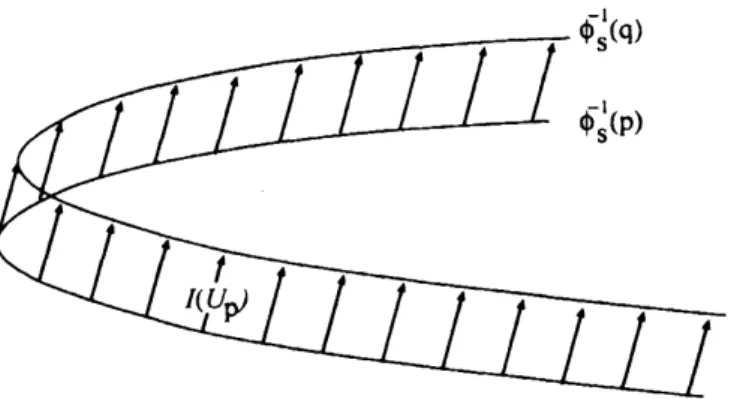
a generalization of the first theorem ofMorse to non-compact level sets: if $|\nabla\phi_{s}(U, U_{L})|^{2}\geq m$ for any $U\in\phi_{s}^{-1}[p, q]$, then
$Fi_{h)}\backslash .\backslash AI_{(1\backslash (}|\backslash$ Foliation
where $I(U_{\rho})$ : integral
curves
of the equation (8) connecting $U_{p}\in\phi_{8}^{-1}(p)$ anda
certainpoint on the level set $\phi_{n}^{-1}(q)$.
Case I: We inay
assume
tliat $U_{L}$ is a repeller. Figure 7 to 9 show nine levelcurves
of $\phi_{s}$ for $a=0.5,$$b=1,$ $s=-3.5$ and $U_{L}=\ell(1,1)$. Let $\epsilon$ be
a
positive small constant.$T1_{1}e$ level set $\{\phi_{s}=\epsilon\}$ is composed of
a
small closed curve enclosing $U_{L}$ and threeunbounded regular
curves
$($Fig 7: $\phi_{\theta}=10.00)$. Suppose thata
critical point $U_{1}$ existson
the level set $\{\phi_{s}(U)=p_{1}\}$, $($Fig.7: $p_{1}=25.88)$ such that there isno
critical pointin $\{\epsilon\leq\phi_{s}(U)\leq p_{1}-\epsilon\}$. By the Morse lemma, we find that $\phi_{s}^{-1}[\epsilon,p_{1}-\epsilon]$ is a Morse
foliation. When the level
curve
meetsa
critical point for $\phi_{s}(U)=p_{1}$,an
integralcurve
connects two critical points $($Fig.7: $\phi,$ $=25.88)$. Repeating this argument, we have
three trajectories connecting critical points (Fig 8, 9).
Figure 6: Flow af a $C_{/I}^{1}\cdot itit_{f}\iota 1$ Poiiit
Case II: We may
assume
that $U_{L}$ isa
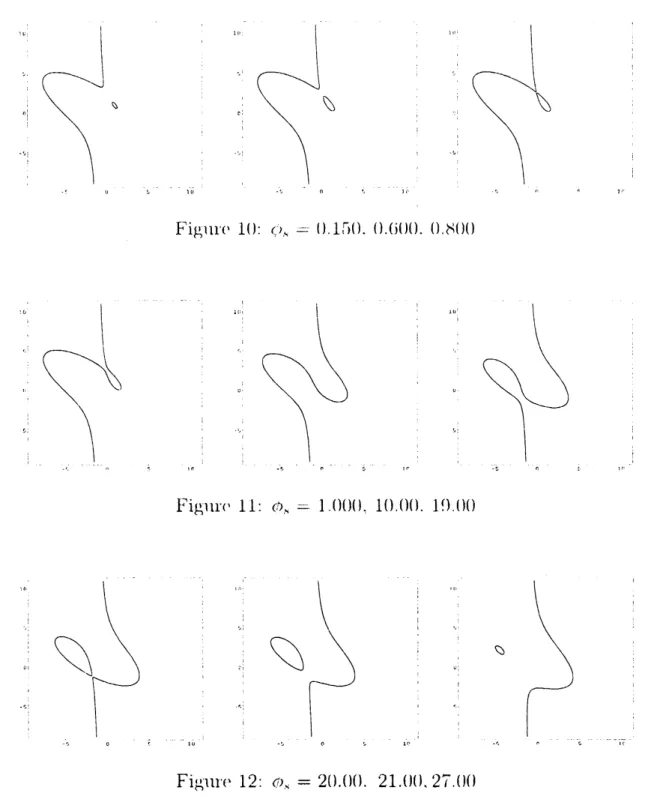
repeller. Figure 10 to 12 show nine levelcurves
of $\phi_{s}$ for $a=1.5,$ $b=1,$ $s=-1$ and $U_{L}={}^{t}(1,1)$.
The level set{
$\phi_{s}=\epsilon$ :small}
is composed of a small closed
curve
enclosing $U_{L}$ and a single unbounded regularcurves
in thiscase
$($Fig 10: $\phi_{s}=0.150)$. Suppose that the first critical point $U_{1}$exists
on
$t\}_{1}e$ level set $\{\phi_{R}(U)=p_{1}\}$, $($Fig.10: $p_{1}=0.800)$ such that there isno
critical point in $\{\epsilon\leq\phi_{s}(U)\leq p_{1}-\epsilon\}$
.
By thesame
argumentas
above,we
find atrajectory connecting $U_{L}$ and the first critical point $($Fig 10: $\phi_{s}=0.800)$. Repeating
Above the second critical point,
we
havea
closedcurve
anda
single unboundedcurve
(Fig 12: $\phi_{s}=21.00$, 27.00).
Since
the closedcurve
enclosesan
attractor, we concludethat there
are
infinitely many trajectories issuingfrom $U_{L}$ and drawn into the attractor.Figure 7: $c/’)_{\backslash }$. $=1(].(\}(). 23.()(). 2_{\iota}^{\ulcorner}).88$
$\lrcorner 0^{--}\overline{v}^{-}$
$-$
$\lrcorner 0|$ $\aleph$
$|$
$0$
Figure 8: $(/’J.\backslash =\backslash \sigma).()().()_{t}^{\ulcorner}).()()$. $8_{l})_{t}).)$
$\ovalbox{\tt\small REJECT}_{10}\ovalbox{\tt\small REJECT}$
Figure 10: $c_{l})_{\backslash }=|).1_{\iota}\ulcorner)()$. $().()()()$. $().b()()$
1$(|\mathfrak{l}$ 10 $1$ $|$ $|$ $r$ $\mathfrak{l}.|$ $\iota$ $1$ $1$ $r$ $tt$ $|\ulcorner$ $t$
.
$Fi_{h^{tt1(}}\cdot\backslash 11:\zeta^{}).,$ $=1.()()(|. 1().()(). 1^{(}).()()$ 1$||$ $|$...
$d|$ $1$ $|$ $\uparrow t$’ $1111$..
$\Im$ $)(t$ .,. $\overline{1(}$ $Fi_{\epsilon}(;1t1^{\cdot}(112:(|)_{\tau}=2().()(). 21.t)(I,$$27.()(|$5.
COMPRESSIVE SHOCK
WITHOUTVISCOUS SHOCK
PROFILE
Liu-Oleinik Condition: Let
us
denote: $\mathcal{H}(U_{L})$ : $U=U(\xi;U_{L})$ the Hugoniot curveissuing from $U_{L};s(\xi)$ : the shock speed at $U(\xi);U_{R}=U(\xi_{1})$
.
We say that $U_{L}$ and $U_{R}$satisfy tlie (strict) $Liu- Oleir\iota ik$ condition if $s(\xi_{1})<s(\zeta)$ for all $0\leq\xi<\xi_{1}$ ([9]).
For strictly hyperbolic systems,
as
long as $U_{R}$ is sufficiently close to $U_{L}$, there existsa
viscous shock profile connecting these states ifand only ifthey satisfy the Liu-Oleinik$Figltl\cdot(|$ $L$3: $]_{\lrcorner}i_{1}\iota-()1\epsilon i_{11}ik\zeta^{1}oii(1itioi1$
State $U_{L}$
on a
Median (Case I): In this case, the Hugoniotcurves
are composedof the median and a hyperbola, and their intersection points
are
$U_{L}$(first bifurcationpoiIit) and $U_{*}$ (secon(1 bifurcation poirit). We
can
deduce by TheoreIn 2 that tliere isa saddle-saddle connection (Fig. 14: left).
Theorern 5 ([2]) Suppose that the medians and the
inflection
curves inter.sect only atthe origin $O$ and that $U_{L}\in M_{j}\backslash \{O\}.(j=1,2,3)$. Then $tf\iota er\cdot e$ exists one branch $\mathcal{H}_{*}$
of
the hyperbola $\mathcal{H}_{j}(U_{L})$ issuing $fro7nU_{*}$ such that the state $U_{L}$, on the left, can be joined
to any $state\in \mathcal{H}_{*}$ sufficiently close to $U_{*}$,
on
the right, byan
inadmissible, compressiveLiu-Oleinik shock. In this case, there exists
a saddle-saddle
connection along $M_{j}$.Outline of proof: Let $U_{L}\in M_{1}$ and $u_{L}>0$
.
We find by direct computation that the2-shock
curve
issuing frorn $U_{L}$ is composed ofthe segment $\overline{U_{L}U_{*}}$ andone
branch of thehyperbola $\mathcal{H}_{j}$ issuing from $U_{*}$
.
Figure 14: Hugoniot $I_{J((11b\dot{c}\mathfrak{l}11(1^{\zeta_{)}^{t}}1_{1t(}\cdot]^{\zeta_{)}^{\tau}}\backslash }vI\backslash ^{r}\llcorner 1)1^{t}((1$
Since $\sigma\cdot=\lambda_{2}$ and $\dot{s}\neq\dot{\lambda}_{2}$ at $U_{*}$, one branch of hyperbola containing $U_{*}$ is
a
com-pressive branch ofthe 2-shock
curve.
Hence by choosing the shock speed $s$ close to $s_{*}$we
havea
2-cornpressive shock conriecting $U_{L}$ anda
st\‘ate $U_{R}$ that is close to $U_{*}$. As we
which is close to $U_{*}$, hence close to $U_{R}$. Thus
we
conclude from the configuration oftrajectories tliat it is impossible.
Figure 14 is the Hugoniot
curves
and the graph of shock speed for $a=0.1$,$b=1,$ $U_{L}={}^{t}(0.5,0.5\mu_{1}),$ $\mu_{1}=-2.65004,$ $\mu_{2}=-0.369954,$ $\mu_{3}=1.02,$ $U_{*}=$
${}^{t}(-0.0484773$,0.128465$)$, $s_{*}=0.653999$; the par\‘ameter of the shock speed is $\xi=\underline{v}\underline{-}v$ $u-u_{\iota}$
.
In the graph of shock speed, $s$ decreases from $\lambda_{2}(U_{L})$ to $\lambda_{*}$ along $\xi=\mu_{1}$
.
then thecompressive blanch goes to the right. It is clear from this figure, the Liu-Oleinik
con-dition actually holds. Figure 15 shows the level
curves
of the potential function for「$\overline{\prime\prime}|i|$ $r$ $\prime’’-\neg$ $\text{ノ^{}\prime}$ $arrow–\cdot\cdot’-\cdot\simarrow\sim\cdots-\cdot--$ $arrow..-\cdot\sim-\cdot-\cdots\cdot,\ldots\ldots-$ $|$ ’
$L–$
$\text{沖_{}-\vee\cdot-arrow-}\rfloor$Figure $1_{\backslash )}^{\ulcorner}:\backslash \cdot=().r)4C),$ $\phi\backslash \backslash =(\}.47_{\backslash }^{\cdot}\backslash ()78_{t}^{r_{J}}$ (left):
$\phi_{l},$ $=(I.47’)()8()$ (riglit)
$s=0,646$. The left figure: $\phi_{s}=0.4730785$ shows the connection of $U_{L}$ and
a
certainstate
on
the median $M_{1}$, hence the existence ofan
undercompressive shockwave.
Theright one shows a small closed level
curve
that enclosesan
attractor.References
[1] Asakura F.
&Yamazaki
M. (2005) Geometry of Hugoniotcurves
in $2\cross 2$ systems ofhyperbolic conservation laws with quadratic flux functions, IMA J. Appl. Math.,
70, no. 6, 700-722.
[2] Asakura F.
&Yamazaki
M. (2008) Viscous Shock Profiles for 2 $\cross 2$ Systems ofhyperbolic conservation laws with
an
umbilic point, to appear J. HyperbolicDif-ferential Equations.
[3] Chicone C. (1979) Quadratic gradients on the plane
are
generically Morse-Smale,J. Differential Equations, 33, 159-166.
[4]
Gonies
M. E.S.
(1989) Riemann problems requiringa
viscous profile eritropycondition, Adv. Appl. Math., 10, 285-323.
$|^{r_{)}}]$ Liu T.-P. (1975b) The Riemann problem for general systems of conserv\‘ation laws.
[6] Majda A.
&Pego
R. (1985) Stable ViscosityMatrices
fo Systems ofConservation
Laws, J. Differential Equations, 56, 229-262.
[7] Marchesin D.
&Plohr
B. (2001) Theory of Three-Phase Flow Applied toWater-Alternating-Gas Enhanced Oil Recovery, Hyperbolic Problems; Theory, Numerics,
Applications, Vol.II, Birkh\"auser Verlag,
693-702.
[8] Medeiros H. B. (1992) Stable Hyperbolic Singularities for Three-Pha.ge Flow
Mod-els in Oil Reservoir Simulation, Acta Applicandae Mathematicae, 28, 135-159.
$[^{(})]$ Oleinik $0$
.
(1957) Discontinuous solutions of non-linear differentialequations,
Amer.
Math. Soc. Transl. Ser. 2,26
(1957),95-172.
[1()] Schaeffer D.
&Shearer
M. (1987) The $c1\ ;_{t};ification$ of$2\cross 2$ systems ofnon-strictlyhyperbolic conservation laws, with applications to oil recovery, Comm. Pure Appl.
![Figure 7: $c/’)_{\backslash }$ . $=1(].(\}(). 23.()(). 2_{\iota}^{\ulcorner}).88$](https://thumb-ap.123doks.com/thumbv2/123deta/5988842.1060595/9.892.74.789.201.1122/figure-c-backslash-iota-ulcorner.webp)
![Figure 14: Hugoniot $I_{J((11b\dot{c}\mathfrak{l}11(1^{\zeta_{)}^{t}}1_{1t(}\cdot]^{\zeta_{)}^{\tau}}\backslash }vI\backslash ^{r}\llcorner 1)1^{t}((1$](https://thumb-ap.123doks.com/thumbv2/123deta/5988842.1060595/11.892.220.619.112.357/figure-hugoniot-mathfrak-zeta-cdot-backslash-backslash-llcorner.webp)

