On the Standard
Expression
for
the Party Algebra
琉球大学理学部数理科学科
小須田雅
(Masashi KOSUDA)
Department
of
Mathematical
Sciences,
University
of the Ryukyus
1
$\mathrm{I}\mathrm{n}\mathrm{t}\mathrm{r}\mathrm{o}\mathrm{d}\mathrm{u}\mathrm{c}\mathrm{t}\mathrm{i}\mathrm{o}^{\backslash }\mathrm{n}$In this note we explain about the party algebra $P_{n,r}(Q)$ and its standard
ex-pression. The party algebra is originallydefined
as
the centralizer ofthe unitaryreflection
group
of type $G(r, 1, k)$ which diagonally actson
the $n$ times tensorspace $V^{\otimes n}$
.
This algebra is also definedas a
diagram algebra likeTemperly-Lieb’s algebra, Brauer’s centralizer algebra, the partition algebra, and
so on.
Itis well known that these diagram algebras have the cellular structures.
The cellular
structure
ofan
algebra tells that how the algebra’s basis isdecomposed into the cells,
which
may turn out to be the representatives ofthe
irreducible
representations.When
we
tryingto find
a
characterization for the party algebra bygenera-tors and relations [9],
we
founda
good expression ofthe basis elements of thealgebra, which naturally gives the cellular structure. In
this
note, we presentthis expression
as a
candidate of the standard expression.2
Definition of the
party
algebra
2.1
Define the party algebra
as a
centralizer algebra
First we quickly review the definition of the unitary reflection group of type
$G(r, 1, k)$
.
The unitary reflectiongroup
$G(r, 1, k)$ in Shephard-Todd’snota-tion [15] consistsof all
the
monomial matrices ofsize $k$ whosenon-zero
compo-nents
are
powers ofan
r-th primitive root of unity and it is generated by allthe permutation matrices and the identity matrix whose $(1, 1)$-component
was
replaced by
an
r-th primitive root ofunity $\zeta$.
Let $V$ bea
$k$-dimensional vectorspace
on
which the unitary reflectiongroup
$G(r, 1, k)$ naturally acts. Considerthe tensor space $V^{\otimes n}$
on
which $G(r, 1, k)$ acts diagonally. Weassume
that thedimension $k\geq n$ [resp. $k\geq 2n-1$] if$r>1$ [resp. $r=1$]. The party algebra
$P_{n,r}(k)$ is defined
as
the centralizer of $G(r, 1, k)$ in $V^{\otimes n}$ with respect to theabove action. Namely,
In particular $P_{n,1}(k)=\mathrm{E}\mathrm{n}\mathrm{d}_{\mathfrak{S}_{k}}V^{\otimes n}$is known
as
the partition algebra, which hasbeen intensively
studied
[5, 10, 11, 2, 17]. It is well known that in the similarsetting,
we
have the following correspondence :$GL_{k,6_{n}}(\mathbb{C})$ $\subset\supset$ $O_{k}(\mathbb{C})\supset B_{n}(k)\subset$ $P_{n,1}(k)\mathbb{C}6_{k}$
.
2.2
Find the
basis
Since $G(r, 1, k)$ contains $G(1,1, k)=6_{k}$, the party algebra $P_{n,r}(k)$ must be
a
subalgebra of the partition algebra. To find which element is in the partyalgebra precisely,
we
observe the actions ofthe generators of $G(r, 1, k)$.
Let $e_{1},$$\ldots,e_{k}$ be the natural basis of the vector
space
$V$. Weassume
that$G(r, 1, k)$ acts naturallywith respectto this $\mathrm{b}\mathrm{a}s$is. Case $r=1$
First consider the
case
$r=1$, the partition algebracase.
Suppose thatan
endomorphism map $X$
moves
one
of the elements of the natural basis of thetensor space to
a
linear combination of the basis:$X(e_{f_{1}} \otimes\cdots\otimes e_{f_{n}})=\sum_{m_{1},\ldots,m_{\mathrm{n}}}X_{f_{1},,f_{n}}^{m_{1}.’.\cdot.\cdot.,m_{n}}e_{m_{1}}\otimes\cdots\otimes e_{m_{n}}$
.
(1)Since $X$ commutes with the diagonal action of the symmetric group, for an
arbitrary
element
$\sigma\in 6_{k}$we
have
$\sigma^{-1}X\sigma(e_{f_{1}}\otimes\cdots\otimes e_{fn})=\sum_{m_{1},\ldots,m_{n}}X_{\sigma(f_{1}),,\sigma(f_{n})}^{\sigma(m_{1}).’.\cdot.\cdot.,\sigma(m_{n})}e_{m_{1}}\otimes\cdots\otimes e_{m_{n}}$
.
Hence
we
have$X_{\sigma(f_{1}),,\sigma(f_{n})}^{\sigma(m_{1}).’.\cdot.\cdot.,\sigma(m_{n})}=X_{f_{1},,f_{n}}^{m_{1}.’.\cdot.\cdot.,m_{n}}$.
Erom this, in the paper [5] Jones showed that the following transformations
make
a
basis of$\mathrm{E}\mathrm{n}\mathrm{d}_{G(1,1,k)}(V^{\otimes n})$.
{
$T^{\sim}|\sim \mathrm{i}\mathrm{s}$an
equivalent relationon
$2n$, the number of classes $\leq k$},
(2)$(T^{\sim})_{f_{1}\cdots,fn}^{fn+1},’\ldots|f_{2n}$ $:=$ $\{$
1
if$(f_{i}=f_{j}\Leftrightarrow i\sim j)$,
$0$ otherwise,
$f_{n+J’}$ $:=$ $m_{j}$ $j=1,2,$ $\ldots,$$n$
.
Since
we
assumed that the dimension $k$ ofthe vector space is large enough, inthe following
we can
omit the second condition of the expression (2).1A. Ram [12] called such aalgebra “tantalizer”. The meaning of it is “Centralizer ofthe
described in the expression (2) and the following set of the set-partitions:
$\Sigma_{n}^{1}$ $=$ $\{\{T_{1}, \ldots, T_{s}\}|s=1,2,$
$\ldots$
,
$T_{j}(\neq\emptyset)\subset F\cup M(j=1,2, \ldots, s)$
,
$\cup T_{j}=F\cup M$
,
$T_{i}\cap T_{j}=\emptyset$ if $i\neq j$},
(3) where$F=\{f_{1}, \ldots, f_{n}\}$
,
$M=\{m_{1}, \ldots, m_{n}\}$, $|F\cup M|=2n$.
Case $r>1$
Next consider the
case
$r>1$.
In this
case we
haveto consider the actionof$\xi=\mathrm{d}\mathrm{i}\mathrm{a}\mathrm{g}(\zeta, 1, \ldots, 1)$. Note that$\xi$ multiplies $e_{f\iota}\otimes\cdots\otimes e_{f_{n}}$ by $\zeta$
at
eachoccurrence
of $e_{1}$. Let $f_{1},$$\ldots,$$f_{n}$ and $m_{1}$,:. . ,$m_{n}$ be the indices defined in the equation (1).
Let
$p$ be thenumber
ofls in the array $(m_{1}, \ldots, m_{n})$ and $q$ the number of ls in the array $(f_{1}, \ldots, f_{n})$
.
Since
$X\xi=\xi X$ $\Leftrightarrow$ $\zeta^{p}X_{f_{1},.,fn}^{m_{1}.’..\cdot.,m_{n}}=(^{q}X_{f_{1},,fn}^{m_{1}.’.\cdot.\cdot.,m_{n}}$
for all possible $(f_{1}, \ldots, f_{n})$ and $(m_{1}, \ldots, m_{n})$,
in order that $X$ is
an
element ofthe centralizer $\mathrm{E}\mathrm{n}\mathrm{d}_{G(r,1,k)}V^{\otimes n}$,
the coefficients$x_{f^{1}\cdot fn}^{m_{1},.\cdot.\cdot.,m_{n}},$
, must be $0$ unless that the number of ls in $(f_{1}, \ldots, f_{n})$ is equal to
the number of ls in $(m_{1}, \ldots, m_{n})$ modulo $r$
.
Further since $\sigma\in G(1,1, k)$runs
all the permutations,
the
coefficients mustbe
$0$unless that
the number of$is$ in$(f_{1}, \ldots, f_{n})$ is equal
to
that of $is$ in $(m_{1}, \ldots, m_{n})$modulo
$r$ for any letter $i$,
If
we
describe this in terms of the set-partitions, the $\xi$-action adds thefol-lowing restriction to the basis for the partition algebra.
$T_{j}\cap F\equiv T_{j}\cap M$ (mod $r$).
In fact, Tanabe [16] showed that the following set becomes a basis of the party
algebra $P_{n,r}(k)$
.
$F=\{f_{1}, \ldots, f_{n}\}$, $M=\{m_{1}, \ldots, m_{n}\}$, $|F\cup M|=2n$,
$\Sigma_{n}^{f}$ $=$ $\{\{T_{1}, \ldots,T_{s}\}|s=1,2,$$\ldots$
,
$T_{j}(\neq\emptyset)\subset F\cup M(j=1,2, \ldots, s)$,
$\cup T_{j}=F\cup M$, $T_{i}\cap T_{j}=\emptyset$if$i\neq j$,
$|T_{j}\cap F|\equiv|T_{j}\cap M|$ (mod $r$)$\}$
.
(4)2.3
Define
the
party
algebra
as
a
diagram
algebra
As we can see in
Martin’s
papers $[10, 11]$, the partition algebra is definedas a
diagram algebra imposing
a
producton
the set (3). (See also the paper [2].)In
case
that the partition algebra is defined as a diagram algebra on the linearspan
of $\Sigma_{n}^{1}$,
the parameter $k$ does not have to bean
integer anymore.
Since theparty algebra $P_{n,\mathrm{r}}(k)$ is asubalgebra of the partition algebra (as a
centralizer), it is expected that
a
diagram subalgebra $\overline{P_{n,r}}(Q)$ (which will turnout to be isomorphicto $P_{n,r}(k))$ ofthe partition algebra is defined
on
the linearspan of $\Sigma_{n}^{r}$.
We explainthediagram algebra$\overline{P_{n,r}}(Q)$taking
an
example ofthecase
$r=2$.
Let
$w=\{\{m_{1}, f_{1}, f_{2}, f_{4}\}, \{m_{2}, f_{5}\}, \{m_{3}, m_{4}\}, \{m_{5}, f_{3}\}\}\in\Sigma_{5}^{2}$.
The corresponding diagram of $w$ will become the
one
in Fig. 1. In general, thediagram of
an
$r$-modularseat-plan is obtainedas
follows. Considera
rectanglewith$\mathrm{n}$ marked points
on
the bottom and thesame
$n$on
thetop. The$n$ markedFigure 1: $w\in\Sigma_{5}^{2}$
points
on
the bottomare
labeled by $f_{1},$ $f_{2},$$\ldots f_{n}$ from left to right. Similarly,the $n$ markedpoints
on
the top is labeled by$m_{1},$ $m_{2},$ $\ldots,$ $m_{n}$ from left to right.If$w\in\Sigma_{n}^{2}$ has $s$ parts, then put $s$ shaded circles in the middle of the rectangle
so
that they haveno
intersections. Each of the circles corresponds toone
ofthe
non-empty $T_{j}\mathrm{s}$.
Thenwe
join the $2n$marked
points and the $s$ circles with$2n$ shaded
bands
so
that the marked points labeled by the elements of$T_{j}$are
connectedto thecorresponding circlewith $|T_{j}|$ bands. We call $T_{j}\cap M$the upper
part of$T_{j}$ and $T_{j}\cap F$ the lowerpartof$T_{j}$
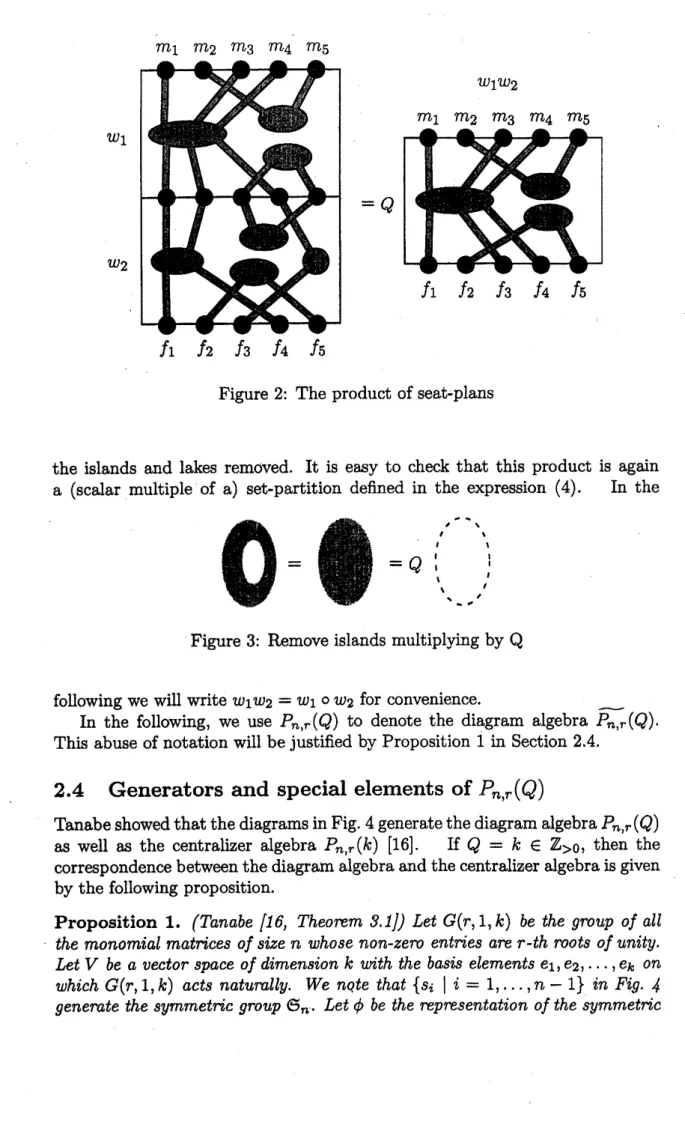
Define thecomposition product$w_{1}\mathrm{o}w_{2}$ of diagrams$w_{1}$ and$w_{2}$ to be the
new
diagram obtained by placing$w_{1}$ above $w_{2}$, gluingthe correspondingboundaries
and shrinking half along the vertical axis
as
in Fig. 2. We then have a newdiagram possibly containing
some
islands $\mathrm{a}\mathrm{n}\mathrm{d}/\mathrm{o}\mathrm{r}$lakes. If thereoccur
islands $\mathrm{a}\mathrm{n}\mathrm{d}/\mathrm{o}\mathrm{r}$lakesinthe resulting diagram,then first bury the lakes andremove
each$w_{1}w_{2}$
Figure 2: The product ofseat-plans
the islands and lakes removed. It is easy to check that this product is again
a
(scalar multiple of a) set-partition defined in the expression (4). In the ” $\backslash \iota$$\mathrm{t}$
$=Q$
Il
11$\iota$
$\iota\backslash -\prime\prime\prime$
Figure 3: Remove
islands
multiplying by $\mathrm{Q}$$\mathrm{f}\mathrm{o}\mathrm{U}\mathrm{o}\mathrm{w}\mathrm{i}\mathrm{n}\mathrm{g}$
we
$\mathrm{w}\mathrm{i}\mathrm{U}$ write$w_{1}w_{2}=w_{1}\mathrm{o}w_{2}$ for convenience.
In the following,
we
use
$P_{n,t}(Q)$ to denote the diagram algebra $\overline{P_{n,r}}(Q)$.
This abus$e$ of notation will bejustified by Proposition 1 in Section 2.4.
2.4
Generators
and special elements of
$P_{n,r}(Q)$Tanabe
showed that
the diagramsinFig.4
generate the diagram algebra$P_{n,r}(Q)$as
wellas
the centralizer algebra $P_{n,\mathrm{r}}(k)[16]$. If $Q=k\in \mathbb{Z}_{>0}$,
then thecorrespondencebetweenthe diagram algebra andthecentralizer algebra$is$given
by the following proposition.
Proposition 1. (Tanabe [16, Theooem 3.$\mathit{1}J$) Let $G(r, 1, k)$ be the
group
of
allthe
monomial
matricesof
size $n$ whosenon-zero
entniesare
r-th rootsof
unity.Let $V$ be
a
vector spaceof
dimension $k$ with the basis elements $e_{1},$$e_{2},$$\ldots,$$e_{k}$
on
which $G(r, 1, k)$ acts naturally. We $nQte$ that $\{s_{i}|i=1, \ldots, n-1\}$ in Fig.4
Figure 4: Generators of $P_{n,r}(Q)$
group
$6_{n}$on
$V^{\otimes \mathrm{n}}$ obtained by permuting the tensor product factors, $i.e.$,
for
$v_{1},v_{2},$$\ldots,$$v_{n}\in V$ and
for
$w\in 6_{n\mathrm{z}}$$\phi(w)(v_{1}\otimes v_{2}\otimes\cdots\otimes v_{n}):=v_{w^{-1}(1)}$Ci}$v_{w^{-1}(2)}\otimes\cdots\otimes v_{w^{-1}(n)}$.
For$f$ and $e^{[r]}$ in Fig. 4,
define
$\phi(f)$ and $\phi(e^{[r]})$ asfollows:
$\phi(f)(e_{p_{1}}\otimes e_{p_{2}}\otimes\cdots\otimes e_{p_{\mathfrak{n}}})$ $:=$ $\{$
$e_{p_{1}}\otimes e_{p_{2}}\otimes\cdots\otimes e_{\mathrm{p}_{n}}$
if
$p_{1}=p_{2}$,$0$ otherwise,
$\phi(e^{[r]})(e_{p_{1}}\otimes e_{p_{2}}\otimes\cdots\otimes e_{p_{n}})$ $:=$ $\{$
$\Sigma_{i=1(e_{i}^{\otimes r})\otimes e_{p_{\mathcal{P}+1}}\otimes\cdots\otimes e_{p_{n}}}^{k}$
if
$p_{1}=p_{2}=\cdots=p_{f}$,$0$ othenvise.
Then $\mathrm{E}\mathrm{n}\mathrm{d}_{G(r,1,k)}(V^{\otimes n})$ is generated by $\phi(6_{n}),$ $\phi(f)$ and $\phi(e^{[r]})$
.
Since $s_{i}\mathrm{s}$ in Fig. 4 make the symmetric
group,
we
find that the ‘conjugate’$e$lements of $f$ and $e^{[f]}$
as
in Fig. 5(a),(b)are
obtainedas
a product of thegenerators. Further, the diagram (c) in Fig. 5 is also obtained from
some
$f\mathrm{s}$and $s_{i}\mathrm{s}$ in Fig.
4.
Hence ifan
$r$-modular seat-plan is presentedas a
product ofthespecialelements inFig. 5, then it is presented as aproduct ofthegenerators
in Fig.
4.
3
Bratteli diagram
for
$P_{n,r}(k)$Thanks to the Schur-Weyl duality,
we can
obtain the Bratteli diagram for theparty algebra observing how the tensor representation of $G(r, 1, k)$ is
decom-posed into irreducibles in accordance with the increase of the number of
ten-sors.
The irreducible representations of the unitary reflectiongroup
$G(r, 1, k)$are
indexed bythe $r$-tuples ofYoung diagramswhose
total number of the boxesis equal to $k$
.
(As for the irreducible representation of $G(r, 1, k)$, we refer thepaper
[1].) Weare
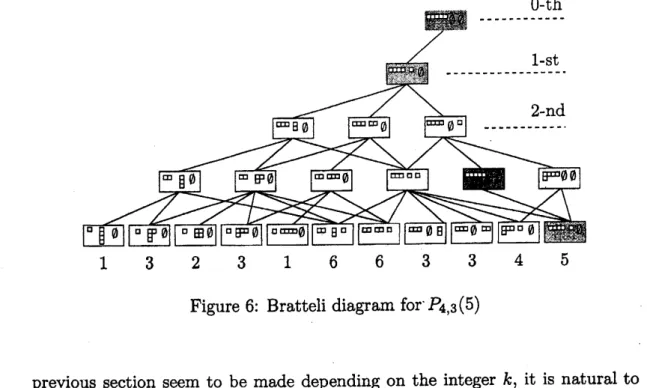
going to explain this, taking thecase
$r=3$ (Fig. 6). Inthis example
we
set $k=5$.
Since we
set $r=3$, theirreducible
componentsare
indexed by 3-tuples of Young diagrams of total size5.
First consider thecas
$en=1$.
In thi$s$case
we
have the natural representation. We know that(a) (b) (c)
Figure 5: Special elements of $P_{n,r}(Q)$
on
the l-st floor in Fig. 6. If the number oftensors increases by one, then theirreducible components will be branched obeying the following rules:
$\bullet$
one
of the boxesinone
coordinateismoved to thenext coordinateso
thatall the
coordinates
have again Young diagrams,$\bullet$ in
case
the box to beremoved
is in the last (r-th) coordinate, this box ismoved to the first coordinate.
Note that in this picture, the vertex
on
the l-st floorappears on
the4-th floor.Fig.
7
is another example of the Bratteli diagram of the party algebra incase
$r=2,$ $k=5$.
In thisexample,we note
that verticeson
the 2-nd floor againappear
on
the 4-th floor.In
case
$r=1$,or
the partition algebra case, the situation is slightlydiffer-ent, however, the similar argument still applies for the
case
$r=1$ with slightmodifications. Hereafter,
we
assume
that $r>1$.
Schur-Weyl’s duality assert$s$ that the multiplicity of each irreducible
com-ponent becomes the degree of the corresponding irreducible representation of
the centralizer. In
this
Bratteli diagram, eachvertex
on
the bottom expresses
an
irreducible component of the party algebraas
wellas
the correspondingir-reducible representation of the unitary reflection
group
and the number of thepathsfrom the top vertexto
a
vertexon
the bottom becomes the degree of theirreducible representation of the party algebra.
4
Irreducible
components
of
$P_{n,r}(Q)$If
we
define the party algebraas a
diagram algebra, the parameter $Q$ does notFigure
6:
Bratteli diagram $\mathrm{f}\mathrm{o}\mathrm{r}\cdot P_{4,3}(5)$previous section
seem
to be made dependingon
the integer $k$, it is natural toguess that there must exist a description which does not depend on the choice
$\mathrm{o}\mathrm{f}k$
.
Fig.
8
is sucha
description. We shiftan
$r$-tuple of Young diagramson
the n-th floor
to
the left andthe
leftmost
Young diagram to the right mostremoving
the
l-strow.
Let $\Lambda_{n,\mathrm{r}}$ bethe index set obtained from such operations. We find that $\Lambda_{n,\mathrm{r}}$
is equal to the following set:
$\Lambda_{n,r}=\{[\lambda^{(1)}, \ldots, \lambda^{(r)}] ; \sum_{j}^{r}j|\lambda^{(j)}|=n, n-r,n-2r, \ldots\}$.
Let $\ell_{j}=|\lambda^{(j)}|$ be the size of $\lambda^{j}$
and $1=(\ell_{1}, \ldots,l_{r})$ the array of$\ell_{j}s$
.
In thefollowing sections this array 1 will play
an
important role.As
for the previous examples, Fig. 6 and Fig. 7,we
obtain theparametriza-tions Fig.
9 and
Fig.10
respectivelywhich do not
dependon the choice
of $k$.
The weight
sum
$||\lambda||$ of $\lambda=[\lambda^{(1)}, \ldots, \lambda^{(\tau)}]$ is defined by $\sum_{j=1}^{r}j|\lambda^{(j)}|$.
Forexample the weight
sums
in Fig. 9are
4 and $4-3=1$ . Those in Fig. 10are
4and $4-2=2$ and
$4-2-2=0$
.
5
Standard
expression
of
$P_{n,r}(Q)$Keeping the facts presented in the previous sections in mind, for
an
r-modularseat-plan $w\in\Sigma_{n}^{r}$,
we
now try to define thestandard
expression by the specialFigure 7: Bratteli diagram for $P_{4,2}(5)$
Figure
8:
Irreducible representation of$P_{n,r}(Q)$5.1
Propagating number
To define the standard expression,
we
introduce the notion of the thicknessof the propagating parts and classify the propagating parts by the
thickness.
Now
we
quickly review the definition of propagating parts. Thenwe
define thethickness ofa part of an $r$-modular seat plan.
For
a
part$T$ ofan
$r$-modular seat-plan, if$T\cap F\neq\emptyset$ and$T\cap M\neq\emptyset$,we
call
$T$ propagating. For an $r$-modular seat-plan $w\in\Sigma_{n}^{r}$, let $\pi(w)=\{T\in w|T$ :
propagating}
be the set of propagating parts. If$T\in w\backslash \pi(w)$, thenwe
call $T$non-propagating
or
defective.
The number ofthe propagating parts $|\pi(w)|$ of$w$is called the propagating number (of$w$).
Forexample, in Fig. 1, $\pi(w)=\{T_{1}, T_{2}, T_{4}\}$
.
Hence $|\pi(w)|=3$.
On the other hand $T_{3}$ is non-propagating. Note that the following remark holds.$\emptyset\emptyset\Psi\emptyset\emptyset$ $\mathrm{H}\emptyset\emptyset \mathrm{F}\emptyset\emptyset\ovalbox{\tt\small REJECT}\emptyset\emptyset \mathrm{B}^{\mathfrak{g}}\emptyset \mathrm{m}\mathrm{o}_{\emptyset}$ $\emptyset^{\mathrm{B}}\emptyset\emptyset^{\varpi}\emptyset 0_{\emptyset^{\mathrm{O}}}$ $\circ\emptyset\emptyset$
Figure 10: Irreducibles of $P_{4,2}(Q)$
Remark 2. The number
of
elements contained ina
defective
part isan
integermultiple
of
$r$.
Namely,if
$w\in\Sigma_{n}^{r}$ and $T_{i}\in w$ is non-propagating, then thereexists
an
integer$d$ such that$|T_{i}|=dr$
.
5.2
Thickness
For apropagating part of
a
seat-plan,we
define its thickness. The notion of thethickness will also be used to define the conjugacy classes of the party algebra.
As
for the conjugacy classes
and characters of$P_{n,r}(Q)$, it isnow
being studiedby Naruse [13].
Suppose that $w\in\Sigma_{n}^{r}$ and $T_{i}\in\pi(w)$
.
We define the thickness $t(T_{i})$ of$T_{i}$ astheleast positive integer which is equaltothe number ofthe elements contained
in its upper part by modulo $r$:
$t(T_{i})$ $\in$ $\{1, 2, \ldots, r\}$,
$t(T_{i})$ $\equiv$ $|T_{i}\cap M|$ (mod $r$).
Since $|T_{\iota’}\cap F|\equiv|T_{i}\cap M|$ (mod $r$) for any part $T_{i}\in w$
,
we
can also define thethickness using its lower part.
Put $t=t(T_{i})$
.
Then there exist at least $t$ elements both in the upper andthe lower parts of $T_{i}$
.
The number of the other elements in $T_{i}$ must be aninteger multiple of $r$
.
Hence there exist permutations $w_{1},$$w_{2}\in 6_{n}$ such thatthe diagram of$w_{1}T_{i}w_{2}$ does not contain any crossing
as
in Fig. 11.Figure 11: $w_{1}T_{i}w_{2}$
Conversely, everypropagating part isobtained from suchan$r$-modular
seat-plan
as
in Fig. 11 by attaching permutations to its lower $\mathrm{a}\mathrm{n}\mathrm{d}/\mathrm{o}\mathrm{r}$ upper part(s).$\mathrm{t}(w)$ $:=$ $(\ell_{1}, \ldots,\ell_{r})$
$:=$ $(\mathrm{t}(w)_{1}, \ldots, \mathrm{t}(w)_{r})$
$:=$ $(\#\{T_{i}\in w ; t(T_{i})=1\}, \ldots , \#\{T_{i}\in w ; t(T_{i})=r\})$
.
Note that we are abusing the
same
notation $\ell_{i}$ which we have used tomeasure
the sizes of Young diagrams for indexing the irreducible $\mathrm{r}\mathrm{e}\beta \mathrm{r}\mathrm{e}s$entations.
For
example, in Fig. 12 ifwe
regard $w_{1},w_{2}$as
3-modular seat-plans, then$\mathrm{t}(w_{1})=(2,0,1)$ and $\mathrm{t}(w_{2})=(3,1,0)$
.
On
the other hand, ifwe
regard $w_{1},$$w_{2}$as
2-modular seat-plans, then $\mathrm{t}(w_{1})=(3,0)$ and $\mathrm{t}(w_{2})=(3,1)$.
$w_{1}$ $w_{2}$
Figure 12: Note that
$|\mathrm{t}(w)|:=\mathrm{t}(w)_{1}+\cdots+\mathrm{t}(w)_{r}=l_{1}+\cdots+\ell_{r}=\pi(w)$ (propageting number).
5.3
Standard expression
To obtain the
standard
expression, firstwe
rename
all the propagating parts ofthe seat-plan
so
that$t(T_{1})=t(T_{2})=\cdots=t(T_{\ell_{1}})$ $=$ 1, $t(T_{\ell_{1}+1})=t(T_{\ell_{1}+2})=\cdots=t(T_{\ell\iota+\ell_{2}})$ $=$ 2,
:
:
.
:
$t(T_{\ell_{1}+\ell_{2}+\cdots+\ell_{r-1}+1})=t(T_{\ell_{\iota+\ell_{2}+\cdots+\ell_{r-1}+2}})=\cdots=t(\tau_{\ell_{1}+\ell_{2}+\cdots+\ell_{r-1}+\ell_{r})}$ $=$ $r$
.
Then
we
twist the parts which have thesame
thicknessas
follows. Let$T_{\ell_{1}+\ell_{2}+\cdots+\ell_{\dot{g}-1}+1},$ $T_{l_{1+\ell_{2+\cdots+\ell_{j-1}+2}}},$$\ldots,T_{\ell_{1}+\ell_{2+\cdots+l_{\mathrm{j}-1}+\ell_{j}}}$
be all the parts whose thickness is $j$
.
First
we
divide each ofthem
into thethe minimum elements of the upper parts become increasing order. (Here we
assumed that the elements of $M$ have
an
order, $m_{1}<m_{2}<\cdots<m_{n}.$) Nextwe sort the lower parts of them
so
that the minimum elements of the lowerparts become increasing order. (Here
we
assumed that the elements of$F$ havean
order, $f_{1}<f_{2}<\cdots<f_{n}.$) In order to restore the original parts whosethickness is $j$, join the upper and the lower parts of them. In this process, we
have
a
permutation $v_{j}\in 6_{\ell_{j}}$.
We explain this process using Fig. 13. In this picture,
Figure
13:
$w_{1}\in\Sigma_{9}^{2}$$w_{1}=$ $\{ \{m_{2}, m_{3}, f_{1},f_{2},f_{4}, f_{7}\}\{m_{9},f_{3}\},’ \{m_{1},m_{7},f_{5},f_{6}\}\{m_{6},f_{9}\},’ \{m_{4},m_{5}\}\{m_{8},f_{8}\}’ \}\in\Sigma_{9}^{r}$
.
The thickness ofthe three gray parts of$w_{1}$ is 1. So $\ell_{1}=3$
.
And the thicknessofthe two black pats is 2. So $\ell_{2}=2$
.
Consider the gray parts first. The minimum element of the upper parts is
joined to the maximumelement ofthe lower parts. And the maximum element
ofthe upper parts is joined to the minimum element of the lower parts. So we
have
a
$\mathrm{p}e$rmutation $\sigma_{1}=(13)(2)\in 6_{3}$ (See the left figure of Fig. 15).Next
consider
theblack
part$s$.
Ifwe
sort these parts in accordance with theminimum elements of the
upper
parts, thenthe rightislandcomes
first. On theother hand, if
we
sort them in accordance with the minimum elements of thelowerpart$s$, then theleft island
comes
first. Henceinorderto restorethe originalparts,
we
have tojointheupper
part$s$ and the lower partswitha crossing. Notethat ifthere exist $\ell_{t}$ part$s$ whose thickness is $t$, then the permutation obtained
in this way is
an element
of the symmetricgroup
of degree $\ell_{t}$.
However, topresent this permutation by the generators, we need $t$-parallel strings at each
crossing
as
in Fig. 14. So the permutation is realized in the symmetric group ofdegree $t\cross\ell_{t}$
.
As for the black parts of$w_{1}$ in Fig. 13
we
have a transposition $\sigma_{2}=(12)\in$$6_{2}$
.
However, this is presentedas an
element of $6_{2\cross 2}$as
in the right figure ofFig. 15.
The standard expression of$w_{1}$ in Fig. 13 is obtained fromthe expression in
$\perp$ $\angle$
$\iota_{t}$
Figure
14:
Figure
15:
the bottom respectively:
$x$ $=$
$y^{-1}$ $=$
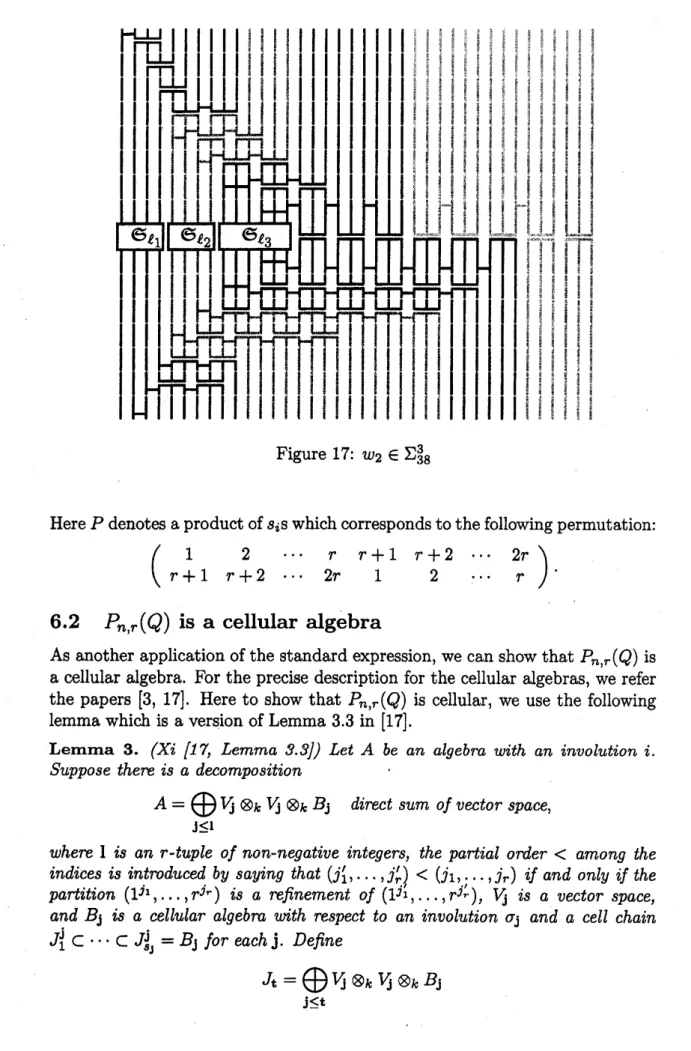
Fig. 17is anotherexampleof astandardexpression. Since $w_{2}$ is a 3-modular
seat-plan, the thickness
array
isa
3-tuple ofpermutations. Inthiscase
we
havea thickness
array$1=\mathrm{t}(w_{2})=(\ell_{1},\ell_{2},\ell_{3})=(4,2,2)$
and
a
permutation array$(v_{1},v_{2},v_{3})\in 6_{\ell_{1}}\cross \mathfrak{S}_{\ell_{2}}\cross 6_{l_{3}}arrow 6_{1\cross\ell_{1}}\cross 6_{2\cross\ell_{2}}\cross 6_{3\cross\ell_{3}}$,
Thepermutationarrayis uniquelydeterminedbythegiven$r$-modularseat-plan.
6
Application
Using the
standard
expression above,we can
obtain the defining relation of theFigure
16:
6.1
Defining relation
of
$P_{n,r}(Q)$We
can
find the defining relation of $P_{n,r}(Q)$ by the following try-and-errormethod: First
guess
the relations. Then try to show that multiplication ofa
generator and the standard expression will be transformed toa
scalarmulti-ple ofanother (possibly the $s\mathrm{a}\mathrm{m}e$) word of the standard expression, only using
the guessed relations.
In this
manner
we
have shown that the following relations characterize theparty algebra$P_{n,r}(Q)[9]$:
$s_{i}^{2}$ $=$ 1 $(i=1,2, \ldots, n-1)$,
$s_{i}s_{i+1}s_{i}$ $=$ $s_{i+1}s_{i}s_{i+1}$ $(i=1,2, \ldots, n-2)$,
$s_{i}s_{j}$ $=$ $s_{j}s_{i}$ $(|i-j|\geq 2, i,j=1,2, \ldots, n-1)$,
$f^{2}=f,$ $fs_{2}fs_{2}=s_{2}fs_{2}f,$ $fs_{2}s_{1}s_{3}s_{2}fs_{2}s_{1}s_{3}s_{2}=s_{2}s_{1}s_{3}s_{2}fs_{2}s_{1}s_{3}s_{2}f$
,
$fs_{1}=s_{1}f=f,$ $fs_{i}=s_{i}f(i=3,4, \ldots, n-2)$,
$(e^{\lfloor r]})^{2}=Qe,$ $e^{[f]}s_{i}=s_{i}e^{[r]}=e^{[r]}(i=1,2, \ldots , r-1)$,
$e^{[r]}f=fe^{[r]}=e^{[r]}e^{[r]}s_{r}e^{[r]}=e^{[r]}$,
$e^{[r]}Pe^{[r]}P=Pe^{[r]}Pe^{[r]}$,
$fs_{2}s_{3}\cdots s_{r+1}s_{1}s_{2}\cdots s_{r}es_{r}\cdots s_{2}s_{1}s_{r+1}\cdots s_{3^{S_{2}}}$
$=s_{2}s_{3}\cdots s_{r+1}s_{1}s_{2}\cdots s_{r}es_{r}\cdots s_{2}s_{1}s_{r+1},$
.
$.s_{3}s_{2}f$,$es_{i}=s_{i}e=e$ $(i=r+1,r+2, \ldots, n-1)$
,
Figure
17:
$w_{2}\in\Sigma_{38}^{3}$Here$P$denotes
a
productof$s_{i}\mathrm{s}$whichcorrespondsto the followingpermutation:6.2
$P_{n,r}(Q)$is
a
cellular algebra
As
another application of thestandard expression,we
can
show that $P_{n,r}(Q)$ isa
cellular
algebra. For the precise descriptionfor
thecellular
algebras,we
referthe
papers
$[3, 17]$.
Here to
show that $P_{n,r}(Q)$ is cellular,we
use
the followinglemma which is
a
version ofLemma3.3
in [17].Lemma 3. ($Xi[\mathit{1}7$
,
Lemma 3.$\mathit{3}J$) Let $A$ be an algebra with an involution $i$.Suppose there is
a
decomposition$A=\oplus V_{\mathrm{j}}\otimes_{k}V_{\mathrm{j}}\otimes_{k}B_{\mathrm{j}}$ direct
sum
of
vector space,$\mathrm{j}\leq 1$
where
1
isan
$r$-tupleof
non-negative integers, the partial order $<$ among theindices is introduced by saying that $(j_{1}’, \ldots,j_{\mathrm{r}}’)<(j_{1},..,j_{r}j)$
if
and onlyif
thepartition $(1^{j_{1}}, \ldots , r^{j_{\Gamma}})$ is
a
refinement of
$(1^{j_{1}’}, \ldots, r^{j_{f}}),$ $V_{\mathrm{j}}$ isa
vector space,and $B_{\mathrm{j}}$ is
a cellular
algebra with respect toan involution
$\sigma_{\mathrm{j}}$ and
a
cell chain$J_{1}^{\mathrm{i}}\subset\cdots\subset J_{s_{\mathrm{J}}}^{\mathrm{i}}=B_{\mathrm{j}}$
for
each
$\mathrm{j}$.
Define
and
$J_{<\mathrm{t}}= \bigoplus_{\mathrm{j}<\mathrm{t}}V_{\mathrm{j}}\otimes_{k}V_{\mathrm{j}}\otimes_{k}B_{\mathrm{j}}$.
Assume that the rest$7\dot{T}$ction
of
$i$on
$V_{\mathrm{j}}\otimes_{k}V_{\mathrm{j}}\otimes_{k}B_{\mathrm{j}}$ is given by $w\otimes v\otimes brightarrow$$v\otimes w\otimes\sigma_{\mathrm{j}}(b)$
.
If for
each $\mathrm{j}$ there isa
bilinearform
$\phi_{\mathrm{j}}$ : $V_{\mathrm{j}}\otimes V_{\mathrm{j}}arrow B_{\mathrm{j}}$ suchthat$\sigma_{\mathrm{j}}(\phi_{\mathrm{j}}(w, v))=\phi_{\mathrm{j}}(v, w)$
for
all $w,$$v\in V_{\mathrm{j}}$ and that the multiplicationof
two
elements in $V_{\mathrm{j}}\otimes V_{\mathrm{j}}\otimes B_{\mathrm{j}}$ is govemed by $\phi_{\mathrm{j}}$ modulo $J_{\triangleleft}$, that is,
for
$x,$ $y,$ $u,$$v\in V_{\mathrm{j}}$and$b,$$c\in B_{\mathrm{j}}$
, we
have$(x\otimes y\otimes b)(u\otimes v\otimes c)=x\otimes v\otimes b\phi_{\mathrm{j}}(y, u)c$
modulo the ideal $J_{<\mathrm{j}}$
,
andif
$V_{\mathrm{j}}\otimes V_{\mathrm{j}}\otimes J_{t}^{\mathrm{j}}+J_{<\mathrm{j}}$ isan
ideal in $A$for
all$\mathrm{j}$ and$t$$(1\leq t\leq s_{\mathrm{j}})$, then $A$ is a
cellular
algebra.For
a
finite set $E$ of size $n$, let $\Sigma_{E}$ be the set of all set-partitions of$E$: $\Sigma_{E}$ $=$ $\{v=\{E_{1}, \ldots, E_{s}\}|s=1,2,$$\ldots$
,
$E_{j}(\neq\emptyset)\subset E(j=1,2, \ldots, s)$
;
$\cup E_{j}=E$
,
$E_{i}\cap E_{j}=\emptyset$ if$i\neq j$}.
Suppose that $v\in\Sigma_{E}$ and $E_{j}\in v$. We define the thickness $t(E_{j})$ of$E_{j}$
as
theleast positive integer which is equal to $|E_{j}|$ modulo $r$:
$t(E_{j})\in\{1,2, \ldots,r\}$
,
$t(E_{j})\equiv|E_{j}|$ (mod $r$).Thethickness
array
$\mathrm{t}(v)=(\ell_{1}, \ldots,\ell_{r})$ of$v$ is definedas
the list of the numbersof the sets whose
thicknesses
are
1, 2,.
..
,
$r$:$\mathrm{t}(v)$ $:=$ $(\ell_{1}, \ldots,\ell_{r})$
$:=$ $(\mathrm{t}(v)_{1}, \ldots, \mathrm{t}(v)_{r})$
$:=$ $(\#\{E_{j}\in v ; t(E_{j})=1\}, \ldots , \#\{E_{j}\in v ; t(E_{j})=r\})$
.
Note that the
definitions
of the thickness and the thicknessarray
aboveare
slightlydifferent from the
one
defined in Section5.2: we
donot
have the notionof‘propagating’
or
‘defective’for$v\in\Sigma_{E}$.
Foran
$r$-tupleof non-negative integers$1=(\ell_{1}, \ldots,\ell_{r})$ such that $||1||= \sum_{j=1}^{r}j\ell_{j}\leq n$, we define
a
vector space $V_{1}$ whosebasis is indexed by the set
$S_{1}$ $=$ $\{(v, S)|v\in\Sigma_{M}$,
$(\mathrm{t}(v)_{1}, \ldots,\mathrm{t}(v)_{r-1})=(\ell_{1}, \ldots,\ell_{r-1}),$ $\mathrm{t}(v)_{r}\geq\ell_{\mathrm{r}}$
,
$S$ is
a subset
ofthe set ofall parts of$v$ with$\mathrm{t}(v)_{r}=\ell_{r}\}$
.
If$v\in\Sigma_{M}$,
we
may
assume
$t(M_{1})=t(M_{2})=\cdots=t(M_{\ell_{1}})$ $=$ 1, $t(M_{\ell_{1}+1})=t(M_{\ell_{1}+2})=\cdots=t(M_{\ell_{1}+l_{2}})$ $=$ 2,
:
.
:
:
$t(M_{\ell_{1}+l_{2}+\cdots+\ell_{P-1}+1})=t(M_{\ell_{1}+\ell_{2}+\cdots+\ell_{r-1}+2})=\cdots=t(M_{\ell_{1}+\ell_{2}+\cdots+\ell_{r-1}+\ell,)}$ $=$ $r$, $a_{1}^{(j)}<a_{2}^{(j)}<\cdots<a_{t_{\mathrm{j}}}^{(j)}$ for$j=1,2,$ $\ldots,$$s$ and $a_{1}^{(\ell_{\dot{g}-1}+1)}.<a_{1}^{(\ell_{j-1}+2)}<\cdots<a_{1}^{(\ell_{\dot{g}-1}+l_{j})}$ for $j=1,2,$ $\ldots$,
$s$,
where we put $\ell_{0}=0$
.
It is clear that there is onlyone
standard form for $e$ach$v$
.
Wemay
also introduce an orderon
the set of all part$s$ of $v$ by saying that$M_{j}<M_{k}$ if and only $\mathrm{i}\mathrm{f}a_{1}^{(j)}<a_{1}^{(k)}$. Suppose that $D\subset E$
and $v\in\Sigma_{E}$
.
Let$r_{D}(v)$
denot
$e$the
partition of$E\backslash D$obtained
from $v$ by deletingall elements
in$D$ from the parts of $v$
.
Let $6_{1}$ be the direct product of the symmetricgroups
$6_{\ell_{\dot{g}}}(j=1,2, \ldots, r)$
and
$k6_{1}$ thetensor
product of thegroup
algebras of themover
the
field
$k$.
Recall that from the standard expression of
an
$r$-modular seat-plan $w$,
we
obtain the thickness
array
$\mathrm{t}(w)=(\ell_{1},\ell_{2}, \cdots,\ell_{r})$.
More precisely,we
have thefollowing lemma.
Lemma 4. For each $r$-modular seat-plan $w\in\Sigma_{n}^{r}$, there exists uniquely
an
r-tuple
of
non-negative integers $1=(\ell_{1}, \ldots, \ell_{r})$ such that$\sum_{j=1}^{r}jl_{j}=n$ and$w$can
be written uniquely
as an
elementof
$V_{1}\otimes V_{1}\otimes_{k}k6_{1}$.
Proof.
Takean
$r$-modular seat-plan $w\in\Sigma_{n}^{r}$, we
define
$x:=r_{F}(w)\in\Sigma_{M}$ and$y:=r_{M}(w)\in\Sigma_{F}$
.
For $t\in\{1, \ldots,r\}$, let
$S^{(t)}$ [resp. $T^{(t)}$] bea subset
of$x$ [resp.
$y]$ obtained from $\{T_{j}\in\pi(w)|t(T_{j})=t\}$ by deleting
the
elements containedin $F$ [resp. $M$]. It is clear that both $|S^{(t)}|=|T^{(t)}|=\mathrm{t}(w)_{t}$
.
Now if we write$S^{(t)}=\{S_{1}^{(t)}, \ldots, S_{\ell_{t}}^{(t)}\}$ and $T^{(t)}=\{T_{1}^{(t)}, \ldots, T_{\ell_{\mathrm{t}}}^{(t)}\}$in standard form, there exists
a
permutation $b^{(t)}\in 6_{\ell_{t}}$ such that $T_{b^{(\mathrm{t})}(j)}^{(t)}\cup S_{j}^{(t)}\in\pi(w)$ for $j=1,2,$ $\ldots,\ell_{t}$.
Put $S= \bigcup_{t=1}^{r}S^{(t)}$ and $T= \bigcup_{t=1}^{f}T^{(t)}$
.
Note that$x,$ $y$ and $b^{(t)}(t=1, \ldots, r)$
are
uniquely determined by $w$ in standard form. Note also that ifwe
identify theset $F$ with $M$ by sending $f_{j}$ to $m_{j}$, then $T\subset y\in\Sigma_{M}$
.
Thus, wecan
associatewith the given $w$
a
unique elements$(x, S)\otimes(y,T)\otimes b^{(1)}\otimes\cdots\otimes b^{(r)}$
.
Obviously, $(x, S)$ and $(y, T)$ belong to $V_{1}$ and $b\in 6_{\ell_{1}}\cross\cdots\cross 6_{\ell,}$. Conversely,
each element $(x, S)\otimes(y,T)\otimes b$ with $(x, S),$ $(y, T)\in S_{1}$ and $b\in 6_{1}$ corresponds
Observing the actions of the generators of $P_{n,r}(Q)$ on the set of r-modular
seat-plans (presentedin the standardexpressions), we can define a bilinearform
$\phi_{\mathrm{j}}$ : $V_{\mathrm{j}}\otimes V_{\mathrm{j}}rightarrow B_{\mathrm{j}}$
so
that it satisfies the condition in Lemma 3. Moreover$J_{1}= \bigoplus_{\mathrm{i}\leq 1}V_{\mathrm{j}}\otimes_{k}V_{\mathrm{j}}\otimes_{k}B_{\mathrm{j}}$
.
and
$J_{<1}= \bigoplus_{\mathrm{i}<1}V_{\mathrm{j}}\otimes_{k}V_{\mathrm{j}}\otimes_{k}B_{\mathrm{j}}$
.
satisfy the condition in Lemma 3. Hence
we
finally obtain the followingTheo-rem.
Theorem
5.
Theparty algebra $P_{n,\mathrm{r}}(Q)$ isa cellular
algebra.References
[1] Ariki, S., andKoike, K., “A Hecke algebra of $(\mathbb{Z}/r\mathbb{Z})l6_{n}$
and
constructionofits irreducible representations.”
A
dv. in Math. 106(1994),216-243.
[2] Doran IV, W., Wales, D., “The partition algebra revisited.” J. Algebra
231(2000),
265-330.
[3] Graham, J.J., and Lehrer, G.I., “Cellular algebras.” Invent. Math.
123(1996), 1-34.
[4] Halverson, T., and Ram, A., “Partition algebras” European J. Combin.
26(2005), 869-921.
[5] Jones,
V.
F. R.,“The
potts
model
and
the symmetric group.”Subfactors
(Kyuzeso, 1993) 259-267, World Sci. Publishing, River Edge, NJ,
1994.
[6] Kazhdan, D., and Lusztig, G., “Representations of Coxeter groups and
Hecke algebras.” Invent. Math. 53(1979),
165-184.
[7] Kosuda, M., “Characterization for the party algebras.” Ryukyu Math. J.
13(2000),
7-22.
[8] Kosuda, M., “Irreducible representations of the party algebra.” to appear
in Osaka J. Math.
[9] Kosuda, M., “Characterization for the modular party algebras.” in
prepa-ration
[10] Martin, P., “Representations ofgraph Temperley-Lieb algebras.” Publ. Res.
Inst. Math. Sci. 26(1990),
485-503.
[11] Martin, P., “Temperley-Lieb algebras for non-planar statistical
mechan-ics –The partition algebra construction.” J. Knot Theory
Ramifications
preprint
[13] Naruse, H., “Characters of the party algebras.” manuscript
for
Workshopon
Cellular and Diagram Algebras in Mathematics and Physics, Oxford,2005.
[14] Sagan,
B.
E., The Symmetric Group: Representations,Combinatorial
Al-gorithms, and Symmetric
Functions.
2nd ed. Graduate Texts
in Math. 203,Springer-Verlag, New York, 2001.
[15] Shephard, G. C., and Todd, J. A., “Finite unitary reflection groups.”
Canad. J. Math. 6(1954),
274-304.
[16] Tanabe, K., “On the centralizer algebra of the unitary reflection
group
$G(m,p,$n).” Nagoya. Math. J. 148(1997),
113-126.
[17] Xi, C.C., “Partition algebras