スグループ研究の予備的調査
著者
Gladman Andrew
雑誌名
比較文化
巻
13
ページ
21-40
発行年
2007
URL
http://id.nii.ac.jp/1106/00000034/
Collaborative Interdisciplinary Team Teaching (CITT):
An Exploratory Focus Group Study
Andrew Gladman 本研究は宮崎国際大学で行われている、大学一、二年生向けの異分野教員による チームティーチングに参加している英語教員グループと教科教員グループへのイン タビューを用いたパイロットテストである。本研究は過去の研究の発見と本研究の 結果を比較した後に、これから行い得る研究へのスタート地点となりうるものでも ある。上記二グループの教員の答えの分析からチームティーチングの成功と失敗を 分ける重要な十一の要因が発見された。それらの要因の大部分は教員のもつ性質と 他の教員への接し方とに分類できる。本研究の結果の多くは過去の研究の発見と重 なったが、新しい要因も発見された。これから先の研究ではこれら十一の要因の中 の幾つかの要因の重要度の違いを調査することが課題となるであろう。
This paper describes an exploratory focus group study of MIC’s team teaching approach for lower-division classes, Collaborative Interdisciplinary Team Teaching (CITT). The study was designed to test previous findings from the professional team teaching literature and provide a baseline dataset for a program of further studies into CITT. Content analysis of the data revealed eleven major categories of response emerging independently across the focus groups, primarily concerned with team teacher attributes and secondarily with team teacher interactions. Most categories are well represented in the team teaching literature, although some less common responses also emerged. A number of potential tensions between team teachers’ professional responsibilities with respect to the major categories are identified in the analysis, and these have been used to guide the development of further CITT research.
ne of the most notable features of Miyazaki International College (MIC) is the unusual mode of instruction implemented across the curriculum for nearly all of its first- and second-year classes. Dubbed ‘Collaborative Interdisciplinary Team Teaching’ (CITT) by Stewart, Sagliano & Sagliano (2000), this is a collaborative teaching approach derived from adjunct models of team teaching and grounded in Brinton, Snow and Wesche’s (1989) ‘sheltered instruction model’ of Content-Based Language Instruction (CBLI) for second language learners, which the authors describe as “the concurrent study of language and subject matter, with the form and sequence of language presentation dictated by content material” (p.vii). In the CITT approach, two teachers form a partnership comprised of a content teacher (CT), who is a specialist in the content or subject discipline of the class (e.g. psychology, history, economics); and an English language teacher (LT), who is a specialist in TESOL. The two partners team teach both ESOL and the subject discipline together in the same course, engaging the principles of CBLI for meeting parallel learning goals in both disciplines. They are expected to team teach each course jointly as equal partners, being present in the classroom at all lesson times and sharing responsibility for classroom management, lesson planning, materials development, student assessment and course evaluation.
O
Research into team-teaching is not uncommon in the TESOL literature, particularly with reference to the JET programme (Miyazato, 2006). However, it is less common to find studies of interdisciplinary collaborative approaches. Much of
Andrew Gladman teaches at Miyazaki International College. Correspondence may be sent to: MIC, 1405 Kano, Kiyotake-cho, Miyazaki-gun, Japan 889-1605, Tel: 0985-85-5931, Fax: 0985-84-3396,
E-this area is comparatively new ground for research, and MIC is unique in being the first tertiary education institution in Japan to implement interdisciplinary team teaching across its entire curriculum (Stewart, 1996). As a field ripe for study, CITT has attracted the research interest of several MIC faculty members in previous years, most notably Tim Stewart, who published findings in Comparative Culture (Stewart, 1996), as well as other professional TESOL journals in Asia and Canada (J. Sagliano, Sagliano, & Stewart, 1998; M. Sagliano, Stewart, & Sagliano, 1998; Stewart, 1999, 2001; Stewart et al., 2000). Stewart explored the theoretical bases for team teaching at MIC, and, with Bill Perry, conducted videotaped interviews of team teachers to describe their perceptions of various aspects of CITT (Perry & Stewart, 2005). Since much of the previously published literature concerning CITT tended to be self-anecdotal in character, Perry and Stewart’s (2005) use of more objective research methods provided useful data to help substantiate existing knowledge in this field.
In the first stage of their project in 2001, Perry and Stewart interviewed four separate pairs of team teaching partners at MIC, using questions to elicit the respondents’ beliefs and opinions about CITT (described to respondents as “content-based team teaching” (Perry & Stewart, 2005, p.567)). In the second stage of their project in 2002, the researchers interviewed six different team teaching partners using similar questions, but separated each respondent from his/her partner by conducting interview sessions individually. Data collected from both sets of interviews were collated and content-analysed “in an effort to uncover common categories” (Perry & Stewart, 2005, p.566), and the results were used to describe the various aspects of an effective CITT partnership.
By comparison, the research project that forms the focus of this article has been designed as an exploratory, small-scale study to build on the strengths of the Perry and Stewart (2005) project by exploring the beliefs and opinions of CITT practitioners several years later, using interview-based research to allow the practitioners to identify and define features of CITT that are of importance to them. Most of the respondents in the current study were not participants in Perry and Stewart’s (2005) interview project, and half of them had yet to be employed as MIC faculty in 2001-2002. Thus, the current study was expected to act as a useful point of comparison with Perry and Stewart’s (2005) interviews and perhaps offer some support for their original findings. In addition, the current study was designed to test some of the major categories and concepts arising in the professional team teaching literature, and to provide baseline data for future studies that would allow larger and more representative numbers of team teachers at MIC to participate.
Methodology
Since the current study was designed as the first step in a planned programme of interrelated research projects investigating CITT, focus group research methodology was selected as an appropriate tool for generating initial data (Dushku, 2000; Frey & Fontana, 1993). As Ho (2006) observes, focus group methodology is an increasingly common method of collecting qualitative data in the social sciences because of its effectiveness in eliciting a wide range of relevant ideas and observations with respect to a given research topic. Participants are interviewed in groups, rather than as individuals, on the principle that group interaction stimulates more responses. In other words, “the synergistic effect of the focus group can help to produce data or ideas less forthcoming from a one-on-one interview” (Ho, 2006, p.05.2). Thus, as an exploratory project, a goal of the current study was to use focus group methodology to identify and define a wide variety of pertinent data
concerning CITT directly from its practitioners, and provide directions for follow-up studies within the research programme.
In July 2006, eight faculty members at Miyazaki International College agreed to participate in focus group discussions, drawn from a total population of approximately 30 active CITT practitioners. The participants were divided into two separate groups, with each group comprised of four participants from one of the two primary teacher designations at MIC, i.e. content or language teachers. Although focus groups are typically comprised of 5-12 participants (Fowler, 1995; Krueger & Casey, 2000), they are feasible with as few as four participants, and Krueger and Casey (2000) note that there are distinct advantages in preferring “mini-focus groups” (p.10) to larger gatherings for ease of accommodation and affording “more opportunity to share ideas” (p.10).
The decision was made to assemble a separate focus group for each teacher designation because the distinction between content and language teachers is institutionally mandated (indeed, each group elects its own ‘facilitator’ from within its ranks to represent its members’ interests within the college), and MIC encourages content teachers and language teachers to take responsibility for different aspects of CBLI in their shared classrooms, as relevant to their own particular fields of academic specialization (MIC Faculty Council, 2006b). As Krueger & Casey (2000) explain, a focus group is best composed of participants with homogeneous characteristics within the commonality of the group from which they are drawn, and this principle was therefore applied to the group designations that determine the two different professional types of CITT practitioner.
A further selection consideration was that still-current team teaching partners should not both be included in a single focus group, on the grounds that it can be difficult for a team teacher to publicly voice honest opinions about team teaching issues while in the presence of a partner with whom he or she is expected to continue maintaining a working relationship (Dudley-Evans, 2001; Perry & Stewart, 2005). By keeping partners separate, it was hoped that the potential for awkwardness among participants would be lessened. Also, although focus group designs are more effective in achieving their desired aims when the participants do not know each other well, if at all (Anderson, 1990; Krueger & Casey, 2000), it was clearly impossible to meet this requirement for such a small population, and thus it was hoped that the participants’ familiarity with each other would be offset by the grouping of participants with no direct experience of each other as team teaching partners, despite the likelihood of their having collegial relationships outside the classroom. In addition, at the beginning of each discussion, participants were asked to respect the confidentiality of other faculty by not identifying specific individuals if mention of actual situations was deemed necessary. In this way, it was hoped that participants would not be tempted to pursue any discussion of what Frazee (2007) describes as the “private animosities [that] distort professional judgement” which can emerge in faculty relations, and which could have been a source of distraction from the interview questions.
Although Perry and Stewart (2005) sought to obtain a representative sampling of the CITT population for their research project, it should be noted that representativeness was not a goal in assembling participants for the current study. As Fowler (1995) explains, the primary goal of focus group research design is “to get a sense of the diversity of experience and perception, rather than to get a representative sample” (p.107). Therefore, no attempt was made to randomise the selection of eligible participants, and some of the selection decisions were made on
the basis of participant availability and researcher convenience, subject to the aforementioned selection criteria.
One of the limitations of the Perry and Stewart (2005) study was that their interview questions tended to confine respondents to the specific aspects of CITT which the researchers deemed to be of value, instead of allowing the respondents to determine which aspects of team teaching were of importance to them. For example, Perry and Stewart’s (2005) interviewees were asked how they distinguished between language and content in their team-taught classes, which assumed that they did so and that the distinction could reveal insights into effective partnerships. By comparison, an important feature of focus group methodology is that, while the researcher dictates the parameters of the discussion by creating “carefully predetermined” (Krueger & Casey, 2000, p.12) interview questions in a logical sequence to collect data of relevance to the research topic, he/she designs the questions to be as open-ended as possible to ensure that the participants’ perspectives are allowed to emerge with a minimum of researcher imposition, while staying within the parameters of the topic itself (Anderson, 1990; Fowler, 1995; Ho, 2006; Krueger & Casey, 2000). To this end, the ‘moderator’ (i.e. group interviewer) “does not offer any viewpoints during the talk-in process session” (Ho, 2006, p.05.3), but simply allows respondents to address the predetermined questions in their own way. In Grotjahn’s (1987) terms, such interview questions serve an ‘exploratory-interpretative’ function in creating the conditions for data to emerge which the researcher can then analyse to develop theoretical propositions, as is commonly associated with Glaser & Strauss’s (1967) qualitative research tradition of ‘grounded theorising’. Krueger & Casey (2000) note that, in focus group methodology, such a sequence of open-ended questions is typically described as a ‘questioning route’. For the current study, the researcher assumed the role of moderator and designed a single questioning route for both focus group discussions, to allow participants to discuss what team teaching is to them and how it works (or doesn’t work), as distinct from other ways of teaching (see appendix).
A meeting room at MIC was used as the venue for the two focus group discussions. All discussions were audio-taped for transcription and data analysis. Although the suggested time limit was 90 minutes, participants in both focus groups ended the discussions shortly after one hour had elapsed by indicating that they had had sufficient time to fully address all relevant points.
Results
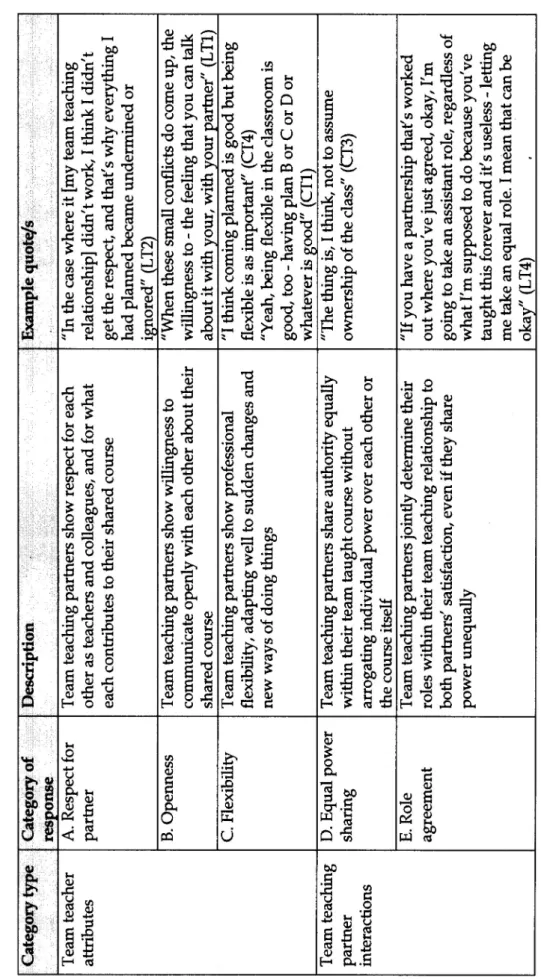
Data emerging from the focus group discussions were content-analysed to categorise the types of responses which were of common importance to the respondents. Since the focus group discussions yielded data concerned with a wide variety of team teaching issues, responses of lesser prominence were filtered out of the final results table, but all major categories of response that emerged from the data were identified and tabulated, without exception. The criteria for defining a category of response as a major category were that it must have emerged independently in the responses of each of the two focus group discussions and be identifiable in quotes from at least two different respondents. In fact, all but one of the categories (category ‘K’) in the final results table exceeded the minimum terms of these criteria by emerging several times in the responses from different participants or at different points within the discussions. Table 1 provides definitions and descriptions of each major category of response, together with example quotes from the respondents to demonstrate how each category was
manifested in the data. The categories have also been collocated into general types for purposes of comparison and ease of reference.
In the course of data analysis for this study, a researcher with no past or present association with MIC agreed to perform an inter-rater reliability check on the results by categorising 39 selected respondent quotes from a randomly compiled list, according to an earlier version of table 1. An inter-rater agreement of 89.7% resulted. Where the raters’ judgments diverged, marginal adjustments were made to the table to improve the mutual exclusivity of its category definitions and clarify its descriptions.
The final question in the moderator’s question route asked respondents to identify what was to them the single most important point about effective team teaching from everything that had arisen in the preceding discussion. The initial three categories of table 1 emerged as the three most common types of response to this question. ‘Respect (for one’s team teaching partner)’ was considered important by four respondents (CT1; CT2; CT4; LT2), while ‘openness’ and ‘flexibility’ were each considered important by three respondents (CT4, LT1, LT4 and CT4, LT1, LT2, respectively) 1.
Analysis
(I) Category types
The major common categories from the data were collocated into category types which represent various aspects of team teaching, such as common attributes of effective team teachers, or administrative requirements for the institution where team teaching occurs. From these categorisations, table 1 shows that the three most important common categories of response were concerned with team teacher attributes and four of the remaining eight categories were concerned with team teaching partner interactions. It is perhaps unsurprising that these aspects figure so largely in the responses of CITT practitioners when a team teacher is likely to perceive his/her partner, and the attributes and behaviours demonstrated by that person in relation to the perceiver, as the closest and most readily apparent manifestation of team teaching in action. Also, although the pedagogical outcomes of CITT, as with any form of teaching, are expected to be of most direct benefit to the students to whom it is targetted, team teaching is an educational initiative centred on teachers themselves and their collaborative relationships with each other. Therefore, its effects on students, administrators and the wider institution might well be conceptualised as secondary aspects of the team teaching phenomenon, while the relationship between the two team teaching partners constitutes the heart of the phenomenon itself.
(II) Respect for one’s partner
When the respondents were asked to identify the single most important point about effective team teaching from all issues discussed, it is notable that most of them did not provide a single point in response to this question as directed, but tended to offer several points of equal importance. Their lack of compliance is suggestive that the respondents may tend to perceive team teaching variables as highly interdependent and consider the isolation of any single specific feature as an
1 Individual respondents are identified by code number within each designation: CT for
T ab le 1. M aj or c at egor ie s of r es po n se f ro m f oc u s gr ou p da ta , w it h d es cr ip ti on s an d ex am pl es (I ndi vi dual r es ponde nt s ar ide n ti fie d by co de n u m be r w it hi n e ac h de si gn at io n : C T fo r co n te n t te ac he r an d LT fo r la n gu age t ea che r) .
arbitrary distinction. Nevertheless, from all responses offered, respect for one’s team teaching partner (category ‘A’) emerged as the most common response, with four of the eight respondents emphasizing its importance.
The belief that respect between partners is of fundamental importance to the effective team teaching relationship is evident in much of the data, where it commonly emerges in responses to a range of questions about different aspects of team teaching, e.g.:
“Mutual respect, I think, is an important thing. You and the other person have different abilities, different interests, different approaches, different experiences, all that kind of stuff, but you can respect each other and bring it together in the same classroom” (CT1)
Indeed, one respondent defined respect as a first principle underlying other necessary attributes for effective team teaching, as follows:
“Of the things we have discussed so far, what would you say is the single most important point about effective team teaching?” (Moderator) …
“I would say it’s the respect. I mean, from the respect you get the flexibility and the tolerance” (LT2)
However, the respondents also identify a number of difficulties in showing respect for one’s partner behaviourally within the constraints of other responsibilities faced by CITT practitioners, as explained below.
(III) Coordinated student instruction
Although the need to show respect is one example of the responsibilities team teachers have towards their partners, they also bear the responsibilities that any teacher has toward his/her students, such as the responsibility to provide students with accurate and comprehensible information. Category ‘G’ notes that respondents recognise the importance of team teaching partners coordinating their instruction to avoid giving their students conflicting information, as expressed in the following quote:
“For students, maybe confusion sometimes. If it happens that you have a, as we talked about, you may …” (CT2)
“Get two versions of the same [instructions]” (CT1) “Yeah” (CT2)
“Two non-complementary versions … he said, she said” (CT1)
The data from this study reveal how these different responsibilities can create tensions when the need for partners to show respect for each other, and coordinate their classroom instruction, conflicts with their responsibility to provide their students with accurate information. These tensions are manifested in the classroom when a team teacher is faced with the dilemma of his/her partner giving students information that the observing teacher believes to be in error, but cannot correct for the students’ benefit without publicly undermining the partner’s authority and thereby showing disrespect for him/her. The following respondent expresses the dilemma thus:
“You don’t want to stop them [your team teaching partner], you know, midstream and then, and say, no, that’s wrong. On the other hand, you don’t want the students to be misled on something that needs to be, you know, made clear to them” (CT3)
Similarly, in the following exchange, a respondent appears to demonstrate some degree of embarrassment at the hypothetical suggestion that he/she would point out his/her partner’s mistakes in front of students in a team taught class, and laughs, perhaps nervously, at the idea. As a group, the participants proceed to discuss the issue, and seem to reach an informal consensus that pointing out a partner’s errors in front of students is not necessarily damaging to an effective team teaching relationship, but requires some degree of goodwill between the two teachers:
“In my experience, I don’t know whether you’ve ever experienced that, but the other teacher will make some mistake – factual errors, but I wouldn’t point it out in front of the students” (LT3)
“Oh no, not in front of students, no” (LT1) [Some dialogue omitted]
“No, I’ll keep quiet, of course [laughs]” (LT3) [Some dialogue omitted]
“It depends a great deal on the partnership …” (LT4) “And neither person minds” (LT1)
“Right” (LT4)
Since the participants identify mutual respect as very important to an effective team teaching partnership, this exchange suggests that partners with little respect for each other run the risk of damaging their (already poor) relationship still further by pointing out each other’s errors in front of students; yet they might be giving students inaccurate or misleading information if they did not. It therefore seems likely that the way team teachers reconcile these potentially conflicting responsibilities is one of the most problematic features of the CITT partnership.
(IV) Awareness of multiple perspectives
The prominence of category ‘H’ in the data, namely the potential for CITT to raise student awareness of multiple perspectives, introduces further complications to the tensions between the teachers’ various responsibilities. While respondents stress the importance of team teaching partners giving their students non-conflicting information in category ‘G’, they also paradoxically identify disagreement between team teachers as a potential benefit for students in category ‘H’, as exemplified in the following quote:
“If a good spirit is maintained, then I think it [disagreement between team teaching partners] contributes to this business of different, differing expert opinions and potentially helping critical thinking” (LT4)
Here, teacher disagreement is identified as a means of raising student awareness of multiple perspectives, and fostering critical thinking skills. Interestingly, while several of the categories of response emerging from the current study are well represented in the team teaching literature, category ‘H’ is far less prominent, although, in their CITT research, Perry and Stewart (2005) do note that students benefit from exposure to “multiple perspectives on key issues and concepts in their courses” (p.568). One possible explanation for the relative lack of prominence of this
category beyond the CITT context is that much team teaching research is focussed on unidisciplinary models of collaboration, such as the JET programme. These models are likely to require greater unity of instruction from their practitioners than interdisciplinary collaborations, which rely on experts from separate disciplines to pursue more distinctly different (albeit coordinated) educational goals. Additionally, since critical thinking is emphasized as a key feature in the MIC college mission (MIC Faculty Council, 2006a), and students are routinely expected to seek out and critically evaluate multiple viewpoints to synthesize their own coherent arguments in English across the curriculum, it seems unsurprising that the potential for using CITT to advance critical thinking skills has emerged as a prominent issue in this context.
Nevertheless, the balance struck between categories ‘G’ and ‘H’ in the data indicates that there is a need for CITT practitioners to make a distinction between the kinds of instruction for which classroom disagreement between the teaching partners may or may not be beneficial. The following quote helps to clarify this distinction:
“Discussing certain issues, having two different opinions is fine, but when it comes to an assignment, there should be one vision for the assignment, which I’ve had a problem with. It was an assignment I created, it was an assignment I planned out, it was an assignment I delivered to all the students but my partner had a completely different idea of the assignment. So when the students consulted him, you know, with any kind of questions that they had, he gave them a complete - different answer from what I wanted.” (LT2)
In this example, one might argue that the respondent is expressing frustration at the lack of coordination between team teaching partners when issuing instructions to their students about what they are supposed to know or do to meet the assessable requirements of their course, in contrast with theoretical or philosophical differences of opinion which are likely to model accepted differences between authorities in the wider academic or general community. In short, receiving conflicting information from multiple authorities can be of benefit to the development of students’ critical thinking skills, but will be of no benefit when the information they require constitutes directions for what their teachers expect them to do. Thus, team teaching partners must make on-the-spot decisions as to when they should present their students with a ‘united front’ in the classroom and when it is acceptable for them to diverge in opinion, but such a decision is dependent on how the teachers interpret the purpose of the classroom event in which they are engaged at any given time. If this purpose is interpreted differently by the individual team teachers, it might be expected to provoke frustration based on the perception that one’s partner is not behaving appropriately, and lead to deterioration in the relationship between the two team teachers.
(V) Equal power sharing and role agreement
Another potential conflict between categories that can be identified from the results of this study is that of equal power sharing (category ‘D’) and mutually determined role agreements (category ‘E’). While it is possible for team teachers to share power equally and jointly determine their roles within the team teaching relationship to both partners’ satisfaction, thus satisfying the requirements of both criteria, it is also possible for team teachers to jointly determine their roles in such a way that one teacher exercises a disproportionate degree of authority over his/her partner, thus violating the terms of category ‘D’, as is indicated in the description for category ‘E’ in table 1. The respondents identify different versions of team teaching
that are defined by the way team teaching partners distribute power between themselves, as expressed in the following quote:
“It just depends on who I’m working with, what team teaching means. For one class, I feel like it’s more of a team where we decide on what will be taught in the classroom and then we decide who is stronger in that aspect and then that person will take the lead and the other person will provide the support. And in another class, it was more of a senior teacher situation and the other partner would just be there to kind of fill in the gaps whenever something comes up. So I guess it depends on who you ask, or which partner I work with – it becomes a different type of team teaching situation” (LT2)
This finding is consistent with the team teaching literature, in which it is a common observation that partners in an effective team teaching relationship must negotiate a shared understanding of their roles and responsibilities in relation to each other in order to avoid the unwanted imposition of one partner’s authority into the other’s professional ‘territory’ (Bailey, Dale, & Squire, 1992; Brumby & Wada, 1990; Miyazato, 2006).
In their research into CITT, Perry and Stewart (2005) observe that power sharing problems can arise through disagreements between partners about the territorial boundaries of their roles, particularly with reference to the language/content distinction, and claim that a ‘leader/subordinate’ relationship can emerge which undermines the ideal of the equal CITT partnership. It is important to note here that a team teaching partnership at MIC in which power is shared unequally between partners contravenes the mandate of the institution, since CITT, by definition, is collaboration between equals (Stewart et al., 2000). Yet CITT practitioners themselves recognise circumstances where equality between partners is unrealistic and the teachers assume ‘leader/subordinate’ roles instead. It is notable how, in the following quote, the respondent twice qualifies his/her comments about equal power sharing at MIC with the word ‘supposed’, to suggest the divergence of reality from the institutional description of CITT:
“There’s a lot of cases where one person is the main teacher or the senior teacher and then the other teacher or teachers are basically assistants. I think that’s found in many situations elsewhere, though supposedly not here. And then, of course, this, the case that is supposed to be here at MIC, where we have equal partners” (LT1)
The usefulness of team teaching as a means of matching new teachers with senior mentors for on-the-job teacher training purposes does not go unnoticed by CITT practitioners, and one respondent even advocates a one-semester ‘training’ period of subordination for new team teachers before they assume equal authority with their partners in their team teaching relationships:
“This is my personal opinion, I think a first semester teacher at MIC, regardless of their credentials, if they don’t have a background in this kind of situation, and almost nobody does, I think it helps that person to allow the partner to take a leading role for a while and to take a supporting role. But then, after a semester, I think that’s enough. It’s just my personal view on it” (LT1)
“And then what should happen?” (Moderator)
“Then I think they can be, easily be equal partners from then on” (LT1)
Problems of inequality in power sharing also emerge in the historical context of the college itself. Since the prerequisite qualifications for content teachers hired by MIC have always been Ph.D.-level or equivalent, while those for language teachers have always been Masters degree-level or equivalent, the respondents recount how,
in past years, conflict was created by some team teachers’ expectations that the more academically qualified partner had the right to assume seniority over the less qualified partner, in violation of the institutional mandate for equal authority between the two teachers. For example:
“Earlier on, there was a sense that the content faculty owned the class and the language faculty assisted the – you know, there was a sentiment, and that was really very, very damaging and - it was the wrong view and the wrong attitude, and it led to bad feelings very quickly” (CT3)
Unsurprisingly, the arrogation of power by some team teachers has tended to breed resentment and contributed to the deterioration of relationships between partners. But the respondents make a clear distinction between this unwilling imposition of unequal power between partners and the mutually agreed acceptance of unequal roles by both partners (category ‘E’), and stress that it is possible for an effective team teaching relationship to be maintained in the latter case. As long as both partners voluntarily agree to their roles, the distribution of power between them can become negotiable without necessarily endangering the relationship. For example,
“It may be that, if ‘Vanna White’ likes to be ‘Vanna White’, then that works2. There was one
teacher here who actually liked to be ‘Vanna White’ because there was no preparation involved. You just have to stand there and look vaguely glamorous - [inaudible] - so, in terms of complementarity, it worked because they understood, both understood what their roles were in the class and there wasn’t any conflict in those roles. I don’t think it’s a very good model of how team teaching should work, but - it worked” (CT1)
As suggested here, while the respondent affirms that a team teaching partnership based on a relationship of unequal power between partners is viable, it tends to be perceived by respondents as a ‘weaker’, less preferable version of team teaching than the institutionally mandated version, and is recommended only when, for various reasons, it is unrealistic to expect partners to share their power equally. The key point of these observations is that if both team teachers negotiate a relationship to their mutual satisfaction, they can create a partnership with some degree of effectiveness, even if their relationship falls short of the ideal CITT partnership in other respects. However, if one partner attempts to exercise power arbitrarily over the other, the relationship is under a more fundamental threat, perhaps because it is likely to be interpreted by a team teacher as a lack of respect from the offending partner. Such an interpretation might be inferred from the following quote if it is supposed that one partner repeatedly telling the other that he/she is wrong is an inappropriate assumption of superior authority:
“[After discussing his/her relationship with a partner that worked well] The other partner, on the other hand, didn’t give me the same kind of respect and – anything I said was wrong!” (LT2)
Perry and Stewart (2005) conflate power inequality issues under the category of teacher ‘experience’, noting that they impact mostly on new team teachers and claiming that such issues “tend to dissipate” (p.569) as the practitioner gains in CITT experience. However, despite some advocacy of leader/subordinate roles for the training of new team teachers, there is little indication of concurrence with Perry and Stewart’s (2005) claim by respondents in the current study.
2 'Vanna White': A television game show hostess and actress mocked “for her limited
acting ability and her position on Wheel [of Fortune] as a non-speaking clotheshorse” (A & E Televsion Networks, 2007)
(VI) Openness and flexibility
Beyond the primary category of respect for one’s partner, two other attribute-related categories have emerged from this data, namely ‘openness’ and ‘flexibility’. The recurrence of these specific terms in the response data, and the identification of these attributes by respondents as the single most important points about effective team teaching from their discussions after ‘respect’, necessitated their inclusion as major categories of response in table 1, yet there seems to be a vagueness of interpretation in the way that the respondents themselves define these terms with reference to team teaching, as demonstrated by the following quotes:
“Openness is seeing the positive side of the person” (LT4) “What are the requirements of team teaching?” (Moderator)
“I was thinking as far as, you know, psychological requirements or sociological requirements, more tolerance on the part of both partners. More, more sensitivity, umm…. ” (LT1)
“Openness” (LT3)
“Um-hmm. Willing – willingness to accept other ways of doing things. Willingness to compromise, yeah?” (LT1)
“And sometimes learn from other ways …” (LT4)
“Um-hmm. Willingness to learn new ways of doing things” (LT1) “And could be more flexible” (LT2)
“Flexibility, yeah, yeah” (LT1)
In the course of data analysis, it became clear that these two categories were closely related to each other in the perceptions of participants, with several instances of respondents merging the two key terms in the same response. For example,
“Basically, it’s similar to what [LT4] said, the openness and the flexibility, the willingness to change and learn new things” (LT1)
With reference to openness generally, the general context of the discussion suggests that this might be interpreted most precisely as an openness of attitude, with a corresponding willingness to communicate openly with one’s partner on team teaching matters. Though not using the word ‘openness’ specifically, one respondent offers an insight into how it might be articulated in this response, which follows on closely from the previous quote:
“When these small conflicts do come up, the willingness to - the feeling that you can talk about it with your, with your partner and if you do have some sort of conflict you have the confidence that you can work it out and reach some kind of a compromise with them” (LT1)
In contrast, flexibility might be defined from this data as a willingness to adapt one’s behaviour to meet sudden or unexpected situations, as best expressed in the following exchange:
“I think coming planned is good but being flexible is as important” (CT4)
“Yeah, being flexible in the classroom is good, too - having plan B or C or D or whatever is good” (CT1)
This distinction between the two terms suggests that, while both categories are concerned with closely-related attributes of the effective team teacher, ‘openness’ might best be considered a willingness to communicate for cooperative purposes, while ‘flexibility’ might best be considered a willingness to adapt one’s behaviour for cooperative purposes.
The need for teacher flexibility emerges commonly in the team teaching literature, predominantly in terms of the partners’ potential differences in how they teach. According to Perry and Stewart’s (2005) respondents, one of the main obstacles to effective team teaching is “incompatible teaching styles” (p.565). Consequently, a teacher who has the flexibility to adapt well to his/her partner’s differences in ways of teaching is likely to team teach more effectively than one who adapts less well, as has been observed by a number of researchers (Dudley-Evans & St. John, 1998; Miyazato, 2006; M. Sagliano & Greenfield, 1998; Stewart, 2001).
(VII) Advance joint planning and preparation time
While the respondents’ comments in the previous quote highlight the importance of teacher flexibility, there is also a recognition that a team teacher’s ability to make sudden changes and adaptations in the classroom must be balanced against the importance of team teachers jointly planning and structuring various aspects of their shared curriculum outside the classroom. The need for team teachers to engage in advance preparation is well highlighted by CITT practitioners as a whole. Category ‘F’ indicates that team teaching partners need to jointly engage in the administrative requirements of their course because CITT requires joint commitment from both partners both inside and outside the shared classroom. Partners cannot simply meet in their shared classroom during lesson times to team teach, or they end up wasting lesson time on the planning that should have occurred beforehand, as noted by the following respondent:
“I have a partner who’s not very good about planning ahead of time, and sometimes we do the planning on the spot. When the class starts, we just do our discussion on what we’re going to do for that day, and that could eat up 10, 15, 20 minutes of their period. And the students have – don’t know what to do, because the teachers also don’t know what to do because we hadn’t planned anything out for the day” (LT2)
While this quote identifies the need for team teachers to engage in advance joint planning, it also suggests an implicit need for teachers to be given extra time in their schedules for class preparation, which is a common concern for CITT practitioners, as expressed in category ‘J’. The data from this study reveals that there is a close relationship between categories ‘F’ (‘advance joint planning’) and ‘J’ (‘preparation time’) in the perceptions of several of the respondents. Indeed, most of the inter-rater disagreement of the earlier version of table 1 resulted from the confusion of response items across these two categorisations. Yet despite their similarities, data analysis allowed a distinction to be made between these categories on the basis of the emphasis placed by respondents on specific aspects of the team teachers’ interactions. Category ‘F’, advance joint planning, implies a focus on the importance of team teachers not simply meeting in the classroom at class time and expecting the lesson to unfold without preparation, but to meet outside the classroom beforehand to jointly determine how the lesson is to proceed. The following quote emphasises this aspect of team teaching:
“Which is what I think, what [CT4]’s talking about, planning outside of the classroom so that the – the other person knows where you’re going to and why you’re going there and
roughly how long it’s going to take you to get there, so that they can plan that, or you can plan it” (CT1)
Category ‘J’, by comparison, is focussed specifically on the amount of time that team teachers require to jointly coordinate the different aspects of their team taught courses overall. This category reflects a common concern arising in the professional literature on team teaching, particularly CITT. Perry and Stewart (2005) quote a respondent’s claim that team teaching takes “twice as long” (p.571) to implement as single teacher instruction, and conclude that many respondents “emphasized the time-consuming nature of these extensive relationships” (p.572). Stewart, Sagliano et al. (2000), Sagliano, Sagliano et al. (1998), and Sagliano and Greenfield (1998) also note the need for extra time to implement CITT, and Nunan (1992) stresses the need for sufficient implementation time for team teaching in general to be successful. While it is true that much of this extra time is needed for the advance joint planning of category ‘F’, it also encompasses other aspects of collaborative teaching that may need to be negotiated and coordinated by both partners, such as summative student assessment or course evaluation. Such aspects are likely to be dealt with more quickly by a single teacher for a comparable non-team taught course, who has little need to take time to coordinate his/her actions with colleagues. The emphasis on the coordination time required by team teaching partners, rather than the specific activities they use to occupy that time, is evident in the following quote:
“[Team teaching is] time-consuming. Takes time to meet up, talk, talk through the things when you could just simply write it up, write up your, your curriculum, your course, on your own, on your time. So yeah, it takes time to meet up with someone…” (LT3)
It is notable that there is little in the major categories of response that might be interpreted as a drawback of CITT as an educational approach (as distinct from what teachers must have or do in order to implement it effectively), while perceived beneficial outcomes of CITT for both teachers and students emerged from the data as aspects of importance (categories ‘H’ and ‘I’). Evidently, CITT practitioners tend to support the widespread belief that the benefits of team teaching outweigh its disadvantages (Bailey et al., 1992; Edmundson & Fitzpatrick, 1997; Gottlieb, 1994; Nunan, 1992). ‘Extra preparation time’ emerging as a major category (category ‘J’) is thus conspicuous in this context, yet it might be considered unsurprising if it is remembered that such a requirement impacts directly on teachers’ scheduled workloads but is potentially invisible to administrators and other key institutional stakeholders, particularly if they have had little prior experience with team teaching in other institutional contexts. Inevitably, team teachers’ meeting times outside the classroom tend not to appear on administrators’ schedules, while lesson times do. Thus, teachers may feel a need to protect their interests by ensuring that the need for extra preparation time for team teachers remains a high-profile concern in the face of potential financial constraints and budget cuts that could result in the encroachment of expanding class contact hours into their team teacher coordination time. Such an encroachment would not only place extra workloads on teachers but, as far as CITT practitioners are concerned, would also hinder their ability to team teach effectively.
(VIII) Professional development opportunities
One of the most recurrent observations in the team teaching literature that is supported in data from the current study is conceptualised here as category ‘I’, that
team teaching offers opportunities for improvements in the partners’ professional development by learning from each other, e.g.:
“What are the strengths and benefits of team teaching?” (Moderator) “You could learn from another teacher” (LT2)
“Mmm” (LT1)
Many researchers have claimed that team teaching can act as a useful tool for professional development by raising teachers’ awareness of their own strengths and weaknesses and allowing critical reflection on their experiences and assumptions (Edmondson & Fitzpatrick, 1997; Kaufman & Brooks, 1996; J. Sagliano et al., 1998; Sandholtz, 2000; Stewart, 1999), hence its common use in teacher training scenarios, where new teachers are partnered with experienced mentors (Bailey et al., 1992; Kachi & Choon-hwa, 2001; Sandholtz, 2000). Perry and Stewart (2005), specifically, note that most of their respondents make mention of the benefits of having a teaching partner for professional self-reflection. As an example of this process, a respondent notes that having a partner to “bounce ideas off” (Perry & Stewart, 2005, p.568) can improve teacher creativity. Perry and Stewart (2005) infer from their findings that team teachers “grow as teachers through effective partnership” and that effective team teaching “can lead to increased reflection and professional growth” (p.568).
(IX) Priority of student needs
Like category ‘H’, category ‘K’ in the current study is largely unrepresentative of common findings from the professional team teaching literature. The claim of category ‘K’ responses is that student needs take priority over the state of the relationship between the two team teaching partners in terms of how its effectiveness should be evaluated, e.g.:
“I want my students to learn, even if it’s a horrible [teaching] relationship, or partnership, but students learn something, I’m very happy with that because that’s what matters.” (LT3)
Although, as has been mentioned, this category met only the minimum requirements for inclusion in table 1 by emerging explicitly from the responses of only one respondent in each focus group, it is notable that, in each case, the teacher was responding specifically to the final prompt of the interview, when asked to identify what they believed to be the single most important point about effective team teaching from the preceding discussion. It might be suggested that category ‘K’ was offered by respondents as a kind of caveat to earlier discussions, which were largely focussed on the attributes and interactions of the team teachers themselves, as has already been noted. But the importance of category ‘K’, even if not widely reflected across the beliefs of most CITT practitioners, should not be overlooked. Although it is largely unrepresentative of findings from the team teaching literature, it might be argued that category ‘K’ is consistent with a recent trend among team teaching researchers to take into consideration the interactions between all participants in the team taught classroom (Dudley-Evans, 2001; Miyazato, 2001; Tajino & Tajino, 2000), in contrast with typical older team teaching studies, which tended to focus primarily on the interpersonal dynamic between the two team teaching partners to the exclusion of their students. It is possible, then, that category ‘K’ is indicative of a changing zeitgeist in the field of teacher collaboration amongst researchers and teachers alike.
Conclusion
Eleven major categories of importance to participants were identified in the data analysis of this study. Three team teacher attributes were identified as the most important, with four of the remaining eight categories concerned with team teaching partner interactions. Although the responses suggest that there is a high level of interdependence between the various features of team teaching, ‘respect for one’s partner’ was identified as fundamentally important to an effective partnership, and was observed to underlie other aspects of an effective team teacher’s behaviour. ‘Openness’ and ‘flexibility’ were also considered of key importance, though some inferences needed to be made as to how the respondents defined these terms.
Despite an acknowledgement of the time-consuming nature of team teaching, the respondents tended to emphasize the beneficial outcomes of CITT as an educational approach. Most of the prominent categories emerging from the current study are commonly represented in the findings of previous research into team teaching literature in general and CITT in particular, especially ‘professional development opportunities’; ‘equal power sharing’; ‘role agreement’; ‘need for extra preparation time’; and the importance of teacher ‘flexibility’. However, two less common categories have emerged from the current study, namely, ‘awareness of multiple perspectives’ and ‘priority of student needs’.
With regard to the effective implementation of CITT, a number of potential tensions were identified between a team teacher’s various responsibilities, including: the need to show respect for one’s partner and the need for both team teachers to provide students with non-conflicting instruction; the need to provide students with non-conflicting instruction and the potential for team teachers to develop their students’ critical thinking skills by representing divergent perspectives; the importance of teacher flexibility and the need for partners to conform to jointly planned classroom behaviour; and the need for team teachers to negotiate their roles and distribute power within the partnership to the satisfaction of both parties.
The findings of the current study have provided a number of possible directions for further research in this area, particularly with reference to the potential tensions arising between specific categories of response. These tensions suggest a need for further research to provide ordinal data indicating how CITT practitioners rank in importance their various responsibilities in relation to each other, since such data might enhance our understanding of team teacher behaviour that seems paradoxical at face value, when team teachers feel they must fail one of their professional responsibilities to meet another responsibility deemed to be of greater importance. At the time of writing, a questionnaire-based research project is being conducted at MIC which will address these issues in more depth and gather data from a broader sampling of CITT practitioners in order to further our knowledge in this field.
References
A & E Television Networks. (2007). Vanna White biography (1957-). Retrieved Nov 19, 2007, from http://www.biography.com/search/article.do?id=9542236 Anderson, G. (1990). Fundamentals of educational research. London: Falmer Press. Bailey, K. M., Dale, T., & Squire, B. (1992). Some reflections on collaborative
language teaching. In D. Nunan (Ed.), Collaborative language learning and
teaching (pp. 162-178). Cambridge: Cambridge University Press.
Brinton, D. M., Snow, M. A., & Wesche, M. B. (1989). Content-based second language
instruction. Boston: Heinle & Heinle.
Brumby, S., & Wada, M. (1990). Team teaching. London, New York: Longman.
Dudley-Evans, T. (2001). Team-teaching in EAP: Changes and adaptations in the Birmingham approach. In J. Flowerdew & M. Peacock (Eds.), Research
Perspectives on English for Academic Purposes (pp. 225-238). Cambridge:
Cambridge University Press.
Dudley-Evans, T., & St. John, M. J. (1998). Developments in ESP: A multi-disciplinary
approach. Cambridge: Cambridge University Press.
Dushku, S. (2000). Conducting individual and focus group interviews in research in Albania. TESOL Quarterly, 34(4), 763-768.
Edmondson, E., & Fitzpatrick, S. (1997). Collaborative language teaching: A catalyst for teacher development. The Teacher Trainer, 11(3), 16-18.
Edmundson, E., & Fitzpatrick, S. (1997). Collaborative language teaching: A catalyst for teacher development. The Teacher Trainer, 11(3), 16-18.
Fowler, J., Floyd J. (1995). Improving survey questions: Design and evaluation (Vol. 38). Thousand Oaks: Sage.
Frazee, J. P. (2007). When private animosities distort professional judgement. The Chronicle of Higher Education Retrieved Nov 20, 2007, from http://chronicle.com/jobs/news/2007/10/2007103101c/careers.html
Frey, J. H., & Fontana, A. (1993). The group interview in social research. In D. L. Morgan (Ed.), Successful focus groups: Advancing the state of the art (pp. 20-34). Newbury Park, CA: Sage.
Glaser, B., & Strauss, A. (1967). The discovery of grounded theory. Chicago: Aldine. Gottlieb, N. (1994). Team teaching Japanese language in Australian universities. In
M. Wada & A. Cominos (Eds.), Studies in team teaching (pp. 186-200). Tokyo: Kenkyusha.
Grotjahn, R. (1987). On the methodological basis of introspective methods. In C. Faerch & G. Kasper (Eds.), Introspection in second language research. Clevedon, Avon: Multilingual Matters.
Ho, D. (2006). The focus group interview: Rising to the challenge in qualitative research methodology. Australian Review of Applied Linguistics, 29(1), 05.01-05.19.
Kachi, R., & Choon-hwa, L. (2001). A tandem of native and non-native teachers: Voices from Japanese and American teachers in the EFL classroom in Japan. Paper presented at the Annual International Conference on Language Teacher Education, Minneapolis, MN.
Kaufman, D., & Brooks, J. G. (1996). Interdisciplinary collaboration in teacher education: A constructivist approach. TESOL Quarterly, 30(2), 231-251.
Krueger, R. A., & Casey, M. A. (2000). Focus groups: A practical guide for applied
research (3rd ed.). Thousand Oaks: Sage.
MIC Faculty Council. (2006a). Faculty Handbook: Institutional Mission 1.1. Retrieved April 27, 2007, from http:// sekai.miyazaki-mic.ac.jp / Faculty_Handbook/mission.html
MIC Faculty Council. (2006b). Faculty Handbook: Teaching partnerships 4.12.1. Retrieved November 20, 2007, from http:// sekai.miyazaki-mic.ac.jp / Faculty_Handbook/policies.html#partners
Miyazato, K. (2001). Team teaching and Japanese learners' motivation. The Language
Teacher(November), Online version.
Miyazato, K. (2006). Role and power sharing between native and non-native EFL teachers: Three cases of team teaching in Japanese high schools. Unpublished doctoral dissertation, Temple University, Philadelphia.
Nunan, D., (ed). (1992). Collaborative language learning and teaching. Cambridge: Cambridge University Press.
Perry, B., & Stewart, T. (2005). Insights into Effective Partnership in Interdisciplinary Team Teaching. System, 33(4).
Sagliano, J., Sagliano, M., & Stewart, T. (1998). Peer coaching through team teaching: Three cases of teacher development. Asia-Pacific Journal of Teacher Education
and Development, 1(1), 73-82.
Sagliano, M., & Greenfield, K. (1998). A collaborative model of content-based EFL instruction in the liberal arts. TESOL Journal, 7(3), 23-28.
Sagliano, M., Stewart, T., & Sagliano, J. (1998). Professional training to develop content-based instruction in higher education. TESL Canada Journal, 16(1), 36-53.
Sandholtz, J. H. (2000). Interdisciplinary team teaching as a form of professional development. Teacher Education Quarterly, 27(3), 39-54.
Stewart, T. (1996). Organizing and teaching course content in fully integrated language and content instruction. Comparative Culture: The Journal of Miyazaki
International College, 2, 1-17.
Stewart, T. (1999, Nov). Fostering communication among teachers in pre-service training sessions. The Language Teacher Retrieved Oct 26, 2004, from http://www.jalt-publications.org/tlt/articles/1999/11/stewart/
Stewart, T. (2001). Raising the status of ESP educators through integrated team teaching. Asian Journal of English Language Teaching, 11, 45-67.
Stewart, T., Sagliano, M., & Sagliano, J. (2000). An alternative team teaching model for content-based instruction. Asia-Pacific Journal of Teacher Education and
Development, 3(1), 211-243.
Tajino, A., & Tajino, Y. (2000). Native and non-native: What can they offer? ELT
Appendix
The following “questioning route” (Krueger & Casey, 2000, p.47) was used by the moderator to guide the focus group discussions:
1. What does the term 'team teaching' mean to you?
2. What are the requirements of team teaching that are different from the requirements of traditional teaching?
3. What are the strengths and benefits of team teaching for participating teachers? 4. What are the strengths and benefits of team teaching for participating students? 5. What makes a team teaching partnership work effectively?
6. What are the weaknesses and limitations of team teaching for participating teachers?
7. What are the weaknesses and limitations of team teaching for participating students?
8. What prevents a team teaching partnership from working effectively?
9. Of the things we have discussed so far, what would you say is the single most important point about effective team teaching?