「 するとすぐに」の意味を持つ接続詞の発達 (経
済学部開設50周年記念号)
著者
原口 行雄
雑誌名
熊本学園大学経済論集
巻
24
号
1-4
ページ
287-315
発行年
2018-03-28
URL
http://id.nii.ac.jp/1113/00003140/
The Development of Conjunctive WordGroups
1)Which Express Two Events or Actions that Take Place one after the other
原 口 行 雄
要 約
拙論は 16 世紀前半から 19 世紀前半までの『〜するとすぐに』の意味を表す「時の 副詞節」を導く接続詞の発達と衰退について論じたものである。資料としてフィクショ ンならびにノンフィクションの散文作品を用いた。 接続詞は形態を中心に 4 つのグループに分類した。即ち、第 1 グループ (as soon as, so soon as、as soon as ever、anon as、as fast as、soon as の 6 種類); 第 2 グループ(no sooner 〜 but、no sooner 〜 than、no sooner 〜 when、no sooner 〜 but that、scarce
〜before、scarce 〜 but、 scarce 〜 but that、scarce 〜 ere、 scarce 〜 that、scarce 〜 then、 scarce 〜 when、scarcely 〜 before、scarcely 〜 ere、scarcely 〜 than、scarcely 〜 when、 hardly 〜 before、hardly 〜 e're、hardly 〜 when、barely 〜 when の 19 種類);第 3 グルー プ(the moment、the instant、the minute、the moment that、the instant that の 5 種類);第
4 グループ(directly と immediately の 2 種類)。
第 1 グループの場合、as soon as と so soon as の 2 種類の出現回数が他を大きく上回っ
ている。だが、18 世紀後半にso soon as は出現回数を大幅に減らし、19 世紀前半に完
全に消失する。as soon as は優勢を保持したまま現在でも唯一残存し続けている。第 2
グループでは、no sooner 〜 but と no sooner 〜 than の 2 種類はその出現回数が他の 17
種類よりも比較的多い。それでもno sooner 〜 but は 18 世紀後半に出現回数が大幅に
減少し、19 世紀前半に完全に姿を消し、no sooner 〜 than の優勢が決定する。残りの
接続詞はその出現が概ね一定しておらず、19 世紀前半にはscarcely 〜 before、scarcely
〜when、hardly 〜 before、hardly 〜 when の 4 種類がその出現回数から見て残存して
いく可能性が窺われる。第 3 グループの場合、18 世紀前半から 19 世紀前半までの 3
1) 調査対象の時の副詞節を導く接続詞を英語での表記をconjunctive word-groups としたのは、Poutsma の表記方法を援用したものである。See Poutsma (1929: 665): Than appears at the head of a clause thought of in a relation of time is expressed by the group no sooner …than, which differs from other conjunctive word-groups of time such as as soon as, etc., only in so far as its two members are divided by other elements of the sentence. In early Modern English but was often used instead of than.
期を通じて、the moment は出現回数が他の接続詞を大幅に上回り優勢を保持しており、
またthe instant や the minute と共に現代英語に残存している。第 4 グループの directly
とimmediately も現代英語に残存している。先ず、directly はイギリス英語でのみ使用
されるもので、19 世紀前半に登場した際、主にDickens、Thackeray、M. Arnold が用 いている。一方、immediately は Robinson Crusoe(1719)でのみ使用され稀有な存在
であった。 第 2 グループのno sooner、scarce、scarcely、hardly、barely の否定の副詞が文や節 の先頭に来ると通例主部と動詞句の間で倒置構造が生まれる。兎に角、いずれかの否 定の副詞が先頭に来て、倒置構造を形成するものは多いとも少ないとも云えないほど であった。それでもno sooner 〜 than に限り、18 世紀前半までは倒置構造を生じる回 数は少数であったが、18 世紀後半から 19 世紀前半までその回数が増加している。 すべての接続詞が 2 つの節、即ち従属節と主節を備えている。この 2 種類の節に 現れる動詞の時制を調べた結果、「単純過去時制+単純過去時制」の組合せの総数が 第 1 位で、「過去完了時制+単純過去時制」の組合せの総数が第 2 位であった。
序
この論文は 16 世紀初頭から 19 世紀前半までの初期近代英語期と後期近代英語期における 「〜するとすぐに」の意味を持つ接続詞の発達を扱ったものである。資料として用いたのはイ ギリス英語の散文作品である。 次の四項目について論じる。 ( 1 )4 グループから成る接続詞と各グループの特徴 ( 2 )主節と従属節における各動詞の時制の組合せ ( 3 )初期近代英語期から後期近代英語期までの各接続詞の衰退と発達( 4 )No sooner, Scarce, Scarcely, Hardly, Barely で始まる接続詞が倒置構造を取る実態
16 世紀初頭から 19 世紀前半までの 3 世紀半(350 年間)に亘る接続詞の発達と衰退の歴史 を見ていくにあたり、半世紀(50 年間)毎に区切って検討していく。従って、7 つの時代区分 を設定し、半世紀毎に 4 つの各グループのどの接続詞が登場し、発展、衰退(消失を含む)し ていったのかを表で示す。 Ⅰ.16 世紀前半(1501 年〜 1550 年) Ⅱ.16 世紀後半(1551 年〜 1600 年)
Ⅲ.17 世紀前半(1601 年〜 1650 年) Ⅳ.17 世紀後半(1651 年〜 1700 年) Ⅴ.18 世紀前半(1701 年〜 1750 年) Ⅵ.18 世紀後半(1751 年〜 1800 年) Ⅶ.19 世紀前半(1801 年〜 1850 年) 用例を提示する際、テキストからの場合該当ページを明記する。一方、電子テキストからの 場合には該当ページは明記しない。 今回、「時の副詞節を導く接続詞の発達」を再考する際に、以前の同じ内容の拙論で資料と して調査した全てのテキスト(電子テキストを含む)から収集した全用例を見直し、様々な観 点から分類し直したり、再検討を行ない、必要な修正を施した。
第 1 章 各グループに属する接続詞とグループ別特徴
接続詞をその形態面の特徴に基づいて以下の 4 グループに分類した。 第 1 グループ 6 種類as soon as、so soon as、as soon as ever、anon as、as fast as、soon as
第 2 グループ 19 種類
no sooner 〜 but、no sooner 〜 than、no sooner 〜 when、no sooner 〜 but that、scarce 〜 before、 scarce 〜 but、scarce 〜 but that、scarce 〜 ere、scarce 〜 that、scarce 〜 then、scarce 〜 when、 scarcely 〜 before、scarcely 〜 ere、scarcely 〜 than、scarcely 〜 when、hardly 〜 before、hardly
〜e're、hardly 〜 when、barely 〜 when
第 3 グループ 5 種類
the instant、the minute、the moment、the instant that、the moment that
第 4 グループ 2 種類
directly、immediately
上に挙げたように、第 1 グループに属する接続詞は 6 種類、第 2 グループに属する接続詞 は 19 種類、第 3 グループに属する接続詞は 5 種類、第 4 グループに属する接続詞は 2 種類あ り、全部で 32 種類ある。32 種類の内、現代英語まで存続できたのは、第 1 グループに属する 接続詞ではas soon as 1 種類だけであり、第 2 グループに属する接続詞では no sooner 〜 than、 scarcely 〜 before、scarcely 〜 when、hardly 〜 before, hardly 〜 when と barely ~ when の 6 種 類
であり、第 3 グループに属する接続詞ではthe instant、the minute、the moment の 3 種類であり、
第 4 グループに属する接続詞ではdirectly、immediately の 2 種類共に生き残っている。つまり
全部で 12 種類の接続詞が残存している。 第 1 節 第 1 グループに属する接続詞
第 1 グループに属する接続詞の内、as soon as、so soon as の 2 種類は特に使用頻度が高く、
一般的なものである。それで各時代区分に両方の接続詞が現れる時、両者は競合関係にあると 考えられている。残りのas soon as ever、anon as、as fast as、soon as の 4 種類は前述の 2 種類
と意味及び用法の点では類似のもので、as soon as ever は as soon as の強意形だと見なされてい
る。 次に、16 世紀前半から 19 世紀前半までの各半世紀におけるこれらの接続詞のそれぞれの出 現実態を披露しておく。各接続詞がいくつのテキストに全部で何回現れるのか、それは以下の 通りである。 表 1 第 1 グループの接続詞の半世紀毎の出現回数と出現したテキストの数 16 世紀前半 as soon as 115 回 7 テキスト 1501 — 1550 as soon as ever 1 回 1 テキスト anon as 3 回 2 テキスト 16 世紀後半 as soon as 106 回 14 テキスト 1551 — 1600 as soon as ever 4 回 3 テキスト as fast as 1 回 1 テキスト so soon as 31 回 7 テキスト 17 世紀前半 as soon as 63 回 4 テキスト 1601 — 1650 as soon as ever 1 回 1 テキスト so soon as 3 回 2 テキスト 17 世紀後半 as soon as 99 回 11 テキスト 1651 — 1700 as soon as ever 4 回 3 テキスト as fast as 1 回 1 テキスト so soon as 27 回 5 テキスト 18 世紀前半 as soon as 320 回 11 テキスト 1701 — 1750 as soon as ever 4 回 1 テキスト as fast as 9 回 6 テキスト 18 世紀後半 as soon as 204 回 17 テキスト 1751 — 1800 as soon as ever 1 回 1 テキスト as fast as 1 回 1 テキスト
so soon as 1 回 1 テキスト soon as 2 回 2 テキスト 19 世紀前半 as soon as 167 回 13 テキスト 1801 — 1850 as soon as ever 6 回 4 テキスト as fast as 4 回 4 テキスト so soon as 8 回 4 テキスト soon as 2 回 1 テキスト 表 1 の各接続詞の半世紀毎の出現回数からas soon as と so soon as の 2 種類のみが競合関係 にあったことが窺える。16 世紀後半に両者の競合関係はas soon as 109 回対 so soon as 31 回で 始まり、17 世紀前半には 62 回対 3 回と一旦弱まり、17 世紀後半には 105 回対 27 回と勢いを 盛り返した。だが 18 世紀前半にはso soon as は一度も使用されず、競合関係は消失し、18 世 紀後半に再び出現するがわずか 1 回に過ぎず、19 世紀前半にやや盛り返したものの 8 回のみで あった。従って、両者が実質的競合関係にあったのは 17 世紀後半までであったと結論づける ことができよう。
As soon as の強意形 as soon as ever は 16 世紀前半から 19 世紀後半まで途切れることなく出現
する。とはいえ、その出現回数は極めて少ない。因みに、半世紀毎に 1 回、4 回、1 回、4 回、 4 回、1 回、6 回の計 21 回に過ぎない。次に、as fast as は 16 世紀後半から、17 世紀前半は除
いて、19 世紀前半までほぼ連続して現れる。因みに、半世紀毎に 1 回、1 回、9 回、1 回、4 回と計 16 回でしかない。しかしながら、現代英語では接続詞としては機能せず、むしろ副詞 句としてのみ使用されている。例えば、Tim ran as fast as he could. のように強意の副詞句とし て、あるいはThat student can think as fast as her professor of physics does. のように同等比較を表 す副詞句として用いられている。Anon as は Middle English の名残りともいうべき接続詞で、例
えば、King Arthur と円卓の騎士を題材とした The Works of Sir Thomas Malory (a1470) の長編散文 ではanone as の spelling で 61 回も使用されている。なお、この接続詞は 16 世紀前半の笑い話
とWilliam Tyndale 訳の新訳聖書にのみ使われており、これ以降の時代には一切現れない。最後 に、soon as は 18 世紀後半の The Castle of Otranto (1764) と The Monk (1796) に各 1 回、19 世紀
前半のDavid Copperfield (1850) に 2 回使われているだけである。従って、第一グループの接続
詞としては、最も頻繁に使用されており、現代英語まで生き残ったas soon as が代表格の接続
詞である。
文法面では、第一グループの接続詞で始まる節が従属節として機能しており、従属節の述部 動詞が述べる行為に続いて起こる、別の述部動詞が表す行為が述べられている節が主節として
機能していることになる。
As soon as the King was departed, that noble Prince his son drew toward London, which at
the time of his father’s death, kept his household at Ludlow in Wales. [The History of King Richard the Third (1513)]
And therefore so soon as he [= Solomon] had made it, he concluded to make all the spirits come and appear before him. [The Mirrour of Mirth (1583), p. 370]
I will for this night lie in my cloathes, so that as soone as euer you call, I will straight be ready. [The Gentle Craft, Part I (?1597), p. 125]
As soon as ever the Phantastick Monarch cou’d find in his heart to divorce himself from the
dear and charming Embraces of his Beautiful Bedfellow, he came flying to Sir Phillip, [king of Bantam (1697), p. 290]
As fast as he [= the Saint] translated, he got every parcel o it by Heart, and with that help,
was of Opinion, that he might begin to declare the Gospel. [The Life of St. Francis Xavier (1688), p. 245]
the latter will be destroyed as fast as the former is spent, [David Simple (1744), p. 137]
Anon as this gentleman saw him [= a scholar of Oxford], he bad him go with him into
the City and he should be sped [= taken care of] anon.
[A Hundred Merry Tales (1526), p. 100]
But anone as Sir Launcelot harde of the shylde of Cornwayle, he wyste well hit was sir Trystram that had fought with hys enemyes,
[The Works of Sir Thomas Malory (a1470), p. 509]
And anon as he went on his way, his servants met him, and told him saying: thy child liveth. [Tyndale’s New Testament (1534): John, Ch. 4]
Soon as the company was dispersed their several ways, Frederic, quitting his chamber,
enquired if Hippolita was alone; [The Castle of Otranto (1764), p. 106]
第 2 節 第 2 グループに属する接続詞 表 2 第 2 グループの接続詞の半世紀毎の出現回数と出現したテキストの数 16 世紀前半 no sooner 〜 but 1 回 1 テキスト 1501 — 1550 scarce 〜 then 1 回 1 テキスト 16 世紀後半 no sooner 〜 but 55 回 17 テキスト 1551 — 1600 no sooner 〜 than 3 回 3 テキスト
no sooner 〜 but that 19 回 2 テキスト
scarce 〜 before 2 回 2 テキスト
scarce 〜 but 6 回 4 テキスト
scarce 〜 but that 1 回 1 テキスト
scarce 〜 ere 2 回 2 テキスト
scarce 〜 when 3 回 3 テキスト
scarcely 〜 before 2 回 2 テキスト
scarcely 〜 but that 3 回 1 テキスト
scarcely 〜 when 4 回 1 テキスト 17 世紀前半 no sooner 〜 but 33 回 10 テキスト 1601 — 1650 no sooner 〜 than 2 回 2 テキスト scarce 〜 that 2 回 1 テキスト 17 世紀後半 no sooner 〜 but 62 回 11 テキスト 1651 — 1700 no sooner 〜 than 19 回 2 テキスト no sooner 〜 when 4 回 3 テキスト scarce 〜 before 1 回 1 テキスト scarce 〜 but 1 回 1 テキスト scarce 〜 when 6 回 3 テキスト scarcely 〜 before 1 回 1 テキスト scarcely 〜 when 12 回 1 テキスト hardly 〜 e’re 4 回 1 テキスト hardly 〜 when 2 回 1 テキスト 18 世紀前半 no sooner 〜 but 35 回 8 テキスト 1701 — 1750 no sooner 〜 than 105 回 7 テキスト scarce 〜 before 9 回 3 テキスト scarce 〜 but 8 回 4 テキスト scarce 〜 when 12 回 6 テキスト hardly 〜 before 2 回 2 テキスト hardly 〜 when 2 回 2 テキスト 18 世紀後半 no sooner 〜 but 3 回 2 テキスト
1751 — 1800 no sooner 〜 than 137 回 13 テキスト scarce 〜 before 5 回 3 テキスト scarce 〜 ere 3 回 2 テキスト scarce 〜 when 26 回 8 テキスト scarcely 〜 before 5 回 4 テキスト scarcely 〜 ere 2 回 1 テキスト scarcely 〜 than 1 回 1 テキスト scarcely 〜 when 26 回 8 テキスト hardly 〜 when 7 回 3 テキスト 19 世紀前半 no sooner 〜 than 41 回 11 テキスト 1801 — 1850 scarce 〜 before 1 回 1 テキスト scarce 〜 when 2 回 2 テキスト scarcely 〜 before 6 回 2 テキスト scarcely 〜 ere 1 回 1 テキスト scarcely 〜 than 1 回 1 テキスト scarcely 〜 when 15 回 8 テキスト hardly 〜 before 3 回 3 テキスト hardly 〜 when 6 回 6 テキスト barely 〜 when 1 回 1 テキスト
No sooner 〜 but は初期近代英語期に Howleglas (?1528) にのみ現れる。ところが、16 世紀後
半からは使用回数も増し、増減を繰り返しながら 18 世紀後半まで連続して使用される。それ でも 18 世紀後半には使用回数が急激に減少し、19 世紀前半には姿を消してしまう。次に、no sooner 〜 but と競合関係にある no sooner 〜 than は初期近代英語期には 16 世紀後半に初めて登
場する。その後増大し始め、17 世紀後半に漸くno sooner 〜 but との競合関係の萌芽 (62 回対
19 回) が見られる。さらに、18 世紀前半に終にno sooner 〜 but に対し優勢(35 回対 105 回)
になり、19 世紀前半までその状況が継続する。No sooner 〜 than の出現回数は 18 世紀後半に
はさらに増えている (3 回対 137 回) のに、どういうわけか 19 世紀前半には大きく数を減らし ている(0 回対 41 回)。それでもなお、19 世紀前半にno sooner 〜 but が突然姿を消した結果、
終にno sooner 〜 than は no sooner 〜 but に対して交替を確立する。
なお、no sooner は「否定の意味を持つ副詞」で、後に続く語句の方は、no sooner と共に用
いる場合は、元々接続詞に分類されている。例えばOED において、no sooner に続く but は接
続詞に分類されており、現代英語の用法ではbut の代わりに than が必要であり、but は現代英
use requires than. (Also but that.) Obs.2)
Scarce ならびに scarcely は、「二つの行為が連続して起きる時に時の副詞節を導く接続詞」
として機能する際、両者共に他の語句を伴って使用される。他の語句としてscarce は 7 種類
(before、but、but that、ere、that、then、when) を 持 ち、 一 方 scarcely は 5 種 類(before、but that、ere、than、when)を持っている。Scarce あるいは scarcely で始まる接続詞は no sooner
で始まる接続詞に比べて、相対的に共に出現回数は少ない。従って、scarce 〜 before [(or) but、 but that、ere、that、then、when] と scarcely 〜 before [(or) but that、ere、than、when] 同 士 の 競
合関係も、この両者とno sooner で始まる接続詞との競合関係も概ねないと云ってもよいであ ろう。因みに、scarce で始まる接続詞と scarcely で始まる接続詞の出現回数を 16 世紀後半か ら比べてみると、次のようになる。順に、14 回対 9 回、2 回対 0 回、8 回対 13 回、29 回対 0 回、34 回対 34 回、8 回対 23 回である。顕著な傾向としては、scarce で始まる接続詞の方は 16 世紀前半から 19 世紀後半まで連続して現れるが、scarcely で始まる接続詞の方は 17 世紀前 半ならびに 18 世紀前半には完全に姿を消し、断続的にしか出現しない点である。別の顕著な 傾向としては、scarce ならびに scarcely に続く語句が、17 世紀後半から 19 世紀前半までを検 討すると、一貫して出現する語句が固定してくる点である。因みに、scarce に続く語句を、半
世紀毎に見てみると以下の通りである:before/but/when; before/but/when; before/ere/when; before/ when、つまり常に現れるのは、before と when である。一方、scarcely に続く語句の場合、次
の通りである:before/when; 18 世紀前半は scarcely の例はない;before/ere/than/when; before/ere/ than/when、つまり常に現れるのは、before と when である。Before か when との組合せの数の方
が、残りの語句との組合せの数よりも多いことからも、現代英語の時期へ近づくに連れて後続 の語句の種類が整理されてきたと推測しても無難であろう。因みに、半世紀毎に見てみると、 scarce の場合[7 回対 1 回;21 回対 8 回;31 回対 3 回;3 回対 0 回]、一方 scarcely の場合[13 回対 0 回;18 世紀前半はscarcely の例はない;31 回対 3 回;21 回対 2 回]となっている。以 上の数値の左側のものはbefore と when の出現回数を合算したものである。 Hardly で始まる接続詞は 17 世紀後半に初めて出現する。その後 18 世紀前半から 19 世紀前 半まで連続して使用されている。その出現回数は、scarce ないしは scarcely で始まる接続詞 のものと比べてもかなり少ない。因みに、半世紀毎に見てみると、6 回、4 回、7 回、9 回と なっている。また、hardly に続く語句を見てみると、scarce や scarcely で見たように、before か when との組合せの合計数の方が、残りの語句との組合せの合計数よりも多い傾向が窺われる。
因みに、半世紀毎に見てみると、[2 回対 4 回;4 回対 0 回;7 回対 0 回;9 回対 0 回]となっ
ている。即ち、17 世紀後半のみ別の語句との組合せの方が多いが、18 世紀に移行してからは
before か when との組合せしか見られない。この点も scarce や scarcely の場合同様に、現代英語
の時期へ近づくに連れて後続の語句の種類が整理されてきたと推測できよう。
最後に、barely 〜 when という接続詞は 19 世紀前半に初めて Austen の Northanger Abbey に 1
回のみ登場する。
以上から、No sooner 〜 than は第 2 グループの中では出現回数が一番多く、使用頻度も一番
高くもあり、代表の座を占めていると云えよう。
現代英語には残存していない no sooner ~ when は scarce ~ when、scarcely ~ when や hardly
~ when との混淆(混成)から生じたものであると Poutsma は解説している。(Poutsma: 668: The use of when instead of than after no sooner is another instance of contamination)3) 同様にこの解説
を基にして、scarce ~ but は no sooner ~ but との混淆から生じたと推測できよう。
The sun was no sooner stepped from the bed of Aurora, but Aliena was wakened by Ganymede, who, restless all night, had tossed in her passions, saying it was then time to go to the field to unfold their sheep. [Rosalynde (1590)]
But the young man no sooner saw it, but that beating his brest, he cried, [The New Arcadia (1590), p. 9]
No sooner was the unhandsome beast dislodged from his darksome habitation, when every
person well-horsed endeavoured to show his own skill and his courser’s vigour, [The Princess Cloria (1653/1661), p. 232]
Returning home this evening, a little before my usual hour, I scarce had seated myself in my easy-chair, stirred the fire, and stroked my cat, but I heard somebody come rumbling upstairs. [Isaac Bickerstaff (1709)]
Scarce a Day or Night pass’d over, but some dismal Thing or other happened at the End of that Harrow Alley, [the Plague Year (1722), p. 177]
She had scarce got twenty paces distant from me, ere something within me called out for a more particular enquiry [Sentimental Journey (1768), p. 20]
and Jacob was yet scarce gone out from the presence of Isaac his father, that Esau his brother came in from his hunting. [Genesis (1611), Ch. 27]
As soon as Isaac had made an end of blessing Jacob, and Jacob was scarce gone out from the
presence of Isaac his father: then came Esau his brother from his hunting: [Pentateuch: The First Book of Moses Called Genesis, Ch. 27 (1530), p. 46]
Their Tea was scarce over, when News came of the Arrival of old Mr. Andrews and his Wife. [Joseph Andrews (1742), p 263]
that some Popes haue scarcely liued 2 daies, nay some one day: before they haue bene made away [=get rid of or kill] by the Cardinals, [The Spanish Masqverado (1589), p. 261]
She had scarcely finished ere the bell announced bedtime: no delay could be admitted; [Jane Eyre (1847), p. 62]
Such she believed were his words; but scarcely had she received their sound, than her attention was caught by other sounds immediately behind her, which rendered every thing else trivial. [Persuasion (1818), p. 188]
I had scarcely reached the landing-place, when a violent knocking at the door shook my whole frame. [Memoirs of Emma Courtney (1796), p. 186]
One of the best of these I entered; but I had hardly placed my foot within the door, before the children shrieked, and one of the women fainted. [Frankenstein (1818), p. 70]
I’l take thy word, said t’other, and went directly to the place, where he had hardly sate down and call’d for some drink e’r [=e’re] the Souldier came in; [The Unhappy Mistake (1698), p. 432]
An hour had hardly flown away when the musicians played the signal for parting, so well known in Scotland. [Waverley (1814), p. 318]
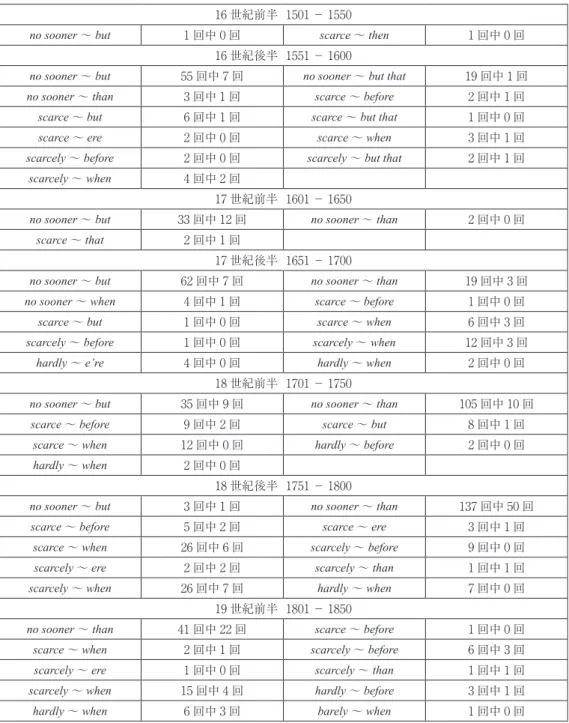
he accordingly set off by himself, and Catherine had barely watched him down the street, when her notice was claimed by the approach of the same two open carriages, containing the same three people that had surprised her so much a few mornings back. [Northanger Abbey (1818), p. 84] 次に、no sooner、scarce、scarcely、hardly、barely のいずれかで始まる接続詞は全て、その構 造上「否定の意味を持つ副詞+接続詞」から成り立っている。また、これらの否定の意味を持 つ副詞が文の先頭あるいは節の先頭に来ると、概ね前半の節は一般に倒置構造を取る。では、 no sooner、scarce、scarcely、hardly、barely の副詞が文や節の先頭に来て、倒置構造を取る回数 はどうなっているのかを表 3 に提示している。
表 3 第 2 グループの接続詞が倒置構造を取る回数
16 世紀前半 1501 - 1550
no sooner 〜 but 1 回中 0 回 scarce 〜 then 1 回中 0 回
16 世紀後半 1551 - 1600
no sooner 〜 but 55 回中 7 回 no sooner 〜 but that 19 回中 1 回
no sooner 〜 than 3 回中 1 回 scarce 〜 before 2 回中 1 回
scarce 〜 but 6 回中 1 回 scarce 〜 but that 1 回中 0 回
scarce 〜 ere 2 回中 0 回 scarce 〜 when 3 回中 1 回
scarcely 〜 before 2 回中 0 回 scarcely 〜 but that 2 回中 1 回
scarcely 〜 when 4 回中 2 回
17 世紀前半 1601 - 1650
no sooner 〜 but 33 回中 12 回 no sooner 〜 than 2 回中 0 回
scarce 〜 that 2 回中 1 回
17 世紀後半 1651 - 1700
no sooner 〜 but 62 回中 7 回 no sooner 〜 than 19 回中 3 回
no sooner 〜 when 4 回中 1 回 scarce 〜 before 1 回中 0 回
scarce 〜 but 1 回中 0 回 scarce 〜 when 6 回中 3 回
scarcely 〜 before 1 回中 0 回 scarcely 〜 when 12 回中 3 回
hardly 〜 e’re 4 回中 0 回 hardly 〜 when 2 回中 0 回
18 世紀前半 1701 - 1750
no sooner 〜 but 35 回中 9 回 no sooner 〜 than 105 回中 10 回
scarce 〜 before 9 回中 2 回 scarce 〜 but 8 回中 1 回
scarce 〜 when 12 回中 0 回 hardly 〜 before 2 回中 0 回
hardly 〜 when 2 回中 0 回
18 世紀後半 1751 - 1800
no sooner 〜 but 3 回中 1 回 no sooner 〜 than 137 回中 50 回
scarce 〜 before 5 回中 2 回 scarce 〜 ere 3 回中 1 回
scarce 〜 when 26 回中 6 回 scarcely 〜 before 9 回中 0 回
scarcely 〜 ere 2 回中 2 回 scarcely 〜 than 1 回中 1 回
scarcely 〜 when 26 回中 7 回 hardly 〜 when 7 回中 0 回
19 世紀前半 1801 - 1850
no sooner 〜 than 41 回中 22 回 scarce 〜 before 1 回中 0 回
scarce 〜 when 2 回中 1 回 scarcely 〜 before 6 回中 3 回
scarcely 〜 ere 1 回中 0 回 scarcely 〜 than 1 回中 1 回
scarcely 〜 when 15 回中 4 回 hardly 〜 before 3 回中 1 回
hardly 〜 when 6 回中 3 回 barely 〜 when 1 回中 0 回
かった。それでもなお、例えば、no sooner 〜 than の場合(18 世紀前半までは比較的少ないが、
18 世紀後半から 19 世紀後半にはかなり増えたとは云えよう。)下記の例からして、倒置構造 を取るものには過去完了で始まるものが多いという特徴が見られる。
倒置文の例
No sooner was the lady brought before the Emperor but he conceived her to be some goddess, and
offered to worship her, [no sooner 〜 but: The Blazing World (1666), p. 260.]
No sooner had Amata heard the name of Mignon, but she cried out, ‘Surely my happiness is now
complete, and all my sorrows, by this joyful moment, are more than fully recompensed; [no sooner 〜
but: The Governess (1749)]
No sooner was the treacherous Brother gone, than the old Lady taking Philadelphia by the hand, led
her into the Parlour; [no sooner 〜 than: The Unfortunate Happy Lady (1698), p. 368]
No sooner was the unhandsome beast dislodged from his darksome habitation, when every person
well-horsed endeavoured to show his own skill and his courser’s vigour, [no sooner 〜 when: The
Princess Cloria (1653/1661). P. 232]
but some indispensable business intervening to detain her [=Mrs. Cole], I was obliged to set out alone; and scarce had I got a third of my way, before the axletree broke down, and I was well off, to get out safe and unhurt, into a publick-house of a tolerably handsome appearance, on the road. [scarce ~ before:
Memoirs of a Woman of Pleasure (1749), p. 156]
scarce did they use any Caution, but run into any Business, which they could get Employment in, tho’
it was the most harzardous; [scarce ~ but: The Plague Year (1722), p. 90]
but scarce had she felt a mother's pangs, ere she heard the fatal rumour of her lord’s death, and the succession of Ricardo. [scarce 〜 ere: The Castle of Otranto (1764), p. 114]
We climbed the highest of these [hills], but scarce had we reached the top, when a mist descended upon every thing, and the rain began to fall: [scarce 〜 when: Six. Weeks’ Tour (1817), p. 29]
and scarcely had she felt a five minutes’ longing of friendship, before the object of it appeared, and inviting her to a secret conference, led the way to a seat. [scarcely〜before: Northanger Abbey (1818), p. 143]
Scarcely could I recollect where, or, indeed, what I was, ere they poured upon me such a torrent of
questions and enquiries, that I was almost stunned with their vociferation. [scarcely ~ ere:
Scarcely had He succeeded in his design, than He shuddered at himself and the means by which it was
effected. [scarcely 〜 than: The Monk (1796), p. 384]
Scarcely had he ended his Prayer, when he was assur’d, it was answer’d: [scarcely 〜 when: Life of St. Francis Xavier (1688) p. 95]
for hardly had she been seated ten minutes before a lady of about her own age, who was sitting by her, and had been looking at her attentively for several minutes, addressed her with great complaisance in these words: [hardly ~ before: Northanger Abbey (1818), p.31]
Darkness then came over me, and troubled me; but hardly had I felt this, when, by opening my eyes, as I now suppose, the light poured in upon me again. [hardly 〜 when: Frankenstein (1818), p. 68] 第 3 節 第 3 グループに属する接続詞 表 4 第 3 グループの接続詞の半世紀毎の出現回数と出現したテキストの数 18 世紀前半 the moment 73 回 7 テキスト 1701 — 1750 the instant 1 回 1 テキスト 18 世紀後半 the moment 98 回 11 テキスト 1751 — 1800 the instant 9 回 4 テキスト the minute 1 回 1 テキスト
the moment that 2 回 1 テキスト
the instant that 1 回 1 テキスト
19 世紀前半 the moment 31 回 10 テキスト 1801 — 1850 the instant 8 回 4 テキスト
the minute 2 回 2 テキスト
第 3 グループの接続詞は、「定冠詞 the + moment (or instant or minute)」の形式で機能する。 なお、3 種類の名詞moment、instant、minute はいずれもが「極めて短い時間」を表している。 Merriam-Webster's Advanced LEARNER’S English Dictionary では、それぞれの名詞の定義は以下
のようになっている。
moment: a very short period of time; instant: a very short period of time; minute: a brief period of time
さらに、上記の辞書ではthe instant と the minute は「as soon as」の意味で、the instant that、the minute that の形式で使用されることもあると例を挙げて示している。
I knew it was him the instant (that) [=as soon as] I heard his voice. I knew the minute (that) I saw it that I had to have this dress.4)
Swan (2005: 242 Practical English Usage) は、the moment/instant/minute に関して、現代英語に関 するコメントではあるが、the moment (that)、the instant (that)、the minute (that) [the second (that)
を含めて] のように that を伴って 接続詞 as soon as の意味でイギリス英語とアメリカ英語の両 方で使用されることもあると、2 個の用例を上げて解説している。[The moment (that), the instant (that), the second (that) and the minute (that) can be used in the same way [=as conjunctions, to mean ‘as
soon as’.] (in both British and American English). Telephone me the moment (that) you get the results. I loved you the instant (that) I saw you.] 5)
She flew with all speed to her chamber; and the moment she entered, Chloe cried out, ‘Can you forgive me, Caelia?’ [The Governess (1749)]
The moment he saw I could enjoy myself without him, and that others knew my value better
than himself, the selfish wretch began to accuse me of coquetry and extravagance, and to abuse Harry Meltham whose shoes he was not worthy to clean; [Agnes Grey (1847), p. 161]
and we having fee’d them the instant they entered the room, according to the instructions of our host, they bowed and smiled, and offered to introduce us to whatever disease we pleased. [Journey from This World (1743), p. 15]
yet, the instant I listened again, there was the doleful cry moaning on! [Wuthering Heights (1847), p. 21]
I understood that the minute the affair of the fire was over Mr. Falkland had retired to his own room. [Caleb Williams (1794), p. 134]
My mother was the daughter of a king; she died the minute I was born, as my good nurse Lychorida has often told me weeping. [Tales from Shakespeare (1807), p. 203]
But the moment that the Clock struck ‘One,’ irresistable slumber seized them, nor left them till The departure of the Ghost. [The Monk (1796), p. 163]
The instant that, from my window, I saw her returning, I flew down stairs, and met her in the
garden. [Evelina (1778), p. 302]
第 4 節 第 4 グループに属する接続詞
表 5 接続詞用法の Immediately and Directly
18 世紀前半
1701 — 1750 immediately 1 回 1 テキスト 19 世紀前半
1801 — 1850 directly 40 回 8 テキスト
現代英語の語法書であるSwan の Practical English Usage Third Edition に拠れば、イギリス英 語では、immediately と directly は「as soon as」と同じ意味で接続詞として用いることができる
と述べている。(Swan: 242: The moment (that), the instant (that), the second (that), and the minute (that) can be used in the same way (in both British and American English).6)ところで、後期近代英語では
どうなのかを以下で述べる。
Immediately と directly は共に「すぐに(without any delay, at once, right away)」の意味で一般
には副詞として使われている。ところが後期近代英語期に接続詞として「〜するとすぐに (as soon as) 」の意味で使用されるようになった。接続詞用法の immediately に関して、例えば、
Gilman は Webster's English Dictionary of Usage (1989) の中で「immediately は 100 年以上に亘っ て使われてきたが、アメリカ英語では確立するには至らなかったし、誤用だとされており、ア メリカの作家でこの語を使用するのはまれである。イギリス英語では接続詞用法の immediately
は普通であり、標準語となっている。」と述べている。(Gilman: s.v. immediately, 524-525:
Immediately has been used as a conjunction equivalent to as soon as for well over a hundred years, but
it has never really succeeded in establishing itself in American English. Many American commentators have cited it as an error, and our evidence shows that its use by American writers has been rare. In British English, however, it is common and standard)7) 一方、接続詞用法のdirectly に関して、Evans が
A Dictionary of Contemporary American Usage (1957) の中で「接続詞用法の directly は Dickens、
Thackeray、M. Arnold によってイギリス文学で確立し、過去 100 年間使用されてきた。」と 述 べ て い る。(Evans: s.v. direct; directly. 136: For the last hundred years the word directly has also been used as a conjunction, that is, to introduce a clause, as in directly he arrived, I left. Here the word means “as soon as.” The only possible objection to this construction is that it is relatively new. Most conjunctions have developed from adverbs in just this way, and this particular one has been established
6) See Swan (2005: 242) Practical English Usage Third Edition.
in English literature by Dickens, Thackeray, and Matthew Arnold.)8)
先ず、immediately は小野博士が『英文学研究 (1978)』で紹介された Robinson Crusoe (1719)
からの例が唯一のものである。9)また、18 世紀前半から 19 世紀前半までの数多くの散文テキ
ストを資料として扱った私の博士論文執筆の過程で残念ながら接続詞用法の例はCrusoe 以外
からは見つからなかった。一方、接続詞用法の directly については、Dickens、Thackeray、M.
Arnold の作品をそれぞれ 4、3、1 の計 8 テキストを調査し、40 回分見つかった。内訳は以下 の通りである。
Oliver Twist (183739、3回 )、Nicholas Nickleby (183839、9回 )、Old Curiosity Shop(1840
41、9 回)、Barnaby Rudge(1841、10 回)、Catherine(18391840、2回)、History of S. T. and H.
D.(1841、2 回)、Vanity Fair(1848、4 回)、Function of Criticism (1864、1 回)
さらに、接続詞用法のdirectly は、「くだけた、日常会話的な、話し言葉」として使用されるの
で、語りの箇所よりはむしろ対話の箇所に現れるのが普通である。Wilson は、接続詞用法の
directly は主としてイギリス英語であり、アメリカでは、標準語からははずれた使い方とされ、
イギリスの語法解説者の中にはこの用法はくだけた、日常会話的な、話し言葉として使う場合 のみ適切だと考える者もいるとコメントしている。[and the third (is) predominantly British (in the United States it is frequently labeled Nonstandard, and in Britain some commentators consider it suitable only for Informal use). ] 10)Swan と Sinclair が挙げている例も informal なものである:Directly we
get our visas we’ll be on our way. 142; Directly I walked in the door, I smelt smoke. 242; Directly I saw
the word Pankot it occurred to me that you must have known Colonel Layton and his family. 191. 今回 の調査では、語りの箇所に 21 回、対話の箇所に 19 回という結果であった。その内訳は次の 通りである。語りの箇所には、Nicholas Nickleby(4 回)、Old Curiosity Shop(4 回)、Barnaby Rudge(7 回 )、Catherine(1 回 )、Vanity Fair(1848、4 回 )、Function of Criticism(1 回 )。 一
方、対話の箇所には、Oliver Twist(3 回)、Nicholas Nickleby(5 回)、Old Curiosity Shop(5 回)、 Barnaby Rudge(3 回)、Catherine(1 回)、History of S. T. and H. D.(2 回)。
I made him understand that I would shoot and kill the Bird; accordingly I fir’d and bad him [=Friday] look, and immediately he saw the Parrot fall, he stood like one frighted again, notwithstanding all I had said to him; [Robinson Crusoe (1719) p. 211]
and directly he got into Wild’s gang, I knew that he had not a year to run. [Catherine (1839-40)]
8) See Evans (1957: 136) (s.v.) direct; directly A Dictionary of Contemporary American Usage.
9) 小野捷 (1978: 241-260) 参照「18 世紀における英語副詞節の変化について」『英文学研究』第 55 巻第 2 号 10) Wilson (1993: 142 The Columbia Guide to Standard American English, s.v. direct (adv., adj.), directly (adv.))
directly she got up I saw her look towards his infernal red lamp with the pantomime-light.
[Oliver Twist (1837-39) p. 94]
Directly people expect to make a large interest, their judgment seems to desert them;
[The History of S. T. and the H. D. (1841)]
for directly the man addressed me in the road, I recognised his speech again. [Barnaby Rudge (1841), p. 50]
She knew it was all up, directly I found it. [Vanity Fair (1848) p. 555]
‘That’s him,’ whispered Mr Kenwigs, greatly excited. ‘Morleena, my dear, run down and let your uncle in, and kiss him directly you get the door open. Hem! Let’s’ be talking.’ [Nicholas
Nickleby (1838-39) Ch. 14, p. 165]
I’ll go away directly you tell me to [go away], Quilp. [The Old Curiosity Shop (1840-41) p. 474]
Directly this play of mind wants to have more scope, and to forget the pressure of practical
considerations a little, it is checked, it is made to feel the chain. [The Function of Criticism (1865)]
第 2 章 主節と従属節の動詞の時制
第 1 グループの接続詞に関しては出現回数の多いas soon as について検討する。第 2 グルー
プの場合、出現回数が多いno sooner 〜 than について検討する。第 3 グループでは、出現回数
の多いthe moment を検討する。第 4 グループの場合、出現回数が多い directly が検討対象であ
る。
as soon as、so soon as、the moment、directly のいずれかで始まる節が従属節である。一方、no sooner 〜 but 及び no sooner 〜 than では、no sooner の後に述部動詞が来る節が主節で、but ない
しthan の後に主語と述部動詞が来る節が従属節だと考えられる。それは no sooner 自体は否定
の意味を持つ副詞句であり、but 及び than はそれぞれ接続詞だからである。
いずれにせよ、as soon as、the moment、directly に続く従属節の述部動詞が表す動作が先に
起こり、それに続いて主節の述部動詞が表す動作が生じる。一方、no sooner 〜 than では、no sooner の後に来る述部動詞が表す動作が先に起こり、それに続いて than に続く従属節の述部動
詞が表す動作が生じる。第 1 動作及び第 2 動作を表す各述部動詞の時制並びにその形態は、出 現回数が多いものについては下記の 4 パターンに分類される。
Present Perfect + Simple Present - Ⅲ- A(略記) Simple Past + Simple Past - Ⅱ- A(略記) Simple Present + Simple Present - Ⅰ- A(略記)
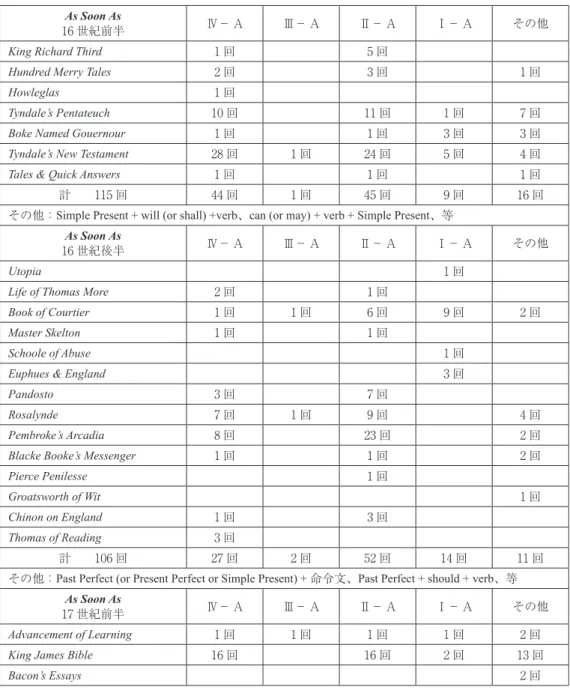
表 6 As Soon As で始まる従属節と主節の述部動詞の時制、形態と出現回数
As Soon As
16 世紀前半 Ⅳ- A Ⅲ- A Ⅱ- A Ⅰ- A その他
King Richard Third 1 回 5 回
Hundred Merry Tales 2 回 3 回 1 回
Howleglas 1 回
Tyndale’s Pentateuch 10 回 11 回 1 回 7 回
Boke Named Gouernour 1 回 1 回 3 回 3 回
Tyndale’s New Testament 28 回 1 回 24 回 5 回 4 回
Tales & Quick Answers 1 回 1 回 1 回
計 115 回 44 回 1 回 45 回 9 回 16 回 その他:Simple Present + will (or shall) +verb、can (or may) + verb + Simple Present、等
As Soon As
16 世紀後半 Ⅳ- A Ⅲ- A Ⅱ- A Ⅰ- A その他
Utopia 1 回
Life of Thomas More 2 回 1 回
Book of Courtier 1 回 1 回 6 回 9 回 2 回
Master Skelton 1 回 1 回
Schoole of Abuse 1 回
Euphues & England 3 回
Pandosto 3 回 7 回
Rosalynde 7 回 1 回 9 回 4 回
Pembroke’s Arcadia 8 回 23 回 2 回
Blacke Booke’s Messenger 1 回 1 回 2 回
Pierce Penilesse 1 回
Groatsworth of Wit 1 回
Chinon on England 1 回 3 回
Thomas of Reading 3 回
計 106 回 27 回 2 回 52 回 14 回 11 回 その他:Past Perfect (or Present Perfect or Simple Present) + 命令文、Past Perfect + should + verb、等
As Soon As
17 世紀前半 Ⅳ- A Ⅲ- A Ⅱ- A Ⅰ- A その他
Advancement of Learning 1 回 1 回 1 回 1 回 2 回
King James Bible 16 回 16 回 2 回 13 回
Voyage to Virginia 6 回 2 回
計 63 回 23 回 1 回 19 回 3 回 17 回 その他:Simple Past + Simple Present、Simple Past + would + verb、Present Perfect + will + verb、等
As Soon As 17 世紀後半 Ⅳ- A Ⅲ- A Ⅱ- A Ⅰ- A その他 Leviathan 2 回 2 回 Compleat Angler 1 回 Prince Cloria Mary Carleton 2 回 1 回 1 回 Blazing World 3 回 2 回 2 回 Elizabeth Lillyman 2 回 Pilgrim’s Progress I 1 回 Pilgrim’s Progress II 1 回 1 回 Life of F. Xavier 4 回 9 回 2 回
A. Behn’s short stories 14 回 33 回 1 回 6 回
Incognita 5 回 3 回 1 回
計 99 回 31 回 53 回 4 回 11 回 その他:should + verb + should (or would )+ verb、should + verb + Simple Past、等
As Soon As
18 世紀前半 Ⅳ- A Ⅲ- A Ⅱ- A Ⅰ- A その他
Isaac Bickerstaff 2 回 3 回 3 回
Robinson Crusoe 31 回 5 回
Journal of Plague Year 12 回 6 回
Roxana 7 回 18 回 5 回
Gulliver’s Travels 1 回 8 回 1 回 2 回
Pamela 2 回 1 回 18 回 2 回 15 回
Joseph Andrews 16 回 16 回
Journey from This World 1 回 5 回 2 回
David Simple 17 回 54 回 5 回
Fanny Hill 16 回 17 回 2 回
Governess 8 回 18 回 1 回
計 320 回 69 回 2 回 200 回 5 回 44 回 その他:Simple Past & Past Perfect + Simple Past、Simple Past + would + have + past participle、
could + have + past participle + Past Perfect、should + verb + would + verb、would + verb + would + verb、等
As Soon As 18 世紀後半 Ⅳ- A Ⅲ- A Ⅱ- A Ⅰ- A その他 Rasselas 1 回 Castle of Otranto 2 回 5 回 2 回 Vicar of Wakefield 1 回 7 回 Sentimental Journey 3 回 4 回
Humphry Clinker 1 回 2 回 4 回
Man of Feeling
Old English Baron 3 回 14 回 5 回
Evelina 7 回 24 回 3 回
Tour to the Hebrides 3 回 1 回 3 回
Vathek 1 回 2 回 2 回 Sicilian Romance 1 回 1 回 Simple Story 11 回 20 回 2 回 1 回 Caleb Williams 7 回 12 回 1 回 Emma Courtney 1 回 The Monk 12 回 23 回 3 回 4 回 Maria 1 回 1 回
Vaccination against Smallpox 1 回 2 回
計 204 回 50 回 120 回 9 回 25 回 その他:would + verb + might + verb、would + verb + Simple Past、Simple Past (or Simple Present) + should + verb、Simple Past + would + have + past participle、shall + verb + will + verb、等
As Soon As
19 世紀前半 Ⅳ- A Ⅲ- A Ⅱ- A Ⅰ- A その他
J. A. Letters 1 回 1 回 6 回 6 回 6 回
Tales from Shakespeare 1 回 4 回 1 回
Waverley 9 回 1 回 4 回
Six Weeks Tour 1 回 2 回
Frankenstein 1 回 6 回 1 回
Northanger Abbey 2 回 13 回 1 回
Persuasion 1 回 9 回 1 回
Opium-Eater 3 回
Voyage of the Beagle 1 回 18 回 7 回 1 回
Agnes Grey 2 回 4 回 3 回 1 回
Jane Eyre 1 回 9 回 3 回
Wuthering Heights 2 回 14 回 1 回 6 回
David Copperfield 1 回 11 回 1 回
計 167 回 14 回 1 回 97 回 29 回 26 回 その他:Simple Past + could + have + past participle、Past Continuous + Simple Past、Simple Past + Past Perfect、等
As soon as の場合、16 世紀前半から 19 世紀前半まででは、17 世紀前半を除いて、Ⅱ- A が
一番多い。因みに、順に 115 回中 45 回(39.1%)、106 回中 52 回(49%)、63 回中 19 回(30.2%、 2 番)、99 回中 53 回(53.5%)、320 回中 200 回(62.5%)、204 回中 120 回(58.8%)、167 回中
97 回(58.1%)である。次に多いのが、Ⅳ- A であるが、順に 115 回中 44 回(38.3%)、106 回 中 27 回(25.5%)、63 回 中 23 回(36.5%、1 番 )、99 回 中 31 回(31.3%)、320 回 中 69 回 (21.6%)、204 回中 50 回(24.5%)、167 回中 14 回(8.4%、4 番)となっている。Ⅲ- A は特に
少なく、17 世紀後半及び 18 世紀後半は皆無であった。
And as soon as he had made an end of communing with them, he put a covering upon his face. [past perfect + simple past: Pentateuch (1530), p. 136]
As soon as they have compleated the term of eighty Years, they are look’d on as dead in
Law; [present perfect + simple present: Gulliver’s Travels (1726) p. 180]
Then Martha, as soon as she heard that Jesus was coming, went and met him: but Mary sat
still in the house. [The New Testament: St John, Ch. 11 (1611), p. 120]
But as soon as the bird is seen flying, its whole appearance changes; [simple present + simple present: The Voyage of the Beagle (1839)]
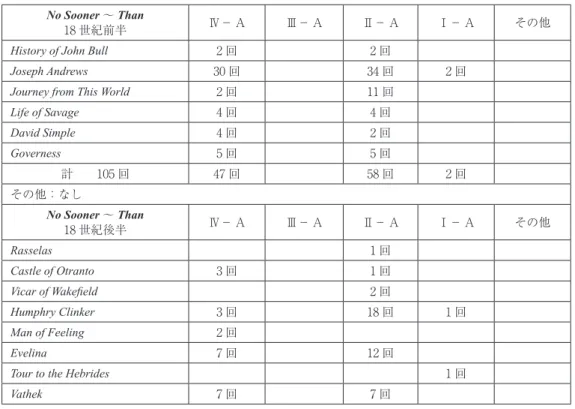
表 7 No Sooner 〜 Than で始まる従属節と主節の述部動詞の時制、形態と出現回数
No Sooner 〜 Than
18 世紀前半 Ⅳ- A Ⅲ- A Ⅱ- A Ⅰ- A その他
History of John Bull 2 回 2 回
Joseph Andrews 30 回 34 回 2 回
Journey from This World 2 回 11 回
Life of Savage 4 回 4 回 David Simple 4 回 2 回 Governess 5 回 5 回 計 105 回 47 回 58 回 2 回 その他:なし No Sooner 〜 Than 18 世紀後半 Ⅳ- A Ⅲ- A Ⅱ- A Ⅰ- A その他 Rasselas 1 回 Castle of Otranto 3 回 1 回 Vicar of Wakefield 2 回 Humphry Clinker 3 回 18 回 1 回 Man of Feeling 2 回 Evelina 7 回 12 回
Tour to the Hebrides 1 回
Simple Story 6 回 1 回 6 回 1 回
Caleb Williams 8 回 21 回
The Monk 9 回 17 回
History and Romance 2 回
Maria 1 回
計 137 回 45 回 1 回 86 回 4 回 1 回 その他:Past Continuous + Simple Past、
No Sooner 〜 Than
19 世紀前半 Ⅳ- A Ⅲ- A Ⅱ- A Ⅰ- A その他
Tales from Shakespeare 4 回 3 回
Waverley 3 回 5 回 1 回
Frankenstein 1 回
Northanger Abbey 2 回
Persuasion 1 回 1 回
Opium-Eater 1 回
Voyage of the Beagle 2 回 3 回 3 回
Agnes Grey 1 回
Jane Eyre 3 回 1 回 2 回
Wuthering Heights 1 回
David Copperfield 1 回 2 回
計 41 回 16 回 1 回 19 回 3 回 2 回 その他:Simple Past + Past Perfect、Past Perfect & Past Perfect(従属節)+ Past Perfect(主節)
No sooner 〜 than の場合、18 世紀前半から 19 世紀前半までの三期全般を通じてⅡ- A が一
番多い。因みに、順に 105 回中 56 回(53.3%)、137 回中 86 回(62.8%)、41 回中 19 回(46.3%) である。次に多いのがⅣ- A で、因みに順に 105 回中 47 回(44.8%)、137 回中 45 回(32.9%)、 41 回中 16 回(39%)である。Ⅲ- A は相変わらず少なく、18 世紀前半のみ皆無であった。as soon as に比べて III - A は極端に減少しており、18 世紀前半では皆無であった。
No sooner had he changed the bill, than he vanished from the sight of all his acquaintances,
and lay for some time out of reach of all the enquiries that friendship or curiosity could make after him; [past perfect + simple past: The Life of Savage (1744), p. 550]
‘no sooner have you got settled in a pleasant resting-place, than a voice calls out to you to rise and move on, for the hour of repose is expired.’ [present perfect + simple present: Jane
Eyre (1847) , p. 213]
that they were approaching the habitations of men. [simple past + simple past: The History of
Rasselas (1759), p. 83]
but no sooner do you find yourself in good quarters, than you forget that you are to move. [simple present + simple present: Tour to the Hebrides (1786), p. 352]
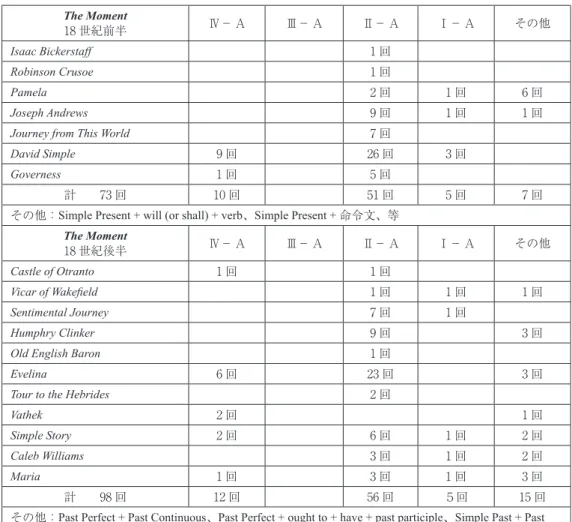
表 8 The Moment で始まる従属節と主節の述部動詞の時制、形態と出現回数 The Moment 18 世紀前半 Ⅳ- A Ⅲ- A Ⅱ- A Ⅰ- A その他 Isaac Bickerstaff 1 回 Robinson Crusoe 1 回 Pamela 2 回 1 回 6 回 Joseph Andrews 9 回 1 回 1 回
Journey from This World 7 回
David Simple 9 回 26 回 3 回
Governess 1 回 5 回
計 73 回 10 回 51 回 5 回 7 回 その他:Simple Present + will (or shall) + verb、Simple Present + 命令文、等
The Moment 18 世紀後半 Ⅳ- A Ⅲ- A Ⅱ- A Ⅰ- A その他 Castle of Otranto 1 回 1 回 Vicar of Wakefield 1 回 1 回 1 回 Sentimental Journey 7 回 1 回 Humphry Clinker 9 回 3 回
Old English Baron 1 回
Evelina 6 回 23 回 3 回
Tour to the Hebrides 2 回
Vathek 2 回 1 回
Simple Story 2 回 6 回 1 回 2 回
Caleb Williams 3 回 1 回 2 回
Maria 1 回 3 回 1 回 3 回
計 98 回 12 回 56 回 5回 15 回 その他:Past Perfect + Past Continuous、Past Perfect + ought to + have + past participle、Simple Past + Past Perfect、should + verb + would + verb、Present Perfect + will + verb、等
The Moment
19 世紀前半 Ⅳ- A Ⅲ- A Ⅱ- A Ⅰ- A その他
J. A. Letters 1 回
Tales from Shakespeare 1 回 3 回
Waverley 1 回
Persuasion 1 回
Voyage of the Beagle 1 回 1 回
Agnes Grey 1 回
Jane Eyre 1 回 3 回 2 回 1 回
Wuthering Heights 4 回 1 回 1 回
David Copperfield 2 回 3 回 1 回
計 31 回 7 回 17 回 4 回 3 回 その他:Simple Past + would + verb、Simple Past + would + have + past participle、Simple Present + will + verb、
The moment の場合、18 世紀前半から 19 世紀前半までの三期全般を通じてⅡ- A が一番多い。
因みに、順に 73 回中 51 回(69.9%)、98 回中 56 回(57.1%)、31 回中 17 回(54.8%)である。 次に多いのが、Ⅳ- A であり、因みに順に 73 回中 10 回(13.7%)、98 回中 12 回(12.2%、3 番)、 31 回中 7 回(22.6%)である。Ⅲ- A は三期全てで皆無であった。その他は 18 世紀後半のみ 98 回中 15 回(15.3%)と他の二期と比べると多い方である。
The moment it had taken its direction, Gulchenrouz, whose heart always trembled at any
thing sudden or rare, drew Nouronihar by the robe and anxiously requested her to return to the harem. [past perfect + simple past: Vathek (1786), p. 69]
the moment they approached each other, she begged him with the utmost Earnestness to
relieve a distressed Creature, [simple past + simple past: Joseph Andrews (1742) p. 210] We were left at peace in our beds as long as the summer moon shone, but the moment a blast of winter returns, you must run for shelter! [simple present + must + verb (as simple present):
Wuthering Heights (1847), p. 137] 表 9 Directly で始まる従属節と主節の述部動詞の時制、形態と出現回数 Directly 19 世紀前半 Ⅳ- A Ⅲ- A Ⅱ- A Ⅰ- A その他 Oliver Twist 1 回 1 回 1 回 Nicholas Nickleby 5 回 4 回 Catherine 2 回
Old Curiosity Shop 1 回 6 回 1 回 1 回
Barnaby Rudge 2 回 7 回 1 回
Titmarsh & Hoggarty 1 回 1 回
Function of Criticism 1 回
計 40 回 3 回 26 回 5 回 6 回 その他:Simple Present +will + verb、Simple Past + should (or would) + verb、等
Directly の場合、Ⅱ- A が一番多く、40 回中 26 回(65%)である。ところが、Ⅳ- A は 40 回中 3 回(7.5%、4 番)で一番少ない。また、Ⅲ- A は皆無であった。
まとめ
16 世紀前半から 19 世紀前半までの 3 世紀半にわたり、2 つの動作が連続して起こる際に使 用されてきた「時の副詞節を導く接続詞」の発達と衰亡の歴史の実態を、イギリスの散文作品 を資料として考察してきた。以上の事項を簡単にまとめると次のようになるであろう。 第 1 グループでは、出現回数の多いas soon as と so soon as が 16 世紀後半から競合関係に入 るが、18 世紀後半にはso soon as は衰退の一途を辿って行く。19 世紀前半には完全に消失し、 as soon as が最も有力な地位を確立する。第 2 グループでは、出現回数の多い no sooner 〜 butとno sooner 〜 than が 17 世紀後半から競合関係に入るが、18 世紀後半には no sooner 〜 but の
衰退が明確になり、19 世紀前半には完全に姿を消してしまう。その結果、no sooner 〜 than が
最も優勢になる。第 3 グループでは、18 世紀前半に登場したthe moment が同時期に出現した the instant ならびに 18 世紀後半に出現した the minute に対しても出現回数の点で大きく上回り、
19 世紀後半まで一番優勢な地位を保持し続けた。第 4 グループのdirectly は 19 世紀前半に登
場し、イギリスの作家の間で使用された。もう一つのimmediately は Robinson Crusoe に一度だ
け登場した。 さらに、第 2 グループの場合、no sooner、scarce、scarcely、hardly、barely のいずれかが文や 節の先頭に来ると、倒置構造が生まれる。調査結果からは、倒置構造を取ることが多いとも少 ないとも明確な結論には至らなかった。それでもなお、no sooner 〜 than の場合、18 世紀前半 までは比較的少ないが、18 世紀後半から 19 世紀後半にはかなり増えている。 以上の接続詞は、必ず従属節と主節の 2 種類の節と共に用いられる。この 2 種類の節で用い られる動詞の時制を調査した結果、一番多い組合せは「Simple Past + Simple Past」で、2 番目 に多い組合せは「Past Perfect + Simple Past」であった。さらに倒置構造を取る例を検討した結 果、動詞句は過去完了で始まるものが多かった。
参考文献
井上 義昌編(1972)『英米語用法辞典』東京:開拓社 Rep. of 1960. 小西 友七[編](2006) 『現代英語語法辞典』東京:三省堂 小野 捷(1978)「18 世紀における英語副詞節の変化について」『英文学研究』第 55 巻第 2 号 東京:日本英文学会 241260. 小野 捷(1984)『英語時間副詞節の文法』東京:英宝社Curme, George O. (1978) “Clause of time and its conjunctions.” Syntax. Boston: D. C. Heath and Company, Rep. of 1931. 266-277.
Curme, George O. (1986) A Grammar of The English Language. Volume I: Parts of Speech. Essex, Connecticut: Verbatim. Rep. of 1935.
Evans, Bergen and Cornelia Evans. (1957) A Dictionary of Contemporary American Usage. New York: Random House.
Gilman, E. Ward. (1989) Webster’s Dictionary of English Usage. Springfield, Massachusetts: Merriam-Webster Inc., Publishers.
Perrault, Stephen J. (2008) Merriam=Webster’s Advanced LEARNER’S English Dictionary. Springfield: Merriam Webster, Incorporated.
Poutsma, Hendrik. (1929) “Adverbial Clauses of Time.” A Grammar of Late Modern English. Part I The Sentence Second Half The Composite Sentence. Second Edition. Groningen: P. Noordhoff, 661-680. Quirk, Randolph et al. (1985) A Comprehensive Grammar of the English Language. New York:
Longman.
Sinclair, John. (1990) Collins COBUILD English Grammar. London: William Collins Sons & Co Ltd. Sinclair, John. (1993) Collins COBUILD English Usage. London: HarperCollins Publishers. Rep. of
1992.
Swan, Michael. (2005) Practical English Usage. Third Edition. Oxford: Oxford U. P.
Wilson, Kenneth G. Wilson. (1993) The Columbia Guide to Standard American English. New York: Columbia U. P.
The Oxford English Dictionary. Second Edition. (2009) on CD-ROM. Version 4.0. New York: Oxford