Japan Advanced Institute of Science and Technology
JAIST Repository
https://dspace.jaist.ac.jp/Title
MgO/MgCl_2/TiCl_4 Core-Shell Catalyst for Establishing Structure-Performance Relationship in Ziegler-Natta Olefin Polymerization
Author(s) Chammingkwan, Patchanee; Thang, Vu Quoc; Terano, Minoru; Taniike, Toshiaki
Citation Topics in Catalysis, 57(10-13): 911-917 Issue Date 2014-03-05
Type Journal Article
Text version author
URL http://hdl.handle.net/10119/12609
Rights
This is the author-created version of Springer, Patchanee Chammingkwan, Vu Quoc Thang, Minoru Terano, ToshiakiTaniike, Topics in Catalysis, 57(10-13), 2014, 911-917. The original
publication is available at www.springerlink.com, http://dx.doi.org/10.1007/s11244-014-0251-2 Description
MgO/MgCl
2/TiCl
4Core-Shell Catalyst for Establishing
Structure-Performance Relationship in Ziegler-Natta Olefin Polymerization
Patchanee Chammingkwan, Vu Quoc Thang, Minoru Terano and Toshiaki Taniike*
School of Materials Science, Japan Advanced Institute of Science and Technology, 1-1 Asahidai, Nomi, Ishikawa, 923-1292, Japan
Corresponding author
Assoc. Prof. Dr. Toshiaki Taniike
Keywords: Ziegler-Natta polymerization, structure-performance relationship, core-shell,
nanoparticle, S-plot
Summary
Recently we successfully established the first structure-performance relationships between the catalyst surface area and propylene polymerization activity using novel MgO/MgCl2/TiCl4
core-shell catalysts with non-porous and non-fragmentable features. In the present paper, we have addressed the physical and chemical natures of these novel model catalysts in comparison with typical Ziegler-Natta catalysts, by means of comprehensive characterization and analyses. It was clarified that the MgO/MgCl2/TiCl4 core-shell catalysts offer an ideal and
powerful tool to address relationships between the support architectures and polymerization performance, which had been long un-clarified.
1. Introduction
Since the memorial discovery by Karl Ziegler and Gulio Natta in 1953 and 1954, the heterogeneous Ziegler-Natta (ZN) catalyst has become indispensable catalyst for the industrial production of polyolefins for more than half century. A numerous amount of research have been undertaken during the past 60 years to attain molecular-level knowledge on the catalyst structure as well as on the polymerization mechanism. As a consequence, the nature of active site has been elucidated to some extent. For instance, the adsorption site of TiCl4 occurs on the lateral
surfaces of MgCl2 such as the (110) and (104) cuts exposing under-coordinated Mg2+ ions on the
surfaces[1]. In contact with alkyl aluminum cocatalyst, supported TiCl4 is converted to an active
site that equips a coordinative vacancy for incoming monomer olefin and a Ti-carbon bond as a growing chain. The polymerization initiates from the coordination of olefin monomer followed by migratory insertion of the coordinated monomer into the Ti-carbon bond as described by the Cossee-Arlman mechanism[2]. Ethylene can be polymerized irrespective of the oxidation state of Ti species with the tendency of higher molecular weight for a lower oxidation state of Ti[3]. On the contrary, Ti2+ species is inactive for polymerization of -olefin. Internal donor play important roles in stabilizing primary crystallites of MgCl2[4] and in drastically improving the
stereoselectivity in propylene polymerization through its coadsorption with a Ti center.[5-7] One of the breakthroughs in the heterogeneous ZN catalyst is the discovery of highly active catalyst by utilizing activated MgCl2 as the catalyst support. The activation can be
conducted by either mechanical grinding of anhydrous MgCl2 or chemical treatment of MgCl2
-alcohol adduct or magnesium alkoxide with a chlorinating agent. Microscopically, the activation causes the disordering in the stacking of Cl–Mg–Cl layers along the [001] axis as well as the
reduction of the crystal dimensions of MgCl2. Macro- and mesoscopically, catalyst particles
consist of hierarchical but irregular agglomeration of primary structural units, which bears a wide variety of intra-particle porosity from macro to micro. The hierarchy structure is important to control the polymerization activity over hours: polymerization-induced fragmentation breaks up the porosity and thus continuously supplies new active sites which are originally hidden inside pores. However, such the complexity makes it extremely demanding to quantitatively examine latent correlations between the support architectures and polymerization performance of typical ZN catalysts. Gerbasi et al.[8] examined the correlation between the ethylene polymerization activity and the grinding time for a TiCl4/MgCl2 catalyst. The activity was correlated with the
structural disorder of MgCl2 support rather than the catalyst surface area.[8] Margio et al.[9]
employed several ZN catalysts prepared from MgCl2-alcohol adduct to study the correlation
between the propylene polymerization activity and the catalyst surface area. While the activity was never correlated with the BET surface area, some level of correlation was found for the surface area obtained by small-angle X-ray scattering technique. Recently, we have applied the S-plot method to investigate the validity of the BET surface area for MgCl2-alcohol
adduct-based and Mg(OEt)2-based ZN catalysts.[10] The S-plots revealed the presence of two classes of
micropores, which disabled the evaluation of the physically meaningful BET surface area for typical ZN catalysts.
To overcome the above-mentioned problems for the support architectures, a model catalyst approach has been successfully employed by our group[11]: A series of MgO/MgCl2/TiCl4 core-shell catalysts with a variety of surface areas were fabricated.
Non-porous particles with a non-fragmentable MgO crystal core enabled us not only to systematically alter the catalyst surface area by changing the particle size but also to establish the first clear
proportional relationship between the propylene polymerization activity and the BET surface area.
The present paper delivers full characterization results for the MgO/MgCl2/TiCl4
core-shell catalysts, including X-ray diffraction (XRD), S-plot analysis in nitrogen adsorption, X-ray
photoemission spectroscopy (XPS) and polymerization kinetics, in order to clarify novel physicochemical properties of the model catalysts.
2. Experimental Part
Preparation of MgO nano-crystals
MgO nano-crystals were prepared using a sol-gel method according to the procedure described in literature.[12] Magnesium nitrate hexahydrate (Mg(NO)3.6H2O), and oxalic acid
dihydrate ((COOH)2.2H2O), purchased from Wako Pure Chemical Industries, Ltd. were
separately dissolved in ethanol. Subsequently, two precursors were mixed together at the molar ratio of 1:1 and vigorously stirred for 12 h. After completion, dense white gel of magnesium oxalate precursor was dried at 100ºC for 24 h before calcination in air to obtain MgO nano-crystals.
Preparation of MgO/MgCl2/TiCl4 catalyst
MgO nano-crystal powder was preliminarily dehydrated at 130°C under nitrogen flow for 6 h. 30 ml of TiCl4 (purchased from Wako Pure Chemical Industries, Ltd.) was slowly added to
2 g of MgO powder at room temperature. The mixture was then heated slowly to 140°C and kept at this reflux temperature for 2 h under stirring. The solid catalyst was washed several times with heptane and kept as suspension in anhydrous heptane under nitrogen.
Propylene polymerization
Propylene polymerization in slurry phase was performed in a 1 L stainless steel autoclave equipped with a mechanical stirrer. The reactor was repeatedly evacuated and purged with nitrogen several times to minimize residual oxygen and moisture. 200 ml of anhydrous heptane was introduced to the reactor under nitrogen flow. The solvent was then saturated with
propylene (donated by Japan Polypropylene Co., Ltd.) at 50ºC for 30 min, followed by the addition of 2.0 mmol of triisobutyl aluminum (TiBA, donated by Tosoh FineChem Co., Ltd.). 30 mg of catalyst in heptane was charged to the reactor to start polymerization. Semi-batch polymerization was carried out at 50ºC under 0.5 MPa of propylene pressure for 30 min before terminating by the addition of acidic alcohol. In separate experiments, propylene consumption profiles (termed as kinetic profiles) were recorded on a mass-flow meter for 2 h, where the polymerization conditions were the same with those described above except the fact that the polymerization was initiated by bomb injection of the catalyst.
Characterization
XRD was recorded on RINT 2100, Rigaku, using CuK radiation at 40 kV and 30 mA in the 2è range of 5-85º with the scanning speed of 1º/min to identify and determine the crystallite structures and dimensions of MgO nano-crystals and MgO/MgCl2/TiCl4 catalysts. In the case of
MgO/MgCl2/TiCl4 catalysts, the samples were prepared in a glove bag and sealed with Mylar
film to minimize the contact with air and moisture. The crystallite size of MgO was calculated using the Scherrer equation: d = K/Bcosè, where K is 0.94 for cubic dimensional crystal[13] and
B is the full width at half maximum (FWHM) of the (200) diffraction peak. Transmission electron microscope (TEM) was recorded on Hitachi H-7100, operated at the accelerating voltage of 120 kV, to observe the morphology and estimate the particle size of MgO nano-crystals. Nitrogen adsorption/desorption experiments were conducted on Belsorp-max at 77 K and the surface area was calculated based on the BET method. The S-plot[14] was constructed
from the adsorption volume (Vads(p/p0)) normalized at Vads(0.4) for a reference material (given
continuous S axis. XPS was measured on Kratos AXIS-ULTRA DLD using monochromated
Al-K radiation as the X-ray source. The anode was operated at 10 kV and 15 mA in an ultrahigh vacuum chamber maintained at the pressure below 5×10⁻⁹ Torr. A catalyst sample was transferred to the chamber using an air-tight transfer vessel. The neutralizer was used to reduce the charging effect to obtain better signal to noise ratio. The bulk titanium content of the MgO/MgCl2/TiCl4 model catalysts was analyzed by titration method. A catalyst sample was
dissolved in H2SO4/HCl (aq) before the addition of excess aluminum beads to reduce Ti4+ into
Ti3+. The titration was performed using Fe2(SO4)3 in H2SO4 (aq) as titrant in the presence of
NH4SCN as an indicator. The stereostructure of obtained polypropylene was analyzed by 13C
NMR (Bruker 400 MHz NMR spectrometer) at 120ºC using 1,1,2,2-tetrachloroethane-d2 as an internal lock and reference.
3. Results and Discussion
MgO/MgCl2/TiCl4 core-shell catalysts with different surface areas were prepared by
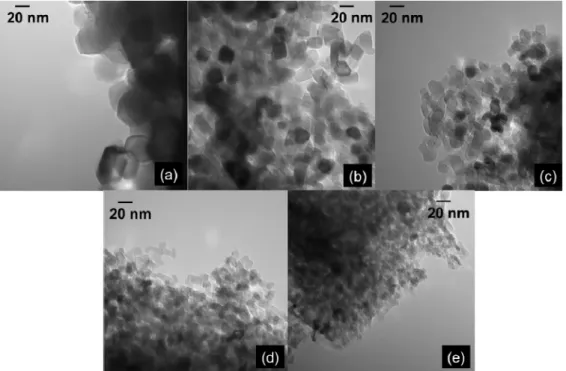
utilizing MgO nanoparticles having different sizes as the core material as described in our previous work.[11] Briefly, magnesium oxalate was calcined at different temperatures. The resultant MgO (MgO1-5) exhibited a cubic crystal structure in XRD, where the diffraction peaks became narrower for a lower calcination temperature. The crystal size estimated from the (200) diffraction peak of MgO using the Scherrer equation was in the range between 8 nm to 32 nm, depending on the calcination temperature as summarized in Table 1. TEM images in Figure 1 illustrated that all MgO samples have either a cubic or polygonal shape with the sizes almost the same as the crystal sizes obtained in XRD. The surface area analyzed by the BET
method increased with the decrease of particle size and the maximum surface area was found to be 221.5 m2/g for MgO5, having the smallest particle size of 8 nm. The absence of
intra-particle porosity for all the samples was validated by three different approaches; XRD analysis, TEM observation and particle size calculation from the BET surface area. Principally, particle size analysis from the BET surface area under the assumption of a cubic shape coincided well
with the sizes obtained from crystallographic analysis by XRD and direct visualization by TEM, except for MgO1, which exhibited the BET-based size much larger than the other two sizes. This deviation for MgO1 arose from the assumption of the cubic shape. Indeed, the assumption of a spherical shape resulted in a smaller BET-based size, indicating that MgO1 has an intermediate shape between cubic and spherical, i.e. polygonal, in accordance with the TEM observation. The concurrence of the three different sizes indicated that the MgO samples are of single crystal and free from internal pores. Thus obtained MgO nano-crystal with well-defined structures was treated with TiCl4, leading to the formation of MgCl2
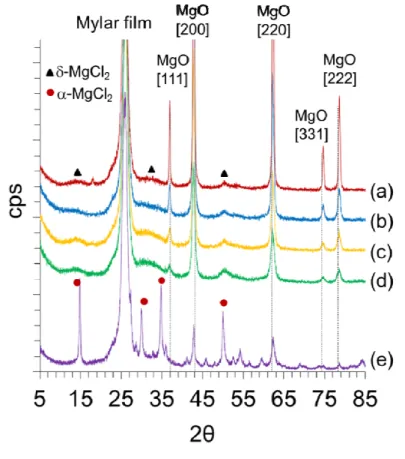
overlayer containing TiCl4. As shown in Figure 2, minor and broad peaks appeared after the
chlorination at around 15º, 30-35º and 50º, which are typical for anhydrous δ-MgCl2. On the
other hand, the FWHM values of the diffraction peaks for MgO were hardly affected except for MgO5, indicating that the formed δ-MgCl2 overlayer was negligibly thin compared with
the particle sizes. For exceptional MgO5, the chlorination underwent deeply into the bulk and MgO was mostly converted into -MgCl2 (Figure 2), plausibly due to the penetration of TiCl4
into the bulk of this smallest MgO. Whilst MgO1-4/MgCl2/TiCl4 catalysts more or less kept
their BET surface areas after the chlorination, the surface area of MgO5/MgCl2/TiCl4 was
greatly reduced (from 221.5 to 47 m2/g) due to particle agglomeration. Figure 3 shows S
catalysts using that of MgO1/MgCl2/TiCl4 as reference. The linearity of the plots for all the
samples revealed the absence of micropore filling up to p/p0 =1 (i.e. S = 1). Especially, it
was found that MgO5/MgCl2/TiCl4 still kept the non-porous feature in spite of the severe
agglomeration. The external surface areas of MgO2-5/MgCl2/TiCl4 calculated from the
gradients of the S-plots were all in good agreement with the BET surface areas (Table 1).
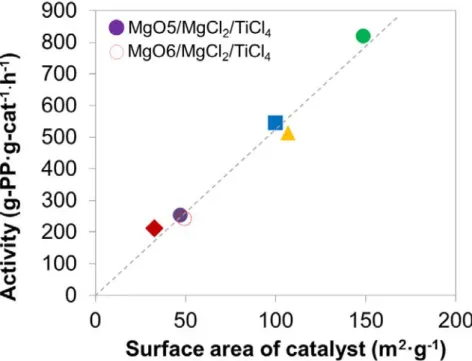
Propylene polymerization was conducted using the obtained catalysts. We found that the propylene polymerization activity of the agglomerated MgO5/MgCl2/TiCl4 catalyst shared
the same straight line with the non-agglomerated MgO1-4/MgCl2/TiCl4 catalysts when
plotted against the BET surface area (Figure 4). In order to endorse this fact, we have prepared a MgO6/MgCl2/TiCl4 catalyst starting from MgO6 calcined at 600C, which also
experienced deep chlorination and severe agglomeration, evidenced by great reduction if the BET surface area from 157 to 49 m2/g. The propylene polymerization activity of
MgO6/MgCl2/TiCl4 also laid on the same line. Thus, it was concluded that the agglomeration
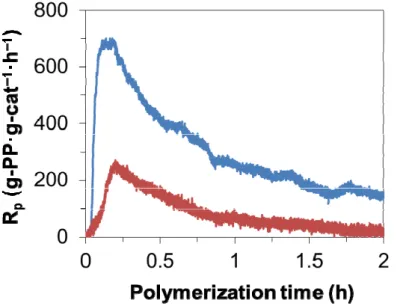
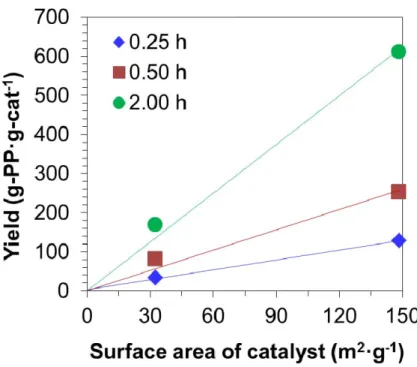
of the nanoparticles as the building unit does not affect the indistinct correlation between the BET surface area and olefin polymerization activity, which holds as long as the catalyst particles are free from intra-particle porosity. Figure 6 shows the kinetic profiles of the propylene polymerization using MgO4/MgCl2/TiCl4 and MgO1/MgCl2/TiCl4 catalysts. The
curves belonged to the so-called decay-type kinetics, showing the maximum activity at the initial timing followed by rapid deactivation. Moreover, when the polymer yields were estimated from the kinetic profiles at each polymerization time (Figure 7), the two catalysts showed linear relationships between the yield and the BET surface area at each polymerization time. Namely, the two kinetic profiles were totally scalable over 2 h, where the ratio of the BET surface areas of the two catalysts corresponded to the scaling constant.
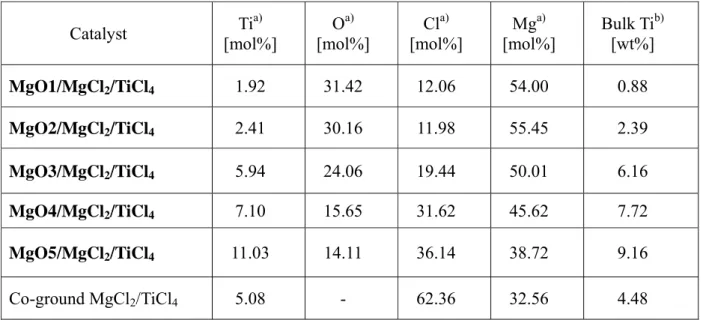
In order to understand the chemical states of the MgCl2/TiCl4 catalytic overlayer, the
XPS analysis was conducted. The surface chemical composition of the model catalysts (summarized in Table 2) showed that the Ti concentration increased with the increase of the original MgO surface area, in line with the bulk Ti content determined by the titration technique. The surface chloride content similarly increased with the increase of the surface area, suggesting that the chlorination occurred more deeply for smaller MgO nano-crystal. The presence of lattice O from MgO was still observable, suggesting that the formed MgCl2/TiCl4 overlayers were sufficiently below 2 nm in agreement with the XRD results.
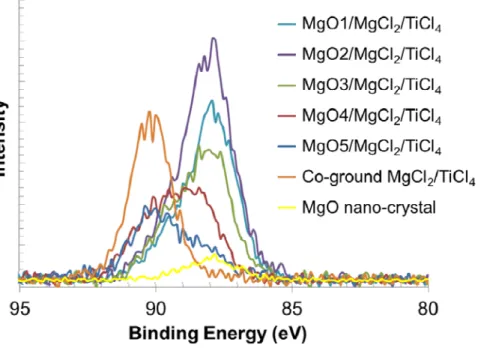
Nevertheless, one should keep in mind that the non-uniform chlorination of MgO surfaces would also lead to similar observation. The binding energy (BE) of Mg 2s became broader in the direction of higher BE when MgO was chlorinated (Figure 5), which indicated the co-presence of MgCl2 and MgO near the surfaces. For the most deeply chlorinated
MgO5/MgCl2/TiCl4 catalyst, the Mg 2s BE value became almost identical to that for a
co-ground MgCl2/TiCl4 catalyst. This result clearly demonstrated the chemical transformation of
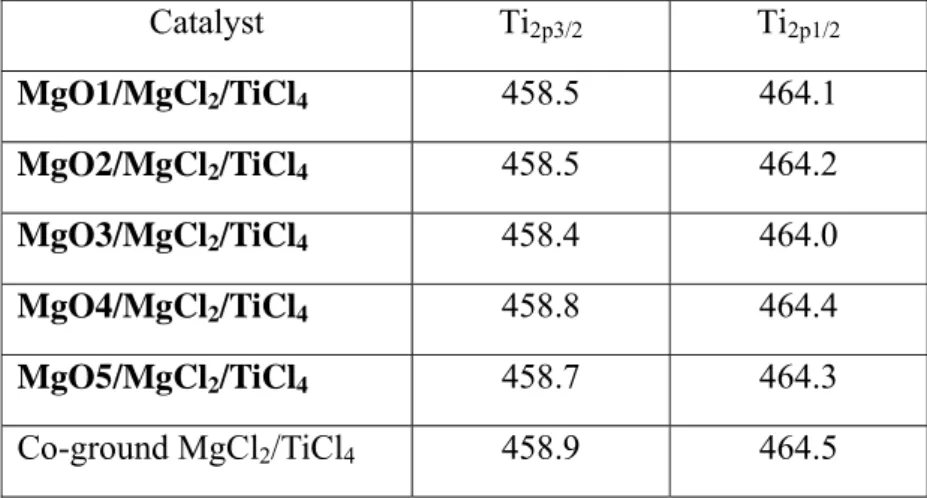
magnesium species due to the deep chlorination of MgO5 at least over a few nm. The BE values of Ti 2p for the MgO/MgCl2/TiCl4 catalysts were slightly shifted but basically similar
when compared with those of a co-ground MgCl2/TiCl4 catalyst (Table 3). This fact suggested
that Ti species most likely exists as TiCl4 that is bound to MgCl2 via chlorine bridges rather
than TiClxO4-x directly bound to MgO through oxygen bridges. Hence, the chemical states of
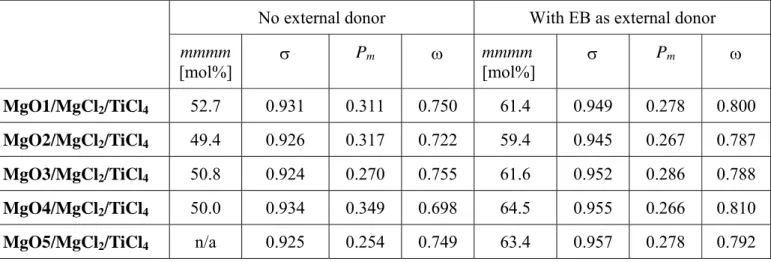
the MgCl2/TiCl4 overlayers are very similar to those of a typical ZN catalyst (MgCl2/TiCl4). 13C-NMR analysis of the obtained polymer followed by the two-site model analysis
on the pentad sequences[15] showed that the MgO/MgCl2/TiCl4 core-shell catalysts yielded
Ziegler-Natta catalyst: the mmmm fraction around 50 mol% with a relatively high rrrr sequence, as can be seen in the non-negligible presence of the chain-end controlled fraction (i.e. ( < 1)).[16,17] Furthermore, it must be noted that the stereostructures of polypropylene, which reflect the nature of the active sites, were not affected by the catalyst surface area. These results are consistent with the conclusion obtained in XPS. The response of the model catalysts to the addition of ethylbenzoate (EB) as external donor (Al/donor = 10) was also similar to that of a typical MgCl2/TiCl4 catalyst: the increase in the isospecificity (i.e. higher
value) together with the reduction in the chain-end controlled fraction (i.e. higher value).[16,17]
Conclusion
Non-porous and non-fragmentable MgO/MgCl2/TiCl4 core-shell catalysts were
exploited as model catalysts to uncover the correlation between support architectures and the olefin polymerization performance of heterogeneous Ziegler-Natta catalysts. The non-porous nature of the MgO/MgCl2/TiCl4 catalysts were evidenced by comparative size analyses based
on TEM, XRD, and nitrogen adsorption and by the S-plot analysis. The analyses of XPS
results and polymer stereostructures clarified that MgCl2/TiCl4 overlayers well modeled the
surface chemistry of typical Ziegler-Natta catalysts, being ideal to explore impacts of support architectures on the polymerization performance. It was concluded that the BET surface area of the catalysts is a primary parameter for the propylene polymerization activity and its kinetic profile as long as the catalysts are poreless.
typical Ziegler-Natta catalysts, while its unique structural features offer an ideal and powerful system to address relationships between the polymerization performance and support architectures, which had been long unclarified.
Acknowledgement
The Authors appreciate Japan Polychem Co., Mitsui Chemicals, Inc., Sumitomo Chemical Co., Ltd., Toho Titanium Co., Ltd., and Tosho Finechem Co. for the donation of reagents.
References
[1] E. Albizzati, U. Giannini, G. Collina, L. Noristi, L. Resconi, in: E.P. Moore, Jr. (Ed.), Polypropylene Handbook, Hanser-Gardner Publications: Cincinnati, OH, 1996, p. 11.
[2] E. J. Arlman, P. Cossee, J. Catal. 1964, 3, 99.
[3] D. Fregonese, S. Mortara, S. Bresadola, J. Mol. Catal. A: Chem. 2001, 172, 89.
[4] R. Credendino, J. T. M. Pater, A. Correa, G. Morini, L. Cavallo, J. Phys. Chem. C 2011, 115, 13322.
[5] V. Busico, R. Cipullo, G. Monaco, G. Talarico, M. Vacatello, J. C. Chadwick, A. L. Segre, O. Sudmeijer, Macromolecules 1999, 32, 4173.
[6] B. Liu, T. Nitta, H. Nakatani, M. Terano, Macromol. Chem. Phys. 2003, 204, 395. [7] T. Taniike, M. Terano, J. Catal. 2012, 293, 39.
[8] R. Gerbasi, A. Marigo, A. Martorana, R. Zannetti, G. P. Guidetti, G. Baruzzi, Eur. Polym. J.
[9] A. Marigo, C. Marega, R. Zannetti, G. Morini, G. Ferrara, Eur. Polym. J. 2000, 36, 1921. [10] T. Taniike, P. Chammingkwan, V. Q. Thang, T. Funako, M. Terano, Appl. Catal. A: Gen.
2012, 24, 437.
[11] T. Taniike, P. Chammingkwan, M. Terano, Catal. Commun. 2012, 27, 13. [12] A. Kumar, J. Kumar, J. Phys. Chem. Solids 2008, 69, 2764.
[13] N. Rakmak, W. Wiyaratn, C. Bunyakan, J. Chungsiriporn, Chem. Eng. J. 2010, 162, 84. [14] K. S. W. Sing, in: D.H. Everett, R. H. Ottewill (Eds.), Surface Area Determination, Butterworths, London, 1970, pp. 2542.
[15] Y. Inoue, Y. Itabashi, R. Chujo, Y. Doi, Polymer 1984, 25, 1640.
[16] K. Goto, T. Taniike, M. Terano, Macromol. Chem. Phys. 2013, 214, 1011. [17] S. Takahashi, T. Wada, T. Taniike, M. Terano, Catalysts 2013, 3, 137.
Figure/Scheme Captions
Figure 1. TEM images of MgO particles: (a) MgO1, (b) MgO2, (c) MgO3, (d) MgO4 and (e) MgO5
Figure 2. XRD patterns of MgO/MgCl2/TiCl4 model catalysts: (a) MgO1/MgCl2/TiCl4, (b)
MgO2/MgCl2/TiCl4, (c) MgO3/MgCl2/TiCl4, (d) MgO4/MgCl2/TiCl4 and (e)
MgO5/MgCl2/TiCl4
Figure 3. S-plots for MgO/MgCl2/TiCl4 model catalysts: (a) MgO1/MgCl2/TiCl4, (b)
MgO2/MgCl2/TiCl4, (c) MgO3/MgCl2/TiCl4, (d) MgO4/MgCl2/TiCl4 and (e)
MgO5/MgCl2/TiCl4
Figure 4. Relationship between the catalyst surface area and propylene polymerization activity Figure 5. Mg 2s binding energy of MgO/MgCl2/TiCl4 model catalysts
Figure 6. Kinetic profile of the propylene polymerization using MgO1/MgCl2/TiCl4 and
MgO4/MgCl2/TiCl4
Figure 7. Relationship between the catalyst surface area and polymerization yield at various
Table 1. Characterization results for MgO nanoparticles and MgO/MgCl2/TiCl4 catalysts
a)
Based on the Scherrer equation for the (200) peak of MgO (K = 0.94 for cubic crystal).
b) Based on d
p = 6×10³/SBETρ for cubic particles, where SBET is the BET surface area and ρ is the
density of MgO (3.58 g/cm3).[18]
c) Assuming spherical particles.
Sample Calcination temperature
[C]
MgO nanoparticles MgO/MgCl2/TiCl4 catalyst
Crystal size in XRDa) [nm] BET surface area [m2/g] Particle size in BETb) [nm] BET surface area [m2/g] External surface area from S-plot [m2/g] MgO1 800 32.0 (30.3c)) 32.6 51.4 (20.7c)) 32.7 - MgO2 750 19.5 72.9 23.0 99.8 99.2 MgO3 700 16.3 103.4 16.2 106.8 105.7 MgO4 650 12.8 128.7 13.0 148.5 150.9 MgO5 500 8.0 221.5 7.6 47.0 47.3
Table 2. Chemical composition of MgO/MgCl2/TiCl4 catalysts and a typical MgCl2/TiCl4
catalyst prepared by co-grinding
Catalyst Tia) [mol%] Oa) [mol%] Cla) [mol%] Mga) [mol%] Bulk Tib) [wt%] MgO1/MgCl2/TiCl4 1.92 31.42 12.06 54.00 0.88 MgO2/MgCl2/TiCl4 2.41 30.16 11.98 55.45 2.39 MgO3/MgCl2/TiCl4 5.94 24.06 19.44 50.01 6.16 MgO4/MgCl2/TiCl4 7.10 15.65 31.62 45.62 7.72 MgO5/MgCl2/TiCl4 11.03 14.11 36.14 38.72 9.16 Co-ground MgCl2/TiCl4 5.08 - 62.36 32.56 4.48 a)
Surface chemical composition based on the XPS measurements.
b)
Table 3. Binding energy of Ti 2p for MgO/MgCl2/TiCl4 model catalysts and a typical
MgCl2/TiCl4 catalyst prepared by co-grinding
Catalyst Ti2p3/2 Ti2p1/2 MgO1/MgCl2/TiCl4 458.5 464.1 MgO2/MgCl2/TiCl4 458.5 464.2 MgO3/MgCl2/TiCl4 458.4 464.0 MgO4/MgCl2/TiCl4 458.8 464.4 MgO5/MgCl2/TiCl4 458.7 464.3 Co-ground MgCl2/TiCl4 458.9 464.5
Table 4. Stereoregularity of produced polypropylene determined by 13C NMR and fitting
parameters based on the two-site model analysis in the absence and presence of ethylbenzoate (EB)
No external donor With EB as external donor
mmmm [mol%] Pm mmmm [mol%] Pm MgO1/MgCl2/TiCl4 52.7 0.931 0.311 0.750 61.4 0.949 0.278 0.800 MgO2/MgCl2/TiCl4 49.4 0.926 0.317 0.722 59.4 0.945 0.267 0.787 MgO3/MgCl2/TiCl4 50.8 0.924 0.270 0.755 61.6 0.952 0.286 0.788 MgO4/MgCl2/TiCl4 50.0 0.934 0.349 0.698 64.5 0.955 0.266 0.810
Table of content
Unique structure of MgO/MgCl2/TiCl4 core-shell catalysts but yet identical surface chemistry
with typical Ziegler-Natta catalyst offers an ideal and powerful tool to address relationships between the support architectures and polymerization performance.