Japan Advanced Institute of Science and Technology
JAIST Repository
https://dspace.jaist.ac.jp/
Title
On bipartite powers of bigraphs
Author(s)
Okamoto, Yoshio; Otachi, Yota; Uehara, Ryuhei
Citation
Discrete Mathematics and Theoretical Computer
Science, 14(2): 11-20
Issue Date
2012
Type
Journal Article
Text version
publisher
URL
http://hdl.handle.net/10119/10887
Rights
Copyright (C) 2012 Discrete Mathematics and
Theoretical Computer Science. Yoshio Okamoto,
Yota Otachi, and Ryuhei Uehara, Discrete
Mathematics and Theoretical Computer Science,
14(2), 2012, 11-20.
Discrete Mathematics and Theoretical Computer Science DMTCS vol. 14:2, 2012, 11–20
On bipartite powers of bigraphs
Yoshio Okamoto
1†Yota Otachi
2‡Ryuhei Uehara
2§1
Department of Communication Engineering and Informatics, Graduate School of Informatics and Engineering, University of Electro-Communications, Chofugaoka 1-5-1, Chofu, Tokyo, 182-8585 Japan.
2
School of Information Science, Japan Advanced Institute of Science and Technology, Asahidai 1-1, Nomi, Ishikawa 923-1292, Japan.
received 11thApril 2012, accepted 16thJuly 2012.
The notion of graph powers is a well-studied topic in graph theory and its applications. In this paper, we investigate a bipartite analogue of graph powers, which we call bipartite powers of bigraphs. We show that the classes of bipartite permutation graphs and interval bigraphs are closed under taking bipartite power. We also show that the problem of recognizing bipartite powers is NP-complete in general.
Keywords: Bipartite power, Interval bigraph, Bipartite permutation graph, Closure property, NP-completeness
1
Introduction
For a positive integer k, the kth power Gkof a graph G has the same vertex set as G, and two vertices are adjacent in Gkif and only if their distance in G is at most k. If Hk = G, then H is called a kth root of G. (In general, kth roots of a graph are not unique and do not necessarily exist.) The concept of graph powers has been extensively studied in graph theory and its algorithmic applications (see Prisner (1995) and the references therein). It is known that several important graph classes are closed under the power operation. That is, for some graph classC, G ∈ C implies Gk
∈ C as well. The recognition problem has also been studied for graph powers. It was shown that recognizing graph powers is NP-complete in general while it is solvable in polynomial time for some special graph classes (Chang et al. (2006); Farzad et al. (2009); Kearney and Corneil (1998); Lau (2006); Lau and Corneil (2004); Le and Nguyen (2010); Lin and Skiena (1995); Motwani and Sudan (1994)).
A graph is bipartite if its vertices can be partitioned into two parts in such a way that the endpoints of every edge belong to different parts. Bipartite graphs are also known as bigraphs. It is known that the class of bigraphs coincides with the class of graphs with no cycle of odd length. If a bigraph is connected and has at least three vertices, then clearly its kth power (for k ≥ 2) has a cycle of length three. Hence, the class of bigraphs is not closed under the power operation. Furthermore, any non-trivial subclass of the class of bigraphs is not closed under the power operation.
†Email: [email protected]. ‡Email: [email protected]. §Email: [email protected].
Chandran et al. (2011) introduced a bipartite analogue of graph powers. For odd k ∈ Z+, the kth bipartite powerG[k]of a bigraph G has the same vertex set as G, and two vertices are adjacent in G[k]
if and only if their distance in G is at most k and odd. It is easy to see that G[k] is also bipartite. They
showed that for any tree T and for any odd k, T[k] is a chordal bipartite graph. They used this fact to
prove that chordal bipartite graphs can have arbitrarily large boxicity. Recently, Chandran and Mathew (2012) have strengthened the closure-property result by showing that the class of chordal bipartite graphs is closed under the bipartite power operation.
In this paper, we complement the known closure-property results by proving that some subclasses of the class of chordal bipartite graphs are closed under the bipartite power operation. Note that the closure property of a graph classC under the bipartite power operation is not implied by the closure property of a superclass of C, and vice versa. We also focus on the computational complexity of the problem for recognizing the kth bipartite power graphs. We prove that given a bipartite graph G, the problem of determining whether there exists a bipartite graph H such that G = H[k] is NP-complete for any fixed odd k≥ 3.
2
Preliminaries
In this paper, graphs are finite, simple, and undirected. We denote by NG(v) the neighborhood of a vertex
v in a graph G. We denote by distG(u, v) the distance between u and v in G.
A graph G = (V, E) with V ={1, 2, . . . , n} is a permutation graph if there is a permutation π over V such that{i, j} ∈ E(G) if and only if (i − j)(π(i) − π(j)) < 0. A graph is a bipartite permutation graph if it is bipartite and a permutation graph. A bi-interval representation of a bigraph G = (U, V ; E) is a pair (IU, IV) of sets of closed intervals such that IU ={[`u, ru]| u ∈ U} and IV ={[`v, rv]| v ∈ V }, and
{u, v} ∈ E(G) if and only if [`u, ru]∩ [`v, rv]6= ∅ for u ∈ U and v ∈ V . A bi-interval representation
(IU, IV) is unit if for each interval [`, r] ∈ IU ∪ IV, r− ` = 1. A bigraph is an interval bigraph if it
has a bi-interval representation. An interval bigraph is a unit interval bigraph if it has a unit bi-interval representation. A bigraph is a chordal bipartite graph if every induced cycle is of length four. We denote the classes of bipartite permutation graphs, unit interval bigraphs, interval bigraphs, and chordal bipartite graphs by BP, UIB, IB, and CB, respectively. The following relations among these classes are known. Theorem 2.1 (Hell and Huang (2004); M ¨uller (1997)) BP = UIB⊂ IB ⊂ CB.
3
Closure properties of bipartite powers of bigraphs
It is known that several important (non-bipartite) graph classes are closed under the power operation. For example, the classes of unit interval graphs, interval graphs, strongly chordal graphs are closed under the kth power for any k (Chen and Chang (2001); Dahlhaus and Duchet (1987); Lubiw (1987); Raychaudhuri (1987, 1992)). On the other hand, few things are known on bipartite powers of bigraphs. To the best of our knowledge, the following is the only known closure property.
Theorem 3.1 (Chandran and Mathew (2012)) If G is a chordal bipartite graph, then so is G[k]for any oddk∈ Z+.
In this section, we show that the closure property holds also for smaller graph classes. Theorem 3.2 If G is an interval bigraph, then so is G[k]for any oddk∈ Z+.
On bipartite powers of bigraphs 13 We note that the closure property is not hereditary for the graph classes. That is, Theorem 3.1 does not imply Theorem 3.2, and Theorem 3.2 does not imply Theorem 3.3.
3.1
Bipartite powers of interval bigraphs
Now we prove Theorem 3.2. Let G = (U, V ; E) be an interval bigraph, and (IU, IV) be a bi-interval
representation of G. For odd k ∈ Z+and I
w ∈ IU ∪ IV, we form a new interval Iw(k) = [`w, rw(k)],
where
rw(k) = max{lx| distG(w, x) is odd and at most k}.
This extension of intervals is inspired by the proof of Agnarsson et al. (2000), who showed that the kth power of an interval graph is also an interval graph. Note that Iu∩ Iv6= ∅ if and only if max{`u, `v} ≤
min{ru, rv}. The following two lemmas show that for u ∈ U, v ∈ V , and odd k ∈ Z+, Iu(k)∩Iv(k)6= ∅
if and only if distG(u, v)≤ k. Since u ∈ U and v ∈ V , clearly distG(u, v) is odd. Thus we have the
theorem by the two lemmas.
In what follows, we assume u∈ U and v ∈ V . We also assume that G is connected. It is easy to see that if Theorem 3.2 is valid for connected graphs, then it is also valid for disconnected graphs.
Lemma 3.4 If distG(u, v)≤ k, then Iu(k)∩ Iv(k)6= ∅.
Proof: Without loss of generality, we assume `u≤ `v. Since distG(u, v) is odd and at most k, it holds that
`v≤ ru(k) from the definition of ru(k). Hence `v ∈ [`u, ru(k)] = Iu(k), and thus Iu(k)∩ Iv(k)6= ∅. 2
Lemma 3.5 If Iu(k)∩ Iv(k)6= ∅, then distG(u, v)≤ k.
Proof: Without loss of generality, we assume `u ≤ `v. By this assumption and Iu(k)∩ Iv(k) 6= ∅,
it holds that `u ≤ `v ≤ ru(k). Let v0 ∈ V be a vertex such that distG(u, v0) ≤ k and ru(k) = `v0. Let P = (u0, v1, u2, . . . , u2d, v2d+1) denote a shortest u–v0 path in G, where u0 = u and v2d+1 = v0.
Clearly, 2d + 1 ≤ k. If {v, ui} ∈ E(G) for some i, there is a u–v path (u0, v1, u2. . . , vi−1, ui, v) of
length i + 1≤ 2d + 1 ≤ k in G and this implies that distG(u, v)≤ k. Hence, we assume there is no such
index i. Then, the following claim holds.
Claim 3.6 There is some index j such that Iv⊆ Ivj.
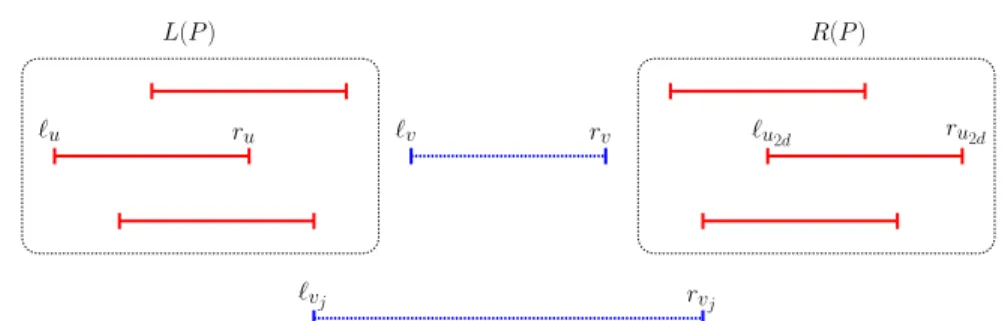
Proof (Claim 3.6): Since Iv does not intersect with any Iui, we can partition U ∩ V (P ) into two parts L(P ) = {ui | rui < `v} and R(P ) = {ui | rv < `ui}. By the assumption `u ≤ `v and {u, v} = {u0, v} /∈ E(G), it holds that ru < `v. Furthermore, since `v ≤ ru(k) = `v0 and{u2d, v0} = {u2d, v2d+1} ∈ E(G), we have `v ≤ `v0 ≤ ru
2d. Because{u2d, v} /∈ E(G), it holds that rv < `u2d. Hence, both L(P ) and R(P ) are non-empty since u∈ L(P ) and u2d ∈ R(P ). Since P is a connected
subgraph of G, there is a vertex vjthat has neighbors both in L(P ) and in R(P ). Then, the corresponding
interval Ivj contains Iv(see Fig. 1). 2
Since G is connected, v has a neighbor u0in G. Thus, we have Iv∩Iu0 6= ∅, which implies Iu0∩Iv j 6= ∅. It is easy to see that (u0, v1, . . . , uj−1, vj, u0, v) is a u–v path of length j + 2, where j− 1 ≤ 2d − 2.
ℓu ru ℓv rv ℓu2d ru2d
L(P ) R(P )
ℓvj rvj
Fig. 1: The bridge interval Ivjbetween L(P ) and R(P ).
3.2
Bipartite powers of bipartite permutation graphs
Next we prove Theorem 3.3. An asteroidal triple is a set of three pairwise non-adjacent vertices such that there is a path between any pair of them avoiding the neighbors of the third. If a graph has no asteroidal triple, then it is AT-free. We use the following characterization of bipartite permutation graphs.
Theorem 3.7 (Hell and Huang (2004)) A bipartite graph is a permutation graph if and only if it is AT-free.
By the theorem above, it is sufficient to show the following lemma. Our proof is inspired by the proof of Raychaudhuri (1987), who proved that the kth power of an AT-free graph is also AT-free.
Lemma 3.8 If G is bipartite and AT-free, then so is G[k]for any oddk
∈ Z+.
Proof: Let v1, v2, v3 be any pairwise non-adjacent triple of vertices in G. Without loss of generality,
assume that any v1–v2path in G passes through a neighbor of v3. We shall prove that any v1–v2path in
G[k]passes through a neighbor of v 3.
Let P = (u1, u2, . . . , up) be a v1–v2 path in G[k] such that u1 = v1 and up = v2. For 1 ≤ i ≤
p− 1, let P (ui, ui+1) denote a shortest ui–ui+1path in G. Replacing every edge{ui, ui+1} in P by the
corresponding path P (ui, ui+1), we obtain a walk WP in G. Clearly, WP contains a v1–v2path in G,
and hence, NG(v3)∩ V (WP) 6= ∅. Let w ∈ NG(v3)∩ V (WP). Assume, without loss of generality,
w ∈ V (P (ui, ui+1)) for some i, 1≤ i ≤ p − 1. Since {ui, ui+1} ∈ E(G[k]), distG(ui, ui+1) is odd
and at most k. If w ∈ {ui, ui+1}, then NG[k](v3)∩ V (P ) 6= ∅. Thus, we assume w /∈ {ui, ui+1}.
Since P (ui, ui+1) is a shortest ui–ui+1 path in G and w ∈ V (P (ui, ui+1)), we have distG(ui, w) +
distG(w, ui+1) = distG(ui, ui+1). Thus, distG(ui, ui+1) ≤ k and w /∈ {ui, ui+1} together imply
distG(ui, w) < k and distG(w, ui+1) < k. Hence, distG(v3, ui)≤ k and distG(v3, ui+1)≤ k. Since
distG(ui, ui+1) is odd, one of distG(ui, w) and distG(w, ui+1) is also odd.
Without loss of generality, we assume distG(ui, w) is odd, and distG(w, ui+1) is even. Then, G has a
v3–ui+1path with length distG(w, ui+1) + 1, which is odd and at most k. Since G is bipartite, G cannot
have any v3–ui+1 path of even length. Hence distG(v3, ui+1) is odd and at most k. This implies that
On bipartite powers of bigraphs 15
4
Recognizing bipartite powers of bigraphs is hard
Powers of graphs are studied also in computational complexity aspects. Motwani and Sudan (1994) first showed that given a graph G, it is NP-complete to decide whether there exists a graph H such that H2= G. Following their result, several related results have been obtained (Chang et al. (2006); Farzad et al. (2009); Kearney and Corneil (1998); Lau (2006); Lau and Corneil (2004); Le and Nguyen (2010); Lin and Skiena (1995)). Recently, Le and Nguyen (2010) have shown the following hardness result. Theorem 4.1 (Le and Nguyen (2010)) For any fixed k ≥ 2 and given a graph G, it is NP-complete to determine whether there exists a graphH such that Hk = G.
In this section, we prove that the problem of recognizing bipartite powers is also hard.
Theorem 4.2 For any fixed odd k ≥ 3 and given a bipartite graph G, it is NP-complete to determine whether there exists a bipartite graphH such that H[k]= G.
The problem is clearly in NP. Thus, it is sufficient to show that the problem is NP-hard. We reduce SET
SPLITTING, a well-known NP-complete problem, to ours. Problem: SETSPLITTING(Garey and Johnson, 1979, SP4) Instance: Collection C of non-empty subsets of a finite set S.
Question: Is there a partition of S into two subsets S1 and S2such that no subset in C is entirely
con-tained in either S1or S2?
Without loss of generality, we assume that every element of S belongs to at least one set in C.
4.1
An auxiliary lemma
Before presenting the reduction, we show a useful lemma. In their proof of NP-hardness, Le and Nguyen (2010) used the following tail structure presented first by Motwani and Sudan (1994) and generalized later by Lau (2006). Note that for two sets A and B, we mean by A⊂ B that A ⊆ B and A 6= B; that is, A is properly included in B.
Lemma 4.3 (Lau (2006)) Let G be a connected graph with{v1, . . . , vk+1} ⊂ V (G) where NG(v1) =
{v2, . . . , vk+1}, and NG(vi)⊂ NG[vi+1] for all 1≤ i ≤ k. If Hk= G for some graph H, then
1. NH(v1) ={v2}, NH(vi) ={vi−1, vi+1} for all 2 ≤ i ≤ k, and
2. NH(vk+1)\ {vk} = NG(v2)\ {v1, v2, . . . , vk+1}.
The tail structure played an important role in the proofs of NP-hardness of recognizing powers of graphs (Lau (2006); Le and Nguyen (2010); Motwani and Sudan (1994)). Although we cannot use the structure directly, we show the following similar structure for bipartite powers.
Lemma 4.4 Let k ≥ 3 be odd, and G be a connected bipartite graph with {v0, . . . , vk+1} ⊂ V (G)
whereNG(v0) ={v1, v3, . . . , vk−2, vk}, NG(v1) ={v0, v2, . . . , vk−1, vk+1}, and NG(vi)⊂ NG(vi+2)
for0≤ i ≤ k − 1. If H[k] = G for some bipartite graph H, then
1. NH(v0) ={v1}, NH(vi) ={vi−1, vi+1} for 1 ≤ i ≤ k, and
To prove Lemma 4.4, we need some definitions. A vertex u∈ U in a bipartite graph G = (U, V ; E) is bipartite universalif NG(u) = V . We denote by NHd(v) the set of vertices in H such that the distance
from v is exactly d; that is, Nd
H(v) ={u ∈ V (H) | distH(u, v) = d}.
Proof (Lemma 4.4): First, observe that the vertices v0and v1are not bipartite universal in G.
Since v0is not bipartite universal in G = H[k]and G is connected, there is a vertex u∈ V (H) such
that distH(v0, u) is finite and greater than k. This implies that NH2i+1(v0)6= ∅ for all 0 ≤ i ≤ (k − 1)/2.
Moreover, since|NG(v0)| = |{v1, v3, . . . , vk−2, vk}| = (k + 1)/2, it follows |NH2i+1(v0)| = 1 for all
0≤ i ≤ (k − 1)/2. Then, the assumption NG(vi)⊂ NG(vi+2) implies that NH2i+1(v0) ={v2i+1} for all
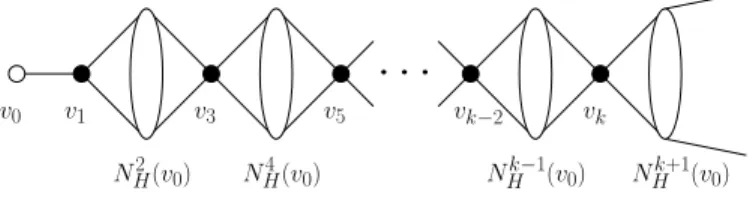
0≤ i ≤ (k − 1)/2 (see Fig. 2).
...
vk−2 v5 v3 v1 vk NH2(v0) NH4(v0) NHk−1(v0) NHk+1(v0) v0Fig. 2: Partial tail structure of vertices.
Next we apply a similar argument to v1. Since v1is not bipartite universal in G, NH2i+1(v1)6= ∅ for all
0≤ i ≤ (k − 1)/2. Since NH(v0) ={v1} and |NG(v1)| = |{v0, v2, . . . , vk−1, vk+1}| = (k + 1)/2 + 1,
it follows|NH(v1)| = 2 and |NH2i+1(v1)| = 1 for all 1 ≤ i ≤ (k − 1)/2. By the assumption NG(vi)⊂
NG(vi+2), we have NH(v1) ={v0, v2} and NH2i+1(v1) = {v2i+2} for 1 ≤ i ≤ (k − 1)/2 (see Fig. 3).
Thus the first property holds. The second property immediately follows from the first one. 2
...
vk−2 v5 v3 v1 vk v0 v2 v4 vk−1 vk+1Fig. 3: Tail structure of vertices.
4.2
Reduction
Let (S, C) be an instance of SET SPLITTING, where S = {u1, . . . , un} is the ground set, and C =
{c1, . . . , cm} is a set of non-empty subsets of S. For any fixed odd k ≥ 3, we construct a graph G from
(S, C). The vertex set V (G) of G consists of the following vertices: • Element vertices uifor all element ui∈ S;
• Subset vertices c0 j, . . . , c
k+1
j for all cj ∈ C; and
• Partition vertices S0 1, . . . , S k−2 1 and S 0 2, . . . , S k−2 2 .
On bipartite powers of bigraphs 17 The edge set E(G) of G consists of the following edges: For each subset cj ∈ C,
• cpjis adjacent to c q j if p6≡ q (mod 2), • cpjis adjacent to c q j0 if p + q≤ k − 4 and p 6≡ q (mod 2); • cpjis adjacent to c q j0 if cj∩ cj0 6= ∅ and p + q = k − 2, • cpjis adjacent to all ui∈ S if p is even and 0 ≤ p ≤ k − 3,
• ck−1 j is adjacent to each ui ∈ cj, • cpjis adjacent to S q 1and S q 2if p + q≤ k − 2 and p 6≡ q (mod 2),
For each element ui∈ S,
• uiis adjacent to S10, S12, . . . , S k−3 1 and S20, S22, . . . , S k−3 2 ; For each i∈ {1, 2}, • Sipis adjacent to S q i if p6≡ q (mod 2), • S1pand S q
2 are adjacent if p + q≤ k − 4 and p 6≡ q (mod 2).
4.3
Equivalence
Now we prove that (S, C) has a desired partition if and only if there exists a bipartite graph H such that H[k]= G.
Lemma 4.5 If there exists a partition of S into two disjoint subsets S1andS2such that each subset inC
intersects bothS1andS2, then there exists a bipartite graphH such that G = H[k].
Proof: Let V (H) = V (G). We define E(H) as follows (see Fig. 4). • For each cj ∈ C, {cij, c
i+1
j } ∈ E(H) for 0 ≤ i ≤ k, and {c0j, ui} ∈ E(H) for each ui∈ cj.
• For each ui∈ S, {ui, Sj0} ∈ E(H) if ui ∈ Sj.
• For j ∈ {1, 2}, {Si j, S
i+1
j } ∈ E(H) for 0 ≤ i ≤ k − 3.
It is a routine exercise to verify that G = H[k]. 2
Lemma 4.6 If there is a bigraph H such that H[k]= G, then there exists a partition of S into two disjoint
subsetsS1andS2such that each subset inC intersects both S1andS2.
Proof: We construct a partition (S1, S2) of S such that S1={ui| {ui, S10} ∈ E(H)} and S2= S\ S1.
We show that (S1, S2) is a good partition; that is, cj∩ Si 6= ∅ for each cj ∈ C and i ∈ {1, 2}. To this end,
we show that
c04 c14 c24 c34 c44 c54 c64 c03 c13 c23 c33 c43 c53 c63 c02 c12 c22 c32 c42 c52 c62 c01 c11 c21 c31 c41 c51 c61 u5 u4 u3 u2 u1 S20 S21 S22 S23 S10 S11 S21 S13 k = 5 Fig. 4: An example (k = 5).
2. no ui∈ S has both S10and S20as neighbors in H.
They will conclude the proof. Let cj∈ C. From Lemma 4.4, NH(ck+1j ) ={ckj}, NH(cij) ={c i+1
j , c
i−1
j }
for 1 ≤ i ≤ k, and NH(c0j) = {c1j} ∪ {ui | ui ∈ cj}. Obviously, distH(cpj, c q j) = |p − q|. For v /∈ {c0 j, . . . , c k+1 j }, every c p j–v path in H has c q
j as an internal node if p > q. Hence, distH(c p j, v) =
p− q + distH(cqj, v). Note that this also holds when p≤ q.
Claim 4.7 For `∈ {1, 2} and a, b ≥ 0, distH(caj, S`b) = a + b + 2.
Proof (Claim 4.7): First, we show that distH(ck−b−2j , S b `) = k.
Since{ck−b−2j , Sb
`} ∈ E(G), distH(ck−b−2j , S b
`) is odd and at most k. Clearly, distH(ck−bj , S b `) is also
odd. Thus{ck−bj , S`b} /∈ E(G) implies that distH(ck−bj , S b `) = 2 + distH(ck−b−2j , S b `) > k. Hence, distH(ck−b−2j , S b
`) = k since k is odd. Recall that distH(c p j, v) = p−q+distH(c q j, v). Therefore, distH(caj, S b `) = a− (k − b − 2) + distH(ck−b−2j , S b `) = a + b + 2.
Thus, the claim holds. 2
Let `∈ {1, 2}. From Claim 4.7, we have distH(c0j, S`0) = 2. Since NH(c0j) ={c1j} ∪ {ui | ui ∈ cj}
and NH(c1j) ={c 2 j, c
0
j}, some ui∈ cj must be adjacent to S`0in H. Thus, we have the first property. To
On bipartite powers of bigraphs 19 Claim 4.8 distH(S20, S
k−2
2 ) = k− 2.
Proof (Claim 4.8): By Claim 4.7, any shortest c0 j–S
k−2
2 path in H is of length k. Let P = (p0, p1, . . . , pk)
be such a path, where p0 = c0j and pk = S2k−2. It is easy to see that p1 = ui for some ui ∈ cj. Also,
it is not difficult to see that either p2 = c0j0 for some cj0 ∈ C, or p2 = S`xfor some x∈ {0, . . . , k − 2} and ` ∈ {1, 2}. If p2 = c0j0, then distH(c0j0, Sk−22 ) = k− 2. This contradicts Claim 4.7. Hence, we have p2 = S`x. Since (c0j, ui, S`x) is a shortest path in H, distH(c0j, Sx`) = 2. Thus we have x = 0 from
Claim 4.7. If p2= S10, then (p2, . . . , pk) is a S10–S k−2
2 path of length k−2. So, distH(S10, S k−2
2 ) = k−2.
This contradicts{S0 1, S
k−2
2 } /∈ E(G) = E(H[k]). Hence, we can conclude that p2 = S20, and thus
(p2, . . . , pk) is a shortest S20–S k−2
2 path of length k− 2 in H. 2
Now we prove the second property. Suppose some ui ∈ cj has both S10and S20as neighbors in H.
Then, distH(S01, S20) = 2. Since distH(S02, S k−2 2 ) = k− 2 by Claim 4.8, distH(S10, S k−2 2 )≤ distH(S10, S 0 2) + distH(S20, S k−2 2 ) = k. Since there is a S0 1–S k−2
2 path of odd length in G and because G is bipartite, distH(S10, S k−2
2 ) is odd.
Hence,{S0 1, S
k−2
2 } ∈ E(H[k]). This contradicts{S10, S k−2
2 } /∈ E(G) = E(H[k]). 2
References
G. Agnarsson, R. Greenlaw, and M. M. Halld´orsson. On powers of chordal graphs and their coloring. Congr. Numer., 144:4165, 2000.
L. S. Chandran and R. Mathew. Bipartite powers of k-chordal graphs, 2012. Preprint available at http:// arxiv.org/abs/1108.0277.
L. S. Chandran, M. Francis, and R. Mathew. Chordal bipartite graphs with high boxicity. Graphs Combin., 27:353–362, 2011.
M.-S. Chang, M.-T. Ko, and H.-I. Lu. Linear-time algorithms for tree root problems. In SWAT 2006, volume 4059 of Lecture Notes in Comput. Sci., pages 411–422, 2006.
M. Chen and G. J. Chang. Families of graphs closed under taking powers. Graphs Combin., 17:207–212, 2001.
E. Dahlhaus and P. Duchet. On strongly chordal graphs. Ars Combin., 24B:23–30, 1987.
B. Farzad, L. C. Lau, V. B. Le, and N. N. Tuy. Computing graph roots without short cycles. In STACS 2009, volume 3 of LIPIcs, pages 397–408, 2009.
M. R. Garey and D. S. Johnson. Computers and Intractability: A Guide to the Theory of NP-Completeness. Freeman, 1979.
P. Hell and J. Huang. Interval bigraphs and circular arc graphs. J. Graph Theory, 46:313–327, 2004. P. E. Kearney and D. G. Corneil. Tree powers. J. Algorithms, 29:111–131, 1998.
L. C. Lau. Bipartite roots of graphs. ACM Trans. Algorithms, 2:178–208, 2006.
L. C. Lau and D. G. Corneil. Recognizing powers of proper interval, split, and chordal graphs. SIAM J. Discrete Math., 18:83–102, 2004.
V. B. Le and N. T. Nguyen. Hardness results and efficient algorithms for graph powers. In WG 2009, volume 5911 of Lecture Notes in Comput. Sci., pages 238–249, 2010.
Y.-L. Lin and S. S. Skiena. Algorithms for square roots of graphs. SIAM J. Discrete Math., 8:99–118, 1995.
A. Lubiw. Doubly lexical ordering of matrices. SIAM J. Comput., 16(5):854–879, 1987.
R. Motwani and M. Sudan. Computing roots of graphs is hard. Discrete Appl. Math., 54:81–88, 1994. H. M¨uller. Recognizing interval digraphs and interval bigraphs in polynomial time. Discrete Appl. Math.,
78(1–3):189–205, 1997. Erratum is available at http://www.comp.leeds.ac.uk/hm/pub/node1.html. E. Prisner. Graph Dynamics. Longman, 1995.
A. Raychaudhuri. On powers of interval and unit interval graphs. Congr. Numer., 59:235–242, 1987. A. Raychaudhuri. On powers of strongly chordal and circular arc graphs. Ars Combin., 34:147–160,