Japan Advanced Institute of Science and Technology
JAIST Repository
https://dspace.jaist.ac.jp/Title Coordination as a means to understand and to
organize complex systems
Author(s) Krzysztof, Malinowski; Piotr, Tatjewski Citation
Issue Date 2005-11
Type Conference Paper
Text version publisher
URL http://hdl.handle.net/10119/3893
Rights ⓒ2005 JAIST Press
Description
The original publication is available at JAIST Press http://www.jaist.ac.jp/library/jaist-press/index.html, IFSR 2005 : Proceedings of the First World Congress of the International
Federation for Systems Research : The New Roles of Systems Sciences For a Knowledge-based Society : Nov. 14-17, 2103, Kobe, Japan, Symposium 4, Session 3 : Meta-synthesis and Complex Systems Methodology and Applications
Coordination as a means to understand and to organize complex systems
Krzysztof Malinowski1,2 and Piotr Tatjewski1 1Institute of Control and Computational Engineering
Warsaw University of Technology ul. Nowowiejska 15/19, 00-665 Warszawa, Poland
[email protected], [email protected]
2Research and Academic Computer Network Institute (NASK)
ul. Wawozowa 18, 00-796 Warszawa, Poland
ABSTRACT
Modeling, optimization and control of complex systems is now commonly regarded as a necessity, in view both of current needs and opportunities. The needs stem from a desire to better use the existing assets and resources and the opportunities are due to well developed and still fast improving computing and communication facilities. Large systems arise in numerous fields of production, environmental or military activities and usually are structured in a natural way as consisting of a number of interconnected or otherwise interacting subsystems. Decentralized or hierarchical structures with suitable decision mechanisms and some sort of coordination are then required to optimize or control such systems. Coordination of actions of a number of agents or subsystems is a general concept. This paper presents and discusses various, vastly different, concepts of coordination, amenable to practical applications; namely iterative coordination and periodic coordination. It is shown that iterative coordination may be realized in a centralized or in a distributed form, and that it may be concerned with solving a large optimization problem or with a control of a complex system, like a computer network, operating in steady state conditions. Periodic coordination may be used for control of large dynamical systems as a means to suitably shape local decentralized decision mechanisms. The examples of structures employing such coordination, described in this paper are: flood management in a multiple reservoir system and command/control system for missile defense of an important object. The paper is concluded with a short discussion of the issues concerning the case when a large computational problem or a system to be controlled is unstructured, i.e. is not a priori partitioned into a number of subproblems or subsystems.
Keywords: complex systems, hierarchical control, iterative coordination, periodic coordination
1. CENTRALIZED ITERATIVE COORDINATION
Centralized iterative coordination may be implemented to solve large scale structured control or decision making problems sharing a common goal. The main idea is to decompose the problem into a number of smaller-scale subproblems solved by local units and a coordinator problem. The decision variables v of the coordinator problem are sent as parameters to local problems, entering their goal functions and/or constraints. The coordinator improves iteratively (j=1,2.3,… indexes iterations) its decisions basing on optimal reactions xi(vj), i=1,…,n
(number of subsystems), as shown structurally in Fig. 1. Such an approach to complexity is justified if the structure of decomposition of the decision making or optimization problem corresponds to the structure of the underlying large scale system composed of clearly separated (e.g., spatially) subsystems with their own local decision units and local information links. There are two main classes of interconnections between subsystems, entering the overall problem as constraints: physical links (interactions) and/or common, shared resources.
x (v )
v
1 v x (v )n
Local unit 1 Local unit n
COORDINATOR
j j j
j
Fig.1. Centralized iterative coordination structure There are two main mechanisms of coordination:
1. Direct mechanism, where coordinator’s decision
variables are parameters directly entering local goal functions and/or constraints (as e.g. its right hand side values).
2. Price (indirect) mechanism, where coordinator’s
multipliers) for certain common resources or interaction links (formulated as global, common constraints).
1.1. Coordination in System Optimization
The theory and algorithms of centralized iterative coordination have been well developed when a large-scale structured decision problem can be formulated as a common goal optimization problem. Let us consider a simple case of a common resource constraint. The complex optimization problem can have then the form
v x g n i X x x Q x Q i i n i i i n n ≤ = ∈ Ψ
∑
= ( ) ,..., 1 , : to subject )) ( , ), ( ( min 1 1 1 Kwhere Ψ is a strictly order preserving mapping. Applying the direct coordination mechanism, a decomposition of the common resource v into a vector of local parts, v = [v1,…,vn], is needed. For a given value v=vj local units will be solving the following local optimization problems
j i i i i i i i x x X g x v Q ( )sub.to: ∈ , ( )≤ min
i=1,…,n, while the coordinator’s goal will be to find,
iteratively, an optimal partition of v such that the overall goal is minimized. For pure mathematical formulation leading to strict optimal solution, there is a quite complex theory describing properties and strategies of the coordinator, see e.g. [10]. It applies, in particular, to complex computerized industrial automatic control or decision support software applications and is especially effective when local problems are computationally easier, particularly if they are not only of smaller dimension but also from classes of structurally simpler problems (all or most of them). For practical complex decision problems it could be reasonable to have simplified, aggregated strategy of the coordinator, without detailed knowledge of local constraints, models, uncertain informations and decision making processes.
Application of the price coordination mechanism is possible in additive case, i.e. when Ψ=Σ. It is based on the following Lagrange function and its decomposition v p x g p x Q v x g p x Q p x L T i i T n i i i n i i i T n i i i − + = = − + =
∑
∑
∑
= = = )] ( ) ( [ ) ) ( ( ) ( ) , ( 1 1 1where p is the price vector. For a given value of prices pj local units will be solving local problems
i i i i T j i i x p g x x X Q( )+( ) ( )} sub.to: ∈ min{
i=1,…,n, while the coordinator’s goal will be to find,
iteratively, an optimal (balancing) value of the prices, i.e. a value such that pˆ
∑
n= ≤i1gi(xi(pˆ)) v. As with the direct approach, strict optimal mathematical iterative solutions are here possible [10,16], as well as simplified aggregate approaches.
The philosophy of the approach in cases when physical interconnections between subsystems are present is identical, but mathematical formulations are slightly more involved [10].
1.2. On-Line Coordination under Uncertainty Centralized iterative coordination has also found applications to on-line (with measurement-based feedback information) optimization of steady states of interconnected controlled systems operating in a multilayer structure [2,10] in cases of significant uncertainty, i.e. when subsystem models are not sufficiently precise for optimization purposes – a situation encountered in process control applications. We can distinguish here a case based on available models only and a one with combined optimization and model parameters estimation. Let us consider an interconnected system as shown in Fig. 2, where individual processes are described by
y = F (u ,x ) yn u1 u=H y un y 1
...
...
...
...
1 *1 1 1 y = F (u ,x )n *n n n x1 xn SUBSYSTEM 1 SUBSYSTEM n STRUC-TUREFig.2. Interconnected system description
mappings , known only as their inaccurate models based on local information available, ) , ( *i i i i F u x y = ) , ( i i i i F u x y = i i F
F ≠ *. When applying price
∑
∑
= = = = ∈ n j ij j j j i i i i n i i i i x u F H u n i UX x u x u Q 1 1 ) , ( ,..., 1 , ) , ( : to subject ), , ( minwhere Hij are submatrices of the structure matrix H, one decomposes the Lagrange function
∑
∑
∑
∑
∑
= = = = = = − + = − + = n i i i i n j ji i i i T j i T i n i i i i n j ij j j j i T i n i i i i p x u L x u F H p u p x u Q x u F H u p x u Q p x u L 1 1 1 1 1 ) , , ( )] ) , ( ) , ( [ )] ) , ( ( ) , ( [ ) , , (and local control units solve optimization problems
i i i i i i u x p u x UX L( , , )} subjectto:( , )∈ min{
computing solutions using the local model-based information available. However, due to model-reality differences interactions measured in the real system are different from these calculated from the model only, . The goal of the coordination is to find, iteratively, value of the prices balancing model-based and measured interactions, i.e. ) ( ˆ ), ( ˆ p u p xi i ) ( ˆ* p u ) ( ˆ ) ( ˆ* p u p u ≠ pˆ n i p u p ui(ˆ)= *i(ˆ), =1,...,
therefore, the method is known as the interaction balance method [10]. The theory of iterative
coordination algorithms leading to the above equality is well developed [2], the most effective being the coordination strategy based on an augmented version of the Lagrange function, namely
], || ) ) , ( || 5 . 0 ) ) , ( ( ) , ( [ ) , , ( 2 1 1 1
∑
∑
∑
= = = − + + − + = n j ij j j j i n j ij j j j i T i n i i i i x u F H u r x u F H u p x u Q p x u L in the form )] ( ) ( ˆ ))][ ( ˆ ), ( ˆ ( [ ' * 1 n n n n u n n p rI HF u p x p u p u p p + = + − −The method itself is suboptimal, that is at coordinating price a suboptimal value of the performance function is achieved, however it occurs usually to be a close to optimal one.
In the case of combined optimization and model parameter estimation, the coordination instruments are used to achieve mutual cooperation between identification and optimization goals, this technique can be also seen as a means to carry experimental
search on the real system, under uncertainty. If the underlying process is, additionally, large-scale and interconnected, then a number of centralized iterative coordination algorithms have been also proposed capable to deal with both discussed aspects: acting to provide for cooperation of a number of subsystems and carrying experimental search on the real system to improve its profit function, under uncertainty. The examples may be drawn from industrial applications in which it is of a particular importance not only to maximize certain profit function, but also to enforce satisfaction of important constraints, e.g. on quality of products. A comprehensive presentation of theory and example applications of this techniques (often quite involved) can be found in a recently published book [2], dealing with both steady-state and dynamic cases, it is beyond the limited space of this paper.
2. DISTRIBUTED ITERATIVE COORDINATION
In case when the interacting subsystems are autonomous, i. e. they are not subject to any overall authority, the situation is different from that considered in the previous section. The important question is then in what way such subsystems can be made to cooperate, to behave in a satisfactory manner. This issue may be approached using the concepts and tools from the noncooperative or cooperative game theory; recently the problems of cooperation between the autonomous entities are considered also in the context of behavioral games [3], including the approach according to which the local agents try to reach changing levels of aspiration [5]. The potential of applying those concepts to organize operation of complex systems with multiple interacting autonomous subsystems is not yet fully investigated. Here we would, however, like to point that the old and well known mechanism of iterative coordination using dual variables (price variables) can be adopted for decentralized operation and be used for distributed coordination of interacting subsystems. Fairly important and interesting possible applications of such coordination has been recently proposed for congestion control of communication networks.
2. 1. Network control: price mechanisms
In several congestion control mechanisms, as recently proposed in [6,7,8,13], the network is represented by
N traffic sources, representing particular
source-destination pairs, and a grid of a set of L links. The
links, together with associated routers, are the network resources, of limited traffic carrying capacity cl. Each
source i is supposed to use a set L(i) ⊆ L of links.
These sets define and L× N routing matrix R (the fixed
routing is assumed); the element Rli of R is equal to 1 if l∈ L(i) and is equal to 0 otherwise. Each source i
has at a given time an associated transmission rate xi; the set of transmission rates determines the aggregate flow yl through each link. Then, the feedback mechanism communicates to sources the congestion information about the network. This congestion measure – the price pl – is a positive valued quantity associated with link l. The fundamental assumption is
made that sources have access to the aggregate prices of all links in their route (this information can be e.g. piggybacked on the ACK packet messages); the vector of aggregate prices is q = RTp. At steady-state
the transmission rates are the functions of q, i.e. xi* =
fi(qi*), where fi(⋅) is a positive, strictly monotone decreasing function; this function in the static case is just given by the source static law.
2. 2. TCP congestion control and network flow optimization by price instruments
The above model includes [9] the mechanism present in existing protocols, with a different interpretation for price in different protocols (e.g. packet loss probability in TCP Reno and queuing delay in TCP Vegas). The model allows us to introduce an optimization interpretation for the equilibrium. Namely, if we introduce a source utility function
Ui(xi), then we can define this function to be an integral of fi-1(xi); that is Ui’(xi) = fi-1(xi). Then, by this construction the equilibrium rate xi* will solve the following local source problem:
max x [Ui(x) – qi*x]
The above equation has an obvious economic interpretation – at the equilibrium each source i
maximizes its profit equal to utility minus payment charged by the network. It is important to note that this interpretation can be made for any reasonable congestion control protocol (TCP).
The role of prices p (and q = RTp) is to coordinate the
actions of the individual sources; in fact to ensure that the local rates together solve the network flow optimization problem (NOP):
∑
≥ i i i xU
(
x
)
max
0 subject to Rx ≤ c, where c T = (c 1,...,cL).In other words the rates maximize aggregate utility across all sources, subject to link capacity constraints. It has to be understood, however, that the above optimization problem formulation is just an “optimization” interpretation of the network equilibrium which can be reached in steady-state conditions by using a stable control protocol. It does not mean that the local network users (the sources)
are conscious of their utilities or are willing to maximize them when paying “price” q for a unit transmission rate. The source transmission rates xi are decided by the control protocol, like TCP Reno or TCP Vegas, or other. Yet, this interpretation demonstrates that an optimization framework together with price coordination may allow for better understanding of network control mechanisms. In particular, Low et al. [9] provide the utility functions which would yield equilibriums that are attainable under several different network control protocols. 2. 3. Utility sensitive sources; network coordination
by price instruments.
Assume now that the traffic sources (or source-destination pairs) are indeed utility oriented, i.e. they
have utilities Ui(xi) and are willing to maximize profits defined as Ui(xi) – qixi . In such case it would seem possible – at least in theory – to propose the following congestion control scheme – CCS-1. For given link prices pl(k), l = 1,...,L, at time k, the sources solve local problems
∑
∈ ∈ [ ( )− ( ) ], where ( )= () ( ) max i L l l i i i i i I xi i U x q k x q k p k and where L(i) is the set of those links which are usedfor transmission by the i-th source (path for
source-destination pair); Ii = [xi,min,xi,max]. The solutions xi*(k) = xi(qi(k)) are signaled to all concerned links, which then adjust their link prices – for the next iteration k+1
- according to the following rule
pl(k+1) = {pl(k) + γ[∑i∈S(l)xi*(k) - cl]}+ (CCS-1)
where S(l) is the set of all sources transmitting
through the link l and γ is a positive step – chosen to
allow the scheme to converge. Then the new link prices are signaled to links, etc., until the convergence is obtained. It should be observed that this scheme is just a distributed price coordination. Yet, it requires a lot of signaling between sources and routers before the desired equilibrium is reached.
It was proposed in [13] to modify the distributed price iterations in the following way. Once the sources determine their rates xi*(k) by solving the local problems at the beginning of time period k, the
resulting traffic is routed through the network and each link experiences and observes the actual flow rate ylr(k). Then the link prices are changed, for the next period k+1, according to the distributed pricing
(coordination) rule
pl(k+1) = {pl(k) + γ[ ylr(k) - cl*]}+ (CCS-2)
At this point it may be worthwhile to ask why one should be concerned with construction of such hierarchical control mechanisms. It would seem possible, especially in these days, to introduce one, centralized, decision unit and allocate to this unit all decision responsibilities. The required computing equipment and communication facilities should be
available, and sufficiently robust, fault-tolerant, operation of such centralized controller could be in most cases assured. Yet, if at the subsystem level there are human decision makers or just operators responsible for supervisor actions, then the compatible decentralized or hierarchical control structure is a must. In particular, the decisions and actions made by human beings require time and thus may induce considerable delays, especially at the overall control level. Within a hierarchical structure it should be possible to introduce fast and sufficiently simple local decision mechanisms and – if necessary – to propose upper level controller, periodic coordinator, providing for satisfactory cooperation between the local units. Let us now turn to the examples.
where cl* is chosen to be smaller than the full link capacity cl.
This means that the objective is to satisfy at steady-state the modified link capacity constraints ∑i∈S(l)
xi*(k) ≤ cl*. The headroom hl = cl - cl* is left to provide for traffic bursts and for early congestion notification. In this modified scheme there is no need for the sources to signal their desired transmission rates xi*(k) to the links. This is an important feature, since there can be numerous sources transmitting through a given link. The new link prices are, as before, signaled to the sources before next values of the source rates are established.
This short exposition of price-based congestion control schemes is just to demonstrate possible use of distributed iterative coordination of autonomous systems. La and Anantharam [7], Kelly et al. [6], as well as other researchers, proposed a number of interesting distributed mechanisms.
3. PERIODIC COORDINATION
The concept and applications of periodic coordination are different. Consider a system composed of a number of interconnected dynamical subsystems or directly non-interacting subsystems but dependent on globally constrained resources. Each subsystem is – or has to be – managed by a local decision agent capable of operating in a fast mode, with little decision or information delays [12]. The coordinator is, however, needed to take, at a slower rate, and possibly by exception, the decisions providing for satisfactory cooperation of subsystems.
3. 1. Hierarchical flood control with periodic coordination
Good management of available reservoirs during floods generated by intensive precipitation is considered to be one of the most important activities to mitigate flood damages and to preserve water for future uses during dry periods [11]. It requires carefully designed decision mechanisms, allowing for large uncertainty concerning future inflows to reservoirs; those inflows being dependent, of course, on future precipitation. Research and multiple computer experiments concerned with development and validation of various control structures for flood management in Upper Vistula system of catchments and reservoirs in southern Poland demonstrated [15] that the best possible effects could be achieved by using hierarchical control structure with periodic coordination.
Fig. 3. Hierarchical system for flood management with periodic coordination
In this structure, depicted in Fig. 3, local objective functions are modified (only if there is a need to do so) by the coordinator at large time intervals, e.g. every three or six hours, so as to induce suitable delay or acceleration of water releases from the reservoirs. Local reservoir operators are recomputing, at short time intervals and using currently available inflow forecasts, their releases. Their objective is to minimize peak releases – taking into account changing weightings adjusted by the coordinator. The objective of the coordinator is to minimize overall flood damages. It means that each decision making by the coordinator involves multiple simulations of lower level operation, including simulations of local decision makers as well flood waves transformation in the considered river reaches. This mechanism is complicated and computationally demanding. It has to be observed, however, that it is the local units that have, in such structure, to use simple decision rules and react fast [12]. Decision delays at the coordinator level are less important [14]. Is is also worthwhile to mention that the decision making at the coordinator level should be activated only when there is a need to do so; this management by exception feature of the
proposed structure is an important property.
The structure depicted in Fig.3 can be considered as representing a generic type of hierarchical systems with periodic coordination.
3. 2. Hierarchical missile defense system with periodic coordination
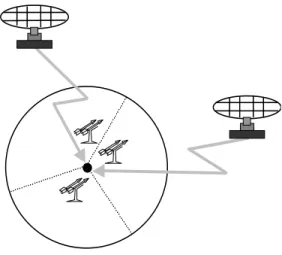
System considered in this point, presented in more detail in [1], is dedicated to the point defense of a selected object (e.g., an airbase) and consists of a number of sectors commanded by Weapon Directors. Each Weapon Director (WD) is responsible for defense of his/her sector using weapons allocated by central command – the Coordinator. Additionally, the scope of sectors (which can in most simplistic way be characterized by their geometric boundaries) can be changed by the Coordinator.
Each WD makes the decisions concerning launching of weapons against enemy missiles detected in his sector. The coordinator reallocates, if necessary, the available resources and sector sizes either every time when new enemy assets are detected. Both the sector commanders and the coordinator desire to minimize the number of hits by attacking missiles.
Operation of this hierarchical system (having very similar structure to that shown in Fig.3) requires multiple (often thousands) of simulations of lower (here Weapon Director) level to find an overall
solution. This emphasizes the necessity of applying fast algorithms and appropriate (i.e. simplified but still sufficiently precise) models. The evaluated sector models covered full range extending from stochastic models, that required solution by dynamic programming, to simplified casualty function based linear models. Representing uncertainty by multiple variant forecast scenarios was chosen and this implied the application of multiple scenario predictive decision algorithms, allowing for considerable computational speedup with respect to conventional closed loop design techniques. The main advantage of using such multiple scenario approach is, however, a possibility to describe the forecasted evolution of the attack by means of tree-like graphs providing information about probability and dependence of the considered attack variants.
Fig. 4. Sectored missile defense system
Similarly, for efficient coordination several algorithms, that may be in most general way classified as optimal and sub optimal (heuristic), were developed. Furthermore, several strategies of coordination including only an a single one (initial stage of attack), repetitive and on-demand were tested. The importance of such strategies is that they not only allow for speeding up the computations but also model various modes of operation of the system as, for example, independent operation of Weapon Directors in case of destruction of the Coordinator. The proposed models and decision mechanisms were verified by simulation. Numerous experiments demonstrated potential capability of the proposed hierarchical control structure for on-line missile defense system.
4. RELATED ISSUES
The presented examples of structures and decision mechanisms, with iterative or periodic coordination, were developed for complex systems that may be characterized as consisting of a priori recognizable subsystems that are either coupled by elastic links (communication network) or/and through common goal (flood management) or/and by common limited resources (missile defense). There are other categories of complex systems, that are more difficult to cope with as far as design of structures and decision mechanisms with coordination is concerned.
The first class are systems consisting of well recognizable yet tightly coupled elements, where, in particular, the output from one subsystem is the input to another subsystem. Computing methods using decomposition and coordination may be used to assist decision making in such systems, yet hierarchical control structures are difficult to conceive and to properly function, especially under the uncertainty. The reasons for that are explained in [12].
The second class are complex problems or systems that are unstructured in the sense that one cannot readily identify proper local problems/subsystems. Then, prior to proposing a hierarchical or distributed decision mechanisms, one has to address the issue of problem partitioning. This issue was recognized from the very beginnings of the large scale systems theory. It was with some, limited, success followed as far as the decomposition of large computational problems is concerned: solving large sets of equations and inequalities or solving of large optimization problems. It definitely merits further research, especially when real life large unstructured systems are concerned. Acknowledgment. The work supported by Polish budget funds for science in 2005-2007 as a statutory and project research.
REFERENCES
[1]. Arabas., P., K. Malinowski (2001). Periodic
coordination in hierarchical air defense system.
Int. J. App. Mathematics and Computer Science,
vol. 11, no. 2, str. 493-513.
[2]. Brdys M.A., Tatjewski P. (2005). Iterative
Algorithms for Multilayer Optimizing Control,
Imperial College Press/World Scientific, London.
[3]. Camerer, C. F. (2003) Behavioral Game Theory,
Princeton University Press.
[4]. Courcoubetis C., R. Weber (2003). Pricing
Communication Networks, Economics, Technology and Modelling, Wiley and Sons.
[5]. Karandikar, R., Mookherjee, D., Ray, D i
Vega-Redondo, F (1998). Evolving aspirations and cooperation. Journal of Economic Theory, vol.
80, str. 292-331.
[6]. Kelly, F. P., A. K. Maulloo, D. K. H. Tan (1998).
Rate control for communication networks: shadow prices, proportional fairness and stability. Journal of Operations Research Society, vol. 49 (3), str. 237-252.
[7]. La, R. J., V. Anantharam (2002). Utility-Based
Rate Control in the Internet for Elastic Traffic.
IEEE Trans. on Networking, vol. 10, no. 2, str.
272-286.
[8]. Low S., D. E. Lapsley (1999). Optimization flow
control, I: basic algorithm and convergence.
IEEE/ACM Transactions on Networking, vol. 7
(6), str. 861-874.
[9]. Low S. H., F. Paganini and J. C. Doyle (2002)
Internet Congestion Control, IEEE Control Systems Magazine, February 2002, str. 28-43.
[10]. Findeisen W., Bailey F.N., Brdys M.,
Malinowski K., Tatjewski P., Wozniak A. (1980).
Control and Coordination in Hierarchical Systems, J.Wiley, London.
[11]. Malinowski, K., J. ¯elaziñski (1990). Reservoir
systems: Operational flood control. Systems and Control Encyclopedia, supplementary vol.1, str.
495-503, Pergamon Press
[12]. Malinowski, K. (1992). Practical Issues of
Coordination in Control of Large-Scale Stochastic Systems. Stochastic Large-Scale Engineering Systems (red. S. G. Tzafestas i K.
Watanabe, Marcel Dekker, str. 195-227.
[13]. Malinowski K. (2002). Optimization network
flow control and price coordination with feedback: proposal of a new distributed algorithm. Computer Communications, 25,
1028-1036.
[14]. Niewiadomska-Szynkiewicz, E., K. Malinowski
(1994). Decision and transmission delays in complex systems. Archives of Control Sciences.
[15]. Niewiadomska-Szynkiewicz, E., K. Malinowski,
A. Karbowski (1996). Predictive methods for real-time control of flood operation of a multireservoir system: Methodology and comparative study. Water Resources Research,
vol. 32, no. 9, str. 2885-2895.
[16]. Tatjewski P. (1989). New dual type decom-
position algorithm for nonconvex separable optimization problems”. Automatica, 25,