Japan Advanced Institute of Science and Technology
JAIST Repository
https://dspace.jaist.ac.jp/Title
Analyzing the Effect of New Product Development Using an Agent Based Consumer Behavior Model - An Application to the Sanitary Products Market in Japan
Author(s) Kitanaka, Hideaki; Shiba, Naoki; Tanaka, Hirokazu Citation
Issue Date 2005-11
Type Conference Paper
Text version publisher
URL http://hdl.handle.net/10119/3877
Rights ⓒ2005 JAIST Press
Description
The original publication is available at JAIST Press http://www.jaist.ac.jp/library/jaist-press/index.html, IFSR 2005 : Proceedings of the First World Congress of the International
Federation for Systems Research : The New Roles of Systems Sciences For a Knowledge-based Society : Nov. 14-17, 2087, Kobe, Japan, Symposium 2, Session 6 : Creation of Agent-Based Social Systems Sciences Agent-based Applications (1)
Analyzing the Effect of New Product Development Using an Agent Based Consumer Behavior
Model - An Application to the Sanitary Products Market in Japan
Hideaki Kitanaka1, Naoki Shiba2 and Hirokazu Tanaka3 1
Takushoku University
3-4-14 Obinata, Bunkyo-ku, Tokyo 112-8585, Japan [email protected]
2
Chiba Institute of Technology
2-17-1 Tsudanuma, Narashino, Chiba 275-0016, Japan [email protected]
3
Kanagawa Institute of Technology
1030 Shimo-Ogino, Atsugi, Kanagawa 243-0292, Japan [email protected]
ABSTRACT
When new products are launched in the marketplace, companies try to alter market conditions in their favor through various marketing activities. Such activities will cause several phenomena in the marketplace. Word-of-mouth communication is one of such phenomena. Word-of-mouth communication attracts wide attention from researchers and practitioners because of its potential influence in consumers purchasing decision process. We have chosen sanitary products because of unique characteristics of the product and consumers’ purchasing behavior. We have employed agent based approach to develop a simulation model with which we can analyze several dimensions of word-of-mouth communication. Our computer simulation indicated that word-of-mouth communication has several functionalities, such as amplifying and sustaining capabilities of promotion effects.
After the discussion of consumers’ purchasing behavior and marketing communication activities, categorization of consumer behavior in word-of-mouth communication will be presented. The categorization has four types of consumer behavior: 1) Socially Integrated, 2) Socially Independent, 3) Socially Dependent, and 4) Socially Isolated. The categorization was used as a basis in developing our simulation model. Description of our simulation model and discussion of simulation results will follow. After some other findings through our study are discussed, we will conclude our study by stating future development.
Keywords: new product development, consumer
behavior, agent based approach, marketing strategy, word-of-mouth communication
1. INTRODUCTION
Managing new product development is one of the most important strategic activities for corporations facing today’s competitive business environments. There are several motivating forces that drive corporations to introduce new products into the marketplace. Jain divided such forces into two categories: Internal Force and External Force [1]. Internal Force includes, increasing sales/profit, optimizing R&D efforts, developing cost advantage, maintaining market leadership, and creating an innovative corporate image. External Force includes maturing product life cycle, emerging new regulations, rapidly changing technology, changing customer needs, and increasing local and global competition.
New products can be classified into the following six categories: 1) New-to-the-world products, 2) New product lines, 3) Addition to existing product lines, 4) Improvements and revisions of existing products, 5) Respositionings, and 6) Cost reductions[2]. According to these categories, strategic meanings of new product development and required course of actions will vary widely. Usually new product development follows a process of several phases. Kotler illustrated a typical example of such new product development process which starts from idea generation, idea screening, concept development and testing, marketing strategy development, business analysis, product development, market testing, and to commercialization (market launch) [3]. Although each phase possesses irreplaceable importance respectively, commercialization (market launch) would be one of the most important phase because it will determine whether the product will be successful or not.
In pursuit of bringing about successful results, various marketing efforts are conducted in the marketplace. Promotion, such as sales promotion or advertising, is one of such marketing efforts. Promotion is supposed
to deliver stimuli in consumers’ decision making process and considered to be official communication method from a company to consumers. In addition to this official communication, there is unofficial and inter-personal communication among consumers. Such communication is called as word-of-mouth communication. It has been recognized widely because of its potential influence on consumers’ purchasing decision processes.
In this paper, we will focus on word-of-mouth communication among consumers when a new product is introduced into the marketplace. As we need to focus on individual consumer behavior in detail and overall market mechanism at the same time, agent-based approach will be suitable for the purpose. The duality agent-based approach has will enable us to acquire more comprehensive understanding of the objects being studied as Axelrod has suggested [4].
2. CONSUMER BEHAVIOR AND PURCHASE DECISION MAKING
Understanding consumer behavior is regarded as an essential task for marketers in order to implement their marketing strategies successfully. It is expected to provide information about several determinants of consumer behavior, such as consumers’ needs, attitudes, perceptions, and intentions. Obtained information can be utilized in defining the market, developing and evaluating marketing strategies, and assessing future consumer behavior.
Reflecting the situation stated above, in the field of marketing, a vast amount of researches on consumer behavior have been conducted and accumulated for a long period of time. There is a wide variety of approaches in those researches sometimes introducing new perspectives and concepts from different disciplines such as sociology or psychology.
Figure 2.1
A basic concept of understanding consumer’s purchase behavior is the stimulus-response model as shown in figure 2.1. Marketing and environmental stimuli are perceived by consumers first. Consumers, then go through their decision making processes where their characteristics play key roles. Finally, certain purchase decisions are made by consumers as their responses to stimuli.
Regarding consumer decision making process, the central part of consumer’s purchase behavior, Assael [6] presented a widely known four categorization of the process based on the following two dimensions: 1) the extent of decision making and 2) the degree of involvement in the purchase. Four categories are, 1) complex decision making, 2) brand royalty, 3) limited decision making, and 4) inertia.
He also indicated that communication influences consumer decision making process (see Figure 2.2)
Figure 2.2
3. COMMUNICATION
3.1. Communication and Promotion
The objective of marketing communication activities is to convey stimuli from a company to consumers effectively in hope of influencing consumers’ purchasing decision making process. Usually, a company carries our communication activity by promotion, such as advertising, sales promotion, or public relations. Communication by promotion activities is initiated by a company based upon its own purposes. In other words, it is intentional communication activities by a company. Therefore, we will call Communication by promotion activities as
official communication from a company to consumers. Stimuli (Marketing/Other Consumer’s Decision Making Consumer Response The Individual Consumers Environmental Influence Consumer Decision Making Consumer Response Communications
Development of Marketing Strategy Postpurchase Evaluation
In contrast to this official communication, there is a different mode of communication that influences consumers’ decision making process, too. Such communication is not initiated by a company; rather it happens spontaneously and unintentionaly from a company’s point of view. We will call such communication as unofficial communication. One of such unofficial communication is word-of-mouth communication.
3. 2. Word-of-mouth Communication
Word-of-mouth communication has been recognized from earlier because of its potential influence on consumers’ purchasing decision processes. There are several researches on word-of-mouth communication and its importance. One of such researches suggests that word-of-mouth communication has stronger impact on brand evaluation [7]. After the recent advent of Blogging or SNS (Social Networking Service) technologies, word-of-mouth communication seems to gain more influential potential than before.
There are several types in word-of-mouth communication. The first is product information. Product information includes features or attributes of the product being communicated. The next type is advice whether one should buy the product or not. Another type of word-of-mouth communication is personal experiences of the product.
When examined in conjunction with companies’ official communication activities, word-of-mouth communication is considered to have several effects. One effect will be to amplify impacts of messages from companies to consumer in official communication. This effect is advantageous to a company when it works positively. However, the effect can work negatively and in such a case it can be hazardous to a company. Word-of-mouth communication may sustain effectiveness of messages in official communication also. Unless noticed by consumers, product information or discount sale information in promotion activities, for example, cannot cast influence on consumers’ decision making process. Word-of-mouth communication might function as a buffer to susdtain such information.
3. 3. Consumer Behavior in Word-of-mouth Communication
Reynolds and Darden [8] have conducted a research on woman’s clothing fashions and categorized consumer behavior in word-of-mouth communication. They divided consumer behavior into four categories using
the following two dimensions: 1) the degree of opinion leadership, and 2) the degree of information seeking. Opinion leadership indicated that the individual has tendency to influence other people’s behavior. Individuals with high opinion leadership are also considered to be more exposed to several relevant media, thus obtaining more information on products. On the other hand, individuals with higher Information seeking degree are active in soliciting information from others. Using these two dimensions, they categorized four types of consumer behaviors. (See table 3.1)
Table 3.1 Categorization of Consumer Behavior in Word-of Mouth Communication
Information seeking High Low High Socially Integrated (32%) Socially Independent (18%) Opinion leadership Low Socially Dependent (18%) Socially Isolated (32%)
Note: Numbers in parentheses represent proportions of each segment
The first category is Socially Integrated consumer who is high on both opinion leadership and information seeking. Individuals in this category are more exposed to various information sources and exert considerable personal influence on other consumers’ purchasing decision making processes. They are also active in gathering information form other consumers. The second category is Socially Independent consumer who has the same high level of opinion readership as Socially Integrated consumers have but seldom seek for information from others. This category may be a traditional notion of opinion leaders. The third category is Socially Dependent Consumer. Individuals in this category are very active in seeking information from others. However, as leadership is low, they don’t have influential power on other consumer’s decision making processes, thus casing an old image of followers. The last category is Socially
Isolated consumer who is low on leadership and seldom
seeks for information from others
In this paper, we used Reynolds classification in building the model. Before describing the model, in the following section, we will overview the industry and the product that are dealt in the model.
4. INDUSTRY 4. 1. The Industry
The Japanese sanitary goods industry sells about 7.5 billion sheets annually. In monetary terms, the market size is around ¥90 billion annually with approximately 29 million consumers. These data give us a rough figure of ¥2,855 as the average annual purchasing expenditure per person and 256 sheets as average annual consumption volume per person. There are several major manufacturers, such as Unicharm, P&G, and Kao, in this industry. The competition within the industry is becoming intense due to the pressure for price cut and the recent trend of reduced birthrate in Japan.
4. 2. Product Characteristics
We have selected this product (sanitary goods) because the product, unlike any other consumer products, has unique features that seem to be suitable for building an agent based model. First, consumption of the product occurs periodically, and the interval of consumption can be assumed as common among consumers. In addition to that, as many consumers usually do not keep large stocks at home in the case of this product, purchasing behavior can be considered to take place in the same manner as consumption does. Second, it is assumed that purchasing behavior is personal. In other words, purchases are mainly made by an individual who dose consume products. Thirdly, although purchasing of the products are almost mandatory and felt somewhat annoying by most consumers, there still exist a room of symbolic purchasing behavior, such as projecting self-images in purchasing activities. Thus, purchase behavior of this product could be influenced by consumers’ value and lifestyles. As word-of-mouth communication is considered to become active when a purchasing behavior involves consumer’s value and lifestyle, this product was considered to be suitable for our simulation. Some other factors, the size of the industry or the frequency of new product launches, were also taken into consideration in selecting the industry.
5. MODEL 5. 1. Overview of the Model Structure
In tuning parameters in our model, POS data provided by courtesy of Toppan Printing Co. Ltd was used. The POS data are assembled based on two major databases, RDS and JICFS/IF-DB, and covers about 100 regional
chain store organizations, or approximately 400 stores nationwide. From the POS data, we have used data for the period of 2003.4-2005.3.
The model has a two dimensional space with 21 * 21 cells (441 cells). Each cell represents an individual consumer. The space, we call is as consumer place, can be regarded as an ideal marketplace where various marketing phenomena happen. This consumer place can also be regarded as an ideal trade-area of each store because simple calculation of the POS data and the industry statistics indicated that that each store have about 450 consumers on average.
Each cell (consumer) on the consumer place has one of four consumer behavior types based on the Reynolds’s categorization: 1) Socially Integrated consumer, 2) Socially Independent consumer, 3) Socially Dependent consumer, and 4) Socially Isolated consumer. Each cell is randomly allocated to one of these four types at the beginning of simulations. The proportion of each category is designed to be fall in the approximation of the Reynolds’s proportion, but not exactly the same with Reynolds’s proportion.
Secondly, each cell has a parameter, period, which represents menstrual period and it is assumed to take the range of “0” to “27” (28 days). When a simulations starts, each cell will have a randomy generated value for
period. Due to the nature of the product, we figured
that we will be able to set the common period for agents’ purchasing intervals. Therefore we designed that each cell (consumer) will make purchasing decisions on every 28 steps. It means that one step in our simulation model is assumed to be equal to a single day. Thus, we could reasonably tie steps in simulations to the time scale of the real world. Each cell counts up their period as simulation steps advance, and when its cycle period elapses on every 28 steps, it will repeatedly go into its purchase decision making process.
5. 2. Type of Products and Effect of Promotion Activities
In this model we simply put only two products types: new product and existing product. As the nature of the purchasing behavior is somehow mandatory, consumers are supposed to purchase either new product or existing product when they go into their purchasing decision making process. According to the POS data, the averages market share for new products that are launched in the marketplace within past three months was roughly around 5% of the total sales in terms of
volume. This figure was used as a guideline in tuning parameters in our model.
Normally consumers in our model are supposed to purchase existing product. When they receive stimuli from outside, whether it is via promotional activities from companies or word-of-mouth communication, they might switch to new product according to their judgment rules in their purchase decision making process. The judgment rules are defined by the consumer behavior category, thus, it is common among consumers in the same category.
Promotion activities are symbolized as promotion effect in our mode. It is an abstract mixture of both sales promotion and advertising activities. In order to introduce promotion effect, we randomly scattered agents across the consumer place. Agents are released at the beginning of every step and will be placed on a cell somewhere within the consumer place. A Cell (consumer) recognizes this encounter as receiving stimulus from promotion activities and purchase new product instead of existing product.
The magnitude of promotion effect will be determined by both the amount of available resources to be allocated to promotion activities and the range that promotion activities can cover. The amount of resource is a relative values which we can specify. It can take “5” as the minimum value to “100” as the maximum value. When the amount of resource is specified, the equivalent number of agents will be created to be released. Market coverage can take three levels: “Full,” “Half,” and “Quarter”. With “Full” coverage, created agents will be randomly dispersed overall the consumer place. When “Half” coverage is specified, created agents will be dispersed only in the right half of the consumer place. With “Quarter” coverage, the area where agent can be dispersed will be limited to only the upper and right half of the consumer place. In real business situations, sometimes budgeting limitations will not allow companies to select certain combinations of variables. In our simulation model, however, any combination of the two variables can be specified. The amount of resources and the range of coverage will be given to the model via the model’s interface functionality.
5. 3. Word-of-mouth communication and Consumer Behavior
As discussed in the above, each cell represents one of four consumer behavior types. In our model, the consumer behavior type determines consumer’s
behavior rule that includes both decision process of what to purchase and judgment process of how to respond to word-of-mouth communication.
In purchasing behavior, Socially Integrated consumer checks to see if there is any promotion first. If it encounters a promotion agent, it will purchase new product instead of old product, and will set a flag which indicates that it is transmitting word-of-mouth communication. The status of the flag remains as it is for the rest of the period until it will make new purchase decision after 28 steps (days) later.
If there isn’t any promotion agent, then it will seek for word-of-mouth communication. In the model, it will look around its Moore neighborhood to see if there is any consumer who is transmitting word-of-mouth communication. If there is any, it will purchase new product instead of existing product. In this case, however, Socially Integrated consumers will not set the flag. In other words, in our model, Socially Integrated consumers will set their word-of-mouth communication flag only when they purchase new product because of promotion effect and they will not set the flag when they purchase new product from word-of-mouth communication themselves. This is to avoid unrealistic communication loop between cells (consumers) in the model.
Socially Independent consumers will only react to promotional effect in their decision making process. Socially Integrated and Socially Independent consumers are designed to have higher sensitivity when encounters with any promotion agent than the other two types reflecting their higher leadership degree. After purchasing new products, it will set the word-of-mouth communication flag in the same manner as Socially Integrated consumers do, and the condition for the flag status is also the same.
Socially Dependent consumers will seek for word-of-mouth communication first, and then look for the promotion effect. The manner how to react to word-of-mouth communication is the same as the Socially Integrated consumers. Only difference is that they will never transmit word-of-mouth communication. Socially Isolated consumers only respond to the promotional effect in their purchase decision making process. Its sensitivity to the promotion is relatively lower than Socially Integrated or Socially Independent consumers. Socially Isolated consumers will never be engage in any part of word-of-mouth communication in the marketplace.
The summary of 4 types of consumer behaviors in are shown in the table 5.1
Table 5.1 Consumer Behavior in word-of-mouth communication by category
Transmit WOM
Receive WOM Socially Integrated Yes Yes Socially Independent Yes No Socially Dependent No Yes Socially Isolated No No
6. SIMULATION RESULTS
We have coded the rules discussed in the above section into our simulation model. In building our consumer behavior model, we used NetLOGO as a simulator (http://ccl.northwestern.edu/netlogo/).
In order to observe phenomena in the marketplace for one year period, we ran simulations for 12 cycles. As we set one step in our simulation model is equal to one day, and we assumed that a month is composed of 28 days for the sake of simplicity, we ran each simulation to 336 steps (12 * 28). We ran simulations changing several variables to see how they will affect market shares of new products.
6.1. Amount of Promotion
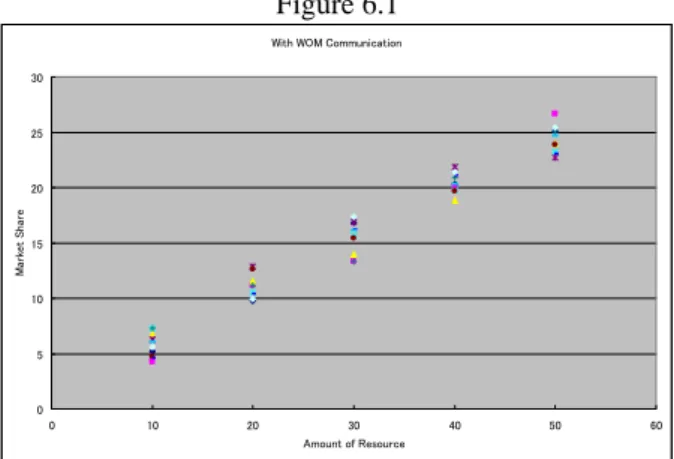
First, we varied the amount of promotion from 10 to 50 increasing by 10, while fixing the market coverage constant (“Full” coverage). For each value, we made 10 simulation runs and the results of simulations are depicted in Figure 6.1. We also added cases when there is no word-of-mouth communication in the same manner and the results are shown in Figure 6.2.
As expected, the increase of the amount of promotion resulted in higher market share in both cases. When word-of-mouth communication exists, there are relatively higher variances in the performances. This might suggest that word-of-mouth communication has a potential to amplify the promotion effect.
6.2. Combination of Amount of Promotion and Coverage
If conditions permit, it is likely that spending the maximum amount of promotion with “Full” coverage would yield the maximum performance.
Figure 6.1 With WOM Communication
0 5 10 15 20 25 30 0 10 20 30 40 50 60 Amount of Resource M ar ket S ha re Figure 6.2 Without WOM Communication
0 2 4 6 8 10 12 0 10 20 30 40 50 60 Amount of Resource M ar ket S ha re
To examine this likelihood, we ran 10 simulations for each 9 patters [(amount: 10 – 20 - 40) X (range: “full” – “half” – “quarter”)] of simulations with word-of-mouth communication. We repeated the same combination without word-of-mouth communication. Figure 6.3 and Figure 6.4 show the results respectively.
Figure 6.3 0 5 10 15 20 25
full half quarter
WOM 10 WOM 20 WOM 40
Figure 6.4 0 1 2 3 4 5 6 7 8
full half quarter
w/o WOM 10 w/o WOM 20 w/o WOM 40
One note from these results is that performance differences between coverage at the same amount of promotion seem to be bigger with word-of-mouth communication situations than those of without word-of-mouth communication situations. One possible interpretation of this outcome would be that word-of-mouth communication sustains the effect of promotion. Figure 6.6 full half quarter 5 10 15 20 250 2 4 6 8 10 12 14 Market Share Coverage Amount
To further examine several combinations, we ran simulations in the same manner for the combination of [(amount: 5 – 10 – 15 – 20 - 25) X (range: “full” – “half” – “quarter”)].
We obtained the results that support the interpretation. Figure 6.6 shows the results of those simulations with word-of-mouth communication and Figure 6.7 without word-of-communication. Figure 6.7 full half quarter 5 10 15 20 250.00 0.50 1.00 1.50 2.00 2.50 3.00 3.50 4.00 4.50 Market Share Range Amount 6.3. Resource Concentration
It is widely recognized that concentrating business resources are more effective that dispersing them. The recognition is particularly important in making strategic decisions. In order to examine whether the recognition holds true in this case, we extracted three sets of combinations from the above simulations. The combinations sets are shown in Table 6.1. Theoretically, the total resources consumed should be the same among the three cases. Therefore, outcomes from each case should not be much different. However, the simulation results, as shown in Figure 6.8, indicates that there is a significant difference in performances and concentrating resources (Case 3) will be the most favorable option among the three.
Table 6.1 Amount of Resource Market coverage Case 1 10 Full (100%) Case 2 20 Half (50%) Case 3 40 Quarter (25%) Figure 6.8 0 2 4 6 8 10 12 14 16 1 2 3 Case Ma rk et S ha re WOM w/o WOM
This result might be explained by the design of our simulation model. Each individual consumer is represented by a single cell on the consumer place, and they do not move around during the simulation process. Also, (promotion) agents are restricted to be scattered in a certain part on the consumer place. As a result, in our model, word-of-mouth communication might have occurred more frequently in consumer’s purchasing decision process.
This is, however, indicates that if a certain segment of consumers are targeted and contacted repeatedly, promotion effect to such particular consumers can be significantly high. If a promotion strategy can be developed in this way, the performance of such promotion strategy would be satisfactory.
7. CONCLUSION AND FURTHER DEVELOPMENT
Word-of-mouth communication is a powerful communication method because of its potential influence on consumers purchasing decision making process. Our computer simulation indicated that word-of-mouth communication has several functionalities, such as amplifying and sustaining capabilities of promotion effects. Although it would be difficult for a company to control word-of-mouth communication directly, expected benefit might justify endeavors of finding ways to somehow influence word-of-mouth communication.
As for further development, our simulation model might need further sophistication in representing more real situations in the marketplace. Some other marketing variables, such as pricing conditions or channel management issues might need to be implemented in the model in the future. In addition to consumer behavior in word-of-mouth communication, more detailed and thorough consumer behavior rules might be added, too. Besides continual development of our model, possible further step will be to apply our model to other consumer goods products/industries in similar situations. In expanding the model’s coverage, our focus will be, by finding any commonality across products/industries, to obtain a deeper understanding of consumer’s purchasing behavior.
REFERENCES
[1] Jain, D., “Managing New Product for Strategic Competitive Advantage,” in Iacobucci, D. (ed.), Kellogg on Marketing, John Wiley & Sons, 2001, pp.130-147
[2] Booz-Allen & Hamilton, “New Product Management for the 1980’s,” 1982
[3] Kotler, Philip, “Marketing Management(Millennium ed.),” Prentice Hall, 1999
[4] Axelrod, Robert, “The Complexity of Cooperation,” Princeton University Press,1997
[6] Assael, Henry, “Consumer Behavior and Marketing Action(5th ed.),” Kent Publishing, 1995
[7] Herr, Paul M., Frank R. Kardes, and John Kim, “Effects of Word-of-Mouth and Product-Attribute Information on Persuasion: An Accessibility Diagnosticity Perspective,” Journal of Consumer Research, 17, March 1991, pp. 454-462
[8] Reynolds, Fred D. and William R. Darden, “Mutually Adaptive Effects of Interpersonal Communication,” Journal of Marketing Research, Vol. 8, November 1971, pp. 449-454