Japan Advanced Institute of Science and Technology
and International Students
Author(s)
Bui Ba, Hoang Anh; 西本, 一志
Citation
インタラクション2016論文集: 219-222
Issue Date
2016-02-24
Type
Conference Paper
Text version
publisher
URL
http://hdl.handle.net/10119/13770
Rights
社団法人 情報処理学会, Bui Ba Hoang Anh, 西本一
志, インタラクション2016論文集, 2016, 219-222.
ここに掲載した著作物の利用に関する注意: 本著作物
の著作権は(社)情報処理学会に帰属します。本著作
物は著作権者である情報処理学会の許可のもとに掲載
するものです。ご利用に当たっては「著作権法」なら
びに「情報処理学会倫理綱領」に従うことをお願いい
たします。 Notice for the use of this material:
The copyright of this material is retained by the
Information Processing Society of Japan (IPSJ).
This material is published on this web site with
the agreement of the author (s) and the IPSJ.
Please be complied with Copyright Law of Japan
and the Code of Ethics of the IPSJ if any users
wish to reproduce, make derivative work,
distribute or make available to the public any
part or whole thereof. All Rights Reserved,
Copyright © Information Processing Society of
Japan.
BiTak: A Half-duplex Dual-lingual Video Chat to
Improve Languages Proficiency both of Japanese and
International Students
Bui Ba Hoang Anh
1西本 一志
2Abstract: In this paper, we propose a video chat system named BiTak which employs strict turn-taking
dual-lingual communication using recording function. BiTak aims to motivate the dual-lingual conversation between Japanese and International students as well as to identify the mutual benefits through this kind of conversation for the need of improving simultaneous bilingual acquisition. The two most outstanding features of BiTak is following two functions: 1) a strict turn-taking function by discretely recording each utterance and 2) a text chat function related to each recorded utterance. We conducted a preliminary experiment to evaluate the effectiveness of BiTak and found that strict turn-taking function favorably boost students’ speaking skills while recording function failed to meet the expectation.
1.
Introduction
Among the global community in which English is in-creasingly considered the predominant international lan-guage, Japan presents a particularly compelling case of learning English. On the other hand, more and more foreigners study Japanese for their profession, language choice or living in Japan. However, there are lots of diffi-culties to study languages. Japanese students experience great obstacles in studying English, due to fundamental differences in grammar and syntax, as well as important differences in pronunciation. According to Galloway, N. (2013), there are several factors influence Japanese stu-dents’attitudes in learning English such as pedagogical beliefs, stereotypes, future goals and motivation[1]. On the other hand, Seward, J. (1969) asserts that foreigners also have to deal with language frustration when study-ing Japanese[2]. They are afraid of borrowed words, male and female speech forms, polite and non-polite speech, and anatomical terms, proverbs, dialects, and other as-pects of Japanese culture. These language barriers pre-vent people from communicating directly (Holman et al.,
1 School of Knowledge Science,Japan Advanced
Insti-tute of Science and Technology
2 Research Center for Innovative Lifestyle Design,Japan
Ad-vanced Institute of Science and Technology
2011)[3]. Some conventional ways of learning languages have been applied such as attending classes, group dis-cussion and learning, self-study. Apparently, there is not the most appropriate method, people learn in different ways at different paces, and the most effective way may involve not one but a mixture of different techniques. Language learning, much like language itself, might be an inherently social pursuit. Kimber, L. (2014) recom-mends providing more opportunities for interactions be-tween Japanese and internationals [4]. Being inspired by that recommendation, our study suggests building an on-line environment for both Japanese and internationals to talk freely using both English and Japanese. We pro-pose a video chat system named BiTak that employs strict turn-taking dual-lingual communication using Recording function.
Dual-lingual Communication
Myers-Scotton (2006) defines bi-/multilingual as “the ability to use two or more languages to sufficiently carry on a limited casual conversation”[5]. The concept of Dual-lingual Communication in our research is defined as two languages being spoken in the conversation and under-stood by respective participating parties. Japanese stu-dents will use English while foreign stustu-dents will speak
Strict turn-taking
In an informal conversation, talking naturally without caring overlapping usually brings about the comfort of ex-pressing ideas. Smooth turn-taking is an essential aspect to coordinate one’s communicative actions and interact successfully with others. However, it is not always good for learning a language. You may hardly recognize your speaking mistakes by yourself although the listeners can understand clearly. Hence, our system strictly applies the turn-taking approach by using Recording function. In our system, we ask users to entirely obey the turn-taking rule while turning on the recording button. The rest of this paper is organized as the followings. Section 2 reviews related works and correlates them with our proposed sys-tem. The description of our prototype system is men-tioned in Section 3. Section 4 describes the preliminary experiment to estimate the proposed system as well as mentions its results. The effectiveness of the system is also discussed in Section 4 by comparing two experiment ap-proaches, one using ”strict turn-taking” with the record-ing button and one without usrecord-ing it. Section 5 concludes the paper.
2.
Related works
Recent studies have suggested some implications for the design of tools that might enhance cross-cultural group chat (Li, N., & Rosson, M. B., 2012)[6]. They recom-mended computermediated communication (CMC) tools as an important role in both work and educational mul-tilingual contexts. In addition, CMC tools design such as Instant Annotation for tagging or side-chatting or Thread Chat which helps people organize their chat logs into thread may allow global organizations to help non-native speakers be more comfortable and more effective mem-bers. Ogura, K., & Nishimoto, K. developed the voice chat system named “ChaTEL” which can record the utterances for the re-listening to achieve multithreaded voice communication (2006)[7]. The ChaTEL system is equipped with a “ history of conversation” as well as functions that specify receivers of messages and related messages which make it possible to simultaneously talk about multiple topics with voice communication. Never-theless, few studies have aimed to utilize video chat appli-cations for supporting simultaneous learning of multiple languages. Our study proposes a video chat system as
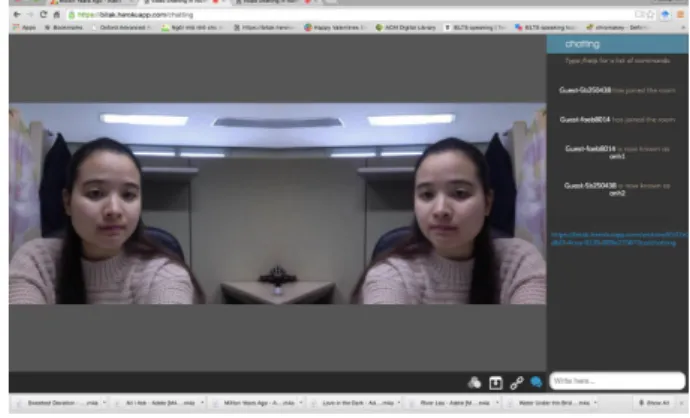
Figure 1 User Interface of BiTak
a virtual turn-taking face-to-face environment for users to practice dual-lingual conversation. Instead of choos-ing one partner’s language over the other, they prac-tice “dual-lingual”pattern. It is a communication pat-tern in which each partner actively uses his or her sec-ond language and receives the partner’s second language in response. This video chat system will support group turn-taking conversations speaking Japanese and English in which their voices and images will be intentionally recorded so that they can re-listen to utterances again at anytime.
3.
BiTak System
Fig.1 shows a snap shot of the user interface of BiTak. We developed a web application called “BiTak” using the open source from WebRTC[8], which is a free, open project that provides browsers and mobile applications with real-time communications with simple APIs. The most prominent features of BiTak is following two func-tions: 1) a strict turn-taking function by discretely record-ing each utterance and 2) a text chat function related to each recorded utterance. In the following sections, these two functions are described in detail.
3.1 Strict turn-taking function by discretely recording each utterance
Each utterance in BiTak is recorded in order to give participants a chance to watch the video again to fully understand the dual-lingual situation, not to realize multi-threaded communication. When a person wants to talk, he/she just needs to click on the Recording button then his/her voice will be automatically recorded. At the same time, others’microphone will be off; they can do nothing but listen to the speaker. After the speaker finishes talk-ing, he/she clicks the Recording Button again, the record-ing link will appear in the main window chat (See Fig.2).
Figure 2 An example of the recording link
The next person will take turn to talk by repeatedly click-ing the Recordclick-ing Button. Therefore, the communication style with using BiTak is in a half-duplex manner similar to that of a transceiver. The users can download all the recording videos for further reference.
3.2 Text chat function related to each recorded utterance
The recording link will lead users to another tab where they can re-watch the video. Meanwhile, the main chat will be still facilitated without any interruption. If, for example, an utterance in English from a Japanese par-ticipant includes some errors or unsuitable expressions, it should be corrected immediately. In order to readily achieve it, we provide a text chat function to each record-ing link, not to all recordrecord-ing links. The users can chat, ask or point out about any unclear points by typing text in the chat bar right beside the recording video. This fea-ture is separately designed for each recording link with the hope of achieving deeper understanding.
4.
Preliminary Experiment
4.1 Procedure
We conducted a preliminary experiment in a group of four subjects including a Mexican student and a Viet-namese student who both speak English as a second lan-guage and two Japanese students. All subjects are famil-iar with some popular video chat applications like Skype or Facetime, however, the recording function with strict turn-taking approach is totally new to them. The exper-iment is carried out by two stages: Stage 1 using BiTak without turning on Recording function which also means strict turn-taking is not employed either and Stage 2 using BiTak with employing Recording function and strict turn-taking approach. In each stage, the two Japanese used En-glish while the foreigners practiced Japanese concurrently.
Figure 3 Group chat interface
Figure 4 The recording link where user can re-watch and download the recording video
We performed the experiment to achieve these following aims: 1) to investigate whether strict turn-taking can be applied to effectively facilitate Dual-lingual Conversation for practicing speaking skill and 2) to evaluate the useful-ness of the newly added Recording function for language learning. The subjects communicated informally using five suggested topics for both stages:“Self-introduction”;
“Talk about your hobby or daily routines”;“How your life is at Jaist”;“How you learn English/Japanese”;“Your plan for the coming Christmas and New Year”. Each stage lasted 45 minutes and they are allowed to actively talk about any new topics if the time has not been not over. Fig.3 shows an instance of the group chat interface and Fig.4 shows an example of the recording link where user can re-watch and download the recording video.
4.2 Result Analysis
We employed a semi-structure interview to collect the data from the experiment. As mentioned above, BiTak is created based on our hypothesis that Dual-lingual Communication is helpful for language learning, particu-larly speaking skills and strict turn-taking approach with Recording function play a crucial role in making it
pos-receive constructive comments. We used three main ques-tions to ask the subjects:
( 1 )“How did you feel about the operation of the sys-tem?”
( 2 )“What was different between using Recording func-tion and without using Recording funcfunc-tion?”
( 3 )“How do you evaluate the effectiveness of BiTak in facilitating Dual-lingual conversation to enhance lan-guage proficiency?”
Some fruitful results as well as existing issues have been achieved after the interview: - All participants had good evaluation on our app interface, sound quality and easy-to-use features. - When not using Recording function in Stage 1, they all felt the conversations went natural but it also made no difference than normal chatting. The only good point they asserted is that it is a new and interest-ing experience to deliberately use dual-linterest-ingual conversa-tion for practicing languages. - On the other hand, most of the subjects found it uncomfortable when turning on the recording function in Stage 2. However, the strict turn-taking really helped them to talk more. It was easy for them to express clearly what they want to speak since no one can interrupt them at that time. The listeners also had time to listen carefully to what they said so that they were eager to help the speaker correct any mistakes. In contrast, all of the subjects admitted of not listening to the recording link so often, just once or twice because they feel distracted and could not catch up with the main chat. -They all think that this kind of dual-lingual con-versation can help them practice and improve language speaking skills.
5.
Conclusion
In this paper, we proposed a video chat system named
“BiTak”to facilitate strict turn-taking dual-lingual com-munication for language speaking practice. Our system is equipped with a recording function that can record all speakers’utterances and strictly asks users to take turn to talk. Based on the preliminary experiment, it was sug-gested that the turn-taking function of Bitak successfully promotes speaking skills. However, the recording failed to meet the expectation. In the future, we plan to improve the Recording function to be better used in enhancing language proficiency and want to conduct further long-term experiments to investigate effectiveness of BiTak as
Acknowledgment
This work was supported by JSPS KAKENHI Grant Number 26280126.
References
[1] Galloway, N. (2013). Global English and English Lan-guage Teaching (ELT)Bridging the gap between theory and practice in a Japanese context. System, 41(3), 786-803.
[2] Seward, J. (1969). Japanese in Action; An Unorthodox Approach to the Spoken Language and the People Who Speak It.
[3] Holman, C., Leibrock, J., Jimenez, J., Greitzer, D., & Haynes, T. (2011, May). Lingua: cultural exchange through language partnerships. In CHI’11 Extended Ab-stracts on Human Factors in Computing Systems (pp. 1001-1006). ACM.
[4] Kimber, L. (2014). Attitudes and beliefs of students to-ward bi-/multilingualism at an international university in Japan. Ritsumeikan Journal of Asia Pacific Studies, 33, 139-152.
[5] Myers-Scotton, C. (2006). Multiple voices: An introduc-tion to bilingualism. Malden: Blackwell Publishing. [6] Li, N., & Rosson, M. B. (2012, October). At a different
tempo: what goes wrong in online cross-cultural group chat?. In Proceedings of the 17th ACM international con-ference on Supporting group work (pp. 145-154). ACM. [7] Ogura, K., & Nishimoto, K. (2006, April). ChaTEL: a voice communication system for facilitating multi-threaded conversation. In CHI’06 Extended Abstracts on Human Factors in Computing Systems (pp. 1163-1168). ACM.