Stream
Cipher Systems
Using aChaotic
Sequence of
I.I.D
Random
Variables
i.i.d.
カオス系列を用いたストリーム暗号システム
Tohru
KOHDA
香田徹 e-mail: [email protected]Department of Computer
Science
andCommunication
Engineering,Kyushu University,
Hakozaki 6-10-1, Higashi-ku, Fukuoka, 812-8581, Japan
九州大学大学院システム情報科学研究院情報工学部門
〒
812-8581
福岡市東区箱崎6 丁目 10-1Abstract- Asequence of i.i.d. binary random variables has found significant
applica-tions in modern digital communication systems, such
as
aspreading spectrum sequence fora
DS/CDMA system and akey-stream sequence for astream cipher system. In this paper,after reviewing the generation method ofsequences of i.i.d. binary random variables
gener-ated by chaotic dynamics
we
give astream cipher system using asequence of i.i.d. binaryrandomvariables which has cryptographic resistance for severalkinds of cryptanalysis based
on
correlation functions.$\mathrm{K}\mathrm{e}\mathrm{y}\mathrm{w}\mathrm{o}\mathrm{r}\mathrm{d}_{\mathrm{S}}-\mathrm{s}\mathrm{t}\mathrm{r}\mathrm{e}\mathrm{a}\mathrm{m}$cipher, keystreamsequences, randomsequence,
i.i.d.
sequence,
chaoticdynamics, Cryptanalysis, aut0-/cross-correlation function, secret key
1Introduction
Asequence of independent and identicallydistributed $(i.i.d.)$ binary random variables $[1]-[4]$
hasfoundsignificant applicationsin moderndigitalcommunication systems such
as
in spreadspectrum (SS) communicationsystems [5]
or
cryptosystems $[6, 7]$as
wellas
in computationalapplications requiring random numbers $[8, 9]$
.
Such abinary sequencecan
be generatedin various ways. Nevertheless, linear feedback shift register (LFSR) sequences which have
already been thoroughly investigated based
on
finite field theoryare
employed in nearly aUthe methods [10].
It is, however, $\mathrm{w}\mathrm{e}\mathrm{u}$ knownfromprobability theory $[1]-[3]$
and ergodic theory [4] that coin
tossing is atheoretic model that generates
asequence
of i.i.d. binary random variables inthe following
sense.
Imagine $n$ independent tosses of afair coin. Ifwe
label 1and 0insteadof head and tail, then the resulting binary
sequence
of length $n$ gives uniquely both theassociated dyadically rational number and
one
of2’$l$disjoint half-0pen subintervals of widt$\mathrm{h}$
数理解析研究所講究録 1240 巻 2001 年 74-87
$d,(\omega)$
$d_{2}\mathrm{t}\omega)$
$d_{\mathrm{J}}(01)$
Figure 1: Binary functions $d_{k}(\omega)$ which define Rademacher functions $rk(\omega)$
.
$2^{-n}$ whose left endpoint is the dyadically rational number.
On
the other hand, choosea
dyadically rational number $\omega$ at random and consider the ‘map’ (or ‘transformation’) on the
half-0pen unit interval $[0, 1)$, defined by $\tau(\omega)=2\omega$(modl), referred to
as
the dyadic map.Then the dyadic map shifts the digit
one
place to the left ofthe binary expansion of$\omega$.
Insuch
an
expansion, the binary function is sometimes referred toas
theRademacher
function.
Thus throwing adie may be
seen as
both adeterministic and arandom event.Ulam andvonNeumann [11] pointed out the logisticmap, themost famous chaotic one, is
agoodcandidateof pseudorandomnumbergenerators. Ontheotherhand,several encryption
algorithms based
on
chaos theory [12]-[18] have been discussed (see, for example, thesurveyin [18]$)$
.
We have recently givenseveral methodsforgenerating abinarysequencebased
on
chaoticdynamics [19]-[21] and asimplesufficient conditionfor
some
classofergodicmapsto produceasequence of i.i.d. binary random variables $[23, 24]$. Furthermore,
we
have proposeda
cryptosystem in afloating point environment whose keystream sequences
are
chaotic bitsequences $[25, 26]$
.
In this paper, wefirst review asufficient condition $[23, 24]$ for
some
class of ergodic mapsand theirassociatedbinary functions to produceasequence ofi.i.d. binaryrandomvariables.
Seconddly,
we
give astream cipher system whose running key is asequence of i.i.d binaryrandom variables and show such asystem has its cryptographical strength $[25, 26]$
.
2Design of
Binary Sequences Using
PM
Maps
2.1
SequencesGenerated
byBernoulli
Shift and
Rademacher Function
Let
us
start byreviewing fundamentalsubjects from the textbooks ofelementary probabilitytheory $[1]-[3]$ and ergodic theory [4].
Let $\omega$ be apoint drawn at random from the half-0pen unit interval $[0, 1)$
.
With each$\omega$
associate its nonterminating binary expansion
$\omega=\sum_{k=1}^{\infty}\frac{d_{k}(\omega)}{2^{k}}=0.d_{1}(\omega)d_{2}(\omega)\cdots$, wwhhoesree$d_{i}(\omega)\in\{0,1\}$
.
(1)Imagine
now
acoinwithfaces labeled 1and0instead
ofthe usual heads (H) and tails (T). If$\omega$ is drawn at random, $\{d_{k}(\omega)\}_{k=1}^{\infty}$ behaves
as
if it resultedfroman
infinite sequence oftossesofafair coin On the other hand, define the map $\tau_{B}(\cdot)$, referred to
as
the Bernoullishift
or
dyadic map by $\tau_{B}(\omega)=2\omega$, $\mathrm{m}\mathrm{o}\mathrm{d} 1$ which gives $\tau_{B}(\omega)=0.d_{2}(\omega)d_{3}(\omega)\cdots$
.
This implies that$\tau_{B}(\cdot)$
shifts the
digitsone
place to the left, namely, $d_{k}(\tau_{B}(\omega))=d_{k+1}(\omega)$,for
$k\geq 1$.
The75
$T=\{t_{0}|$
$T=\{t_{l}$
.
t,.-t,$|$$T=\mathrm{I}\mathrm{t}d=t_{\phi}t.t.t- l,e=\mathrm{J})- i,l- t_{2’}’\sim 2Ji_{1}$,
Figure 2: Independentpulse
functions
defined by $C_{T}(\omega)$.
functions
$d_{k}(\omega)$,$k=1,2$,$\cdots$are
often replaced by theRademacher
fienctions
$[1, 3]$ definedas, $rk()=1-2dk(\omega)$, $k=1,2$,$\cdots$
.
Since
thefunctions
$r_{k}(\omega)$, $k=1,2$,$\cdots$ furnishus
withamodelof independent tosses of a“fair” coin, their values give rise to “independent random
variables”. Figure 1shows the binary
functions
$d_{k}(\omega)$.
2.2
Binary Sequences
Generated
byErgodic Maps
In the application of chaotic dynamics to cryptosystem, the dyadic map is impracticable with
the help ofacomputer with its limited accuracy in the
sense
that the period of its chaoticorbit is very short. Ofcruicial importance is the question whether any other maps than the
dyadic map
can
realizecoin tossingor
not.Let
us
start withgiving threesimple methods [19]-[21] forobtainingbinarysequences ffomchaotic real-valued sequences $\{\omega_{n}\}_{n=0}^{\infty}$, generated by
an
ergodicmap
$\tau(\cdot):J=[d, e]arrow J$$\omega_{n+1}=\tau(\omega_{n})$, $\omega_{n}=\tau^{n}(\omega_{0})\in J$,
n
$=1,$2,\cdots . (2)Method-l: Define athreshold function $\Theta_{t}(\omega)$
as
Qt(w) $=\{$mentary
function
$\overline{\Theta}_{t}(\omega)=1-\Theta_{t}(\omega)$.
0for $\omega<t$,
and its
comple-1for $\omega$ $\geq t$
Method- 1: For $\omega(|\omega|\leq 1)$ introduce its binary representationof.$\cdot$
$|\omega|=0.A_{1}(\omega)A_{2}(\omega)\cdots A:(\omega)\cdots$,$A_{:}(\omega)\in$
{0,1}
(3)where
$A_{i}( \omega)=\bigoplus_{r=1}^{2}.\{\Theta_{-\frac{r}{2}}$
.
$( \omega)\oplus\Theta_{\frac{r}{2}}.(\omega)\}=\sum_{r=1}^{2}.(-1)^{r-1}\{\Theta_{\frac{r}{2}}.(\omega)+\overline{\Theta}_{-\frac{r}{2}}.(\omega)\}$, (4)and $\oplus \mathrm{d}\mathrm{e}\mathrm{n}\mathrm{o}\mathrm{t}\mathrm{e}\mathrm{s}$ modulo 2addition.
Method-S: [23] Define abinary function with the set of thresholds, T$=\{t_{r}\}_{r=0}^{M_{T}}$, definedby
$C_{T}( \omega)=\oplus\ominus_{t_{r}}(\backslash \omega)=\sum_{rr=0=0}^{M_{T}}(-1)^{r}\Theta_{t_{r}}(\omega)M_{T}$, (5)
then
we
get the following examples:Example 1:
Ct{w)
$=\mathrm{Q}\mathrm{t}$ (w) when $M_{T}=0$.
$(’)-d$
Example $\mathit{2}\ovalbox{\tt\small REJECT}$ The value of C [0,1] has
e-d
$\frac{\omega-d}{e-d}=0.B_{1}(\omega)B_{2}(\omega)\cdots B_{i}(\omega)\cdots$ , where$B_{i}(\omega)\in\{0,1\}$ (6)
which implies that $\mathrm{C}\mathrm{T}(\mathrm{u})=\mathrm{B}\mathrm{i}\{\mathrm{u}$), when$M_{T}=2^{i-1}$,$t_{r}=(e-d) \frac{r}{2}$
.
$+d$.
If the interval$J=[0,1]$, then $A_{:}(\omega)=B_{i}(\omega)$
.
The binary functionCt{w)
is referred toas
the binary pulsefunction. Figure 2shows its examples. Note that $\mathrm{B}\{(\mathrm{u})=d_{i}(\omega)$ when $\tau(\cdot)=\tau_{B}(\cdot)$
.
2.3
The Equidistributivity
PropertyEDP and the Constant
Summation
Property
CSP
It is
an
important problem whether any other maps and theirassociated
binary functionsthan the dyadic map and the Rademacher function, respectively
can
realizeasequence
ofi.i.d. binary random variables
or
not. Recentlywe
have replied in the affirmative: There is awide class ofergodic maps with the equidistributivity property (EDP) and their associative
binary functions with the constant summation property (CSP) $[23, 24]$
.
To review this,we
begin bydefining the class ofmapsto bediscussed and introducingseveral definitions needed
in this discussion.
Define apiecewise monotonic (PM) onto ergodic map $\tau(\cdot)$ : $J=[d, e]arrow J$ that satisfies
the following conditions:
i) there is apartition $d=d_{0}<\cdots<d_{N_{\mathrm{r}}}=e$ of $J$ such that for each integer $i=$
$1$,$\cdots$ ,$N_{\tau}$, $(N_{\tau}\geq 2)$ the restriction of $\tau(\cdot)$ to the interval $J_{i}=[d_{i-1}, d_{\dot{l}})$, denoted by
Bi{
$\mathrm{u})$, isa
$C^{2}$ function;as
wellas
ii) $\tau(J_{i})=(d,$e);
iii) $\tau$ has aunique ACI measure, denoted by $f^{*}(\omega)d\omega$
.
Definition 1For$PM$onto rnap with its $ACI$measure, the partition $\{J_{i}\}_{i=1}^{N_{\tau}}$ is
referred
toas
the trivial partition
of
the interval $J$.
Definition 2 $[\mathit{2}7, 28]$ The Perron-Frobenius operator (or
‘transfer’
operator) $P_{\tau}$ acting onthe
function of
bounded variation $\mathrm{H}(\mathrm{w})\in L^{\infty}$for
$\tau(\omega)$ isdefined
as
$P_{\tau}H( \omega)=\frac{d}{d\omega}\int_{\tau^{-1}([d,\omega}H(\gamma_{)})dy=\sum_{j=1}^{N_{\tau}}|g_{/}’.(\omega)|H(g_{i}(\omega))$ , (7)
where
Ct{w)
$=\tau_{i}^{-1}(\omega)$ is the $i$-th preimageof
$\omega$.This implies $P_{\tau}$ is the (discrete-time) evolutionoperator ofthe probability density function
under the map$\mathrm{r}()[27]$
.
Note that theACI
measure
$f^{*}(\omega)d\omega$ satisfiies the invariant equation$P_{\tau}f^{*}(\omega)=\mathrm{C}\mathrm{t}\{\mathrm{w}$), referred to
as
the P-F equation.Definition 3 [23] The rnap is said to satisfy equidistributivityproperty (EDP)
if
the relation$|g’, \cdot(\omega)|f^{*}(g_{\dot{l}}(\omega))=\frac{f^{*}(\omega)}{N_{\tau}}$, $1\leq i\leq N_{\tau}$ (8)
Definition 4[23]
If for
a classof
maps with EDP its associatedfunction
$F(\cdot)$satisfies
$\frac{1}{N_{\tau}}\sum_{\dot{l}=1}^{N_{\tau}}F(g_{i}(\omega))=\mathrm{E}[F]$,
(9)
then$\mathrm{F}(-)$ is said to satisfy the constant summationproperty (CSP), where
$\mathrm{E}[F]$, theensemble
average
of
$F(\omega)$, isdefined
inDefinition
8.Remark 1
f23J
Consider a
random variable$\mathrm{F}(\mathrm{u})$ and its weightedrandomfunction
$F(\omega)f^{*}(\omega)$with the weight
function
$f^{*}(\omega)$.
Observe$P_{\tau} \{F(\omega)f^{*}(\omega)\}=\frac{1}{N_{\tau}}\sum_{\dot{l}=1}^{N_{\mathrm{r}}}|g_{\dot{l}}’(\omega)|f^{*}(g:(\omega))F(g:(\omega))$
.
(10)
An easy consequence
of
thedefinition
is thatif
givena
weighteddensityfunction
with respectto
a
random variable $\mathrm{F}(\mathrm{u})$ with $\mathrm{E}[F]\neq 0$,defined
by $F(\omega)f^{*}(\omega)$, bothof
the $CSP$of
$F(\omega)$and the $EDP$
of
$f^{*}(\omega)$are
satisfied, then $\frac{F(\omega)}{\mathrm{E}[F]}f^{*}(\omega)$ isan
invariantfunction
under the map$\tau(\cdot)$
.
Definition 5(Topological Conjugation)$[28, \mathit{3}\mathit{1}]$ Two
transformations
$\overline{\tau}$: $\overline{I}arrow\overline{I}$ and$\tau$ : $Iarrow$
I on intervals $\overline{I}$
and I are called topological conjugate
if
there exists a homeomorphism $h$:$\overline{I}\frac{\mathrm{o}\mathrm{n}\mathrm{t}\mathrm{q}}{}$
, $I_{f}$ such that $\tau(\omega)=h\mathrm{o}\overline{\tau}\mathrm{o}h^{-1}(\omega)$
.
Suppose $\tau(\cdot)$ and $\overline{\tau}(\cdot)$ have their ACI
measures
anddenote them by $f^{*}(\omega)d\omega$ and $\neg f(\overline{\omega})\Phi$,
respectively. Then, under the topological conjugation, these ACI
measures
have the relation$f^{*}( \omega)=|\frac{dh^{-1}(\omega)}{d\omega}|f(h^{-1}(\omega))\neg$
.
(11)It is easily checked ffom simple calculation that the EDP is invariant under the topological
conjugation.
Examples ofthe mapswith theirACI
measures
which satisfy theEDPare
listedas
follows.(1) $R$-adic map $(N_{\tau}=R, R=2,3,4, \cdots)$
$\tau_{R}(\omega)=R\omega$ $\mathrm{m}\mathrm{o}\mathrm{d} 1$, $\omega$ $\in[0,1]$, $f^{*}(\omega)d\omega$$=d\omega$,
(2) logistic map $(N_{\tau}=2)[11]$
$L_{2}(\omega)=4\omega(1-\omega),\omega$ $\in[0,1]$, $f^{*}( \omega)\mathrm{d}v=\frac{d\omega}{\pi\sqrt{\omega(1-\omega)}}$,
(3) Chebyshev map ofdegree$p(N_{\tau}=p, p=2,3,4, \cdots)$ $[29]-[31]$
Tp{u) $=\cos(p\cos^{-1}\omega)$, $\omega$ $\in[-1,1]$, $f^{*}( \omega)d\omega=\frac{d\omega}{\pi\sqrt{1-\omega^{2}}}$,
(4) Zigzag map withp branches $(N_{\tau}=p,$p$=2,$3,4,
\cdots )
[31]$N_{p}(\omega)=(-1)^{\Psi^{v\rfloor}}p\omega$, $\omega$ $\in[0,$ 1], $f^{*}(\omega)d\omega=M$,
Figure 3: Sequence generator of$\mathrm{i}.\mathrm{i}.\mathrm{d}$
.
binary random variables for astream cipher systemusing chaotic dynamics.
where $\lfloor x\rfloor$ denotes the largest integer not greater than $x$ and $N_{2}(\omega)$ is referred to
as
the tentmap.
Ulam and von Neumann [11] pointed out that the logistic map $L_{2}(\omega)$ and the tent map
$N_{2}(\overline{\omega})$
are
topological conjugate via$h^{-1}(\omega)=\underline{2}\sin^{-1}\sqrt{\omega}$
. On
the other hand, GrossmannandThomae [31] observed that$T_{p}(\omega)$ and
$N_{p}(\overline{\omega})^{\pi}\mathrm{a}\mathrm{r}\mathrm{e}$
topological conjugate via$h(\overline{\omega})=\cos\pi\overline{\omega}$
.
Now let
us
consider astationary real-valued sequences $\{F(\omega_{n})\}_{n=0}^{\infty}$, where $\omega_{n}=\tau^{n}(\omega_{0})$.
Definition 6(Birchoffindividual ergodic theorem)$[4, 28]$ The time average
of
any $L_{1}$func-than $\mathrm{F}(-)$ along a chaotic real-valued trajectory $\{\omega_{n}\}_{n=0}^{\infty}$ $gen$erated by the map (2), denoted
by Averagc4$\{F\}$,
defined
by Average4 $\{F\}--\lim_{Tarrow\infty}\frac{1}{T}\sum_{n=0}^{T-1}\mathrm{F}(\mathrm{u}\mathrm{n})$ is equal almost everyw here tothe expectation
of
$F(\omega)$,defined
by $\mathrm{E}[F(X_{n})]=\int_{I}F(X_{n})f^{*}(\omega)d\omega$.
From the stationarityof
process,
we
denote $\mathrm{E}[\mathrm{F}\{\mathrm{X}\mathrm{n})\}$ by $\mathrm{E}[F(X)]$or
simply $\mathrm{E}[F]1$Ofmajor importance to theinvestigationofstatistical propertiesof twosequences $\{F(\tau^{n}(\omega))\}_{n=0}^{\infty}$
and$\{G(\tau^{n}(\omega))\}_{n=0}^{\infty}$is their$2\mathrm{n}\mathrm{d}$-ordercross-covariancefunction with delay$\ell=0,1$,$\cdots$ which
is defined by
$\rho(\ell;F, G)=\int_{I}(F(\omega)-\mathrm{E}[F])(G(\tau^{\ell}(\omega))-\mathrm{E}[G])f^{*}(\omega)d\omega$, (12)
which denotes the aut0-covariance function when $F=G$
.
Remark 2Note that the opertaor$\mathrm{P}\mathrm{T}(-)$ has the mostimportantproperty
of
the P-F operator$P_{\tau}$:
$\int_{J}F(\omega)G(\tau(\omega))d\omega$ $= \int_{J}P_{\tau}\{F(\omega)\}G(\omega)d\omega$, (13)
where $G(\tau(\omega))$ in the integrand in the $Ihs$ is
referred
toas
the Koopman operator,as
theadjoint operator
of
the Perron-Frobenius operator in a Hilbert space $[\mathit{2}\mathit{8}, 32]$.
Using (13),we
get the
rew
ritten$form$of
(12)$\rho(\ell;F, G)=\int_{I}P_{\tau}^{l}\{F(\omega)f^{*}(\omega)\}G(\omega)d\omega$ $-\mathrm{E}[F]\mathrm{E}[G]$
.
(14)1 It should be noted that expectation $\mathrm{E}[\cdot]$ is used here in asense applicable to deterministicsequencesof
the form (2), anddiffers from the standardonefor stochasticsequenceswhich will involve ajoint probability
densityfunction
Equation (10) andcondition ii) ofthe onto map $\tau(\cdot)$ give
Lemma 1[23] The $PM$ onto maps $\tau(\cdot)$ with $EDP$ satisfy
$P_{\tau}\{\Theta_{d}\dot{.}(\omega)f^{*}(\omega)\}=\mathrm{E}[\Theta_{d:}]f^{*}(\omega)$
.
(15)Lemma 2 [23]For
a
classof
maps with $EDP$, the following three symmetric properties:SI: the symmetric binary
function
$C_{T}(\omega)$,defined
as
$t_{r}+t_{2M-r}=d+e$,
r
$=0,$ 1,\cdots ,M;S2: the symmetric
ACI
measure,defined
as
$f^{*}(d+e-\omega)=f^{*}(\omega)$;
S3: the symmetric map,
defined
as
$\tau(d+e-\omega)=\tau(\omega)$, $\omega$ $\in I$
give
$P_{\tau}\{C_{T}(\omega)f^{*}(\omega)\}=\mathrm{E}[C_{T}]f^{*}(\omega)$
.
(16)Remark 3Relation (16) is a generalized version
of
(15); theCSP
of
$\mathrm{F}(\mathrm{J})$ guarantees theirzero
correlations, $\rho(\ell,$F,$G)=0$,for
‘positive’ delay$\ell$ irrespectiveof
$G(\omega)$.
Next, let $\mathrm{U}=U_{0}U_{1}\cdots U_{m-1}$ be
an
arbitrary string of $m$ binary digits where $U_{n}\in$$\{0,1\}(0\leq n\leq m-1)$
.
Then thereare
$2^{m}$ possible strings. Let $\mathrm{u}^{(r)}=u_{0}^{(r)}u_{1}^{(r)}\cdots u_{m-1}^{(r)}$ bethe $r$-th string. Introducing abinary random variable
$\Gamma_{n}(\omega;$F,$\mathrm{u}^{(r)})=F(\omega)u_{n}^{(r)}+\overline{F}(\omega)\overline{u}_{n}^{(r)}$ (17)
for any binary
function
$\mathrm{F}(\mathrm{v})$ with CSP,we can
get [23]Theorem 1: The probability
of
the event$\mathrm{u}^{(r)}$in
an
infinite
binarysequence
$\{C_{T}(\omega_{n})\}_{n=0}^{\infty}$is given by
$Pr(\mathrm{u}^{(r)}; C_{T})$ $=$ $\int_{I}\{\prod_{n=0}^{m-1}\Gamma_{n}(\omega_{n};C_{T}, \mathrm{u}^{(r)})\}f^{*}(\omega)d\omega$
$=$ $\mathrm{E}[C_{T}]^{s}(1-\mathrm{E}[C_{T}])^{m-s}$, (18)
where$s$ is the number
of
1in $\{u_{n}^{(r)}\}_{n=0}^{m-1}$.
This implies $\{C_{T}(\tau^{n}(\omega))\}_{n=0}^{\infty}$ is asequenceof i.i.d. binary random variables with probability
$\mathrm{E}[\mathrm{C}\mathrm{t}]-$ Note that
we
can
get afair Bernouli sequence when $E[Cr]= \frac{1}{2}$, that is,an
m-distributed binary randomsequence. Figure 2shows
an
example of symmetric binaryfunction$C_{T}(\omega)$
.
3Stream
Cipher System
3.1
Stream
Cipher System
Using
Chaotic Dynamics
We employ the s0-called binary additive stream ciphers in which ashort secret key $\vec{K}=$
$(s_{1}.s_{2},$\cdots ,$s\#)$ is used only to controlakeystream generator. We havesecret key parameter
$4$
,
0 $,*$ $\mathrm{r}$ $\infty$ $*$ $u$ $*$ 00 ,0 , $\infty$ $u$ $\infty$ $\infty$ 90 $\prime l$ $\infty$ , $*$ $\infty$
.
Time Delay ’ TimeDelay’ Time Delay ’
(a) (b) (c)
$\rho_{64}(0,\omega_{0},\omega_{0};_{0}, _{0})$ $\rho_{64}(\ell,\omega_{0},\omega_{0;}A_{2}, A_{2})$ $\rho_{64}(\ell,\omega_{0},\omega_{0};B_{2},B_{2})$
Figure 4: Autocorrelation functions
$\alpha s$ $\wedge$ $\alpha \mathrm{a}$ tzgnc$\mathrm{a}\mathrm{v}*\prime u*\dot{.}$ $\overline{\Phi.}$ $\tilde{\Phi.}$ $\alpha$’ $8*\delta\Leftrightarrow$ . 0
$\mathrm{r}\mathrm{r}\mathrm{m}\mathrm{b}\mathrm{k}\cdot \mathrm{a}\mathrm{v}\mathrm{u}\cdot \mathrm{r}i$
. $\mathrm{O}$ $\alpha$’ : $\mathrm{a}^{3}$ $\alpha \mathrm{a}$ $t\backslash$ . $\alpha \mathrm{a}_{0}$ $02$ $\alpha$
.
0$\cdot$ $0l$ , ’’$\rho_{64}(0,\omega_{0},\omega 0;_{t}, \ominus_{t’})$ $\rho_{64}(0,\omega_{0},\omega_{0;}\Theta_{t}, \Theta_{t’})$
Figure 5: Crosscovariance functions
$\omega 0$ and T
as
wellas
parameters ofthe map $\tau(\cdot)$.
As anonlinear ergodic map$\tau(\cdot)$,
we use
theChebyshev mapsof degree k, defined by
$\tau(\omega)=\cos(k\cos^{-1}\omega)$, k $=2,$3,4, \cdots (19)
in the following numerical experiments. The central problem in stream cipher cryptography
is the difficulty of efficiently generating long running-key sequences from ashort and random
key. It is obvious thatasequence of$\mathrm{i}.\mathrm{i}.\mathrm{d}$
.
binaryrandomvariablesisone
of good candidates ofrunning-key sequences. Such asituation motivated us to proposeastream cipher system [25,
26] whose running-key sequence is asequence of $i.i.d$
.
binary random variables basedon
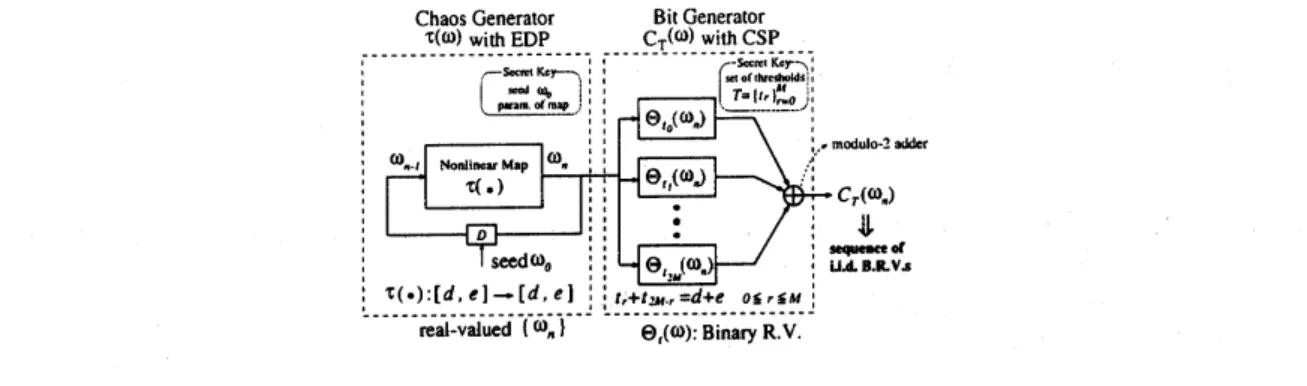
chaotic dynamics, $e.g.$, symmetric binary sequence $\{C_{T}(\omega_{n})\}_{n=0}^{\infty}$, defined by (5) with $M_{T}=$
$2M$ and the symmetric threshold set $T=\{t_{r}\}_{r=0}^{2M}$, defined by condition Sl in Lemma 2.
Figure 3shows astream cipher system based
on
$C_{T}(\omega)$.
3.2
Statistical
Properties of
Chaotic
Bit
SequencesThe set of thresholds$T=\{t_{r}\}_{r=0}^{2M}$ of$\mathrm{C}\mathrm{r}(-)$
are
candidates of secretkey parameters. However,such parameters
are
notcryptographicallysecure
and shouldnot beusedbecause thestatisticsofchaotic bit sequences
are
not sensitive to $\{\mathrm{t}\mathrm{r}\}$as
follows 5Consider the time-averagedcrosscorrelation functionbetweensequences $\{F(\omega_{n})\}_{n=0}^{\infty}$ with
5 This situation is similar to the one that chaos synchronization systems are insensitive to their system
parameters.
esm’ $\blacksquare\bullet$ ’
(a) 7-bit precision (b) 8-bit precision (b) 9-bit precision (d) 10-bit precision
Figure
6:
Cryptanalysis of t of$C_{T}$ sequence using $\rho_{64}(0, \omega_{0}, \omega_{0}’;C_{T}, \Theta_{t})$ (M $=2)$.
(a) 7-bit precision (b) 8-bit precision (b) 9-bit precision (d) 10-bit precision
Figure 7: Cryptanalysis of t in $C_{T}$ sequence using $\rho_{64}(0, \omega_{0}, \omega_{0}’;C_{T}, \Theta_{t})$ (M $=19)$
.
$u$ $\hat{.-\mathrm{k}.}u$
.:.
$\cdot$ $\cdot.$ ’–
$\mathrm{a}^{*}\vee\Leftrightarrow.$ , $l$.
.
.,$u$$\cdot*\cdot\cdot u\dot{.}\cdots \mathrm{J}\cdot\cdots$
\prime\prime
(a) $M=3$, $\epsilon=0.01$ (b) $M=20$, $\epsilon=0.01$ (c) $M=3$, $\epsilon=0.02$ (d) $M=20$, $\epsilon=0.02$
Figure 8: Cryptanalysis of$t_{M}$ using $\rho_{64}(0, \omega_{0}, \omega_{0;}C_{T}, C_{T},)$.
Figure 9: Cryptanalysis using$\rho_{64}(0,\omega_{0}, \omega 0’;\Theta_{t}, \Theta_{t},)$
.
an
initial seed $\omega_{0}$ and $\{G(\omega_{n}’)\}_{n=0}^{\infty}$ with anotherinitial seed$\omega_{0’}$, defined by
$\rho_{N}(\ell, \omega_{0}, \omega_{0}’; F, G)=\frac{1}{N}\sum_{n=0}^{N-1}F(\omega_{n})G(\omega_{n+\ell}’)$ , (20)
where the subscripts
are
taken $\mathrm{m}\mathrm{o}\mathrm{d} N$.
Note that $\mathrm{r}\mathrm{p}\mathrm{i}(1, \omega_{0}, \omega_{0}’;\ominus_{t}, _{t’})$has alargevalueonlyat$\ell=0$ because of its n0-correlation property. Figure 4showsautocorrelationfunctions with
theirn0-correlation property. Onthe other hand, thefluctuated and smooth
curves
inFigure5indicate respectively the time-average $r_{64}(0, \omega_{0}, \omega_{0};_{t}, \ominus_{t’})$ of cross-correlation between
Qt(-) and $_{t’}(\cdot)$
versus
$t’$, and the ensemble-averagedone
$\tilde{\rho}(0;\ominus_{t}$,easy. where $\tilde{\rho}(\ell;F, G)$ isdefined by
$\overline{\rho}(\ell;F, G)=\int_{J}F(\omega)G(\tau^{\ell}(\omega))f^{*}(\omega)$ du. (21)
Observethat thisfigureimpliesthat theestimationof the parameter$t$iseasyif the seed$\omega_{0}$ and
parameters ofthemap
are
previously knownandhencethat the key$t$ isnot cryptographicallysecure
and should not be used. Thus the set ofthresholds, $T=\{t_{r}\}_{r=0}^{2M}$, may be used onlyto satisfy the i.i.d. condition of sequences.
3.3
Cryptanalysis
3.3.1 Cryptanalysis of thresholds $t_{i}$
Figure 6and 7show searches ofthe thresholds $\{\mathrm{t}\mathrm{r}\}$ using cross-covariance functions
$\rho_{64}(0, \omega_{0}, \omega_{0}’;C_{T}, \ominus_{t})$, where $T=$
{0.3.0.6}
and $T=\{0.06,0.12,0.18,0.2,0.27,0.3,0.36,0.41$,$\mathrm{e}.\mathrm{g}\cdot$,0.5, 0.6, 0.62, 0.65, 0.67,0.7,0.79, 0.89, 0.9,
0.96}
$(M=19)$, respectively and where $\omega_{0}’$ isnearly equal to $\omega$ within (a) 7-bit precision, (b) 8-bit precision, (b) 9-bit precision, and (d)
10-bit precision. Observe that these figures imply that the
estimation
ofthe parameter $t$andhence the estimation of the parameter $T=\{t_{r}\}_{r=0}^{2M}$ is easy if the seed $\omega_{0}$ and parameters
of the map
are
previously known. Unless $\omega_{0}’$ is equal to $\omega$, however, the search of $t$ is noteasy. Eventhough, the key $t$ is not cryptographically
secure
and should not be used. On thecontrary, the parameters $T$ may be used only to satisfy the conditions for asequence to be
one
of $i.i.d$.
binary random variables. Figure 8shows $\rho_{64}(0, \omega_{0},\omega 0;C_{T}, C_{T’})$versus
$t_{M}’$ tosearch $t_{M}$, where $T=\{t_{r}\}_{r=1}^{M}$,$T’=\{t_{r}’\}_{r=1}^{M}$, and $\{t_{r}\pm\epsilon\}_{r=1}^{M-1}=\{t_{r}’\}_{r=1}^{M-1}$
.
3.3.2 Cryptanalysis of seed $\omega 0$
On the other hand, aseed $\omega_{0}$ ($i.e.$, an initial condition) is the best choice of asecret key in
stream cipher cryptography because of the SDIC(sensitive dependence
on
initialconditions)property and the ergodicity of chaotic maps
as
discussed in Section 2. Figures 9showsan
illustration of cryptanalysis using the statistics $r_{64}(0, \omega_{0}, \omega_{0}’;\theta_{t}, \theta_{t’})$, $r_{64}(0, \omega 0, \omega_{0}’;C\tau, C_{T’})$,
and $\rho_{64}(0, \omega_{0}, \omega_{0’};C_{T}, C_{T})$, respectively to search a10-digit seed $\omega_{0}=(0.0110100101)_{2}\simeq$
0.4113281.
.
., apartial secret key of abit sequence $\{C_{T}(\omega_{n})\}_{n=0}^{\infty}$ provided that all ofotherparameters
are
known within the limited accuracy, ($\omega_{0}’$ is nearly equal to $\omega$ within (a)7-bit precision, (b) 8-bit precision, (c) 9-bit precision, and (d) 10-bit precision). In this
search all possible $2^{10}\omega_{0}’$’s
are
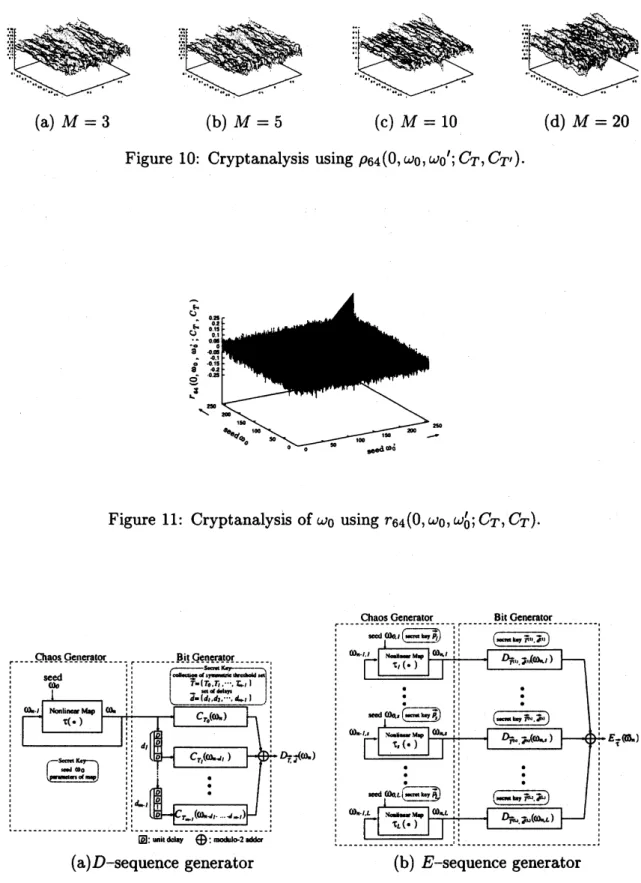
scanned. Figure 10 shows cryptanalysis of $t_{M}$ and $\omega 0$us-ing $\rho_{64}(0, \omega_{0}, \omega_{0’};C_{T}, C_{T’})$, where $T=\{t_{r}\}_{r=1}^{M}$, $T’=\{t_{r}’\}_{r=1}^{M-1}$, and $\{t_{r}\}_{r=1}^{M-2}=\{t_{r}’\}_{r=1}^{M-2}$
.
Figure 11 shows cryptanalysis of$\omega_{0}$ using $r_{64}(0, \omega_{0}, \omega_{0}’;C_{T}, C_{T})$
.
Wecan
find thatwe
needexhaustive searches of$\omega_{0}’$
even
if the parameters ofthe map, $e.g.$, degree$p$ of$T_{p}(\omega)$ and theset
of
thresholdsare
previously known because $r_{64}(0, \omega_{0}, \omega_{0}’;C_{T}, C_{T})$ has apeak only when$\mathrm{w}\mathrm{j}\ovalbox{\tt\small REJECT}\ovalbox{\tt\small REJECT}$ is equal to
$(\ovalbox{\tt\small REJECT}_{t})0$ completely in agiven precision [26]. This implies that this strategy is
computationally
infeasible
because of the large keyspace
of$(\ovalbox{\tt\small REJECT}_{t})0$.
3.4 Hierchical Structure
Achaotic
bitsequence
$\{C_{T}(\omega_{n})\}_{n=0}^{\infty}$ isasequence
of $i.i.d$.
binary random variables undercertain conditions[23]. The $i.i.d$
.
property make it easier to construct chaotic bitgenera-tors with hierarchical structures which
can
also produce sequences of $i.i.d$.
binary randomvariables. The first one, called level 1hierarchy, is based
on
the n0-correlation betweenany
twosequences, $\{C_{T}(\omega_{n})\}_{n=0}^{\infty}$ and $\{C_{T’}(\omega_{n+\ell})\}_{n=0}^{\infty}$,
ffom
a
seed for $\ell\geq 1$.
The n0-correlationproperty between $\{C_{T}(\omega_{n})\}_{n=0}^{\infty}$ and $\{C_{T’}(\omega_{n}’)\}_{n=0}^{\infty}$ is defined by[23]
$\rho_{N}(\ell,\omega 0, \omega 0’;C_{T}, C_{T’})-\frac{1}{4}arrow(Q_{7\mathrm{T}’}-\frac{1}{4})\delta(\ell)\delta(\omega_{0}-\omega_{0}’)$ ,
as
$Narrow \mathrm{o}\mathrm{o}$ (22)where$Q_{TT’}$ denotes anontrivial value which is afunction of$T$and$T’$
.
The second one, calledlevel 2hierarchy, is based
on
the n0-correlation betweenany
two sequences ffom differentseeds. Such asequence $\{C_{T}(\omega_{n})\}_{n=0}^{\infty}$ is referred to
as
level 0hierarchy.In order to increasethe number ofdifferent secret keys,
we can use
the modulo2additionofchaotic symmetricbinary sequences $\{C_{T_{j}}(\omega_{n})\}_{n=0}^{\infty}$ with asymmetric threshold set
$T_{j}=\{t:(j)\}_{\dot{|}=0}^{2M(j)}$, $0\leq j\leq m-1$
.
(23)For apositive integer
4
$(1 \leq i\leq m-1)$,we
get$D_{\vec{T},\overline{d}}\{\omega_{n}$) $=\mathrm{C}\mathrm{T}\mathrm{o}\{\mathrm{u}\mathrm{n}$) $\oplus C_{T_{1}}(\omega_{n-d_{1}})\oplus\cdots\oplus C_{T_{m-1}}(\omega_{n-d_{1}-\cdots-d_{m-1}})$, (24)
$\vec{T}=\{T_{0},T_{1}, \cdots,T_{m-1}\}$, $\vec{d}=\{d_{1},d_{2}, \cdots, d_{m-1}\}$ (23)
which is obtained from achaotic real-valued trajectory $\{\omega_{n}\}_{n=0}^{\infty}$
as
shown in Figure 12 (a).Note that
{
$D_{\vec{T},\vec{d}}\{\omega)\}_{n=0}^{\infty}$ is alsoasequence
of $i.i.d$.
binary random variables.Hence
we
callsuch asequence
{
$D_{f,\overline{d}}\{\omega)\}_{n=0}^{\infty}$a
generalized versionof
chaotic symmetric binary sequences.For such asequence,
we
can use
not only $\vec{T}$but also $\vec{d}\mathrm{a}\mathrm{s}$
secret keys.
For$L$seedswhich
are
chosen statistically independently andfor$L$ergodicmaps,we
define$E_{\vec{\tau}}(\vec{\omega_{n}})=D_{\vec{T}(1),d11)(\omega_{n,1})\oplus D_{\vec{T}(2),d\mathrm{t}2)(\omega_{n,2})\oplus\cdots\oplus D_{\vec{T}(L),d1\iota)}(\omega_{n,L})}}$ (26) $\vec{\tau}=\{\tau_{1}, \tau_{2}, \cdots, \tau_{L}\}$, $\vec{\omega_{n}}=\{\omega_{n,1}, \omega_{n,2}, \cdots,\omega_{n,L}\}$, $\omega_{n,s}=\tau_{s}^{n}(\omega_{0,s})$ (27)
The additive property of$i.:.d$
.
binary random variables aUowsus
to get asequence of$i.i.d$.
binary random variables $\{E_{\vec{\tau}}(\vec{\omega}_{n})\}_{n=0}^{\infty}$
as
shown in Figure 12. Note that periods of suchsequences canbe longerthanonesof each real-valuedsequences $\{\omega_{n,s}\}_{n=0}^{\infty}$in afinite precision
computation system. Figure 12 shows (a) abit generator $D_{\vec{T},d}\prec\omega$) and (b) abit generator
$E_{\vec{\tau}}(\vec{\omega}_{n})$, respectively.
4Concluding Remarks
Nevertheless, it is hardto prove that suchasystem implemented in afloating-point
environ-ment is cryptographically
secure
from the cryptographic point of view: $e.g.$, the period ofa
running sequence generatedby this cryptosystemis short.
Some
cryptographic problemscan
be settled only if
progress
insome
number-theoretic problems $\mathrm{a}\mathrm{n}\mathrm{d}/\mathrm{o}\mathrm{r}$ information theoreticones can
be made. Lastly note that most of the existing chaos cryptosystems have beenincapable of fully utilizing the sensitive dependence on initial conditions property, Le., $\omega_{0}$,
primarily because they
are
basedon
analog circuits(a) M $=3$ (b) $M=5$ (c) M $=10$ (d) M $=20$
Figure
10:
Cryptanalysis using $\rho_{64}(0,\omega_{0},\omega_{0’};C_{T}, C_{T’})$.
Figure 11: Cryptanalysis of$\omega_{0}$ using $r_{64}(0, \omega_{0}, \omega_{0}’;C_{T}, C_{T})$
.
$(\mathrm{a})D$-sequence generator (b) $E$
-sequence
generatorFigure 12: Hierachicalsequence generator
References
[1] M. Kac,
“Statistical
Independence inProbability
Analysis andNumber
Theory,”The
Mathematical Association
ofAmerica,1959.
[2] M. Loeve, “ProbabilityTheory I,”
Graduate
Texts inMathematics
45,Springer-Verlag,
1977.
[3] P. Billingsley, “Probability and Measure,” John Wiley&Sons,
1995.
[4] P.R. Halmos, “Lectures
on
Ergodic Theory,” TheMathematical
SocietyJapan,1956.
[5] A. J. Viterbi and J. K. Omura, “Principles of Digital
Communication
and Coding,”McGraw-HillBook Company, Tokyo,
1979.
[6] J. L. Massey, “An introduction to contemporary cryptology,” Proc. IEEE, 76, n0.5,
533-549, May
1988.
[7] T.W. Cusick, C.Ding, and A.Renvall, “Stream Ciphers and Number Theory,” North
Holland,
1998.
[8] J.
von
Neumann, Summary written by G. E. Forsythe, “Various techniques used inconnection with random digit”, National Bureau
of
Standards, Applied Math. Series,12, 36-38,
1951.
[9] D. Knuth, “The Art of Computer Programming 2,
Seminumerical
Algorithms,” 2nd ed.,Addison-Wesley, Reading, Mass, 1981.
[10] D. V. Sarwate and M. B. Pursley,
“Crosscorrelation
properties of pseudorandom andrelatedsequences,” Proc. IEEE, 68, n0.3, 593-619,
1980.
[11] S. M. Ulam and J.von Neumann, “On combination ofstochastic and deterministic
pr0-cesses”, Bull. Math. Soc. 53, pp.1120,1977.
[12] R.A. Matthews, “On the derivation of a“chaotic” encryption algorithm,” Cryptologia,
13,pp.29-42,
1989.
[13] D.D. Wheeler and R.A. Matthews, “Supercomputer Investigations of achaotic
encryp-tion algorithm,” Cryptologia, 15,pp.140-152, April, 1991.
[14] T.Habutsu, Y.Nishio, I.Sasase and S.Mori, “A secrete key cryptosystem by
iter-ating achaotic map,” in Proc. Advances in $C\eta ptology$
-EUROCRYPT’91.
Berelin,Germany:Springer-Verlag,1991,
pp.127-140.
[15] M. Gotz, K. Kelber, andW. Schwarz,
“Discrete-time
chaotic encryption systems part I:statistical design approach” IEEE Trans.
Circuit
Syst, CAS-44, n0.5,963-970, 1997.
[16] F. Dachselt, K. Kelber, and W. Schwarz, “Discrete-time chaoticencryption systems part
III: cryptographical analysis” IEEE Rans.
Circuit
Syst, CAS-45, n0.9, pp.983-988,1998.
[17]
M.S.
Bapista, “Cryptography with chaos,” Phys. Lett.A, 240, pp.5-54.1998.
[18] G. Jakimoski and L. Kocarev, “Chaos and cryptographyrblock encryption ciphers based
on
chaotic maps,” IEEE $\mathfrak{R}ans$.
Circuit
Syst, CAS-48, n0.2, pp.163-169,2001
[19] T. Kohda, A. Tsuneda, and T. Sakae, “Chaotic Binary Sequences by Chebychev Maps
and Their Correlation Properties”,Proc.
of
the IEEE Second Int. Sympo. on SpreadSpectrum Techniques and Applications, 63-66,
1992.
[20] T. Kohda and A. Tsuneda, “Pseudonoise
sequences
by chaotic nonlinear maps andtheircorrelation properties,”
IEICE
Trans. Communications, E76-B, n0.8, 855-862,1993.
[21] T. Kohda and A. Tsuneda, “Explicit evaluations of correlation functions of Chebyshev
binary and bit
sequences
basedon Perron-Frobenius
operator,” IEICE., Trans.Funda-mentals, E77-A,
no.
11, 1794-1800,1994.[22] D.S. Broomhead, J.P. Huke, and M.R. Muldoon, “Codes for spread spectrum
applica-tions generatedusing chaotic dynamical systems. Dynamics and Stability
of
Systems,14,pp.95-105,1999.
[23] T. Kohda and A. Tsuneda, “Statistics ofchaotic binary sequences”, IEEE Trans.
Infor-mation Theory, 43, no.1, 104-112, 1997.
[24] T. Kohda, “Sequences of i.i.d. binary random variables using chaotic dynamics”,
Se-quences and Their Applications, eds. by C. Ding, T. Helleseth, and H. Niederreiter,
297-307, Springer-Verlag, 1999.
[25] T.Kohda and A.Tsuneda, “Chaotic Bit Sequences for Stream Cipher Cryptographyand
Their Correlation Functions” , Proc. SPIE’s Photonics East ’95 Sympo. (Chaotic Circuit
for Communication), SPIE Vo1.2612, PP.86-97, 1995.
[26] T. Kohda and A. Tsuneda, “Stream cipher systems based on chaotic binary
se-quences”,Proc. the 19996 Symp. on Cryptography and
Information
Security,SCIS96-11 , pp.1-8, 1996.
[27] O. W. Rechard, “Invariant
measures
for many-0ne transformation,” Duke Math. J., 23pp.477-488, 1956.
[28] A. Lasota and M. C. Mackey, Chaos, Fractals, and Noise, Springer-Verlag,
1994.
[29] R. L. AdlerandT. J.Rivlin, “Ergodic and mixingproperties ofChebyshevpolynomials,”
Proc. Amer. Math. Soc, 15, 794,
1964.
[30] T. J. Rivlin, “Chebyshev polynomials,”, John Wiley&Sons, Inc., 1990.
[31] S. Grossmann and S. Thomae, “Invariant distributions and stationary correlation
func-tions ofone-dimensional discrete processes,” Z. Naturforsch., 32a, 1353-1363, 1977.
[32]
B.O.
Koopman, “Hamiltonian systems andtransformations
in Hilbert space” ,Proc. Natl.Acad.Sci., U.S.A.,17,pp.315-318,1931