Construction of
diffusion
processes
penetrating
fractals
-
An
application
of the theory of
Besov spaces
-Takashi
Kumagai
*熊谷
隆
(
京都大学数理解析研究所
)
1
Introduction
Assume thatthere are countable number of disordered media $\{K\dot{.}\}_{=1}^{M}\dot{.}(1\leq M\leq$
$\infty)$ on $\mathrm{R}^{N}$
.
Can we construct adiffusionprocess whichmoves
the whole space,whose behaviour islikeBrownian motionon$K_{i}$ foreachmedia and like Brownian
motion on$\mathrm{R}^{N}$
outside? If
we
can, howdoesthediffusionbehave asymptotically? In this paper,we
will treat this problem when $K_{i}$’sare
fractals.Since late $80’ \mathrm{s}$, there have been many works for diffusion processes and
Laplace operators
on
fractals (see [1], [9], [11] e.t.c). Recent works ([6], [7], [10]$)$ reveal that domains of the corresponding quadratic forms (Dirichlet forms)are Besov spaces andthat theories of Besov spacescould be applied to this field. Our work shows that $\mathrm{t}\mathrm{r}\mathrm{a}\mathrm{c}\mathrm{e}$ theory of Besov spaces is applicable to the question
posed.
The initialwork
on
diffusionprocesses penetratingfractalswas
by$\mathrm{L}\mathrm{i}\mathrm{n}\mathrm{d}\mathrm{s}\mathrm{t}\mathrm{r}\emptyset \mathrm{m}$ [14] and has been followed up bymore
general constructions in [7], [10]. These’Research Institute for Mathematical Sciences, Kyoto University,
Kyoto 606-8502, Japan. $\mathrm{E}$-mail:[email protected] 数理解析研究所講究録 1235 巻 2001 年 91-114
papers have been primarily interestedindemonstrating theexistence ofaprocess
whichbehaves like adiffusion
on
afractalwithin asubset ofEuclideanspace, yetstandard Brownian motion outside. Our work will extend this construction to
incorporate many different fractals which may be embedded in
some
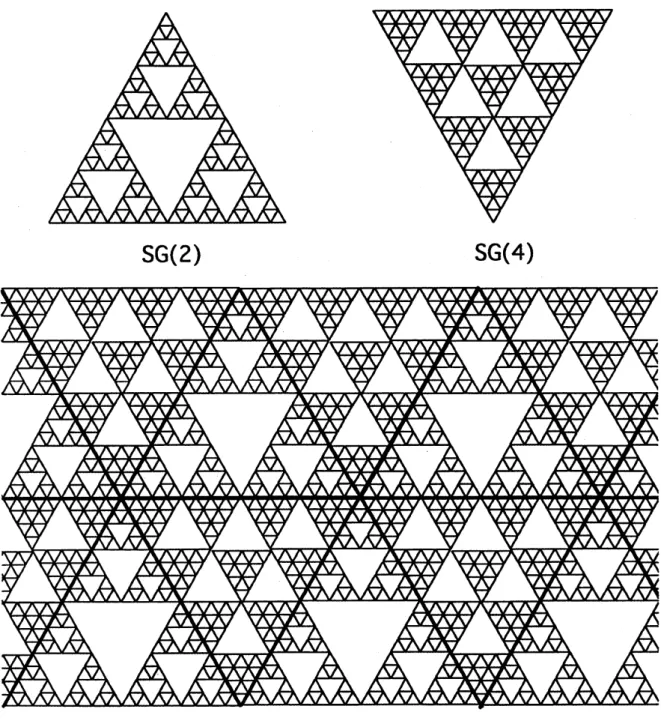
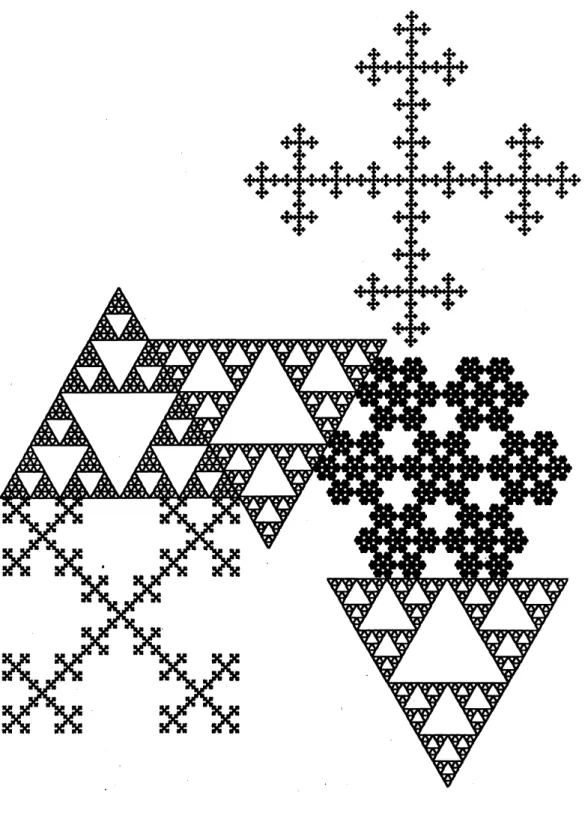
Euclideanspace (Figure 2), but also may tile the space (Figure 1). We will call spaces of
either type
fractal fields.
Akey examplethat
we
would like the reader to bear inmind throughout the paper is the gasket tiling in $\mathrm{R}^{2}$.
Consider atriangularlattice
on
$\mathrm{R}^{2}$ where eachedge is of length 1. We will fill each triangle with aversion of the Sierpinski
gasket in periodicway. Moreprecisely, let $SG(l)$ be thefamilyof2-dimensi0nal
Sierpinski gaskets from [3] with sidelength 1constructed by contraction maps
with contraction factor 1/1. Now, takeaset of triangles (welet $L$ be thenumber of triangles in the set) from the triangular lattice
so
that the union of them isaconnected closed set. In each triangle
we
place $\{SG(l_{k})\}_{k=1}^{L}$ and denote theunion of these fractals by $K_{0}$
.
Without loss of generality,we can
assume
thatone
oftheverticesof$K_{0}$ is $(0, 0)$.
We take $i_{x}\in \mathrm{N}$so
that $\mathrm{K}\mathrm{o}(K_{0}+(\mathrm{i}\mathrm{x}, 0))\neq\emptyset$ and Int $K_{0}\cap \mathrm{I}\mathrm{n}\mathrm{t}$ $(K_{0}+(i_{x},0))=\emptyset$.
We also take $i_{y}\in \mathrm{N}$ in thesame
way bytaking $(0, i_{y})$ instead of$\langle$$i_{x},0)$
.
Then, $G \equiv\bigcup_{l,m\in}\mathrm{z}(K_{0}+(li_{x},mi_{y}))$ is the spacewe
will consider. Figure 1indicates thecase
when $K_{0}$ is aparalelogram filledwith $SG(2)$ and $SG(4)$
.
This paper will treat the general construction problem. We incorporate the
$\mathrm{t}\mathrm{r}\mathrm{a}\mathrm{c}\mathrm{e}$ theory of Besov spaces, for the embedding
into aEuclidean space, with
an
idea originally due to Kusuoka, [12] which shows how to extend aLipschitzfunction from the boundary of afractal to the interior while controlling its
energy. This will allow
us
to build up aDirichlet form and establishsome
properties, such
as
aNash inequality. In the forthcoming paper [5], we willfurther discuss
on
heat kernel estimates and the largedeviations
ofour
diffusionprocess. In the paper, we will
demonstrate
the shape of the shortest pathsthrough
our
fractal fields and observe thatit isfractals with small $d_{w}$ which takethe longest to
cross
(inthe short timelimit) andthis allowsus
todetermine
theshortest paths in arecursive manner, first fixing them through the slow parts
and filling inthe details for the faster paths.
2Fractal fields
and
their Dirichlet forms
In this section we will introduce fractal fields, the framework within which we
will work. Our aim is to construct local regular Dirichlet forms on these spaces. Let $\{K_{i}\}_{i=1}^{M}\subset \mathrm{R}^{2}(1\leq M\leq\infty)$ be afamily of(bounded or
unbounded) nested
fractals whose definition will be given in Appendix. When $K_{i}$ isunbounded, we
denote by $\hat{K}_{i}$ the
corresponding bounded nested fractal (when $K_{i}$ is bounded,
$\hat{K}_{i}=K_{i})$ and denote by $\{\Psi_{j}^{(i)}\}j\in s\dot{.}$ the family of contractions
which determine
$\hat{K}_{i}(S_{i}=\{1,2, \cdots,N_{i}\})$
.
Let $V_{0}^{(i)}$ be theset of essential fixed points for $\hat{K}_{i}$.
For each closed set $A$, let Cov (A) be the set of points
covered by $A$, i.e., decomposing $\mathrm{R}^{2}\backslash A$ into connected components
$\{D_{j}\}_{j=1}^{\infty}$ and denoting by
$\{Dj\}j\in U(A)$ the unbounded components, Cov $(A)= \mathrm{R}^{2}\backslash \bigcup_{j\in U(A)}D_{j}$
.
We notethat ifthe set $A$ has holes, these may be contained
in Cov(A). We
assume
thefollowingfor the location of $\{K_{i}\}_{i}$
.
Assumption 2.1 1) For each $1\leq i\neq j\leq M$,
Int (Cov $(K_{i}))\cap Int$ (Cov $(K_{j}))=\emptyset$,
where Int (K) is the interior
of
K.2) For each compact set $C\subset \mathrm{R}^{2}$,
$\#\{i:C\cap K_{i}\neq\emptyset\}<\infty$
.
Define $G= \bigcup_{i=1}^{M}K_{i}$ and $D=\mathrm{R}^{2}\backslash \mathrm{C}\mathrm{o}\mathrm{v}(G)$ , then $G$ is aclosed set by 2) of
Assumption 2.1. Clearly, $D= \bigcup_{j\in U(G)}D_{j}$
.
We define $\tilde{G}=G\cup D$ and call it afractal field
generated by $\{K_{\dot{2}}\}_{i=1}^{M}$.
See Figure 1and Figure 2for examples of fractal fields. Note that wecan
define fractal fieldson
$\mathrm{R}^{N}$ in thesame
way usingnested fractals
on
$\mathrm{R}^{N}$, butas our
Assumption2.2, which will be introducedlater,seldom holds for nested fractals
on
$N\geq 3$,we
will restrict to $N=2$.
Let $\partial_{e}G$ be the topological boundary of $G$
as
asubset of R. For $1\leq i\neq$$j\leq M$, let
$\Gamma_{ij}=\mathrm{C}\mathrm{o}\mathrm{v}$ $(K\dot{.})\cap \mathrm{C}\mathrm{o}\mathrm{v}$ $(K_{j})$, $\partial_{i}G=\bigcup_{1\leq:\neq j\leq M}\Gamma_{ij}$
.
(2.1)Set $\partial G=\partial_{e}G\cup\partial\dot{.}G$
.
Let $\mu$:be
normalized Hausdorffmeasure on
$K_{i}$, i.e.$\mu:(\hat{K}\dot{.})=1$, and set $\mu=\Sigma_{i=1}^{M}\mu\dot{.},\tilde{\mu}=m|_{D}+\mu$ where
m
isthe Lebesgue measureon
R.We next define aform
on
$\tilde{G}$.
First, for each $i$, the local regular Dirichlet
form $(\mathcal{E}_{K}F_{K}.):’$
.on
$\mathrm{L}^{2}(K_{i,\mu:})$ is givenas
in Theorem A.2 and Theorem A.5.We denote $d_{f}(K_{i}),d_{s}(K.\cdot),d_{w}(K_{i})$ the Hausdorff, spectral and walk dimension
respectively w.r.t. Euclidean metric. Let $K\subset K_{i}$ be acompact nested fractal
which is congruent to $\hat{K}\dot{.}$ (thus, when
$K\dot{.}$ is bounded, $K=K_{i}$). For each $\Gamma_{ij}$ in
(2.1) where $1\leq i\neq j\leq M$ and for $\omega$ $\in\Sigma_{:}\equiv(S_{i})^{\mathrm{N}}$, let $d_{\Gamma_{\mathrm{j}},K}. \cdot(\omega)=\min\{n\geq$
$1$ : $\Gamma_{\dot{|}j}\cap\Psi_{\omega_{1}\cdots\omega_{n}}^{(K)}(K)=\emptyset\}$ where $\{\Psi_{j}^{(K)}\}_{j\in S}.\cdot$ is afamily of $\mathrm{a}\mathrm{i}$-contractions which
determine $K$, and define
$\kappa(\Gamma_{\dot{|}j}, K)=-\lim\sup\log\nu\dot{.}(d_{\Gamma_{j\prime}K}.\cdot(\omega)>n)\underline{1}\underline{1}$,
$\log N_{i}narrow\infty n$
where $\nu_{i}$ is aBernoulli
measure
on $\Sigma_{i}$so
that $\nu_{i}(\{\omega\in\Sigma_{i} : \omega_{1}=l\})--1/N_{i}$ foreach $\mathit{1}\in S_{i}$. We adopt the convention that -logO $=\infty$.
Assumption 2.2 For each $1\leq i\neq j\leq M$, the following holds where K and
$Yij$ are
as
above,$\frac{2}{d_{s}(K)}-\frac{2}{d_{f}(K)}<\kappa(\Gamma_{ij}, K)$. (2.2)
Remark 2.3 For the gasket tiling introduced in the Introduction (also indicated in Figure $\mathrm{I}$), (2.2) always holds.
Indeed, let $K=SG(l)l\geq 2$ and $\Gamma=\Gamma_{ij}$ be the bottom line
of
K. As there are$l^{n}n$-cells which intersect with $\Gamma$, we see that$\nu(d_{\Gamma,K}(\omega)>n)=l^{n}/L^{n}$ where $L–l(l+1)/2$ . Thus, $\kappa(\Gamma, K)--1-\log l/\log L$
and (2.2) is equivalent to
$\frac{\log(\rho L)-2\log l}{1\mathrm{o}\mathrm{g}L}<1-\frac{1\mathrm{o}\mathrm{g}l}{1\mathrm{o}\mathrm{g}L}$,
which is equivalent to $\rho<l$
.
Note that $\rho=P^{x_{0}}(\tau_{V_{0}}\backslash \{x_{0}\}(X)<\tau_{x\mathrm{o}}(X))^{-1}$ where$x_{0}\in V_{0},$ $X$ is a Markov chain $co$ responding to $(\mathcal{E}_{SG(l)})_{1;}$ and $\tau_{A}(X)$ is the
first
hitting timeof
$X$ to A. Note also thatif
wedefine
$\overline{X}$be a simple random walk on $\mathrm{Z}$, then $l=P^{0}( \tau\{-\iota,\iota\}(\overline{X})<\inf\{n\geq 1 : \overline{X}(n)=0\})^{-1}$. Then, by the
comparison
of
escape probabilities using the electrical network method (we useso called cutting law), we can easily obtain $\rho<l$
.
Assumption 2.1 and Assumption 2.2 will hold throughout the paper. We define abilinear form $(\tilde{\mathcal{E}}, D(\tilde{\mathcal{E}}))$ on $\mathrm{L}^{2}(\tilde{G},\tilde{\mu})$ as follows,
$\tilde{\mathcal{E}}(u, v)$ $= \sum_{i=1}^{M}\mathcal{E}_{K}(:u|_{K_{i}},v|_{K:})+\frac{1}{2}\sum_{j\in U(G)}\int_{D_{j}}\nabla u(x)\nabla v(x)dx$ for all
$u$,$v\in D(\tilde{\mathcal{E}})$,
$D(\tilde{\mathcal{E}})$ $=$ $\{u\in C_{0}(\tilde{G}) : u|_{K}:\in F_{K}.\cdot\forall i, u|_{D_{j}}\in W^{1,2}(D_{j})\forall j,\tilde{\mathcal{E}}(u,u)<\infty\}$,
where $D= \bigcup_{j\in U(G)}D_{j}$is adecomposition of $D$ into open connectedcomponent$\mathrm{s}$
and $C_{0}(\tilde{G})$ is aspaceofcontinuous functions on$\tilde{G}$
withcompact support. Then,
it is easy to check the following.
Lemma 2.4 1) $(\tilde{\mathcal{E}}, D(\tilde{\mathcal{E}}))$ is closable in $\mathrm{L}^{2}(\tilde{G},\tilde{\mu})$
.
2) $D(\tilde{\mathcal{E}})$ is
an
algebra.3) For each$j$, $x\in K_{j}$ and each $U(x)$ which is
a
neighborhoodof
$x$, there xists $f\in F\kappa_{\mathrm{j}}\cap C_{0}(K_{j})$ such that $f(x)>0$ and Supp $f\subset U(x)\cap K_{j}$ where Supp $f$ denotes the supportof
$f$.
4) $C_{0}^{\infty}(D)\subset D(\tilde{\mathcal{E}})$
.
Now, denote$\tilde{F}=\overline{D(\tilde{\mathcal{E}})}^{\overline{\mathcal{E}}_{(1)}}$
so
that $(\tilde{\mathcal{E}},\tilde{F})$ is the smallest extension of $(\tilde{\mathcal{E}},D(\tilde{\mathcal{E}}))$,where $\tilde{\mathcal{E}}_{(1)}(f, f)=\tilde{\mathcal{E}}(f, f)+||f||_{\mathrm{L}^{2}(\overline{G},\overline{\mu})}^{2}$
.
We then have the following. Theorem 2.5 $(\tilde{\mathcal{E}},\tilde{F})$ isa
$local$ regularDirichletform
on
$\mathrm{L}^{2}(\tilde{G},\tilde{\mu})$.
Bythegeneral theory ([2]), there is
aone
toone
correspondence between alocalregular Dirichlet form
on
$\mathrm{L}^{2}(\tilde{G},\tilde{\mu})$ anda
$\mu\sim$-symmetric diffusion process on $\tilde{G}$
except for
some
exceptional set of starting points. We will denote by $\{\tilde{X}_{t}\}_{t\geq 0}$the diffusion process corresponding to $(\tilde{\mathcal{E}},\tilde{F})$
.
Note that,as
the originalforms on $\{K\dot{.}\}$
:and
$\{D_{j}\}_{j}$are
strong local, $(\tilde{\mathcal{E}},\tilde{F})$ is also strong local.For the proof ofTheorem 2.5, the keypart is to prove the following.
Proposition 2.6 1) For each $x\neq y\in\tilde{G}$, there $n\cdot s\$ $g\in D(\tilde{\mathcal{E}})$ such that $g(x)\neq g(y)$
.
2) For
any
compact set $L$ in $\tilde{G}$, there exists$f\in D(\tilde{\mathcal{E}})$ such that $f|_{L}=1$
.
Indeed, usingthisproposition,
we can
prove Thorem 2.5as
follows. It is easy tosee
that $(\tilde{\mathcal{E}},\tilde{F})$ is alocal Dirichlet form. Also,as
$\tilde{F}=\frac{-}{D(\tilde{\mathcal{E}})}(1)$
, it is clear that
$D(\tilde{\mathcal{E}})$ is dense in $\tilde{F}$
w.r.t. $\tilde{\mathcal{E}}_{(1)}$
-norm.
Thus, allwe
need for the regularityofthe
form is to show that $D(\tilde{\mathcal{E}})$ is dense in $C_{0}(K)$ w.r.t.
$||\cdot||_{\infty}$
-norm.
Now,as
$D(\tilde{\mathcal{E}})$is an algebra (Lemma 2.42)$)$,
we see
that for each compact set $L$ in $\tilde{G}$, $D(\tilde{\mathcal{E}})|_{L}$
is dense in $C(L)$ by using Proposition 2.6 and applying the Stone-Weierstrass
theorem. This establishes regularity and we have completed the proof.
For each $B\subset \mathrm{R}^{2}$, define $\tau_{B}=\inf\{t\geq 0:\tilde{X}_{t}\in B\}$
.
Wecan
then prove that$\tilde{X}_{t}$ penetrates into each
$K_{i}$
.
To saymore
exactly, we have the following.Proposition 2.7 Assume that $m(G)=0$ where $m$ is the Lebesgue
measure on
R. Then,
for
any nearly Borel set B with positive $l$-capacity $(w.r.t.\tilde{\mathcal{E}})$,$\tilde{P}^{x}(\tau_{B}<\infty)>0$
for
quasi-every x$\in \mathrm{R}$.
(2.3)Especially, when$B$ is either
a
subsetof
$K_{i}$ whose$l$-capacity $w.r.t$. $\mathcal{E}_{K}\dot{.}$ ispositiveor a subset
of
$\mathrm{R}^{2}$ whose $l$-capacity$w.r.t$
.
the Dirichlet integral is positive, then(2.3) holds.
The proofis the same as Proposition 2.9 in [10].
In the
same
way as Theorem 2.11 in [10], wecan
prove aNashtype estimatefor the heat semigroup. Let $P_{t}^{\overline{\mathcal{E}}}(t>0)$ be the semigroup corresponding to
$(\tilde{\mathcal{E}},\tilde{F})$
.
Then, the following holds (see [10] for the proof).Proposition 2.8 Assume
further
that thereare
onlyfinite
types in $\{K_{i}\}_{i=1}^{M},$ $i.e$.if
we
define
that two $K_{i}’ s$ which are similarare
equivalent, thereare
onlyfinite
number
of
equivalence classes in $\{K_{i}\}_{i=1}^{M}$.
Define
$d_{s}^{\min}= \min_{i=1}^{M}d_{s}(K_{i})$.
Then,there exists $c_{2.1}>0$ such that thefollowing holds
for
all $x,y\in\tilde{G}$,$||P_{t}^{\overline{\mathcal{E}}}||_{1arrow\infty}\leq\{$
$c_{2.1}t^{-1}$,
for
all $t\in(0,1]$,$c_{2.1}t^{-d_{\epsilon}^{\min}/2}$,
for
all $t\in[1, \infty)$.
(2.4)
3Proof of Proposition 2.6
In this section,
we
will give aproof of Proposition 2.6. The crucial part is toshow 1) for the
case
$x\vee y\in\partial\dot{.}G$ and $x\vee y\in\partial_{e}G$, where $x\vee y$means
$x$or
$y$.
We adopt completely different methods for the two cases;
we
use
self-similarityand nesting property for the former
case
and for the latter case,we
apply theextension operator used in the $\mathrm{t}\mathrm{r}\mathrm{a}\mathrm{c}\mathrm{e}$ theory of Besov spaces.
We will first prove 1) for the
case
$x\vee y\in\partial_{\dot{1}}G$.
Assumption 2.2 will be usedhere. For each $f\in C(\mathrm{R}^{2})$, let $||f|| \mathrm{L}\mathrm{i}\mathrm{p}=\sup\{|f(x)-f(y)|/||x-y|| : x,y\in \mathrm{R}^{2}\}$
and let Lip $(\mathrm{R}^{2})=\{f\in C(\mathrm{R}^{2}) : ||f||\mathrm{L}\mathrm{i}\mathrm{p}<\infty\}$
.
Wenow
givean
importantlemma due essentialy to Kusuoka ([12]).
Lemma 3.1 For each $\Gamma_{\dot{|}j}$ in (2.1) where $l\leq i\neq j\leq M$ and
for
each $K\subset K_{i}$ which is congruent to $\hat{K}.\cdot$ and $K\cap\Gamma_{j}.\cdot\neq\emptyset$, let$H_{\Gamma_{j},K}.\cdot$ : Lip $(\mathrm{R}^{2})arrow C(K)$ be $a$
linear operator given by
$H_{\Gamma_{j},K}\dot{.}g(x)=E^{x}[g(X_{\tau_{\Gamma_{j}}}\dot{.})]$,
for
all $x\in K$, $g\in Lip$ $(\mathrm{R}^{2})$ (3.1)where $\{X_{t}\}$ is the Brownian motion
on
$K$ and $\tau \mathrm{r}_{\mathrm{j}}.\cdot=\inf\{t\geq 0 : X_{t}\in\Gamma_{ij}\}$. Then, $H_{\Gamma_{j},K}.\cdot g\in F_{K}$.
$h\hslash her$, there eists $c_{2.2}=c_{2.2}(K)>0$ suchtteat
$\mathcal{E}(H_{\Gamma_{\mathrm{j}\prime}K}.\cdot g, H_{\Gamma_{j\prime}K}.\cdot g)\leq c_{2.2}\{\int_{\Sigma}\dot{.}(\rho:L:\alpha_{i}^{-2})^{d_{\Gamma_{j\prime}K}(\cdot)}.\cdot\nu(\mathrm{d}v)\}||g||_{Lip}^{2}$ (3.2)
holds
for
any $g\in Lip$ $(\mathrm{R}^{2})$.
PROOF. In the following,
we
will abbreviate $\Gamma_{j}.\cdot$ to $\Gamma$ andremove
thesub-scripts i and K. For each g $\in C(K)$, define $h_{\Gamma}(\cdot$: g):K $arrow \mathrm{R}$ as follows,
$h_{\Gamma}(\pi(\omega) : g)=\{$
$E^{\pi(\sigma^{m}\omega)}[g\circ\Psi_{\omega_{1}\cdots w_{m}}(X_{\tau_{\mathrm{V}_{0}}})]$ if $d\mathrm{r}(\omega)=m$,
$g(\pi(\omega))$ if $d_{\Gamma}(\omega)=\infty$,
(3.3)
for each $\omega\in\Sigma$ (see the Appendix for the notation). It is easy to
see
that$\mathrm{h}\mathrm{r}(- :g)$ is
awell-defined
continuous map which is harmonic inside $\Psi_{\omega_{1}\cdots\omega_{m}}(K)$if$\mathrm{d}\mathrm{v}(\mathrm{u})=m$, and $h_{\Gamma}(\cdot :g)|_{\Gamma}=g|\mathrm{r}$
.
Moreover, noting that$\mathcal{E}_{n}(g)=\rho^{n}\sum_{w\in S^{n}}$each
$\mathrm{o}\Psi_{w}$) for all $g\in C(V_{n})$,
where we abbreviate $\mathcal{E}_{n}(g,g)$ to $\mathcal{E}_{n}(g)$, we
can
easilysee
that$\mathcal{E}_{n}(h_{\Gamma}(\cdot : g)|_{V_{n}})=\int_{\Sigma}\rho^{d_{\Gamma}((v)\wedge n}\cdot L^{d_{\Gamma}(v)\wedge n}‘ \mathcal{E}_{0}(\{g(\pi([\omega,i]_{d_{\Gamma}(\omega)\wedge n}));i\in S\})\nu(h)$ , (3.4)
where we set $[\omega, i]_{l}=\omega_{1}\cdots\omega_{l}ii\cdots$. Note also that there exists $c_{1}>0$ such that
$c_{1}^{-1} \mathcal{E}_{0}(u)\leq\max\{|u(x)-u(y)|^{2} : x,y\in V_{0}\}\leq c_{1}\mathcal{E}_{0}(u)$ (3.5)
for any $u\in C(V_{0})$
.
Using (3.4), (3.5) and the fact $\rho L\alpha^{-2}>1(,\mathrm{w}\mathrm{h}\mathrm{i}\mathrm{c}\mathrm{h}$ is shownin [1], Proposition 6.30), we have foreach $g\in C(K)$ that
$\mathcal{E}_{n}(h_{\Gamma}(\cdot :g)|_{V_{n}})$ $\leq$ $c_{1} \cdot\{\int_{\Sigma}(\rho L\alpha^{-2})^{d_{\Gamma}((\psi)}\nu(d\omega)\}$
$\cross$ $\sup_{m}\{\alpha^{m}\cdot\max\{|g(x)-g(y)| : x, y\in V_{\xi}\};m\geq 0,\xi\in S^{m}\}^{2}$
.
On the otherhand,from Assumption 2.2, we see that $A= \int_{\Sigma}(\rho L\alpha^{-2})^{d_{\Gamma}(\omega)}\nu(h)<$
$\infty$. We thus obtain
$\mathcal{E}(h_{\Gamma}(\cdot :g), h_{\Gamma}(\cdot : g))\leq c_{1}\cdot A$
.
$\{$diain
$K\}^{2}\cdot||g||_{\mathrm{L}\mathrm{i}\mathrm{p}}^{2}$,for each $g\in \mathrm{L}\mathrm{i}\mathrm{p}(\mathrm{R}^{2})$
.
As$\mathcal{E}(H_{\Gamma,K}g, H_{\Gamma,K}g)=\inf\{\mathcal{E}(u,u) : u\in F, u|_{\Gamma}=g\}$ for all $g\in \mathrm{L}\mathrm{i}\mathrm{p}(\mathrm{R}^{2})$,
we obtain the desired facts.
:
Using this, we now show 1) of Proposition2.6 for the
case
$x\vee y\in\partial_{i}G\backslash \partial_{e}G$.Proposition 3.2 For each $x\neq y\in\tilde{G}$ there $x\in\partial_{i}G\backslash \partial_{e}G$, there exists $f\in$
$D(\tilde{\mathcal{E}})$ such that $f(x)=1$,$f(y)=0$
.
Proof. For $x\in\partial\dot{.}G\backslash \partial_{\mathrm{e}}G$, denote $\{K_{i}\}_{i\in I(x)}$ the set of all $K_{i}$ such that
$x\in K_{i}$
.
For each $K\dot{.}i\in I(x)$, take $m:\in \mathrm{N}$ such that $\alpha_{i}^{-m_{t}-1}\leq e^{-m}<\alpha_{j}^{-m}$:and define $N_{m}(x)$as
aunion ofthe $m_{i}$-complexes which contain $x$ for each $i\in I(x)$.
Also, define $N_{m}^{1}(x)$
as
aunion of the $m_{i}$-complexes whichintersect with $N_{m}(x)$.
Wetake $m$suitablylarge
so
that $N_{m}^{1}(x) \cap\tilde{G}\subset\bigcup_{:\in I(x)}K\dot{.}$, $(\cup:\in t(x)V_{0}^{(i)})\cap(N_{m}^{1}(x)\backslash$$N_{m}(x))=\emptyset$ and $y\not\in N_{m}^{1}(x)$
.
Then, it is enough to prove that there exists$g\in D(\tilde{\mathcal{E}})$ such that
$g|_{N_{m}(x)}=1$, Supp $g\subset N_{m}^{1}(x)$
.
(3.6) We willnow
construct $g\in D(\tilde{\mathcal{E}})$ which satisfies (3.6). Set $g|_{N_{m}(x)}=1$ and takean
arbitrary connectedcomponentof$\Gamma_{\dot{\iota}j}\cap(N_{m}^{1}(x)\backslash N_{m}(x))$, $i,j\in I(x)$ whichwe
denote $\Gamma$
.
Denote $a_{0}\in N_{m}(x),a_{1}\not\in N_{m}(x)$ end vertices of $\Gamma$.
Take $f\in \mathrm{L}\mathrm{i}\mathrm{p}(\mathrm{R}^{2})$so
that $f(a_{0})=1$,$f(a_{1})=0$.
Then, by Lemma 3.1,we can
construct continuousfunctions $H\mathrm{r},\kappa_{:}f$ and $H_{\Gamma,K_{\dot{f}}}f$
on
the $m_{i}$-complexes ofeach sides of$\Gamma$ such that$H_{\Gamma,K_{l}}f|_{\Gamma}=f|_{\Gamma}$ and $\mathcal{E}_{(1)}(H_{\Gamma,K_{l}}f)<\infty$for$l=i,j$
.
We do thesame
procedure foreach connected components of$\Gamma_{j}.\cdot\cap(N_{m}^{1}(x)\backslash N_{m}(x))$, $i,j\in I(x)$
.
Then, usingthe $m$-harmonic extension (A.2) for the rest of $N_{m}^{1}(x)\backslash N_{m}(x)$,
we
can
easily extend $\{H_{\Gamma,K_{l}}f\}_{\Gamma,K_{l}}(l\in I(x))m$-harmonically and construct $g$ which satisfies (3.6). By the construction,we
see
that $g\in D(\tilde{\mathcal{E}})$.
We next consider the
case
$x\vee y\in\partial_{e}G$.
As we
mentioned,we
will applythe extension operator used in the theory of Besov spaces (see [8] for details of the theory). For this purpose,
we
will briefly explain the construction ofan
extension operator. It is aslight modification ofthe operator which extends
a
function in the Lipschitz (Besov) space
on
$K_{i}$ to afunction in aBesovspaceon
$\mathrm{R}^{N}$ ($N=2$ for
our
case, but wecan
argue for all $N\in \mathrm{N}$).We begin by setting up the Whitney decomposition of the complement of
$K_{i}$,which has the following properties. It consists ofacollection of closed cubes
$\{Q_{j}^{(i)}\}_{j\in \mathrm{N}}$, with mutually disjoint interiors and sidesparallel to the
axes so
that$\mathrm{R}^{N}\backslash K_{i}=\bigcup_{j}Q_{j}^{(\cdot)}.$
.
Weassume
that the sidelength of the cubes is ofthe form$2^{-M}$,$ni\in \mathrm{Z}$
.
Denote the center of $Q_{j}^{(i)}$ by $x_{j}^{(i)}$, its diameter by $l_{j}^{(i)}$ and itssidelength by $s_{j}^{(i)}$. Then $s_{j}^{(i)}=l_{j}^{(i)}/\sqrt{n}\in\{2^{-M} : M\in \mathrm{Z}\}$
.
(In the following, wemay omit the superscript (i) when there is no confusion.) This decomposition
has the following properties,
$l_{j}\leq d(Q_{j}, K_{i})\leq 4l_{j}$, $Q_{j}\cap Q_{k}\neq\emptyset\Rightarrow l_{j}/4\leq l_{k}\leq 4l_{j}$
.
(3.7)Let $0<\epsilon<1/4$ and put $Q_{j}^{*}=(1+\epsilon)Q_{j}$. Note that by the above properties
of $\{Q_{j}\}_{j}$, each point in $\mathrm{R}^{N}\backslash K_{i}$ is contained in at most $N_{0}(n)$ (which depends
only on the Euclidean dimension) cubes $Q_{j}^{*}$ and, $Q_{j}^{*}\cap Q_{k}\neq\emptyset$ if and only if $Q_{j}\cap Q_{k}\neq\emptyset$
.
To this decomposition, weassociate apartitionof unity, consistingof nonnegative functions $\{\varphi_{j}\}_{j\in \mathrm{N}}$ such that $\varphi_{j}|_{(Q}j)^{c}=0$, $\Sigma_{j}\varphi_{j}(x)=1$ for all
$x\in \mathrm{R}^{N}\backslash K_{i}$, and
$|D^{k}\varphi_{j}(x)|\leq A_{k}(l_{j})^{-|k|}$ for all $x\in \mathrm{R}^{N},j\in \mathrm{N}$,$k\in(\mathrm{N}\cup\{0\})^{n}$, (3.8)
for some constant $A_{k}>0$ depending only on $k$
.
Here, for $k=(k_{1}, \cdots, k_{n})$, weset $D^{k}= \frac{\theta^{k_{1}}}{\partial x_{1}^{k_{1}}}\cdots\frac{\partial^{k_{\hslash}}}{\partial x_{1}^{k_{\hslash}}}$and $|k|=k_{1}+\cdots k_{n}$.
We now define the extension operator $\xi_{\delta_{0}}$. Set $m_{j}=\mu(B(x_{j}, 6l_{j}))^{-1}$
.
Notethat when $l_{j}=\sqrt{n}2^{-}$’for $\nu\in \mathrm{N}$, then $m_{j}\leq c_{1}2^{\nu d}:$
.
Now, for $f\in \mathrm{L}^{2}(K_{i},\mu_{i})$,define
$\xi_{\delta_{0}}f(x)=\sum_{j\in I_{\delta_{0}}}\varphi_{j}(x)m_{j}\int_{||t-x_{j}||\leq 6l_{j}}f(t)d\mu_{i}(t)$ for all
$x\in \mathrm{R}^{N}\backslash K_{i}$, (3.7)
where $\delta_{0}>0$ and
$I_{\delta_{0}}\equiv\{j\in \mathrm{N} : s_{j}\leq c_{2}\delta_{0}\}$
.
(3.10)We note that for the usual extension operator, $I\equiv\{j\in \mathrm{N} : s_{j}\leq 1\}$ is used
instead of $I_{\delta_{0}}$
.
The concrete value 6is not important; it is enough to choosesufficiently large number $\alpha_{0}$
so
that $\mu_{i}(\{t : ||t-x_{j}||\leq\alpha_{0}l_{j}\}\cap K_{i})$ is boundedawayfrom 0. Take $f\in C_{0}(K\dot{.})$
.
Foreach fixed $x\in \mathrm{R}^{N}\backslash K_{i}$, thereare
only finite number of$\varphi_{j}$ where $\varphi_{j}(x)\neq 0$so
that $\xi_{\delta_{0}}f$ is well defined and in$C^{\infty}(\mathrm{R}^{N}\backslash \cdot K_{i})$.
Further, by (3.7) and by the definition of $I_{\delta_{0}}$, $\xi_{\delta_{0}}f(x)=0$ if$x\in Q_{j}$,$s_{j}>c_{3}(\delta_{0})$
for
some
$c_{3}(\delta_{0})$ which dependson
$c_{2}$ and $\delta_{0}$.
We will take$c_{2}$ (which depends
only
on
the dimension of the Euclidean space) small enoughso
that Supp $\xi_{\delta_{0}}f$is in the $\delta_{0}$-neighborhood of $K_{\dot{1}}$
.
We thussee
that $\xi_{\delta_{0}}f\in C_{b}^{\infty}(\mathrm{R}^{N}\backslash K_{i})$ for$f\in C_{0}(K\dot{.})$, where $C_{b}^{\infty}(\mathrm{R}^{N}\backslash K.\cdot)$ is aspace of infinitely differentiate bounded
supported functions
on
$\mathrm{R}^{N}\backslash K.\cdot$.
In this case, $\xi_{\delta_{0}}f$ is uniformly continuouson
$\mathrm{R}^{N}\backslash K\dot{.}$ and $\lim_{xarrow x\mathrm{o}\in\theta K}.\cdot\xi_{\delta_{0}}f(x)=f(x_{0})$, whichcan
beproved in thesame
wayas
in [10] $\mathrm{p}78$, $\mathrm{p}80$.
Thus, by defining $\xi_{\delta_{0}}f(x)=f(x)$ for $x\in K_{\dot{\iota}}$, it holds that$\xi_{\delta_{0}}f\in C_{0}(\mathrm{R}^{N})$ for each $f\in C_{0}(K.\cdot)$
.
Itcan
be also proved by the general $\mathrm{t}\mathrm{r}\mathrm{a}\mathrm{c}\mathrm{e}$theory (or for this
case as
in [10] $\mathrm{p}79$) that $\int_{(K.)^{e}}.|\nabla(\xi_{\delta_{0}}f)(x)|^{2}dx<\infty$.
Noting that Supp $\xi_{\delta_{0}}f$ is in the $\delta_{0}$-neighborhood ofK.
$\cdot$,we
obtain that $\xi_{\delta_{0}}f\in D(\tilde{\mathcal{E}})$ for each $f\in C_{0}(K.\cdot)$.
Using$\xi_{\delta_{0}}$,
we now
show 1) of Proposition 2.6 for thecase
$x\vee y\in\partial_{\mathrm{e}}G\backslash \partial_{i}G$.
Proposition 3.3 For each $x\neq y\in\tilde{G}$ where $x\in\partial_{\mathrm{e}}G\backslash \partial\dot{.}G$, there exists $f\in$
$D(\tilde{\mathcal{E}})$ such that $f(x)=1$,$f(y)=0$
.
PROOF. As $x\in\partial_{e}G\backslash \partial\dot{.}G$, there is unique $K\dot{.}$ such that $x\in K_{i}$
.
Denote$B(x,r)$ ballin$\mathrm{R}^{2}$ centered at
$x$ and radius$r$
.
We take$r$,$\delta_{0}>0$smallenoughso that $U(x, r+\delta_{0})\cap G\subset K.\cdot$ and$y\not\in U(x,r+\delta_{0})$.
UsingLemma2.43),we see
thatthere exists $f\in F_{K}:\cap C_{0}(K_{i})$ such that $f(x)=1$ and Supp $f\subset U(x, r)\cap K_{i}$
.
Now using the above extension operator, $\xi_{\delta_{0}}f\in D(\tilde{\mathcal{E}})$, $(\xi_{\delta_{0}}f)|_{K}:=f$ and Supp
$f\subset U(x,r+\delta_{0})$
.
Thus $\xi_{\delta_{0}}f(x)=1$, $\xi_{\delta_{0}}f(y)=0$ and the proofis completed,1
End of the proof of Proposition 2.6
We first complete the proof of 1). When $x\vee y\in\tilde{G}\backslash \partial G$, 1) is clear using
Lemma 2.43) and 4). When $x$ and $y$
are
both in $\partial G$, thereare
threecases:
a) $x\vee y\in\partial_{i}G\backslash \partial_{e}G$, b) $x\vee y\in\partial_{e}G\backslash \partial_{i}G$, c) $x,y\in\partial_{i}G\cap\partial_{e}G$.
For thecase
a)and $\mathrm{b}$), 1) is proved in Proposition 3.2 and Proposition 3.3 respectively. For the
case
$\mathrm{c}$), denote $\{K_{i}\}_{i\in I(x)}$ the set of all $K_{i}$ such that $x\in K_{i}$.
Inthe same wayas
Proposition 3.2 (using Lemma3.1 repeatedly), we can construct $f\in C_{0}(G)$ suchthat $f|_{K}\dot{.}\in F_{K}.\cdot$ for all $i\in I(x)$, Supp $f \subset\bigcup_{i\in I(x)}K_{i}\backslash \{y\}$ and $f|_{U(x)}=1$ for
some small neighbourhood of $x$
.
Now we prepare the Whitney decomposition $\{Q_{j}\}$ of$( \bigcup_{i\in I(x)}K_{i})^{c}$, the associatedpartitionof unity$\{\varphi_{j}\}$ anddefine$\xi_{\delta_{0}}f$ inthesame way as (3.9) using this $\{Q_{j}\}$, $\{\varphi_{j}\}$ and $\mu\equiv\Sigma_{i\in I(x)}\mu_{i}$. For $y \in\bigcup_{i\in I(x)}K_{i}$,
we set $\xi_{\delta_{0}}f(y)=f(y)$
.
Then, by taking $\delta_{0}$ small, wecan
prove $\xi_{\delta_{0}}f\in D(\tilde{\mathcal{E}})$ inthe
same
wayas
before so that $\xi_{\delta_{0}}f$ is the desired function.We next prove 2). For eachcompact set$L\subset\tilde{G}$, define $I_{L}=\{i : L\cap K_{i}\neq\phi\}$
.
Note that $\# I_{L}<\infty$, which is due to Assumption 2.12). As each $K_{i}$ is closed, we can take $\delta_{0}’(L)>0$
so
that the set of the index of $K_{i}$ which intersects with$\{y:d(L,y)\leq\delta_{0}’(L)\}$ is equal to $I_{L}$, where $d$ is the Euclidean metric. Now, by
the similar way
as
the proof of 1), there exists $f\in D(\tilde{\mathcal{E}})$ so that $f|_{L\cap G}=1$.
Now, set $M=L \backslash \bigcup_{i\in I_{L}}\{x\in L:f(x)\geq 1/2\}$. Then there exists $g\in C_{0}^{\infty}(\mathrm{R}^{N})$ sothat $g|_{M}=1$ and the support of $g$ is in $\{x\in\tilde{G} : d(L, x)\leq\delta_{0}’(L)\}\backslash G$
.
Clearly$g\in D(\tilde{\mathcal{E}})$. Define $h=2f+g\in D(\tilde{\mathcal{E}})$. Then, $h|_{L}\geq 1$. Thus, $\overline{h}\equiv(h\vee 0)\Lambda 1$ (which is in $D(\tilde{\mathcal{E}})$ by the Markovian property of$\tilde{F}$) is the desired function.
$\mathrm{I}$
4Another framework
-d-sets floating
on
$\mathrm{R}^{N}-$When
we
relax Assumption 2.1 andassume
Assumption 4.1 instead, then wecan
construct local regular Dirichlet forms under awider class of $\{K_{i}\}_{i=1}^{M}$ usingthe
same
techniquewe
have introduced. In this section,we
will briefly discussit.
Let $K_{i}\subset \mathrm{R}^{N}$ ($1\leq i\leq M;M$ could be infinite
as
before) be aclosedcon-nested $d\dot{.}$-set for
some
$0<\mathrm{A}$. $\leq n$.
That is, there exists aBorelmeasure
$\mu_{i}$whose support is
K.
$\cdot$ such that$c_{4.1}r^{d_{t}}\leq \mathrm{H}\mathrm{i}(\mathrm{B}\{\mathrm{x},\mathrm{r}))\leq c_{4.2}r^{d_{t}}$ for all $x\in K\dot{.}$, $r\leq \mathrm{c}_{4.3}$
.
(4.1)Here $B(x,r)$ is aball of radius $r$ (centered at $x$) w.r.t. the Euclidean
norm
and(4.1)C4.3.$c_{4.3}$
are
positive constants which may dependon
$K\ldots$ Weassume
thefollowing about the location of $\{K.\cdot\}_{=1}^{M}\dot{.}$
.
Assumption 4.1 There exists $\delta_{0}>0$ such that
$d(K. \cdot, \bigcup_{j\neq:}K_{j})>\delta_{0}$
for
all i $\in \mathrm{N}$,where $d$ is the Euclidean distance.
Now, take aset of connected components of$\mathrm{R}^{N}$
$\langle$ $\bigcup_{=1}^{M}.\cdot K\dot{.}$, say $\{D_{j}\}_{j}$,
so
that$\tilde{G}\equiv(\bigcup_{=1}^{M}\dot{.}K\dot{.})\cup(\bigcup_{j}D_{j})$ is aconnected closed set. This $\tilde{G}$ is the space
we
will consider. Set $D=UjDj$ and deffie $\mu=m|_{D}+\Sigma_{\dot{|}=1}^{\infty}\mu:$.
By Assumption 4.1, $\mu$is
awell-defined
Borelmeasure.
Examples 4.2 $K_{1}$ is
a
nestedfractal
or a
Sierpinski carpet, $D_{1}$ isa
complimentof
theconvex
hullof
$K_{1}$ and $KjyDj=\emptyset$for
all$j\geq 2$.
This example is treated in[10]. Especially, when $K_{1}$ is the Sierpinski gasket, it is treated also in [7] [14].
We next give
an
assumption of the processon
each $K_{i}$.
Assumption 4.3 For each i $\in \mathrm{N}$, there is
a
regularDirichletform
$(\mathcal{E}_{K}\dot{.},F_{K}):$ on $\mathrm{L}^{2}(K_{i},d\mu_{i})$ such that$F_{K}. \cdot\subset Lip(\frac{d_{w}^{(i)}}{2}, 2, \infty)(K_{i})$ (4.2)
for
some
$d_{w}^{(i)}\geq 2$ where the Lipschitz space $Lip(d_{w}^{(i)}/2,2, \infty)(K_{i})$ isa
setof
$f\in \mathrm{L}^{2}(K_{i}, d\mu_{i})$ such that
$\sup_{\nu\in \mathrm{N}\cup\{0\}}\alpha^{\nu(d_{w}^{(\cdot)}+d)}.:\int\int_{||x-y||<c_{0}\alpha^{-\nu}}|f(x\rangle$ $-f(y)|^{2}d\mu_{i}(x)d\mu_{i}(y)<\infty$ (4.3)
for
some
$\alpha>1$,$c_{0}>0$.
Remark 4.4 In [10], it is proved that domains
of
Dirichletforms
whichcor-respond to Brownian motions on nested
fractals
and Sierpinski carpets satisfy Assumption4.3
For each $D_{j}$, we define aDirichlet integral
$\mathcal{E}_{D_{j}}(u, u)=\frac{1}{2}\int_{D_{j}}|\nabla u(x)|^{2}dx$,
where $\nabla u$ is adistribution function of
$u$ on $D_{j}$.
We now define abilinear form $(\tilde{\mathcal{E}},D(\tilde{\mathcal{E}}))$ on $\mathrm{L}^{2}(\tilde{G},d\mu)$ as follows, $\tilde{\mathcal{E}}(u, v)$ $= \sum_{i=1}^{M}\mathcal{E}_{K}\dot{.}(u|_{K}\dot{.},v|_{K}:)+\sum_{j}\mathcal{E}_{D_{j}}(u|_{D_{j}},v|_{D_{j}})$ for all $u,v\in D(\tilde{\mathcal{E}})$,
$D(\tilde{\mathcal{E}})$ $=$ $\{u\in C_{0}(\tilde{G}) : u|_{K}:\in F_{K}\dot{.}\forall i, u|_{D_{j}}\in W^{1,2}(D_{j})\forall j,\tilde{\mathcal{E}}(u, u)<\infty\}$
.
Then, it is easy to check Lemma 2.4 in this framework, too. Denote $\tilde{F}=$
$\overline{D(\tilde{\mathcal{E}})}^{\mathcal{E}_{(1)}}$
so that $(\tilde{\mathcal{E}},f)$ is the smallest extension of $(\tilde{\mathcal{E}},D(\tilde{\mathcal{E}}))$
.
By the similarargument as in the proofof Theorem 2.5, especially that of Proposition 3.3, we
have the following
Theorem 4.5 $(\tilde{\mathcal{E}},\tilde{\mathcal{F}})$ is a local regularDiriMet
form
on
$\mathrm{L}^{2}(\tilde{G}, d\mu)$.AAppendix
Inthis appendix,
we
will briefly summarizenested fractals and Brownian motionon
them introduced byLindstrom
([13]). See $[1],[9]$, [11] e.t.c for details.Let $S=\{1,2, \cdots,L\}(L<\infty)$ and let $\{\Psi_{i}\}_{i\in S}$ be similitude maps
on
$\mathrm{R}^{N}$, i.e.,$\Psi_{i}(x)=\alpha^{-1}U_{i}x+\beta_{i}$, $x\in \mathrm{R}^{N}$ for
some
unitary maps $U_{i}$, $\alpha>1,\beta_{i}\in \mathrm{R}^{N}$.
Weassume
the open set condition for $\{\Psi_{i}\}:\in s$, i.e., there is anon-empty, boundedopen set $V$ such that $\{\Psi_{i}(V)\}_{i\in}s$
are
disjoint and $\cup:\epsilon s\Psi_{i}(V)\subset V$.
As $\{\Psi_{i}\}_{i\in}s$is afamily of contraction maps, there exists aunique non-void compact set $\hat{K}$
such that $\hat{K}=\cup:\in s\Psi:(\hat{K})$
.
Before giving the definition ofnested fractals, wegive
some
definition and notation. Let $F$ be aset offixed points of $\Psi_{i}$’s, $i\in S$(thus $\# F$ $=L$). $x\in F$ is called
an
essential fixed point ifthere exist $i,j(i\neq j)$ and$y\in F$such that $\Psi_{:}(x)=\Psi_{j}(y)$.
Let $V_{0}$ be aset of essential fixed points. Set $V_{n}= \bigcup_{x\in V_{0}}\cup i_{1},\cdots,i_{n}\in s\Psi:_{1}\ldots\dot{rightarrow}(x)$ where $\Psi_{i_{1}\cdots i_{n}}\equiv\Psi:_{1}\circ\cdots\circ\Psi_{*}$. and $V_{*}= \bigcup_{n\geq 0}V_{n}$;them $\hat{K}=d(V_{*})$
.
For $i_{1}$,$\cdots$,$i_{n}\in S$, we call $\Psi_{:_{1\dot{\mathrm{b}}}}\ldots(V_{0})n$-cell and $\Psi_{:_{1}\cdots i_{n}}(K)$n-complex. For $x,y\in \mathrm{R}^{N}(x\neq y)$, set $H_{xy}=\{z \in \mathrm{R}^{N} : |z-x|=|z -y|\}$ and
let $U_{xy}$ : $\mathrm{R}^{N}arrow \mathrm{R}^{N}$ be asymmetric transformation with respect to $H_{xy}$
.
Now,$\hat{K}$
is called a(compact) nested fractal ifthe following holds in addition to the
above conditions:
1) $K\wedge$
is connected, $VO $\geq 2$
.
2) (Nesting)If$(i_{1}, \cdots,i_{n})$ and $(\mathrm{j}\mathrm{i}, \cdots,j_{n})$
are
distinct elements of $S^{n}$, then$\Psi_{i_{1}\cdots i_{n}}(\hat{K})\cap\Psi_{j_{1}\cdots j_{n}}(\hat{K})=\Psi:_{1}\ldots\dot{rightarrow}(V_{0})\cap\Psi_{j_{1}\cdots j_{n}}(V_{0})$
.
3) (Symmetry)For $x$,$y\in V_{0}(x\neq y)$, $U_{xy}$ maps $n$-cells to $n$-cells, and it maps any $n$-cell which contains elements in both sides of $H_{xy}$ to itselffor each $n\geq 0$
.
From 2), we know that every nested fractal is afinitely ramified fractal. It
is known that for each nested fractal, $V_{0}$ should be vertices of aregular planar
polygon, a $d$-dimensional tetrahedron or a $d$-dimensional simplex (see [1], page
71). Set $\Sigma=S^{\mathrm{N}}$ and define acontinuous surjective map
$\pi$ : $\Sigmaarrow\hat{K}$ as $\pi(\omega)=$
$\lim_{marrow\infty(v_{1}\cdots\omega_{m}}\Psi(x_{0})$ where $x_{0}\in V_{0}$
.
Let $\sigma$ : I $arrow\Sigma$ be the shift map, i.e.$\sigma w=w_{2}w_{3}\cdots$ for $w=w_{1}w_{2}\cdots$
.
The Hausdorff dimension of$\hat{K}$
is $\log L/\log\alpha(\equiv d_{f})$. ABernoulli measure $\hat{\mu}$ on $\hat{K}$
withthe property$\hat{\mu}(\Psi_{i_{1}\cdots i_{n}}(\hat{K}))=L^{-n}$is normalized Hausdorff
measure.
We will nextsumerize how to construct aDirichlet formon$\hat{K}$
. Let $\{l_{1}, \cdots, l_{r}\}$ $\{|x-y| : x,y\in \mathrm{V}\mathrm{O}\mathrm{i}\mathrm{x}\neq y\}$ (where $l_{1}<\cdots<l_{r}$). Set $m_{i}--\#\{y\in V_{0}$ : $|x-y|=$
$l_{i}\}$ (remark that $m_{i}$ is independent of $x\in V_{0}$) and let $P$ $=\{(p_{1}, \cdots,p_{r})$ :
$p_{1}$, $\cdots,p_{r}>0$,$\Sigma_{i=1}^{r}m_{i}p_{i}=1\}$. Now, for $f$,$g\in l(V_{n})\equiv\{f : V_{n}arrow \mathrm{R}\}$ and {/1, $\cdots,p_{r}$) $\in P$, set
$B_{n}(f, g)$
$= \sum_{i_{1},\cdots,i_{n}\in S}\sum_{x,y\in V_{0}}(f\circ\Psi_{i_{1}\cdots i_{n}}(x)-f\circ\Psi_{i_{1}\cdots i_{n}}(y))$
$\cross(g\circ\Psi_{i_{1}\cdots i_{n}}(x)-g\circ\Psi_{i_{1}\cdots i_{n}}(y))q_{xy}$
(where $q_{xy}=p_{i}$ if $|x-y|=l_{i}$, 0 otherwise). Then, it is known that there
exists unique $(p_{1}, \cdots,p_{r})\in P$ and unique $\rho>1$ such that
$\rho\cdot\inf\{B_{1}(g, g) : g|_{V_{0}}=v\}=B_{0}(v, v)$ for all $v\in 1(\mathrm{V}\mathrm{q})$
.
(A.I)In the following we use this $(p_{1}, \cdots,p_{r})$ to define the form. For $f$,$g\in l(V_{n})$, set
$\hat{\mathcal{E}}_{n}(f,g)=\rho^{n}B_{n}(f, f)$
.
Using (A. 1) and the nesting property of $\hat{K}$,
$\hat{\mathcal{E}}_{n}(f, f)\leq\hat{\mathcal{E}}_{n+1}(f, f)$ for all $f\in l(V_{n+1})$
(equality holds when $f$ is harmonic on $V_{n+1}\backslash V_{n}$). Define
$\hat{F}=\{f\in l(V_{*}) : \lim_{narrow\infty}\hat{\mathcal{E}}_{n}(f, f)<\infty\}$, $\hat{\mathcal{E}}(f,g)=\lim_{narrow\infty}\hat{\mathcal{E}}_{n}(f, g)$ for all $f$,$g\in\hat{F}$.
Then, for each $f\in\hat{F}$, there exists unique $Pmf\in\hat{F}$ such that
$\hat{\mathcal{E}}(P_{m}f, P_{m}f)=\hat{\mathcal{E}}_{m}(f|_{V_{m}}, f|_{V_{m}})$ , (A.2)
which is called
a
$m$ harmonic extension of $f|_{V_{m}}$.
In order to embed this closedform to $\mathrm{L}^{2}(\hat{K},\mu)$,
we
prepare the following.$\mathrm{R}(\mathrm{p}, q)^{-1}=\inf\{\hat{\mathcal{E}}(f, f) : f\in V_{*}, f\zeta p) =1, f(q)=0\}$ for all $p,q\in V_{*}$, $p\neq q$.
This $R(p, q)$ is
an
effective resistance between $p$ and $\mathrm{g}$.
We set $R\mathrm{R}(\mathrm{p},\mathrm{p})$ $=0$ for each$p\in V_{*}$.
Proposition A.I 1)$R(\cdot, \cdot)$ is
a
metricon
$V_{*}$.
Itcan
be extended toa
metricon
$\hat{K}$, (which will be denoted by the
same
symbol$R$) and it gives thesame
topologyon
$\hat{K}$as
theone
from
Euclidean metric.2) For$p\neq q\in V_{*},$ $R(p, q)= \sup\{|f(\mathrm{p}) -f(q)|^{2}/\hat{\mathcal{E}}(f, f) : f\in\hat{F}, f(p)\neq f(q)\}$ .
Note that $\rho>1$ is important for $R(\cdot$,$\cdot$$)$ to be ametric
on
$\hat{K}$.
In fact,we
havea
stronger result
on
nested fractals. Defining $\mathit{4}_{v}=\log t_{K}/\log\alpha(t_{K}\equiv\rho L)$, whichis called awalk dimension,
we
have $R[p, q)\wedge\vee|p-q|^{d_{w}-d_{f}}(|$ $|$ is aEuclidean metric, $f(x)\wedge\vee g(x)$means
$f(x)/g(x)$are
bounded ffom above and below bysome
positive constants). From 2),we
have $|f(p)-f(q)|^{2}\leq R(p, q)\hat{\mathcal{E}}(f, f)$ for $f\in\hat{F},p,q\in V_{*}$.
Therefore $f\in\hat{F}$can
be extended continuously to $\hat{K}$.
By this,
we can
regard $\hat{F}\subset C(\hat{K}, \mathrm{R})\subset \mathrm{L}^{2}(\hat{K},\hat{\mu})$.
Theorem A.2 $(\hat{\mathcal{E}},\hat{F})$ is
a
local regular Dirichlet$fom$
on
$\mathrm{L}^{2}(\hat{K},\hat{\mu})$ with thefollowing properry.
$|f\zeta p)$ $-f(q)|^{2}\leq R\zeta p$,$q)\hat{\mathcal{E}}(f, f)$
for
all $f\in\hat{F}$,and$p$,$q\in\hat{K}$ (A.2)$\hat{\mathcal{E}}(f,g)=\rho\dot{.}\sum_{\in S}\hat{\mathcal{E}}(f\mathrm{o}\Psi_{i},g\circ\Psi_{i})$
for
all$f,g\in\hat{F}$ (A.4)
Further,
for
$\beta>0,\hat{\mathcal{E}}(\beta)$ admitsa
positive symmetric continuous reproducingkernel.
By the general theory ([2]), there is
aone
toone
correspondence between alocal regular Dirichlet formon
$\mathrm{L}^{2}(\hat{K},\hat{\mu})$ and a $\mu\wedge$-symmetric diffusion process on $\hat{K}$except
some
exceptional set of starting points. In this case, thanks to(A.3), we
can
prove the Feller property of the processso
that theone
to onecorrespondence holds without any ambiguity of the starting points. We will
denote $\{\hat{X}_{t}\}_{t\geq 0}$ the diffusion process corresponding to $(\hat{\mathcal{E}},\hat{F})$
.
Roughly saying,this process is constructed from the random walk $\hat{X}_{n}$ on
$V_{n}$ (whose transition
probability is given by $(p_{1}, \cdots,p_{r}))$ by multiplying $t_{K}^{n}$ to the time (,which is
$\hat{X}_{n}([t_{K}^{n}t]))$ and taking $narrow\infty$. It is known that any self-similar Feller diffusion
process which is invariant under localsymmetric transformations on $\hat{K}$
is
acan
stant time change ofthis process,so
that we call this process Brownian motionon $\hat{K}$
.
Define $d_{s}=2\log L/\log t_{K}$ which is called aspectral dimension and $d_{w}^{R}=$
$d_{w}/(d_{w}-d_{f})$ which is awalk dimension w.r.t. the resistance metric $R(\cdot, \cdot)$.
Theorem A.3 Brownian motion on$\hat{K}$
has
a
jointly continuous transitionden-sity (heat kernel) $\hat{p}_{t}(x,y)t>0,x,y\in K$
.
Further, there exist $d_{\mathrm{c}}>0$ and (A.4)$\cdots$ ,$c_{A.4}$ such that$c_{A.1}t^{-d_{\epsilon}/2} \exp(-c_{A.2}(\frac{R(x,y)^{d_{w}^{R}}}{t})^{\frac{d_{c}}{d_{w}^{R}-d_{\mathrm{c}}}})$
$\leq\hat{p}(t,x,y)$
$\leq$ $c_{A.3}t-d_{*}/2 \exp(-c_{A.4}(\frac{R(x,y)^{d_{w}^{R}}}{t})^{d_{w}-d_{c}})\#^{d}-$ ,
for
all $0<t<1$ and all $x,y\in\hat{K}$.Theorem A.4 $([\mathit{1}\mathrm{O}J)$
$\hat{F}=Lip(\frac{d_{w}}{2}, 2, \infty)(\hat{K})$, (A.5)
where the Lipschitz space $Lip(d_{w}/2,2, \infty)(\hat{K})$ is
a
setof
$f\in \mathrm{L}^{2}(\hat{K},\hat{\mu})$ such that$\sup_{\nu\in \mathrm{N}\cup\{0\}}\alpha_{0}^{\nu(d_{w}+d_{f})}\int\int_{||x-y||<c_{0}\alpha_{0}^{-\nu}}|f(x)-f(y)|^{2}d\hat{\mu}(x)d\hat{\mu}(y)<\infty$ (A.6)
for
some
$\alpha_{0}>1$,$c_{0}>0$.
Note that it iseasy to
see
that in (A.6), different valueson
the constants $c_{\mathrm{O}}$ and$\alpha_{0}$ give equivalent spaces
as
longas
the formeris positive and the latterisgreaterthan 1. It is known that when $d_{w}/2\not\in \mathrm{Z}$, this Lipschitz space corresponds to (a
subspaceof) the Besov space $B_{d_{w}/2}^{2,\infty}(\hat{K})$ (see [8] Chapter$\mathrm{V}$ Proposition 3and [6]
Proposition 1).
Now
assume
without loss of generality that $\Psi_{1}(x)=\alpha^{-1}x$.
Then,an
un-bounded nested fractal $K$ is constructed
as
$K= \bigcup_{n=1}^{\infty}\alpha^{n}\hat{K}$.
The local regular Dirichlet form $(\mathcal{E}, F)$on
$K$, whoserestriction to $\hat{K}$ is $\hat{\mathcal{E}}$,
can
be constructed on$\mathrm{L}^{2}(K,\mu)$ (where $\mu$ is aBernoulli
measure on
$K$so
that $\mu|_{\hat{K}}=\hat{\mu}$)as
follows. Set$\hat{K}_{<l>}=\alpha^{l}\hat{K}$ and define
$\sigma_{l}$ : $l(\hat{K}_{<l>})arrow l(\hat{K})$ by $\sigma\iota f(x)=f(\alpha^{l}x)=f\circ\Psi_{1}^{-l}(x)$
for all $x\in\hat{K}$
.
Set $\hat{F}_{\hat{K}_{<1>}}=\sigma_{-l}\hat{F}$ and $\hat{\mathcal{E}}_{\dot{K}_{<l>}}(f,g)=\rho^{-l}\hat{\mathcal{E}}(\sigma_{l}f, \sigma_{l}g)$ for all$f$,$g\in\hat{F}_{\hat{K}_{<l>}}$
.
It is easy to see$\hat{\mathcal{E}}_{\hat{K}_{<1-1>}}(f|_{\hat{K}_{<\mathrm{t}-1>}}, f|_{\hat{K}_{<l-1>}})\leq\hat{\mathcal{E}}_{\hat{K}_{<l>}}(f, f)$ for all $f\in\hat{F}_{\hat{K}_{<l>}}$
.
(A.7)Define
$D_{K}$ $=$ $\{f\in C_{0}(K) : f|_{\hat{K}_{<\mathrm{t}>}}\in F_{\hat{K}_{<l>}}\forall l\in \mathrm{N},\lim_{larrow\infty}\hat{\mathcal{E}}_{\hat{K}_{<1>}}(f|_{\hat{K}_{<\mathfrak{l}>}}, f|_{\hat{K}_{<l>}})<\infty\}$ ,
$\mathcal{E}(f,g)=\lim_{larrow\infty}\hat{\mathcal{E}}_{\dot{K}_{<l>}}(f|_{\hat{K}_{<1>}},g|_{\hat{K}_{<l>}})$ for all $f,g\in D_{K}$
.
It is easy to show that $(\mathcal{E},D_{K})$ is closable in $\mathrm{L}^{2}(K,\mu)$ by using (A 7). Denote
$F=\overline{D_{K}}^{\mathcal{E}_{(1)}}$
so
that $(\mathcal{E}, F)$ is the smallest extension of $(\mathcal{E},D_{K})$.
Thenwe can
define the resistance metric $R(\cdot$, $\cdot$$)$ in the
same
way andwe
have the followingTheorem A.5 $(\mathcal{E},F)$ is a local regular Dirichlet
form
on $\mathrm{L}^{2}(K,\mu)$ whichsat-isfies
(A.3) and the following scaling property,$\mathcal{E}(f,g)=\lambda \mathcal{E}(f\circ\Psi_{1}, g\circ\Psi_{1})$
for
all $f,g\in F$.Further,
for
$\beta>0$, $\mathcal{E}_{(\beta)}$ admits a positive symmetric continuous reproducingkernel
We call the corresponding diffusion process Brownian motion on $K$. Theorem
A.3 holds for the heat kernel on $K$ for $0<t<\infty$
.
Similarly to Theorem A.4, wehave $F=\mathrm{L}\tilde{\mathrm{i}}\mathrm{p}(_{2^{4L}}^{d}\lrcorner, 2, \infty)(K)$, where $\mathrm{L}\tilde{\mathrm{i}}\mathrm{p}(d_{w}/2,2, \infty)(K)$ is aset of $f\in \mathrm{L}^{2}(K,\mu)$
such that
$\sup_{\nu\in \mathrm{Z}}\alpha^{\nu(d_{w}+d_{f})}\int\int_{||x-y||<c_{0}\alpha_{0}^{-\nu}}|f(x)-f(y)|^{2}d\mu(x)d\mu(y)<\infty$ (A.8)
for some $\alpha_{0}>1$,$c_{0}>0$
.
References
[1] M.T. Barlow, Diffusions on fractals, Lectures in Probability Theory and
Statistics: Ecole d’ete de probabilites de Saint-Flour XXV, Springer, New
York, 1998.
[2] M. Fukushima, Y. Oshima and M. Takeda, Dirichlet forms and symmetric
Markov processes, de Gruyter, Berlin, 1994.
[3] B.M. Hambly, Brownian motion on arandom recursive Sierpinski gasket,
Ann. Probab. 25 (1997) 1059-1102.
[4] B.M. Hambly and T. Kumagai, Transition density estimates for diffusions on p.c.f. fractals, Proc. London Math. Soc, 78 (1999), 431-458
[5] B.M. Hambly and T. Kumagai, Diffusion processes
on
fractal fields andtheir large deviations, in preparation.
[6] A. Jonsson, Brownian motion
on
fractals and function spaces, Math. Z.,222 (1996), 496-504.
[7] A. Jonsson, Dirichlet forms and Brownian motion penetrating fractals,
Potential Analysis, 13 (2000), 69-80.
[8] A. Jonsson and H. WaJlin, Function spaces
on
subsets of$\mathrm{R}^{n}$, MathematicalReports Vol. 2, Part 1, Acad. Publ., Harwood, 1984.
[9] J. Kigami, Analysis
on
fractals, Cambridge Univ. Press, Cambridge, 2001.[10] T. Kumagai, Brownian motion penetrating fractals-An application of the
trace theorem of Besov spaces-, J. Func. Anal,
170
(2000), 69-92.[11] S. Kusuoka, Diffusion processes
on
nestedfractals, In: R.L. Dobrushin andS. Kusuoka: Statistical Mechanics and Fractals (Lect. Notes Math., vol.
1567), Springer, New York, 1993.
[12] S. Kusuoka, unpublished work, 1993.
[13] T. Lindstrom, Brownian motion
on
nested fractals, Memoirs Amer. Math. Soc. 420, 83, 1990.[14] T. Lindstrom, Brownian motion penetrating the Sierpinski gasket, In:
Asymptotic Problems in Probability Theory, stochastic models and
diffu-sions
on
fractals (K. D. Elworthy and N. Ikeda (eds.)), pp. 248-278,Long-man
Scientific, Harlow UK, 1993[15] H. Triebel, Fractals and spectra-related to Fourier analysis and function
spaces-, Monographs in Math. Vol. 91, Birkhauser, Basel,
1997.
$\mathrm{S}\mathrm{G}(2)$ $\mathrm{S}\mathrm{G}(4)$