Japan Advanced Institute of Science and Technology
JAIST Repository
https://dspace.jaist.ac.jp/
Title
Faithful Reproduction of Deep Sensation in Digital Audio System Focused on Socialization in SECI Model : Discovery of Important Physical Factors Concerned with Sound Deteriorations in Digital Audio System with CD Players
Author(s) MITSUI, Minoru; ISHIKAWA, Tomoharu; MIYAHARA, Makoto
Citation
Issue Date 2007-11
Type Conference Paper
Text version publisher
URL http://hdl.handle.net/10119/4073
Rights
Description
The original publication is available at JAIST Press http://www.jaist.ac.jp/library/jaist-press/index.html, KICSS 2007 : The Second International Conference on Knowledge, Information and Creativity Support Systems : PROCEEDINGS OF THE CONFERENCE, November 5-7, 2007, [Ishikawa High-Tech Conference Center, Nomi, Ishikawa, JAPAN]
Faithful Reproduction of Deep Sensation in Digital Audio System
Focused on Socialization in SECI Model
-
Discovery of Important Physical Factors Concerned with Sound Deteriorations in Digital Audio System with CD Players-Minoru MITSUI† Tomoharu ISHIKAWA† Makoto MIYAHARA‡
†School of Information Science, Japan Advanced Institute of Science and Technology {mminoru, ishikawa}@jaist.ac.jp
‡Department of science and engineering, Chuo University [email protected]
Abstract
Fundamentally speaking, audio system should be faithfully reproduced deep sensations of human that evoke deep musical emotions such as “at-mospherics”, “feel of tension” and “texture of sound”, etc. It is possible to construe faithful reproduction of deep sensations in audio system as an example of process to translation from tacit knowledge into the other tacit knowledge. Therefore, development of audio systems which can faithfully reproduce deep emotions is possi-ble to say the same as “Socialization” in SECI model. However, most of existing audio system can not reproduce such as deep musical emotion. For this purpose, we have been developed such as audio systems focused on the deep musical sen-sations. In our researches, we found jitter in digital audio systems deteriorate sound quality seriously.
In this paper, at first, we investigate the relation between sound quality concerned with deep sensations and jitter in digital audio systems. Accordingly, we speculated that the influence of jitter was transformed to other shapes before or within the D/A converter block. One of the pos-sibilities is that the influence of the jitter affects the sound quality, indirectly, via the power sup-ply line.
Secondarily, we attempted to clarify the relation of sound quality and an ideal power supply of audio systems. The measurement result showed the proposed power supply can suppress the turbulence comparing with conventional ones. The assessment result showed that the MOS value of sound quality of the proposed power supply was higher than conventional ones.
Keywords: Socialization in SECI model, Deep sensations, “atmospherics”, jitter in digital au-dio systems, Ideal power supply
1 Analysis of effects of jitters
In our researches, we clarified jitter which is fluctuation of clock in digital signal deteriorates sound quality seriously [2]-[5]. Especially, in addition, “atmospherics” of sound was deterio-rated [2]-[5]. Fig.1 shows a brief paradigm of these research used in our investigation on an audio system. Results showed that RF jitter (part 1 in Fig.1) deteriorates sound quality at output (part 4) but no any specific jitters were observed in D/AC clock (part 3) which has constant fluc-tuation less than 300ps no matter with the RF jitter. Secondarily, Bit Stream jitter (part 2) also deteriorates sound quality. The same as the case of RF jitter, no special jitter were observed in the D/AC clock (part 3).
When tracing the stream of the jitter in the audio system for several jitter sources, we found that the jitter was suppressed by the PLL circuit (part 3). Therefore, the jitter almost was not observed in the D/A converter block. Accordingly, we speculated that the influence of jitter was trans-formed to other shapes before or within the D/A converter block. One most plausible possibility is that the influence of the jitter affects the sound quality, indirectly, via the route of power supply line since the conventional power supply is not ideal one. We confirmed our speculation with psychophysical-method.
2 Set up of equipment for experiment According to result of our researches concerned about jitter within digital audio systems, we speculated that the influence of jitter might be transformed via the power supply line.
Consequently, digital audio systems need ideal power supply witch can suppress influences of jitter.
In this research, “Series-Shunt parallel power supply” was devised to approach below two ideal conditions for an ideal power supply.
(1) Supplying a necessary electric current im-mediately when loading becomes heavy sud-denly.
(2) Absorbing excess an electrical charge quickly when loading reduces suddenly.
Furthermore, we used the audio system with the proposed power supply for psychological as-sessment experiments and compare with con-ventional ones.
2.1 Design of ideal power supply
The series regulator is popularly used the most conventional power supply in audio systems be-cause of its cost and simple structure. It can sup-ply a necessary electric current (condition (1)), but is not good for condition (2). On the other hand, shunt regulator can absorb the excess electrical charge quickly when loading reduces suddenly (for condition (2)). To satisfy both of the conditions, we used these electric power circuits in parallel to construct an ideal power supply. Therefore, we devised “Series– Shunt parallel power supply”[5][6] as an ideal power supply, referred to as “proposed power supply”.
2.2 Conversion of power supply circuit of D/A Converter equipment
A power supply circuit of D/AC equipment was replaced with the proposed power supply, and then compare its performance with that of con-ventional series power supply, where D/AC equipment was LHH1002 (Philips). The circuit was designed easily to switch between the re-placed power supply circuit and the original one. Fig.2 shows the circuit with proposed power supply.
3 Assessment experiment
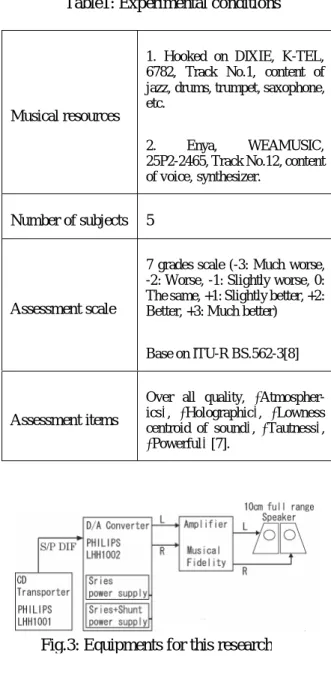
We conducted assessment experiments to com-pare the conventional series power supply with proposed power supply. Fig.3 shows the setup used in this assessment experiments. The series power supply is used as the base line of assess-ment. Experimental conditions are showed in Table1. Assessment words are extracted from assessment word concerned with deep sensations [7]. Assessment sessions repeated until when subjects were fully understood.
Fig.2: The circuit of proposed power supply
smooth-ing circuit
PWR loadings
Fig.1: Overview of digital audio system CD Transporter D/A Converter
CD Amplifier Speaker RF signal Bit Stream (SPDIF, AES/EBU) Data PLL 1 D/AC Clock 2 4
?
Power supply circuitD/AC IC
Table1: Experimental conditions
3.2 Result of assessment experiment Table 2 shows the result of assessment experi-ment. The scores of assessment are average score of 5 subjects, and parenthetical numbers are Standard Deviation (SD) of scores.
In Table 2, score of the all assessment words were obtained positive score. The average score were over “+2”. This means that the proposed power supply improved sound quality a lot compare with the base line system, and the out-performs than conventional ones. Especially, “Atmospherics”, “Holographic”, and “Tautness” were larger than “+2”.
Table 2: The results of assessment experiment
4 Evaluation of anti-turbulence properties 4.1 Measurement method
It is believed that the outstanding perform of the proposed power supply was obtained in assess-ment experiassess-ment. However, we could not find any concrete evidence in analogue output signal under the normal condition to give a physical support. This is because we had not clear idea how to detect the difference in a complex audio system. For this reason, we simplified the system by removing unnecessary parts in the measure-ment. The measurements were carried out only on the division of power supplies.
In the experiment, voltage turbulence was added to both power supplies respectively. Fig.4 shows measurement equipments. Turbulence signal was set to rectangular wave (peak to peak amplitude: 2V, Frequency: 200Hz).
Musical resources
1. Hooked on DIXIE, K-TEL, 6782, Track No.1, content of jazz, drums, trumpet, saxophone, etc.
2. Enya, WEAMUSIC, 25P2-2465, Track No.12, content of voice, synthesizer.
Number of subjects 5
Assessment scale
7 grades scale (-3: Much worse, -2: Worse, -1: Slightly worse, 0: The same, +1: Slightly better, +2: Better, +3: Much better)
Base on ITU-R BS.562-3[8]
Assessment items
Over all quality, “Atmospher-ics”, “Holographic”, “Lowness centroid of sound”, “Tautness”, “Powerful” [7]. Assessment words Resources 1 Average (SD) Resources 2 Average (SD)
Over all quality +2.4 ( 0.89 ) +2.2 ( 0.45 )
“Atmospherics” +2.2 ( 0.84 ) +2.0 ( 0.71) “Holographic” +2.2 ( 0.45 ) +2.2 ( 0.84 ) “Lowness centroid of sound” +1.6 ( 1.14 ) +2.2 ( 0.84 ) “Tautness” +2.4 ( 1.10 ) +2.4 ( 1.12 ) “Powerful” +1.8 ( 0.89 ) +2.0 ( 0.89 )
4.2 Result of measurement
Fig.5 and Fig.6 shows result of measurement of voltage turbulence in 5 ms period of inputted rectangular signal and response of voltage tur-bulence at time waveform. Horizontal axis is time. Left vertical axis and solid line are response of voltage turbulence. Right vertical axis and broken line show input voltage.
In the rising transient of signal, the part A in Fig.5, the response voltage of conventional power sup-ply was an impulse with amplitude of 1.26V. In contrast, response voltage of proposed power supply (see the part C in Fig.6) was greatly re-duced. The amplitude was only 0.01V, less than one-hundredth. This difference clearly shows that the proposed power supply was mush more ro-bust than the conventional one. In the dropping transient of signal, conventional power supply suppress the turbulence to 0.25V (part B in Fig.5) because of its ability of supplying. Moreover, proposed power supply suppressed the turbu-lence to 0.07V (part D in Fig.6).
The measurement results show that the proposed power supply has excellent anti-turbulence property. This is why the audio system with the proposed power supply outperforms that the conventional ones.
4.3 Discussion
As the result of assessment and experiment, the proposed power supply improved “Atmospher-ics” especially. On the other hand, our researches concerned with digital signal jitter showed that jitter deteriorate “Atmospherics” seriously [2]-[5]. According to the result of these re-searches noted above, from the psychophysical standpoint, the proposed power supply might suppress influence of jitter. That is to say the anti-turbulence property is helpful in suppressing the effects caused by jitters. Therefore, we con-firmed our speculation. However, we should need much more experiments to clarify the complex structures between sound deterioration, jitter and power supply.
5 Conclusions
In this study, as an example of “Socialization”, aspiring faithful reproduction of deep sensations of human, we clarify the relation of sound quality and the power supply. “Series–Shunt parallel power supply” was devised to approach the ideal conditions, and implement in an audio system. The assessments result showed that the proposed
Fig.4: Measurement equipment of voltage turbulence
Fig.6: Turbulence of proposed power supply C
D response input Fig.5: Turbulence of series power supply
A
B response input
power supply can faithfully reproduce the sound and can evoke the deep emotion. To find the physical evidence we conducted a voltage tur-bulence experiment. It showed that the proposed power supply can suppress the turbulence to 1% comparing with conventional ones. The anti-turbulence property is helpful in suppressing the effects caused by jitters.
References
[1] Makoto Miyahara, “New Generation Audio: New Perception Model for the High Order Sen-sation -Distortion of the Expansion and Contrac-tion of Time and Digital Sound-”, 13-6, pp.39-46, 1996. (in Japanese)
[2] Shingo Fuyuki, Tomoharu Ishikawa, Yukio Kobayashi, Makoto Miyahara, “The Deteriora-tion of High Order SensaDeteriora-tions in Digital Audio Signal caused by Jitter - A Sharp Loss of “At-mospheric” and (Deepness) - ”, Technical report of IEICE, EA97-104, pp.9-16, 1998. (in Japa-nese)
[3] Makoto Miyahara, Yukio Kobayashi, To-moharu Ishikawa, Minoru Mitsui, Teppei Koga, “Degradation of sound quality caused by jitter of digital sound system”, FORUM ACUSTICUM SEVILLA, MUS-05-001-IP, 2002.
[4] Minoru MITSUI, Tomoharu ISHIKAWA, Yukio KOBAYASHI, Makoto MIYAHARA, “The Relationship between Degradation of the Sound Quality and Digital Signal Jitter”, 1029D, WESPAC8, 7.2003.
[5] Minoru MITSUI, Kouta Yoneyama, Tomo-haru ISHIKAWA, Makoto MIYAHARA, “Considerations of Relationships between De-terioration of Sound Quality and Physical Factors on the Digital Audio Systems ” , ITE report, Vol.30,No.68,pp67-79,2006.12. (in Japanese) [6] H.L Jou, J.C Wu, etal, “A new control algo-rithm of active power line conditioner for im-proving power quality”, Electric Power Systems Research, Volume 70, Issue 1, June 2004, pp.1-6, Elsevier.
[7] Tomoharu Ishikawa, Makoto Miyahara, “Hi-erarchical Structure of Assessment Words for the Evaluation of Information of High Order Sensa-tions”, KANSEI2001, 2001.10.
[8] Subjective assessment of sound quality, ITU-R BS.562-3, 1978