On numerical methods for solving linear
systems
appearing in
Infinite
Precision
Numerical Simulation.
Toshiki
TAKEUCHI
(竹内敏己), Hideo SAKAGUCHI (坂口秀雄),Cheng-Hai JIN (金成海) and Hitoshi IMAI (今井仁司)
Department ofMathematics, Faculty of Engineering, University of Tokushima
(徳島大学工学部)
1
Introduction
We presented already IPNS(Infinite-Precision Numerical Simulation) to PDE systems with
smooth $\mathrm{s}\mathrm{o}\mathrm{l}\mathrm{u}\mathrm{t}\mathrm{i}\mathrm{o}\mathrm{n}\mathrm{S}[5]$ . Errors in numerical simulations originate from truncation errors in
discretization and roundingerrors. IPNSrealizes arbitrary reduction of both errors. InIPNS
the spectral method is used for the control of truncation errors. In particular, the spectral
collocation method with the $\mathrm{C}\mathrm{h}\mathrm{e}\mathrm{b}\mathrm{y}_{\mathrm{S}\mathrm{h}}\mathrm{e}\mathrm{V}-\mathrm{G}\mathrm{a}\mathrm{u}\mathrm{S}\mathrm{S}$-Lobatto $\mathrm{p}\mathrm{o}\mathrm{i}\mathrm{n}\mathrm{t}\mathrm{s}[1]$ is very useful. The order of
the approximation can be controlled bythe number of collocation points. Multiple precision
$\mathrm{a}\mathrm{r}\mathrm{i}\mathrm{t}\mathrm{h}\mathrm{m}\mathrm{e}\mathrm{t}\mathrm{i}\mathrm{c}[7]$is used for the control of rounding errors, and it is easily available by using the
libraryonthenet, e.g. http:$//\mathrm{w}\mathrm{w}\mathrm{w}.\mathrm{l}\mathrm{m}\mathrm{u}.\mathrm{e}\mathrm{d}\mathrm{u}/\mathrm{a}\mathrm{c}\mathrm{a}\mathrm{d}/\mathrm{p}\mathrm{e}\mathrm{r}\mathrm{s}\mathrm{o}\mathrm{n}\mathrm{a}\mathrm{l}/\mathrm{f}\mathrm{a}\mathrm{c}\mathrm{u}\mathrm{l}\mathrm{t}\mathrm{y}/\mathrm{d}\mathrm{m}\mathrm{s}\mathrm{m}\mathrm{i}\mathrm{t}\mathrm{h}2/\mathrm{F}\mathrm{M}\mathrm{L}\mathrm{I}\mathrm{B}.\mathrm{h}\mathrm{t}\mathrm{m}\mathrm{l}$
[10]. It has already been shown that
IPNSis-
effective in inverse problems, free boundaryproblems, $\mathrm{e}\mathrm{t}\mathrm{c}[4,6,9,12]$.
On the other hand, IPNS needs huge computer
resources.
This is due to that IPNS isbased on multiple precision arithmetic. High-performance solver is necessary to solve the
linear system which is derived by applying the spectral collocation method. The coefficient
matrix of this linear systems are non-symmetric and the condition numbers are large in
general. The Gauss elimination method has been used to solve linear system until now.
But, the Gauss elimination method need the great time of calculation and the large memory
area.
Then, we use the $\mathrm{C}\mathrm{G}\mathrm{S}[11]$ method in this paper. Preconditioning is important for theCGS method. We use the SOR method that iteration step is fixed as preconditioner.
2
Test problem
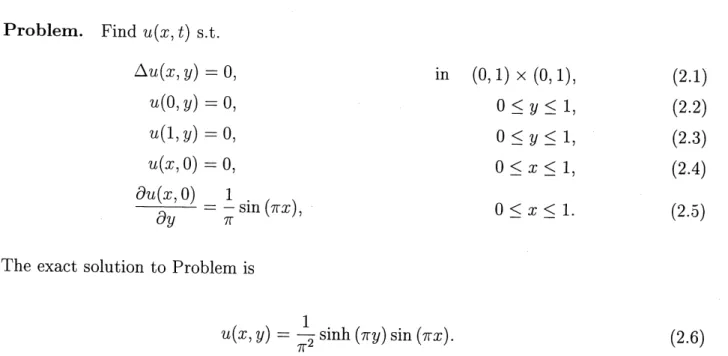
Problem. Find $u(x, t)\mathrm{s}.\mathrm{t}$.
$\triangle u(x, y)=0$, in $(0,1)\cross(0,1)$, (2.1)
$u(0, y)=0$, $0\leq y\leq 1$, (2.2)
$u(1, y)=0$, $0\leq y\leq 1$, (2.3)
$u(x, 0)=0$, $0\leq x\leq 1$, (2.4)
$\frac{\partial u(x,0)}{\partial y}=\frac{1}{\pi}\sin(\pi x)$,
$0\leq x\leq 1$. (2.5)
The exact solution to Problem is
$u(x, y)= \frac{1}{\pi^{2}}\sinh(\pi y)\sin(\pi x)$. (2.6)
This is an inverse problem. Usual approaches
are
applications of the regularization andleast square method or $\mathrm{A}\mathrm{I}$. We tried
some
$\mathrm{m}\mathrm{e}\mathrm{t}\mathrm{h}\mathrm{o}\mathrm{d}\mathrm{s}[\mathrm{s}, 8]$, however we were not satisfied.
Here, we apply IPNS directly. We
use
thesame
order approximation in $\mathrm{x}$ and $\mathrm{y}$ directionsfor simplicity. $N$ represents the order in spectral collocation method. The number oftotal
collocation points is $(N+1)^{2}$. The coefficient matrix of the linear system which is derived
by applying the spectral collocation method is $M\cross M$ matrix, where
$M=N(N-1)$
. Thisis a sparse matrix but is not a band matrix. Fig. 1. shows the form of the coefficient matrix.
Here, $*\mathrm{r}\mathrm{e}\mathrm{p}\mathrm{r}\mathrm{e}\mathrm{s}\mathrm{e}\mathrm{n}\mathrm{t}_{\mathrm{S}}$
non-zero
element.$\ovalbox{\tt\small REJECT}*****$ $*****$ $*****$ $*****$ $********$ $********$ $********$ $********$ $********$ $********$ $********$ $********$ $********$ .$********$ $********$ $********$ $********$ $********$ $********$ $********\ovalbox{\tt\small REJECT}$
In the following chapters, we introduce the results by using various solvers.
3
Gauss
elimination
method
In this section thenumerical results by the Gausselimination method with 120 digit numbers
are shown. The maximum errors, CPU times and the used memory are shown in Table 1.
The amount of operations is proportional to $M^{3}(N^{6})$ and the amount of use of memory is
proportional to $M^{2}(N^{4})$. In this paper, all numerical calculation
are
executed by Compaq$\mathrm{A}1_{\mathrm{P}}\mathrm{h}\mathrm{a}\mathrm{S}\mathrm{e}\mathrm{r}\mathrm{v}\mathrm{e}\mathrm{r}$ ES40 (CPU : $21264-666\mathrm{M}\mathrm{H}_{\mathrm{Z}}$, memory : $4\mathrm{G}\mathrm{B}$).
Table 1. Numerical results by the Gauss elimination method.
4
SOR method
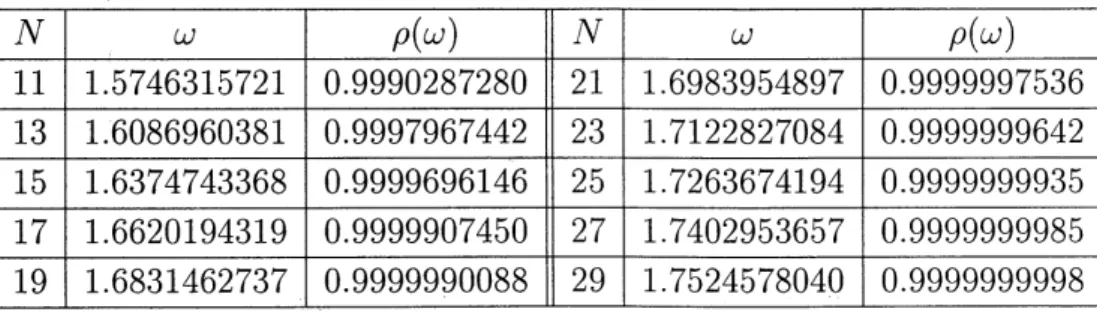
In this section the SORmethod for Cauchy problem is considered. We calculate the optimum
relaxation parameters $\omega$ and the spectral radiuses $\rho(\omega)$ to the iterations matrices of SOR
method by numerically. The results when 10 $\leq N\leq 30$
are
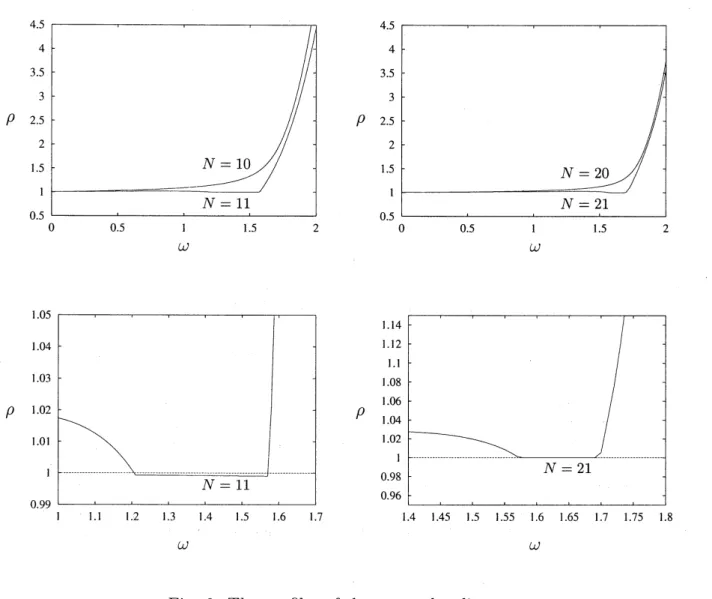
shown in Table 2. When$N$ is even number, the value of $\omega$ is more than 1. In these case, the SOR method are
not converged. When $N$ is odd number, the spectral radius to the optimum relaxation
parameter is approximately 1. It shows that the convergence of the SOR method is very
slow. Therefore, the SOR method doesn’t suit this problem.
Fig. 2. shows the profiles of the spectral radiuses in $N=10,11,20$ and 21. $\rho$ $\rho$ $\omega$ $\omega$ 1.14 1.12 $\mathrm{l}.\mathrm{l}$ 1.08 1.06 $\rho$ $\rho$ 1.04 1.02 $[$ $0.98$ $0.96$ 1.4 1.45 1.5 1.55 I6 1.65 1.7 1.75 1.8 $\omega$ $\omega$
Fig. 2. The profiles of the spectral radiuses.
5
CGS method
In this section some numerical results by the CGS method are shown.
First, Fig. 3 shows the results obtained with unpreconditioned CGS method. In this
$,=^{\mathrm{o}\iota}0$
$\sim=^{\mathrm{N}}=$
$\zeta^{\mathrm{e}}$
.
Iteration number
Fig. 3. Unpreconditioned CGS method
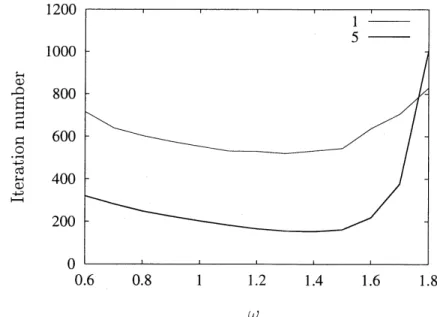
Next, we show the results by PCGS method. The SOR method was used as
precondi-tioner. The iteration step of the SOR method is fixed. The iteration numbers of the CGS
method to the relaxation parameters when the number of iteration for the SOR method are
1 and 5 are shown in Fig. 4. Here, $N=20$ and 60 digit numbers have been used.
Itera-tions were stopped when $||r_{n}||_{2}/||b||_{2}\leq 10^{-60}$. The vertical axis represents the iteration
numbers of the CGS method. The CGS method is converged for various values of the
relax-ation parameter $\omega$. When the relaxation parameter $\omega$ is 1.3\sim 1.4, it seem that the iteration
numbers are least. On the other hand, the SOR method is not converged when $N=20$.
Therefore, the optimal relaxation parameter $\omega$ in original SOR method is not important.
$\omega\succ_{\neg}$
$\Delta\underline{\supset\in\not\supset}$
$.+\overline{\frac{\mathrm{o}}{c6D}}$
$\underline{\dot{+\omega_{\partial}}}$
$\omega$
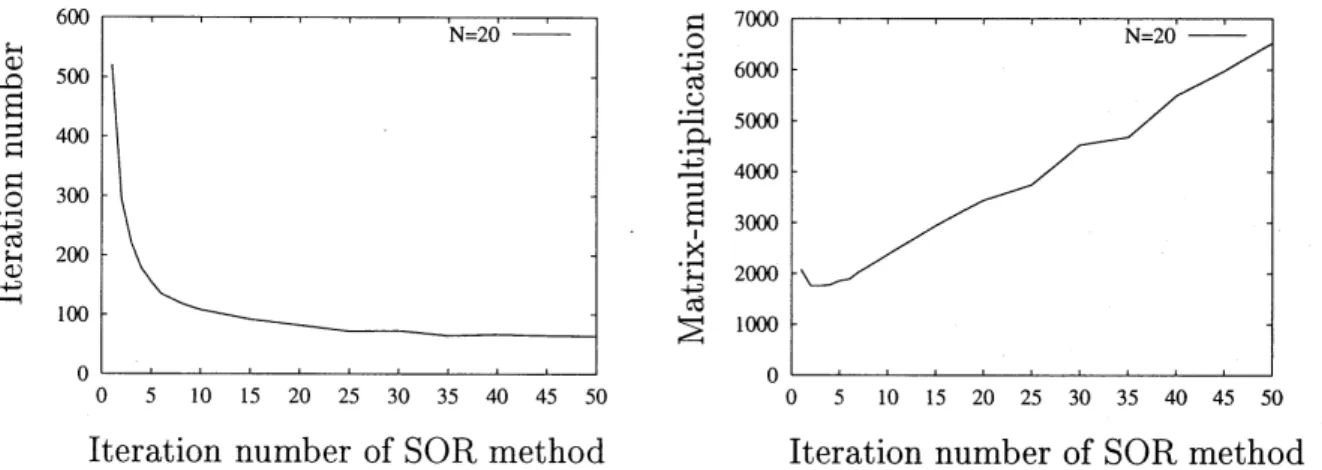
Fig. 5 shows that the iteration number and the amount of operations of the PCGS
method to the iteration step of the SOR method with $\omega=1.3$ and 60 digit numbers.
Iterations
were
stopped when $||r_{n}||_{2}/||b||_{2}\leq 10^{-60}$. The horizontal axis represents thenumber ofiterations for SOR method. The vertical axis represents the number of iterations
for CGS method and the number of matrix-multiplications for the CGS method and the
SORmethod in the left figure and right figure, respectively. The mount of operations of the
PCGS is least when the number of iterations for SOR method is 3.
$\overline{\omega}$
$r \frac{\lrcorner\supset\Xi}{\mathrm{E}}$
$.-^{\underline{\Phi}}+\overline{\frac{\mathrm{o}}{-^{6}\mathrm{c}^{\partial}}}$
Iteration number ofSOR method Iteration number of SOR method
Fig. 5. Relationship between CGS and SOR
Fig. 6 shows the convergence behavior ofPCGS method when $N=60$ and digit number
is 400. In preconditioner SORmethod,
we
take the parameter $\omega=1.4$ and fixed the numberof iterations is 3. Iterations
were
stopped when $||r_{n}||_{2}/||b||_{2}\leq 10^{-90}$. In thiscase
ourmethod needs only $300\mathrm{M}\mathrm{B}$ memories, but the Guass elimination method needs $2600\mathrm{M}\mathrm{B}$.
$.=0^{\circ \mathfrak{j}}$
$=\backslash _{\mathrm{N}}=$
$\sigma_{-}^{\mathrm{P}}$
Iteration number
6
Conclusion
In this paper, the Gauss elimination method, the SOR method and the PCGS method are
applied to the linear system which is derived by IPNS to Cauchy problem. The PCGS
method with the SOR method that iteration step is fixed
as
preconditioner is effective.The memory could be substantially saved compared with the
case
to have used the Gauss elimination method.Acknowledgements
This work is partially supported by Grant-in-Aid for Scientific Research$(\mathrm{N}\mathrm{o}. 10354001)$
and by CCSE of Japan Atomic Energy Research Institute.
References
[1] C. Canuto, M. Y. Hussaini, A. Quarteroni, T.A. Zang, Spectral Methods in Fluid Dynamics,
Springer-Verlag, New York, 1988.
[2] H.Han and H. -J. Reinhardt, SomeStability Estimates for Cauchy Problems for Elliptic Equations, J.
Inv. Ill-Posed Problems, 5(5), 1997, pp.1-18.
[3] H. Imai, Application of the Fuzzy Theory and Spectral Collocation Methods to an Ill-Posed Shape
Design Problem With a Free Boundary, in “Inverse Problems in Mechanics,” Eds. S. Saigal and L.G.
Olson, 186, pp.103-107, The American Society of Mechanical Engineers, 1994.
[4] H. Imai and T. Takeuchi, Application of the Infinite-Precision Numerical Simulation to an Inverse
Problem, Proceeding of 1998-WorkshoponMHD Computations “StudyonNumerical Methods Related
toPlasma Confinement”, $\mathrm{N}\mathrm{I}\mathrm{F}\mathrm{S}_{-}\mathrm{p}\mathrm{R}\mathrm{o}\mathrm{c}_{- 40}$, 1999, pp.38-47.
[5] H. Imai, T. Takeuchi and M. Kushida, On Numerical Simulation of Partial Differential Equations in
Infinite Precision, Advances in MathematicalSciences and Applications, 9(2), 1999, pp.1007-1016.
[6] H. Imai, T. Takeuchi, S. S. Shanta and N. Ishimura. On Numerical Computation of Lyapunov
Expo-nents ofAttractorsin Free BoundaryProblems, Proceeding of 1999-Workshopon MHD Computations
“Studyon Numerical Methods Related to Plasma Confinement”, $\mathrm{N}\mathrm{I}\mathrm{F}\mathrm{S}- \mathrm{P}\mathrm{R}\mathrm{o}\mathrm{c}_{-4}6$, 2000, pp.21-29.
[7] D. E. Knuth, The Art of Computer Programming, Addison-Wesley, 1981.
[8] A. Sasamoto, H. Imai and H. Kawarada, A Practical Method for an Ill-Conditioned Optimal Shape
Design ofa Vessel in Which Plasma Is Confined, in “Inverse Problems in Engineering Sciences”, Eds.
M. Yamaguti et al., pp.120-125, Springer-Verlag, 1991.
[9] S.S.Shanta, T. Takeuchi, H. Imai, M. Kushida, Numerical Computation ofAttractorsinFree Boundary
Problems, Advancesin Mathematical Sciences and Applications, 11(2), 2001. (in press)
[10] D. M. Smith, A FORTRAN Package For Floating-Point Multiple-Precision Arithmetic, Transactions
on Mathematical Software 17, 1991, pp.273-283.
[11] P. Sonneveld, CGS, A Fast Lanczos-type Solver for Nonsymmetric Linear Systems, SIAM J. Sci. Stat.
Comput., 10, 1989, pp.26-52.
[12] Tarmizi, T. Takeuchi, H. Imai, Numerical $\mathrm{S}^{r}\mathrm{i}\mathrm{m}\mathrm{u}\mathrm{l}\mathrm{a}\mathrm{t}\mathrm{i}_{\mathrm{o}\mathrm{n}}$
of One-Dimensional Free Boundary Problems in