
VolatileConstituents of Japanese
and Korean
びdo
(λΓalia cor data Thunb.)
and Butterbur (Peはs的0四〇
「cusMiq.)
Masayoshi SawAMURA', Mie-Soon Lee Kim**,
Ken-ichi Shichiri*, Tetsuya TSUJI*** and Keiji MACHIDA***
'Laboratoりof Chemistry a几d Technology of Agricultural Products.Facultv 0/ Agriculture, Ko-chi Uniuersit^i; ”Department o/ Foods and. Nutrition, DufeSung Womeがs Uniuersit\i, Seoul, Ko-rea; ・・・Kochi Highland Agricultural Experiment Station, Otoyo一cho, Kochi 789-昭.
Abstract: The aroma constituents from two kinds of wild vegetables collected respectively in Japan and Korea were investigated by gas chromatography (GC ) and GC-mass spectro-metry, of which one is udo (Araliaむo 「ata Thunb.) and the other is butterbur (7)etasites ja-ponicus Miq.). The volatile constituents were extracted by a simultaneous distillation
extrac-tor devised by Likens and Nickerson. The steam distillation-eχtraction was carried out at at-mospheric pressure, with diethyl ether as a solvent. \
There were 45and 114compounds in Japanese and korean udo, respectively. Among those compounds the major components were in common monoterpenes such as α-pinene,β-pinene and sabinene, amounting to 84 t0 88%of relative peak area. It is presumed that these are deep-ly related to the flavor of udo. Beyond them, the following compounds were detected in Korean udo:1 -methyl- 4 -( 1 -methylethyl) benzene, 3 -tridecen- 1 -yne, 2 , 3 , 4 , 5 , 6 , 7
-heχahydro-1 H-inden- 2 -ol, octadehydro- 4 -methyl- 6 −(1-methylethyl) -3,5 -dioxo- 4 a ( 2 H)一一naphtha-lenecarboxyaldehyde。
The components detected by GC were at least 53 in Japanese butterbur and 85in Korean one. There were great differences between the components of Japanese and Korean butterbur. Olefinic hydrocarbons such as 1 -nonene and 2 -undecene were largely shown in Japanese butterbur, while sesquiterpenes such as eremophilene, valencene,β-bisabolene,β・cadinene,
a -caryophyllene and β-cubebene were more abundant in Korean one.
・ Introduction
Among wild vegetables, either udo or butterbur (“Fuki” in Japanese), is one of the most popularly edible plants, being distributed in Eastern Asia, especially in Japan, Korea and Chi-na. In these countries the stalk of udo is often used for green salad with dressing and that of butterbur is cooked. Most of Japanese and Korean have enjoyed eating the wild vegetables in the spring as their edible quality is 仙e best during this season. びdo and butterbur give out their specific fragrance of mild intensity. There seems to be few papers on the volatile constit-uents of 乙zdo1.2)and butterbur.3−5)lnthe present paper we compared the volatile constituents
of udo and butterbur grown in both Japan and Korea. ・ ・ :
Materials
and Methods
50
高知大学学術研究報告 第38巻(1989年)農 学
were obtained from the Kochi Highland Agricultural Experiment Station in April to May, 1988. These vegetables were also collected in Korea at the same season : udo (Araria
continen-talis Kitagawa) and butterbur (the same species as Japanese one).
Extraction of volatile constituents Each immature stalk of udo and butterbur (300 g ) was homogenized and then mixed with water (500ml). The volatile constituents were extracted with diethyl ether using a Likens and Nickerson's simultaneous steam distillation-extraction appa-ratus modified by Flath and FORREY.6)The extractions of volatile constituents from native udo and butterbur were independently carried out at Sawamura's and Kim's laborato-ries under the same conditions as mentioned by Flath and FORREY.6)Theconcentrates re-moved from ether were finally dried with anhydrous sodium sulfate.
Fractionation of the concentrates The concentrates were fractionated by silica gel (Wako gel Q-23, 100-200 mesh) columり(I cm i. d.×25cm) chromatography to facilitate identifica-tion of the components. The eluent system was ,z。heχanefollowed by 90% M-hexane in ether. GC and GC-MS conditions A Shimadzu GC- 8 A gas chroma tograph equipped with FID was used, and the analytical conditions were same as that in a previous paper." The chromato-graphic data were treated with a Shimadzu C-RIB integrator. A GC-mass spectrometer used was a Shimadzu LKB-9000 system. The GC connected with the mass spectrometer was equipped with the "same type of column as described above. The operation conditions for MS were as follows: separator temperature, 250°C;ion source temperature, 270°C; ionization energy, 70 eV. The other GC-MS, Shimadzu LKB-9020 DF, was also used for further qualitative analysis.
Results
and Discussion
Volatile constituents of び&) Typical gas chromatograms
on the volatile constituents of
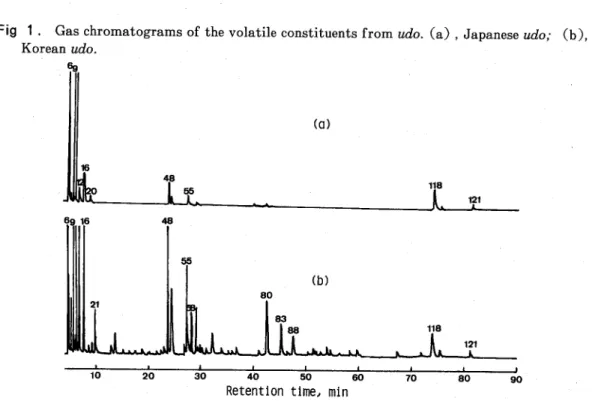
Fig 1 .
Gas chromatograms
of the volatile constituents from udo. (a) , Japanese udo.・(b),
Korean Ufio.
Japanese and Korean・udo
are shown in・
Fig. 1 (a) and (b). As shown in these figures,
great-er numbgreat-er
of peaks were detected from
Korean
udo than Japanese one, that is, 114 in the
former
and 45 in the latter. Their peak area ratios are shown
in Table 1 。 Identification
Table l .
peak area percentages of Japanese and Korean udo
Peak
Retention Peak area (%)
No. time (min) Japanese Korean
12345678901234567890123456789012345678 1111111111222222222233333333na 3.72 3.94 4.09 4.17 4.24 4.75 5.14 5.22 5.89 6.06 6.58 6.83 6.91 7.00 7.26 7.73 7.97 8.61 8.99 9.22 9.76 10.17 10.49 10.69 11.71 12.15 12.56 12.76 12.94 13.55 14.05 14.82 15.21 16.42 17.36 17.59 17.94 18.88 -0.15 57.23 0.04 0.28 13.33 7.57 0.78 0.02 0.19 0.18 2.10 0.40 0.79 0.42 0.14 0.09 0.16 0.03 -0.03 0.12 0.27 0.04 0.06 0.08 0.05 C O C M L O O O a > O 一 〇 r o ≪ 3 0.04 0.27 11.43 2.77 0.24 1.56 0.02 1.78 0.18 0.06 0.04 0.10 0.41 0.05 0.02 0.02 0.02 0.02 0.02 0.03 0.11 0.25 0.03 0.09 0.04 0.06 0.05 0.02 0.16
Compounds
2 -propanone 4 -nonene, 2,3,3 -trimethyl-,(E)− a-pinene r-terpinene camphene β-pinene sabinene 3 -carene myrcene (十) -limonene ト β-terpinene (涵-β-ocimene ∧ 4 -carene ト ocimene・benzene, 1 -methyl- 4 - ( 1 -methylethyl) -terpinolene ●●
a-pinene oxide octanal
cyclopentane, 2・methyl-1 -methylene-3 べ1
-methylethenyl)-5-undecen-l-ol,
(Z)-benzeneaceticacid,
a-methoxy-3-undecyne ・. ..
benzene, 1, 3-bis(l,l -dimethylethyl) -
5-methyl-a-cubebene ダ十 .. 8-octadecynoic acid, methyl ester …… 1 1, 4-methano- lH-inden, octahydroニ4inethyト8methylene 7べ1しmむthylethyl)
-52 高知
学学術研究報告・ 第38巻(1989年)農 学
Table 1 。(Continued)
Peak Retention Peak area (%)
Naつtime (min)
Japanese Korean
Compounds
90123456 7890 12 3 4 56789012 345 67890 1234 34444444 4445 55 5 5 55555666 666 66667 7777 19.86 20.16 21.28 21.67 22.40 22.59 22.82 23.15 23.56 23.97 24.36 25.06 25.47 25.76 26.97 27.16 27.57 28.02 28.14 28.29 28.69 29.32 29.59 30.02 30.32 30.54 31.12 32.19 33.36 34.09 34.27 35.46 35.87 36.36 37.02 38.74 0.06 0.05 -0.08 3.41 1.15 0.11 1.78 − 0.02 0.10 0.39 0.26 0.12 0.08 0.23 -0。06 0.05 0.02 つ 0.04 0.05 0.03 (十)二longifolene ‥ 0.06 ニ0.11 naphthalene, decahydro-1 , 6 -bis(methylene) -4 -( 1 -meth- ylethyl)- ,(4α√4aα,・8aα)− − 2.54 0.82 0.02 0.05 0.03 0.13 β-caryophyllene . ... コ 十 terpinen- 4 -ol 十\
bicyclo[7, 2, 0]undec- 4 -ene, ∧4, 11, 11-trimethyl-
8-methylene一 \ bicycloelemene。 十 十
bicyclo[3 , 1 , 1]・hept- 2 -ene- 2 -carboχaldehyde,
6,6-dimethyl-, (IS)
-bicyclo[3, 1, 1]heptane,・2, 6, 6 -trimethyl- 3 −(.2一一
propenyl) -, (1・α,2β,3α,5a)ン 上
0。06 1 H-benzocvcloheptene, 2 , 4a, 5 , 6 , 7 , 8 , 9 , 9
a-octa-j hydro- 3,5,5 -trimethyl- 9 -methylene-, ( 4 aS-cis)−
1.54 0.16
a-caryophyllene ・..・.. ・・
cyclopentaneacetaldehyde, 2 -formyl- 3 -methyl- a-methylene
0.50 3 -cyclohexene」 -methanol, a, a, 4 -trimethyl-, (S) 0.07 0.61 0.12 0.16 0.07 0.02 0.13 0.37 0.02 0.09 0.02 0.07 0.03 0.07 0.11 0.04 a-terpineol .. ∧ .・ ・. \ β-cubebene \
naphthalene, 1, 2, 3, 5, 6, 7, 8,8a-octahydro- 1 ,
8a-dimethyl- 7 T ( 1 -methylethenyl:) - , 1 S-(l a, 7 a, 8aα)- ‥
β-cadinene ∧ \
6 -octen-圭一ol, 3 , 7 -dimethyレ \
tricyclo[5 , 4 , 0 , 02, 8・]undec- 9 -ene, 2 , 6 , 6 ,
9-tetra-methyl − \
bicyclo[3, 1, 1]hept- 2 -ene- 2 -methanol, 6,6
-dimethyl-ethanone, 1 - (。1, 3a,・4・,5,6,7
-hexahydro-・4
-hydroxy-3,8 -dimethyl- 5 -azulenyl)一 十
(E) - carveol し
benzene methanol, a.α,4 -trimethyl- 上
1 -naphthalenol, 1 , 2 , 3 , 4 , 4a, 7 , 8 , 8a-octahydro- 1 ,6−
4aβ,8aβ]]-5 6 7 8 9 0 1 2 3 4 5 6 7 只 ︶ 7 7 7 7 7 8 8 8 8 8 8 8 8 Q U 9 0 1 2 3 4 5 6 7 8 9 0 1 2 3 4 5 6 7 8 9 9 9 9 9 9 9 9 9 9 0 0 0 0 0 0 0 0 1 1 1 1 1 1 1 1
Peak Retention Peak area (%) No. time (min) Japanese Korean
39.92 40.30 41.27 41.99 42.39 42.79 44.06 44.39 45.44 46.01 46.61 46.92 47.41 47.82 49.69 50.02 50.87 51.54 51.86 52.22 52.56 53.37 54.27 54.49 54.82 55.22 56.62 57.12 57.81 58.86 59.62 60.07 60.51 − 0.30 一 一 0.17 − 0.07 -0.03 0.09 0.05
Table 1 。 (Continued)
0.10 γ-cadinene 0.02 0.07 1 0.98 0.02 0.04 0.57 0.03 0.07Compounds
1, 3 , 6 , 10-dodecatetraene, 3,7,11-trimethyl-, (Z, E)3 tridecen 1 yne, (Z)
-bicyclo[3,1,1]heptane, 6 , 6 -dimethyl- 3 -meth-
ylene-heχadecanal
1 H-inden- 2 -ol, 2, 3, 4, 5, 6, 7
-heχadehydro-cyclohexanol, 3 -ethenyl- 3 -methyl- 2 −(1 -methylethenyl) -6 −( 1 -methylethyl)
-0.06 naphthalene, 1 , 2 , 3 , 4 , 4a, 7 -hexahydro-dimethyl- 4 −
(1 -methylethyl)
-0.02 2 -naphthalenemethanol, decahydro-α,α, 4a-trimethyl- 8 −
methylene-, [2Rべ2 a, 4a a, 8aβ)]一 犬
0.39 4a (2H) - naphthalenecarboxaldehyde, octahydro-4
-methyl- 6 -Cl -methylethyl) -3,5 -dioxo-, [4S-(4α,4aα, 6 a, 8a
α)]−
0.02 1 -naphthalenol, decahydro-4a-inethyl- 8 -methylene- 2 −(1−
methylethyl) -, acetate
0.03 r-muurolene
0.06 androstaご4 , 16-dien- 3 -one . . ..
0.04 azulene, 1, 2, 3, 4, 5, 6, 7, 8 -・octahydro- 1 ,4
-di- methyl-7- ( 1 -methylethylidene) -, ( 1 S-cis)
-0.13 naphtha!ene, decahydro- 1 ,1,4 a-trimethyl- 6 -methylene- 5-(3 -methyl- 2 ,4 -pentadienyl) -,[4aS-(4aa,5α,8aβ)] 0.07 1 H-cycloprop [e]azulen- 4 -ol, decahydro-1 , 1 , 4 , 7 - tetramethyl-,[lai? −(laa,4α,4aβ,7β,7aβ,7 a.a)]− 0.04 5 -azulenemethanol, 1,2,3,4,5,6,7,8 -octahydro − α,≪, 3, 8 -tetramethyl-, acetate
0.15 0.04
0.13 6,9 -octadecadiynoic acid, methyl ester 0.02
0.09
0.03 0.09 0.03
cyclohexanol, 3 -ethenyl- 3 -methyl- 2 −(1 -methylethenyl) -6 -(1 -methylethyl) -, acetate +
9 -octadecyne
0。18 1 H-inden- 1 -methanol, a-methyl。acetate 0.02
0.02
54
高知大学学術研究報告 第38巻(1989年)農 学
Table
1 。(Continued)
Peak Retention Peak area (%) No. time (min) Japanese Korean
8 9 0 1 2 3 4 5 6 7 8 9 0 1 2 3 4 t 0 0 1 1 1 1 1 1 1 1 1 1 2 2 2 2 C S l 1 1 1 1 1 1 1 1 1 1 1 1 1 1 1 1 1 61.01 61.13 61.71 62.54 64.61 65.12 66.36 68.01 72.34 72.62 74.71 76.16 78.54 81.94 83.47 88.07 89.44 0.06 -4。77 0.26 − 1.56 一 0.21 0.08 0.04 0.02 0.02 0.02 0.02 0.03 0.12 0.02 0.09 0.60 0.18 0.04
Compounds
8 ,11-octadecadiynoic acid, methyl ester
1, 3 , 6 , 10-cyclotetradecatetraene, 3,7, ll-trimethyl-14 − ( 1 -methylethyl) -, S -(E,Z,E,E)−
1,5 heχadiene 3 , 4 diol, 1 , 6 diphenyl -8 -octadecynoic acid, methyl ester
0.20 hexadecanoic acid 0.05
-of peaks was carried out by comparisons
with the retention time from GC
and the data from
GC-MS
of authentic compounds,
and by referring to the spectral data base.'・9)The
common
and major components
in Japanese and Korean
udo were monoterpenes
such as α-pinene,β−
pinene and sabinene, amounting
to 84 to 88%.TheSe
major compounds
would be also
impor-tant components
contributing to the characteristic odour of udo." This assumption
would be
supported from
organoleptic evaluation that ひdo smells, in fact,like wood
to be represented
by pinenes. Among
sesquiterpenes β-caryophyllene was considerably abundant in the udo.
Bi-Fig. 2. Mass spectrum of β-caryophyllene (bicyclo[7, 2, 0]undec- 4 - ene, 4 , 11, 11-trimethyl- 8 -methylene-,[1R-(1R, AE, 9S)]-).
Fig. 3 . Mass spectrum of bicyclo [7, 2, 0]undec- 4 -ene-4, 11,」l-tri。 methyl- 8 -methylene. 十 十尚
cyclo[7, 2,・O]undec- 4 -ene- 4 ,11, 11-trimethyl- 6 -methylene (peak万No. 50)・, an isomer of β-caryophyllene, was also identified by GC-MS. These mass spectra are shown in Fig. 2 and
3 . Terpinen- 4 -ol was noticed among minor oxygenated compound. As shown in Fig. 1 , sev-eral peaks as higher-boiling point compounds appeared in the gas chromatogram of Korean udo. The compour!ds specific to Koreanudo were as follows: 1 -methyl- 4 −(1 -methylethyl) benzene (peak No. 21) ; 3 -tridecen- 1 -yne(N0.80); 2, 3, 4, 5, 6, 7 -hexahydro 1 H-inden 一回・ol(No. 83) ; octahydro- 4 -methyl- 6 −( 1 -methylethyl) - 3 , 5 -dioxo- 4 a (2H) -naphtha-lenecarboxaldehyde (No. 88). BothAralkicordata grownin Japan and Aralia continentalis
Fig. 4.
Gas chromatograms
of volatile constituents from butterburs.
(a),Japanese butterbur: (b), Korea!l butterbur. \
56
高知大学学術研究報告
(1989年)農 学Table 2.
Peak area percentages of Japanese and Korean butterbur
Peak Retention Peak area (%) No. time (min) Japanese Korean
12345678910一11 121314151617181920212223242526272829303132333435363738394041 42 3.04 3.38 1 3.64 3.83 3.93 4.16 4.81 5.01 5.46 5.75 6.44 6.86 6.97 7.06 7.17 7.49 7.75 8.34 8.69 8.98 9.66 9.86 12.66 12.87 14.07 14.23 15.03 15.21 17.41 , 17.96 18.95 20。22 21.24 21.43 21.92 22.17 22.94 24.23 25.16 25.37 25.83 26.23 − 0.31 0.86 41.56 0.08 0.24 0.06 0.17 0.04 11.66 0.03 0.05 0。29 0.32 0.21 0.77 − 0.05 0.08 0.37 0.76 0.65 2.13 0.16 1.47 0.52 5.16 − 0 90 0.16 0.23∇ 1 -butanol 0.04 0.06 0.05 0.96 1 -nonene 0.04 1 -decene 3。19 。2 -undecene 0.03 0.04 0.04 0。08 0.05 − Compounds
bicyclo[2, 2, 1]heptane, 2 -butylidene-1 -dodecene 4。76 tridecene − 」-hexanol 0.20 3 -hexen- 1 -ol, (Z)− 0.29 2 -hexen- 1 -ol, (Z) − 0.09 α-cubebene 0。10 0.06 L20 − β-cubebene 0.39 linalool
0.09 \
23.58 eremophilene
0.12
0.11 naphthalene, 1 , 2 , 3 ,恥6 , 8a-heχahydro∠4,へ7-di- methyl↓(1-㎡ethylethyl) -,(1 S-cis) 十 〇.143 4 5 6 7 8 9 0 1 2 3 4 5 ρ り 4 4 4 4 4 4 4 5 5 5 5 5 5 r a 7 8 9 0 1 2 3 4 5 6 7 8 9 0 1 2 3 4 5 5 5 6 6 6 6 6 6 6 6 6 6 7 7 7 7 7 5 6 7 8 9 0 1 2 Q り 7 7 7 7 7 8 8 8 Q り
Peak Retention Peak area (%) No. time (min) Japanese Korean
27.31 27.64 27.86 27.98 28.16 28.32 28.47 28.74 29.43 29.67 29.91 30.18 30.66 31.06 31.46 32.43 33.43 34.01 34.19 34.50 35.31 35.98 37.06 37.29 37.81 38.43 38.83 39.13 39.59 40.04 40.66 41.36 42.18 42.46 42.84 45.53 46.44 46.66 46.99 47.29 47.89 -0.28 0.07 − 0.09 0.28 − 0.88 5.02 0.27 − 1.26 − − 0.93 − -0.94 − 0.11 − 0.84 -0.25
Table 2. (Continued)
0.12 2.97 a -caryophyllene 2.31 0.23 0.04 16.72 0.10 0.19 5.02 15.24 8.52 1.91 0.03 0.03 valencene Compoundscyclopropa[d]naphthalene, 1 , la, 4 , 4a, 5 , 6 , 7 , 8
octahydro- 2 ,4a, 8, 8 -tetramethyl-, [laS- (laα,4aβ
8aR)]-β-bisabolene β-むadinene α-bisabolene 0.03 0.10 0.12 β-selinene 0.03 0.08 0.57 r-cadinene 0。09 0.12 hydrazine,
(phenylmethyl)-0.40 3a, 7 -methano- 3aH-cyclopentacyclooctene。
1,4,5,6,7,8,9, 9a-octahydro- 1 , 1 , 7 -trimethyl-。 [3aR-(3a a, 7α,9aβ)]-0.09 0.06 0.75 (Z,E)−β-farnesene 0.14 0.16 0.89 nerolidol・ 0.31 α-muurolene 0.03 0.18 α-ylangene
58
高知大学学術研究報告 第38巻(1989年)農 学
Table 2. (Continued)
Peak Retention Peak area (%) No, time (min) Japanese Korean
4 5 6 7 8 9 0 1 2 3 4 5 6 7 8 9 0 1 2 3 4 5 6 7 8 9 0 1 2 3 4 5 6 7 8 9 0 1 8 8 8 8 8 8 9 9 9 9 9 9 9 9 9 9 0 0 0 0 0 0 0 0 0 0 1 1 1 1 1 1 1 1 1 1 2 ( N ! 1 1 1 1 1 1 1 1 1 1 1 1 1 1 1 1 1 1 1 1 1 1 49.74 50.29 50.68 51.29 51.93 52.63 53・.21 53.64 54.58 54.96 55.28 56.6「 57.09 57.88 58.29 58.84 59.64 60.36 60.86 61.73 62.34 63.06 63.69 66.44 67.14 67.54 67.64 70.74 71.08 73.63 73.81 76.81 78.04 78.54 81.86 82.44 86.38 87.98 0.15 -0.30 0。34 − -0.30 -一 一 0.25 0.22 1.14 0.10 0.27 0.12 − 13.15 2.71 0.36
Compounds
0。16 lH-cycloprop[e]a!ulene-・ 4 -ol, decahydro- 1 ,
1,4,7- tetramethyl一汗laR-
(laα,4β,4aβ,7β,7aβ,7bα)]-0.04 0.15 0.04 0.24
0.54 lH-3a, 7 -methanoazulen- 5 -ol, octahydro- 3 , 8 ,
8-tri-
niethyl-6-inethylene-0.26 1 -naphthalenol, 1 , 2 , 3 , 4 , 4a, 7 , 8 , 8a-octahydro- 1 , 6−
dimethyl- 4 −(1 -methylethyl) -,[IS-(la, 4α,4aβ,8aβ)]−
−
1.25 tricyclo[5 , 1, 0 , 02, 4]octane- 5 -car.boxylic acid, 3,3 8,8 -tetramethyl-, methyl ester
0。09 0.28 0.05
0.23 furan, 3 -( 4 , 8 -dimethyl- 3 , 7 -nonadienyl)。(£) − 0.40 0.77 0.01 0.03 0.03 0.04 0.10 − 0.19 0.08
6,9 -octadecadiyonic acid, methyl ester
1,6, 10-dodecatriene- 3 -ol, 3,7, 11-trimethyl −
0.07 0.31 9 -eicosyne 0.06 0.07 0.05 0.10 0.21 0.02
grown in Korea have been regarded as same species, but the present data show great differ-ences of the composition 0f minor volatile components between Japanese and Korean udo . It is obscure whether these differences simply result from varied growing conditions or both spe-cies !ire not exactly identical. 十 ∧
VOlati!econstituents of butterbur The gas chromatograms for Japanese and Korean butter-bur are shown in Fig. 4 (a) and (b), and the peak area percents are listed in Table 2 . Fifty three peaks were detected in the essential oil from Japanese butterbur, and their major com-ponents were as followsソ1 -nonene (41.5%), peak 119 (13.1%),ニ2-undecene (11.6%), peak 36 (5.1%) and valencene (5.0%). Olefinic hydrocarbons were characteristically predominant in the essential oils of Japanese butterbur. Major components of Korean butter bur, in contrast to the Japanese one, were sesquiterpenes such as ere!nophilene (23.5%)。valencene (16.7%),
β-bisabolene (15.2%),β-cadinene (8・.52%),Λa-caryophyllene (2.97%) andβ。cubebene (1.20 %), amounting to about 70%. Terpinen-4-ol and α-terpineol were noticed among them: how-ever as a whole, there were few oxygenated compounds such as d叩hols and aldehydes in the butterbur of both countries. Consequently hydrocarbons would mainly contribute to the char-acteristic flavor of butterbur. NAYAd 「.3.4)have isolated some: kinds of fukinolides from the flower stalks of wild butterbur. In the present study higher concentration of
ere-mophilene, which is an isomer of valencene and supposed to be a prやcursor for the genesis of fukinolide and its homologues, was found in the stalks of Korean butterbur. Japanese butter-bur√incontrast to the Korean one, contained only less than 0.1% of eremophilene. The mass spectra of valencene and eremophilene are shown in Fig 5 and 6 . It is assumed that these differences of compositions between Japanese and Korean vegetables have resulted from their growing circumstances, even if。they are of identical species. 〉 ユ.
Fig. 5 . Mass spectrum of valencene 「naphthalene,」, 2, 3,:5, 6, 7 8 , 8a-octahydro- 1 , 8a-dimethyl- 7 −( 1 -methylethenyl),[li?x(l a 尚 ・7.β,8a a)]一犬 し \
60
高知大学学術研究報告 第38巻(1989年)農 学
Fig. 6 . Mass spectrum of eremophilene (naphthalene.!, 2, 3, 5, 6 7,8, 8a-octahydro- 1 ,8a-dimethyl- 7 -( 1 -methylethenyl),[1S(1α 7β, 8aa)]L レ ダ ニ 上
Acknowledgements
The authors are grateful to Professor Yutaka OSAJIMA of the Department of Food Science
and Technology at Kyushu University for his helpful suggestions. We are also indebted to Dr.
Mitsuya Shimoda of Kyushu University for his analysis by Shimadzu GC-MS 9020DFよ 〉づ
I References +
1 ) ITO, T., TSUKIJI, K. and Odagiri, S.: Constituents of the head space gas of udo
(Aralia corda- £αThunb.). Nippt)y1NogelKagafeuKaishi,52.22S-224(1978).
2)ITO, T., TSUKIJI, K. and Odagiri, S.: Aroma constituents of udo (AraliacordataThunb.).Nip
y)n NogeiKagafeuKaishi,55, 399-405 (1981). ニ
3 ) Naya, K., Hayashi, M., Takagi, I., NAKAMURA, S. and KOBAYASHI, M.:The structural
elu- cidation of sesquiterpene lactones from PetasitesjaponicusMaxim.Bull.Ckem.. Soc. Jpn.A5,
3673一3685 (1972). 工大 コ
4 ) TAKAGI, I., TAZUKE, Y. and NAYA, K.:The components of PetasitesjaponicusMaxim. IV・
The structure of petasitin.Bull. Ohem. Soc. Jp几ヽ, 50, 3320二3323 (1977). ‥ 十 几
5 ) Naya, K., Nakata, M. and Miyamoto, T.:The 32 nd Symposium on the Chemistry of
Terpe- nes, Essential 011Sand Aromatics, p. 49-51 (198り). ニ
6 ) Flath, R. a. and FORREY, R. R.:Volatile components of皿apaya (CaricapapayaL.,Solo
va- riety). J. Agric.Food Chen・^.,25, 103-109 (1977).
7 ) SAWAMURA, M., TSUJI, T. and KUWAHARA, S.:Changes in the volatile constituents of
pum- melo(CitrusgrondisOsbeck forma Tosa-buntan) during storage.Agric,Biol. Chem。53,
243- 246(1989). エ. ・● ・・
8 ) Heller, S. R. and Milne, G. W. A.:“EPA/NIH mass Spectral Data Base" vo1.卜4 and
Suppl. 1 , U. S. Government Printing Office, Washington (1978 and 1980).
9)The Royal Society of Chemistry: “Eight Peak Index of Mass Spectra" Vol. 1 - 3 , The mass
Spectrometry Data Centre, The Royal Society of Chemisty, Nottingham, UK (1986)ト
(Manuscript received: September 29, 1989)

![Fig. 2. Mass spectrum of β‑caryophyllene (bicyclo[7, 2, 0]undec‑ 4 ‑ ene, 4 , 11, 11‑trimethyl‑ 8 ‑methylene‑,[1R‑(1R, AE, 9S)]‑).](https://thumb-ap.123doks.com/thumbv2/123deta/8291229.1289704/6.771.55.703.31.1057/fig-mass-spectrum-caryophyllene-bicyclo-undec-trimethyl-methylene.webp)
![Fig. 3 . Mass spectrum of bicyclo [7, 2, 0]undec‑ 4 ‑ene‑4, 11,」l‑tri。](https://thumb-ap.123doks.com/thumbv2/123deta/8291229.1289704/7.771.54.741.42.1056/fig-mass-spectrum-bicyclo-undec-ene-l-tri.webp)


