”Indirect” Time Series Analysis
for
One-Dimensional
Chaos
Based
on
Perron-Frobenius Operator:
”Generalized” Ulam-Li’s
Approximation
to
Invariant
Density
Tohru
KOHDA
\dagger
and Kenji
MURAO
\dagger\dagger
Kyushu University\dagger and Miyazaki University\dagger \dagger , Japan
Abstract A unified approach to time series analysis for one-dimensional discrete chaos is given which is based on the Galerkin approximation to the Perron-Frobenius operator. The proposed method gives approximations with high accuracy to statistics of
various one-dimensional chaos. Numerical results for $1/f^{\delta}$ power
spectrum of intermittent chaos also show that the observed
expo-nent of the FFT power spectrum of long trajectories as $farrow 0$ is
in good agreement not with the Procaccia-Schuster’s estimate but
with our estimate.
I.
Introduction
There are two kinds of time series analysis for long-time chaotic
tra-jectories $\{x_{m}\}_{m=0}^{\infty}$ generated by a recurrence formula $x_{m+1}=\tau(x_{m})$
the “time-average technique”, in which we evaluate certain
statis-tics of a sample long-time trajectory $\{x_{m}\}_{m=0}^{n}$ with some initial
value $x=x_{0}$ ; the other one is the “ensemble-average technique”
under the assumption that $\tau$ is mixing with respect to an
abso-lutely continuous invariant measure, denoted by $f^{*}(x)dx$
.
We givea unified approach to time series analysis for discrete chaos by such
an ensemble-average technique.
The time-average technique which is a usual $method^{[4]}$ is
re-ferred to as the (
direct method’. On the contrary, the ensemble
average technique is a kind of “indirect $method_{S}’$) because there is
no need to directly calculate trajectories. Hence such an indirect
method is expected to play an important role in theoretically
un-derstanding chaos. In fact, the Perron-Frobenius operator whose
fixed point is $f^{*}(x)$ permits us to theoretically calculate the
en-semble average of several $statistics^{[5],[6]}$
.
This operator, denotedby $P_{\tau}$, however, gives no practically calculating method because of
its infinite dimensionality. Such a situation leads us to consider
an efficient algorithm for systematically calculating statistics which
is based on the Galerkin approximation to $P_{\tau}$ on a suitable
func-tion $space^{[7]-[10]}$
.
This algorithm is referred to as ageneralized’)Ulam-Li’s $method^{[7]}$. We used the word “Ulam-Li)$s$ method”
be-cause $Li^{[2]}$ gave an affirmative answer to the Ulam’s $conjecture^{[1]}$
concerning a piecewise-constant approximation for $f^{*}(x)$
.
Numerical experiments demonstrate that the proposed method
one-dimensional chaos.
II.
Perron-Frobenius
Operator and
Statistics
of
Chaos
If $y=\tau(x)$ is mixing with respect to $f^{*}(x)dx$, then for almost
initial value $x=x_{0}$ sequences $\{x_{m}\}_{m=0}^{\infty}$ can chaotically behave.
From the Birchoff individual ergodic theorem, the time average of
any $L_{1}$ function $F(x)$ along a trajectory $\{x_{m}\}_{m=0}^{\infty}$, which is defined
by
$\overline{F}=\lim_{Tarrow\infty}\frac{1}{T}\sum_{n=0}^{T-1}F(\tau^{n}(x))$, (1)
is equal almost everywhere to the ensemble average of $F(x)$ over $I$,
defined by
$<F>= \int_{I}F(x)f^{*}(x)dx$. (2)
The direct time series analysis is based on using $\overline{F}$. However, the
sensitive dependence on initial conditions, one of chaotic$properties^{[3]}$,
prevents us fromprecisely evaluating $\overline{F}$
. On the other hand, the
in-direct time series analysis is based on using $<F>$. We begin with
reviewing relations between typical statistics and $P_{\tau}$. The operator
$P_{\tau}$ is defined by
$P_{\tau}f(x)= \int_{I}\delta(x-\tau(y))h(y)dy$. (3)
For any $L_{1}$ functions of bounded variations $g(x)$ and $h(x)\rangle$ $P_{\tau}$ has
$(g(x), h(\tau(x)))=(P_{\tau}g(x), h(x))$, (4)
where
$(g, h)= \int_{I}g(x)h(x)dx$. (5)
The invariant density $f^{*}(x)$ which plays a key role in our indirect
method is the eigenfunction of $P_{\tau}$ belonging to the eigenvalue 1,
that is,
$P_{\tau}f^{*}(x)=f^{*}(x)$
.
(6)The autocorrelation function is defined by
$\rho(k)=<x\tau^{k}(x)>-<x>^{2}$ (7)
The first term of the rhs of this equation is rewritten as
$<x\tau^{k}(x)>=(P_{\tau}^{k}(xf^{*}(x)), x)$, (8)
where the above property of $P_{\tau}$ is repeatedly used. Let $h_{i}(x)$ be
the eigenfunction of $P_{\tau}$ with the eigenvalue $\lambda_{i}$ for the eigenvalue
$problem^{[4]}$ $P_{\tau}h_{i}(x)=\lambda_{i}h:(x)$
.
(9) If we can expand $xf^{*}(x)$ as $xf^{*}(x)= \sum_{i=1}^{\infty}\eta_{i}h_{i}(x)$, (10) then we have $\rho(k)=\sum_{i=2}^{\infty}u_{l}\lambda_{i)}^{k}$ (11)the Fourier Transform of which gives the power spectrum $S(\nu)$
$S( \iota/)=\sum_{\mathfrak{i}=2}^{\infty}u_{i}\frac{1-\lambda_{\mathfrak{i}}^{2}}{(1-\lambda_{i}z)(1-\lambda_{i}z^{-1})}$ (12)
where
$\lambda_{1}=1,$ $u_{i}=\eta_{\dot{t}}(x, h_{i}))$and $z=exp(j2\pi\nu)$ (13)
with $0<\nu<1$. Oono and $Takahashi^{[5],[6]}$ demonstrated that the
Fredholm theory of $P_{\tau}$ plays an important role in discussions of the
power spectrum. It is, however, difficult to find exact solutions of
eigenvalues and eigenfunctions of $P_{\tau}$, primalily because $P_{\tau}$ has the
infinite dimensionality. Such a situation led us to consider an
effi-cient algorithm of the indirect method.
III. Galerkin Approximations to
Perron-Frobenius
Operator
Let $\triangle$ be a function space which is spanned by a vector basis
function $\ell(x)arrow$. The constructing method of $\triangle$ is as follows. We
divide $I$ into $N$ subintervals $\{I_{n}\}$ with partition points $\{c_{i}\}^{\dot{N}_{=0}}$
sat-isfying $0=c_{0}<c_{1}<c_{2}<\cdots<c_{N}=1$ such that
$I= \bigcup_{n=1}^{N}I_{n}$, $I_{n}=[c_{n-1}, c_{n}]$. (14)
Our Galerkin approximations depend on the appropriate selections
of $\{c_{i}\}_{i=0}^{N}$ and of$\ell(x)^{[7]-[10]}arrow$. A simple but efficient procedure,
how-ever, is omitted here for selecting $\{c_{i}\}_{\mathfrak{i}=0}^{N}$. Next, we take bases
$\ell_{nk}(x)=p_{nk}(x)s(x)\chi_{n}(x)$, $0\leq k\leq K$, $1\leq n\leq N$
.
(15)In the above equation, $\chi_{n}(x)$ is the characteristic function of$I_{n}$ and
$p_{nk}(x)$ is the $k$-th order Legendre)$s$ polynomial which is orthogonal
to each other on $I_{n}$. For most of practical usages, we use $K=$
2. When $\tau$ has a bounded invariant density, the function $s(x)$,
referred to as a supplementary function, is taken to be 1. On the
other hand, $\tau$ has an unbounded invariant density, $s(x)$ is chosen
to be a singular function which approximates to singularities of the
unbounded invariant density and the inner product $(g, h)$ must be
also replaced by the weighted inner product
$(g, h)_{w}= \int_{I}g(x)h(x)w(x)dx$ (16)
with the weighting function
$w(x)=s^{-2}(x)$. (17)
Each component $\ell_{nk}(x)$ is an appropriately chosen piecewise
poly-nomial of at most $K$ degree whose combination approximates to
$xf^{*}(x)$ by the Galerkin $method^{[7]}$ such as
$xf^{*}(x)\simeq f^{t}\ell^{arrow}(x))$ (18)
where the superscript $t$ denotes the transpose ofthe vector $f$
.
Using$\ell^{arrow}(x)$, we get
$<x\tau^{k}(x)>\simeq f^{t}(P_{\tau}^{k}\ell^{arrow}(x), x)$. (19)
Furthermore, using the Galerkin method with $\ell(x)arrow$ on $\triangle$, we
$P_{\tau}\ell^{arrow}(x)\simeq\hat{P}_{\tau}^{t_{\ell(X)}^{arrow}}$ (20)
which leads us to readily obtain
$<x\tau^{k}(x)>\simeq f^{t}(\hat{P}_{\tau}^{t})^{k}(\ell(x), x)arrow$, (21)
where the $N(K+1)\cross N(K+1)$ matrix $\hat{P}_{\tau}$ is referred to as the
Galerkin-approximated matrix
of
the Perron-Frobenius operator where$N$ and $K$ are integers to be given below. The explicit form of $\hat{P}_{\tau}$
is given $in^{[7]}$. Let $h_{i}$ be the $i$-th right eigenvector of $\hat{P}_{\tau}$ with the
eigenvalue $\lambda_{i}$ for the easily tractable eigenvalue problem
$\hat{P}_{\tau}h_{i}=\hat{\lambda}_{\mathfrak{i}}h;$. (22)
Let $\hat{\lambda}_{1}$ be the maximum eigenvalue of $\hat{P}$
.
It is easily shown that $\hat{\lambda}_{1}$
when the supplementary function $s(x)=1$, namely, when both the
polynomial bases and the unweighted inner product are used. But
$\wedge\lambda_{1}\simeq 1$ when $s(x)\neq 1$, that is, when both the singular bases and
the weighted inner product are used. For the latter case, numerical
experiments show $\hat{\lambda}_{1}$ is nearly equal to 1 with the eror less than
$10^{-6}$ for $K=2$ and $N=32$. An approximate solution to the
invariant density given by
$\hat{f}^{*}(x)=h_{1}^{t}l^{arrow}(x)$ (23)
where $h_{1}$ is normalized such that
$\int_{I}\hat{f}^{*}(x)dx=1$ (24)
It is easily shown that Eq.(23) is an approximate solution to Eq.(6)
results by the well-known Ulam-Li’s method. Figure 1 shows
con-vergence rates of approximate solution $\hat{f}^{*}(x)$ by our $method^{[7_{1}}$
.
Fig. 1 Convergence rates of approximate solutions $\hat{f}^{*}(x)$ (the
proposed method) to the bounded invariant densities $f^{*}(x)$ for
mixing chaos in several examples.
IV.
Numerical
Examples
Example 1 Let
$\tau(x)=\{\begin{array}{l}ax^{z}+(a+b-ab)/b0\leq x\leq x_{p}=(1-1/b)^{l/z}-b(x^{z}-1)x_{p}<x\leq 1\end{array}$
This map can generate periodic chaos for suitable parameters.
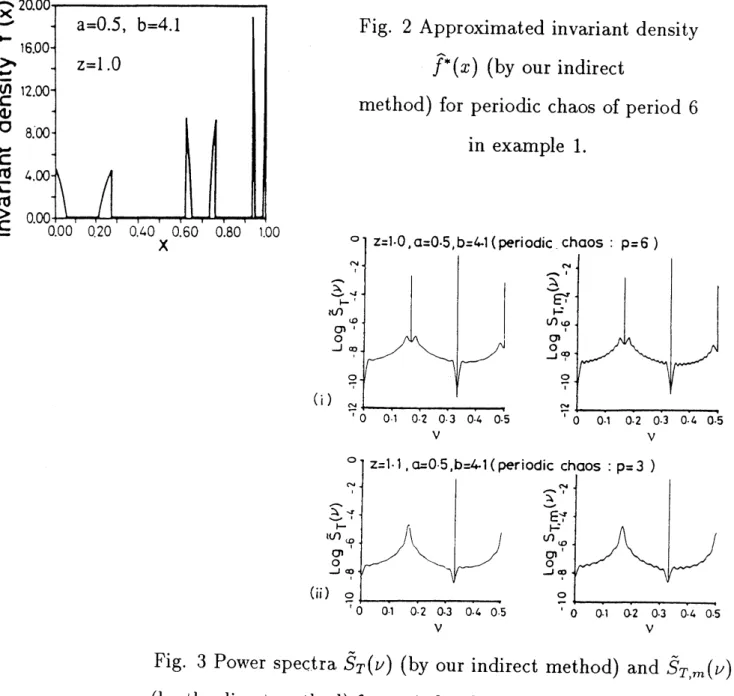
Fig-ures 2 and 3 show $f^{*}(x)$ and the power spectrum $\tilde{S}_{T}(\nu)$ for periodic
chaos of period 6 which are calculated by our $method^{[8],[9]}$. In this
that edges of the support of $f^{*}(x)$ will coincide with the partition
points. In the calculation of $\tilde{S}_{T}(\nu)$, thefinite discrete Fourier
trans-form of $\{\rho(k)\}_{k=0}^{T-1}(T=1,024\cross 6)$ is used instead of using Eq.(12).
On the other hand, $S_{T,m}(\nu)$ is obtained by averaging $m=200$
dis-crete Fourier transforms of trajectories of length $T$. The spectrum
$\tilde{S}_{T}(\nu)$ is in good agreement with $S_{T,m}(\nu)$ except for fluctuations in
the latter.
Fig. 2 Approximated invariant density
$\hat{f}^{*}(x)$ (by our indirect
method) for periodic chaos of period 6
in example 1.
Fig. 3 Power spectra $\tilde{S}_{T}(\nu)$ (by our indirect
method) and $\tilde{S}_{T,m}(u)$
Example 2 Let
$\tau(x)=\{\begin{array}{l}x+ux^{z}(x-x_{p})/(1-x_{p})\end{array}$ $0\leq_{p^{X}}\leq_{X^{X_{p}}}x<\leq 1$
where $\tau(x_{p})=1,$
$u>0,1<z<2$
.
This map generatesinter-mittent chaos with the power spectrum $1/f^{\delta}$. Figure 4 shows the
power spectrum $S(\nu)$ by our $method^{[10]}$ (the smooth solid line) and
$S_{T,m}(\nu)$ with $T=2^{15}$ and $m=100$ by the direct method (the
fluc-tuated line), each of which is in good agreement each other in wide
frequency range. In applying our method, we used $s(x)=x^{-(z-1)}$
because $\tau$ has the unbounded invariant density with a $(z-1)$-th
order pole at $x=0$. In this figure, the broken line shows the
Pro-caccia and Schuster’s estimate [11] of the spectrum when $\nu$ goes to
$0$ which does not coincide well with the former two.
屋
$\underline{\infty OO}0$
log(f)
Fig. 4 Comparison of power spectra calculated by using three
References
[1] S.Ulam, Problems in modern mathematics, Intersience Pub.
(1960).
[2] T.Y.Li, J.Approx. Theo., 17, pp.177-186(1976).
[3] S.Grossmann and S.Thomae, Z. Naturforsch., 32a, $1353- 1363$
(1977).
[4] S.J.Chang and J.Wright, Phys.Rev.A, 23, $1419- 1433$ (1981).
[5] Y.Oono and Y.Takahashi, Progr.Theo.Phys., 63-5, 1804-1807
(1980).
[6] Y.Takahashi and Y.Oono, Progr.Theo.Phys., 71-4, 851-854
(1980).
[7] T.Kohda and K.Murao, Trans. IEICE, J65-A-6, 505-512
(1982).
[8] K.Murao and T.Kohda, Trans. IEICE, J67-A-5, 511-518
(1984).
[9] K.Murao and T.Kohda, Trans. IEICE, J68-A-7, 405-406
(1985).
[10] T.Kohda and K.Murao, Trans. IEICE, E73-6, 793-800 (1990).
[11] I.Procaccia and H.Schuster, Phys.Rev., A, $28- 2,1210- 1212$