145
Indexing
Functions
and Time Lower Bounds
for Sorting
on a
Mesh-Connected Computer
Yijie
Han\dagger ,
Yoshihide
Igartashi\dagger ,\ddagger ,
韓以捷, 五十嵐善英
Miroslaw
Truszczynski\dagger
\dagger Department of Computer Science, University of Kentucky,
Lexington, Kentucky 40506, U.S.A.
\ddagger Department of Computer Science, Gunma University,
Kiryu, 376 JAPAN
Weintroduceaparameter of indexing functions and show its relation to lower bounds for
sorting algorithms on mesh-connected computers that follow from the
Chain
Theorem.We give lower and upper bounds for the parameter. Conclusions from our results
are: (1) no matter what indexing function is used, any sorting algorithm must execute
$2.27n+O(1)$ steps; (2) the best lower bound true for all indexing functions that we can
hope to prove by the Chain Theorem argument is $2.5n+O(1)$.
1
Introduction
In this paper we study a combinatorial problem that arises in considerations of
sorting problems on a mesh-connected computer. As usual in such cases, it is of main
concern to design fast algorithms and to prove lower bounds for the complexity of the
problem to get an idea how good designed algorithms are.
Sorting ona mesh-connected computer has received much attention lately ([HII,HI2,
Kl,$K2,MSS$, SS]). It turns out that the efficiency of asorting algorithm depends on the
indexing function used (see [HI1]). For a snake-like row-major indexing scheme an
algorithm running in $3n+o(n)$ steps is known (Schnorr and Shamir [SS]), and it is
also known to be optimal (Kunde [K1], Schnorr and Shamir [SS]). So far, no sorting
algorithm is known that would run in $(3-\epsilon)rt+o(n)$ steps, for some $\epsilon>0$. Also, the
snake-like row-major is the only (up to trivial variations) indexing schemes for which
fastest algorithms are known to be optimal.
数理解析研究所講究録 第 695 巻 1989 年 145-154
146
The element whose final location is in the processors in a corner of the mesh may
be ini ially stored in the processorin the opposite corner, and it takes at least $2n$ steps
merely tomove it to its proper final destination. This “structure based” lower bound is
too weak. Only recently, a more powerful lower bound technique, known as joker-zone
method, was discovered by Kunde [K1] and Schnorr and Shamir[SS]. Theirmethod was
subsequently refined by Han and Igarashi [H1]. They developed an argument based on
the so called Chain Theorem, and proved that $(1+\sqrt{6}/2)n+\Theta(1)$ is alower bound for
the running time ofany sorting algorithm, no matter what indexing function is used.
The main goal of this paper is to study the power of the Chain Theorem of [HI1]
in proving lower bounds for sorting algorithms. To this end, for an indexing function
$I$ we define a combinatorial parameter called stretch $s(I)$, and show that lower bounds
implied by the Chain Theorem directly depend on this parameter. Our first main result
provides a lower bound for $s(I)$; this allows to prove that independent of an indexing
function, every sorting algorithm requires at least 2.$27n$ steps, an improvement over
the old bound of $(1+\sqrt{6}/2)n+\Theta(1)$ of [HI1]. Our second result exhibits an indexing
function$I$ with $s(I)=0.5n+\Theta(1)$.
2
Preliminaries and
problem
formulation
We consider a general model of a synchronous $n\cross n$ mesh-connected processor
array as given in [SS]. It is denoted by $M$[$0..m$,O..m]; here, and throughout the paper
$m=n-1$
. Each $pr_{-}ocessor$ at location $(i,j),$$0\leq i,$$j\leq m$, is denoted by $M_{-}[i,j]$. Thedistance between $M[i_{1}, i_{2}]$ and $M[j_{1},j_{2}]$ is defined as $|i_{1}-j_{1}|+|i_{2}-j_{2}|$ and denoted
by$d((i_{1}, i_{2}),$ $(j_{1}, j_{2}))$
.
Processor $M[i_{1}, i_{2}]$ is directly connected with processor$M[j_{1},j_{2}]$ ifand only if$d((i_{1}, i_{2}),$ $(j_{1},j_{2}))=1$. All $n^{2}$ processors work in parallel with a single clock,
but they may run different programs. As for sorting computation, the initial contents
of $M$[$0..m$,O..m] are assumed to be $n^{2}$ items drawn from a totally ordered set, where
each processor has exactly one item. The final contents of $M$[$0..m$,O..m] is the sorted
sequence of the items in a specific order. In one step each processor can communicate
147
of directly connected processors or the replacement of the item in a $pro$cessor with the
item inoneofits directly connected processors can bedone in one step. Thecomputing
timeis defined as thenumber of parallel steps of suchbasic operations toreach the final
configuration.
A one-to-onefunction $I$: $\{0,1, \ldots, m\}^{2}arrow\{1,2, \ldots, n^{2}\}$ is called an indexing
function.
Given an indexing function $I$, the goal is to sort $n^{2}$ items initially stored in the $n^{2}$
processors sothat when the algorithm terminates, the item of rank $k$ (the k-th smallest)
is located in processor $M[i, j]$, where $I(i,j)=k$.
A subset of$M$[O..m, 0.$.m$] is called a region. For a region $S$ the numberof processors
in$S$will be called the cardinality of$S$andwill be denoted $|S|$
.
A set $\{(i_{11}, i_{12}), \ldots, (i_{c1}, i_{c2})\}$is calleda chain under indexing
function
$I$(or a chainif$I$is understood) if$\{I(i_{11}, i_{12}),$$\ldots$,$I(i_{c1}, i_{c2})\}$ is a set of consecutive integers. The length of such a chain is $c$. If $(i_{1}, i_{2})$
is in $\{0, m\}^{2}$ and $x$ is a positive real number, $\{M[j_{1},j_{2}] : d((i_{1}, i_{2}), (j_{1},j_{2}))\leq x\}$ is
called a corner region and is denoted by CREG$((i_{1}, i_{2});x)$. An open corner region is
the set $\{M[j_{1},j_{2}] : d((i_{1}, i_{2}), (j_{1},j_{2}))<x\}$, and it is denoted by $CREG_{o}((i_{1}, i_{2});x)$.
The set of all processors that are at distance at least $m-x$ from all four $pro$cessors
$M[0,0],$$M[0, m],$ $M[m, 0]$, and $M[m, m]$ is called a center region and is denoted by CENT$(x)$. Throughout the paper, for any two real numbers $a$ and $b,$ $[a, b]$ denotes the
set of all integers $j$, such that $a\leq j\leq b$.
Consider now an indexing function $I$ and a corner region $R=CREG_{O}((i,j);x)$,
for some real $x,$ $0\leq x\leq 2m$. Let $c$ be the length of a longest chain contained in $R$,
and let $t(R)$ be the smallest real number $t$ such that $c\leq|CREG((i, j);t)|$
.
Finally,put
$s(R)=x-t(R)$
. The stretch $s(I)$ of $I$ is defined as $s(I)= \sup s(R)$, where thesupremum is taken over all corner regions $R$. The next theorem has been derived in
[HI1] and is called the Chain Theorem.
Theorem 2.1 (Chain Theorem [HI1]) Let I be an indexing
function.
Then, everyal-gorithm
for
sorting $n^{2}$ items into the order specified by I takes at least $2n+s(I)+\Theta(1)$steps.
148
over all possible indexing functions on an $n\cross n$ mesh of processors. We show that
0.$27n\leq s_{n}$(hence, every sorting algorithm must require at least 2.$27n$ steps), and that $s_{n}\leq 0.5n$ (hence, the best universal lower bound that can be obtained using the Chain
Theorem only is 2.$5n$).
3
Lower
bounds
In this section we will show two theorems each giving a lower bound for $s_{n}$. The
first one gives the lower bound initially presented in [HI1]. We present here a different
proof of that result which is simpler than the original one and helps better understand
the approach behind the proof of the improved lower bound for $s_{n}$ (Theorem 3.3).
Lemma 3.1 Let $a$ be a real number, $0\leq a\leq 1/2$
.
(a) $I^{-1}([an^{2}, (1-a)n^{2}])\subseteq CENT((1-\sqrt{2a})n+s(I)+\Theta(1))$.
(b) Let $x_{a}= \inf\{x:|CENT(x)|\geq|[an^{2}, (1-a)n^{2}]|\}.We$have
$x_{a}=\{n(1-\sqrt{a})+\Theta(1)n\sqrt{1/2-a}+\Theta(1)$ $ifif0\leq a\leq 1/41/4<a\leq 1/2$
Proof. (a) Let $b$ be an integer, $b\in[an^{2}, (1-a)n^{2}]$. Suppose $I^{-1}(b)$
er
CENT$((1-$$\sqrt{2a})n+s(I)+1)$. Then, forsome$(i, j)\in\{0, m\}^{2},$$I^{-1}(b)\in CREG_{0}((i,j);n\sqrt{2a}-s(I)-2)$.
Let $d((i,j),$$I^{-1}(b))=x$ and let $R=CREG((i,j),$$2m-x$). Clearly, $x<n\sqrt{2a}-s(I)-2$,
and the longest chain contained in $R$ has length at most $(1 -a)n^{2}$. Hence, $t(R)\leq$
$2n-n\sqrt{2a}$. Consequently,
$s(R)=2m-x-t(R)>s(I)$
, a contradiction.(b) Follows directly from the following formula for the number of elements in a center
reglon.
$|CENT(x)|\leq\{\begin{array}{l}2x^{2}+\Theta(x)if0\leq x\leq m/2n^{2}-2(m-x)^{2}+O-(m-x)ifm/2<x\leq m\square \end{array}$
Theorem 3.1 (Han and Igarashi, [HI1]) $s_{n}\geq(\sqrt{6}/2-1)n+\Theta(1)$
.
149
Lemma 3.1 we have
$x_{a}\leq n+s(I)-\sqrt{2a}n+\Theta(1)$
(this follows from Lemma 3.1 $(a)$). Hence (by Lemma 3.1 $(b)$),
Maximizing the right hand side with respect to $a$ we get $s(I)\geq(\sqrt{6}/2-1)n+\Theta(1)$, as
claimed. $\square$
Next, we present an improvement on this result. We first prove an auxiliary lemma.
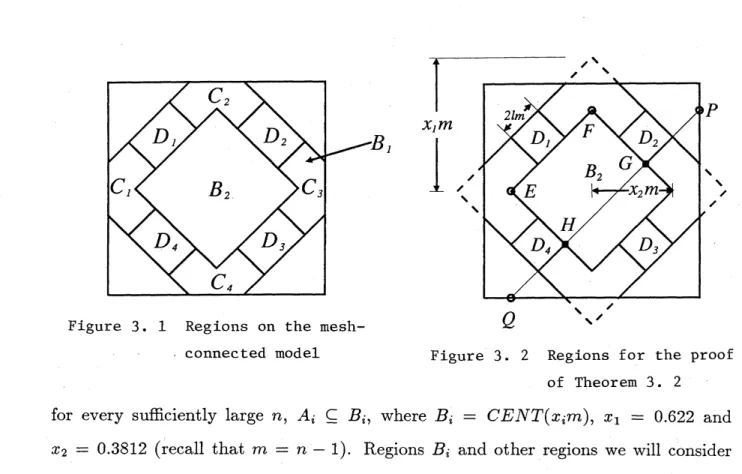
Lemma 3.2 Consider two center regions $B_{1}$ and$B_{2}$ and regions $C_{i}$ and $D_{i},$ $i=1,2,3,4$
as shown in Fig. 3.1.
Define
$H_{i}=C_{i}\cup D_{i}\cup C_{i+1},$ $i=1,2,3_{f}$ and $H_{4}=C_{1}\cup D_{4}\cup C_{4}$.Put $B=B_{1}-B_{2},$ $b=|B|$, and $d=|D_{1}|$ (regions $D_{i}$ have all the same size). Assume
that more than $b/2+2d$ elements
of
$B$ are colored with blue and green and suppose thatthere is at least one element
of
each color. Then at leastone
of
the regions $H_{i}$ containselements
of
both colors.Proof. Without loss of generality we may assume that there are no less blue elements
than green elements.
Case 1. There exists a green element in $\bigcup_{i=1}^{4}C_{i}$. Without loss of generality we may
assume that there is a green element in $C_{1}$. Since more than $b/4+d$ elements are
colored blue, there exists a blue element not in $C_{3}\cup D_{2}\cup D_{3}$, and the assertion of the
lemma holds.
Case 2. All green elements are in $\bigcup_{i=1}^{4}D_{i}$. Without loss of generality we may assume
that there is a green point in $D_{1}$. Since more than $b/2+2d$ elements in $B$ are colored
and no green element is in $C_{1}\cup C_{2}$, there is at least one blue element in $C_{1}\cup C_{2}$. Thus,
the assertion of the lemma holds in this case, too. $\square$
Theorem 3.2 $s_{n}\geq 0.27n+\Theta(1)$.
Proof. Let $I$ be an arbitary indexing function. Suppose that $s(I)<0.27n$. Consider
15
$U$Figure 3. 1 Regions on the
mesh-connected model Figure 3. 2 Regions for the proof
of Theorem 3. 2
for every sufficiently large $n,$ $A_{i}\subseteq B_{i}$, where $B_{i}=CENT(x_{i}m),$ $x_{1}=0.622$ and
$x_{2}=0.3812$ (recall that
$m=n-1$
). Regions $B_{i}$ and other regions we will considerin the proof are shown in Fig. 3.2. Let $B=B_{1}-B_{2}$ and $l=0.1123024$. Color all
elements in $I^{-1}([0.21n^{2},0.395n^{2}])$ in blue and all elements in $I^{-1}([0.605n^{2}\}0.79n^{2}])$ in
green. Altogether, there are 0.$37n^{2}+\Theta(1)$ colored elements. These colored elements
must be located in$B_{1}$
.
At most $|B_{2}|-(0.21n^{2})+\Theta(1)$ of them can be located in $B_{2}$, as$A_{2}\subseteq B_{2}$ and $|A_{2}|=0.21n^{2}+\Theta(1)$. Since $|B_{2}|=2(x_{2}m)^{2}+\Theta(m)=2(x_{2}m,)^{2}+\Theta(m)$,
at least 0.$2893m^{2}+\Theta(m)$ of the colored elements are located in $B$. In particular, it
follows that $B$ contains both blue and green points. Observe that $|B|=2(x_{1}m)^{2}-$
$2(x_{2}m)^{2}-4(x_{1}m-m/2)^{2}+\Theta(m)$. Denote by $d$ the common cardinality of regions $D_{i}$
and observe that $d=\sqrt{2}l(x_{1}-x_{2})m^{2}+\Theta(m)$. Hence, the number of $colo_{-}red$ elements
in $B$ is bigger (for sufficiently large n) than $|B|/2+2d$. Thus, by Lemma 3.3, there are
both blue and green points in one of the regions $H_{i}$ (see notation of Lemma 3.3), say
in $H_{3}$. Consider now set $A_{2}=I^{-1}([0.395n^{2},0.605n^{2}])$. It has 0.$21n^{2}+\Theta(1)$ elements.
All of them belong to $B_{2}$. Notice, that the cardinality of the region EFGH is given
by $(x_{2}m)^{2}+\sqrt{2}lx_{2}m^{2}+\Theta(m)$ and thus it contains at most 0.$206m^{2}+\Theta(m)$ elements.
Therefore, for every sufficiently large $n$, there is an element in $A_{2}$ that belongs to
$B_{2}$-EFGH. Let $R$ be the corner region determined by the line $PQ$ and containing
$H_{1}$. It follows that the longest chain in $R$ has length at most 0.$395n^{2}+\Theta(1)$. Thus,
151
$\square$
$s(R)\geq 0.27n+\Theta(1)$, as required.
We conclude this section witha theorem being a corollary of Theorems 2.1 and
3.2.
Theorem
3.3 Nomatter
what indexingfunction
is used, any algorithmfor
sorting $n^{2}$items on a
mesh-connected
computer takes at least $2.27n+\Theta(1)$ steps.4
Limit
of
the
chain
argument
In this section we study the power of the chain argument. It turns out that the best
lower bound we can hope to obtain using this type of an argument is $2.5n+\Theta(1)$. To
justify this claim we will construct an indexing function $I$ with $s(I)\leq 0.5n+\Theta(1)$.
We denote $CREG_{0}((i,j),$ $\lceil m/2\rceil$), for $i,j\in\{0,m\}^{2}$ by $A_{i,j}$ and CENT$(\lceil m/2\rceil)$ by
$C$. Let $a=|A_{i,j}|$ (it does not depend on $i$ and j) and $c=|C|$
.
Let us assume now thatan indexing function $I$ satisfies the following requirements:
(1) Processors in $A_{0,0}$ (resp. $A_{0,m}$) will be assigned odd (resp. even) integers from
$\{1, \ldots, 2a\}$, processors in $C$ will be assigned elementsfrom $\{2a+1,2a+2,$
$\ldots,$
$n^{2}-$
$2a\}$, and processors in$A_{m,0}$(resp. $A_{m,m}$) will beassigned odd (resp. even) integers
from $\{n^{2}-2a+1,n^{2}-2a+2, \ldots, n^{2}\}$.
(2) For every $x=M[i_{1},j_{1}]$ and $y=M[i_{2}, j_{2}]$,
(a) If$x$ and $\dot{y}$ are both in$A_{0,0}$ or in $A_{m,m}$ and $i_{1}-j_{1}<^{\{}i_{2}-j_{2}$, then $I(x)>I(y)$.
(b) If$x$ and $y$ are both in $A_{0,m}$ or in$A_{m,0}$ and$i_{1}+j_{1}<i_{2}+j_{2}$, then $I(x)>I(y)$.
(c) If$x$ and $y$ are both in $C$ and $i_{1}<i_{2}$, then $I(x)<I(y)$.
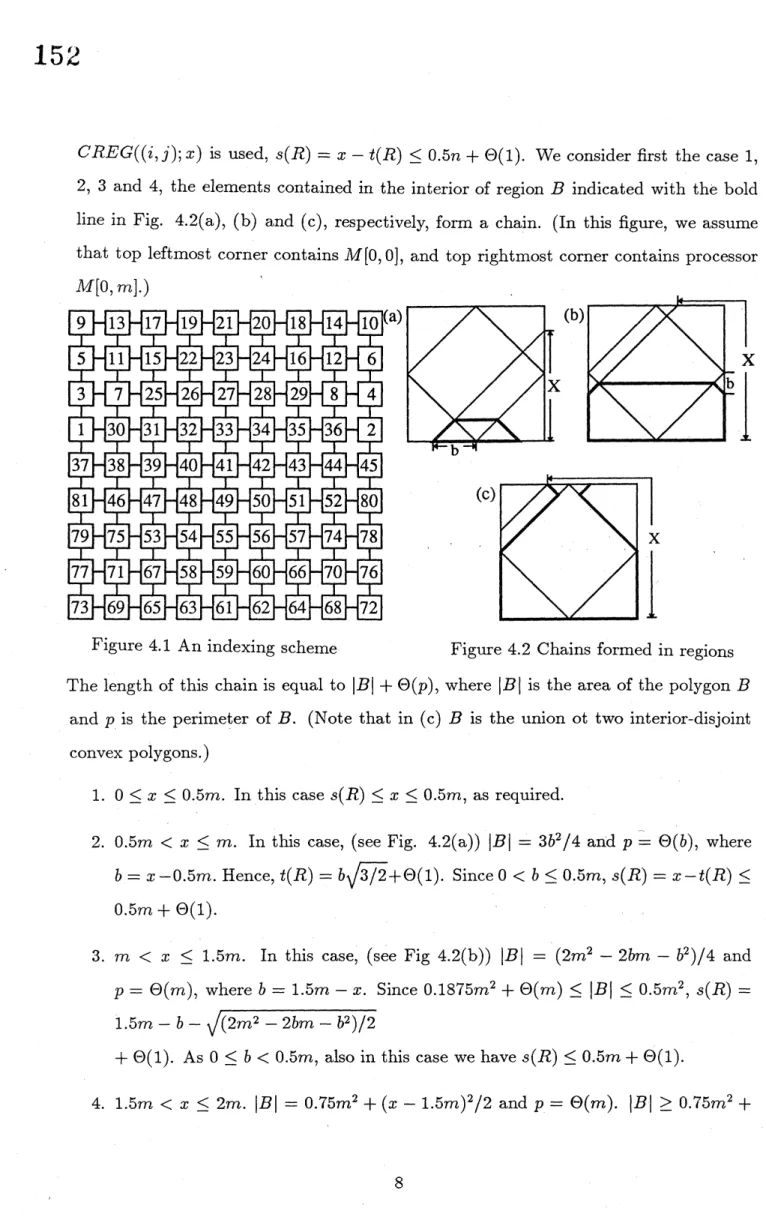
An expample of an indexing function satisfying requirements (1) and (2) (for $n=9$)
is given in Fig. 4.1. It is clear that indexing functions satisfying (1) and (2) exist for
every positive $n$.
Theorem 4.1
If
an indexingfunction satisfies
requirements (1) and (2) then $s(I)=$$0.5n+\Theta(1)$. Hence, $s_{n}\leq 0.5n+\Theta(1)$.
15S2
CREG$((i,j);x)$ is used, $s(R)=x-t(R)\leq 0.5n+\Theta(1)$. We consider first the case 1,
2, 3 and 4, the elements contained in the interior of region $B$ indicated with the bold
line in Fig. 4.2(a), (b) and (c), respectively, form a chain. (In this figure, we assume
that top leftmost corner contains $M[0,0]$, and top rightmost corner contains processor
Figure 4.1 An indexing scheme Figure 4.2 Chains formed in regions
The length of this chain is equal to $|B|+\Theta(p)$, where $|B|$ is the area of the polygon $B$
and $p$ is the perimeter of B. (Note that in (c) $B$ is the union ot two interior-disjoint
convex polygons.)
1. $0\leq x\leq 0.5m$. In this case $s(R)\leq x\leq 0.5m$, as required.
2. 0.$5m<x\leq m$. In this case, (see Fig. $4.2(a)$) $|B|=3b^{2}/4$ and $p^{-}=\Theta(b)$, where
$b=x-0.5m$. Hence, $t(R)=b\sqrt{3/2}+\Theta(1)$
.
Since$0<b\leq 0.5m,$$s(R)=x-t(R)\leq$$0.5m+\Theta(1)$.
3. $m<x\leq 1.5m$. In this case, (see Fig $4.2(b)$) $|B|=(2m^{2}-2bm-b^{2})/4$ and
$p=\Theta(m)$, where $b=1.5m-x$ . Since 0.$1875m^{2}+\Theta(m)\leq|B|\leq 0.5m^{2},$ $s(R)=$
$+\Theta(1)$
.
As $0\leq b<0.5m$, also in this case we have $s(R)\leq 0.5m+\Theta(1)$.153
$s(R)\leq 0.5m+\Theta(1)$ follows.
In the other three cases for the corner we consider identical subcases and get the
same
formulas for $t(R)$ and $s(R)$ as in the correspondingsubcasefor the corner $(m, m)$.
This
completes the proof. $\square$
5
Concluding remarks
We showed that $0.27n+\Theta(1)\leq s_{n}\leq 0.5n+\Theta(1)$. Improving the lower bound on
$s_{n}$ would give a better lower bound for sorting on a mesh-connected computer. The
upper bound on $s_{n}$, which we proved by exhibiting a class ofindexing functions $I$ with
$s(I)=0.5n+\Theta(1)$ shows the limit of the Chain Theorem in proving lower bounds.
Although the Chain Theorem is strong enough to prove optimality (up to the leading
term) of the $3n+o(n)$ algorithm of Schnorr and Schamir [SS], it seems unlikely that an
indexing function
exists
that would admit a sorting algorithmrunning in $(3-\epsilon)+o(n)$steps. So, in general, stronger lower bound techniques are needed.
Recently Kunde also showed a lower bound of 0.$25n$ on $s_{n}$ [K3]. However, our lower
bound of 0.$27n$ on $s_{n}$ is still the best one known. Using a more complicated indexing
scheme we can showan upper bound of 0.$46n$ on $s_{n}$ [HIT2].
References
[HI1]. Y. Han and Y. Igarashi, Time lower bounds for sorting on a mesh-connected
$N_{0}tesinComputerScienceP^{rocessorarray,inProceedin}\S_{o1}^{SO}s\varphi_{nger- v_{e}rightarrow \text{宕甘萄}}^{Worksh}$’ 1988, Lecture
[HI2]. Y. Han and Y. Igarashi, Time lower bounds for parallel sorting on
multidimen-sional mesh-connected processor arrays, in Proceedings of International
Confer-ence on Parallel Processing, 1988, pp.194-197.
[HITI]. Y. Han, Y. Igarashi, M. Truszczynski, Indexing functions and time lower bounds
on a mesh-connected computer, Technical Report No.114-88, Dept, of Computer
Science, University of Kentucky, May 1988.
[HIT2]. Y. Han, Y, Igarashi, M. Truszczynski, Technical Memo, Dept. of Computer
Science, University of Kentucky, 1988.
[K1]. M. Kunde, Lower bounds for sorting on mesh-connected architectures, Acta
154
[K2]. M. Kunde, Optimal sorting on multi-dimensionally mesh-connected computers,
4th Symp. on Theoretical Aspects of Computer Science, LNCS 247 Springer,
1987, pp.408-419.
[K3]. M. Kunde, Bounds for l-selection and related problems on grids of processors,
Technical Report, Institute f\"urInformatik. TechnisheUniversit\"at, 1988
(Proceed-ings of Paralell 88, Berlin, EDR 1988)
[MSS]. Y. Ma, S. Sen and I.D. Scherson, The distance bound for sorting on
mesh-connected processor arrays is tight, 27th Symp. on Foundations of Comput. Sci.,