Metamorphism of eclogites and associated
metamorphic rocks in the Chandman district, Lake
Zone, SW Mongolia
A dissertation submitted to the Department of Geoscience in partial fulfillment of the
requirement for the Degree of Doctor of Science (D.Sc) at the Interdisciplinary Graduate School of Science and Engineering, Shimane University, Japan
Javkhlan Otgonkhuu
July, 2014
i
Abstract
Chandman district is located in the southeast part of Lake Zone, SW Mongolia, which is situated in the Central Asian Orogenic Belt. Chandman district consists of four major geologic units, i.e. Neoproterozoic ophiolites of Khantaishir Formation, eclogite-bearing orthogneisses of the Alag Khadny metamorphic complex, marbles of the Maykhan Tsakhir Formation, which lie in contact with eclogite bodies, and the basement block of the Zamtyn Nuruu Formation.
Eclogites in the Chandman district have two modes of occurrences, i.e. lenses and boudins of eclogites surrounded by orthogneisses of the Alag Khadny metamorphic complex (eclogite-1) and eclogites in marbles of the Maykhan Tsakhir Formation (eclogite-2). The marbles contain small lenses of garnet-chloritoid schists, which occur close to a body of eclogite-2. Eclogite-1 is intruded by veins of orthogneisses.
Eclogite-1 consists mainly of porphyroblastic garnet (<2 mm), clinopyroxene (omphacite, aegirine-augite), sodic, sodic-calcic, and calcic amphiboles (glaucophane, taramite, barroisite, winchite, pargasite, tschermakite, Fe/Mg-hornblende, and actinolite) with minor amounts of epidote, phengite, paragonite, plagioclase, biotite, K-feldspar, rutile, titanite, quartz, calcite, hematite, ilmentite and zircon. Eclogite-2 consists mainly of garnet (<0.3 mm), omphacite, and minor amounts of sodic-calcic calcic amphiboles (barroisite, Mg-taramite, tschermakite, pargasite, Mg-hornblende and actinolite), epidote, paragonite, plagioclase, chlorite, calcite, biotite, quartz, titanite and rutile.
Both eclogites (eclogite-1 and -2) experienced four metamorphic events i.e. precursor metamorphism (M1) of high-temperature amphibolite facies; high-pressure metamorphism (M2)
of the eclogite facies; and medium-pressure metamorphism (M3) of the epidote-amphibolite facies. Some of eclogite-1 does not preserve the evidence of M3 metamorphism.
M1 event indicate an early and relatively high-temperature metamorphism before the eclogitic metamorphism. Porphyroblastic garnets of eclogite-1 show a prograde zoning. The core of the garnets contains polyphase and discrete grain inclusions of high TiO2 (up to 1.32%) taramite, Fe-pargasite, tschermakite, aegirine-augite (Jd=13) + taramite + quartz, plagioclase (An<19) + biotite + epidote. Those inclusions indicate relatively high-temperature metamorphism of amphibolites facies conditions (M1).
M2 event with prograde and peak stages of metamorphism represents relatively high pressure and low temperature metamorphism of the blueschist to eclogite facies, causing continuous subduction resulted in cooling of the hangingwal after the initial early M1 event. The prograde and peak stages of the high-pressure metamorphic event (M2) is characterized by cores of glaucophane in barroisites and coexisting assemblage of rim of garnets, omphacite (Jd<46%), phengite (6.51-7.11), barroisite, rutile and quartz, respectively. THERMOCALC (v.3.33) calculations for the peak stage of eclogite yielded P-T conditions of 565 ± 69ºC and 22.5 ± 2.6 kbar. The retrograde stage of M2 is characterized by symplectite of sodic plagioclase (An=1-18) + amphibole ± Na-poor clinopyroxene (Jd=2-25). These mineral assemblages give 450-560°C and 4-11 kbar.
M3 event is represents medium pressure metamorphism. The M3 metamorphism is characterized by prograde zoned amphiboles with winchite, actinolite, tremolite core and barroisite rim. Large prograde zoned poikiloblastic barroisitic amphibole also developed in the eclogite-2. They contain inclusions of garnet, omphacite and symplectite of amphibole +
iii
metamorphism. The cores of the amphiboles indicate 300-400°C and 3-8 kbar, whereas the rims indicate >400-600ºC and 3-12 kbar.
Garnet-chloritoid schists consist mainly of garnet, chloritoid, phengite, chlorite and quartz, with minor amounts of kyanite, rutile, and zircon. Prograde zoned garnet and associated minerals suggest that garnet-chloritoid schists experienced pre-peak (500-510°C and 7-8 kbar) and peak stages (560-590°C and 10-11 kbar) of medium-pressure metamorphism, corresponding with M3 metamorphism of eclogites (-1 and -2).
The fourth metamorphic event (M4) defined in the amphibolized eclogites-1 can be corresponding with metamorphism of the vein-type orthogneisses which suffered two metamorphic events, i.e., first (M1) greenschist facies metamorphism (~380°C and 3 kbar), second (M2) amphibolite facies metamorphism (~500°C and 4 kbar). The P-T conditions of peak stages of M1 and M2 for vein-type orthogneiss correspond to geothermal gradients of ~35 °C/km and ~30 °C/km, respectively. The peak temperature conditions of M2 event (~ 500 °C) for the vein-type orthogneiss are lower than peak temperature of M4 metamorphic event of intruded amphibolized eclogites-1 (550-640 °C) whereas the pressure conditions of vein-type orthogneiss (4 kbar) correspond with peak pressure of M4 for amphibolized eclogites-1 (2-5 kbar). This feature suggests that geothermal gradient of M4 metamorphic event of amphibolized eclogites-1 same as vein-type orthogneiss.
Trace elements of Ba, Ce, Nb, Sc, Sr, Y and Zr contents of eclogites are comparable with MORB compositions. Major and trace element compositions of eclogites are comparable with ophiolitic metabasalts of Khantaishir Formation. Khantaishir metabasalts are plotted in the field of calc-alkaline series by AFM diagram.
We obtained K-Ar ages of c. 500-480 Ma from the vein-type orthogneiss intruded into eclogite-1 as well as c. 500-460 Ma from the orthogneisses surrounding eclogite bodies. These ages indicate that an exhumation ages of eclogite-1 and vein-type orthogneisses.
Based on the textural and geochronoligical evidence, after the exhumation of eclogite blocks which were decoupled from subducted oceanic slab, eclogites were suffered by the medium-pressure prograde collisional metamorphism (M3) together with garnet-chloritoid schists. Metamorphosed orthogneisses intruding into and surrounding eclogite-1 suggest the M4 event of low-pressure metamorphism took place during the collision, and subsequent exhumation at c. 500-460 Ma.
The P-T-t evolution of the Chandman metamorphic rocks reconstructs the entire tectonic sequence from initiation of subduction (M1 and M2) to collision events (M3 and M4).
CONTENTS
AbstractCHAPTER 1 INTRODUCTION
1.1 Geological framework of Mongolia 1.2 Previous work
1.3 Aim of study and significance of study
CHAPTER 2 GEOLOGICAL SETTINGS 2.1 General geology of Lake Zone 2.2 Geology of Chandman district
2.3 Field relations of eclogites and associated rocks of Chandman district
2.4 Field sampling
CHAPTER 3 PETROGRAPHY 3.1 Eclogites
3.1.1 Eclogite-1 within orthogneisses 3.1.2 Eclogite-2 within marbles 3.2 Amphibolite within marbles
3.3 Garnet-phengite schists intercalating with eclogites-1 3.4 Garnet-chloritoid schists within marble
3.5 Pelitic schist intercalating with orthogneisses 3.6 Orthogneisses
3.6.1 Vein-type orthogneiss
3.6.2 Orthongeisses surrounding eclogite bodies 3.7 Khantaishir ophiolite
CHAPTER 4 MINERAL CHEMISTRY 4.1 Analytical procedures 4.2 Garnets 4.3 Clinopyroxenes 1-5 6-13 14-70 71-87
4.4 Amphiboles 4.5 White micas 4.6 Epidotes 4.7 Other minerals
CHAPTER 5 MINERAL PARAGENESIS AND PRESSURE-TEMPERATURE PATH OF METAMORPHIC ROCKS
5.1 Eclogites
5.1.1 Eclogite-1 within orthogneisses 5.1.2 Eclogite-2 within marbles 5.2 Garnet-chloritoid schists within marble 5.3 Vein-type orthogneiss CHAPTER 6 GEOCHRONOLOGY 6.1K-Ar 6.2 Sm-Nd CHAPTER 7 GEOCHEMISTRY CHAPTER 8 DISCUSSIONS
8.1 Tectonic settings of associated basement block and ophiolite units in the Chandman district
8.2 Protoliths of eclogites and associated metamorphic rocks 8.3 Comparison of pressure-temperature-time paths of the eclogites and associated metamorphic rocks
8.4 Tectonic implications CHAPTER 9 CONCLUSIONS REFERENCES 88-103 104-113 114-122 123-132 133-136 136-142
CHAPTER 1 INTRODUCTION
1.1 Geological framework of Mongolia
Mongolia is composed of a number of tectonic zones situated within the Central Asian Orogenic Belt (CAOB: Mossakovsky et al., 1994; Jahn et al., 2000, 2004) or the Altaids (Şengör et al., 1993; Şengör and Natal’in, 1996). The CAOB developed among the Siberian craton in the north, the Tarim craton in the south-west, and the North China craton in the south (Fig. 1.1a; Jahn et al., 2000). Tectonic evolution of the CAOB suggests that it probably represents a long-lived accretionary complex related to subduction of the North China oceanic plate beneath the Siberian craton, closure of the Palaeo-Asian ocean between the continents, and final collision of the Tarim and North China cratons during the Permian (Ao et al., 2010; Xiao et al., 2010, and references therein; Glorie et al., 2011; Rojas-Agramonte et al., 2011). Several tectonic models have been proposed for formation of the CAOB. These include presence of a long-lived single subduction system (Şengör and Natal’in, 1996), operation of several subduction systems with different polarities and collision of various microcontinents (Coleman, 1989; Mossakovsky et al., 1994; Xiao et al., 1994); involvement of a ridge-subduction system (Kovalenko et al., 1995; Windley et al., 2007), and occurrence of huge chains of double arc-backarc pairs (Yakubchuk, 2004). However, the detailed tectonic interpretation remains controversial.
Mongolia is traditionally subdivided into northern and southern domains. These domains are separated by a major fault, the Main Mongolian lineament (MML). The MML is a regional structural boundary separating mainly Precambrian and Lower Palaeozoic rocks in the north from Middle to Upper Palaeozoic rocks in the south (Badarch et al., 2002) (Figs. 1.1b and 1.2).
The western part of the northern domain contains a roughly 1,000 km long island arc terrane known as the Lake Zone. The arc is composed of several pre-Cambrian ophiolites, such as the Khantaishir ophiolites associated with the Dzabkhan-Baydrag basement block (Badarch et al., 2002) (Fig. 1.1b). Chandman district in the Lake Zone contains mainly of eclogite-bearing orthogneisses of the Alag Khadny metamorphic complex interleaving metacarbonate rocks with lenses of eclogite and garnet-chloritoid schist of the Maykhan Tsakhir Formation. Whole sequences associated with ophiolites of Khantaishir Formation in the north and basement block of Zamtyn Nuruu Formation in the south.
Fig. 1.1 (a) simplified tectonic map of the Central Asian Orogenic belt and adjacent cratons (modified after Jahn et al., 2000). (b) Simplified tectonic sketch map of the Lake Zone
1.2 Previous work
The general geology and tectonics of th
during regional geological mapping, studies of magmatism, metamorphism and
geochronology.
Geological mapping works at 1:200,000 and 1:50,000 scales was completed (Rauzer et al., 1987 and Hanžl and Aichler, 2007, respecti
district. The geological maps revealed new systematic regional and stratigraphic classification of all geological formations occurring in the study area.
Hanžl and Aichler (2007) first time distinguished newly defined eclogites
bearing Alag Khadny metamorphic complex, Zamtyn Nuruu Formation and Maykhan Tsakhir Formation from the Khantaishir Formation.
Fig. 1.2 Terrane map of Mongolia (Badarch et al., 2002)
The general geology and tectonics of the Lake Zone have been investigated during regional geological mapping, studies of magmatism, metamorphism and
Geological mapping works at 1:200,000 and 1:50,000 scales was completed (Rauzer et al., 1987 and Hanžl and Aichler, 2007, respectively) in the Chandman district. The geological maps revealed new systematic regional and stratigraphic classification of all geological formations occurring in the study area.
Hanžl and Aichler (2007) first time distinguished newly defined eclogites ng Alag Khadny metamorphic complex, Zamtyn Nuruu Formation and Maykhan Tsakhir Formation from the Khantaishir Formation.
Terrane map of Mongolia (Badarch et al., 2002)
e Lake Zone have been investigated during regional geological mapping, studies of magmatism, metamorphism and
Geological mapping works at 1:200,000 and 1:50,000 scales was completed vely) in the Chandman district. The geological maps revealed new systematic regional and stratigraphic classification of all geological formations occurring in the study area.
Hanžl and Aichler (2007) first time distinguished newly defined eclogites
Eclogites were first time reported (Hanžl and Aichler, 2007; Takasu et al., 2008). Štípská et al. (2010) determined the peak mineral assemblage of eclogite (garnet + omphacite + amphibole + rutile + quartz ± muscovite ± epidote) and amphiboles are zoned with winchite core and barroisite rim, but rarely reached tschermakitic composition at some of rim. The peak metamorphic conditions were estimated to be high P/T conditions of 590-610 °C and 20-22.5 kbar and decompressed at conditions of 600-630°C by peak eclogitic minerals and that of tschermakitic amphiboles, respectively (Štípská et al, 2010).
The whole rock composition of the eclogites represents an affinity to T-MORB of magmatic protolith. The protolith of the garnet-chloritoid schists is considered to have been sedimentary rocks derived from the continental crust, based on bulk rock compositions rich in K2O (~3 wt%) and Al2O3 (~20 wt%) (Štípská et
al., 2010).
40
Ar/39Ar muscovite plateau ages of the eclogite (543 ± 3.9 Ma), garnet-chloritoid schists (537 ± 2.7 Ma) (Štípská et al., 2010) and orthogneiss (573 ± 15 Ma) (Lehmann et al. 2010) have been reported, and are interpreted as the timing of cooling after their peak metamorphism.
Garnet-chloritoid schists were explained that they were formed together with eclogites by the subduction and exhumed simultaneously at c. 540 Ma (Štípská et al., 2010). Štípská et al. (2010) pointed out that the Alag Khadny eclogites record the presence in the CAOB of an Early Cambrian long-distance subduction system extending through the Gorny Altay (650-630 Ma; Buslov et al., 2001) and the Kokchetav subduction-collision zone (c.510 Ma; e.g. Katayama et al., 2001).
1.3 Aims and significance of the study
The following studies to aim for discuss metamorphism and tectonic relationships of eclogites and associated metamorphic rocks in the Chandman district, Lake Zone, SW Mongolia: (i) to clarify the metamorphism and timing evolutions of eclogites; (ii) to determine the precise metamorphic and timing evolutions of metamorphic rocks (such as orthogneisses and garnet-chloritoid schists) closely associated with eclogites bodies; (iii) to determine metamorphic and whole-rock compositions of ophiolite rocks of Khantaishir Formation and compare with eclogites of Alag Khadny metamorphic complex.
The determination of metamorphic and tectonic relationship of eclogites and associated metamorphic rocks are significant for providing better understanding of tectonic implications of the Chandman district and Lake Zone and understanding of subduction process and subsequent collisional metamorphism.
CHAPTER 2 GEOLOGICAL SETTING
2.1 General geology of Lake Zone
The Lake zone corresponds to the Lake terrane exhibiting island arc features in the terrane classification by Badarch et al., 2002 (Fig. 1.2). The Lake Zone is composed of slightly metamorphosed volcano-sedimentary sequences of Proterozoic to Lower Palaeozoic ages, which alternate in tectonic mosaic with highly metamorphosed rocks (such as eclogite) with relics of oceanic crusts (ophiolite). The Permian volcanic and volcano-sedimentary sequences cover the Lower Palaeozoic rocks. They are tectonically incorporated into the structure of the Lake Zone along its southern boundary (Hanžl and Aichler, 2007).
2.2 Geology of Chandman district
The Chandman district is located in the southeast part of the Lake Zone (Fig. 1.1b), and is composed of four major geologic units. Neoproterozoic ophiolites of the Khantaishir Formation occur in the north. High-pressure metamorphic rocks including eclogites of the Alag Khadny Metamorphic Complex are interleaved with Maykhan Tsakhir Formation marbles in the central part of the district, and the Zamtyn Nuruu Formation crops out in the south (Fig. 2.1).
The Zamtyn Nuruu Formation consists mainly of migmatized orthogneiss, amphibolites, metagabbro and paragneiss. Plutonic rocks intruded into the Zamtyn Nuruu Formation. Based on a concordia intercept age of 950 ± 16 Ma obtained from orthogneiss, the Zamtyn Nuruu Formation has been interpreted as a basement block (Kröner et al., 2010).
Fig. 2.1 Geology map of Chandman district (after Hanžl and Aichler, 2007). Field localities of samples collected from Alag Khadny metamorphic complex (AK met.comp.), Maykhan Tsakhir Formation (MT Fm.) and Khantaishir Formation (ophiolites). K-Ar ages obtained from samples of eclogites (MG1218 and MG1222) and orthogneisses (MG1220-1, MG1228-1 and MG1229). Sm-Nd analysis conducted in the eclogite sample of MG1223.
This age corresponding that U-Th-Pb dating from oscillatory zoned core of zircon age given 941 ± 11 Ma, whereas the coarse zoned overgrown rim given 514.4 ± 7.4 Ma. U-Th-Pb zircon ages of 542±4 Ma (diorite) and 517±7 Ma and 511 ± 5 Ma(granite), and monazite age of 513 ± 5 Ma have also been determined for plutonic rocks of the Zamtyn Nuruu Formation (Hanžl and Aichler, 2007; Hrdličková et al., 2010). The Zamtyn Nuruu Formation is over-thrusted by both the Alag Khadny Metamorphic Complex and the Maykhan Tsakhir Formation, which themselves are over-thrusted by the Khantaishir Formation (Fig. 2.1) (Lehmann et al., 2010).
The ophiolites of the Khantaishir Formation consists various types of metabasalts, greenschists and metatuffs with lenses of limestones. Ophiolites are originated as a supra-subduction island arc (Zonenshian and Kuzmin, 1978; Khain et al., 2003) or an intra-oceanic island arc complex (Matsumoto and Tomurtogoo, 2003), which was emplaced onto continental crust. Khantaishir plagiogranites have yielded concordia intercept age of 568±4 Ma (Gibsher et al., 2001). However, Jian et al. (2014) obtained distingtly young 206Pb/238U zircon ages of c. 520 Ma from the layered gabbro and the leucogabbro of ophiolitic Khantaishir Formation.
The Alag Khadny metamorphic complex consists of metamorphic rocks and ultramafic bodies, is exposed in a belt extending between the Ulaan Tsakhir Mountain and Alag Khadny Mountain (Fig. 2.1). It forms about 10 km long and up to 4 km wide, E-W oriented, belt between the Khantaishir Formation in the north and the Zamtyn Nuruu Formation and the maykhan Tsakhir Formation in the south. Contacts of all these units are tectonic or tectonized. A series of steep faults separates this complex from the Zamtyn Nuruu metamorphic complex, whereas the
and both units are interpreted as a tectonic mélange (Hanžl and Aichler 2007) (Fig. 2.1). The Alag Khadny metamorphic complex subdivided into the three different parts, (i) orthogneisses with intercalations of pelitic schist. This sequence contains large boudins of eclogite. Some of orthogneisses are intruded into eclogite bodies as veins, (ii) amphibolites bodies tectonically incorporated in limestones of the Maykhan Tsakhir Formation and (iii) serpetinite bodies (Fig. 2.1).
The Maykhan Tsakhir Formation is predominately metacarbonate rocks (marble) accompanied by bodies of volcaniclastic rocks, and is interleaved with the Alag Khadny Metamorphic Complex (Hanžl and Aichler, 2007). Marbles in the Maykhan Tsakhir Formation is considered as former passive margin sediment (Rauzer et al., 1987) scontain lenses of garnet-chloritoid schists (1-2 m in length and ~0.5 m in width), located close to the contact with the eclogite body (Fig. 2.1).
2.3 Field relations of eclogites and associated rocks of Chandman district
Large lenticular-shaped (max. 2 km x 0.8 km) eclogitic bodies occur within orthogneisses and minor pelitic schists of the Alag Khadny metamorphic complex (Figs. 2.1 and 2.2). Marbles of the Maykhan Tsakhir Formation are intercalated some of the large eclogite boudins (Figs. 2.1 and 2.3). At the contact zone between marbles and large eclogite bodies, small lenses of eclogite occur within marbles. Most of bodies are strongly amphibolized, though; fresh massive eclogites are commonly preserved in the interiors of the amphibolized eclogitic bodies (Fig. 2.1). Various veins (from 1 mm to 40 cm in width) of amphibole-, calcite-, chlorite-, K-feldspar-rich veins and vein-type orthogneisses (Fig. 2.2) are developed in eclogite bodies. According to the field studies, eclogites thus have two modes of occurrences, i.e., large blocks of eclogites surrounded and intruded by orthogneisses (eclogites-1) (Fig.
2.2) and small lenses of (up to 0.5 m across) eclogites within marbles (eclogites-2) (Fig. 2.3).
Various types of low to high grade pelitic rocks occur within Alag Khadny metamorphic complex and Maykhan Tsakhir Formation. Orthogneisses surrounding eclogite bodies intercalate pelitic schists and some of pelitic schists enclosed eclogite bodies. Eclogite bodies are also locally intercalated thin layer (~ 40 cm) of garnet-phengite schists close to the contact zone with marbles (Fig. 2.3). Marbles itself contain lenses of garnet-chloritoid schists (1-2 m in length and ~0.5 m in width) which are close to the eclogite lenses within marbles (Fig. 2.3).
Large sequences of various types of metatuffs of the ophiolitic Khantaishir Formation which are strongly chloritized and epidotized occurred in the north. They are tectonically overlying on eclogites-bearing orthogneisses. Metatuffs locally contain metabasalts and metadiorite, intruded by porphyry dykes (Fig. 2.4).
Fig. 2.3 Field photos of boundary zone between large eclogites boudin and intercalated marbles. (a) Intercalation of large boudin of eclogites-1 and marbles. Eclogite-1 intercalated with garnet-phengite schists (samples of MG1204 and MG1207 were collected). At the boundary zone marbles contain small lense of eclogites-2 (sample MG1209-2; zoomed photo shown at photo b) and lenses of garnet-chloritoid schists (samples of MG806 and MG812 were collected). (b) Small lense of eclogites-2 enclosed by marbles (sample MG1209-2). (c) Lens of garnet-chloritoid schist wihin marble (sample MG812).
Fig. 2.4 Field photos of Khantaishir ophiolitic Formation. (a) View of the sequence of Khantaishir metatuffs with minor metabasalts and metadiorites looking north-northeast. The main section with sample collections was conducted along this valley. (b) The foliated metatuffs which are strongly chloritized and epidotized. (c) The massive metabasalt outcrop. (d) Volcanic breccia is created by fracturing existing rock during the intrusion of fresh magma.
2.4 Field sampling
Totally seventy one samples were collected from Alag Khadny metamorphic complex, Maykhan Tsakhir Formation and Khantaishir ophiolite Formation.
Fiftheen eclogite samples have been described petrologically. Fourteen samples collected from the large eclogite bodies (eclogite-1) within the orthogneisses and one sample described (eclogite-2) within marbles. Collected eclogite samples are slightly to intensely amphibolized. One amphibolite sample was collected from amphibolite body within marble. Two samples from orthogneisses surrounding eclogite bodies and one sample from the vein-type orthogneiss in the eclogite bodies. One samples of pelitic schist intercalated with orthogneisses were collected. Two samples of garnet-phengite schists intercalating with eclogites and two samples of garnet-chloritoid schist within marbles were collected. Twelve samples of metatuffs, two samples of metabasalts, three samples of metadiorite and two samples of porphyry dikes were collected from the Khantaishir ophiolitic complex. Representive samples with their numbers and localities shown in the Fig. 2.1.
CHAPTER 3 PETROGRAPHY
3.1 Eclogites
3.1.1 Eclogite-1 surrounded by orthogneisses
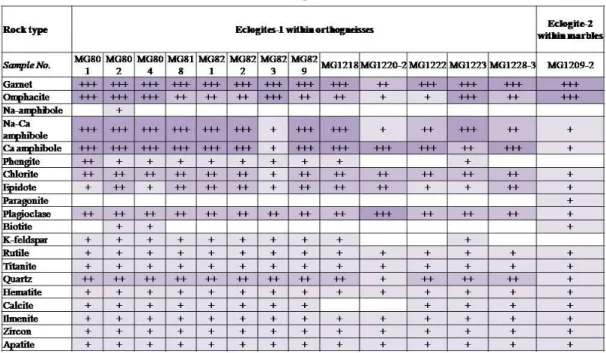
Eclogite-1 consists mainly of garnet, clinopyroxene, and sodic, sodic-calcic, and calcic amphiboles (glaucophane, taramite, barroisite, winchite, pargasite, tschermakite, hornblende, actinolite) with subordinate amounts of epidote, phengite, paragonite, plagioclase (An1-17), biotite, chlorite, K-feldspar, rutile, titanite, quartz, calcite, hematite, ilmenite, and zircon (Table. 3.1). Amphibole (barroisite, pargasite, tremolite) -rich veins (up to 0.3-5 mm in width) which are occur parallel or subparallel to the schistosity of the eclogite, and veins consisting of prehnite, albite, K-feldspar, calcite and quartz bearing veins are developed in eclogite bodies (Fig. 3.2).
Table 3.1. Representative mineral assemblage of eclogites-1 and eclogites-2. +++, rich; ++, common; +, poor.
Fig. 3.1 Photomicrograph of eclogite-1 (MG1218). Garnet (brownish), Amp2 (barroisite), Ph2, Cpx2 (omphacite) and symplectite of Pl2+Amp3+Cpx3 after Cpx2. Most of Cpx2 consumed into symplectites.
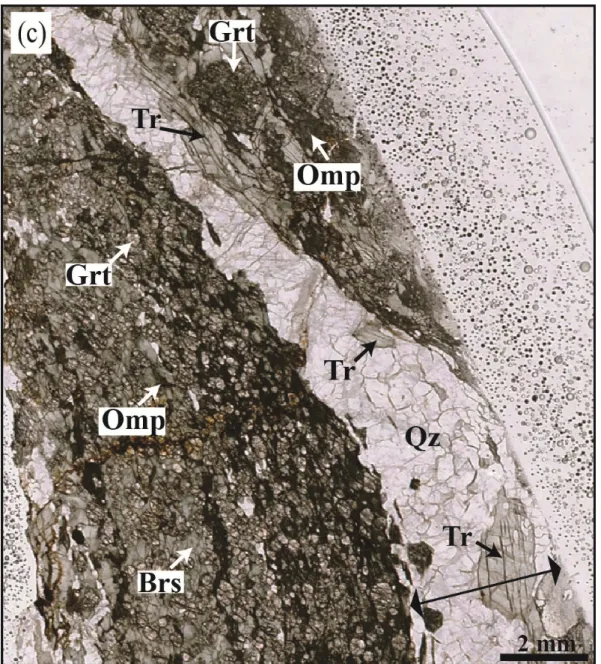
Fig. 3. 2 Microphotopgraph of amphibole-rich veins in the eclogite matrixes. Veins are indicated by double-headed arrows. (a) Amp-NaPl-Ph vein. The vein intruded slightly oblique to the schistosity of the host eclogites (MG1218). (b) Aggregates of barroisitic amphibole, na-plagioclase, phengite, titanite, and calcite in the Amp-NaPl-Ph vein part. In the eclogites part, chlorites strongly replaced garnet grain. Matrix part of eclogites mainly consists of small grain symplectites of plagioclase (Pl2) Amp3 and Cpx3 (MG1218). (c) amp-Qz vein (MG1222).
A schistosity (Se) is defined by preferred orientation of amphibole, epidote, and omphacite. The orientation of inclusions in the porphyroblastic garnet (Si) is oblique comparing to Se (Fig. 3.3).
Garnets occur as euhedral to subhedral porphyroblasts, and their maximum size up to 2 mm across. Sometimes along the fracture of garnet, it is filled by albite (An1-5), K-feldspar, epidote, and chlorite. Garnets consist of inclusion-rich core and inclusion-poor rim (Figs 3.3 and 3.4).
Garnets contain inclusions of polyphase and single grain inclusions in the core and the rim (Table 3.2). The core of the garnet contains polyphase inclusions of Na-Ca amphibole (taramite, Mg-taramite, Fe-barroisite, Fe-pargasite) +quartz ± rutile, Mg-taramite + actinolite + quartz, aegirine-augite (Jd13) + taramite+quartz, aegirine-augite (Jd=14-16) + omphacite (Jd=20-21) + plagioclase (An=1-2) + Fe-tschermakite, epidote+albite (An2-5), biotite + oligoclase (An<17) + epidote, epidote + quartz, albite (An4-5) + calcite and single grained inclusions of taramite, Fe-barroisite, Fe-pargasite, tschermakite, Fe-tschermakite, quartz, epidote, K-feldspar, rutile and titanite (Table. 3.2, Figs. 3.4, 3.5, 3.7, 3.8). The rim of the garnet contains as polyphase inclusions of taramite + Mg-taramite + omphacite (Jd40) + rutile + quartz, taramite + omphacite (Jd41) + rutile, barroisite + omphacite (Jd37), edenite + omphacite (Jd32) and single grained inclusions of taramite, barroisite, omphacite (Jd<39), phengite, quartz, epidote, rutile, and titanite (Table 3.2; Figs. 3.7 and 3.8).
Garnet porphyroblast Porphyroblastic amphibole (Amp4) Core Rim Polyphase inclusions taramite + quartz
Mg-taramite + Fe-actinolite + quartz Fe-barroisite + quartz
Fe-pargasite + quartz
taramite +Mg-taramite + omphacite
(Jd40) + rutile + quartz
taramite + omphacite (Jd41) + rutile,
Edenite + omphacite (Jd32) Mg-Katophorite + omphacite (Jd36) Barroisite + omphacite (Jd35) Omphacite (Jd 30-42) + symplectite of clinopyroxene (Jd2-12) + plagioclase (An 1-12)
biotite+oligoclase (An2-17) + epidote
biotite + titanite biotite + rutile + quartz
aegirine-augite(Jd13) + taramite + quartz
aegirine-augite (Jd14-16) + omphacite (Jd20) + Fe-tschermakite + albite (An2)
oligoclase (An14) + chlorite + titanite
albite (An3-5) + calcite
Epidote + albite (An2-5)
epidote + quartz
Single grain inclusions
Core Rim
Porphyrblastic amphibole (Amp4)
taramite, Fe-barroisite, tschermakite, tschermakite, pargasite, Fe-pargasite, epidote, quartz, rutile, titanite, chlorite, K-feldspar
taramite, Fe-barroisite, barroisite, Fe-pargasite, phengite, omphacite (Jd35-40), quartz, epidote, rutile,
titanite,
garnet, omphacite (Jd33-35), phengite,
quartz, epidote, rutile
Fig. 3.3 Photomicrograph of eclogite-1 (MG829). Porphyroblastic garnet (brownish) consists of inclusion-rich core (prick-line) and inclusion-poor rim. Omphacites (Cpx2; grayish) and porphyroblastic barroisite
(Amp4; greenish) have a preferred orientation (Se) in the matrix. The orientation of inclusions in the core of
Fig. 3.4 Photomicrograph of eclogite-1 (MG802). Mineral assemblage of garnet, omphacite (Cpx2) barroisite (Amp2) and rutile in the matrix. Omphacties replaced by symplectite of plagioclase, clinopyroxene (Cpx3) and Mg-hornblende (Amp3). Garnet included polyphase inclusions of aegirine-augite (Cpx1) and Fe-tschermkaite (Amp1) and single grain inclusions of taramitess in the core. MG802, open nicol.
Fig. 3.5 Backscattered electron image (BEI) showing garnet includes polyphase inclusions
of biotite+oligoclase (An<17)+epidote, Mg-taramite+actinolite+quartz, single grain
inclusions of quartz, and taramite. Inclusion of taramite replaced by chlorite of later stage (MG804).
Clinopyroxenes occur as three modes of occurrence, i.e. clinopyroxene inclusion in the rim of garnet (Cpx1), discrete grain in the matrix (Cpx2), and symplectitic clinopyroxenes (Cpx3) with plagioclase (An1-13) after Cpx2. Cpx2 and Cpx3 are sometimes enclosed by porphyroblastic amphiboles (Amp3). Cpx1 included in garnet occurs as anhedral to subhedral, up to 0.01 mm long (Figs. 3.7, and 3.8). They are mainly classified as omphacite, and rarely as aegirine-augite. Discrete grains of omphacite (Cpx2) occur in the matrix as euhedral to subhedral prismatic crystals. It is up to 1 mm long and pale grey in color (Figs. 3.9 and 3.10). Cpx2 contains quartz, epidote and rutile as inclusion. Cpx3 occurs as symplectite. It is fine-grained (~0.02 mm) and is classified into mainly diopsite, rarely aegirine-augite and omphacite (Figs. 3.9 and 3.10).
Fig. 3.7 The core of garnet includes mainly polyphase and single grained inclusions of taramite, quartz and rutile. Whereas the rim of garnet includes a omphacite (Cpx1), barroisite, Mg-katophorite as well as a taramite (BEI; MG802). Broken line indicates the boundary of inclusion rich-core and inclusion poor-rim of garnet
Fig. 3.8 The core of garnet includes polyphase inclusion of aegirine-augite (Jd<16), jadeite-poor omphacite (<21) (Cpx1), Fe-tschermakite and plagioclase as well as taramite and
bitotie. Polyphase inclusions of barroisite (Amp1)+omphacite (Jd35) (Cpx1) included in the
Amphiboles occur as six modes of occurrence: (1) Inclusion (Amp1) in the garnet, (2) discrete grained in the matrix (Amp2) coexisting with omphacite (Cpx2), (3) symplectitic amphibole (Amp3) with plagioclase (An1-13) after omphacite (Cpx2), (4) amphiboles (Amp4) containing inclusions of garnet, omphacite (Cpx2) and symplectite of plagioclase, Mg-hornblende (Amp3) and clinopyroxene (Cpx3), (5) amphiboles surrounding garnet (Amp5), and (6) amphiboles in amphibole-rich vein (Amp6). Amp1 (taramite, barroisite, barroisite, pargasite, pargasite, Fe-tschermakite, Fe-tschermakite, actinolite, Mg-hornblende) is euhedral to subhedral, up to 0.2 mm long. It is pleochroic with x‘=pale yellowish green and z’= green or deep green (Figs 3.3-3.8). Amp2 (glaucophane, barroisite, Mg-hornblende) occurs as subhedral, up to 0.3 mm long. It is forming a schistosity texture and it is coexisting with omphacite (Cpx2) in the matrix (Figs. 3.1, 3.11 and 3.12). Amp2 have a zoning
Fig. 3.10 BEI (MG829) is showing omphacite (Cpx2) replaced by symplectite of
plagioclase (An1-13)+Mg-hornblende (Amp3)+Na-poor clinopyroxene (Cpx3; Jd<13) and
Ep3 in the matrix. Jadeite component in omphacite slightly is decreasing from the core (Jd 38-39) to the rim (Jd 36-37).
with glaucophane core, barroisite mantle, and Mg-hornblende rim and actinolite outermost rim (Fig. 3.12). It is pleochroic with x’=pale blue and z’=blue in the core, x’=pale green z’=bluish green in the mantle, x’=pale yellowish green and z’=pale green in the rim and x’=pale yellow and z’=pale green outermost rim. Amp3 (Mg-hornblende, actinolite) is, of anhedral to subhedral crystal, fine grained (~0.03 mm) in the symplectite (Fig. 3.10).
Fig. 3.11 Barroisite (Amp2) and omphacite (Cpx2) coexisting together, they are forming a schistosity texture. Cpx2 replaced by symplectite of clinopyroxene (Cpx3), plagioclase and hornblende (Amp3). Amp2 have have a retrograde zoning, barroisite core (dark grey) with Mg-hornblende rim (grey).
Amp4 (barroisite, Mg-katophorite, winchite, actinolite, Fe/Mg-hornblende) is, of euhedral to subhedral in the matrix (Figs. 3.13 and 3.14). Some Amp4 are porphyroblastic sized up to 2.5 mm long. They have a actinolite or winchite core, barroisite mantle and Mg-hornblende rim (Fig. 3.15). It is pleochroic with x’= pale yellowish green, z’=pale green in the core; x’=pale green, z’=green in the rim. The rim of Amp4 includes garnet, omphacite (Cpx2), symplectitic aggregate of clinopyroxene (Cpx3) with plagioclase (Fig. 3.13-3.15), quartz, epidote, rutile and titanite. Amp4 coexists with albite (An2-7) and epidote (Fig. 3.16). Some of eclogites-1 (samples MG1218 and MG1222) does not have an evidence of Amp4 crystallization.
Fig. 3.12 BEI shown the prograde (glaucophane core with barroisite mantle) and retrograde (barroisite mantle with Mg-hornblende rim) zoning in the Amp2, coexisting omphacite (Cpx2).
Fig. 3.13 Amp4 (zoned with Act and/or Wnc core with Brs rim) and Epidote (Ep4) in the matrix. Amp4 and Ep4 formed in between grain boundary of Omp (Cpx2) and in the pressure shadow of garnet. Amp4 contain inclusions of Omp (Cpx2) at the contact zone of garnet and Amp4 (top right site of figure).
Fig. 3.15 Prograde and retrograde zoning of porphyroblastic amphibole (Amp4) in the matrix: Winchite core with barroisite mantle and Mg-hornblende rim. It coexist with albite (An<7) and epidote. Garnet surrounded by pargasite (Amp5). Omphacite surrounded by symplectite of plagioclase, clinopyroxene, and Mg-hornblende (Amp3). BEI; MG829
Fig. 3.16 Barroisite (Amp4), plagioclase (An2-7) and epidote (Ep4) coexist together. Phengite
Amp5 (pargasite, Fe-pargasite, Mg-hornblende) occurs as anhedral, up to 0.2 mm long, surrounding garnet (Fig. 3.15). Amp6 (barroisite, tremolite, pargasite, Fe-pargasite, Mg-hornblende, actinolite) occurs as subhedral prismatic crystal in the vein (up to 5 mm in width) (Figs. 3.2 and 3.16). Amp6 has a zoning with barroisite, Mg-hornblende and tremolite cores, with pargasite, Mg-hornblende rims and actinolite outermost-rims (Fig. 3.17).
Fig. 3.17 Pargasite-rich vein cut the omphacite, eclogite, and porphyroblastic amphibole (Amp4). The
vein mainly consist of pargasite (Amp6), and minor plagioclase (An<11). Later calcite vein cut the
Phengites occur as two modes of occurrence: Inclusion (phn1) in the garnet rim and discrete grain in the matrix (Phn2). Phn1 occurs as subhedral, and up to 0.1 mm across. Phn2 is euhedral to subhedral, and it is up to 0.5 mm across. It is replaced by symplectite of plagioclase (An2-18) and biotite (Fig. 3.9).
Epidote has four modes of occurrence: Inclusion in garnet (Ep1), symplectitic epidote with Amp3, Cpx3 and plagioclase after the omphacite (Ep2), discrete grain in the matrix (Ep3) coexisting with Amp4 and in the fracture zone in the porphyroblastic garnet (Ep4). Ep1 occurs as anhedral to subhedral, and up to 0.1 mm long. Ep2 occurs as in the symplectite with Amp3, plagioclase and Cpx3; it is up to 0.1 mm long. Ep3 occurs as subhedral crystal, and its size is up to 0.5 mm long (Fig. 3.16). It contains quartz as inclusion.
Plagioclase has three modes of occurrence: polyphase and discrete grain inclusions of plagioclase (Pl1; An=1-17) in the garnet, symplectitic plagioclase (Pl2; An=1-18) with Amp3, Cpx3 after the omphacite (Cpx2) and with biotite after the phengite (Ph2), dicrete grains of plagioclase (Pl3) coexisting with Amp4. Pl1 is
Fig. 3.18 BEI images of amphibole-rich veins. (a) The amphoble of Amp-NaPl-Ph vein is zoned, with barroisite core and Mg-hornblende and/or edenite rim. Fractures filled by actinolitic amphiboles are developed in some amphiboles (MG1218). (b) Amphibole in the Amp-Qz vein, zoned from tremolite core to Mg-hornblende rim, with rare actinolite outermost rim (MG1222).
anhedral, up to 0.02 mm across. Pl2 occurs as discrete anhedral grains and its size up to 0.2 mm across. Pl3 occurs as anhedral up to 0.03 mm across. Paragonite occurs as inclusions in the garnet, anhedral, up to 0.02 mm across. Biotite has two modes of occurrence: inclusions of biotite in the garnet (anhedral, up to 0.01 mm across) and symplectitic bioite with Pl3 after the Ph2. K-feldspar occur locally as symplectitic together with Cpx3, Pl3, Amp3, and its size is up to 0.02 mm across.
Chlorites have three modes of occurrence, i.e. chlorite as inclusions in the garnet (Chl1) and occur as filling fractures of garnet grains (Chl2), anhedral, and pale green to green in one nicol. Hematite occurs in the matrix, it is anhedral, up to 0.8 mm across. Rutile occurs in the garnet, clinopyroxene (Cpx2), and amphibole (Amp2 and Amp4) as inclusion and in the matrix. Its size is up to 0.5 mm across. Titanite occurs in the matrix, usually replacing rutile. Titanite also occurs in the garnet as inclusion. Ilmenite often occurs replacing rutile and as anhedral discrete grain in the matrix.
Amphibolized eclogite-1 intruded by vein-type orthogneiss
Amphibolized eclogite-1 consist mainly of calcic amphiboles (Fe-pargasite, tschermakite, Fe-tschermakite Fe/Mg-hornblende, actinolite), plagioclase (An1-9), with minor amounts of garnet, sodic-calcic amphibole (barroisite), epidote, chlorite, K-feldspar, rutile, titanite, quartz, apatite, hematite, and zircon (Fig. 3.19) (Table. 3.1.1). Chlorite veins are locally cross-cut the rock (Fig. 3.19).
Garnets occur as four modes of occurrence, i.e. (1) resorbed garnet (Grt1) which are strongly replaced by chlorites and sometimes included by amphibole (actinolite and barroisite), (2) garnets (Grt2) replacing Grt1 and coexisting with calcic amphibole (tschermakite, Fe-tschermakite, Fe-pargasite and Fe/Mg-hornblende), (3) fracture filling garnets (Grt3) partially developed in the Grt1 and Grt2, and (4) Mn-rich films of garnet (Grt4) rimming Grt1 and Grt2 (Fig. 3.20). Grt1 are anhedral to subhedral, and they are up to 0.7 mm across (Fig. 3.20a). Grt1are rarely contain inclusions of omphacite and quartz (Fig. 3.21). Grt2 are anhedral to subhedral replacing Grt1 (Fig. 3.20c), and their maximum size up to 0.2 mm across, relatively lesser replaced by chlorites. Grt3 are anhedral filling fractures of Grt1 and Grt2 (Fig. 3.20b), up to 0.01
Fig. 3.19 Microphotograph of the amphibolized eclogites-1 intruded by orthogneiss vein. Subhedral to euhedral amphiboles replacing eclogitic garnets are dominant in the amphibolized eclogites-1. Smaller grains of amphiboles and plagioclase preserved rectangular shaped symplectitic texture (shown by dashed lines). Some of garnets are included by the euhedral shaped amphiboles. Chlorite vein cross-cut the rock.
mm in width. Grt4 occur as anhedral thin film, rimming Grt1 and Grt2 (Fig. 3.20 b-d), and they are up to 0.03 mm in width.
Fig. 3.20 BEI image of garnets (Grt1, -2, -3 and -4). (a) Euhedral eclogitic garnet (Grt1) rimmed by thin film of Grt4. Fractures of Grt1 filled by chlorites and minor rutile, titanite and apatite. (b) Thin fracture filling Grt3 developed in the Grt2 and thin film of Grt4 rimmed Grt2. (c) Grt1 replaced by Grt2 then Grt4 developed after the development of Grt2. Chlorites are surrounding garnet grain, apatite and titanite. (d) Grt1 partially replaced by Grt4. (f) Schematic sketch of modes of occurrence of garnets in the amphibolized eclogites-1.
Amphiboles occur as three modes of occurrence: (1) relic amphibole (Amp1; actinolite core with barroisite rim), (2) calcic amphibole (Amp2; Mg-hornblende core with tschermakite/pargasite rim) replacing Amp1, and coexisting with Grt2, (3) thin actinolite micro-vein cross-cutting Amp1 and Amp2.
Amp1 (actinolite and barroisite) is euhedral to subhedral, up to 0.5 mm across, pleochroic with x‘=pale yellowish green to pale green and z’= pale green to pale bluish green. Amp1 are overgrown by Amp2. They have a zoning with actinolite core with barroisite rim (Fig. 3.22). Amp1 locally contain Grt1 and fine-grained symplectites of amphibole and plagioclase as inclusions (Figs. 3.23 and Fig. 3.24).
Amp2 (Fe-pargasite, tschermakite, Fe-tschermakite Fe/Mg-hornblende) occurs as euhedral to subhedral, up to 0.3 mm long. They are pleochroic with x’=pale green to green and z’=green to deep green. Amp2 are overgrown Amp1 and formed
Fig. 3.21 Aggregates of Grt1, Amp1 (barroisite) and Amp2 (Mg-hornblende) are surrounded by chlorite. Grt1 contain inclusion of omphacite.
as discrete grains with plagioclase and epidote, and they have a zoning with Fe/Mg-hornblend cores with tschermakite, Fe-tschermakite, Fe-pargasite rims (Fig. 3.22). Anhedral Grt2 are crystallized with Amp2 replacing Amp1, indicating they were formed at a same time (Figs. 3.22 - 3.25). Smaller grains of Amp2 and plagioclase are preserved symplectitic texture indicating they were formed after the consummations of omphacites (Figs. 3.19 and 3.22).
Amp3 (actinolite) occur as thin micro-vein (up to 0.2 mm thickness) cross-cutting Amp1 and Amp2 (Fig. 3.23).
Fig. 3.22 Resorbed Amp1 overgrown by Amp2, Grt2 and plagioclase (Pl). Amp1 have a zoning with actinolite core and barroisite rim. Amp2 have a zoning with Mg-hornblende core with tschermakite rim. Aggregates of Grt1 surrounded by plagioclase, epidote and Amp2. Discrete anhedral and subhedral smaller Amp2 with plagioclase and K-feldspar forming symplectite texture.
Fig. 3.23 Resorbed Amp1 overgrown by Amp2, Grt2 and Grt1 partially replaced by chlorite. Amp1(actinolite and barroisite) contain symplectitic polyphase inclusion of amphibole and plagioclase, indicating former omphacite inclusion was replaced by amphibole and plagioclase.
Fig. 3.24 Resorbed Amp1 overgrown by Amp2, plagioclase and Grt2. Amp1contain inclusion of Grt1 partially replaced by chlorite. Chlorite partially surrounding Amp2 and Grt2.
Plagioclases occur as anhedral and up to 0.1 mm across. They occur as symplectitic with Amp2 and sometimes replacing Amp1 together with Amp2 (Figs. 3.19). They have a zoning with core (An=4-5), mantle (An=8-9) and rim (An=1-2) (Fig. 3.26)
K-feldspars occur as anhedral and up to 0.1 mm across, coexist with plagioclase and Amp2 (Figs. 3.22 and 3.25).
Epidotes occur as discrete grains often crystallized with Mg-hornblende (Amp1). They are anhedral to subhedral crystal, and its size is up to 0.1 mm across (Fig. 3.22).
Chlorites occur as anhedral, replacing garnets (Grt1 and Grt2) and surrounding amphiboles (Amp1 and Amp2) and plagioclase (Figs. 3.21 - 3.25).
Fig. 3.25 Resorbed Amp1 overgrown by Amp2 and anhedral Grt2. Plagioclase and K-feldspar crystallized with Amp2 and Grt2.
Apatites occur as anhedral and they up to 0.5 mm across. They coexist with Amp2, plagioclase and Grt2. Hematite occurs in the matrix, it is anhedral, up to 0.1 mm across. Rutiles are up to 0.2 mm across surrounded by titanite. Titanite oftern occur as discrete grains and they are up to 0.3 mm across (Fig. 3.24).
Fig. 3.26 Symplectitic plagioclase have a zoning with anorthite content increase from the core (An=4) to the mantle (An=9) and decrease from the mantle to the rim (An=1).
3.1.2 Eclogite-2 within marbles
Eclogite-2 in marbles consists of small grains of garnet (<0.1 mm) and omphacite (XJd=0.34-0.48) with minor amounts of amphibole, epidote, paragonite, plagioclase, chlorite, calcite, biotite, quartz, titanite and rutile (Table. 3.1.1). The matrix of eclogite-2 shows a pseudomorpous texture, where small grains of garnet crowd cemented by titanite forming isomorphic round shape. Some of cores of garnet grain contain relics of garnet indicating previous mineral were larger porphyroblastic garnet. In addition, small grains of omphacite forming rectangular prismatic nature surrounded by garnet grains (Fig. 3.27). Poikiloblastic amphiboles which contain garnet, omphacite, epidote, and symplectites of plagioclase and amphibole are developed (Fig. 3.28).
Garnet grains occur as subhedral to euhedral, and up to 0.3 mm across. Garnets have a zoning with core, mantle and rim. Sometimes rims of garnet crystallized as discrete grains next to the mantles of garnet (Fig. 3.27). Garnets contain rare inclusions of quartz and omphacite.
Fig. 3.27 BEI image of eclogites-2 (MG1209-2) within marble. (a) The matrix of eclogites-2 shows a pseudomorphous texture, where small grains of garnet crowd cemented by titanite forming isomorphic round shape. (b) Zoomed view of the garnet of eclogites-2. Small grains of garnet composed mainly of core and mantle. Some of cores of garnet contain relics of garnet. (c) Mg-rich rims of garnet (darker color) growing on mantes of garnet. Some of rims of garnet crystallized as discrete grains next to the mantles of garnet.
Omphacites occur as two modes of occurrence, i.e. clinopyroxene inclusion in the garnet (Cpx1) and discrete grain in the matrix (Cpx2). Cpx1 included in garnet occurs as anhedral, and up to 0.01 mm long (Fig. 3.29). Discrete grains of clinopyroxene (Cpx2) occurs in the matrix as subhedral prismatic crystals. It is up to 0.1 mm long and pale grey in color (Fig. 3.27 and 3.29). Cpx2 also occur as inclusion in the poikiloblastic amphibole (Amp3) often surrounded by symplectitic assemblage of plagioclase (An=1-17) and amphibole (actinolite, Mg-hornblende, edenite) (Fig. 3.30). Cpx2 contains quartz, amphibole (barroisite, Mg-hornblende and actinolite) as inclusions (Fig. 3.29).
Fig.3.28 BEI image of poikiloblastic barroisitic amphibole (Amp3) containing eclogitic minerals of garnet and omphacite with symplectite of Amp2 and plagioclase in the eclogites-2 within marble. The preferred orientation of inclusions of eclogitic garnet and omphacite (Cpx2) are same as preffered orientation of matrix garnet and omphacite (Cpx2).
Four modes of occurrence of amphibole are distinguished. Amphibole (Amp1) (zoned with actinolite core, barroisite mantle and rims of tschermakite, pargasite, Mg-taramite, Mg-hornblende) coexisting with garnet and omphacite (Fig. 3.30), symplectitic amphibole (Amp2) (pargasite, actinolite, Mg-hornblende), poikiloblastic barroisitic amphibole (Amp3) containing eclogitic minerals of garnet and omphacite with symplectitic Amp2, plagioclase and epidote, and finally actinolitic amphiboles (Amp4) partially filling grain boundaries of omphacite and garnet.
Amp1 occurs as subhedral, up to 0.1 mm long. It is forming a schistosity texture and it is coexisting with omphacite (Cpx2) and garnet (Fig. 3.30). It is
Fig.3.29 BEI image of garnet, Cpx2 (omphacite). Garnet contain inclusions of Cpx1 (omphacite). Amp2 (pargasite) rimmed by quartz formed within Cpx2 indicating that Amp2were formed after the fluid infiltrated into Cpx2. Amp4 (actinolite) toghether with chlorite and calcite are filling grain boundaries of Cpx2.
pleochroic with x’=pale green, yellowish green z’=bluish green, green. Amp2 is, of anhedral to subhedral crystal, and fine grained (~0.03 mm) in the symplectite (Fig. 3.31).
Amp3 occurs as subhedral poikiloblastic, up to 3 mm long. Garnet and omphacite and symplectites of Amp2, plagioclase and epidote are contained as inclusions and their internal orientation is same as preferred orientation of matrix garnet and omphacite (Fig. 3.28). Amp4 (actinolite) are filled grain boundaries of Cpx2 and garnet grains and partially replaced poikiloblastic Amp3 (Fig. 3.32).
Fig.3.30 BEI image of garnet, omphacite (Cpx2) and barroisite (Amp1). Amp1 has zoning with barroisite core and tschermakite rim. Titanite, pargasite (Amp2) and plagioclase (An=8) crystallized between the grain boundaries.
Fig.3.31 BEI image of zoned omphacite (Cpx2). Cpx2 has zoning with core (Jd=27-31%) and rim (Jd=34-42%). Jadeite component is fluctuated in the rim. actinolite, pargasite (Amp2) plagioclase and titanite are filling grain boundaries of Cpx2.
Fig.3.32 BEI image of zoned omphacite (Cpx2). Cpx2 has zoning with core (Jd=27-31%) and rim (Jd=34-42%). Jadeite component is fluctuated in the rim. Actinolite, pargasite
Epidote has three modes of occurrence: epidote (Ep1) occurs as resorbed core of discrete grains of epidote (Ep2) in the matrix. Epidote (Ep3) occurs as symplectitic with plagioclase and Amp2 (Ep3). Discrete grain epidotes (Ep1 + Ep2) occur as anhedral to subhedral crystal, and its size is up to 0.5 mm long (Fig. 3.33).
Paragonites occur as discrete grains in the matrix, and subhedral up to 0.1 mm across. They sometimes replaced by plagioclase (An=2-28) and Ep3 (Fig. 3.34).
Plagioclase occurs as two modes of occurrence: plagioclase (Pl1) symplectitic plagioclase (An1-17) with Amp2 and Ep3; and discrete grains of plagioclase (An=2-28) in the matrix (Figs. 3.33 and 3.34).
Chlorite occurs as filling grain boundaries of Cpx2 and garnet together with biotite and calcite. Hematite occurs in the matrix, it is anhedral, up to 0.03 mm across. Rutile occurs among the garnet crowd, surrounded by titanite.
Fig.3.33 BEI image of garnet, epidote (Ep1 and Ep2), amphibole (Amp1 with barroisite core and Mg-taramite rim) and omphacite (Cpx2). Fractures of garnet filled by chlorites. Tschermakite (Amp2) and plagioclase are formed between grain boundaries.
Fig.3.34 BEI image of garnet, omphacite (Cpx2), paragonite symplectite of pargasite (Amp2) and epdiote (Ep3) and poikiloblastic Amp3. Omphacite consumed into symplectite of pargasite (Amp2), plagioclase (Pl) and epidote(Ep3). Paragonite partially
3.2 Amphibolite within marbles
Amphibolite within marbles of Maykhan Tsakhir Formation consists mainly of calcic amphibole and plagioclase with minor garnet, K-feldspar, rutile, titanite, epidote, paragonite, and quartz (Fig. 3.35) (Table 3.2). They have a preferred orientation of amphiboles.
Amphibole has two modes of occurrence. Amphibole (Fe-pargasite, tschermakite, Mg-hornblende; Amp1) occurs as inclusion in garnet rim (Fig. 3.36). It occurs as subhedral prismatic crystal, up to 0.1 mm long, and it is pleochroic with x’=pale green and z’=green. Discrete grained amphiboles (Amp2) occur in the matrix and they occur as euhedral to anhedral, up to 1 mm long. They have a zoning, Mg-hornblende core to Fe-pargasite or tschermakite rim (Fig. 3.36). They are pleochroic with x’=pale yellowish green, z’=pale green in the core and x’=pale green, z’=green to deep green in the rim. Plagioclase has two modes of occurrence, i.e. polyphase inclusions of plagioclase (An9-12; albite, oligoclase) with Amp1 occur in the rim of garnet and plagioclase (An5-8), coexisting amphibole (Amp2) surrounding a garnet (Fig. 3.36). Garnet is anhedral, and it is up to 0.5 mm across. It includes chlorite, ilmenite, epidote, K-feldspar, quartz and paragonite in the core; polyphase inclusions of plagioclase (An9-12) and Amp1 (Fe-pargasite, Fe-tschermakite and Fe-edenite) are included in the rim (Fig. 3.36). Epidote occurs as inclusion in garnet and in Amp2 (Fig. 3.36). Epidote inclusions in garnet occur as anhedral crystal, up to 0.02 mm across. Epidote inclusions in amphibole occur as subhedral grains up to 0.03 mm long. Rutile occurs as inclusion (0.03 mm) in garnet and in the matrix (0.2 mm); it is sometimes fully replaced by titanite. Paragonite occurs only as inclusion (up to 0.01
Fig.3.35 Microphotograph is showing amphibolites. Subhedral garnet surrounded by
prismatic pargasite or tschermakites (Amp2) with plagioclase (An<12) and quartz (open nicol;
MG803).
Table 3.2. Representative mineral assemblage of amphibole, garnet-phengite schists, garnet-chloritoid schists, orthogneisses and metapelites. +++, rich; ++, common; +,
3.3 Garnet-phengite schists intercalating with eclogite-1
Garnet-phengite schists consist mainly of garnet, phengite and quartz, with minor chlorite, turmaline, rutile, and paragonite. Preferred orientation of phengite, paragonite and quartz defines a schistosity, however there are randomly oriented grains of phengite, plagioclase (An=12-13) and chlorites (Fig. 3.37) (Table 3.3).
Garnets occur as euhedral to subhedral porphyroblasts, and their maximum size is up to 4 mm across. Garnets in the garnet-phengite schists intercalating with eclogites bodies display a compositional zoning and divided as Grt1, Grt2 and Grt3. Grt1 has a zoning with core and mantle and both core and mantle of Grt1 partially replaced by relatively Fe-rich Grt2. Then both Grt1 and Grt2 partially replaced by
Fig.3.36 BEI is showing a zoning of amphiboles in the amphibolites. Amphiboles have a prograde zoning, Mg-hornblende core with pargasite or tschermakite rim (Amp2) coexist
with plagioclase (An5-8). Garnet include tschermakite (Amp1) and plagioclase (An9-12) in
feldspar and chlorite. Garnets contain inclusions of phengite (Ph1), paragonite, and chlorite (Chl1) (Fig. 3.38 and 3.40).
Phengite has three modes of occurrence: inclusions of phengite (Ph1), discrete grains of phengite along schistosity (Ph2) and randomly oriented phengite (Ph3) in the matrix. Ph1 inclusions occur as anhedral, and their maximum size up to 0.03 mm across. Ph2 in matrix occur as subhedral, and their maximum size up to 0.2 mm across. Ph3 in matrix occur as subhedral, and their maximum size up to 0.4 mm across. Chlorite has two modes of occurrence, i.e. inclusions of chlorite (Chl1) in the garnet (anhedral, maximum size up to 0.01 mm), discrete grains of chlorite (Chl2) which are anhedral, up to 0.1 mm across, mostly they are intercalated with Ph2 and occur in the pressure shadows of garnet. Plagioclase in matrix are subhedral, up 1 mm across intercalating with Ph2. Paragonite occur as subhedral, up to 0.02 mm across, intercalating with Ph1. Tourmaline occur as euhedral to subhedral, yellow brown in one nicol, up to 0.3 mm across. Rutile occur as anhedral, up to 0.1 mm in across.
Fig.3.37 Microphotograph of garnet-phengite schist intercalating with eclogites. Schistosity forming phengites (Ph2) and quartz and randomly oriented phengite (Ph3).
Fig.3.38 BEI image of garnet-phengite schist intercalating with eclogites. Garnet contains inclusions of Ph1. Paragonite (Pg) intercalating with Ph2. Chl2, Tur and Ph3 are randomly oriented.
3.4 Garnet-chloritoid schists within marble
Javkhlan et al. (2013) already described the petrographic description of garnet-chloritoid schists. The garnet-chloritoid schists consist mainly of garnet, chloritoid, white mica (phengite, muscovite and paragonite), chlorite and quartz, along with minor amounts of rutile, ilmenite, zircon and carbonaceous matter. Garnet grains occur as porphyroblasts, and occasionally contain inclusions of kyanite. Preferred orientation of chloritoid, chlorite and white micas define a schistosity (Fig. 3.41) (Table 3.3).
Subhedral to anhedral garnet porphyroblasts up to 6 mm across are typically zoned, with pale orange inclusion-rich core, and colorless inclusion-poor rim (Figs. 3.41 and 3.42). The core of the garnet contains inclusions of muscovite (Si=6.06-6.38 cations per formula unit, pfu), paragonite, chlorite (Fe-rich), chloritoid, and quartz
(Fig. 3.42). The core also contains polyphase inclusions of paragonite + chlorite ± phengitic muscovite ± quartz (Fig. 3.43c). The rim of the garnet contains inclusions of phengite (Si=6.38-6.63 pfu), chloritoid, chlorite (Fe-rich), quartz, and occasional kyanite and Mg-rich chlorite (XMg=0.38-0.42) (Figs. 3.42 and 3.43). Most garnet
grains are intensely fractured, with the fractures filled by chlorite (Fe-rich) and muscovite (Si=6.15-6.23 pfu) (Fig. 3.44d).
Chloritoid occurs in the matrix as subhedral crystals up to 1.5 mm across (Fig. 3.44c), containing inclusions of phengite, paragonite, phengitic muscovite, rutile, and quartz. Chloritoid in the matrix is occasionally replaced by Fe-rich chlorite along the rim (Fig. 3.44c). Chloritoid inclusions up to 0.04 mm in diameter also occur within the garnet (Figs. 3.41 and 3.42).
Phengite in the matrix occurs as subhedral to anhedral crystals up to 1 mm across (Fig. 3.41). Paragonite occurs as inclusions in the core of the porphyroblastic garnet (<0.05 mm), and as inclusions within chloritoid (<0.1 mm). Paragonite grains are also found in the matrix as subhedral to anhedral grains about 1.5 mm across, intercalated with phengitic muscovite (Fig. 3.43c).
Chlorite in the matrix consists of subhedral to anhedral grains up to 3 mm across, with zoning from pale green core (Mg-rich) to greenish rim (Fe-rich) (Fig. 3.43b).
Kyanite is occasionally present as inclusions in the rim of the porphyroblastic garnet, as tiny anhedral grain up to 0.03 mm across (Figs. 3.42 and 3.43a).
Fig.3.41 Microphotograph is showing garnet-chloritoid schist (after Javkhlan et al., 2013). Porphyroblastic garnet includes chloritoid, paragonite and chlorite. Muscovite, hematite, and quartz occur among the garnet grains (open nicol; MG812).
Fig.3.42 BEI images of a porphyroblastic garnet in garnet-chloritoid schist from the Maykhan tsakhir Formation (after Javkhlan et al., 2013). The garnet is zoned, with inclusion-rich core and inclusion-poor rim. The core contains muscovite, paragonite and chlorite, and the rim contains kyanite, chloritoid, phengite and quartz.
Fig.3.43 BEI images of kyanite-garnet-chloritoid schists from the Maykhan Tsakhir Formation (after Javkhlan et al., 2013). (a) Inclusion-rich core and inclusion-poor rim of porphyroblastic garnet. Porphyroblastic garnet contains inclusions of chlorite, muscovite and chloritoid in the core and kyanite and phengite in the rim. (b) Rim of the garnet containing inclusions of Mg-rich chlorite; Mg-rich chlorite in the matrix is rimmed by Fe-rich chlorite. (c) Polyphase inclusions of paragonite + chlorite in the core of a garnet. (d) Coexisting garnet, phengite, chlorite and chloritoid; Mg-rich cores of chlorites are rimmed by Fe-rich chlorite.
Fig.3.44 BEI images of the garnet-chloritoid schists (after Javkhlan et al., 2013). (a) Phengites in the matrix rimmed by muscovite. (b) Paragonites coexisting with muscovites rimming phengites. (c) Chloritoids in the matrix rimmed by chlorites. (d) Strongly fractured porphyroblastic garnet; fractures are filled by chlorite and muscovite.
3.5 Pelitic schist intercalating with orthogneisses
Pelitic schists consist mainly of garnet, quartz, and phengite with minor epidote, rutile, ilmenite, chlorite, and hematite (Fig. 3.45) (Table 3.3). Schistosity defined by phengites, quartz and epidotes. Garnets occur as porphyroblast and they are subhedral grain up to 6 mm across. They are intensely fractured. Quartz and rutile are included in garnet as inclusion.
Phengite occurs in the matrix, and it is of subhedral crystal up to 1 mm across. They are sometimes rimmed by muscovite. Epidote occurs as subhedral porphyroblastic, up to 2 mm long. It includes rutile as inclusion. Rutile occurs as inclusion in the garnet and as discrete grain in the matrix. It is usually rimmed by ilmenite. Hematite rarely occurs in the matrix. Chlorite occurs in the matrix often replacing phengite.
Fig.3.45 Microphotograph is showing garnet-phengite schist. Phengite, quartz, and rutiles occur among the porphyroblastic garnet and epidote (open nicol; MG827).
3.6 Orthogneisses
3.6.1 Vein-type orthogneiss
The vein-type orthogneiss (sample MG1220-1) consists mainly of quartz, albite (An=0-1) with minor amounts of K-feldspar, phengite, epidote and chlorite. Accessory minerals are garnet, calcite, zoisite, rutile, titanite, zircon, monazite, apatite and hematite. Textures are fine-grained, granular (Fig. 3.46) (Table 3.3).
The vein-type orthogneiss can be divided as (i) albite-quartz rich part and phengite-rich compositional layer. Albite-quartz rich part consists mainly of quartz and albite with minor phengite, epidote, K-feldspar and garnet; and (ii) phengite-rich layer consist mainly of phengite with minor epidote, chlorite, K-feldspar, albite and quartz (Fig. 3.46).
Quartz and albite are anhedral and up to 0.5 mm across.
Phengite occurs as two modes of occurrence, i.e., relict grains of phengite 1 (Ph1) (subhedral up to 0.5 mm across) overgrown by phengite (Ph2) (subhedral up 0.1 mm across) in the albite-quartz rich part (Fig. 3.46 and 3.47). Phengite-rich layers composed mainly of Ph2 (subhedral up 0.1 mm across) with minor chlorites, epidotes and K-feldspars (Fig. 3.46 and 3.47). Relics of Ph1 occasionally preserved in the Ph2 in the phengite-rich layer (Fig. 3.48).
Chlorites occur as four modes of occurrence i.e., chlorite 1 (Chl1) rarely occur as small (up to 0.02 mm long) aggregate with epidotes in the albite-quartz rich part, chlorite 2 (Chl2) (up to 0.2 mm long, anhedral.) intercalating Ph2 (Fig. 3.46 and 3.47), and chlorite 3 (Chl3) filling fractures of garnet grains (Fig. 3.50). K-feldspars occur as anhedral to subhedral, up to 0.2 mm across (Fig. 3.48).
Fig.3.46The vein-type orthogneiss (MG1220-1) which consist of mainly of quartz + albite assemblage and minor phengite-rich layer.
Fig.3.47BEI image of vein-type orthogneiss. (a) Resorbed Ph1 rimmed by muscovite (Ms) and overgrown Ph2 in the albite-quartz rich part of vein-type orthogneiss. (b) Resorbed Ph1 rimmed by Ms and
Epidotes occur as two modes of occurrence i.e., relict grains of epidote (Ep1) overgrown by secondary epidote (Ep2) (Fig. 3.49). Ep1 is of anhedral to subhedral, up to 0.05 mm across. Ep2 coexisting with garnet and phengite in the albite-quartz rich part (Fig. 3.50) and in the phengite-rich layer with Ph2, Chl2 and K-feldspar (Figs. 3.48 and 3.49). Ep2 locally contains relict grains of Ep1 in the albite-quartz rich domain (Fig. 3.49). Some of Ep2 grains are partially replaced by albite and quartz. Rarely, fine grained, anhedral zoisite grains occur as inclusions in the K-feldspar.
Subhedral to euhedral garnet is up to 0.5 mm across. It is optically zoned from pale green core to colorless rim. Cores of garnet are resorbed and overgrown by colorless rims. Occationally, relic garnets are observed in the cores of garnet (Fig. 3.50 and 3.51). Inclusions of quartz and phengite are occasionally. Fractures are intensely developed in garnet and are mainly filled by chlorite (Chl3), K-feldspar and quartz (Fig. 3.50 and 3.51). Rutile is entirely or partially replaced by titanite.
Fig.3.48 BEI image of vein-type orthogneiss. (a) Ph2 and chlorite (Chl2), epidote (Ep2) and K-feldspar in the phengite-rich layer. (b) Ms surrounded by Ph2, K-feldspar and epidote (Ep2) in the phengite-rich layer.
Fig.3.49 BEI image of vein-type orthogneiss. (a) Resorbed Ph1 and surrounding Ph2 and Ep2 in the phengite-rich layer. (b) Core of resorbed Ep1 with rim of Ep2 in the phengite-rich layer.
Fig.3.50 BEI image of vein-type orthogneiss. Garnet and epidote (Ep2) in the albite-quartz rich part. Garnet is intensely fractured and fractures filled by chlorite (Chl3) and K-feldspar.
Fig.3.51 BEI images of garnets in the vein-type orthogneiss. (a) Garnet composed of core, mantle and rim. (b) Mantle of garnet has been resorbed and early stage of fracture formed. When rim of garnet overgrown on mantle, some part of rim of garnet overgrown on the
3.6.2 Orthongeisses surrounding eclogite bodies
Orthogneiss surrounding eclogite bodies (MG1228-1 and MG1229) consists mainly of quartz and albite with minor amounts of phengite and K-feldspar in the both samples (MG1228-1 and MG1229), except epidote, dolomite, chlorite, calcite, muscovite present in the sample MG1228-1 (Figs. 3.52 and 3.53). Accessory minerals of rutile, zircon, and apatite are present in the both sample (Table 3.3). Orthogneiss shows fine- to medium-grained and granular texture. In the sample MG1228-1, calcite, plagioclase, quartz and dolomite aggregates are sometimes formed large rectangular shape, indicating previous mineral were probably magmatic in origin (Fig. 3.52). In the sample MG1229, large K-feldspar and plagioclase (up to 1.5 mm across) with twin-interface regarded as also magmatic in origin and they are partially replaced by phengite and albite assemblage (Fig. 3.53). Dolomite-rich micro-veins with up to 0.3 mm in thickness intensely developed in the orthogneiss of MG1228-1 (Fig. 3.52).
Quartz and albite are replaced by fine-grained chlorites, dolomite and K-feldspar in the sample MG1228-1 (Fig. 3.54) whereas in the sample MG1229 are not (Fig. 3.55).
Phengite in the sample MG1228-1 occur as subhedral crystal up to 1 mm across intercalated with fine-grained chlorite and K-feldspar. Resorbtion texture preserved in the phengite grains that phengite with slightly higher Si content (6.76-6.84) (Ph1) overgrown by phengite with lower Si content (6.69-6.73) (Ph2) (Fig. 3.54a). Dolomite-rich micro-vein locally infiltrated into phengites.