Title
Edge Detection by Pattern Matching Based on Principal
Component Analysis
Author(s)
Zeng, Xiang-Yan; Chen, Yen-Wei; Nakao, Zensho
Citation
琉球大学工学部紀要(61): 65-68
Issue Date
2001-03
URL
http://hdl.handle.net/20.500.12000/1955
. 2001*
Edge Detection by Pattern Matching Based on Principal Component Analysis
Xiang-Yan Zeng *, Yen-Wei Chen * *, and Zensho Nakao * *
Abstract
In this paper, we have proposed a new method for edge detection by pattern matching. There exist two main problems for
the edge detection methods by gradient operators: (1) gradients in the templates are fixed and not related with those in real
images; (2) the results are edge enhanced images and need to be transformed into binary ones by setting an appropriate threshold. In our method, the pattern templates are obtained by learning the principal components of image patches and edges are represented directly by the class of the matched templates. The effectiveness of the proposed method is demonstrated by experimental results
Keywords: boundary detection, principal component analysis, edge pattern, image patches
1 INTRODUCTION
Boundaries are important features that represent the main information in an image and can be used in later
processing and analysis. Many of the boundary detection
methods attempt to find the edges by pixel gradient magnitudes and/or directions. In edge detection, the images are usually transformed by a set of gradient operators. Various sets of operators have been proposed for producing images with enhanced edges [1,2,3]. All of these methods have the following characteristics: different gradient templates are convolved with the image to detect different directional edges. There exist two main problems for the edge detection by gradient operators: (1) gradients
in templates are fixed and not related with the statistics in
real images: (2) the results are edge enhanced images and need to be transformed into binary images by setting an
appropriate threshold. Since the results depend on the pixel values, in many applications, it is hard to decide the
threshold and a prior knowledge about the distribution becomes necessary.
R.D.Dony, and OJA.E have proposed subspace
classifiers for edge detection, by which a pixel is assigned
to a class number determined by a vector of the neighbor
pixels |4,ll|. In R.D.Dony's method, the classification is applied to the vectors whose dimensions 'are reduced by
principal component analysis, and an important property of
: 2000 *F 12 Jj 25 U
12
*
**
the method is its insensitivity to illumination. This is right the point that methods by pattern matching or classifying are superior to the gradient operators. However, it is demonstrated by our experiments that the existing gradient templates can not be used as the patterns for classification.
In recent years, there is an increasing interest in the research for understanding the feature extraction ability of visual cortex by statistics analysis. Much work has been done to explain the coding principles of nature images by using the principal component analysis (PCA) [7,10] or the independent component analysis (ICA) [8,9]. All.these studies are consistent with the proposal that the visual feature detectors might be the result of a redundancy
reduction process [5].
In this paper, we propose an edge detection methods by pattern matching based on PCA. Different from the works
until now that try to get edge filters, we use the basis
functions of PCA for pattern matching. All the patterns are
obtained by learning the principal components of image patches, and pixels are represented by the classes of the
patterns that match the neighbor blocks best. The patterns obtained from some images can be used to others that have similar statistics. An unsupervised neural network
proposed by Sanger [6] is used to extract the principal
components.
The intention of this paper is trying to apply PCA to pattern matching instead of filter designing. The
experimental results may help us to find new roles for PCA
in feature extraction.
2 LEARNING THE PRINCIPAL COMPONENT
OF IMAGES BY PCA NEURAL NETWORK
Zeng ■ Chen • Nakao : Edge Detection by Pattern Matching- Based on Principal Component Analysis
Principal component analysis is a linear transformation that removes the correlation among the elements of a
random vector. Suppose x is a N x ] vector with elements x1>x2,...x1v as random variables. A linear transformation defined by matrix W is applied to x and a new random vector can be produced by:
where mx is the mean vector of x , and W is constructed
in such a way that its rows are the eigenvectors of the covariance matrix of x. Usually the eigenvectors are arranged in the order that the corresponding eigenvalues are decreased. Since y has a zero mean and its covariance
matrix is diagonal, its elements are uncorrelated.
2.2 Neural network and learning algorithm
PCA neural network has two layers. Image patches with size Sx.S are arranged as the input layer nodes as shown in
Fig. 1. The connection weights wtj (J = \,..S2) respond to
the / th principal component of the sample patches. The
number of the output nodes M is the number ofthe principal
components to be used.
Image patches(5x5 )
Figure 1 PCA neural network
For training patches xj1e U = l~£2,k = l,...T) , the neural
network is trained by the following algorithm:(1) Calculate the output values as below:
j=\ jk
where T is the number of image patches.
(2) Update the weights by:
T i
jfc=l m=\
where t\ is small positive learning rate.
(3) repeat 2-3 until the network converges.
2.3 Analysis of the principal components of image
Patches
The 5x5 image patches used for training are randomly
chosen from the original image in figure 2.
1
mH
m
ML™
11
M
H
liiil
BHHi
p
II
ii
site
I;
I
1
1
•
^11
^P
^P
IP
ml
mmii
Figure 2 256 x256 Original image
The rows of matrix W are the eigenvectors of the covariance matrix of x and thus orthonormal. If each row is mapped as a template with size 5x5 and the templates are arranged left-to-right, top-to-bottom, W can be represented as in Figure 3.
ii
I
1
■
HI
■
I
m # i; fttSkA 1
si ^
w
^^
IP
I
hi
—V
$ mii
ill
KJIGGwRB ?: aI
pi sis«
1
SPi
i
Pi
s
1
1
\ I!
Figure 3 Normalized blocks of Matrix W (M = 16)
The templates are arranged from top to down, and from icit to right
The rows of W represent the principal components in the
training patches and are arranged in order of decreasing variances. The first block in Figure 3 is similar to a Gaussian filter. The second block responds to the
smoothing component and in the experiments the background is classified into this class. The third and the fourth responds to the main horizontal and vertical edges. All of the blocks except the first one can be used for edge
detection.
We have found that the arrangement of the principal
components is affected by the size of the image patches, in
case of detectors with size 8x8, the background pixels are classified into several classes instead of a unique one because the noise within a patch increases. The detectors obtained from large size patches can extract main
2001^ 67
boundaries better than the detail edges. On the contrary, the
detectors with small patch size have a better localization
and are good at extracting detail features, e.g. facial
features in Figure 4.
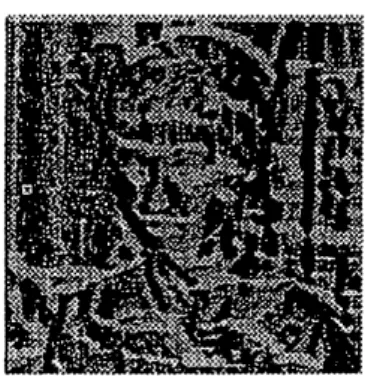
5x5 patch 8x8 patch Figure 4 Edge map by different patch size
3 Edge detection by PCA neural network Because the edge patterns extracted from the training data have been represented by the weights, the trained PCA network can be used for edge detection of images that are rather different from the training patches.
For each pixel, the surrounded 5x5 block is taken as the input to the PCA network. The pixel is assigned to a class number /that yt-MAJi{yk>k = l,..M}. The block
that approximately matches one of the templates will
produce a large value corresponding to that template. Since all the templates are orthononnal, the block will have small values for other templates. In many edge detection methods,
the maximum value over all the gradient operators is the
output[ 1,2,3 J. There are two points that we have to consider
for these methods: (1) different filters may produce similar outputs for blocks with different gray scale values. (2) the result image has values in a very large range and so is difficult to be transformed into a binary image. In our method, however, the class number of the matched template instead of the maximum value is used as the output. So a pixel in the edge map is clearly represented by its pattern class and not affected by the gray scale value.
The existing gradient templates with discrete elements can
not be used as patterns. An example is given that the class of the matched template is used as the output for Han-transform. The 64 basic images obtained from
Han-transform with N=8 are applied to the image in Figure 2,
and the result is shown in Figure 5. Different colors
represent different class. Even though the horizontal and
vertical edges arc separated, the result
is not acceptable.
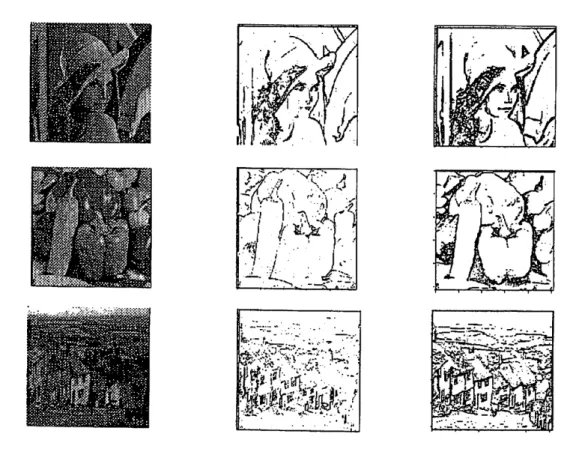
Some of the simulation results are shown in Figure 6. We
provide both the result of our proposed method and that of
the Sobel gradient edge filter.Figure5 Edge map by 8x8 Harr transform mask
4 Conclusions
We have proposed a method for edge detection by analyzing the principal components of image patches. The PCA neural network is trained by using random image patches and the weights connecting to one output node can be mapped into a two dimensional pattern template. The templates represent the features in images and are arranged by decreasing variances. A set of templates has the ability to distinguish edges and edge detection can be realized as pattern matching. The template set has been applied to other images that are much different from the training
image patches.
The performance of the proposed method is related with two parameters: the size of the image patch and the number of the templates. We have found in the experiment that
some edges become invisible when the template number is too small, and noises increase when the number is too big.
The detectors obtained from large size patches can extract main boundaries, while as the detectors with small patch
size have a good localization and are good at extracting
detail features.
Our approach is an edge detection method based on pattern matching. In this case, the patterns obtained from the statistics of images are much more suitable than the patterns with fixed discrete elements. The effectiveness of our method means the possible application of PCA to
feature detection and representation that we plan to use in
image segmentation.
References
[l]Kenneth R. Castleman: Digital image processing, Prentice Hall, Inc. 1996.
[2]J. Hou and R. Bamberger. "Orientation selective operators for ridge, valley, edge, and line detection in imagery," Proc. IEEE int. Conf. Acoustics, Speech and Signal Processing, Adelaide, Australia, 1994,
Zeng • Chen • Nakao : Edge Detection by Pattern Matching Based on Principal Component Analysis
[3] J. Canny:"Computational approach to edge detection," IEEE Trans. On Pattern Anal. And Machine Intel!., Vol.
8, No. 6, pp. 679-698,Nov.l986
[4]R.D.Dony, and S.Haykin:"Image segmentation using a
mixture of principal components representation," IEE,Proc.-Vis. Image signal process.,Vol. 144, No. 2, April,1997.
[5] Barlow H.B.,and TolhurstD.J.: "Why do you have edge dedectorsT Optical society of America: Technical Digest, No. 23, 172,1992
[6]T.D.Sanger: "Optimal unsupervised learning in a single-Layer linear feedforward neural network," Neural Networks 2,pp.459-473,1989.
[7]Hancock PJ.B.,Baddeley R.J. and Smith L.S.: "The
principal components of natural images." Network, Vol. 3, 1992.
[8] Anthony J. Bell and Terrence J. Sejnowski: "The
Independent components of natural scenes are edge filters,"Vision research, Vol. 37, No.23, July,1997. [9]Bruno A. Olshausen and David J. Field: "Emergence of
simple-cell receptive field properties by learning a sparse code for natural images," Nature, Vol. 381,
June,1996.
[10]D.L.Ruderman, T.W.Cronin, and C.-C.Chiao: "Statistics of cone responses to natural images: Implications for visual coding,Vowrwa/ of the Optical Society of America A, 1 5:2036-2045,1 998.
[ll]OJA,E:"Subspace methods of pattern recognition,"
Research Studies, Press Ltd.,Letchworth,U.K,1993..
1 l^/1 J
Figure 6 The edge detector is used to other images