Introduction
In Japan, we are generally taught American English in schools. However, when I was a freshman in high school, I became interested in England especially the culture and language. My eldest brother taught me about British music and English football and this made English and England attractive to me. In school, I was taught American English while my interests were more toward the United Kingdom. When I was a sophomore in the university, a professor told that there are many differences between American and British English usage. Sometimes, each country uses a unique word to express the same thing, e.g. subwayin American English, and undergroundin British English. After learning about these variations, I wanted to investigate some differences between American and British English. In this paper, I will explore one of the distinctions, the intensifier.
To do this, I analyzed intensifiers based on the data extracted from the COBUILD corpus. Those data samples were taken from what is considered standard language for both, that is, American English from NPR, and British English from BBC. I picked up 194 examples in American English, and 195 sentences in British English. These were extracted with the query adverb + adjective + noun, guaranteeing good representations of adverbial intensifiers used with prenominal adjectives (Quirk et al. 1985). And examples that were not corresponding to this structure were deleted manually. Comparing the two languages supported by the corpus data, I will discuss some characteristics of British and American intensifiers in each section as follows.
1. Which data sample has the greatest variety of intensifiers?
2. Which Intensifiers most commonly used in American English and British English?
A Comparison of Intensifiers Between American and British English
NARITA Tetsu
3. Variance of Intensifiers in American English and British English
1. Which data sample has the greatest variety of intensifiers?
First, I will look at the numbers of intensifiers in both English. Which language has more variety in intensifiers? I make a hypothesis that Standard British English has a greater variety of intensifiers because the U.K. has many more dialects than the U.S.
From the data, table 1 shows the variety of intensifiers and its percentage in each country.
Clearly, the British sample has a higher variety with 41 intensifiers. On the other hand, the U.S. sample has 23 types. British English uses about twice the number of intensifiers compared to American English. Also the intensifiers of American English (73.9%) are overwhelmingly common to British English. British English, on the other hand, has a larger number of unique intensifiers (58.5%) even though the number of intensifiers common to American English is 41.5%. From this, we can see that American English and British English use many common intensifiers and the U.S.
shares more of those intensifiers with Britain. However, in the U.K., there are a lot of unique intensifiers. British English tends to use a larger number of expressions not seen in American English.
Considering this, then is there any difference in categories of intensifiers between the countries? Here, to understand this question, I want to use a categorization style proposed by (Lorenz 2002). It implies five categories of intensifiers: Scalar (Sc), Semantic Feature Copying (SFC), Evaluative (Ev), Comparative (Com), and Modal (Mo). These intensifiers and frequencies are represented in table 2.
Table 1 Variety of Intensifiers in American English and British English NPR & BBC NPR ONLY BBC ONLY Total Variety
NPR 23
BBC 41
17 (73.9%)
17 (41.5%)
6 (26.1%)
0
0 24 (58.5%)
100.0%
100.0%
From this table, it appears that both America and Britain have a high frequency of Scalar intensifiers. In particular, this tendency can be seen in American English more than British English. The rate of Comparative intensifiers is equal in both countries.
However, for all the other types, Semantic Feature Copy, Evaluative, and Modal intensifiers, the numbers are higher for British English. As seen in table 1, the U.K. uses a greater variety of unique intensifiers compared to American English. This is supported by table 2. That is to say, British English has higher frequencies in the Semantic Feature Copying, Comparative and Modal categories. These frequencies explain the diversity of intensifiers used only in British English.
After looking at the common intensifiers in American and British English, we can see that the tendency of American English is to use intensifiers common to British English. And although the U.K also uses those common intensifiers, they tend to use more of a variety. The reason is that British English has more categories of intensifiers, e.g., (Semantic Feature Copying, Evaluative and Modal), which are hardly seen in American English. So British English has the greater variety.
2. Which Intensifiers most commonly used in American English and British English?
In the previous section, we observed that Britain has a larger variety of intensifiers Table 2 Variety and Frequency of Intensifiers in American and British English
NPR
158 81.4%
Sc
4 2.1%
SFC
1 0.5%
Ev
28 14.4%
Com
3 1.5%
Mo
194 100.0%
Total
BBC
141 72.3%
Sc
9 4.6%
SFC
4 2.1%
Ev
28 14.4%
Com
13 6.7%
Mo
195 100.0%
Total
>
<
<
=
<
and usage than America. However, as mentioned before, there are intensifiers used in both countries. In this section, I would like to look at which category is the most commonly used and which one in the category is the most commonly used.
Again, I want to use table 2 to discuss the first question.
As can be seen, the most commonly used category is clearly Scalar intensifier. In both countries, it has the highest percentage, while Comparative intensifier usage is the same percentage in both countries. In American English, Scalar intensifiers or Comparative intensifiers are used almost every time. In this respect, both English follow the same tendency. However, in British English, the other three categories have higher numbers than in American English. Conversely, the most infrequently used type of intensifier is Evaluative type for both nations. In particular, American English data shows it is near 0%.
As shown by table 2, the most frequent used category is clearly Scalar intensifier in America and Britain. Then which one of Scalar intensifiers occurs the most in both countries? This question is answered in table 3, below.
Clearly, the most commonly used one is very. So the most frequent in both countries is very in Scalar category. In American English, the second highest one is pretty, however in British English; the second highest one is rather, with prettyand fairly following. So, in America and Britain, we can conclude that Scalar intensifiers are the most used category, and veryis the most frequent in that group.
Table 2 Variety and Frequency of Intensifiers in American and British English NPR
158 81.4%
Sc
4 2.1%
SFC
1 0.5%
Ev
28 14.4%
Com
3 1.5%
Mo
194 100.0%
Total
BBC
141 72.3%
Sc
9 4.6%
SFC
4 2.1%
Ev
28 14.4%
Com
13 6.7%
Mo
195 100.0%
Total
>
<
<
=
<
3. Variance of Intensifiers in American English and British English
As we saw in section 1, Britain has many unique intensifiers. However, the U.S.
also has a small percentage of unique expressions but uses mostly intensifiers common to both American and British English. In this section, I will focus on the unique type of intensifiers occurs in each country and explore the characteristics.
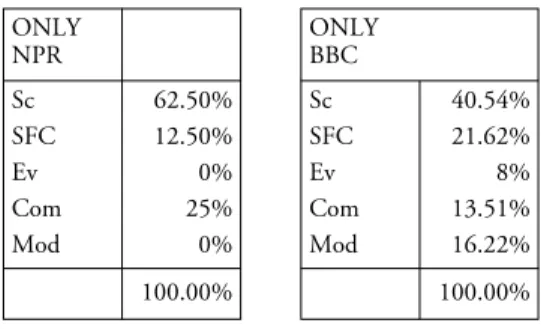
Table 4 shows the comparison between the percentages of each category of intensifiers occurring in American English or British English.
Here, like the most commonly used type in section 2, Scalar is the most frequent in both countries. In American English, only two other categories are found; Comparative, Semantic Feature Copying. However, in British English, all other categories exist. The U.K. uses Evaluative and Modal intensifiers which American English does not have.
This indicates that British English has richer variety of intensifier use than American Table 3 Most Commonly Used Scalar Intensifier Ranking
very pretty rather really fairly totally completely somewhat
123 11 6 6 3 2 1 1
63.4%
5.7%
3.1%
3.1%
1.5%
1.0%
0.5%
0.5%
NPR
very rather pretty fairly totally really completely somewhat
96 13 5 5 3 2 1 1
49.2%
6.7%
2.6%
2.6%
1.5%
1.0%
0.5%
0.5%
BBC
Table 4 The Average of Intensifiers Used by Country ONLY
NPR Sc SFC Ev Com Mod
62.50%
12.50%
0%
25%
0%
100.00%
ONLY BBC Sc SFC Ev Com Mod
40.54%
21.62%
8%
13.51%
16.22%
100.00%
English as also indicated in section 1. Clearly, we can see that a feature of British English is that a wider spectrum of intensifiers is used, some of which we do not see in American English.
4. Summary and Conclusion
In this paper, we have made a comparison of intensifiers between American and British English. There are common elements as well as differences. In both countries, Scalar intensifiers have the highest frequency, especially the use of very. The use of Comparative intensifiers also appears in nearly the same percentage in both nations.
However, there are big differences between them. The tendency of American English is overwhelmingly to use intensifiers common to British English (section 1).
Also in terms of the categories, American English uses Scalar or Comparative types most of the time indicating that American English has a narrow range of using intensifiers.
On the other hand, British English uses all categories of intensifiers. Though the U.K. has intensifiers common to American English, the nation also has their unique intensifiers, especially, the subtypes Semantic Feature Copying, Evaluative and Modal, which are rarely seen in American English. That is to say, this wide variety may indicate British English is a more expressive language in terms of intensifier use.
References :
Lorenz, Gunter. 2002. Really worthwhile or not really significant?: a corpus-based approach to delexicalization and grammaticalization of intensifiers in Modern English. In New reflections on grammaticalization, I. Wisher , G. Diewald (eds.), 143-161, Amsterdam:
John Benjamins.
Quirk et al (1985)