'R'‑sandhi in English : how to constrain
theoretical approaches (特集 英語モジュールと 社会言語学的変異研究)
著者 DURAND Jacques, NAVARRO Sylvain, VIOLLAIN Cecile
雑誌名 Global communication studies = グローバル・コ ミュニケーション研究
号 2
ページ 103‑135
発行年 2015
URL http://id.nii.ac.jp/1092/00001355/
asKUIS 著作権ポリシーを参照のこと
‘R’-sandhi in English:
how to constrain theoretical approaches
D URAND Jacques, N AVARRO Sylvain and V IOLLAIN Cécile
Introduction
Varieties of English can be grouped into two large classes from the point of view of the phoneme /r/: rhotic and non-rhotic varieties. In rhotic varieties, such as General American or Standard Scottish Eng- lish, /r/ is always pronounced, whatever its position within the syllable (red [ɹɛd], bar [bɑːɹ], barn [bɑːɹn], Barney [bɑːɹni]). In non-rhotic vari- eties like British Received Pronunciation (or Southern British English) however, /r/ in coda position has disappeared throughout history (bar [bɑː], barn [bɑːn], Barney [bɑːni]) but may still be heard when in fi nal word-position and followed by a vowel-initial word (a ba[ɹ] in London):
a phenomenon we call ‘r’-sandhi here. Descriptions of this phenom- enon have too often been marred by prescriptive considerations rely- ing on orthography and have rarely been based on the systematic analysis of empirical data according to explicit criteria. The goal of this paper is to present and illustrate the methodology that was ad- opted within the PAC program (“Phonologie de l’Anglais Contempo- rain: usages, variétés et structure”: Carr, Durand & Pukli 2004, Du- rand & Pukli 2004, Durand & Przewozny 2012) to deal with the study of ‘r’-sandhi. This methodology is similar to that of the PFC program (Durand, Laks & Lyche 2002, 2014) which has provided extensive descriptions of another sandhi phenomenon, that of French liaison (Durand & Lyche 2008).
Our plan is as follows: fi rst we raise some essential questions relat-
ing to ‘r’-sandhi in English and review the major theoretical treat-
ments that this phenomenon has received within diverse theoretical
frameworks. Note that we use the term “sandhi” to remain as neutral
as possible on the question of the dichotomy between “linking-r” (a ba[ɹ] in London) and “intrusive-r” (the Shah[ɹ] of Iran). This distinc- tion is important but has prescriptive origins closely linked to orthog- raphy and must be handled with caution. We will then describe the methodology of the PAC program and notably focus on the coding system that was devised to account for ‘r’-sandhi in our corpora. Most importantly, we will illustrate our analyses of ‘r’-sandhi with the re- sults yielded by two corpora collected within the PAC program (Lan- cashire and New Zealand). Finally, we will offer concluding remarks.
Description and modeling of ‘r’-sandhi
Throughout the 17
thand 18
thcenturies, the English spoken in the south of England derhoticized, that is to say that /r/ ceased to be pro- nounced in coda position of a syllable. This is notably the case for Received Pronunciation (hereafter RP). This /r/ however left a trace in fi nal position and can still be pronounced when it is preceded by a vowel of the [ə, ɜː, ɛː, ɪə, eə, ʊə, ɑː, ɔː] group and is followed by a vow- el-initial word (core[ɹ] of). Sandhi-‘r’ is thus the name given to an [ɹ]
which is not pronounced in an isolated word but which may be real-
ized in such a context in connected speech. A distinction exists in the
literature between two sub-phenomena, namely linking-r and intru-
sive-r. Linking-r involves an etymological /r/ which is refl ected in the
orthography and is present in infl ected and derived forms of words
(store, storing, storage), while intrusive-r involves an [ɹ] which is absent
from the orthography (draw[ɹ] a picture) and is also attested at the
lexical level (draw[ɹ]ing). As we will see below, this distinction based
on orthography may well be inadequate for certain varieties or speak-
ers of English, hence our choice of the neutral term “sandhi”. We will
see that many theoretical treatments of ‘r’-sandhi have been built on
idealized linguistic behaviors. We wish to extract three types of sys-
tems out of these classical descriptions before studying their modeling
in various theoretical frameworks.
Most pedagogical descriptions of RP assume the existence of a sys- tem in which the presence or absence of a sandhi-‘r’ is a direct refl ec- tion of the orthography, as is pointed out by Cruttenden (2008: 305):
“Prescriptivists seek to limit the allowability of linking /r/ to those cases where there is an <r> in the spelling.”. Such a hyper-conserva- tive system represents the type of varieties we will label A. In a type A system, it is the absence of an underlying /r/ at surface level that must be accounted for. In standard generative phonology, a rule of deletion such as (1) is usually postulated:
(1) r → Ø / ___ {({+,#})C, ##}
Such a rule deletes an /r/ when it is followed by a consonant, by a consonant-initial morpheme or word, or by a tone unit boundary (Mohanan 1986, Durand 1990: 126–128). Multilinear phonological frameworks have reformulated deletion by calling upon the concept of syllable rime (/r/ is deleted in coda position), but the intuition is the same: in non-rhotic varieties of English, such as RP, sandhi-‘r’ is an underlying segment whose presence or absence recapitulates historical changes.
As early as the fi rst descriptions of RP, the actual existence of such a system was called into question. Daniel Jones, a sharp observer of the pronunciation of English, noticed the presence of an ‘r’ at the end of historically r-less words, for instance idea[ɹ] of it. His attitude to- ward these non-etymological sandhi segments evolved over the course of his work. He first considered himself as part of a majority of speakers who do not use intrusive ‘r’ (Jones 1917) and treated the lat- ter as a feature of London speech. Later, he conceded: “I… occasion- ally found myself using intrusive /r/” (1956a: xxv) and fi nally came to the conclusion that the number of speakers who never use intrusive
‘r’ is probably quite small (1956: §366). At any rate, the usual distinc-
tion between so called linking ‘r’ and intrusive ‘r’ points to the pos-
sible existence of a system that we will label B. In this system, there
is a signifi cant statistical imbalance between two types of behavior:
(quasi-)categorical use of linking ‘r’ in etymological contexts (for in- stance far, better) and occasional presence of intrusive ‘r’ in the class of words ending with a non-high vowel (for instance Shah, draw, sofa). In order to account for this intrusive ‘r’, a variable post-lexical rule of insertion (as in (2)) is usually postulated:
(2) Ø → r / V[-high] ___ #V
The very existence of type B varieties, in which linking ‘r’ is general- ized but intrusion is optional post-lexically, is rejected by certain phonologists (Harris 1994: 293, note 5) who argue that speakers who endeavor to avoid intrusive ‘r’ also tend to forget linking ‘r’ in some cases, and that therefore, a clear-cut distinction between linking and intrusion cannot be validated. Consequently, a number of specialists assume that more “innovative” varieties (which we will label C) exist in which intrusion is generalized at the post-lexical level. Thus, Hughes, Trudgill and Watts (2005: 65) describe intrusion in southern England as “so automatic that if speakers with a southeastern-type English accent fail to use intrusive [ɹ], especially after /ə/ or /ɪə/, they are probably non native speakers.” They explain, however, that many speakers of those varieties try to avoid intrusive ‘r’ at the lexical level (i.e. in examples such as draw[ɹ]ing). Similarly, Wells (1982: 222) of- fers an analysis in which a single post-lexical insertion rule is active and operates on r-less underlying forms: “Instead of these alternations being produced by an /r/-dropping rule operating on underlying forms containing /r/, a new generation of speakers came to infer un- derlying forms without /r/, a phonetic /r/ […] being introduced in the appropriate intervocalic environment by a rule of r insertion.”
The analyses formulated within the SPE tradition have often fo-
cused on the opposition between deletion and insertion, and on the
nature of underlying forms on which they operate. For type C variet-
ies for example, several specialists have analyzed sandhi-‘r’ as a case
of rule inversion by which a rule that deletes /r/ in a given context is
reinterpreted as a rule that inserts an [ɹ] in the opposite context
(Venneman 1972, Donegan 1993, McMahon 2000). It has also been suggested that /r/ is always underlying (e.g. draw /drɔːr/) and submit- ted to a single rule of deletion. However, this hypothesis has often be discarded for two reasons: fi rst, intrusion is productive and applies to sequences borrowed from foreign languages, as in viva[ɹ] España (Wells 1982); second, intrusive ‘r’ is attested after schwas that are reduced variants of full vowels which do not license sandhi-‘r’, as in tomato and pronounced as [təmɑːtərənd], the lexical form of tomato being /təmɑːtəʊ/.
Ever since the development of generative phonology, various theo- retical frameworks have been exploited for the modeling of sandhi-‘r’.
Harris’ infl uential 1994 analysis is couched within Government Pho- nology (Kaye, Lowenstamm and Vergnaud 1985), which rejects deri- vational processes and favors the enriching of phonological represen- tations. Harris’ treatment relies on the idea that an extrametrical segment, or “fl oating r”, is present in fi nal position of the domain under consideration, in the lexical representations of morphemes or words producing ‘r’-sandhi. This solution is identical with what has frequently been proposed for the modeling of French liaison (Durand and Lyche 2008). There is a condition of NON-RHOTICITY which only licenses /r/ in onset position of a syllable. When a fl oating ‘r’
precedes a vowel-initial morpheme (whose initial syllable has an empty onset), it docks onto the empty onset creating an X on the skeletal tier which allows for its phonetic expression. If the onset which follows the floating ‘r’ is already occupied by consonantal material, the ‘r’ cannot be realized and is automatically deleted (or
“not heard” in the terminology of Government Phonology). Linking
‘r’ and intrusive ‘r’ are treated in the same way by Harris. Forms which historically had a fi nal vowel of the relevant class (non-high) automatically acquire a fl oating ‘r’ in their lexical representation. Har- ris describes the difference between type A and type C varieties as
“purely a matter of lexical incidence” (1994: 250). The latter aspect of
Harris’ treatment is problematic insofar as it implies that the central- izing diphthongs of English always come with a fl oating ‘r’. Yet, those centralizing diphthongs are needed at the underlying level in words like beard /bɪəd/ or gourd /ɡʊəd/ which never show a Ø/r alternation.
Furthermore, this solution is equivalent to the postulation of an un- derlying /r/ for all sandhi cases, a solution that we criticized earlier.
Within Government Phonology, specialists have also argued that the use of unary features (called “elements”) allowed for a better descrip- tion of sandhi-‘r’. Thus, Broadbent’s (1991) analysis of West York- shire English sees sandhi-‘r’ as a case of glide formation. She draws a parallel between sandhi-‘r’ and the [j] and [w] glides that can be heard in see[j] a or do[w] it. In the latter cases, the |I| and |U| ele- ments, present in the vowels of see and do respectively, are said to spread to a following empty onset, consequently creating a glide.
What ‘r’-sandhi triggering vowels have in common is the |A| element in head position of their representation (1991: 300). Broadbent con- cludes that |A| is responsible for the formation of ‘r’-sandhi. This description however disagrees with that of Harris (1994) who argues that the coronal element |R| is necessary for the formation of the [ɹ]
segment. If a coronal element |R| is indeed indispensable, Broad- bent’s analysis requires an extra rule of insertion to allow for |A| to be accompanied by |R|, but such a transformational mechanism is rejected by Government Phonology. Finally, if [ɹ] really is the default segment after non-high vowels (in the same way as [j] and [w] after high front and high back vowels respectively), why is ‘r’-sandhi not more widespread in the languages of the world?
The birth of Optimality Theory (Prince and Smolensky 1993) has
also inspired various analyses of ‘r’-sandhi. One of the fi rst illustra-
tions of Optimality Theory (hereafter OT) was in fact McCarthy’s
analysis of ‘r’-sandhi in the non-rhotic Boston variety. His treatment
is based on the existence of incompatible constraints which govern the
coda of linking words. One of them (CODA-COND) bans [ɹ] from
post-nuclear position, and the other (Final-C) requires a consonant or a glide in fi nal position. A ranking of these two constraints allows McCarthy to model ‘r’-sandhi in type C varieties. Still, this treatment also requires an [ɹ] insertion rule in cases of intrusion, which under- mines McCarthy’s overall strategy. In the wake of this analysis, Uff- mann (2007) focuses essentially on intrusive ‘r’ and notably on the motivation of the choice of [ɹ] to break hiatus after [-high] vowels, a problematic aspect of previous treatments.
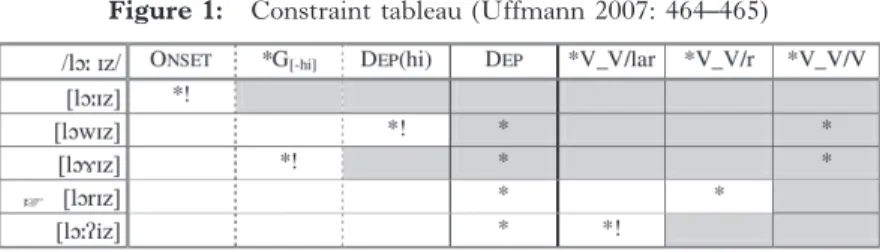
Within OT, the selection of an optimal output form does not mean that it violates no constraint. The optimal output of a given input is the one which violates only the constraint(s) situated lower in a given hierarchy than the most penalizing constraints. Breaking a hiatus by adding a segment within a sequence violates the DEP constraint (i.e.
do not add any material to the input). In the following tableau, fea- turing law is /lɔː ɪz/ as an input, we can see why all potential outputs except the fi rst one violate this constraint:
Figure 1: Constraint tableau (Uffmann 2007: 464–465)
The selection of [lɔrɪz] is justifi ed by the fact that the preceding vowel is non-high and does not allow the hiatus-breaking epenthesis of a high glide such as [j] or [w]. Indeed, the presence of [j] or [w] in a potential hiatus context is usually the result of the spreading of the [+high] feature from the preceding vowel. In the case of sandhi-‘r’, it is usually assumed that only non-high vowels trigger the liaison.
However, it is still necessary to motivate the presence of [ɹ] rather
than a transition such as [ɤ] for example (see [lɔɤɪz] in fi gure 1). We
will not go into further details concerning Uffmann’s constraint rank- ing but will simply point out that his basic intuition is that a hiatus- breaking consonant should be salient enough phonetically, which in his opinion motivates the preference for [ɹ] in English.
Nevertheless, this analysis raises many questions. As we have men- tioned before, the insertion of an anti-hiatus [ɹ] is not a very common strategy in the languages of the world. In contrast, the insertion of a glottal stop is usually motivated for low vowels (see Durand 1987 on Malay). Within Government Phonology analyses, /r/ and the |A|
element have been argued to be linked, but a relation between /r/ and
|@| could be defended as well, given that the reduction of /r/ in English yields schwa. Yet, the |@| element is usually the lowest ele- ment in the sonority hierarchies that have been proposed. Further- more, Uffmann’s analysis, like so many other theoretical studies, suffers from a major drawback: the data presented do not rest on any specifi c observational basis. Varieties under study are presented as evident, while their very defi nition is problematic. Thus, Uffmann only deals with what we have called a type C variety but rules out a sequence such as [lɔːɪz] which is the most penalized candidate in fi gure 1. This type of sequences is however present in the Lancashire and New Zealand corpora that we present below. Similarly, sequences such as [lɔːʔɪz] (also rejected in fi gure 1) are indeed present in our data, even though they are not as common as examples involving ‘r’- sandhi.
Without any data that have been collected according to a precise
protocol, annotated and analyzed systematically, it is impossible to
support or reject the treatments that have been offered within differ-
ent theoretical frameworks. For these reasons, we have decided to
adopt a precise methodology which consists in constructing and ex-
ploiting corpora in a well-defi ned framework, that of the PAC pro-
gram. This is the issue to which we now turn.
The PAC program Protocol
The PAC program (“La Phonologie de l’Anglais Contemporain:
usages, variétés et structure” or “PCE, Phonology of Contemporary English: usage, varieties and structure”) is a sociolinguistic program coordinated by Philip Carr, Jacques Durand and Anne Przewozny. Its main goal is to build a large database of spoken English in its geo- graphical, stylistic and social diversity. This database has strong pho- nological and phonetic foundations allowing for the testing of various contemporary theoretical models, but its ambitions go beyond pho- nology. Indeed, recordings and transcriptions can be exploited for the study of many aspects of English, from lexicon to discourse. In this article however, we will only focus on phonological questions.
The methodology adopted within the PAC program is inspired by the classical work of Labov (e.g. 1966, 1972, 1994, 2001) and relies on the construction of corpora of recordings of spoken English through- out the world. This methodology is similar to that of the PFC pro- gram (see Durand, Laks and Lyche 2003, 2009) and revolves around four registers: the reading aloud of two wordlists focusing on seg- mental phonology; the reading aloud of a text which gives us another access to segmental aspects as well as aspects of post-lexical phonol- ogy (notably ‘r’-sandhi as far as we are concerned here); a formal conversation between the fi eldworker and the informant; and an in- formal conversation involving two or three speakers belonging to the same close network (friends or family members). This latter conver- sation ideally takes place outside the presence of the fi eldworker and is crucial for it offers access to the type of linguistic interaction which involves the least self-monitoring and hyper-correction. It brings our data closer to what can be drawn from surreptitious recordings, an unacceptable method on ethical grounds.
The two wordlists combined with the text and conversations nota-
bly help us determine whether the system under study is rhotic or non-rhotic and explore the consequences of the presence or absence of /r/ on the vowel system. The text resembles a newspaper article and includes many of the segmental oppositions attested in the variet- ies of English. It can be used to test various hypotheses on the post- lexical phonology and prosody of English. As far as we are concerned, it contains several potential sites of ‘r’-sandhi (both linking and intru- sive ‘r’). The protocol we describe here is systematically applied to each survey point although investigators are free to add other ele- ments if they wish (e.g. additional word-lists, short sentences, a map task or a video recording of a meal).
The digitally recorded data are transferred onto a computer and transcribed using Praat (Boersma and Weenink 2009, Boersma 2014).
This software is widely used within the linguistic community. It lets its users align a sound sequence with the corresponding orthographic transcription. It offers the possibility of creating and aligning several tiers containing various types of information. Besides the wordlists and the text, fi ve to ten minutes of both conversations are transcribed (including hesitations, repetitions, truncations, pauses, etc.) using stan- dard orthography without any modification. This methodological choice is the result of a thorough refl ection on the comparability and alignment of transcriptions. Praat’s ability to create several tiers allows us to do away with the necessity of setting up a unique transcription level with complex annotations taking into account many segmental, prosodic or pragmatic features of the data under examination. Simple orthographic transcription combined with a small number of addi- tional conventions ensures the portability of the data and facilitates the devising of search and indexation tools that are effi cient and robust.
We argue below that some phenomena (such as ‘r’-sandhi) can profi t-
ably be studied by simply annotating (coding) our baseline ortho-
graphic transcription on a specifi c tier under Praat.
Transcription, coding and tools
Our coding system for ‘r’-sandhi is inspired by the coding system for French liaison in the PFC program. It aims to provide an accu- rate transcription of the cases of sandhi observed in the auditory analysis (backed with acoustic analysis whenever necessary) and allows for quantitative as well as qualitative analyses by automatic extraction of the codings. The tool we are currently using for the extraction and quantitative analysis is called DOLMEN and was devised by Julien Eychenne (www.julieneychenne.info/dolmen). We will now briefly describe our coding system.
The creation of a tier of orthographic transcription aligned with the signal sets us apart from many corpus-based sociolinguistic projects in which only sequences that are deemed relevant to the study of spe- cifi c variables are transcribed and annotated. While we do not reject this technique, we believe that creating a zero layer of continuous transcription combined with annotation and coding tiers offers sig- nifi cant advances in the treatment of a number of phenomena in con- text.
Our ‘r’-sandhi coding is carried out using the orthographic tran- scription which we duplicate onto an independent tier. This coding is implemented for every (non-rhotic) speaker in the text reading task, fi ve minutes of formal conversation and fi ve minutes of informal con- versation. Two major criteria have led to the elaboration of our coding system: it must be readable and understandable by non-specialists of the subfi eld in question and must offer a global approach of the data.
Thus, we do not code too many details such as the degree of stress of
the left and right syllables involved because of the lack of agreement
among specialists on the relative stress properties of words within the
speech chain. It is however possible to integrate this parameter by
constructing a further tier under Praat specifically devoted to this
dimension (as is done by Navarro 2013). We briefl y return to this
issue further down.
As we have just underlined, our coding system has been devised to offer a fi rst scanning of the data and minimize theoretical preconcep- tions. All sites traditionally considered as potential sites of linking or intrusive ‘r’ are coded. However, we do not sort out these two phe- nomena in the initial stage of the process since, as we have pointed out earlier, this distinction needs to be validated and is universally founded on spelling, thus directly retrievable from our orthographic transcription.
The alphanumeric coding focuses on the following parameters: (i) presence or absence of a sandhi-‘r’, (ii) syllabic makeup of the left word or W1, (iii) syllabic makeup of the right word or W2, (iv) pres- ence of a zone of turbulence or non-linking. To take a concrete ex- ample, a sequence such as more often pronounced [mɔːɹɒfən] would be coded as <more112 often>. In this example, the fi rst fi gure “1” indi- cates that a sandhi-‘r’ is realized. The second fi gure “1” indicates that W1 (more) is monosyllabic and the third fi gure “2” indicates that W2 (often) is polysyllabic. Similarly, the sequence China in February pro- nounced with a so-called intrusive ‘r’ between China and in will be coded as <China121 in February>, since ‘r’ was indeed pronounced (“1”) between a polysyllabic W1 (“2”) and a monosyllabic W2 (“1”).
Let us now look at the coding system more closely. The alphanu- meric notation includes four fi elds, the fi rst three of which are com- pulsory and the fourth one optional.
Field 1:
0: ‘r’ is not realized 1: ‘r’ is realized 2: uncertain realization
3: presence of a non-orthographic word internal (epenthetic) ‘r’ (e.g.
draw[ɹ]ing) Field 2:
1: W1 is monosyllabic
2: W1 is polysyllabic
Field 3:
1: W2 is monosyllabic 2: W2 is polysyllabic
Field 4 (optional) involves the adding of <h> or <rh> after the three fi gures linked to Fields 1 to 3 with the following interpretation:
<h> indicates a zone of “turbulence”, i.e., a glottal stop or a pause or a hesitation. In our broad phonetic transcriptions, we will use the PH (for “pause/hesitation”) notation for such a rough transition.
<rh> indicates the presence of an [ɹ] before a pause, a hesitation or a glottal stop, as in French “liaison non-enchaînée” (unlinked forward liaison).
To illustrate the above remarks, let us consider one more concrete example: brother and sister hypothetically pronounced as [brʌðəɹ PH ənsɪstə]. This sequence would be coded <brother121rh and sister>, where the fi rst “1” indicates the presence of a sandhi-‘r’, “2” indicates that W1 is polysyllabic, the second “1” indicates that W2 is monosyl- labic and <rh> indicates that the sandhi-‘r’ is not directly linked but separated from W2 by a zone of turbulence (for example a period of glottal constriction).
As we have mentioned before, this coding process is only a starting point. Many other factors that are essential to our analyses (particu- larly the nature of the preceding vowel, the degree of stress, the pho- netic quality of the ‘r’ or the syntactic or prosodic domain) are not initially taken into account. Our coding system only offers a fi rst tool to sort out the data which are then submitted to a deeper analysis.
Nonetheless, it is formulated explicitly and applied systematically. It can be examined by other researchers and enriched with extra anno- tations on lower tiers. Consequently, it is an indispensable step in the elaboration of a properly constructed phonological corpus.
The results we would like to present now are based on two spoken
corpora that have been recorded following the PAC methodology
which we have described above. The fi rst one was recorded in 2002
in Lancashire, in north-west England, and the second one was re- corded in 2010 in New Zealand, more specifi cally in the capital of the Otago region, Dunedin.
The PAC Lancashire survey
The PAC Lancashire survey was carried out in southeastern geo- graphical and historical Lancashire, more precisely in the region of Burnley, 30 kilometers north of Manchester. 10 speakers were re- corded during this survey. This fi rst corpus is unbalanced as regards gender since it includes 9 women. However, the speakers represent various age groups and socio-economic backgrounds.
Descriptions of Lancashire pronunciation have often mentioned rhoticity as one of the remarkable characteristics of this part of Eng- land. Upton and Widdowson (1995: 30–31), in An Atlas of English Dialects which synthesizes the fi ndings of the famous SED (Survey of English Dialects coordinated by Harold Orton in Leeds between 1950 and 1961), describe this region as rhotic. Similarly, Wales (2006: 170), in her detailed study of “Northern English”, quotes work such as Trudgill’s (1999: 53) attesting the presence of rhoticity in Lancashire, particularly in the region of Burnley. We do not question the exis- tence of rhotic speakers in Lancashire north of Manchester, but spe- cialists also agree that, in northern England, rhoticity is recessive under the infl uence of what is often called “Estuary English” (Beal 2008: 139–140). Incidentally, the city of Manchester, which has a great linguistic influence over neighboring varieties, is completely non-rhotic. In fact, all of our speakers from the region of Burnley are non-rhotic, which corroborates Ferragne and Pellegrino’s (2010) re- sults who found no trace of rhoticity in their Burnley corpus record- ed in 2003. Although on a modest scale, our study helps to demon- strate the apparently relentless progression of non-rhoticity in England.
It should be obvious that if our speakers were rhotic, the study of
‘r’-sandhi would be impossible. By defi nition, a rhotic speaker pro- nounces every etymological /r/, whether or not this phoneme is fol- lowed by a vowel-initial word. If a speaker of a rhotic variety exhib- ited intrusive ‘r’ (for instance after words like panda, quota, raw, saw, etc.), it would imply that all phonotactic difference between /r/-fi nal and vowel-fi nal words would be eliminated. Pairs such as panda/pan- der or saw/soar would become homophonous. To our knowledge, varieties which are consistently rhotic do not have ‘r’ intrusion. It is therefore essential to make sure that speakers are indeed non-rhotic before applying the codings described above.
As we have mentioned, our coding system does not provide any annotation concerning the quality of linking vowels. It is a key ques- tion for the theoretical interpretation of the data, but it requires the preliminary analysis of the whole vowel system of the speakers under study. Our observations, as well as those of Ferragne and Pellegrino (2010) in Burnley, show that the system is not isomorphic to that of RP mentioned above. Nevertheless, as is the case in all varieties usu- ally described by specialists, only non-high vowels can trigger ‘r’- sandhi. Note that, in this context, the phonetic analyses carried out through our corpus show that prevocalic /r/ is mainly realized as a post-alveolar [ɹ] and in a few cases as an alveolar tap. Yet, the tap never appears in sandhi context where only approximant [ɹ] is at- tested in our observations. The quality of the linking vowel and that of the sandhi-‘r’ are therefore compatible with an interpretation in terms of unary features such as |A| (aperture) or |@| (centrality), as argued in Government Phonology.
Another interesting question for this variety is the relation between
the presence of a sandhi-‘r’ and the behavior of an initial /h/. The
phenomenon described by sociolinguists as “h-dropping” is one of the
most prominent features of the pronunciation of English in northern
England but also in the popular speech of London (Wells 1982, Wales
2006: 177–178, Beal 2008: 137–138). In all varieties of English, an
initial /h/ in a grammatical word is usually not realized in unstressed position, but “h-dropping” actually refers to the non-realization of /h/
in a lexical word. This type of pronunciation is strongly stigmatized in Great Britain. This phenomenon is widely attested in our Burnley survey, even in the reading task, and we have found many occur- rences of ‘r’-sandhi realized before an (orthographic) <h>-initial word, whether lexical (eg. JM1: they’[ɹ]e (h)orrible or fou[ɹ] (h)undred) or grammatical (eg. JM1: fo[ɹ] (h)imself). These pronunciations raise an interesting question for phonological theory. If the initial /h/ is indeed underlying, it must be deleted before the ‘r’-sandhi process, which implies an extrinsic rule ordering (a device found too powerful by most modern generative models). It is however possible that two forms (with and without /h/) are lexically available to the speakers, without involving an actual deletion process. We will leave this ques- tion open for now, but it needs to be solved if one wants to offer an adequate treatment of ‘r’-sandhi.
Let us now examine some of the results yielded by the extraction of our codings. A fi rst observation concerns the rate of realization of sandhi-‘r’ in two different tasks of the protocol: the formal and infor- mal conversations on the one hand, and the reading aloud of the text on the other. The comparison of the rates of realization of ‘r’-sandhi for our Lancashire informants in these two contexts appears in fi gure 2 below.
The fi rst observation we can make is that ‘r’-sandhi is not categor- ical for any of the speakers in this corpus. As we have mentioned, some theoretical treatments consider that the presence of [ɹ] in sandhi contexts is automatic (see our discussion of Uffmann 2007 above).
This is not the case in our corpus since we note such examples as:
(3) Non-realization of ‘r’-sandhi with no pause between W1 and W2 MC1: And when I hear012 Italian, you know
DK1: it’s in your012 exhaust
Moreover, we pointed out that many specialists who favor the hy-
pothesis of generalized ‘r’-sandhi go as far as denying the existence of type B systems (our label) in which linking and intrusion can be dis- tinguished. Our results indicate that the overall rates of realization (all tasks together) are 76% for linking ‘r’ and 38% for intrusive ‘r’
1). In comparison, Foulkes (1997), in the corpus he built in Derby, fi nds 90% for linking ‘r’ and 57.3% for intrusive ‘r’. However, it should be noted that Foulkes withdrew a number of occurrences of non-realiza- tion from his statistics in cases where a clearly perceptible pause was inserted. As we have not excluded such occurrences, we obtain a slightly higher proportion of non-realization and, consequently, slight- ly lower rates.
As regards registers, our Lancashire survey shows that the rate of linking ‘r’ is slightly lower (70%) in the reading task than in the con- versations (78%). Figure 3 below proves that performances are not uniform and that 7 out of our 10 speakers have a greater rate of link- ing ‘r’ in the conversations than in the reading task.
This situation is not comparable to what we observe in French: if we examine the PFC database, we fi nd that the rate of realized liaison is clearly higher in the reading task (59.4%) than in the conversations (43.4%), and this discrepancy is generalized to all speakers (see Du- Figure 2: Individual rates (%) of ‘r’-sandhi in the conversations and text reading task
0 10 20 30 40 50 60 70 80 90 100
DK1 JM1 LB1 LC1 MC1 MD1 MO1 PK1 SC1 ST1 total
Conversation Text
rand, Laks, Calderone and Tchobanov 2011). Besides, in our Lan- cashire survey, the absence of an orthographic <r> does not block intrusive ‘r’. We think that two explanations are possible. First, in spite of purists’ attacks against intrusive ‘r’, the opposition between linking ‘r’ and intrusive ‘r’ does not receive the same attention in English-speaking schools as French liaison does. The latter, as we know, involves explicit learning and plays a more important social and political role than the presence or absence of ‘r’-sandhi in English (Encrevé 1988). Second, our data prove that the prosodic linking of words is necessary to the presence of a sandhi-‘r’. The presence of a PH systematically blocks the sandhi process as in the following ex- ample after wear:
(4) Non-realization of ‘r’-sandhi after a pause/hesitation between W1 and W2
MD1: you had to wear012h indoor shoes when you were112indoor, like plimsolls or
Our informants’ reading performances with slower delivery and oc- casional lack of fl uidity seem to inhibit ‘r’-sandhi in a great number of contexts. In PFC, “liaison non-enchaînée” (unlinked forward liai- son) is extremely rare in conversations but well attested in reading Figure 3: Individual rates (%) of linking ‘r’ in the conversations and text reading task
0 20 40 60 80 100 120
DK1 JM1 LB1 LC1 MC1 MD1 MO1 PK1 SC1 ST1 total
Conversation Text
tasks. We have no example of this type in our corpora and, to our knowledge, it is not discussed in the English literature devoted to ‘r’- sandhi. However, a deeper acoustic analysis of our data revealed a tendency for younger speakers to use “creaky voice” (laryngealization) as a possible hiatus breaking strategy (Mompean and Gomez 2010).
As regards the distinction between informal and formal conversa- tions, we have not noticed any signifi cant discrepancy. The overall rates of realization are 73% in the informal conversation and 79% in the formal conversation. There are, nevertheless, individual differ- ences as some speakers have a higher rate of realization in the infor- mal conversation than in the formal. The number of tokens at our disposal however forces us to use caution in the interpretation of these disparities.
The syllabic weight of W1 and W2 in sandhi context happens to be a relevant factor for which we have more solid results. According to research carried out by Hannisdal (2006) using recordings of BBC World, Sky News and ITV anchors, monosyllabic W1 and W2 words favor ‘r’-sandhi more than polysyllabic W1 and W2 words. Similarly, according to her study, grammatical words trigger more realized ‘r’- sandhi than lexical words. As far as we are concerned, the syllabic makeup of W1 and W2 is clearly a determining factor but only for W1, as can be seen in the chart below (fi gure 4):
l a t o T 2 W c i b a l l y s y l o P 2 W c i b a l l y s o n o M
Monosyllabic W1 78% 75% 77%
Polysyllabic W1 56% 60% 59%
Figure 4: Rates (%) of ‘r’-sandhi realization depending on the syllabic makeup of W1 and W2
If our observations are correct, they correspond to the French state of
affairs where the syllabic weight of W1 is the most crucial factor. The
most frequent W1 words are monosyllabic grammatical words which
are more likely to form fi xed or semi-fi xed phrases with the W2 they specify. This question remains open and, as we enrich our data, our conclusions may agree with Hannisdal’s.
Finally, we wish to briefl y examine the syntactic or prosodic do- main which conditions ‘r’-sandhi in English. As the examples in (5) below show, phrase or even sentence syntactic boundaries do not block the realization of ‘r’-sandhi.
(5)
MO1: I’m not sure111, it looks a bit peculiar.
LC1: Oh, I’m sure111, I’m sure.
MO1: I mean when he, when he was younger121, I mean he was in dra- matics
ST1: I did have a good career121, I worked hard to, to get on the air- line, it wasn’t easy at all.
LB1: Oh yeah, I do have a brother121, I, I haven’t mentioned him on there.
An auditory and acoustic analysis of such examples also indicates that tone group boundaries do not hold back ‘r’-sandhi either. Of course, syntactic structure is relevant but only in so far as it has a prosodic interpretation. As already proposed in the classical work of Nespor and Vogel (1986: 229) on the prosodic hierarchy, we believe that U (for Utterance) is the required domain for ‘r’-sandhi to apply.
The only requirement is complete phonetic fl uidity excluding pauses.
The PAC New Zealand survey
The PAC New Zealand survey, built in late 2010 as we have men-
tioned above, is the most recent of the PAC corpora to have been
used to study rhoticity and ‘r’-sandhi. In as much, it offers the pos-
sibility of supporting or, on the contrary, questioning some of the
results provided by previous corpora, such as the PAC Lancashire
corpus. Indeed, New Zealand English (NZE) and Lancashire English
being two different varieties with distinct origins, histories and evolu-
tions, studying ‘r’-sandhi in both varieties provides a relevant per- spective on the phonological and phonetic characteristics of this phe- nomenon. What is more, the PAC-NZ corpus has benefi ted from the work based on the PAC Lancashire data (Navarro 2013), which has greatly contributed to making it a solid resource that can be analysed in a multi-dimensional way (see Viollain 2014).
For the PAC-NZ oral corpus, 21 informants were initially recorded in Dunedin. This location was chosen because it is the capital of the Otago region which constitutes, with the Southland region, the south- ernmost part of the New Zealand south island. The two regions have always been described as a resistant pocket of rhoticity in a non- rhotic territory (Wells 1982, Bartlett 1992, 2003). In fact, they have a settlement history that is quite different from that of the rest of New Zealand. When New Zealand was colonised from the British Isles in the second half of the 19
thcentury, i.e. after the Treaty of Waitangi (1840), Otago and Southland saw a massive infl ux of Scottish settlers, especially after the discovery of gold in the region in 1861. In the rest of New Zealand, the great majority of the settlers came from England, and more specifi cally from the southern and eastern counties. The census fi gures of 1871 (McKinnon 1997 in Gordon et al. 2004: 444–
445) recorded 51% of settlers coming from England, 27.3% from Scotland and 22% from Ireland. As Scottish variants were the major- ity in Otago and Southland, some Scottish features won out when a local New Zealand dialect emerged (Trudgill 2004), and notably rhot- icity. On the contrary, in the rest of New Zealand, southeastern Eng- lish features were the majority, which contributes to explaining why General NZE, the standard accent in New Zealand today, is non- rhotic. Consequently, the history of Otago and Southland is similar, to some extent, to that of Lancashire inasmuch as these regions are surrounded by non-rhotic varieties and subjected to the pressure ex- erted by standard non-rhoticity.
Dunedin was also chosen as our survey location because it is one of
the four main urban centers in New Zealand, which ensured a diver- sity of potential informants as far as age, sex, socio-economic back- ground and geographical origins were concerned. All the informants in the corpus are Pakeha, which means that they have Anglo-Saxon or European origins, and there are, therefore, no Maori informants in our corpus. Out of the 21 original recordings made in Dunedin, 13 informants were selected. Among the 13 informants that constitute the fi nal corpus, there are 5 men and 8 women, which makes it a rather balanced corpus: 3 informants are between the age of 18 and 20 (2 women and 1 man), 5 informants between 43 and 51 (3 women and 2 men) and 5 informants are between the age of 65 and 76 (3 women and 2 men).
It should be mentioned that an additional reading task, which consists of 14 short sentences (see Viollain 2014), was added to the PAC pro- tocol for the New Zealand survey so as to provide more contexts of
‘r’-sandhi and guarantee more robust statistical results. Our recordings were transcribed and coded according to the conventions defi ned for the PAC program (see above), and the personal information about our 13 informants were compiled into individual profi les which we used to formulate sociolinguistic analyses (see Viollain 2014).
It should also be noted that Otago having long been described as rhotic, we fi rst implemented a coding system to determine whether our speakers are consistently rhotic, non-rhotic or variably rhotic.
These codings revealed that out of our 13 informants, 2 are variably
rhotic, and the rest are consistently non-rhotic. For our 2 variably
rhotic informants (BM1 and LB1), our data showed that they are
undergoing a process of derhoticisation, which means that they are
gradually becoming non-rhotic. Consequently, we decided to apply
the codings for ‘r’-sandhi described earlier to the recordings made
with all our informants as we deemed that they would provide valu-
able information as to the stage of derhoticisation reached by our two
variably rhotic informants. Therefore, we treated these two informants
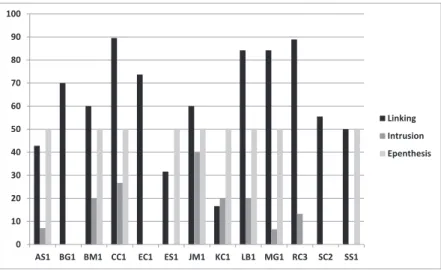
separately from the rest of our consistently non-rhotic informants. For the reading tasks (text and short sentences) and the conversations (formal and informal), we got the following rates of realization of linking ‘r’, intrusive ‘r’ and epenthetic internal intrusion, as shown in fi gures 5 and 6 below.
In total, we extracted 1179 codings of ‘r’-sandhi, 923 of which cor- respond to a linking ‘r’, since an orthographic <r> is present in the transcription, 226 to an intrusive ‘r’ since no orthographic <r> is present in the transcription, and 30 to an internal epenthetic ‘r’ since an [ɹ] is realized word-internally between a vowel-fi nal morpheme and a vowel-initial morpheme, as in drawing. We can establish from our results that, as in the PAC Lancashire corpus, ‘r’-sandhi is not cate- gorical for any of our speakers in any of the tasks, and that the three phenomena under study behave differently in the reading tasks and in the conversations. In as much, the variety of English spoken by our New Zealand informants does not correspond to any of the labels we have described before in our summary of the theoretical accounts of
‘r’-sandhi presented in the literature.
We notice that linking has higher rates of realisation among our
consistently non-rhotic informants (i.e. excluding BM1 and LB1) than
intrusion, with 52,1% of realized linking in the reading tasks and
62,2% in the conversations for 10,3% realised intrusion in the reading
tasks and 46,7% in the conversations. Thus, there is a statistical im-
balance between the rates of realisation of linking ‘r’ compared to
intrusive ‘r’, as was the case in the Lancashire corpus. We also ob-
serve great inter-individual variation between our informants as some
of them have high rates of realisation of linking ‘r’ (RC3 in the read-
ing tasks for example) and others low rates (KC1 in the reading
tasks), and as some of them realise 100% of the potential intrusions in
the conversations (CC1, MG1, RC3) while others do not realise any
intrusion at all, either in the reading tasks or the conversations (EC1,
ES1 and SS1).
0 10 20 30 40 50 60 70 80 90 100
AS1 BG1 BM1 CC1 EC1 ES1 JM1 KC1 LB1 MG1 RC3 SC2 SS1
Linking Intrusion Epenthesis
Figure 5: rates (%) of realisation of linking, intrusion and epenthesis in the reading tasks by the PAC-NZ informants
Figure 6: rates (%) of realisation of linking, intrusion and epenthesis in the conversations by the PAC-NZ informants
0 10 20 30 40 50 60 70 80 90 100
AS1 BG1 BM1 CC1 EC1 ES1 JM1 KC1 LB1 MG1 RC3 SC2 SS1
Linking Intrusion Epenthesis