undergraduates in Japan
journal or
publication title
The Journal of Kanda University of International Studies
number 31
page range 313‑333
year 2019‑03
URL http://id.nii.ac.jp/1092/00001598/
Conducting business case discussions with undergraduates in Japan
Kevin Knight
Abstract
Following Layder (1988) and taking the stance of Schön’s (1983) reflective practitioner, Knight explores and provides an account of his curriculum development decisions that empower his students to participate in business case discussions in two different types of classes, where the instructor is both a content specialist and a language specialist: 1) a business course and 2) a communication course. Knight’s EMI (English as the medium of instruction) and/or content-driven CBI (content-based instruction) methods in the classroom with learners in Japan have been influenced by several factors including Harvard Business School case teaching and publications, Fairhurst’s (2011) focus on framing as the “language of leadership,” Knight’s (2013) personal conceptualization of leadership, and Richards’ (2013) ideas concerning creative teachers.
Conducting business case discussions with undergraduates in Japan
Kevin Knight, Kanda University of International Studies
1. Introduction/Background
Harvard Business School (2014) in an informative and promotional brochure writes of the value of business case teaching:
The case method packs more experience into every hour of learning than any other instructional approach. That’s why it forms the basis of learning at Harvard Business School as well as many other universities around the world. Case studies provide an immersion experience, bringing students as close as possible to real business situations. Judgment and experience lie at the very core of managerial success. There is no better way to develop these leadership skills than through case studies from Harvard Business Publishing.
In agreement with the above, I had found the case method to be one of the means for developing leadership skills (Knight, 2015), based in part on my personal experience as a graduate student who had experienced the case method with HBS materials. In Japan, I adapted the case method to meet the needs of my undergraduate students, and in this paper, I take the stance of Schön’s (1983) reflective practitioner and explore my curriculum development decisions that empowered my students to participate in business case discussions in two different types of classes: 1) a business course and 2) a communication course. In these courses, I am the instructor and qualified as both a content specialist and a language specialist, and my approaches included primarily EMI (English as the medium of instruction) and/or content-driven CBI (content-based
instruction) where language was not the focus of instruction as would be the case in language-driven CBI or an ESP (English for specific purposes) approach. (See Met, 1999, and Abrar-ul-Hassan, 2010.)
My initial experience with the case method and HBS cases in particular was as a graduate student in the Graduate School of International Relations and Pacific Studies (IR/PS) at the University of California, San Diego. (The name of IR/PS was recently changed to the School of Global Policy and Strategy or GPS.) In that rigorous learning environment, I came to understand firsthand the skills needed to succeed in business school learning teams (consisting of my peers) and in case discussions (led by the professors in the classroom). After receiving an MPIA degree (Master of Pacific International Affairs) from IR/PS, I was sponsored and obtained an MBA (Master of Business Administration) degree (summa cum laude) from California State University, Dominguez Hills (CSUDH) in order to facilitate my creation of a program to support CSUDH MBA students in Japan at Kanda Gaigo Career College (KGCC) in Tokyo.
KGCC is a member of the Kanda Group and affiliated with Kanda University of International Studies (KUIS) in Chiba, Japan, which is one of the institutions where I have been teaching cases to undergraduates and Japanese adult learners as Associate Professor in the Department of International Communication. Knight (2011) records my use of Daniels, Radebaugh, and Sullivan (2004) at KUIS to conduct teacher-led class discussions of the intellectual property (IP) system. For enhancing such discussions in the classroom, my previous professional experiences in the private and public sectors, including my part-time work in the International Division of the Japan Patent Office (JPO) and my full-time work as a professional communication trainer and English language teacher in Sony, have been helpful.
The connection between the case method and leadership development were illuminated in my conceptualizations of leadership and of leadership development in my
doctoral thesis (i.e., PhD in linguistics) obtained from Macquarie University in Sydney under the supervision of Emeritus Professor Christopher Candlin and Dr. Alan Jones (Knight, 2015). Based on my research and teaching experience, I came to see that the following activities contributed to the leadership development of my students: online forums focused on leadership, leadership seminars, leadership projects, my students’
leadership related activities off-campus (e.g., part-time jobs) and on-campus (e.g., clubs and projects), their internships (in Japan and abroad), and the English for Business Career courses (EBC 1 to 4) which are focused on preparing students for roles ranging from entry-level company employee to president and founder of a company and included business cases. (I created and taught the EBC courses as one of the founders of the International Business Career (IBC) major at KUIS.)
My ideas about leadership development were expanded during my research trip to two institutions in San Diego, California: 1) GPS at UCSD and 2) the Center for Creative Leadership (CCL), which was ranked worldwide in 2016 as one of the top 5 providers of executive education (Knight, 2017b). It should also be noted that since May 5 in 2015, I have published in the TESOL Blog (in my role as an official blogger of TESOL International Association) and later in ESP News (in my role as editor) over 50 ESP Project Leader Profiles featuring my interviews with leaders of ESP projects on six continents. The profiles were expressed as follows in an email sent to me by a teacher at a university in the USA: “I stop and read each new one you post and feel my knowledge of leadership, different practices and the state of the field are enhanced.” On my website (Knight, 2016) - The Leadership Connection Project: Exploring the conceptualization of leadership worldwide! - can be found my leadership development programs and activities.
Thanks to the guidance of Chris Candlin, I have come to see the world in terms of relationships, and I therefore view my current use of business cases in connection with my past professional and academic experiences, which have led me to seek ways to use
creatively business cases in class discussions.
In the next section (2), I discuss case teaching approaches with my learners in Japan in view of what may be considered best practices. In section 3, I focus on two approaches that were used to conduct business case discussions with undergraduates in Japan.
2. Case teaching
As I have written in the previous section (1), my teaching of cases has been inf luenced by my experience as a graduate student and as a researcher/teacher/trainer/
professor over time. Although I am recognized as having expertise in the ESP field, I may choose to take an EMI approach when I am a content specialist of the subject that I am teaching. An image of EMI based upon the work of various scholars appears in Brown and Bradford (2017, p. 329):
x “The central focus is on students’ content mastery and no language aims are specified” (Unterberger & Wilhelmer, 2011, p. 96).
x “focuses on content learning only” (Smit & Dafouz, 2012, p. 4)
x “an umbrella term for academic subjects taught through English, one making no direct reference to the aim of improving students’ English” (Dearden &
Macaro, 2016, p. 456)
x “English-taught degree programs . . . predominately aim at the acquisition of subject knowledge” (Unterberger, 2014, p. 37).
x “the use of English to teach academic subjects in countries or jurisdictions where the first language (L1) of the majority of the population is not English”
(Dearden, 2015, p. 4)
In view of the above, if I am teaching an International Business course to high-level
English speakers, and the content of the course is based upon an international business textbook written primarily for native English speakers, I prefer to give the students an
“authentic” experience, and my aim is to simulate the kind of classroom experience that the students might have in a similar course in the United States. In other words, I am not teaching business English. I am teaching international business as I would to a class of native English speakers. However, if the materials intended for native English speakers are difficult for the Japanese students to handle, I look for ways to make the class interesting and to make the authentic materials more manageable for the Japanese students, but my focus is still on the content and not on the language. In this sense, I am still using an EMI or a content-driven CBI approach with scaffolding.
From a content-driven perspective, I strive to emulate the content experts in teaching the subject matter. I have found material helpful for teaching business cases and for leading case discussions from three Harvard sources. First, the expertise of business case teaching is apparent in the following 28 tips from an HBS professor (Shapiro, 2014, pp.
1-6):
1. “Case teaching is very much a mixture of art and skill.”
2. “Do not strive or expect to simulate another teacher’s style or approach.”
3. “Have reasonable expectations for each class, and understand that some will be better than others.”
4. “The best advice is to use case discussions to accomplish what they can do better than other pedagogical methods.”
5. “Establish an explicit contract with the students by showing your expectations about their performance and yours early in the course.”
6. “Stress very early in the course the importance of student preparation, presence, promptness, and participation.”
7. “Show your commitment to the case discussion process by complete preparation of material and concern for student development.”
8. “Have a complete set of teaching objectives and a copious collection of likely board structures and questions.”
9. “Have the students accept and maintain ownership of the discussion.”
10. “Avoid making a choice about the case decision, but force each student to do so.”
11. “All students should be expected to have a plan of action for the protagonist in the case.”
12. “Understand that in the discussion process, action drives analysis.”
13. “Use themes to manage the discussion. Themes include topics, areas of analysis, and decisions.”
14. “Use questions to manage the trade-off between depth and breadth, and to heighten conflict.”
15. “Clarify and heighten conflicts.”
16. “Use questions of various types for various purposes.”
17. “Use the board to clarify conflicts and issues.”
18. “Listen.”
19. “Provide respect and protection to students and their comments.”
20. “Use humor carefully and constructively.”
21. “Only do that which is personally comfortable in class.”
22. “Body language can be used to help pace the class and manage the discussion.”
23. “Help students talk to one another.”
24. “Make the class an enjoyable experience.”
25. “Use summary and ‘offline’ lectures to deliver general comments or
important related material.”
26. “Nurture the discussion process even if that means trading off some coverage of a case.”
27. “Put particular emphasis on the development of a good discussion process in early classes, especially the first two.”
28. “Strive for excellence.”
In view of the excellence of HBS and its fame for the case method, I consider these 28 tips to be representative of “best practices” in conducting business case discussions with undergraduates in Japan where I am the leader of the class discussion (as was the case in the business course that is explored in this paper).
On the other hand, the aim of the communication course that I teach is to empower student teams to prepare, lead, and participate effectively in the business case discussions for which they select the material. The focus of the (communication) course is on the communication that occurs in a case discussion. Two additional Harvard publications describe best practices for team projects, such as preparing for and leading a case discussion. One of the publications is concerned with innovative teams and contains advice about establishing rules of contact (Extract 1). The other focuses on essential discipline in project management (Extract 2). The two extracts (1 and 2) are from email addressed to the students. Extract 1 was replicated from Harvard Business Review (2015, pp. 43-45).
Extract 1
Start with four rules that are appropriate for any creative group:
1. Respect all members of the group. Ideas and assumptions may be
attacked; individuals may not.
2. Be a good listener. Everyone will have the opportunity to speak and should actively listen to others.
3. Value varying points of view. Everyone has the right to disagree and challenge assumptions. Conflicting views are a valuable source of learning and should be welcome when raised at the appropriate time in the discussion.
4. No idea is a bad idea. No idea should be deemed “bad,” “stupid,”
“useless,” or any other negative descriptor that can shut down creative thinking.
Next, team members can work together to define additional norms based on the unique preferences and working styles of those in the group….With rules of interaction in place, you can now move on to generating creative ideas.
Extract 1 was shared with the students as recommendations for working effectively together. The second Extract (2) is replicated from Harvard Business Review (2012, pp.
108-109).
Extract 2
A team’s essential discipline comprises five characteristics:
1. A meaningful purpose that the team has helped shape. Most teams are responding to a mandate from outside the team. But to be successful, the team must “own” this purpose, develop its own spin on it.
2. Specific performance goals that flow from the common purpose…
3. A mix of complementary skills…
4. A strong commitment to how the work gets done. Teams must agree
on who will do what jobs, how schedules will be established and honored, and how decisions will be made and modified. On a genuine team, each member does equivalent amounts of real work; all members, the leader included, contribute in concrete ways to the team’s collective work-products.
5. Mutual accountability. Trust and commitment cannot be coerced…
Once the essential discipline has been established, a team is free to concentrate on the critical challenges it faces.
In Extract 2, the first point is especially relevant to Section 4 in this paper that focuses on
“framing the problem” in a discussion. Following Layder (1998) in view of these best practices, this paper is my account of my own classroom performances. In writing this paper and reflecting on and discussing my teaching performances, I am striving for excellence, as Shapiro advises in point 28 above.
3. Two approaches to conducting business case discussions with learners in Japan
Two approaches were used to conduct business case discussions with students at two different universities, including KUIS which was ranked number 33 among all Japanese universities at the time. The other Japanese university, which I choose not to mention by name in this paper, had a higher ranking. My aim is to illuminate the approaches that I used to teach my classes and the effectiveness of those approaches so I discuss my interactions with the participants in connection with the courses (i.e., business or communication), but I do not reveal the specific institutions to which those participants belong. An overview of the objectives, participants, materials, and methods can be seen in Table 1.
Table 1. Overview of courses and participants
Business course case discussions Communication course case discussions Objectives To replicate in Japan a case
discussion in a business course in the United States where the students participate actively
To empower the students to work in teams to plan, lead, and participate in case discussions
Participants The students were primarily Japanese, and the majority of the students found the content of the textbook to be challenging but not overwhelming.
Half of the students were Japanese and the other half of the students were primarily from the United States and Europe.
Materials The class discussed the cases in the global edition of a textbook intended for native-English speakers.
The student teams selected case discussion materials accessible online.
Approaches A teacher-led discussion following Shapiro (2014)
A student-team led discussion where cooperation among team members was essential
In the light of the overview in Table 1 and in order to enhance the case discussion performances of the students, I took a few key steps:
1. Business course
a. Showed to the students a video of a case discussion as a model of what I wanted to create in the course.
b. Assigned the students to teams in which they discussed the cases and wrote and submitted a team case report in advance of the case
discussion in class.
c. Asked students to create name plates that they displayed during a case discussion.
d. Asked students to record the number of times that they spoke during each case discussion, which I used in part to grade student performances.
e. Increased opportunities for students to earn points during a case discussion; for example, the students were asked a question about the case and given a point if they could tell the answer to a partner.
f. Used the board to record what was being discussed.
2. Communication course
a. Showed to the students a video of a case discussion as a model of what I wanted to create in the course.
b. Used TED Talk videos to share lessons about communication that could be used by the students to improve their case discussions.
c. Asked the students to evaluate the performance of the team that led a discussion as well as the performances of individual students who participated in “communication displays.”
d. Used email to share the recommendations of students for improving team performance.
e. Used email to offer my own recommendations for improving individual and team performances in planning, creating, leading, and participating in case discussions.
During the courses, I recognized that the key to a great discussion is leadership, and in
the next section (4), I discuss the relevance of leadership and framing, which has been called the language of leadership (Fairhurst, 2011).
4. The relevance of leadership and framing
Knight (2017a) refers to two publications in clarifying my conceptualization of leadership:
x Leadership [is] a communication process consisting of two parts: 1) communicating to create a vision and 2) communicating to achieve a vision (Knight, 2013).
x Leadership is making real a vision in collaboration with others (Knight and Candlin, 2015, p. 36).
My perspective of leadership as a creative activity has influenced how I have come to teach case discussions. I have a “vision” of what a case study should be, and in my communication course, I shared parts of this vision with my students through e-mail that included my comments on the students’ performances in class.
My written messages to my students focused on “control” of the discussion.
However, in class, we discussed the importance of “framing,” which I believe is one of the keys to a good discussion. The student teams in the communication class had the tendency to think that they needed to lead a case discussion to a specific conclusion.
According to Ellet’s (2007, p.12) handbook on case studies:
Students provide most of the content of a case discussion. They are indispensable to the creation of knowledge. In fact, if they don’t come to class well prepared, the case method will fail because the people responsible for making meaning from the case are not equipped to do it. In a lecture-, or expert-based, teaching method, facts
tend to be configured in a way that yields a single interpretation, the “truth.” Case discussions are replete with facts and information, but they aren’t shaped into a single truth.
Ellet is writing about HBS cases. In the communication, course, however, students usually selected much shorter cases that could easily be obtained online. In order to conduct interesting discussions, the student team leading the discussion needed to frame the case in a way that allowed students to interact with the materials, draw upon their own experiences, share their insights, and create knowledge as a group.
In e-mail sent to my students, I communicated the following:
Extract 3
I was pleased that everyone seemed to be contributing in the last discussion. On the other hand, it felt like a question and answer session, not a problem solving discussion that creates new knowledge.
My advice (in short) to the students was to do the following in 45 minutes: 1) present the problem, 2) elicit ideas from others, and 3) reach agreement about a solution (if possible).
The case discussion would take the form of a business meeting.
Another challenge was to get all of the members from both teams to contribute to the discussion. The members of the team responsible for leading the discussion took turns leading parts of the discussion, and otherwise, they did not speak. Leading a discussion usually meant asking questions to members of the other team. When I asked one student from Europe about this, she replied that it was not her assigned role to contribute to the discussion when she was not the leader.
As a way to help the students to develop their discussion skills, I would have them
watch TED Talks. In connection with a TED Talk about leadership that focused on how great conductors use different levels of control with the musicians in their orchestras, I wrote to the students:
Extract 4
I hope that you are beginning to realize through experience that "leadership" is the key to achieving a great discussion. As we saw in the TED Talk about the great conductors, a leader can "control" a discussion in such a way as to maximize the creativity and contribution of the participants in order to achieve a goal; e.g., an amazing concert performance in which all stakeholders are satisfied.
In that email, I also asked the students to imagine framing a case in the following way:
“You are the CEO of the company. What would you do in the situation described in the case?” This question was to be asked by one discussion leader to all of the other students in the class. I was encouraging the students to learn from each other during the discussion, as they focused on identifying the options and exchanged views on the best course of action. In the next section (5), I reflect on my actions and share my conclusions.
5. Discussion and conclusions
In the previous section (4), I discussed how Fairhurst’s (2011) focus on framing as the “language of leadership” and my conceptualization of leadership have had a significant influence on how I approach case discussions with learners in Japan.
Shapiro’s (2014) tips have also resonated with me, especially the following:
x “Case teaching is very much a mixture of art and skill.”
x “Do not strive or expect to simulate another teacher’s style or approach.”
x “Have the students accept and maintain ownership of the discussion.”
x “Avoid making a choice about the case decision, but force each student to do so.”
x “All students should be expected to have a plan of action for the protagonist in the case.”
x “Help students talk to one another.”
x “Make the class an enjoyable experience.”
x “Use summary and ‘offline’ lectures to deliver general comments or important related material.”
x “Nurture the discussion process even if that means trading off some coverage of a case.”
x “Put particular emphasis on the development of a good discussion process in early classes, especially the first two.”
x “Strive for excellence.”
These tips apply to both types of courses: 1) the business course, and 2) the communication course.
As Shapiro writes above, case teaching involves art and skill, and I also agree that
“creativity” and “expertise” are important factors in the success of a case discussion.
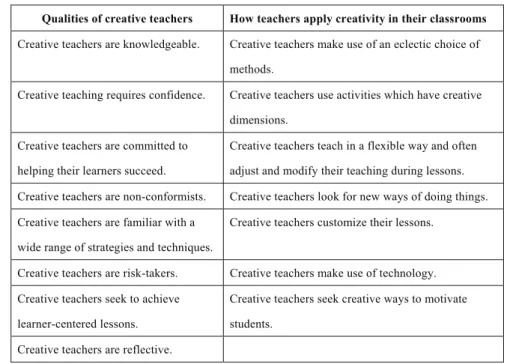
Richards (2013) highlights creative teachers in a plenary address. (See Table 2.)
Table 2. Creative teachers
Qualities of creative teachers How teachers apply creativity in their classrooms Creative teachers are knowledgeable. Creative teachers make use of an eclectic choice of
methods.
Creative teaching requires confidence. Creative teachers use activities which have creative dimensions.
Creative teachers are committed to helping their learners succeed.
Creative teachers teach in a flexible way and often adjust and modify their teaching during lessons.
Creative teachers are non-conformists. Creative teachers look for new ways of doing things.
Creative teachers are familiar with a wide range of strategies and techniques.
Creative teachers customize their lessons.
Creative teachers are risk-takers. Creative teachers make use of technology.
Creative teachers seek to achieve learner-centered lessons.
Creative teachers seek creative ways to motivate students.
Creative teachers are reflective.
Table 2 reflects my attitude and activities in both the business course and the communication course. I argue that a case discussion needs to be mentally stimulating.
The participants need to learn from each other and to have fun in the process. In order to create such a learning environment, creativity and expertise are required.
In exploring how creativity, expertise, and risk taking are related, Knight (2014) quotes Benner (1984, pp. 31-32) in Candlin (2002):
The expert performer no longer relies on an analytic principle (rule, guideline, maxim) to connect his or her understanding of the situation to an appropriate action.
In the classroom, I try to create “interesting” discussions in which the students are able to participate actively and to learn from each other. (From a metaphorical perspective, leading a discussion feels like surfing in the ocean, as you stay alert, relax, and move to catch and ride the wave. It is an enjoyable experience that combines art and skill.) My approach seems to have been well received by the students in the business course. In the communication course, one of my students commented that I should lead the discussions because I am good at doing so, but in that course, my aim is to empower my students themselves to excel in discussion leadership. In conclusion, it may be a good idea for me to accept my student’s recommendation in the communication course and lead short, model discussions, more frequently and reflectively. My students might benefit from my example, and in addition, I would have the opportunity to become more aware of how I lead a discussion. I could then pass on this knowledge to my students. Most importantly, I plan to follow Shapiro (2014) and always strive for excellence in creating outstanding case discussions.
6. References
Abrar-ul-Hassan, S. (2012). State-of-the-art review: Revisiting the ins and outs of ESP practice.
Professional and Academic English, 39, 4-11.
Benner, P. (1984). From novice to expert: Excellence and power in clinical nursing practice. Menlo Park, CA: Addison-Wesley.
Brown, H., & Bradford, A. (2017). EMI, CLIL, & CBI: Differing approaches and goals. In P. Clements, A. Krause, & H. Brown (Eds.), Transformation in language education. Tokyo: JALT.
Candlin, S. (2002) Taking risks: An indicator of expertise? Research on Language and Social Interaction, (35)2, 173-193.
Daniels, J.D., Radebaugh, L.H., & Sullivan, D.P. (2004). International business: Environments and operations (10th ed.). Upper Saddle River: Pearson Education.
Dearden, J. (2015). English as a medium of instruction – A growing phenomenon. London, UK: British Council.
Dearden, J., & Macaro, E. (2016). Higher education teachers’ attitudes towards English medium instruction: A three-country comparison. Studies in Second Language Learning and Teaching, 6, 455-486.
https://doi.org/10.14746/sllt.2016.6.3.5
Ellet, W. (2007). The case study handbook: How to read, discuss, and write persuasively about cases. Boston, MA: Harvard Business School Press.
Fairhurst, G. (2011). The power of framing: Creating the language of leadership. San Francisco, CA: Jossey Bass.
Harvard Business Press (2014). Hints for case teaching [Brochure]. Boston, MA: Harvard Business School Publishing.
Harvard Business Review. (2015). Innovative teams (HBR 20-minute manager series). Boston, MA:
Harvard Business Review Press.
Harvard Business Review. (2012). HBR guide to project management (Harvard business review guides). Boston, MA: Harvard Business Review Press.
Knight, K. (2011). Teaching intellectual property (IP) English creatively. In A. Stewart (Ed.), JALT2010 Conference Proceedings. Tokyo: JALT.
Knight, K. (2013, December 3). Looking at communication through a leadership lens [Web log post]. Retrieved from
http://blog.tesol.org/looking-at-communication-through-a-leadership-lens/
Knight, K. (2014, August 26). Taking risks in ESP – A sign of expertise? [Web log post]. Retrieved from http://blog.tesol.org/taking-risks-in-esp-a-sign-of-expertise/
Knight, K. (2015). Analysing the discourses of leadership as a basis for developing leadership communication skills in a second or foreign language (Doctoral dissertation). Macquarie University, Sydney, Australia. Retrieved from
http://www.researchonline.mq.edu.au/vital/access/manager/Repository/mq:42732
Knight, K. (2016). The leadership connection project: Exploring the conceptualization of leadership worldwide! [Website]. Retrieved from
https://leadershipconnectionproject.wordpress.com/
Knight, K. (2017a). English for specific purposes project leader profiles. The Journal of Kanda University of International Studies, 29, 187- 206.
Knight, K. (2017b, April 25). Leadership research in the west for students in the east [Web log post].
Retrieved from
http://blog.tesol.org/leadership-research-in-the-west-for-students-in-the-east/
Knight, K., & Candlin, C.N. (2015). Leadership discourse as basis and means for developing L2 students into future leaders. In P. Shrestha (Ed.), Current developments in English for academic and specific purposes: Local innovations and global perspectives (pp. 27-50). Reading, UK:
Garnet.
Layder, D. (1998). Sociological practice: Linking theory and social research. London, UK: Sage.
Met, M. (1999). NFLC reports – Content-based instruction: Defining terms, making decisions.
Washington: The National Foreign Language Center. Retrieved from
<http://www.carla.umn.edu/cobaltt/modules/principles/decisions.html>.
Richards, J.C. (2013, June 5). Creativity in language teaching [Plenary address]. Summer Institute for English Teacher of Creativity and Discovery in Teaching University Writing, City University of Hong Kong. Retrieved from
https://www.professorjackrichards.com/wp-content/uploads/Creativity-in-Language-Teaching.pdf Schön, D. (1983). The reflective practitioner: How professionals think in action. New York, NY:
Basic Books.
Shapiro, B.P. (2014). A Harvard business school case study. In Hints for case teaching [Brochure].
Boston, MA: Harvard Business School Publishing.
Smit, U., & Dafouz, E. (2012). Integrating content and language in higher education: An introduction to English-medium policies, conceptual issues and research practices across Europe.
AILA Review, 25, 1-12. https://doi.org/10.1075/aila.25.01smi
Unterberger, B. (2014). English-medium degree programmes in Austrian tertiary business studies:
Policiesand programme design (Doctoral dissertation). University of Vienna, Austria.
Retrieved from
http://othes.univie.ac.at/33961/
Unterberger, B., & Wilhelmer, N. (2011). English-medium education in economics and business studies: Capturing the status quo at Austrian universities. International Journal of Applied Linguistics, 161, 90-110.