3
Copyright@SPSD Press from 2010, SPSD Press, Kanazawa
Disaster Management in Coastal Tourism
Destinations: The Case for Transactive Planning and Social Learning
David Nguyen¹*, Fumihiko Imamura² and Kanako Iuchi2
¹Department of Civil and Environmental Engineering, Graduate school of Engineering, Tohoku University
²Tsunami Engineering, International Research Institute of Disaster Science,Tohoku Univeristy
* Corresponding Author, Email:[email protected] Received 12 June, 2015; Accepted 25 October, 2015
Key words: Tourism, Disasters, Urban Planning, Social Learning
Abstract: Due to its intrinsic scenery, many tourism destinations are located in areas that are exposed to various natural hazards such as tsunamis, volcanic eruptions, and high winds. In particular, coastal tourism presents numerous risks unique to the tourism sector due to differences in the type of vulnerabilities faced by tourists compared to other types of communities. Tourists are transient, may lack knowledge of local hazards, perceive risks differently, and may present various communication barriers. Physical mitigation may also be limited as local communities rely on the preservation of the area’s natural assets.
Research on the effects of disasters in tourism destinations have generally fallen into the categories of emergency management, which is focused on the preparedness and response phases, or solutions, adopting a structural engineering approach. Long-term solutions that utilize non-structural approaches have been acknowledged as vital towards mitigation in various literatures, but in reality, have been scarcely applied. As disasters can constitute a wicked rather than tame problem, long-term solutions should include the input of multiple stakeholders striving towards a working solution that is constantly updated through feedback loops. Urban planning can provide such theoretical backgrounds that are missing from tourism planning studies, but have thus far, been limited to the needs of the permanent communities and not the transient community. This paper examines literature on disaster management planning in coastal destinations and bridges the gap between the fields of urban planning, disaster management and tourism planning, by suggesting the utilization of social learning to address disaster management gaps found in existing literature.
1. INTRODUCTION: COASTAL TOURISM AND NATURAL HAZARDS
Tourism is a major source of income, investment, and employment for coastal communities. The World Trade Organization believes that tourism has the capacity to stimulate development, economic growth, and create new opportunities for poverty alleviation and self-governance, especially in regions that are resource scarce or have limited livelihood options (World Tourism Organization, 2005). Regions in economic decline as well as
remote areas, such as islands, have used tourism as a means to revitalize their economies, promote investment into the region and job creation.
However the tourism economy contains a number of vulnerabilities that are unique to the industry. As many tourism products rely on the intrinsic assets of the local environment, tourism sites are often located near areas that are exposed to natural hazards such as high winds, volcanic activity, storm surges, tsunamis and sea level rise. As tourism is a major user of local infrastructure which includes transportation networks, electrical systems and water supply systems, disruption to these services can have negative repercussions for tourism, both short and long-term, leading to eroding destination image (Byrd, 2007; Huan, Beaman & Shelby, 2004).
In December 2004, a magnitude 9.1 earthquake occurred southwest of Sumatra Island generating massive tsunamis that directly devastated six countries in the Indian Ocean. In the case of Thailand, the tsunami contributed to the country’s worst natural disaster with over 5,300 confirmed deaths, nearly 3,000 missing, and losses accounting nearly a quarter of the national GDP (Rosa, 2012). Heavily dependent on the tourism industry, the tsunami was a major blow to the Thai economy as half of the confirmed deaths consisted of tourists (Thanawood, Yongchalermchai &
Densirisereekul, 2006). The loss of tourism confidence led to a sharp decline in tourism, affecting locals whose livelihoods relied on the visitor industry.
Factors contributing to large loss of life include limited utilization of tsunami sirens, lack of tsunami signage, poor hazard knowledge of tourists, limited evacuation training and conflicts over responsibilities (Calgaro & Lloyd, 2008).
Tourism represents a paradox as on the one hand, the industry relies heavily on positive images of safety, stability and low risk, but on the other, the intrinsic aspects that the industry is built upon are often vulnerable to natural hazards. In other words, tourism is considered a risky industry (Sonmez, Apostolopoulos & Tarlow, 1999). In order to reduce this risk, disaster management planning should prioritize improving the destination’s resiliency. In clarifying the differences between resistance and resilience, Jonientz-Tristler describes resistance as actions where the effects of a disaster can be opposed. In contrast, resilience implies that efforts, products, and policies can promote the ability of a community to bounce back from an inevitable disaster event. Although natural hazard events are uncontrollable, its outcomes can be managed (Jonientz-Trisler, 2001).
2. VULNERABILITIES IN COASTAL TOURISM
Lindell’s Disaster Impacts Model identifies three characteristics that provide insight into how hazards influence physical and social vulnerabilities.
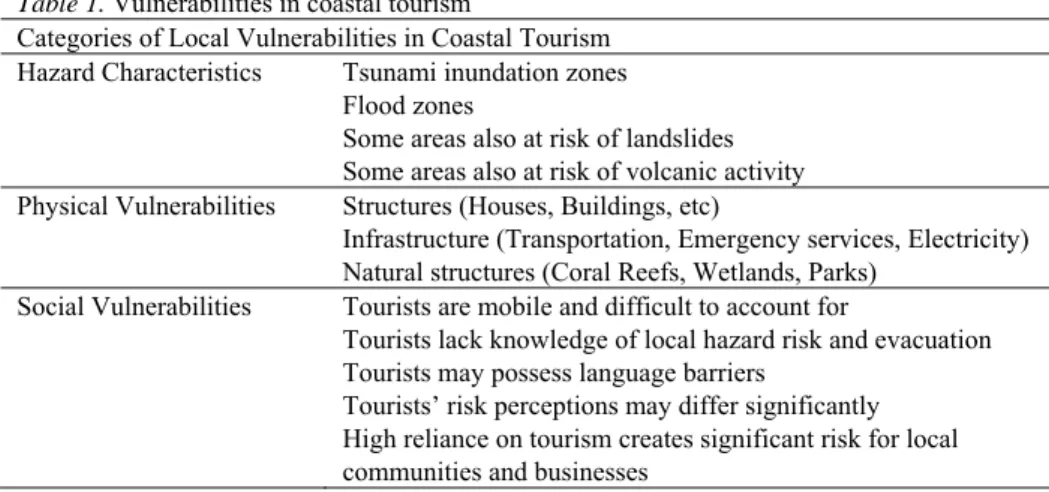
First, hazard characteristics identify the degree of exposure of natural hazards to a particular area. Next, physical vulnerabilities examine what type of structures, infrastructure and natural environments are susceptible to damage and loss based on the interaction between exposure and physical characteristics. Finally, social vulnerability examines the impacts of a disaster on a community group and their type of susceptibility (Lindell, Prater & Perry, 2006). Building upon these three characteristics, Table 1, below, modifies and summarizes it within the context of coastal tourism.
Table 1. Vulnerabilities in coastal tourism
Categories of Local Vulnerabilities in Coastal Tourism Hazard Characteristics Tsunami inundation zones
Flood zones
Some areas also at risk of landslides Some areas also at risk of volcanic activity Physical Vulnerabilities Structures (Houses, Buildings, etc)
Infrastructure (Transportation, Emergency services, Electricity) Natural structures (Coral Reefs, Wetlands, Parks)
Social Vulnerabilities Tourists are mobile and difficult to account for
Tourists lack knowledge of local hazard risk and evacuation Tourists may possess language barriers
Tourists’ risk perceptions may differ significantly High reliance on tourism creates significant risk for local communities and businesses
Hazard characteristics discuss the types of natural hazard vulnerabilities a coastal tourism area may be exposed to. Each area’s hazard characteristics vary from one another due to their unique geography. For example, Hilo City in the State of Hawaii has experienced multiple tsunamis, leading to the city declaring much of its coastal zone a tsunami evacuation area. However, other coastal cities such as Beppu, in southern Japan, are exposed to both volcanic and tsunami risks due to its proximity to the Pacific Ocean and Mount Tsurumi, an active lava dome.
Physical vulnerabilities examine the exposure of natural and built structures to the aforementioned hazard characteristics. As tourism relies on sites to generate consumption, a number infrastructure found in the destination are also exposed to hazards. For example, coastal tourism may include a number of beaches, which in turn rely on the creation of nearby transportation infrastructure for accessibility, businesses to provide services and accommodation to be provided in the hazard area. In addition to built structures, the condition of natural structures can also influence vulnerability as the lack of mangroves, coral reefs, wetlands and open areas can increase an area’s susceptibility to inundation (Klee, 1998).
Social vulnerabilities in coastal tourism examine both the transient population and the long term population which, while sharing the same hazard characteristics, may differ in social vulnerabilities. Tourists themselves present unique vulnerabilities as they are mobile, difficult to account for, may present communication and language barriers and are not easy to reach with relevant information such as warnings (Byrd, 2007).
Tourists’ risk perceptions may also differ as personal experiences with certain types of disasters may lead to higher risk aversion leading to reluctance to take action during a disaster event.
Communities dependent on the tourism economy are vulnerable to external shocks such as fluctuations in energy prices, currency rates, conflict, epidemics, or externally generated disaster (Table 2, below). Shocks can cause simultaneous losses for household, community, regional and national actors, diminish investment confidence, lower rates of job creation, slow economic growth and reduce GDP (Calgaro & Lloyd, 2008; Ritchie, 2009).
In the case of Japan, tourism numbers decreased following the invasion of Iraq in 2003, the SARS epidemic in 2003, the Great East Japan Tsunami and Earthquake in 2011, and increased tension over the Senkaku Islands dispute in 2012 (Cooper, 2005; Kimura, 2012). In terms of recovery, tourism industries can struggle to rebuild its branding or image. The terrorism incidents in Bali, and more recently in Tunisia, deterred many tourists from returning and instead opt for alternate destinations that offer similar
environments (Prideaux, Laws & Faulkner, 2003). For communities reliant on the tourism economy, prospects for recovery are delayed as the working force struggles to return to their old professions and may be forced to adopt new ones.
Table 2. Five factors that explain vulnerabilities of tourism economies to external shocks.
Adapted from Calgaro & Lloyd (2008)
1. Place-specific nature of tourist activity
2. Fragility of destination images to negative perceptions of risk 3. High dependency on tourism as a primary livelihood
4. Heavy reliance on the marketing strategies of international tour operators
5. High levels of seasonality
Despite these vulnerabilities, several factors contribute to the persistence of communities residing in areas exposed to natural hazards. The first detriment of people’s behavior in the face of hazards is often livelihoods.
People may choose to risk living in a hazardous area for the assurance of a better everyday life because it allows access to sustainable livelihoods (Dove, 2007; Kelman & Khan, 2013). Even in developed countries, people can move out of the city towards hazardous areas in search for a better quality of life (Chester, 2005).
Cultural and historical factors also contribute to people’s attachment to a particular area despite a history of natural hazard risks. Residents living near volcanic hazard areas in Martinique demonstrate that the spatial dimension of risk perception is closely related to experience or memory of past eruptions (D'ercole & Rancon, 1994). A wide range of studies by anthropologists further show how traditional societies are strongly bonded to the volcano they live on and how their perception of associated risk is biased (Quesada, 2007). In the case of the Tohoku region of Japan, some residents who relied on the fishing industry were reluctant to relocate to higher ground, opting to stay closer to the industries near the coastline (Ranghieri &
Ishiwatari, 2014).
For business owners in coastal tourism destinations, literature has identified numerous problems in the implementation of disaster management policies. First, the tourism industry tends to be poorly prepared for natural disasters, taking almost fatalistic or passive approaches (Cioccio & Michael, 2007; Faulkner, 2001; Prideaux, et al., 2003). Gaps in awareness and implementation of these policies stem from negative attitudes towards crisis planning, perceived lack of responsibility for dealing with crises, lack of money, lack of knowledge, lower risk perception, small size of organisations and perceived lack of cohesiveness due to firms being private (Wang &
Ritchie, 2013). In addition, tourism operators are concerned with false alarms which affect destination image and businesses more so in their sector than compared to others (Becken & Hughey, 2013; Murphy & Bayley, 1989).
For example, in 1990 local businesses in Mammoth Lakes, California, reacted negatively after geologists issued a false alarm, by stating that they would rather take their chances with a restless volcano than yield into fears that could harm the economy (Blakeslee, 1990).
Businesses that are willing to cooperate may lack sufficient resources to accommodate tourists’ needs during disasters, or maintain knowledge of hazard risks and evacuation procedures. Tourism planning literature suggests that much of the current disaster plans in tourism are focused on post- disaster phases, and should shift from response and recovery to reduction and readiness (Ritchie, 2009). Long term strategies should not only include long-term disruptions caused by inundation, which in turn are caused by
tsunamis, but also sea level rise and swells that cause major floods (Carlsen, 2006).
Managing these risks requires good governance to be efffective, essentially confidence in the rule makers by those to whom the replies.
Effective risk management requires engagement at all levels in identifying, prioritizing, warning, and informing, or in other words, building capacity, about potential risk (O'Brien, O'Keefe, Gadema, & Swords, 2010). As risk is a social construct, its relationship to the various stakeholders represents a chain of interconnectedness between them. Distancing an actor in the chain lessens the effectiveness of risk management (O'Brien, et al., 2010).
3. APPROACHES TO DISASTER MANAGEMENT IN COASTAL TOURISM
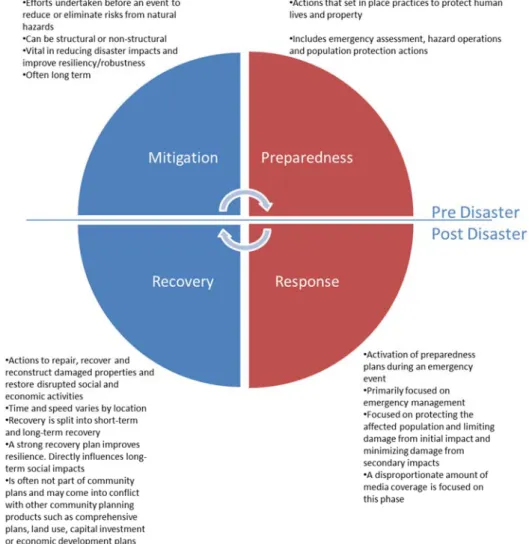
Figure 1. Four Disaster Phases. Modified from Masterson, et al. (2014) and UNEP (2007)
Literature on disaster management categorizes disasters into four phases:
hazard mitigation, disaster preparedness, disaster response and disaster recovery (Queensland Government, 2015). Additional variants of the disaster phases cycle exist, such as Faulkner’s Disaster Management Framework, Robert’s Disaster Crisis Model and Fink’s Crisis Management Cycle, which expand from the original four to a larger number of phases that offer greater detail into the disaster cycle, especially in the emergency management aspect (Faulkner, 2001).
Masterson et al. offer detailed explanations of the four phases. Firstly, hazard mitigation is defined as actions taken to reduce or eliminate risk from natural hazards. Mitigation strategies can be structural or engineering solutions, such as seawalls, or non-structural, such as land-use policies, zoning and education. Following mitigation, preparedness refers to practices that protect lives and property with threats that cannot be achieved by mitigation or are partially controlled. Preparedness strategies include various emergency management functions such as emergency assessment, hazard operations, warning and evacuation training (Figure 1) (Masterson et al., 2014).
Between the preparedness and response phase is a disaster event. The response phases are actions focused on the protection of an affected population, limiting damage from initial impact and to reduce the damage from further impacts. The ability to prepare and respond varies depending on the lead time of a natural hazard. For example, tropical storms offer more time for communities to prepare than sudden disasters such as earthquakes.
Following response is the recovery phase which is further broken down into short and long-term recovery. Generally, the recovery phase focuses on actions seeking to prioritize the reconstruction and recovery of damaged properties, especially vital infrastructure and restoration of disrupted social and economic activities. Short term recovery focuses on the immediate restoration of infrastructure and services needed by society to function at a basic level, however long term recovery focuses on social and economic vulnerabilities that can last years after the disaster event (FEMA, 2004). A strong recovery plan improves resilience and directly influences long-term social impacts (Masterson et al., 2014).
Although Figure 1 suggests equal emphasis on the different phases of the cycle, Masterson states that in practice, emphasis is often placed on the response. Reasons for the bias stem from the proliferation of media coverage that focuses primarily on the disaster event and the following responses which generate the most interest. In contrast, long term recovery, mitigation and preparedness generate considerably less, if any media interest.
Masterson identifies four types of capital whose accessibility directly influences a community’s resilience to natural hazards: social, economic, physical and human. Social capital consists of social organizations, such as networks and social trust, that facilitate coordination and provides an informal safety net during disasters while assisting the community in accessing resources. Economic capital is economic resources that increase the ability and capacity of individuals and the community to absorb disaster impacts and influences the speed of the recovery process. In general, those with greater access to financial resources recover more quickly from disasters. Physical capital refers to the structural environment such as buildings and dams. Hazard literature suggests that physical capital is one of the most important resources contributing to a disaster-resilient community and a lack of such resources may have a direct negative impact on a community’s ability to prepare, respond and recover to a disaster event. In
terms of disaster resiliency, human capital refers to the education and health of the working population. The knowledge and skills on types of hazard, hazard history and risks can be important assets in building community disaster resilience. Literature suggests that human capital determines a person’s level of disaster resilience more than other types of capital (Burby, 1998; Masterson et al., 2014).
Table 3. Addressing vulnerabilities in tourism Addressing vulnerabilities in Tourism
Built Hard-mitigation structures such as seawalls, embankments and evacuation towers
In areas where such structures cannot be built, utilize dual use structures such as hotels, schools and public areas for evacuation Hotels can serve as both evacuation towers and short term recovery centers due to structure and capacity
Natural Preservation of beaches and reefs, among others, that can reduce the impact of tsunamis
Preservation of trees and open spaces that can reduce the impact of tsunamis, floods and high winds
Social Improve hazard knowledge of local community and tourists Disaster hazard and evacuation signage and pamphlets Training in businesses and facilities in hazard/evacuation areas Early warning sirens and other communication
Utilizing the Lindell’s three characteristics of vulnerabilities, Table 3 adapts them in the context of coastal tourism destinations. The table identifies vulnerabilities tourism destinations may face in terms of built/physical, human and social assets. These take into consideration the place-centric nature of the tourism economy, unique vulnerabilities of the transient tourist population and the reliance of the local community upon the visitor industries.
First, in terms of the built environment, much of the existing mitigation strategies implemented in coastal tourism destinations have focused on structural mitigation strategies. While such actions contribute to the decrease and, in some cases, outright elimination of natural hazard risks, it can in other cases contribute to increased risk. The presence of structures such as seawalls can create a false sense of security as well as promote development into hazardous areas. In cities such as Miyako, Japan, seawalls were not designed for a 1,000 year interval tsunami (Onishi, 2011). The presence of such seawalls may simply push storm surges elsewhere and transplant the hazard risk to another city (Masterson et al., 2014). For many tourism destinations, there may simply be a lack of space to develop structural mitigation strategies as they compete with the presence of hotels and businesses. Structural mitigation can be expensive and may not present the most cost effective solution. More importantly, coastal destinations rely on the preservation of natural assets such as coastlines, beaches, reefs, mangroves and forests. Cities can be reluctant to adopt structural mitigation strategies which can negatively impact its scenery and thus, its economy.
In terms of social vulnerabilities, as mentioned previously, tourists are mobile, may lack knowledge of local hazard risks and evacuation routes, may perceive risks differently and may face communication barriers. While the local community in a destination may possess better knowledge of hazard risks and evacuation strategies, their reliance on the tourism industry can create vulnerabilities during the recovery phase as visitor numbers decline. A tourism destination’s recovery is highly influenced by the destination image and branding which in turn is based on the ability of a
destination to convince visitors that the situation is safe and under control (Ritchie & Crouch, 2003).
In response to these vulnerabilities, long term mitigation strategies should utilize a number of built, natural and social capital in creating structural and non-structural mitigation strategies. However, due to the limitations of many tourism destinations’ abilities to promote structural mitigation strategies, non-structural approaches to mitigation should be further examined.
To address physical vulnerabilities, hotels can serve as sites for evacuation during a disaster and as a place of refuge during the response and recovery phases. Hotels have been identified by the United Nations Environment Programme (UNEP) as containing one of the strongest physical structures in a coastal destination. Their large size and large room capacity combined with their tendency to maintain energy generators and food supplies make them ideal locations for evacuation (UNEP, 2007). The Maldives has enacted a One Island-One Resort concept which is used to mitigate damage and casualties caused by tsunami. Each resort maintains its own emergency response plans for an entire island, which include food stock, emergency generators, and a large amount of rooms, allowing them to reduce dependency on national or international relief efforts (Carlsen, 2006).
For cities which rely on beach tourism for its primary economy, such as Ishigaki and Atami in Japan, the lack of space prevents the city from developing evacuation towers as well as limiting the development of seawalls to a few locations. As a result, the cities cooperate with hotels in identified hazard risk zones to function as an evacuation shelter during the event of a tsunami or typhoon. The utilization of hotels as a mitigation strategy requires cooperation with the private sector, land use planning and zoning to ensure hotel structures in hazard risk zones are capable of withstanding multiple disasters, and regular collaboration to ensure that all stakeholders are able to achieve identified standards and goals.
Land use planning also applies to natural capital, such as the protection and sustainability of natural assets. In some cases, these features can actually serve as a form of structural mitigation, such as open parks near the coast, coral reefs and bay islets. Examples of land use planning that protects natural capital include: reducing or preventing beach erosion, parks with mangroves or trees and zoning that limits development in these areas. The continued functionality of these features after a disaster is vital in promoting economic recovery as well as serving as a form of mitigation.
Social vulnerabilities in among the tourism population rely heavily on improvements in education and communication in order to increase resiliency. The presence of natural hazard signage can communicate to visitors the hazard risks of an area as well as evacuation information. As tourists may lack the ability to speak the local language, signage should be multi-lingual, containing the languages of the most frequent foreign visitors in the area. Signage should also clearly identify the direction of the evacuation route and location of refuge areas. These signs should be located in hazard risk areas with high tourism traffic, such as transportation entry/exit points, popular attractions and shopping areas, and at accommodation. Pamphlets with simple to understand multi-lingual disaster information should be made available in hotels, tourism information kiosks and transportation centers. In the case of tsunamis, sirens have proven to be a useful tool in alerting tourists and local residents of an impending tsunami, creating lead time for individuals to prepare for evacuation (Atwater et al., 1999).
4. DISASTERS AS WICKED PROBLEMS
The reluctance to adopt certain disaster mitigation measures by coastal destination stakeholders reflects the need to further examine obstacles influencing their implementation. In order to properly utilize a destination’s human capital to improve resiliency, stakeholders require a platform or procedure where they can engage each other and produce more effective collaboration through regular meetings and discussions. The goals of these collaborations are to allow each stakeholder the ability to give input towards a specific disaster mitigation goal and to create a working solution based on the feedback from the discussion. Two theories utilized in urban planning, transactive planning and social learning, are utilized to gauge the process of collaboration between stakeholders.
Lew (2012) describes the limitation of tourism planning which often draws upon concepts from urban and regional planning, especially in the area known as rational planning. In practice, some problems can be addressed by a more pure rational planning approach while others require a more incremental approach (Lew, 2012). Transactive planning was developed as a response to the perceived deficiencies of rational planning and advocacy planning. It is based on social learning theory and interaction where the planner brings process knowledge to facilitate shared understanding among people or clients who bring their personal experience and knowledge of local conditions to the planning process. A mutual learning process occurs as the planner and client are recognized for the equal value and importance of the knowledge they contribute (Lew, 2007).
However, the limitations to this approach are the level of time and personal commitment that is required by the planner.
The need for transactive planning is a reaction to problems that Rittel &
Webber (1973) refer to as ‘wicked problems’. Wicked problems are those that are considered resistant to resolutions. These problems are often social and are characterized by perceptions of significant change, difficult quantification, few methods or rules, uncertainty as to when a problem is solved, no true/false decisions, but rather better or worse ones and no opportunity for trial and error. Any mix of these conditions requires a more incremental approach over a comprehensive approach (Rittel & Webber, 1973). In contrast, tame problems are primarily facility and infrastructure based and can often be addressed very well by engineering solutions (cite).
As wicked problems are highly uncertain, a single solution is considered impractical. Urban planning, whether tourism or disaster management focused, is often tasked with the difficulties of changing the mindsets and behaviours of a large number of people in order to achieve or promote change in policy or governance. As such, many disaster events, whether sudden on-set disasters such as earthquakes and tsunamis, or slow onset disasters such as climate change, are considered wicked problems due to the long term planning requirements and political processes involved (Heugten, 2014).
5. SOCIAL LEARNING
By defining sustainable development as a wicked problem, Rittel and Webber (1973) suggest that resolution to these problems are influenced by the capacity of the stakeholders to communicate, negotiate and reach
collective decisions. The concept of “social learning” was based upon Rittel’s acknowledgement of the role deliberation played in solving problems, and in accordance with urban planning theories, such as Habermas’
communicative rationality and Forrester’s deliberative democracy (Forester, 1999; Habermas, 1985). Social learning has been proposed to support participatory planning in various literatures such as on climate change, sustainability, impact assessments, natural resource management and disaster prevention (Roosli & O'Brien, 2013; Siebenhuner, 2004; Wal, et al., 2013;
Webler, Kastenholz, & Renn, 1995).
It provides insight that certain complex societal and/or socio-ecological problems require shared problem identification, which can only be constructed through raised awareness among actors of each other's different mandate and, sometimes, goals and perspectives. The expected final outcomes of such processes are to find the best solutions through cooperative agreements as support for sustainable decision making and actions. Real decision making and actions are though left for the participants to deal with in their subsequent ordinary working processes (Johansson, Nyberg, Evers &
Hansson, 2013).
Social learning is increasingly used in environmental or resource management. It is regarded as a promising approach for collective decision making in societal processes characterized by complexity, uncertainty and multiple social perspectives in overcoming building resilience. It is also important in policy implementations at the local level, as in a modern context, it is an overarching and normative concept where individuals and organizations learn from and about each other through exchange, dialogue or even conflict. Learning occurs when people engage and share their perspectives and experiences to develop a common framework of understanding and basis for joint action (Johansson et al., 2013).
Social learning's greatest value comes from its practical framework for exploring the critical elements of complex problem solving that are characterized by complexity, uncertainty and multiple perspectives (Johansson et al., 2013; Kilvington, 2007). Insight on complex societal and/or socio-ecological problems that require shared problem identification can only be constructed through raised awareness among each other's mandates, goals and perspectives. Societal learning is an iterative and ongoing process that comprises several loops and enhances the flexibility of the socio-ecological system to respond to change. The governance context is shaped both by cultural factors, macro economical and regulatory frameworks which are subject to change during the multi-scale social learning processes (Pahl-Wostl et al., 2008).
The social learning process promotes an environment where awareness of each stakeholder's goals and perspectives allows for reciprocity and reflection, leading them to reach collective decision making in their solutions.
Pahl-Wostl (2008) states that the process includes social involvement and interaction, which are considered to be as important as content management, problem analysis and the development of a solution. These two aspects cannot be separated (Pahl-Wostl et al., 2008). Social learning can be done through site visits, as small group work with an egalitarian atmosphere. The process requires repeated meetings that allow for unrestricted opportunities to influence the process, political support for the process and direct links to formal decision making opportunities. This allows all stakeholders a chance to discuss any topic that comes to mind, debate, provide and dissect expert opinion, visit sites and improve relational qualities (Pahl-Wostl et al., 2008).
Learning occurs when people engage and share perspectives and experiences
to develop a common framework of understanding which leads to a basis for joint action (Johansson et al., 2013). The problems that were identified, information exchanged and solutions developed are a result of this interaction.
The outcomes of this deliberative process are to reach the most optimal solution through cooperation and agreement to support sustainable decision making and actions. Real decision making and actions are left for the participants to deal with in their subsequent ordinary working processes. The competence of the final decision is higher when local knowledge is included and when expert knowledge is publicly examined. Secondly, the legitimacy of the final outcome is higher when potentially affected parties can state their own case before their peers and have equal chances to influence the outcome. Third, public participation is identified with proper conduct of democratic government in public decision making activities (Webler et al., 1995). The participation of local stakeholders makes social learning key in policy implementation at a local level (Johansson et al., 2013).
6. LESSONS LEARNED
In the case of Khao Lak, Thailand, which has been cited in disaster literature as a case study where the lack of appropriate disaster risk reduction measures in both the city and tourism industries has led to high casualty rates, significant improvements have been made. In 2005, a National Disaster Warning Center was established in Thailand. In Khao Lak, multiple non- structural measures were achieved, which include the development of evacuation routes and maps, establishment of evacuation shelters and increasing hazard risk education and awareness of the area. This was achieved through the collaboration between the government and private sectors (Srivichai, Supharatid & Imamura, 2007). In the case of Khao Lak, Srivichai et al. have also identified the need to utilize hotels for vertical evacuation in certain areas of Khao Lak due to congestion.
The need to increase collaboration between the government and private sector was also noticed in Japan as a result of the 2011 Great East Japan Earthquake and Tsunami. The author has visited several coastal tourism destinations to review changes in their disaster management plans since 2011. Atami, a coastal city located 100 kilometers south of Tokyo, developed multi-lingual tsunami signage found throughout the city, multi- lingual hazard map and evacuation routes in tourism brochures and increased cooperation with private businesses and hotels in order to secure buildings that could be used for vertical evacuation. Atami city officials have expressed reluctance in further developing structural mitigation measures due to a lack of space and concerns over its costs and negative impacts to tourism. Similar sentiments were echoed in Okinawa Prefecture which, in 2015, began developing new tsunami mitigation measures in coastal cities and facilitating annual discussions with local governments, transportation and accommodation industries on how to proceed with their next disaster management plans for tourism.
Despite acknowledging the importance of improving disaster resiliency in the tourism sector and identifying the need for private-public collaboration, there has been some resistance. Attempts to modify land-use through urban planning to reduce hazard risks was met with resistance by locals in Phi Phi Island, Thailand (Srivichai et al., 2007). In the Tohoku Region of Japan, which was the most affected by the 2011 disasters, much
attention has focused on reconstruction and recovery. Although prefectural disaster management plans have identified the need to work with the private sector on a number of non-structural measures, actual implementation has been limited. For example, in Miyagi Prefecture many hazard maps of the cities and towns identify only public infrastructure as sites for tsunami evacuation, despite the presence of tall hotels or other privately owned buildings which have, in the past, offered their sites for evacuation purposes.
Multi-lingual hazard and evacuation maps/guides have been produced but are not widely disseminated, especially in businesses, accommodation and transportation gateways in tourism destinations. Both local government and private businesses in the interview stressed an interest and desire to work together and better implement such non-structural measures, both sides have stated a lack of time, money and man power as the reasons for limited collaboration.
7. CONCLUSION
Coastal destinations are often located in areas that are exposed to various natural hazards, such as tsunamis, flooding and high winds, among others.
The tourism industry maintains a number of unique vulnerabilities ranging from physical vulnerabilities, such as limited ability to utilize structural mitigation measures, to social vulnerabilities, such as external shocks in tourism, mobility and communication challenges among tourists and economic vulnerabilities of the local community reliant on this industry.
Non-structural mitigation strategies could provide a viable alternative in the face of natural hazard risks, such as hazard education, hazard and evacuation signage and laws and policies that promote resiliency.
Despite such hazard risks, some stakeholders in coastal destinations have displayed limited adoption of non-structural mitigation strategies, if at all.
Reasons stem from stakeholders’ perceived limited abilities, differences over stakeholder roles, financial and human resource concerns, and fears over harming destination image and branding. Thus the question becomes, if lack of cooperation between stakeholders serves as a barrier in the implementation of non-structural mitigation policies, what can overcome this?
Literature in the field of Urban Planning, particularly focusing on transactive planning theory, has identified social learning as a promising approach for collective decision making. Social learning is a process that allows different sources of knowledge and experiences to come together to learn about and form decisions about wicked problems. In application, such processes require a shift from a reactive, top-down approach to an inclusive approach that proactively reduces risk of disasters occurring and to minimize negative consequences for human lives and economic activities (United Nations, 2005).
Public participation can initiate social learning processes which translate uncoordinated individual actions into collective actions that support and reflect collective needs and understanding. However, there is a tendency for people to want to pursue egoistic aims before collective ones and it has to be responsible for contributing in a positive way to the democratic quality of our societies (Webler et al., 1995). Another limitation involves the time consuming process of deliberation and frequent updates to the working solution that may deter some stakeholders from fully participating in the process.
Despite these challenges, major disaster events such as the 2004 Indian Ocean Tsunami, the 2009 Samoan Earthquake and Tsunami, the 2011 Great East Japan Earthquake and Tsunami and the 2013 Super Typhoon Haiyan, have led to the United Nations developing the Sendai Framework 2015-2030.
Based on the experiences gained from these disaster events, the agreement identifies and prioritizes the need for both the government and businesses to collaborate together in order to promote structural and non-structural mitigation strategies. The tourism sector itself has been identified as a target for the promotion and integration of disaster management due to the heavy reliance of some cities on tourism as a key economic driver (United Nations, 2015). For cities that continue to face disjointed collaboration between the multiple levels of government, tourism businesses, tourists and local community, the establishment of processes that allow for deliberation and contribution of these stakeholders can promote social learning leading to the basis for collaboration and, ultimately, the creation of policies that improve the destination’s resiliency to disasters.
REFERENCES
Atwater, B. F., Cisternas, M., Bourgeois, J., Dudley, W. C., II, J. W. H. & Stauffer, P. H.
(1999). Surviving a Tsunami - Lessons from Chile, Hawaii, and Japan. Hilo: United States Geological Survey.
Becken, S. & Hughey, K. F. D. (2013). Linking tourism into emergency management structures to enhance disaster risk reduction. Tourism Management, 36(0), 77-85.
Blakeslee, S. (1990). Wrong Once, Expert Keep Quiet On Volcanic Activity in California.
New York Times, from http://www.nytimes.com/1990/09/11/science/wrong-once-expert- keep-quiet-on-volcanic-activity-in-california.html
Burby, R. J. (1998). Cooperating with Nature: Confronting Natural Hazards with Land-Use Planning for Sustainable Communities: Joseph Henry Press.
Byrd, E. T. (2007). Stakeholders in sustainable tourism development and their roles: applying stakeholder theory to sustainable tourism development. Tourism Review, 62(2), 6-13.
Calgaro, E. & Lloyd, K. (2008). Sun, sea, sand and tsunami: examining disaster vulnerability in the tourism community of Khao Lak, Thailand. Singapore Journal of Tropical Geography, 29(3), 288-306.
Carlsen, J. (2006). Post-Tsunami Tourism Strategies for the Maldives. Tourism Review International, 10(1-2), 69-79.
Chester, D. K. (2005). Volcanoes, society, and culture. In J. Marti & G. G. J. Ernst (Eds.), Volcanoes and the Environment (pp. 404-439). Cambridge: Cambridge University Press.
Cioccio, L. & Michael, E. J. (2007). Hazard or disaster: Tourism management for the inevitable in Northeast Victoria. Tourism Management, 28(1), 1-11.
Cooper, M. (2005). Japanese Tourism and the SARS Epidemic of 2003. Journal of Travel &
Tourism Marketing, 19(2-3), 117-131.
D'ercole, R. & Rancon, J.-P. (1994). La Future Eruption De La Montagne Pelee: Risque et Representations. Mappe Monde.
Dove, M. R. (2007). Volcanic eruptions as metaphor of social integration: a political ecological study of Mount Merapi, Central Java. In J. Connell & E. Waddell (Eds.), Environment, Development and Change in Rural Asia-Pacific: Between Local and Global (pp. 16-37). Routledge, London.
Faulkner, B. (2001). Towards a framework for tourism disaster management. Tourism Management, 22(2), 135-147.
FEMA (2004). Dimensions of Recovery. In F. E. M. Agency (Ed.), Holistic Disaster Recovery: Creating a More Sustaianble Future. Emmitsburg: United States Department of Homeland Security.
Forester, J. (1999). Deliberative Practitioner: Encouraging Participatory Planning Processes. The MIT Press, Cambridge.
Habermas, J. (1985). The Theory of Communicative Action, Volume 1: Reason and the Rationalization of Society. Beacon Press, Boston.
Heugten, K. v. (2014). Human service organizations in the disaster context. Macmillan Publishers, New York.
Huan, T.-C., Beaman, J. & Shelby, L. (2004). No-escape natural disaster: Mitigating Impacts on Tourism. Annals of Tourism Research, 31(2), 255-273.
Johansson, M., Nyberg, L., Evers, M. & Hansson, M. (2013). Using education and social learning in capacity building - the IntECR concept. Disaster Prevention and Management:
An International Journal, 22(1), 17-28.
Jonientz-Trisler, C. (2001). The Mitigation Strategic Implementation Plan: Toward tsunami- resistant communities. Paper presented at the 2001 International Tsunami Symposium, Washington DC.
Kelman, I. & Khan, S. (2013). Progressive climate change and disasters: island perspectives.
Natural Hazards, 69(1), 1131-1136.
Kilvington, M. (2007). Social learning as a framework for building capacity to work on complex environmental management problems
Kimura, S. (2012). Chinese tourists skip Japan over Senkakus dispute. The Asahi Shimbun, from http://ajw.asahi.com/article/behind_news/social_affairs/AJ201210190081
Klee, G. A. (1998). Coastal Environment, The: Toward Integrated Coastal and Marine Sanctuary Management. Upper Saddle River: Prentice Hall.
Lew, A. A. (2007). Tourism Planning and Traditional Urban Planning Theory: The Planner as an Agent of Social Change. Journal of the Canadian Association of Leisure Studies, 31(2), 383-392.
Lew, A. A. (2012). Planning Theory, Sustainable Cities and Sustainable Tourism. Paper presented at the Sustainable Tourism in Urban Environments.
Lindell, M., Prater, C. & Perry, R. (2006). Disaster Impact Model. Emmitsburg: Federal Emergency Management Agency.
Masterson, J. H., Peacock, W. G., Zandt, S. S. V., Grover, H., Schwarz, L. F. & Cooper, J. T.
(2014). Planning for Community Resilience: A Handbook for Reducing Vulnerability to Disasters, Island Press.
Murphy, P. E., & Bayley, R. (1989). Tourism and Disaster Planning. Geographical Review, 79(1), 36-46.
O'Brien, G., O'Keefe, P., Gadema, Z. & Swords, J. (2010). Approaching disaster management through social learning. Disaster Prevention and Management: An International Journal, 19(4), 498-508.
Onishi, N. (2011). In Japan, Seawall Offered a False Sense of Security. New York Times, from http://www.nytimes.com/2011/04/02/world/asia/02wall.html
Pahl-Wostl, C., Tabara, D., Bouwen, R., Craps, M., Dewulf, A., Mostert, E. et al. (2008). The importance of social learning and culture for sustainable water management. Ecological Economics, 64(3), 484-495.
Prideaux, B., Laws, E. & Faulkner, B. (2003). Events in Indonesia: exploring the limits to formal tourism trends forecasting methods in complex crisis situations. Tourism Management, 24(4), 475-487.
Queensland Government (2015). Disaster management phases, from http://www.disaster.qld.gov.au/About_Disaster_Management/Management_Phases.html Quesada, C. (2007). Vivre dans un ile-volcan: approche anthropologique des relations entre
hommes et volcan a Niuafo'ou (Tonga, Polynesie Occidentale). Ecole des Hautes Etudes en Sciences Sociales.
Ranghieri, F. & Ishiwatari, M. (2014). Relocation in the Tohoku Area Learning from Megadisasters: Lessons from the Great East Japan Earthquake: World Bank.
Ritchie, B. (2009). Crisis and Disaster Management for Tourism. Bristol: Channel View Publications.
Ritchie, B. & Crouch, G. I. (2003). Qualifying and amplifying determinants. Cambridge: Cabi Publishing.
Rittel, H. W. J. & Webber, M. M. (1973). Dilemmas in General Theory of Planning. Policy Sciences, 4, 155-169.
Roosli, R. & O'Brien, G. (2013). Social learning in managing disasters in Malaysia. Disaster Prevention and Management: An International Journal, 20(4), 386-397.
Rosa, D. (2012). The Boxing Day Tsunami and its Effects on Thailand's Tourism: Neumann University.
Siebenhuner, B. (2004). Social learning and sustainability science: which role can stakeholder participation play? International Journal of Sustainable Development, 7(2), 146-163.
Sonmez, S. F., Apostolopoulos, Y. & Tarlow, P. (1999). Tourism in Crisis: Managing the Effects of Terrorism. Journal of Travel Research, 38(1), 13-18.
Srivichai, M., Supharatid, S. & Imamura, F. (2007). Recovery Process in Thailand after the 2004 Indian Ocean Tsunami. Journal of Natural Disaster Science, 29(1), 3-12.
Thanawood, C., Yongchalermchai, C., & Densirisereekul, O. (2006). Effects of the December 2004 Tsunami and Disaster Management in Southern Thailand. Tsunami Society.
UNEP (2007). Disaster Risk Reduction in Tourism Destinations. Paris: United Nations Environment Programme.
United Nations (2005). Hyogo Framework for Action 2005-2015: Building the Resilience of Nations and Communties to Disasters. Kobe: United Nations.
United Nations (2015). Sendai Framework for Disaster Risk Reduction 2015-2030 Sendai:
United Nations.
Wal, M. v. d., Kraker, J. D., Offermans, A., Kroeze, C., Kirschner, P. A. & Ittersum, M. v.
(2013). Measuring Social Learning in Participatory Approaches to Natural Resource Management. Environmental Policy and Governance, 24(1), 1-15.
Wang, J. & Ritchie, B. W. (2013). Attitudes and perceptions of crisis planning among accommodation managers: Results from an Australian study. Safety Science, 52(0), 81-91.
Webler, T., Kastenholz, H. & Renn, O. (1995). Public participation in impact assessment: A social learning perspective. Environmental Impact Assessment Review, 15(5), 443-463.
World Tourism Organization (2005). Tourism and Poverty Alleviation, from http://step.unwto.org/content/tourism-and-poverty-alleviation-1