Unknotting Twist Knots by Forbidden Moves
Shun YOSHIIKE
(Accepted November 11, 2016)
Unknotting twist knots by forbidden moves
Shun Yoshiike
Abstract
It is known that any virtual knot can be deformed to the trivial knot by Reidemeister moves, virtual Reidemeister moves and forbid- den moves. The number of forbidden moves needed to deform a knot to the trivial knot is called the forbidden number of the knot. We give improvements of known upper bounds on the forbidden numbers of twist knots. In particular, the forbidden numbers of the trefoil knot and the figure-eight knot are shown to be at most three.
1 Introduction
A virtual knot was introduced by Kauffman in [2]. A virtual knot diagram is a generic immersion of S
1to
R2with only transverse double points as its singularities, some of which are endowed with over- or under-crossing data but others not. A crossing endowed with over- or under-crossing information is called a real crossing, and one without such information is called a virtual crossing. A virtual knot is an equivalence class of virtual knot diagrams under Reidemeister moves and virtual Reidemeister moves shown in Figure 1.
The forbidden move is the transformation shown in Figure 2, which was introduced by Goussarov-Polyak-Viro in [3]. About the definition and basic properties of virtual knots, see [3], [6], [5] for example.
It was shown by Kanenobu[6] and Nelson[5] independently that for any
virtual knot K , which might be a classical knot, there exists a finite sequence
of Reidemeister moves, virtual Reidemeister moves and forbidden moves that
takes K to the trivial knot. The forbidden number of a virtual knot K is
defined as the minimum of forbidden moves necessary to transform K into
the trivial knot, which we denote by F (K ).
R
1R R
23
R
1V
1V
2C V
3Figure 1: Reidemeister moves and virtual Reidemeister moves
F F
Figure 2: Forbidden move
In this paper, we consider the forbidden numbers of twist knots. For an integer n, the twist knot T
nis depicted in Figure 3.
n-half twists
Figure 3: Twist knot T
n(n
∈ Z)
Here, in the box labeled by n, there are
|n
|positive (resp. negative) crossings in a horizontal sequence if n
≥0 (resp. n < 0).
The following upper bounds on the forbidden numbers of twist knots were given by Crans-Mellor-Ganzell in [1, Example 2.1]. The forbidden number
2
of the twist knot satisfies the next inequalities for k
∈ N. F (T
2k−1)
≤6k
−2
F (T
2k)
≤5k
−1
In this paper, we give an improvement of their result as follows.
Theorem 1.
The forbidden number of the twist knot satisfies the following for k
∈N.
F (T
2k−1)
≤5k
−2 F (T
2k)
≤5k
−2 F (T
−2k−1)
≤5k
−2 F (T
−2k)
≤5k
−2 The forbidden number of T
−1is F (T
−1) = 0.
As a corollary, we have the next.
Corollary 1.
For the forbidden numbers of the trefoil knot K and the figure- eight knot K
′, the following hold.
F (K )
≤3, F (K
′)
≤3
2 Gauss diagram
In this section, we explain some properties of the Gauss diagram used in the proof of Theorem 1.
A Gauss diagram is an oriented circle equipped with some number n of signed, oriented chords, each of which connects two distinct points on the circle (all the 2n points are distinct with each other). We call such a chord an arrow.
To each virtual knot diagram D = D
Kwith n real crossings, we can assign the Gauss diagram G
Dwith n arrows as follows:
(i) Connect the preimages of each crossing of D by an arrow.
(ii) Choose the orientation of each arrow from the overpass branch to the underpass one.
(iii) Give to each arrow the sign + or
−depending on whether the
corresponding crossing is positive or negative, respectively.
F F
Figure 5: The moves corresponding to the forbidden moves on Gauss diagram
3 Proof
In this section, we give a proof of Theorem 1. Before starting a proof, we prepare another move on virtual knot diagrams.
The move shown in Figure 6 (above) was introduced by Kanenobu in [6], and is called the F
2-move. The corresponding move on Gauss diagrams is also shown in Figure 6 (below). This move on Gauss diagrams was considered by Nelson in [5]. In [6], Kanenobu shows that an F
2-move can be realized by twice forbidden moves and some classical and virtual Reidemeister moves.
Also the same fact for the move on Gauss diagram corresponding to F
2-move was obtained by Nelson in [5].
F
2F
2Figure 6: F
2-move
In this section, we use F and F
2instead of a forbidden move and an F
2-move respectively, and let R
jdenote the Reidemeister move of type j (j = 1, 2, 3).
Proof of Theorem 1. Let D
nbe the virtual knot diagram of a twist knot T
nshown in Figure 7 (n
∈ Z) .
In this proof, we use the Gauss diagrams and the corresponding moves in stead of the virtual knot diagrams and Reidemeister moves and forbidden moves.
5 It is shown by Goussarov-Polyak-Viro in [3] that there exists a one-to-one
correspondence between all virtual knots and all equivalence classes of Gauss diagrams modulo the moves in Figure 4.
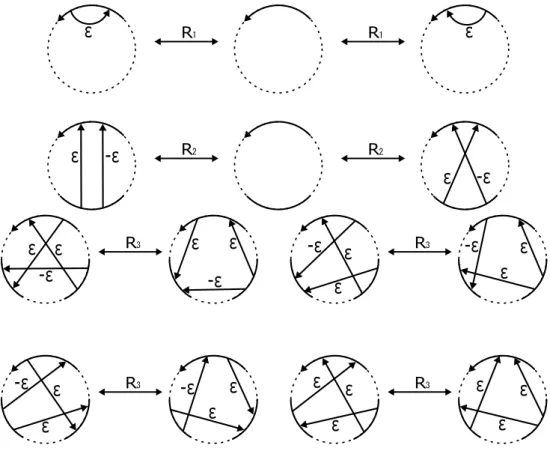
In fact, it is well-known that there exists a correspondence between virtual knots and Gauss diagrams; Let G, G
′be Gauss diagrams such that G
′is obtained from G by a move given in Figure 4 or 5, which corresponds to one of Reidemeister moves or forbidden moves, respectively. On the third Reidemeister moves in Figure 4, the opposite orientation of the external circle is also needed to consider. Then there exist virtual knot diagrams K , K
′corresponding to G, G
′such that K
′is obtained from K by the corresponding Reidemeister move or forbidden move.
ε R1 R1 ε
ε -ε R2 R2
ε -ε
ε ε -ε
R3 ε ε -ε
ε ε
-ε R3 -ε ε
ε
-ε ε ε
R3 -ε ε
ε ε ε
ε
R3 ε ε ε
Figure 4: The moves corresponding to the Reidemeister moves on Gauss diagram (ε =
±)
4
F F
Figure 5: The moves corresponding to the forbidden moves on Gauss diagram
3 Proof
In this section, we give a proof of Theorem 1. Before starting a proof, we prepare another move on virtual knot diagrams.
The move shown in Figure 6 (above) was introduced by Kanenobu in [6], and is called the F
2-move. The corresponding move on Gauss diagrams is also shown in Figure 6 (below). This move on Gauss diagrams was considered by Nelson in [5]. In [6], Kanenobu shows that an F
2-move can be realized by twice forbidden moves and some classical and virtual Reidemeister moves.
Also the same fact for the move on Gauss diagram corresponding to F
2-move was obtained by Nelson in [5].
F
2F
2Figure 6: F
2-move
In this section, we use F and F
2instead of a forbidden move and an F
2-move respectively, and let R
jdenote the Reidemeister move of type j (j = 1, 2, 3).
Proof of Theorem 1. Let D
nbe the virtual knot diagram of a twist knot T
nshown in Figure 7 (n
∈Z) .
In this proof, we use the Gauss diagrams and the corresponding moves
in stead of the virtual knot diagrams and Reidemeister moves and forbidden
moves.
F2 F R1
F F R1
A B A B A B
A B A B A B
Figure 9:
We remove the arrows c
i’s to leave the arrow c
2k−1. See Figure 10.
We consider the left side of the Gauss diagram in Figure 8, and consider the end points of the arrows c
1, c
2, . . . , c
2k−1. There are k arrows such that their head connects on the circle in that part. We use forbidden moves three times to remove top one of the k arrows. Similarly, there are k
−1 arrows such that their tail connects on the circle in that part. We use forbidden moves two times to remove top one of the k
−1 arrows.
+ +
+
Figure 10:
Therefore, the number of necessary forbidden moves to get the diagram shown in Figure 10 is 5k
−5.
Now we transform the Gauss diagram in Figure 10 to the Gauss diagram corresponding to the trivial knot by using Reidemeister moves, forbidden moves and F
2moves, as shown in Figure 11.
7
r1 r2 r3 r4 rn-1 rnV
U
Figure 7: Twist knot T
nWe first consider the case that n = 2k
−1 for k
≥1. The Gauss diagram G
2k−1of D
2k−1is shown by Figure 8.
+ + +
+ +
A B
+
C2k-1
C2k-2 C2 C1
Figure 8: Gauss diagram G
2k−1of D
2k−1We remove the arrows c
i’s corresponding to the crossings r
i’s in Figure 7 by using forbidden moves, F
2-moves and Reidemeister moves as follows. Let A and B be the points in G
2k−1corresponding to the over-crossing at U and to the under-crossing at V . First, we consider the arrow c
1. This arrow-head moves through A and B by using an F
2-move and a forbidden move. The moved arrow can be removed by using an R
1move. Second, we consider the arrow c
2. This arrow-tail moves through A by using a forbidden move, and the arrow-head passes B by a forbidden move. The moved arrow can be removed by using an R
1move. We continue to perform these operation repeatedly. See Figure 9. In Figure 9, we put the label of the transformation that we used on each arrow.
6
F2 F R1
F F R1
A B A B A B
A B A B A B
Figure 9:
We remove the arrows c
i’s to leave the arrow c
2k−1. See Figure 10.
We consider the left side of the Gauss diagram in Figure 8, and consider the end points of the arrows c
1, c
2, . . . , c
2k−1. There are k arrows such that their head connects on the circle in that part. We use forbidden moves three times to remove top one of the k arrows. Similarly, there are k
−1 arrows such that their tail connects on the circle in that part. We use forbidden moves two times to remove top one of the k
−1 arrows.
+ +
+
Figure 10:
Therefore, the number of necessary forbidden moves to get the diagram shown in Figure 10 is 5k
−5.
Now we transform the Gauss diagram in Figure 10 to the Gauss diagram corresponding to the trivial knot by using Reidemeister moves, forbidden moves and F
2moves, as shown in Figure 11.
r1 r2 r3 r4 rn-1 rn V
U
Figure 7: Twist knot T
nWe first consider the case that n = 2k
−1 for k
≥1. The Gauss diagram G
2k−1of D
2k−1is shown by Figure 8.
+ + +
+ +
A B
+
C2k-1
C2k-2 C2 C1
Figure 8: Gauss diagram G
2k−1of D
2k−1We remove the arrows c
i’s corresponding to the crossings r
i’s in Figure 7
by using forbidden moves, F
2-moves and Reidemeister moves as follows. Let
A and B be the points in G
2k−1corresponding to the over-crossing at U and
to the under-crossing at V . First, we consider the arrow c
1. This arrow-head
moves through A and B by using an F
2-move and a forbidden move. The
moved arrow can be removed by using an R
1move. Second, we consider
the arrow c
2. This arrow-tail moves through A by using a forbidden move,
and the arrow-head passes B by a forbidden move. The moved arrow can
be removed by using an R
1move. We continue to perform these operation
repeatedly. See Figure 9. In Figure 9, we put the label of the transformation
that we used on each arrow.
F2 F R1
F F R1
A B A B A B
A B A B A B
Figure 13:
We remove the arrows corresponding to r
i’s to leave the arrows corre- sponding to r
2k−1and r
2k. See Figure 14.
We consider the left side of the Gauss diagram in Figure 12, and consider the end points of the arrows c
1, c
2, . . . , c
2k. There are k arrows such that their head connects on the circle in that part. We use forbidden moves three times to remove top one of the k
−1 arrows. Similarly, there are k arrows such that their tail connects on the circle in that part. We use forbidden moves two times to remove top one of the k
−1 arrows.
- - +
+
Figure 14:
Up to this point, the number of necessary forbidden moves to get the diagram shown in Figure 14 is 5k
−5.
Now we transform the Gauss diagram in Figure 14 to the Gauss diagram 9
F2 R3 R1
F R1
+ + +
+ +
+ +
+ +
+
+ + +
Figure 11:
Since we used forbidden moves three times in Figure 11, we get the in- equality F (T
2k−1)
≤5k
−2.
We second consider the case that n = 2k for k
≥1. The Gauss diagram of D
2kis shown by Figure 12.
+ - - + + +
A B
C2k-1
C2 C2k
C1
Figure 12: Gauss diagram G
2kof D
2kWe remove the arrows c
i’s corresponding to the crossings r
i’s shown in Figure 7 by using forbidden moves, F
2-moves and Reidemeister moves as fol- lows. Let A and B be the points in G
2kcorresponding to the over-crossing at U and to the under-crossing at V . First, we consider the arrow c
1. This arrow-head moves through A and B by using a F
2-move and a forbidden move. The moved arrow can be removed by using an R
1move. Second, we consider the arrow c
2. This arrow-tail moves through A by using a forbid- den move, and the arrow-head passes B by a forbidden move. The moved arrow can be removed by using an R
1move. We continue these operation repeatedly. See Figure 13.
8
F2 F R1
F F R1
A B A B A B
A B A B A B
Figure 13:
We remove the arrows corresponding to r
i’s to leave the arrows corre- sponding to r
2k−1and r
2k. See Figure 14.
We consider the left side of the Gauss diagram in Figure 12, and consider the end points of the arrows c
1, c
2, . . . , c
2k. There are k arrows such that their head connects on the circle in that part. We use forbidden moves three times to remove top one of the k
−1 arrows. Similarly, there are k arrows such that their tail connects on the circle in that part. We use forbidden moves two times to remove top one of the k
−1 arrows.
- - +
+
Figure 14:
Up to this point, the number of necessary forbidden moves to get the diagram shown in Figure 14 is 5k
−5.
Now we transform the Gauss diagram in Figure 14 to the Gauss diagram
F2 R3 R1
F R1
+ + +
+ +
+ +
+ +
+
+ + +
Figure 11:
Since we used forbidden moves three times in Figure 11, we get the in- equality F (T
2k−1)
≤5k
−2.
We second consider the case that n = 2k for k
≥1. The Gauss diagram of D
2kis shown by Figure 12.
+ - - + + +
A B
C2k-1
C2 C2k
C1
Figure 12: Gauss diagram G
2kof D
2kWe remove the arrows c
i’s corresponding to the crossings r
i’s shown in
Figure 7 by using forbidden moves, F
2-moves and Reidemeister moves as fol-
lows. Let A and B be the points in G
2kcorresponding to the over-crossing
at U and to the under-crossing at V . First, we consider the arrow c
1. This
arrow-head moves through A and B by using a F
2-move and a forbidden
move. The moved arrow can be removed by using an R
1move. Second, we
consider the arrow c
2. This arrow-tail moves through A by using a forbid-
den move, and the arrow-head passes B by a forbidden move. The moved
arrow can be removed by using an R
1move. We continue these operation
repeatedly. See Figure 13.
4 Problem
We can see the following about Corollary 1.
Proposition 1.
The forbidden number of any non-trivial classical knot is at least two.
Proof. For a virtual knot K, the upper group G
+(K ) and the lower group G
−(K ) are defined [2], [4]. Also see [7]. If K is a classical knot, then G
±(K ) are isomorphic to the knot group G(K ), which is the fundamental group of the knot complement. It is well-known that K is trivial if and only if G(K ) is isomorphic to
Z. Therefore if K is a non-trivial classical knot then G
±(K ) are not isomorphic to
Z. Since it is known that the first forbidden move in Figure 1 does not change G
+(K ) and the second forbidden move does not change G
−(K ), it follows that at least two forbidden moves are necessary to transform K into the trivial knot.
By Corollary 1 and Proposition 1, it follows that the forbidden numbers for the trefoil knot and the figure eight knot are two or three. Then we state the following problem.
Problem.
Determine the forbidden numbers for the trefoil knot and the figure eight knot.
Acknowledgment
The author would like to thank to Kazuhiro Ichihara for his useful advices.
He also thanks to Shin Satoh for letting him know the paper [7], and thanks to the referee for his/her useful comments.
References
[1] A. S. Crans, B. Mellor and S. Ganzell, The forbidden number of a knot, Kyungpook Math. J.
55(2015), no. 2, 485–506.
[2] L. H. Kauffman, Virtual knot theory, European J. Combin.
20(1999), 663–690.
11 corresponding to the trivial knot by using Reidemeister moves, forbidden
moves and F
2moves, shown in Figure 15.
Since we used forbidden moves three times in Figure 15, we get the in- equality F (T
2k)
≤5k
−2.
F2 R3 R1
F R1 R2
- - + +
- -
+ +
- + - +
- -
+
- -
+
- +
Figure 15:
In the cases of n =
−2k
−1 and n =
−2k for k
≥1, a simple proof can be given by using F (T
2k−1)
≤5k
−2 and F (T
2k)
≤5k
−2 for k
≥0 as follows.
Note that T
nis ambient isotopic to the mirror image of T
−n−1for any integer n, and the forbidden numbers of a virtual knot K and its mirror image K
∗are equal. Then for k
≥1, we have
F (T
−2k−1) = F (T
−∗(−2k−1)−1) = F (T
2k∗) = F (T
2k)
≤5k
−2 F (T
−2k) = F (T
−∗(−2k)−1) = F (T
2k∗−1) = F (T
2k−1)
≤5k
−2
We note that Corollary 1 follows from Figures 11 and 15 immediately.
10
4 Problem
We can see the following about Corollary 1.
Proposition 1.
The forbidden number of any non-trivial classical knot is at least two.
Proof. For a virtual knot K, the upper group G
+(K ) and the lower group G
−(K ) are defined [2], [4]. Also see [7]. If K is a classical knot, then G
±(K ) are isomorphic to the knot group G(K ), which is the fundamental group of the knot complement. It is well-known that K is trivial if and only if G(K ) is isomorphic to
Z. Therefore if K is a non-trivial classical knot then G
±(K ) are not isomorphic to
Z. Since it is known that the first forbidden move in Figure 1 does not change G
+(K) and the second forbidden move does not change G
−(K ), it follows that at least two forbidden moves are necessary to transform K into the trivial knot.
By Corollary 1 and Proposition 1, it follows that the forbidden numbers for the trefoil knot and the figure eight knot are two or three. Then we state the following problem.
Problem.
Determine the forbidden numbers for the trefoil knot and the figure eight knot.
Acknowledgment
The author would like to thank to Kazuhiro Ichihara for his useful advices.
He also thanks to Shin Satoh for letting him know the paper [7], and thanks to the referee for his/her useful comments.
References
[1] A. S. Crans, B. Mellor and S. Ganzell, The forbidden number of a knot, Kyungpook Math. J.
55(2015), no. 2, 485–506.
[2] L. H. Kauffman, Virtual knot theory, European J. Combin.
20(1999), 663–690.
corresponding to the trivial knot by using Reidemeister moves, forbidden moves and F
2moves, shown in Figure 15.
Since we used forbidden moves three times in Figure 15, we get the in- equality F (T
2k)
≤5k
−2.
F2 R3 R1
F R1 R2
- - + +
- -
+ +
- + - +
- -
+
- -
+
- +
Figure 15:
In the cases of n =
−2k
−1 and n =
−2k for k
≥1, a simple proof can be given by using F (T
2k−1)
≤5k
−2 and F (T
2k)
≤5k
−2 for k
≥0 as follows.
Note that T
nis ambient isotopic to the mirror image of T
−n−1for any integer n, and the forbidden numbers of a virtual knot K and its mirror image K
∗are equal. Then for k
≥1, we have
F (T
−2k−1) = F (T
−∗(−2k−1)−1) = F (T
2k∗) = F (T
2k)
≤5k
−2 F (T
−2k) = F (T
−∗(−2k)−1) = F (T
2k∗−1) = F (T
2k−1)
≤5k
−2
We note that Corollary 1 follows from Figures 11 and 15 immediately.
A.1 Figures corresponding to Figure11
F
V1
+ +
+
+ +
+
R3 R1
+ +
+
13
[3] M. Goussarov, M. Polyak and O. Viro, Finite-type invariants of classical
and virtual knots, Topology
39(2000), no. 5, 1045–1068.
[4] M. Hirasawa, N. Kamada and S. Kamada, Bridge presentations of virtual knots, J. Knot Theory Ramifications
20(2011), 881–893.
[5] S. Nelson, Unknotting virtual knots with Gauss diagram forbidden moves, J. Knot Theory Ramifications
10(2001), no. 6, 931–935.
[6] T. Kanenobu, Forbidden moves unknot a virtual knot, J. Knot Theory Ramifications
10(2001), no. 1, 89–96.
[7] T. Nakamura, Y. Nakanishi, S. Satoh and Y. Tomiyama, Twin groups of virtual 2-bridge knots and almost classical knots, J. Knot Theory Rami- fications
21(2012), no. 10, 1250095, 18 pp.
A Moves on virtual knot diagrams
In Figures 11 and 15, it seems difficult to find how to use R
3move only with Gauss diagrams. So we here include figures which indicate the moves on the virtual knot diagrams corresponding to the moves on Gauss diagrams shown in Figures 11 and 15.
12
A.1 Figures corresponding to Figure11
F
V1
+ +
+
+ +
+
R3 R1
+ +
+
13
[3] M. Goussarov, M. Polyak and O. Viro, Finite-type invariants of classical
and virtual knots, Topology
39(2000), no. 5, 1045–1068.
[4] M. Hirasawa, N. Kamada and S. Kamada, Bridge presentations of virtual knots, J. Knot Theory Ramifications
20(2011), 881–893.
[5] S. Nelson, Unknotting virtual knots with Gauss diagram forbidden moves, J. Knot Theory Ramifications
10(2001), no. 6, 931–935.
[6] T. Kanenobu, Forbidden moves unknot a virtual knot, J. Knot Theory Ramifications
10(2001), no. 1, 89–96.
[7] T. Nakamura, Y. Nakanishi, S. Satoh and Y. Tomiyama, Twin groups of virtual 2-bridge knots and almost classical knots, J. Knot Theory Rami- fications
21(2012), no. 10, 1250095, 18 pp.
A Moves on virtual knot diagrams
In Figures 11 and 15, it seems difficult to find how to use R
3move only with
Gauss diagrams. So we here include figures which indicate the moves on the
virtual knot diagrams corresponding to the moves on Gauss diagrams shown
in Figures 11 and 15.
R1
V1 C
+
R1
15
R1
C
+ +
F
V1 V2
+ +
14
R1
V1 C
+
R1
A.2 Figures corresponding to Figure15
F
V1
- - + +
- -
+ +
R3 R1
- + - +
16
R1
C
- -
+
F R1
V2
- -
+ A.2 Figures corresponding to Figure15
F
V1
- - + +
- -
+ +
R3 R1
- + - +
16
R1
V1 C
- +
V2
R2 V1
- +
18
R2
V1