Agriculture
著者(英) Komei Sasaki
journal or
publication title
Senri Ethnological Studies
volume 7
page range 141‑180
year 1980‑03‑30
URL http://doi.org/10.15021/00003416
g‑S
"lt s ‑
"LM$
ssg .
:
g ;:.rss" ,l"gS;i .ge.hss.$.
vxts
"s
kX
l :'," .Ltw
hL"
$ sswa ts!l
.P ge"
h h; h""
":s
seh.. "
sL"L
s
‑ g
x
"
s‑ss
sss pus
4Lx" "
s"sws
ge s
"
・:sig .S. cl,
+L
" ","L.,w 'z
Lyts" "s. L) .vN =X""h")Vlt
r """‑ l;
," ssrS"
k.r ..ss
. "r.
" "sl
h tLl
‑ ab7"
h rLl
L}
ss,; L
E s"L
")‑ ‑
wt "LS
‑N "
Y". sthXge
.a
s
,,,NNywssi$igge"
"x
Ef 'sseN
s:
g.
sstu k "ssew"X.
"s"l' '
:L :・.wtx esx.x i・$I sss. s f xg.ssmi¥willL¥.
.st
r"S ss+
""
N
s
li "L
sww e
x
as L
= "" s twk Mss
ms s
Sx x. .
: ljgss .
L. Sh """h
L R . sny""ewisspseqws
Nh
mth
..maxtewvatteema
s
. XL
ge
sSeeding rice.
.9+.ss
iltSII".
ts・g
k'tlh.
g
L
iXi
. I", tl.Lh
・si X LS w tBtG Su"
LL X
ge. tL."l
" NU S"
ge "Lss "・
g.=s‑,
"sstww
g."=e
"
t
Agriculture
KOMEI SASAKI
Nbtional'Mtzseum of Mhnology
I. Subsistence and Commercial Agriculture
1. A Case Study 'of Family Farm Management
2. The Conditions of Cbmmer‑
cial Crop Production 3. Modelling the Crop Combi‑
nation
II. Swidden Land Use and Scale
i of Operation
1. Swiddensand their Utiliza‑
, tion
2. Average Area Per Plot and Per Household
III. Crops and Agricultural Tech‑
niques'
1. Crops at Limau 2. Aspects of Agricultural Techniques
I. SUBSISTENCEANDCOMMERCIALAGRICULTURE
Agricultural activities in Limau Village areJdevoted principally to satisfying family subsistence requirements, but nowdays the commercial cultivation of coconut palms is practised on a limited basis. This chapter describes the general features of both commercial and subsistence agriculture through an analysis of the management of several typical family farms.
1. A Case Study of Family Farm Management
The Sm's family (HN 34) provides a good example of a typical, middle‑class farm family in Limau. At the end ofOctober 1976 this family had five tracts of land under cultivation (Table 1). Three tracts (1, 2 and 3) were used for cultivating sub‑
sistence crops, and two (4 and 5) were devoted to the commercial cultivation of coco‑
nuts.'
The first field (1) is located on a gently sloping hillside to the north of the village.
It was exploited eleven years ago, and although in the first year upland rice was apparently sown, banana suckers were planted there from the second year (Photo. 1).
Seven kinds of banana are cultivated thete now; koijuwa, pisang golontalo, p. roja, p. putih, koigohu, selewati and kosu(a. The land was first used fbr shifting cultivation, such as but because of favorable conditions it was quickly developed for the pgrma‑
nent cultivatiori of bananas.
141
142 K. SASAKI Table 1. Fields of Sm's family
location year of exploitation cultivated crops
(1) (2)
Doku ma ake Jobubu
(3) Akelamo
(4) (5)
Dena ma bane Tiabo
exploited 11 years ago Bananas (7 varieties) are cultivated.
exploited in 1973 Manioc, sweet potatoes cultivated in 1974.
On a part of the field uplanq rice werq sown.
Field barn was built. Manioc and sweet potato were planted in July, 1976.
exploited in 1974 Upland rice was sown in January, 1975.
' Before sowing rice bananas and coconuts were
planted (destroyed largely by wild animals.) Coconuts (47 mature plants, 50 young plants, and 35 new plants) Coconuts (68 mature plants) '
The second field (2), located in Jobubu, to the northwest of the village, is situated at the foot ofthe hill, and consists ofnorthern aind southern portions. The cultivated area totals some 15.5 are and is bounded by a bamboo fence (garao) '(Fig. 1), which is quite rare in Limau. The southern part of this land was exploited in 1973, and in Janqary‑February 1974 manioc and sweet potato were planted there. The harvest of these crops was completed by May‑June 1976, and the field was replanted with manioc and sweet potato in July 1976. At the end of October 1976, the southern part (about 9.5 are) of this field was planted with manioc and sweet potato, but the crops were badly distributed and became heavily infested with alang‑alang (Iptperata cvlinmbica) (Photo. 2). Moreover, apart from some bananas, the northern part (about 6 are) was almost abandoned. In January‑February 1974, however, just after the exploitation of the land, 7.5 kg of upland rice was sown. It was claimed that on this.part of the field about 1.5 sacks of rice was harvested in July‑August.
When thrashed this amount is reduced by some 50 percent, so about 40‑50 kg was harvested.
aj・‑
・‑ ・ee
.by・/ ‑ 1,‑‑. 1.
"tt"tdiit
th
Photo.
se{s "
htEmawwBIZIww."
1. Bananafield.
ss
eq‑
'
◎
Ybanana gmaniOC
V sw㏄t potato
/b bamboo
q standing tree Ω・ chili pepPer 止 grass land
・←← bamboo fbn㏄
、
国 field barn
望Y
やY
?9qq
Y》Y》皇皇
》肌止.
止 ⊥
止止Ψ止止Y
γ 止⊥
止 ⊥
>>⊥〉止
> > V
.血. 」L
N
皇
V
止v止 旦
> 9> 血
』
O o o o
.沿里譜瞬ゴ 空0 c
Fig.1. Sm s swidden in Jobubu.
皇
皇皇
象 亀
皇皇
q
魁q}
q
Photo.2. Sm,s swidden in Jobubu.
144 K. SAsAKI At the southern end of this field is a collapsed barn (toro ma tahu)i) surrounded by a small patch of cultivated ‑vegetables (chili pepper etc.). In the one or two years since the exploitation of the land began, the Sm's family had a barn surrounded by a small kitchen・garden'in this locatioh. But they had a baby, and being short oflabor fbr weeding and other chores' reluctantly allowed the condition of the land to decline, and finally abandoned the barn and kitchen garden. ・ At the time of field research they were supplied with vegetables by their neighbor (HN 35), Ym, the father of Sm's wife, who had a kitcheh garden at Akelamo.
Sm's farm land (3) is located at Akelamo, about one and a half hour's walk southwest of the village. The land was used jn 1974 and upland rice sown in January, l975. A harvest of 22:5 kg was claimed for this land, from which it can be assumed that upland・rice was cultivated on some 15‑20 ares. Only 4 sacks of rice were har‑
vested, owing to the depredatjons of deer and wild boar. In addition, the banana suckers and coconut seedlings set‑out in this land prior to the sowing of rice were also heavily damaged by wild animals, such that only 20 banana plants and about 20 young cacao trees of the total planted among the growing rice now remain there.
These 3 tracts comprised the land farmed by the Sm family for subsistence purpo‑
ses in October 1976. Subsistence production from the cultivated fields is supplemented by sago from the Sm's two sago palm tracts located in the nearby swamps. In addi‑
tion, the family owned 2 tracts of land devoted to coconut plantations. Of these the land at Dena ma bape (4) was relatively recently opened‑up, and is situated on a large sand deposit to the south of the village (Photo. 3). On the other hand, the land near the sand deposit at the mouth of the Tiabo River (5), further to the south, has long been exploited and is now occupied by coconut palms more than twenty years old.
'
Y;s4i.s"i" SL・ itl' ,.e al a・
ee
]ts"'i
th,l
ee‑‑
Photo. 3. New coconut field onithe sand deposit, south of the settlement.
1) ' For convenience, this structure is referred to here as a barn, despite its'multiple fuhctions for grain and tool storage, as a guard house and temporary living quarters.
Table 2.‑ Fields ofAy's family
location year of exploitation cultivated crops
(1) Akelamo
・(2) ・Sokiki
(3) Akelamo (4) Dena ma bane
exploited in 1964
exploited in 1974 newly exploited in 4976 exploited in 1955'
Upland rice, bananas were cultivated in the first year, after which it was converted to a cacao
plantation. ・
Planting bananas.
Scheduled planting of upland rioe after December 1976.
200 coconuts planted in 1976.
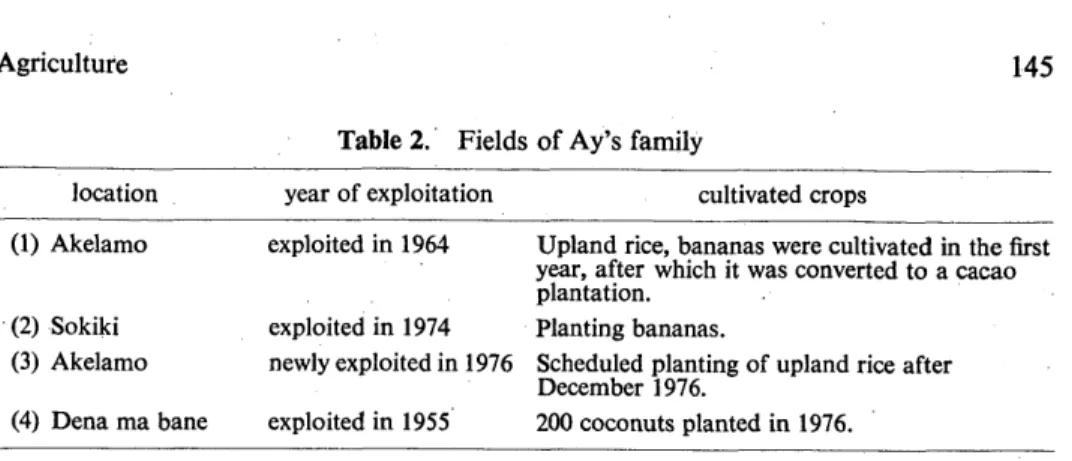
The Sm's can be regarded as a typical Limau subsistence farm family. The Ay's (HN 39), on the other hand, can be regarded as atypical example of the emerging commercially oriented farm family. The management of their farm at the end of October 1976 is illustrated in Table 2. The use of their two subsistence tracts is as follows: Field・(2) was exploited in 1974 and then converted to banana cultivation;
and field (3) was exploited in 1976, when upland rice was to be sown. Field (1) was exploited about 12 years ago, and is now under commercially cultivated cacao.
However, a regular yield cannot be expected because of inadequate management.
Also the coconut plantation (4) at Dena‑ ma bane is much larger compared with those Qf other families.
2. TheConditionsofCommercialCropProduction
According to our informant, Ay, only a few families own coconut plantation larger than his and earn money by selling copra. Those with more land, Ad, the village headman (HN 8), Ps (HN 19), Hy (HN 41), tQgether with Ay himselL
comprise a privileged class in the village. The owner of the largest field is a village, headman, who obtains about 2 MT of copra per harvest. Next comes Ps, who gets about 1 MT per harvest. There are generally three harvests per year in this part of Halmahera. Copra is s,old usually at either Soasio or Tobelo, where it fetched about Rp. 1101kg, at the time of this survey. One ton ofcopra yields some Rp. 110,OOO, a large amount of money fbr income‑poor Limau.
Yet the owner of a cogonut plantation has production expenses, particularly for the large input of labor required for harvesting and transport to market. Harvesters must climb the tree, remove the fruit, open the nuts, remove and dry the copra, and then finally bag and ship the dried copra to market. Plantation owners employ the poor of Limau or those frQm the neighboring village for these tasks. Wages appear to be fixed according''tbitask. For example, Rp. 25!tree is paid for climbing and removing the fruit. The village headman employed two young men from other villages to harvest particular sections of・his coconut plantations. The headman divided the income received equally between himselfand the two laborers. Operating a copra‑producing enterprise appears to be a labor‑intensive operation, and labor costs appear to comprise a large percentage of the total production expense.
Other than by the people mentioned above, and particularly the village headman
146 K; SAsAKI and Ps, only small quantities .of copra are produced in Limau. Moreover average Limau farm families such as Sm, have smaller tracts of coconut palm with few ma‑
ture trees, thus they derive only a small income from copra production. No other commercial crops are cultivated in Limau, or at least were not Systematically cultivated in Limau at the time of this survey. Yet even on a small‑scale a coconut plantation provides some cash income and is an attractive proposition. This accounts for the increase in coconut planting across the old sand deposit to the south of the vil‑
lage, and is the reason why many villagers are slowly beginning to add coconuts to the crop assemblage cultivated in the swidden.
3. Modellipg the Crop Combination
As shown above, 'commercial agriculture in Limau has, with few exceptions, developed rather slowly, and agriculture in this village continues to center on the production of such subsistence foods as bananas, upland rice, manioc and sweet potato, mainly by slash‑and‑burn cultivation on mountain and hill slopes. Use Of the swidden begins with forest clearance and burning, and each crop is cultivated on the newly opened lands. But soil erosion together with Vveed and brush infiestation creates poor land conditions. Lands are therefore fa11owed after a period of culti‑
vation. Slash‑and‑burn cultivation leads to rapid physical and biological change in the land during the 3‑4 years between field clearance and fa11owing. Each house‑
hold must therefore solve the problem of the optimal combjnation of subsistence crops grown on several fields, when the duration of field use varies.
land type
condition in October 1976 old banana field (exploited 10‑15 years ago) used perennially
Elliliiiilll
swidden (exploited 34 years ago) partially abandoned
manioc, sweet potato, banana
pm
swidden (exploited 2 ygars.ago)
mixed cultivation of vegetative planting crops in surrounding kitchen garden with field barn
banana, manioc, sweet potato
ew
swidden lands scheduled to be cleared this year
scheduled for upland rice and banana to be sowed ・. ‑..・.・..
and planted next January (and a few manioc, '‑:・:":i:' sweet potato)
lands for coconut (newly‑planted)
lih・tgchfl・thvaexstigsiochyeedatrisieidaienr)five‑sixyears [iiiliiiii]
conditi6n in 1977
Elilli{i[]
abandon
rl
I fallow l
L‑‑‑‑J
[Zl]
[Zkgllil21
[iiliEiiEiiE]
Fig. 2. Types of swidden at Limau and the general model of rotation・
Although the Sm family has been depicted as a standard farm household, a general model is needed to account for other cases and to accommodate the various combinations of the cultivated land of e.ach household. As shown in Table 1 and 2, a standard Limau farm family maintains in principle three fields devoted to subsistence crops. One is an old banana field, the best land of which is often used for 10‑15 years in succession. The other two fields are typical swiddens devoted to the mixed culti‑
vation of banana, manioc and sweet potato. A field barn is built i'n one of the two better swiddens, around which a kitchen garden is often made fbr the intensive culti‑
.
vation vegetables or other minor crops.
Although in principle each Limau household makes it a.rule to exploit a new swid‑
den every year, ・this is not always done in practice, as is revealed by the cases of Sm and Ay. Some families do not make a new swidden every year. Thus when one of the two swiddens become 3‑4 years old it is abandoned owing to the infestation of weeds and undergrowth. Sm's field (2), mentioned above, is a typical example of a halfi abandoned field, and when once each year one swidden becomes infested the pro‑
ductive capacity diminishes 'conspicuously, leading to the need swidden. Thus as new swiddens are explbited the old fields are gradually abandoned. The model in Fig. 2' show's the transformation from new to old fields, as well as an outline of agricultural management.
II. SWIDDEN LAND USE AND SCALE OF OPERATION
1. Swiddens and their Utilization
The features of Limau agriculture have been examined above from the viewpoint of subsistence and commercial agriculture, and considering the kind of arable land that each family attempts to cultivate. It was shown.that subsistence cultivation is preferred to other forms. There fo11o'ws below an examination of the location of agri‑
cultural activities and the techniques used in Limau subsistence agriculture. This is done via a detailed analysis of the land use of two typical swiddens in this village.
The first swidden belongs to I]lj (HN 14), one of the average farmers of Limau, and the second is owned by Ps,̀ one of the largest farmers in this village.
1) LAND UsE in Elj's SwiDDEN
A fairly big swidden cultivated by Ilj is located on the gentle slopes of the moun‑
tain that lies southwest of Limau Village, and which are reached after a 45 minute walk through a swamp containing sago and nipa palm. The swidden is surrounded by mature forest to the east and to the south and west by bamboo groves. The north abuts on formerly cultivated land that was apparently abandoned to fallow a few years ago. At first this swidden seems to be part ofa series ofcultivated fields, but, as it is indicated in Fig. 3, the field is divided into a northwestern part and a southeastern section by a bamboo fence at its center. The east side of the northwestern part lies adjacent to Ah's (HN 24) small tract of some 8.6 are.
The northwestern part (about 29 are) was exploited in 1974. In the center of
148 K. SAsAKI
,
N+
{ajIiisXii'Silllleee,
r,r,r,{l:(r,r,zr"
Y r !r
r 7
‑
r
ee etsuee
eeee ee
ewee/'
ttllisp
A
tweeeeeeeeee
isilllliii
i$illilllii
eeu
ee rri4
rrrrr Qlsii ';K
tryr
'l:1,'t t
//
rA
p. .e. a R .e.R R '9
; ; r(i>]S,' r;
r"r r r
R.e.
za
AAg
A
'1>
r
rA"
"sv
・‑‑g .‑.fi
iiili?
g,
4r x・!
x
Za
z.
x ll ll
r ll
# u
s
9
rg
fr7. vYAs ;'
"rigillllll,Ilite"eagff ge
5s Y
6
r T
g. f Tp.tP.fff g7
9
th
th
a
ea
s s
s
e
6 s
e
th
Z
va
urUr y ra " fiet
iLa '"6 a
"
nU ll "
‑ r
u
" ll r
ll u
r .r u
u ll ll r ll
4r "Y
auar ya u
1 ll tt
A u ll9 u
th
‑‑‑‑..
it il>
't
re
u
ll
LA ‑
t"'
ll
ll ll
ll
a
xr"
g
‑
th ‑‑t"t as
ab ab ‑'
v/ as
....‑.... ib
‑ as as
as
as , 1[>
tt /"
o le 2o 3om
E!iiEr Eii!SZ
1
g u
ll xb
xb
as il>
o,
il>
il>
xb
,I>
as il}
,as
tl)
as
lrlr 1"
il>
as
tl>
il>
/b
,b il)
u upland rioe v foxtailmillet mp Job's‑tears De banana .p. manloc
f sugarcane i chilipepper 6 eggplant ,
¢
A
v
T
g
"
't
ua
pineapple taro
・sweet potato coconUt standing tree dead, standing tree
bamboo
scrub land just after . clearahce , . Fig. 3.
. th
g
A A
cX='es
grass land with scrub field barn
border areas exploited ・ between 1974 and・1975:
Ah's field '
StUMP . Jfe11ed trunk ' ̀
bamboo' fence
the field was a barn, at the time of research,
cultivating bananas, sugar cane, mamoc,' sweet potatO tomato and a small amount
suckers and the coconut seedlings vvere widely planted (probably in January‑February, 1975) to the northwest bf the barn. Banafia and coconuts were also planted in Ah's swidden, but most 'crops planted by ,Dj Were‑heav'ily damaged by wild boar. In September 1976, the land was cultivated again after weeding, the fe11ing of several previously uncleared trees, and burning. Some banana suckers, coconut seedlings and eggplants were planted quite haphazardly, and most of the land was being fa11ow‑
l lj's swiddenr
around,which there was a kitchen garden
'' itaro, pineaPple, chili pepper,
of foxtail millet.・ After exploitation in 1974, banana
,
twW
.ema xss
$ilk
eq {ltzzir t・. :t ,・ ・
Photo. 4. Young bananas interplanted among the rice.
ed. According to Ibj, upland rice was to be sown among the bananas and coconuts in December 1976‑January 1977 (Photo. 4).
To the southeast of the barn, in an area that was cleared in 1974, nothing was planted immediately after burning until manioc, sweet potato and coconuts were probably planted several months later. The productivity ofthe manioc and the sweet potato was low, having been severely damaged by wild boar. Mr. and Mrs. Ibj plan‑
ned to cultivate manioc and sweet potato in 1976, and so in September they began to construct a bamboo fence to prevent the entry of wild boar, but the shortage of labor made completion of the fence impossible, except for some 20 m (Photo. 5). Apart from about 30 are, exploited in 1974, excluding the kitchen garden, this land produced
Photo. 5. Bamboo fence in the swidden.
150 K. SAsAKI
1
only a small harvest of manioc during the 18 months from the beginning of 1975 until mid‑1976, and most other crops (banana and sweet potato) also were damaged by wild animals. Although we assume that the land northwest ofthe barn, which was burned fbr a second time, produced only a small harvest, even where the land was not reburned, no crops were found other than a small patch of manioc. On the other hand, 20‑‑30 young sweet potato plants, planted only a day or so before our research began, occupied only a small area on the south side of the barn. The arable land around Limau therefore appears to be greatly underused, and intensive agriculture certainly was not practised on I lj's land.
The southeastern part of Ibj "s land was cleared and burned in September‑October, 1975, one year earlier than the northwestern part. In principle the land was cleared only by Mr. and Mrs. Ibj, who have not depended on cooperative labor for quite some time. Before clearance the land was occupied by huge trees of the kind that still grow on the mountain slopes to the east of the field. Even now stumps with big buttress remain in the field as do many unburned tree trunks. It is impossible for a man and wife alone to fe11 the huge trees, and they were assisted by other laborers, as in the case of Ps.
As noted above, after the clearance and burning of this land, which took place from September through the end of October, nothing other than a few banana suckers was planted until upland rice was sown in approximately June of the next year.
Because almost a year passed between the time of burning and use of the field, a strip some 20 m wide adjacent to the forest on the east was densely infested by weeds and undergrowth, hence part of the field could not be cultivated, and only about 35 are was actually utilized. Some 29 are, about 75 percent of the total area of the field, was used to cultivate upland rice.
Sowing was done using the cooperative labor of fbur men and four women.
The men used digging sticks to make holes in the soil, into which the woman dropped
Photo. 6. Foxtail millet and large buttress.
the rice seeds. In all, 1.5 oil cans, containing 22.5 kg of seed were used to sow this 29 are tract with rice. It took 10 people (the 4 men and 4 women plus Mr. ]bj and his wife) half a day to sow the rice. Upland rice ripens in about 4 months, so the harvest was scheduled fbr October 1976, but owing to abnormally droughty condi‑
tions and the ensuing water shortage almost the entire crop was lost. Only taro, sweet potato and banana were harvested in the northern 25 percent of the field.
In addition, foxtail millet (about 10‑20 plants) and some Job's‑tears were culti‑
vated separately near the huge tree stump in the center of the field (Photo. 6). They were sown at the same time as the rice. A small quantity of foxtail millet is also cultivated on the south side of the barn. Foxtail millet and Job's‑tears are not impor‑
tant fbodstufig among the Galela, but.are used only in rituals such as those involved in the wedding ceremony. Accordingly, small patches of those plants are commonly found in the swidden.
2) Ps'sSwlDDEN
lbj's field is situated in a flat, basin‑Iike area between two ridges, but Ps's is located on the ridge that projects seaward from the main ridge of Limau Village. As shown in Fig. 4, his field consists of three parts; a western, gently sloping area of about
e;illl}i
v,ll ) #t
ew. f' Y Y thY
Y
it i:
,. ‑'L
ee
k Y
Y" , th NY
it YAth r
Y th
it Y
"̀:'
E‑ew' ‑1:
rgY th Y.o.
dir m
YY
L '.''
"':‑. ‑A.
P‑ p. P.
{lillll2i‑elSIIII'2・ A
N
+
‑LLL grassland
Y banana
.o. manloc V sweetpotato 1 sugarcane 6 eggplant
e yam
.tb
yv vB v Yy
yY
A
iXi]i.>x..
re ayVeizillllt '
v9 ,<
o. o.. Y
.A, A. P'
't ,A
'' L. tXS}
Jit.
=‑' o
. t :Ci'1:,.
N‑
; t. LL
=・i ‑it' ''・,. ', .il ' li'tSi
'・ " ・i :N・.
i[?
,i ,>:l;
c
v
Y
v
,A[
',A.
"f ,ttLJri': t,
='" 'i
/to‑,.
pai"/k・2,Yg'<,,,
.o. p"o, p. p, p. Y p.
P' oY 1
a P・ r P‑ li
Y/
.O,. P'‑/
A
.A ,
D
l
.A. N'̀ .. ‑‑
‑L X
‑.‑‑.. ‑.‑
10 20m
g chilipepper ・'・ tobacco
X clove o papaya o pineapple A, taro g standingtree Fig.4. Ps'sswidden.
l/
.A. bush
tm woodenmortar do kitchengarden VEM field barn rm clifif
t! x
/ N
1 N
x
!
l l
il
li
152 S. SASAI(I
eeee
I‑‑,pt‑ill'l
ec,wasc.ee・xxe''
Photo. 7. Ps's swidden, Section C.
9.8 are, (A), a flat area of 10.8 are at the top of the ridge (B), and a steeply sloping eastern portion of 9.6 are (C). To the west and north the field is surrounded by mature tropical rain forest, and stumps of huge trees are particularly evjdent in areas A and C, which testifies to the nature of vegetation prior to field clearance (Photo. 7).
All these sections of the field were cleared and burned in December 1975. Most of the labor was perfbrmed by the owner, Ps and hjs son, Is (HN 17), but the huge trees were fe11ed using cooperative labor that involved villagers, including Yg (HN 20), Yb (HN 16), Ts (HN 15) and Dj (HN 14). In return, Is and Ps provided one day's field clearance labor to each of the eight villagers who had helped them. This ex‑
change of labor among the Christians in Limau is known as ma‑koki‑rio,.
After clearance and burning in December, 1975 section A remained unused until April‑May 1976, when bananas were planted throughout the field. Then in June‑
July rice was interplanted among the bananas. However, the dry spell that persisted until the end of October 1976 destroyed all the rice, although the bananas grew well.
In section B, after field clearance, manioc and sWeet Potato were Planted in January‑
February 1976. Later, banana, various.kinds of vegetables, taro, yam and sugar cane were interplanted gradually with the manioc and the sweet potato. The vege‑
tables were intensively cultivated around the barn (see below, Fig. 7). The Ps' field shows a distinctively mixed cropping pattern in section B, and they used a higher plant density than did Ibj . The Ps' land is the most intensively cultivated in Limau. Sweet
potato was heavily cultivated in the northern part of section B, and manioc in the southern part. The sweet potato was planted in January and harvested in mid‑ to late September, and early to mid‑October. Sweet potato was immediately replanted in the same location as the debris remaining from the first crop was removed. The manioc harvest begins at the end Qf October. As discussed below, the manioc field is replanted quickly if a piece of stem is planted immediately after harvesting. At
Photo. 8. Ps's swidden, Section D.
s
any given time manioc in each stage of growth is found in the southern part of this field. This is particularly evident during the harvesting season. ‑ At the time of our fie!d study section C was not in use. It had remained unculti‑
vated since the first period of clearance, in December 1975, and was cleared and burned again in August, 1976. It is assumed that only the large trees were fe11ed and burned at the end of 1975 and that a considerable quantity of undergrowth and lighter vegetation remained. Field clearance and burning was done again in August
1976 by Ps and his son.
Because of field preparation in 1975 and 1976, the land was ready for cultivation at any time in October 1976. However, it was not immediately utilized and banana was scheduled for planting in December 1976 and January 1977, fbllowed Iater by upland rice. Yet their land was not cultivated until a year later. It illustrates a peculiar case where land preparation is not immediately fo11owed by cultivation.
This situation, which is sometimes observed at Limau, illustrates the generally exten‑
sive land use practices of the villagers.
As the above data shows, another new swidden, with an estimated area of less than 10 are (D) is being exploited temporarity on slope land (Photo. 8). Section B faces it on the south and it is located on the slope that extends from the back ridge connected with B to the eroded valley to the southwest ofC. Clearance and burning of this tract was completed by October 1976, and banana and rice were scheduled to be planted concurrently with those on C. The Ps planned to be sown about 45kg of rice and expected to harvest about 15 gallon ofrice froni sections C and D.
3) THEBARN(FIELDHUT)ANDITSENVIRONS
Each household erects a barn (toro ma tahu) on their best quality swidden land.
154
Around the barn a kind of intensely cultivated kitchen garden as sugar cane, manioc and vegetables is developed.
Figure 5 and 6 show the structure of Elj's barn and aspects
K. SAsAKI planting minor such of the land use sur‑
.E;
5, "
N
li 11 1 lt e
la l "ii ,
"Il
1 svit
li iip iJ
O 1 2m
es
il‑‑'‑‑‑"‑‑‑Hts‑'s‑‑‑‑'‑st<iJZ lll 2
l
L‑‑‑fi‑.‑.‑.‑.‑‑‑.‑..e‑".‑‑‑‑.‑‑.‑‑‑‑a e
,EFL‑11hliLl IP,IIr
F
lli lLii1,+
4
ill IeIi
id il aF11
l 1‑
p"1r t
1'"
',
l 1
' '
e
m
.o.
2
T"Y ,.
.o, o
1 p."
T&
.o. .o.
9 V ft
9
p.
p. v
9
9
e
‑ Q
Q Q‑
Q ‑‑‑‑‑‑‑‑‑n !E
:To
Xle o .O.
L R)e 'VQ
f
p,
N
f
f /f FA o .o. o
o
.o.
o r‑"m lte le l
t
EIg
L"‑‑‑‑‑‑‑‑‑‑l
ooo o
P'. P' r?ri fiK eElllliilllllllll
.o. .o. T
O 3m
o o
,
Fig. 5. The structure of field barn of Ilj.
.o. manioc EL ginger E sugarcane e tomato V sweetpotato o papaya
9 taro v foxtailmillet
o pineapple c=s±) felledtree T coconut
:'‑‑‑'1 limit ofstructure If gha,"・lia"p2pp,, L.‑‑‑i fireplaoe
n pola wall
Fig. 6. Land use surrounding lbj's field barn.
ue
Photo. 9. l lj's field barn.
es E‑va .k
ke
mp
rounding it (Photo. 9). Figure 7 depicts that belonging to Ps. The barn is a tumbledown structure with a gabled roofl thatched with katu. It contains a platform on which is a granary (pola), surrounded by a katu wall. The barn also contains ' a bench for resting and sleeping (dungi), about 3 m long. Apart from the pola, the barn has no walls. Because at the time of our survey the rice crop had been destroyed
'
by drought, the poia was used as a lumber room.
The pola and dongi in [lj's barn contained tatapas,porochos (a small, circular winnowing basket made from nipa palm leaves) and lelu (a small mortar used to pound banana)', and various bamboo tools such as carrying baskets, water container, a spear, a saw and other items'.
Ps's barn (Fig. 7, Photo. IO) contained various types of winnowing baskets (tatapa, porocho), small square baskets (pigi), carrying baskets (puraka), hoes (pako), axes (basu), bush knives (taito), all of which together with plates, cups and so on, were scattered in a disorderly fashion. Noteworthy is that several moluka, a large, hollow bamboo cylinder 22.5 m long (the same length as the bamboo water container [kiloha]) for storing unhulled rice, were placed on the dongi and pola. Beneath the eaves on the west of the barn palm wine is stored in a large crock (rube) (Photo. 11).
Sugar cane, manioc, chili pepper, eggplant, tomato, pumpkin and other plants are cultivated immediately around the barn, and nianioc, sweet potato, taro and some‑
p.
t7ICN
E)[Z
.o.
f
o
Q
.1
.r.
(!)
&
×
tw@V
m6
Qe
‑‑71
‑"
coconut banana manioc sugar cane papaya chili pepper tobacco
yam watermelon clove
pumpkin balsam pear foxtail millet
stump eggplant ginger supportlng post limit Qf structure
Fig. 7.
.o.
... p.vP・
yg. F
Y9.W
ylo%k.
ff'ftg̀=}.oo"
O ‑1 2m
k
rv'X
4‑L‑L
‑‑‑‑
Pola 1'
...zli ie
l
lpao
l̀$i$gts.
t e"
tL"
6
!1
"
ilht,L
1 rtp
i・ilili,,,.,・±
ig・・
il i'
il iil li':
1,.
l t [ 1 t 1 igsilii
*@
@N
1
ill ,I
1
v
T・ tir
l
,11
i]
.i ill
1l1・
,:
Wi iA"l
lll
・l,
111・・
i・lki:1
'1
N
'i'1' ' F IL
l,
ilii
k,,
O bamboo rice seed container
@ hoe
@ large crock for palm wine
@ winnowing basket
O @
Ps's barn and the cultivated plants surrounding it e
‑J /
@ bamboo water container
@ coconut seraper
@ carrying basket
@ fireplace
.
IQ‑
Z
℃z i!
,lg!
iL
Zov
156 K. SAsAKI
zma
Photo. 10.
kge.$.ifkag
me. IZny
Ps's field barn.
;
2iS%;gSi'of£'Y
wa
faM'ligabas;tEnt
tt
es
ill$ll4
Photo. 11. Palm wine stored inalarge Photo. 12. A swidden surrounded by
crock. mature rain forest.
is
times yam are plantedjust beyond this inner planted area. Not infrequently, ginger, pineapple, papaya, several kinds of melon and foxtail millet are also scattered among these crops. A characteristic feature of the kitchen garden is the interplanting of
many difli)rent crops. ・
4) SUMMARY OF SWIDDEN LAND USE
Detailed study of the swiddens of D. j and Ps revealed certain basic characteristics of shifting cultivation as practised in・Limau. These main characteristics are:
(a) More than 50 percent of Limau swiddens are made in tracts of mature forest (Photo. 12), which, when properly managed, maintains good soil conditions and prevents excessive lateritization;
(b) Polyculture is widely practised (Photo. 13) and the minor crops are generally inter‑
planted among the fbur main crops, banana, upland rice, manioc, and sweet potato, which are usually planted in a specific type of location. Job's‑tears or foxtail millet is often sown among the upland rice and banana, and'banana and taro are interplanted with manioc and sweet potato. Land within 5‑6 m of a field barn is typically used as a polycultural kitchen garden, and in Ps's kitchen garden, fbr example, more than 20 different crops are cultivated in an area of less than 1 are;
(c) Upland rice is an important swidden crop, and as noted above, it is often one of the crops sown in part ofa new swidden. ButIlj did not sow rice in the swidden that he cultivated in 1974, but planted only banana, manioc and sweet potato soon after burning. Upland rice is cropped only in a part of the first year swidden, after which it becomes a banana field, the bananas having been planted concurrently with the rice. Rice might be regarded as only a preliminary crop prior to banana cultivation. Since rice can be harvested only once, in contrast to bananas, manioc and sweet potatoes, the area under rice cultivation is relatively smaller than for other crops. Leaving aside the question of food preferences, upland rice may be less important in Limau than other crops, including bananas; and
(d) Another feature of agriculture in Limau is the lackadaisical style of farm man‑
agement. Most newly cleared land is left unused, or only partially used, for periods often amounting to more than a year. Because insufficient elttention is paid to the
!
t
Photo. 13. Polyculture in a swidden.
158 K.・ SASAKI field after planting, crops are often damaged by animals and sometimes by drought.
Although, the villagers know the technology of bamboo fence construction, few fences to guard against wild boars are found in Limau. Yet subsistence production in Limau is more stable than anticipated, perhaps in part because of the dependence on various kinds of perennial banana, with varying harvest times, and partly because large amounts of sago starch are available (see below).
2. Average Area per Plot and per Household
Table 3 shows empirically derived data of swidden land in Limau. These data were used to calculate the average size of swiddens and the average field area cultivated by a household. The term "plot" is used here to refer to an individual field, a series of which may be exploited concurrently.
Using Ps's land as an example, A and B ,comprise a single plot, whereas C is a separate plot because, although these three fields were exploited simultaneously, A and B were cultivated in April‑May in one year and in January‑February Qf the next,whereasCremainedinuseforayearafterclearance. Followingthesedefinitions the largest plot (about 45.5 are) among the measured ・plots belongs to Ss (HN 2)who burned it in September, 1976, and the smallest plot (about 8.6 are) belongs to Ah (HN 24), ,The latter adjoins Dj's land and it functions like a kitchen garden. But the average area of the eight plots measured is about 22.6 are. This is remarkable considering that a swidden plot in India and parts of Southeast Asia, where mainly millets and upland rice are cultivated, covers an area of40 are or more than 1 ha.
For household subsistence it is usually necessary to own three plots, comprising an old banana field, an old and a'new swidden. Our preliminary calculations showed that an average household owns 67.8 are of farm land. However, old fields are in‑
vaded by weeds and undergrowth, which often reduces the area under cultivation.
This could not be measured during field study, but the rate of reduction appears to be high, judging from the case of 1bj's land; the eastern part of which was cultivated in 1975 and which was overgrown with a strip of forest 20 m wide until he began to
Table 3. Swidden size in Limau
plots area
Ps
Sm
pt
Ah
Ss
A&B
C
(2)
exploited, 1974' exploited, 1975 exploited, 1974 exploited, 1974 exploited, 1976
2o. 6 are 9. 6
15. 5 29. ' 35.
8. 6 16. 8 45. 5
average 22. 6
Table 4. A comparison of Swidden size per household area ethnic group average size of swidden
per household source Taiwan
Taiwan Taiwan
Philippines, Mindoro North Burma North Laos North Borneo North Borneo North India South Japan (Itsuki)
Tayal
Bunun Paiwan Hanun6o Kachin Lamet Land Dayak Iban Paharia Japanese
(acre) 3. 4 5. 0 4. 5 4. 4
2. 5‑3. 0
3. 5 3. 5 4. 0 4. 6 3. 4
(hectare) 1. 45 2. 00 1. 80 1. 75
1. 0‑1. 2
1.4
1. 4
1.6
1. 84 1. 45
"Survey Report", 1937 ditto
ditto Conklin, 1957 Leach, 1950 Iiikowitz, 1951 Geddes, 1950 Freeman, 1955 Sasaki, 1970 Sasaki, 1972 ' SOurce: [SAsAKI 1970].
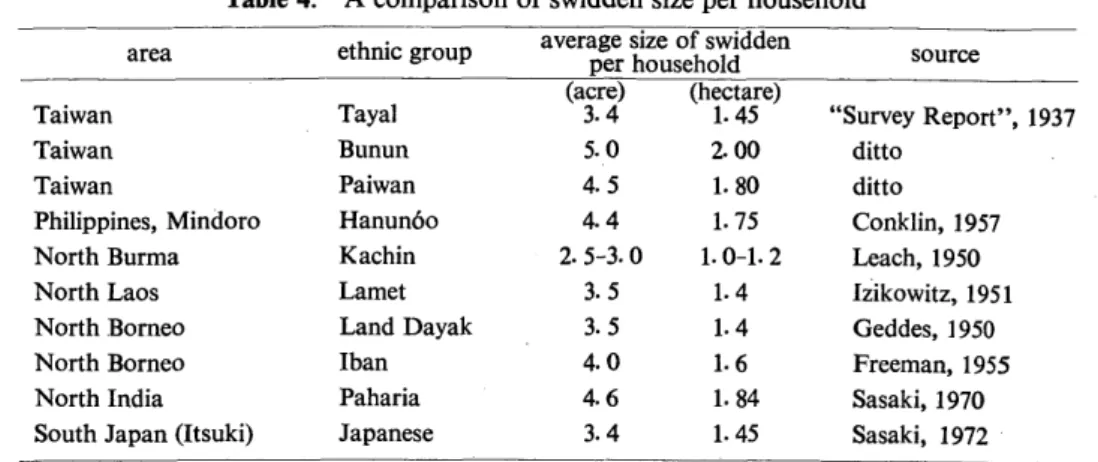
cultivate the field. Although dependent on location, it is clear that more than 10‑15 percent of the cultivated area is lost each year by weed infestation. From this we presume that the cultivated area per a household in Limau amounts to about 60 are.
According to data assembled earlier [SAsAKi 1970: 117], the average cultivated swidden area in India, Southeast Asia and Japan, where millets and upland rice are mainly grown, is 1 .4 ‑1 . 8 hectare per househol d (Table 4) . In comparison, the swidden size per household in Limau, is relatively small, being less than half that of other parts of Southeast Asia, An explanation of this phenomenon 'requires more research, but the Limau data are similar to those of Melanesia where tuber crops (taro, yam, sweet potato) dominate.
According to Barrau [1958: 75‑76], the size of swiddens cultivated per capita per year in Melanesia is about 1000‑1500 square yards (O.25‑O.30 acre), aocording to examples from Flji, where an average five member family owns 1.25‑1.5e acre (50‑
60 are). On the other hand, data from the central highlands of New Guinea [WAD‑
DELL 1972: 43], indicate that the average subsistence swidden area per household is 64‑70 are. These data indicate that the size of swiddens in Limau approximates those in Melanesia rather than of Southeast Asia.
In Limau the rate of upland rice cultivation is relatively low, whereas the rate of vegetatively reproduced cultigens (banana, tuber crops, sugar cane, palms etc.) is high.
In other words, a vegetative planting type of swiddening, as conducted in Melanesia, is practised in Limau. This may account for the similarity between the swiddens of Limau and those of Melanesia.
III. CROPSANDAGRICULTURALTECHNIQUES
1. Crops at Limau
Approximately 40 crops cultivated by Limau villagers were identified during field research. The principal crops, which mostly fa11 into 6 categories, are listed in Table 5. 0ther plants remain to be identified, although some information on them