Drift wave turbulence in toroidal plasmas, such as tokamak and helical plasmas, has been intensively investigated by means of direct numerical simulations, as it is supposed to be a main cause of the anomalous transport of mass, momentum, and heat. In plasmas with a strong toroidal magnetic field, turbulence often shows the quasi- two-dimensional nature, where the parallel scale-length is much longer than the perpendicular wavelengths of turbulence. In case with the finite magnetic shear, the turbulence fluctuation intensity has a peak on the outer side of the torus, which is known as the ballooning mode structure. In order to numerically handle the drift wave turbulence with the ballooning mode structure, the flux tube model has been developed [1], where the local turbulence fluctuations are efficiently captured in a simulation box set up along a toroidal field line.
In application of the flux tube model to drift wave turbulence, however, one needs to be careful to exclude artificial enhancement of turbulence correlation in the field- aligned direction. In order to reduce the artificial effect, it has been proposed to extend the simulation domain in the parallel direction, which simultaneously demands secular increase of the radial wavenumber, 𝑘𝑘!= |𝑠𝑠𝜃𝜃𝑘𝑘!|, where 𝑠𝑠 is the magnetic shear, 𝜃𝜃 is the poloidal angle, and 𝑘𝑘!
means the poloidal wavenumber. This method is straightforward, but may be inefficient if the mode structure has a long tail along the field line leading to a large value of 𝑘𝑘!, because the higher 𝑘𝑘! requires the severer Courant condition. Actually, in case with a moderate value of instability growth rate of the ion temperature gradient mode, the mode structure extending to 𝜃𝜃 = ±8𝜋𝜋 demands the simulation box size of 16𝜋𝜋 in the field-aligned direction.
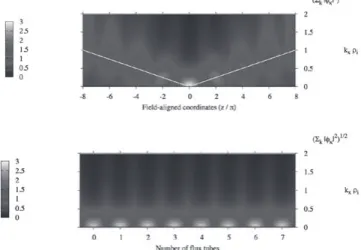
In order to overcome the numerical difficulties, we have developed a new simulation model which consists of a train of flux tubes connected along the field line. The new model is free from the secular increase of 𝑘𝑘! as the simulation domain is limited to 𝜃𝜃 = ±𝜋𝜋, but can exclude the artificial increase of the turbulent correlation by connecting different flux tubes. This can be clearly seen in plots of turbulent intensity on the 𝜃𝜃-𝑘𝑘! plane (see Fig. 1).
The conventional flux tube model shows that the turbulent intensity peaks at every 2𝜋𝜋 in 𝜃𝜃 but with higher 𝑘𝑘! as found in the upper panel of Fig. 1. In contrast, no secular increase of 𝑘𝑘! appears in the flux tube train model (see the lower panel of Fig.1) as turbulence simulated in in each flux tube is statistically equivalent by construction. The results clearly demonstrate that the quasi-modes in the ballooning
representation are equally treated, even in a numerical sense, by use of the flux tube train model.
Comparison of the turbulent transport flux obtained from the conventional flux tube model and the flux tube train model confirms agreement of the two schemes (up to the case of flux tube length of 16𝜋𝜋 for the conventional model; see Fig. 2). Thus, it is verified that the new model has numerical advantages to the conventional one while providing the same transport coefficient.
Application of the flux tube train model to other kinds of turbulence is currently in progress, and will be reported elsewhere.
Fig. 1. Turbulence intensity (power of electrostatic potential fluctuations) plotted in 𝜃𝜃-𝑘𝑘! plane. Upper and lower panels show results from the conventional flux tube model and the flux tube train model, respectively.
Fig. 2. Comparison of the turbulent heat transport obtained by the conventional flux tube model (open squares) and the flux tube train model (open circles).
1) Beer M.A., Cowley S.C. and Hammett G.W.: Phys.
Plasmas 2 (1995) 2687.
Fluid simulation is attractive because it is much faster than the kinetic simulation. However, it is known that classical fluid models such as two fluid model cannot give accurate transport level, as is also understood from the fact that the model includes viscosity coefficients as parameters.
In order to develop a fluid model with high accuracy, Beer et al. [1] developed a closure model, which is so called gyrofluid model. They concentrated on the unstable modes, and the closure coefficients are determined to satisfy the linear dispersion relation. However, Rosenbluth- Hinton [2] pointed out that the transport level by this model is not accurate because zonal flow is not correctly treated. In order to correctly treat zonal flow (ZF) modes in the long time limit, Sugama et al. [3] developed a fluid closure.
In this study we develop new fluid code for the fluid simulation of tokamaks based on a mixture of above fluid closure models. That is, for unstable modes (finite kT), we use a gyrofluid model [1], on the other hand, we use a closure model [3] for zonal modes (kT=0). The models include physically valid coefficients so that it is expected that the simulation results such as transport level are comparable to those of kinetic result. Linear benchmark results of these closures are shown in Ref.[4]
In the nonlinear simulation, we had problem on the numerical instability. This is because the model does not include explicit viscosity terms at all. As an initial test, rather large viscosity is added artificially. The results with and without ZF closure [3] are compared in Fig.1 where time history of energy diffusion coefficient is plotted. After the linear phase, the time average of results between different closures are not clearly seen, because of the large artificial viscosity. Snap shot of perturbed density is shown in Fig.2. As the ZF closure does not work, linear mode structure is clearly seen where the density contour is extended in the radial (x) direction. It is important to reduce the artificial viscosity.
Fig. 1. Diffusion coefficients in GyroBohm unit. Solid and dashed line shows closure with and without zonal flow (solid and dashed lines respectively).
Fig. 2. Snap shot of density perturbation in a fixed theta position.
1)M.A.Beer and G.W.Hammett, Phys.Plasmas 3,4046 (1996)
2) M. N. Rosenbluth and F. L. Hinton: Phys. Rev. Lett. 80 (1998)
3) H. Sugama, T.-H. Watanabe, and W. Horton: Phys.
Plasmas 14 (2007) 022502
4) O.Yamagishi and H.Sugama, Phys. Plasmas 19, 092504 (2012)
383
§11. A Flux Tube Train Model for Toroidal Plasma Turbulence Simulation
Watanabe, T.-H. (Dept. Phys., Nagoya Univ.), Sugama, H., Ishizawa, A., Nunami, M.