CSSE-24 November 7, 2005
Weak Second Order Stochastic Runge-Kutta Methods for Non-commuting Stochastic
Differential Equations
Yoshio Komori
Department of Systems Innovation and Informatics Kyushu Institute of Technology
680-4 Kawazu Iizuka, 820-8502, Japan [email protected]
Abstract
A new explicit stochastic Runge-Kutta scheme of weak order 2 is proposed for
non-commuting stochastic differential equations (SDEs), which is derivative-free
and which attains order 4 for ordinary differential equations. The scheme is di-
rectly applicable to Stratonovich SDEs and uses 2 m − 1 random variables in the
m -dimensional Wiener process case. It is compared with other derivative-free and
weak second order schemes in numerical experiments.
1 Introduction
As the importance of stochastic differential equations (SDEs) increases, numerical meth- ods for SDEs get studied more by many researchers. Especially, many numerical methods in the weak sense have been recently proposed for multi-dimensional SDEs with multi- plicative noise in the multi-dimensional Wiener process case, whereas counterparts in the strong sense have been enormously developed in the last 10 years [3].
Among such weak methods, we are concerned with derivative-free methods. Let us in- troduce results concerning such methods, which attain weak order 2 at least. Kloeden and Platen [6, 10] have proposed a derivative-free scheme by replacing necessary derivatives by finite differences. Tocino and Vigo-Aguiar [15] have also proposed the scheme as an example in their Runge-Kutta family. R¨ oßler [11, 12] has proposed other derivative-free schemes by assuming a commutativity condition [1, 13], which means
g (1) j (y)g l (y) = g (1) l (y)g j (y) ( ∀ y ∈ R d , 1 ≤ j, l ≤ m, j = l )
in (2. 1). Here, g (1) j or g (1) l denotes the derivative of g j or g l , respectively. On the other hand, Talay and Tubaro [14] have proposed the extrapolation method for SDEs.
This method also makes it possible to obtain an approximate solution without using any derivative.
Komori [7] has also proposed a new stochastic Runge-Kutta family and developed Butcher’s rooted tree analysis [4, 5] (which is for ordinary differential equations (ODEs)) to derive weak order conditions transparently for the new family. Then, utilizing the analysis, he has proposed a new explicit stochastic Runge-Kutta scheme of weak order 2, which is derivative-free and which attains order 4 for ODEs, under the commutativity condition [8].
In [7, 11, 15], it has been shown that each stochastic Runge-Kutta family includes the scheme proposed by Platen or its counterpart when the commutativity condition is not satisfied. It, however, still remains to find a solution of the order conditions in order to obtain another new scheme. Therefore, we aim at solving the order conditions and deriving a new explicit Runge-Kutta scheme of weak order 2 for non-commuting SDEs.
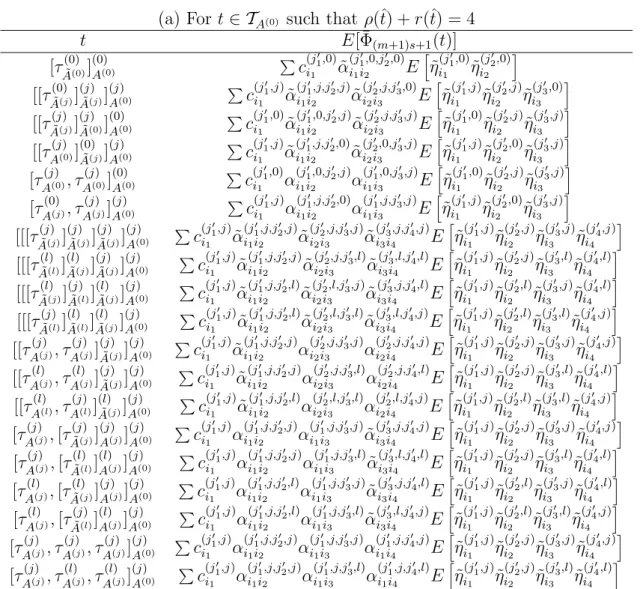
The organization of the present paper is as follows. In the next section we will give a brief introduction of our stochastic Runge-Kutta family as well as the expression of the order conditions of the family with rooted trees. In Section 3 we will find a solution of the order conditions after giving simplifying assumptions, and give some numerical experiments in the non-commutative case. In Section 4 we will give the summary and remarks. In the appendix, we will show the expectations of elementary numerical weights for weak order 2.
2 Stochastic Runge-Kutta family
In this section we introduce a stochastic Runge-Kutta family which gives approximate
solutions for SDEs with a multi-dimensional Wiener process. To derive weak order con-
ditions for the family, we utilize the multi-colored rooted tree analysis.
2.1 Weak order
First of all, we introduce the definition of weak (global) order. Let τ n be an equidistant grid point nh ( n = 0 , 1 , . . . , M ) with step size h def = T end /M < 1 ( M is a natural number) and y n a discrete approximation to the solution y( τ n ) of the d -dimensional stochastic integral equation
y( t ) = x 0 +
t
0 g 0 (y( s ))d s +
m j=1
t
0 g j (y( s )) ◦ d W j ( s ) , 0 ≤ t ≤ T end , (2. 1) where W j ( s ) is a scalar Wiener process and ◦ means the Stratonovich formulation. The initial approximate random variable y 0 is supposed to have the same probability law with all moments finite as that of x 0 . In addition, let C P L (R d , R) be the totality of L times continuously differentiable R-valued functions on R d , all of whose partial derivatives of order less than or equal to L have polynomial growth. Then, the definition of weak order is given as follows [2].
Definition 2.1 Suppose that discrete approximations y n are given by a scheme. Then, we say that the scheme is of weak (global) order q if for each G ∈ C P 2(q+1) (R d , R), C > 0 (independent of h ) and δ > 0 exist such that
|E [ G (y( τ M )] − E [ G (y M )] | ≤ Ch q , h ∈ (0 , δ ) .
In order to obtain an approximate solution y n+1 of the solution y( t n+1 ) when y n is given, we consider the stochastic Runge-Kutta family given by
y n+1 = y n +
s i=1
m j
a,j
b=0
c (j i
a,j
b) Y (j i
a,j
b) , Y (j i
aa,j
b) = η ˜ i (j
aa,j
b)
⎧ ⎨
⎩ g j
b(y n +
s i
b=1
m j
c,j
d=0
α (j i
aai
b,j
b,j
c,j
d) Y (j i
bc,j
d) ) +g (1) j
b(y n )
s i
b=1
m j
c,j
d=0
γ ˜ (j i
aai
b,j
b,j
c,j
d) Y (j i
bc,j
d)
⎫ ⎬
⎭
(2. 2)
(1 ≤ i a ≤ s , 0 ≤ j a , j b ≤ m ), where the constants c (j i
a,j
b) , α (j i
aai
b,j
b,j
c,j
d) and ˜ γ i (j
aai
b,j
b,j
c,j
d) are defined by the Butcher tableau and where each ˜ η i (j
aa,j
b) is a random variable independent of y n and satisfies
E η ˜ i (j
aa,j
b) 2k
=
K 1 h 2k ( j b = 0) , K 2 h k ( j b = 0)
for constants K 1 , K 2 and k = 1 , 2 , . . . . Note that this formulation includes stochastic Rosenbrock-Wanner methods [9].
2.2 Weak order conditions by multi-colored rooted trees
In this subsection we express weak order conditions by multi-colored rooted trees (MRTs).
As preliminaries, we introduce several notations and definitions.
First, we introduce the multi-colored rooted tree (MRT) and a function on its set.
Definition 2.2 (Multi-colored rooted tree) A multi-colored rooted tree with a root
g
j
(colored with a label j from 0 to m ) is a tree recursively defined in the following manner:
1) τ (j) is the primitive tree having only a vertex
jg .
2) If t 1 , . . . , t k are multi-colored trees, then [ t 1 , . . . , t k ] (j) is also a multi-colored rooted tree with the root
jg .
The totality of MRTs is denoted by T.
j
g
τ (j)
j
g
l
g J J
jg
[ τ (l) , τ (j) ] (j)
l
g
j
g
l
g J J
jg
[ τ (l) , [ τ (l) ] (j) ] (j) Figure 1: Examples of MRTs
Definition 2.3 (Elementary weight Φ( t ) on T ) An elementary weight of t ∈ T is given recursively as follows:
Φ( τ (j) ; s ) =
s
τ
n◦ d W j ( s 1 ) , Φ( t ; s ) =
s
τ
nk i=1
Φ( t i ; s 1 ) ◦ d W j ( s 1 ) for t = [ t 1 , . . . , t k ] (j) , where ◦ d W 0 ( s 1 ) def = d s 1 .
For ease of notation we will denote Φ( t ; τ n+1 ) by Φ( t ).
Next, we introduce several matrices related to the formula parameters of (2. 2), the multi-colored rooted tree with labels (MRTL) and a function on its set. Let us adopt nominal symbols ˜ η s+1 (j
a,j
b) , α (j s+1,i
a,j
bb,j
c,j
d) and ˜ γ s+1,i (j
a,j
bb,j
c,j
d) and define α (0,0,j s+1,i
cb,j
d) def = c (j i
bc,j
d) for i b ≥ 1 and
A (j,j
) def =
⎡
⎢ ⎢
⎢ ⎢
⎢ ⎢
⎢ ⎢
⎢ ⎢
⎢ ⎢
⎢ ⎢
⎢ ⎢
⎢ ⎣
α (0,j,0,j 11
) · · · α (m,j,0,j 11
) · · · α (0,j,0,j s+1,1
) · · · α s+1,1 (m,j,0,j
)
.. . .. . .. . .. .
α 11 (0,j,m,j
) · · · α 11 (m,j,m,j
) · · · α (0,j,m,j s+1,1
) · · · α (m,j,m,j s+1,1
)
.. . .. . .. . .. .
α (0,j,0,j 1s
) · · · α (m,j,0,j 1s
) · · · α (0,j,0,j s+1,s
) · · · α s+1,s (m,j,0,j
)
.. . .. . .. . .. .
α 1s (0,j,m,j
) · · · α 1s (m,j,m,j
) · · · α (0,j,m,j s+1,s
) · · · α (m,j,m,j s+1,s
) 0 · · · 0 · · · 0 · · · 0
⎤
⎥ ⎥
⎥ ⎥
⎥ ⎥
⎥ ⎥
⎥ ⎥
⎥ ⎥
⎥ ⎥
⎥ ⎥
⎥ ⎦
for α i (j
aai
b,j,j
c,j
) , where 0 stands for an m + 1-dimensional column vector of 0’s. Similarly, define the matrix ˜ Γ (j,j
) for ˜ γ (j i
aai
b,j,j
c,,j
) and set ˜ A (j,,j
) def = A (j,,j
) + ˜ Γ (j,,j
) . In addition, define the ( m + 1)( s + 1) × ( m + 1)( s + 1) diagonal matrix D (j) by
D (j) def = diag(˜ η 1 (0,j) , . . . , η ˜ 1 (m,j) , . . . , η ˜ s+1 (0,j) , . . . , η ˜ s+1 (m,j) ) .
In the sequel, let us use a label X (j) ∈ {A (j) , A ˜ (j) } as well as a matrix X (j,j
) ∈ {A (j,j
) , A ˜ (j,j
) } .
Definition 2.4 (Multi-colored rooted tree with labels) A multi-colored rooted tree with labels, denoted by t X
(j), is one attached by labels according to the following rules:
1) The label of the root is X (j) .
2) The label of the other vertices is decided by the number of branches and the color of the parent vertex:
• the label is A ˜ (j) if the parent vertex has a single branch and it is colored with j ,
• the label is A (j) if the parent vertex has more than one branch and it is colored with j .
The totality of MRTL’s whose roots are labeled with X (j) , is denoted by T X
(j). For example, some MRTL’s are listed in Fig. 2.
g
j
A (0) τ A (j)
(0)j
g A (j)
l
g
A (j)
J J
jg A (0) [ τ A (l)
(j), τ A (j)
(j)] (j)
A
(0)l
g A ˜ (l)
g
l
A ˜ (j)
g
j
A (0)
[ τ A (l) ˜
(l)] (l) ˜
A
(j)(j)
A
(0)Figure 2: Examples of trees in T A
(0)Definition 2.5 (Elementary numerical weight Φ( ¯ t ) on T X
(j)) An elementary numer- ical weight of t ∈ T X
(j)is given recursively as follows:
Φ( ¯ τ X (j
(j)) ) = 1 D (j
) X (j,j
) , Φ( ¯ t ) = (
· k
i=1
Φ( ¯ t i )) D (j
) X (j,j
) for t = [ t 1 , . . . , t k ] (j
)
X
(j)(0 ≤ j, j ≤ m ), where τ X (j
(j)) and [ t 1 , . . . , t k ] X (j
(j)) express MRTL’s whose roots are labeled by X (j) . In addition, 1 stands for an ( m + 1)( s + 1)-dimensional row vector of 1’s, and
· k
i=1 Φ( ¯ t i ) means the elementwise product of row vectors Φ( ¯ t i ).
Now, we can give weak order conditions. Let ρ ( t ) be the number of vertices of t ∈ T and r ( t ) the number of vertices of t with the color 0, and suppose that any component of g j belongs to C P 2(q+1) (R d , R) (0 ≤ j ≤ m ) and the regularity of the time discrete approx- imation are satisfied [6, 7]. If the following are satisfied, the time discrete approximation y M converges to the y( τ M ) with weak (global) order q as h → 0:
E
⎡
⎣ L
j=1
Φ ¯ (m+1)s+1 ( t j )
⎤
⎦ = E
⎡
⎣ L
j=1
Φ(ˆ t j )
⎤
⎦ (2. 3)
for any t 1 , . . . , t L ∈ T A
(0)(1 ≤ L ≤ 2 q ) satisfying L j=1 ( ρ (ˆ t j ) + r (ˆ t j )) ≤ 2 q and
E Φ ¯ (m+1)s+1 ( t ) = 0 (2. 4)
for any t ∈ T A
(0)satisfying ρ (ˆ t ) + r (ˆ t ) = 2 q + 1.
2.3 Expectations of elementary weights
We show a way of seeking the expectation in the right-hand side of (2. 3) with the help of MRTs. In the multiple Stratonovich integrals, the usual chain rule holds as in the deterministic case. Hence, we can rewrite the product of elementary weights or the composition of subtrees in a elementary weight by the following rules:
• The product of elementary weights of two MRTs t 1 , t 2 can be expressed by the sum of elementary weights of an MRT generated by grafting t 1 to the root of t 2 and an MRT generated by grafting t 2 to the root of t 1 .
• The elementary weight of an MRT having subtrees t 1 , t 2 can be expressed by the sum of elementary weights of an MRT generated by grafting t 1 to t 2 ’s own root and an MRT generated by grafting t 2 to t 1 ’s own root.
For example, we have Φ (
0g ) Φ
lg
j
g
= Φ
lg
j
g
0
g
+ Φ
0g
lg
j
g
= Φ
lg
j
g
0
g
+ Φ
lg
0
g g
j
+ Φ
0g
l
g
0
g
.
In addition, by utilizing the relationship between multiple Stratonovich integrals and multiple Itˆ o integrals ([6], p. 173), we can rewrite the expectations of the elementary weights of MRTs whose each vertex has no more than one branch as follows:
• The expectation of an elementary weight vanishes unless the even number of vertices are of colors different from 0 and each of these vertices has a parent or child vertex with the same color.
• Trace vertices in the direction from the root to upper vertices. Then, the expectation of an elementary weight of an MRT in which a vertex colored by j = 0 has a child vertex with the same color is equal to a half of that of another MRT given by replacing the two vertices with one vertex with the color 0. For example,
E
Φ
jg g
j
g
0
= 1 2 E Φ
0g
0
g
= 1 2 Φ
0g
0
g
.
Note that there is no longer need of the expectation in the right-hand side.
3 Solution of order conditions
In the previous section we have shown the order conditions with MRTL’s, and demon- strated the calculation of the expectations of elementary weights and elementary numerical weights appearing in the order conditions. In this section we will find a solution of the conditions for weak order 2 in the non-commutative case.
3.1 Simplifying assumption
As seen in (2. 3) and (2. 4), the conditions for weak order are generally given in the form
of expectations. By replacing expectations with monomials for trees which have only a
few vertices, however, we can reduce the number of the order conditions. In relation to
τ A (0)
(0), τ A (j)
(0), [ τ A (j) ˜
(j)] (j) A
(0), [ τ A (j) ˜
(0)] (0) A
(0), [ τ A (0) ˜
(j)] (j) A
(0), [ τ A (l) ˜
(j)] (j) A
(0)and [ τ A (j) ˜
(l)] (l) A
(0)( j < l ), let us assume that the following equations hold (simplifying assumptions):
c (j i
11,0) η ˜ i (j
11,0) = h,
c (j i
11,j) η ˜ (j i
11,j) = W j , (3. 1)
c (j i
11,j) η ˜ (j i
11,j) α ˜ (j i
11i
2,j,j
2,j) η ˜ i (j
22,j) = ( W j ) 2
2 ,
c (j i
11,0) η ˜ i (j
11,0) α ˜ (j i
11i
2,0,j
2,j) η ˜ (j i
22,j) = hW j
2 ,
c (j i
11,j) η ˜ (j i
11,j) α ˜ (j i
11i
2,j,j
2,0) η ˜ i (j
22,0) = hW j
2 ,
c (j i
11,j) η ˜ (j i
11,j) α ˜ (j i
11i
2,j,j
2,l) η ˜ i (j
22,l) = W j ( W l + W ˜ l )
2 ( j < l ) , (3. 2)
c (j i
11,l) η ˜ (j i
11,l) α ˜ (j i
11i
2,l,j
2,j) η ˜ i (j
22,j) = W j ( W l − W ˜ l )
2 ( j < l ) , (3. 3) where W j ’s ( j = 1 , . . . , m ) and W ˜ l ’s ( l = 2 , . . . , m ) are mutually independent random variables satisfying
E ( W j ) k =
⎧ ⎪
⎨
⎪ ⎩
0 ( k = 1 , 3 , 5) , ( k − 1) h k/2 ( k = 2 , 4) , O ( h 3 ) ( k ≥ 6) ,
E ( W ˜ l ) k =
⎧ ⎪
⎨
⎪ ⎩
0 ( k = 1 , 3) , h ( k = 2) , O ( h 2 ) ( k ≥ 4) .
(3. 4) Note that the expressions in the right-hand side of (3. 2) and (3. 3) come from the approximation
Φ
lg
j