B1TB2216
Graduation Thesis
Learning visual attribute from image and text
Maharjan Sumit
March 2, 2015
Department of Information and Intelligent Systems
Tohoku University
Learning visual attribute from image and text ∗
Maharjan Sumit
Abstract
Visual attributes are the words describing appearance properties of an object.
They have an interesting property in that they are linguistic entities and yet bear a strong connection to visual information. In other words, it would be impossible to learn a meaningful representation of visual attributes only from language context.
In this paper, we make a preliminary study on the approach to learn the mean- ing of visual attributes from both image and text. We collect a large scale dataset of images and texts from the real-world on-line marketplace. We then attempt to learn a grounded representation of automatically generated attributes from the dataset using Canonical Correlation Analysis (CCA) projecting both image and text representation into a common subspace. This encodes both visual and se- mantic meaning of a word. Through empirical study, we show how grounded learning changes the meaning of the attribute word through the multimodal grounding.
Keywords:
natural language processing, distributional semantics, machine learning, ground- ing, computer vision, multimodal
∗
Graduation Thesis, Department of Information and Intelligent Systems, Tohoku University,
B1TB2216, March 2, 2015.
Contents
1 Introduction 1
2 Related Work 4
2.1 Visual attributes . . . . 4 2.2 Image and text corpus . . . . 4 2.3 Multimodal grounding . . . . 5
3 Etsy Dataset 6
4 Attribute Representation 7
4.1 Image Representation . . . . 7 4.2 Text Representation . . . . 7 4.3 Canonical Correlation Analysis . . . . 8
5 Evaluation 9
5.1 Visualization . . . . 9 5.2 Word-to-word retrieval . . . . 9 5.3 Cross-modal retrieval . . . . 11
6 Discussion 13
7 Conclusion 14
Acknowledgements 15
List of Figures
1 DSMs cannot distinguish between synonyms(fat and oversized) and anytonyms(fat and skinny) since all of them(fat, oversized and skinny) tend to appear in similar linguistic context. . . . 1 2 Including visual information can help to distinguish synonyms and
antonyms as they tend to refer to different types of images. . . . . 2 3 Previous works performed multimodal grounding on manually amn-
notated attributes using different methods while in this paper we perform grounding on automatically generated attributes using CCA. 4 4 Example item from Etsy. Each item consists of a title, an image,
and a description about the product. Notice the visual description about the product, such as color, pattern, or material. . . . 6 5 t-SNE visualization of words by semantic category in the word2vec
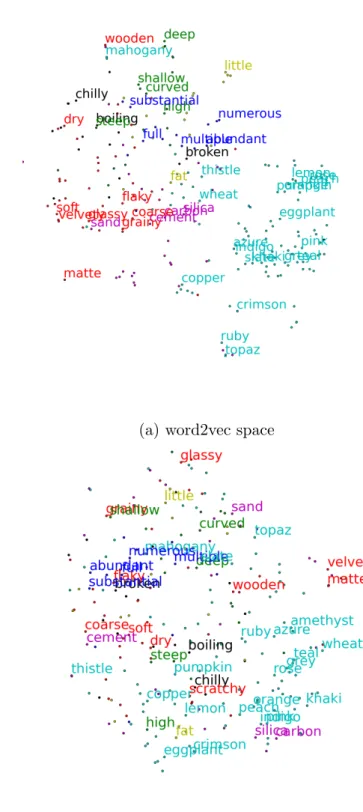
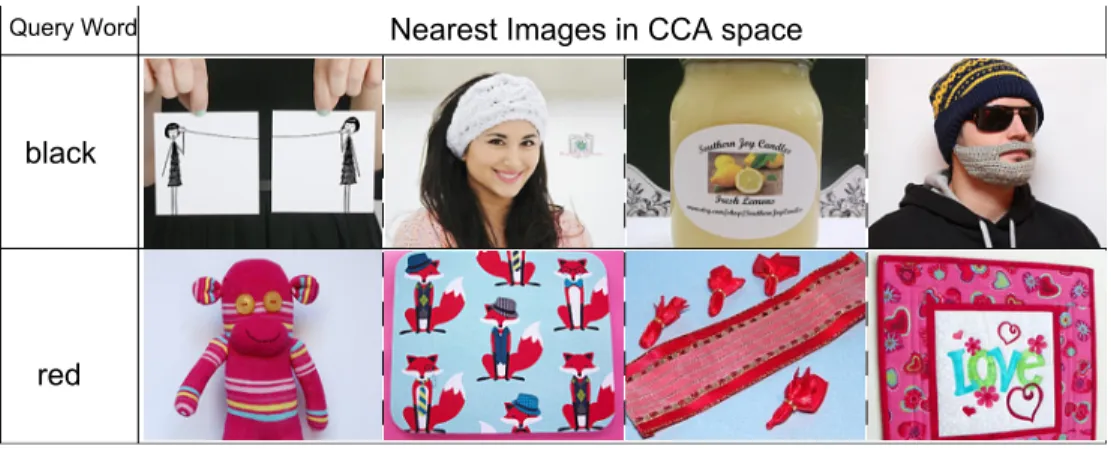
and the CCA space . . . . 10 6 Nearest words/images for a given query word/image in the CCA
space . . . . 12
List of Tables
1 Nearest neighbors for a given query word in the word2vec and the
CCA space . . . . 11
1 Introduction
One of the biggest challenges in the field of Natural Language Processing is proper representation of meaning of words. Recent years have seen a surge in the use of vector space models [12] [3] which are based on distributional hypothesis (similar words appear in similar linguistic contexts). These distributional models approx- imate vectors that keep track of the patterns of co-occurence of the word in the text corpora, so that the degree of semantic similarity between two or more words can be compared.
These models have been successful in many natural language applications but still have several limitations. They cannot distinguish between synonyms and antonyms since both of them tend to appear in similar linguistic contexts. They represent the meaning of a word entirely in terms of connections to other words.
However, meaning of a word has a strong connection with some component in the real world and hence distributional models cannot connect language to its actual meaning in the real world.
I own a really fat cat.
I own a really over-sized cat.
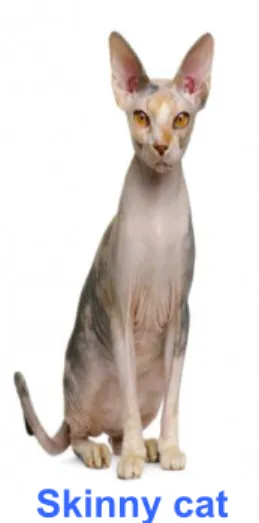
I own a really skinny cat.
Figure 1: DSMs cannot distinguish between synonyms(fat and oversized) and anytonyms(fat and skinny) since all of them(fat, oversized and skinny) tend to appear in similar linguistic context.
Visual attributes are the example of linguistic entities that bear a strong con- nection to visual information. Visual attributes are the words describing appear- ance properties of an object. For example, one might use gray or brown and furry to describe a cat. Visual attributes have been studied in the computer vision community [4], where the main focus has been in the automatic recognition of attributes from an image. Hence, it would be impossible to learn a meaningful representation of visual attributes only from language context.
In this paper, we make a preliminary study on the approach to learn the mean-
ing of visual attributes from both image and text. We collect a large scale dataset
of images and texts from the real-world on-line marketplace. We then attempt to learn a grounded representation of attributes generated automatically from the dataset using Canonical Correlation Analysis (CCA). CCA allows us to project both image and text representation into a common subspace, which encodes both visual and semantic meaning of a word. Through empirical study, we show how grounded learning changes the meaning of the attribute word through the multi- modal grounding.
Grounded representation can be expected to generate better vector models since they encode information from not only linguistic but also visual data. Using the differences in the appearance property it can help to clarify the differences between synonyms and antonyms. Since they relate text with image, it can be used for image retrival and image descriptions tasks. Also, the grounded representation can capture the visual similarity across different semantic contexts;
e.g., distance between metallic in terms of material and gray in terms of color.
I own a really fat cat.
I own a really over-sized cat.
Fat cat/
Oversized cat Skinny cat
I own a really skinny cat.
Figure 2: Including visual information can help to distinguish synonyms and
antonyms as they tend to refer to different types of images.
Our contribution in the paper is summarized in the following points.
• Large-scale dataset of image and text rich in attribute description, collected from a real-world on-line market Etsy.
• Preliminary empirical evaluation of grounded learning by CCA.
2 Related Work
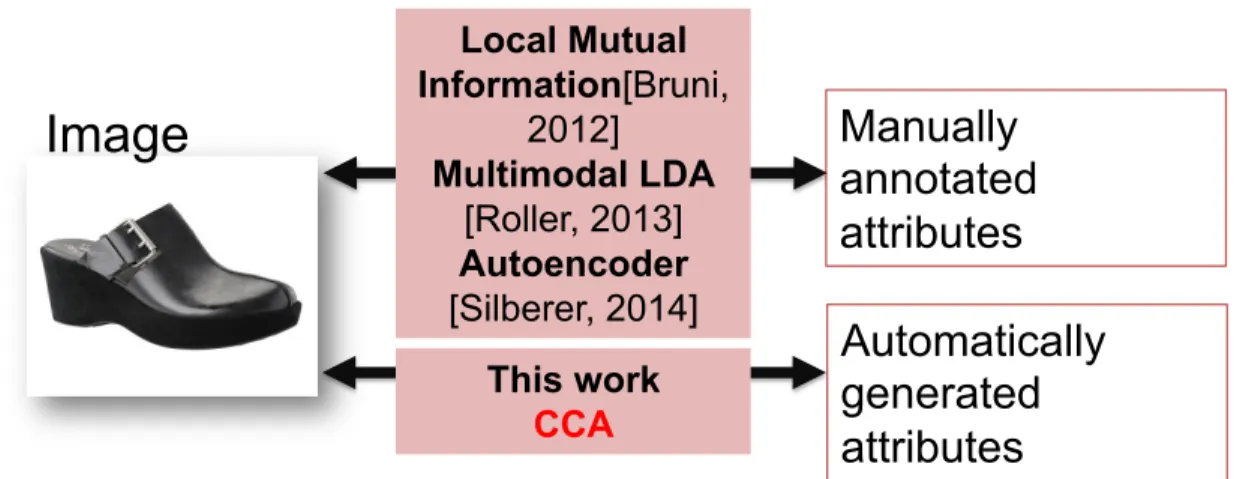
Image Manually
annotated attributes
Local Mutual Information[Bruni,
2012]
Multimodal LDA [Roller, 2013]
Autoencoder [Silberer, 2014]
Automatically generated attributes
This work CCA
Figure 3: Previous works performed multimodal grounding on manually amnno- tated attributes using different methods while in this paper we perform grounding on automatically generated attributes using CCA.
2.1 Visual attributes
Visual attributes have been getting attention in the computer vision community as a mean of categorization [4, 1, 15], zero-shot learning [8], or sentence generation from an image [13, 19]. Previous works mainly focused on the recognition of the attributes from an image. In this paper, we are interested in learning the grounded representation of attributes from both semantic and visual meaning.
2.2 Image and text corpus
There has been a continuous effort in building a larger corpus of image and text in
the research community, such as SBU1M [14], Flickr30k [5], or Microsoft COCO
[10]. All of them contain a large collections of pairs of image and one or more
sentences. However, these existing datasets are not necessarily designed to study
visual attributes. On the other hand, attribute-focused datasets in the vision
community [16, 18] do not come with text descriptions. Visual attributes are
usually manually annotated by looking at the image according to some mentioned guidelines. This task is costly and can generate only limited amount of data while deciding the guidelines is a difficult task. Furthermore, there is not much information on what type of words are the most appropriate visual attributes.
Hence, the visual attributes generated by manual annotation is limited in number.
2.3 Multimodal grounding
Recently there is a surge of interest in learning grounded representation of lexical meaning by various approaches, including Local Mutual Information[2], Multi- modal LDA [17], or Autoencoder [20], since the early work using CCA [9]. All these previous works use manually annotated visual attributes.
In this paper, we build a large corpus of image and text focused on visual
attributes using an on-line market. Instead of manually annotating visual at-
tributes on each of the images, we automatically extract the attributes from the
corpus and make a preliminary study on the grounded learning using CCA.
Robins Egg Blue Market Bag Set - Dragonflies - Hand Printed
A hand screen printed hobo bag
featuring 3 little dragonflies. Tea soaked 100% cotton fabric of course. Then a layer of robins egg blue showing flowers and pineapples, then the dragonflies ...
Figure 4: Example item from Etsy. Each item consists of a title, an image, and a description about the product. Notice the visual description about the product, such as color, pattern, or material.
3 Etsy Dataset
In this paper, we have collected data from Etsy, an on-line marketplace of hand- made crafts. From the website, we have crawled 1,216,512 items that spans across various product categories including art, fabric, gadget accessories, or bath prod- ucts. Each item consists of a title, an image of 170 × 135 pixels, a product description, and other metadata such as price. Figure 4 shows an example of an item.
Etsy has a favorable property for us to study visual attributes. As sellers try to
describe a product in detail to make the product sound more attractive, the seller
description tends to include detailed information about product appearance rich
in attributes, as well as other information such as size, usage, delivery method,
etc.
4 Attribute Representation
Given a pair of image and bag-of-attributes, we wish to learn the grounded rep- resentation of the attribute words. Our strategy is first to process image and text part separately, then combine these two vectors using CCA.
4.1 Image Representation
In this paper, we represent the image by a simple color histogram. Given an image, we calculate 16-bin histogram for red, green, and blue channels and con- catenate them to form a 48 dimensional vector. We sticked to the simple color histogram in this paper for visualization purpose since using higher-level image features do not necessarily produce an easily interpretable visualization.
4.2 Text Representation
Visual attributes could be various linguistic entities, from adjectives, nouns, to verbs. In this paper, we restrict attribute-vocabulary to manually-annotated 248 adjectives for simplification purpose. Note that it is straightforward to expand the range of attributes.
We represent each attribute-word by word2vec [12], which we learn from the dataset. For each item in the dataset, we first normalized text in the title and the description by removing URL, email address, or formatting string. Using the normalized texts as a corpus, we learn a 300 dimensional word2vec model.
Each item in our dataset contains multiple attributes. To represent each item using word2vec, we calculate the average vector for each item. We applied a POS tagger [11] to find adjectives in the title and the text, and kept adjectives with minimum document frequency of 100. This preprocessing left us with a bag of attribute-words for each item. Then we calculated the average word2vec from this bag to obtain a vector representation for items.
After removing items without any attribute words, we obtained 943,934 items
from the Etsy dataset. Out of the 943,934 pairs of text and image vector pairs,
we used 643,934 pairs for training and the remaining 300,000 pairs for testing
purpose.
4.3 Canonical Correlation Analysis
Canonical correlation analysis [7, 6] is a method for exploring the relationships between two multivariate sets of variables, all measured on the same individual.
Consider two random variable X ∈ R
n1and Y ∈ R
n2both characterizing the same object, each a distinct view offering different information. So from them, we want to derive new variables U, V ∈ R
m(where m ≤ min(n
1, n
2)) whose correlation is maximized. CCA finds U = (U
1. . . U
m) and V = (V
1. . . V
m) such that
U
i, V
i= arg max
φ,ψ∈R