On the Cryo-biological Study of the Parasitic Protozoa
(1) Studies on the freezing conditions of trichomonads in a -25C and a -75C freezer
Akira MIYATA
Department of Epidemiology, Institute for Tropical Medicine Nagasaki University
(Chief : Prof. Toshio NAKABAYASHI)
(Recieved for Publication, September 3, 1973)
Abstract
Examinations were done of the cooling method, the effect of the cryo-protective substance such as glycerol (GLY) and dimethyl sulfoxide (DMSO), and of salt concentration on the low temperature preservation of Trichomonas vaginalis and Tritrichomonas foetus in a -25C or a -75C freezer.
The following results were obtained:
1. In the -25C freezer trichomonad survived for several days in the presence of GLY or DMSO. The longest survival record was two weeks in T. vaginalis and one week in T.
foetus, whereas the survival rate in either species was quite low.
2. Both the trichomonad species in a sample with GLY or DMSO placed directly into the -75C freezer could survive for a month or longer, but the survival rate was low.
3. The pre-cooling method in which a sample was pre-cooled in the-25C freezer then trans- fered into the -75C freezer was found to give a good effect to a rise in the survival rate of trichomonads.
4. In a 5-day storage in the -75C freezer by the pre-cooling method, the survival rate became higher than 70% in T. vaginalis and nearly 10% in T. foetus in the presence of 2.5•`7.5%
DMSO, while it remained lower than 20% in T. vaginals and only several percents in T. foetus in the presence of 10% GLY.
5. In a one-day storage in the presence of 5.0% DMSO by the pre-cooling method, the survival rate of T. vaginalis was higher in 0.9•`1.5% NaCl than in the lower salt concent- ration. As the highest survival rate of T. foetus was 30.4% in 0.3% NaCl, the optimum salt concentration for T. foetus was thought to be lower than that for T. vaginalis.
Contribution No. 677 from the Institute for Tropical Medicine, Nagasaki University
142 Akira MIVATA
6. As a conclusion it could be said that the pre-cooling method might be useful for the low temperature preservation of trichomonad and would be applicable to the cases of other parasitic protozoa.
Introduction
Gaylord(1908) reported that Trypanosoma gambiense could resist freezing in liquid air for 20 minutes, and De Jong (1922) also mentioned that Trypanosoma equiperdum survived for 21 days in -190C liquid air.
Coggeshall (1939) reported that malaria infected blood cells which were stored for 70 days in a-76C dry-ice box still could be infective to a fresh host. Horsfall (1940) and Manwell et al. (1942, 1943 a & b) also published their reports. According to Wein- manet al. (1947), Trypanosoma, Plasmodi- um and Leishmania could be preserved safely for several months in a-70~ -79C dry- ice cabinet, but Entamoeba histolytica,
Trichomonas vaginalis, Toxoplasma gondii and Balantidium sp. could not.
Since Polge et al. (1949) found that gly- cerol could be used as a cryo-protective sub- stance for the freezing preservation of bull semen, many workers have attempted to use glycerol for the freezing preservation of pro- tozoa. Fulton et al. (1953) reported that E. histolytica could survive for 65 days at
-76C in the presence of 5~10^ glycerol. T.
vaginalis by McEntegart(1954) and T.foetus by Levine et al. (1955) were found to be ca-
pable of survival for a long period at -76~
-79C in the presence of glycerol.
Lovelock et al. (1959) found out that di- methyl sulfoxide had a cryo-protective action similar to glycerol in the freezing preserva- tion of the living cell. This new cryo-pro- tective substance also has been used for the freezing preservation of parasitic protozoa by many workers.
The freezing preservation of protozoa was thought to be useful to maintain many kinds of protozoa strains in a laboratory. There- fore, since Coggeshall (1939), attempts have been made to preserve protozoa in a freezing condition safely for a long period. Those papers were reviewed by Muhlpfordt (1960), Smith (1961) and Diamond (1964) respecti- vely. Shorb (1963) also reviewed concerning the freezing preservation of trichomonads.
But very few papers have been published as to the cryo-biological study in the freezing preservation of parasitic protozoa. In the present paper an attempt was done to further advance the knowledge on the basic study of the low temperature preservation of T.
vaginalis and T.foetus in a -25C and a -75C freezer.
Materials and Methods
These experiments were carried out as the following procedure :
1. Strain TK of Trichomonas vaginalis ori- ginally isolated from a patient of trichomo-
niasis in Nagasaki City by the author, and strain Yamaguchi of Tritrichomonas foetus was given from Chugoku Branch Laboratory, the National Institute of Animal Health,
V-Bouillon (Modified CPLM by Hamada, 1953)
Peptone Yeast extract Liver extract Glucose
L-cysteine HC1 NaCl
2.0g 0.2g 0.2g l.Og 0.2g O.Qfif
!
Dissolve in 100 ml of boilling distilled water.
Adjust pH to 6.5 with NaOH.
1
Dispense 4.5 ml in test tube.
I i
Autoclave at 15 pounds pressure for 20 minutes.
ji
4-
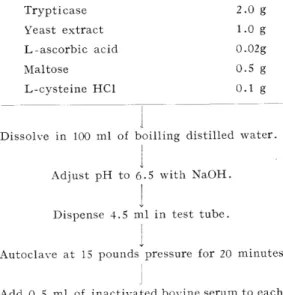
Heat in boilling water for a few minutes and cool rapidly in water, then add 0.5 mlof inac- tivated bovine serum to each tube just before using.
Modified Diamond's Medium (Diamond, 1957)
Trypticase Yeast extract L-ascorbic acid Maltose
L-cysteine HC1
Dissolve in 100 ml of
Adjust pH to
Dispense 4.5
2.0g 1.0g 0.02g 0.5g
0.1 c
boilling distilled water.
..5
ml i
with NaOH.
n test tube.
i
Autoclave at 15 pounds pressure for 20 minutes.
Add 0.5 ml of inactivated bovine serumto each tube just before using.
Table 1. V-Bouillon and Diamond's Medium for trichomonad culture.
Both, strains were cultivated axenically in V-Bouillon or Diamond's Medium for 48 hours at 37C, and the culture was centrifuged at 350xg for 10 minutes. Then the upper half of the supernatant was discarded and tricho- monads were resuspended in the rest of the medium. In Table 1, the components of V- Bouillon and modified Diamond's Medium were presented.
2. Twice as much as the required final con- centration of a cryo-protective substance was prepared in distilled water. In these experi- ments, two kinds of cryo-protective substan- ces, dimethyl sulfoxide ((CH3)2SO, DMSO) and glycerol (CH2(OH)CH(OH)CH2(OH),
GLY) were used. The concentration of substance was shown as volume per volume percent.
3. The diluted cryo-protective substance was mixed into the protozoa suspension, then one ml of the mixture was distributed into each
small test tube with a rubber cap.
4. The mixture was allowed to equilibrate at room temperature for 10 minutes for DMSO or 30 minutes for GLY.
5. After equilibration was finished, the tubes were placed in a --25C freezer (HITACHI Super Freezer, - 25± 2C) or a - 75C deep freezer (REVCO ULT-657, -75±10C). The cooling rate of the samples was recorded automati- cally with an electric recording thermometer
(Chino Works, LTD., ET-1200-IRSP, copper- constantan thermocouple, range of measure- ment +50~ -200C, equilibration time 1 sec.) 6. The samples frozen were rapidly thawed in a 37C water bath, and the survival and dead trichomonads were counted with Thoma's haemocytometer. The survival rate was ex- pressed as follows:
Survival rate (,%')=No. of survival trichomo- nads *- (No. of dead trichomonads+ No. of survival trichomonads) x 100
144 Akira MIYATA
0
££iz
a, H
F
0-j Segment ( l7s^^
I Super-cooled state
20
30
0
&-20
§
-30
0
oIH
Segment ( 2 ) "N^
Liberation of latent heat
Segment ( 3)
0 10 20 30 Minutes
---Control
2.5%GLY
, .^- i=S*>^ 5.0% GLY
^ \ f^tS^ OC**--. 7.5% GLY
V j f j ^§^-O---100%OIY
^tlI ^N^V,
0"J ^V*-^^^i^
0 10 20 M Minutes
Fig. 1. The cooling curves of samples in the presence of GLY.
O -10-
Control
7.5%
10.0%
^ "V-
*^^>^
-20
30
<p s
! HI
Control (0%)
VDMSO V- - ^
0 10 20 30 Minutes
0 L
10- >>'**"***^N^*1^ >.,
^"^^S>-
3 0 10 20
Fig. 2. The cooling curves in the -25C freezer.
30 Minutes
Results
Experiment 1. Freezing in a -25C freezer.
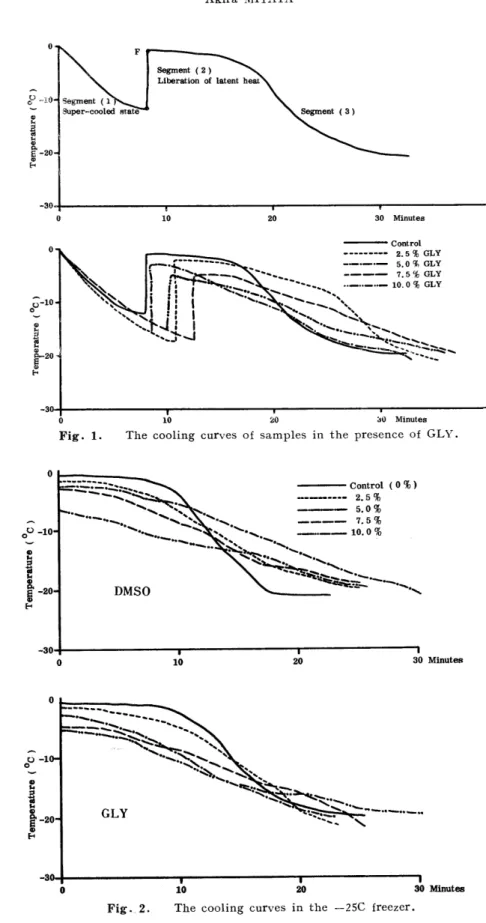
In the -25C freezer, the cooling curve of the sample without cryo-protective substance was consisted of three main segments (Fig. 1 upper).
(1) The first segment : drops without freez- ing, and the super-cooled state is continuing.
(2) The second segment: goes up by the liberation of the latent heat of crystallization, and drops again gradually.
(3) The third segment: drops more rapidly.
The cooling curve of this segment has a similar tendancy as that of the first segment.
The cooling rate described in the paper was expressed as that in the segment 3.
In the sample with GLY, the super-cooled state continued longer, and the cooling rate and the freezing temperature were lower than those in the control sample without GLY.
The cooling curve of the sample in each concentration of GLY was shown in Fig. 1 lower. The cooling curves of the samples in each concentration of GLY and DMSO after passing off the freezing point (F) were in
Fig. 2.
In the control sample without a cryo- protective substance the motile T. vaginalis and T. foetus decreased rapidly in number around -20C and no motile trichomonad was found after a day. While in the sample with 2.5% DMSO the survival rates ofT. vaginalis and T. foetus were higher than 90^ at - 20C
(Fig. 3) and the longest record of storage at-25C was 2 weeks in T. vaginalis and one week in T. foetus. The motile trichomonads detected -microscopically, how- ever, were very few and uncapable of multi-
plying in culture. Attempts were repeated several times and it was clearly understood that these two kinds of trichomonads could
not survive for longer than two weeks in the -25C freezer.
Experiment 2. Freezing in a -75Cfreezer.
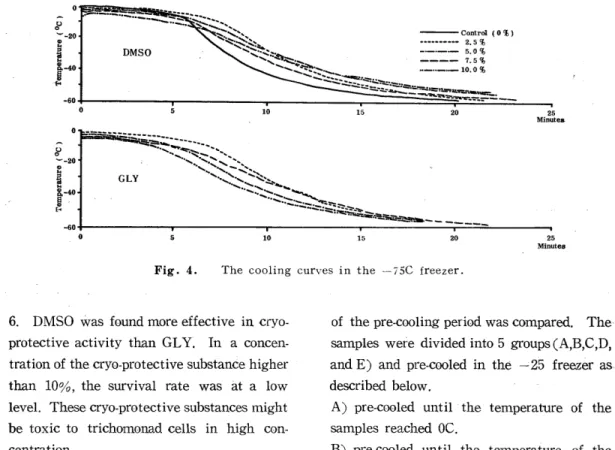
In the -75C freezer the cooling curves of the samples with DMSO or GLY were pre- sented in Fig. 4. The super-cooled state did not continue as long as in the -25C freezer.
The freezing temperature dropped in propor- tion to the concentration of the cryo-protec- tive substance.
To examine the survival rate of trichomo- nads at several points in the cooling curves, the thermocouple was put in one of the samples with GLY or DMSO. When the temperature of the sample dropped to the point respectively, another sample was taken out from the freezer to examine the survival rate. The results were shown in Fig. 5 and
100
£?
PC;
0
«*._ X, 7'-T. vaginalis'
\ T foetus
7". foetus
Control witK 2.5% DMSO
T. vaginali
A B C D
3. The freezing preservation of trichomo- nads in the -25G freezer.
A:at-IOC, B:at-20C,
C : stored for30 minutes after temper- ature reached -20C,
D : stored for 1 hour after tempera- ture reached -20C.
145 Akira MIYATA
0
<?
--20o
ft -40
*i 60
-Control (0%)
à" 2.5%
DMSO :^%>
5.0%
7.5%
10.0%
à"^s^***
0
0 -i
»
--20
60
5 10 15
GLY ^à"à"O"^^
à"^^-^
"52aaa!a5S5ai^*^^ -
20 25
Minutes.
0 5 10 15 20
Fig. 4. The cooling curves in the -?5C freezer.
Minutes25
6. DMSO was found more effective in cryo- protective activity than GLY. In a concen-
tration of the cryo-protective substance higher than 10%, the survival rate was at a low level. These cryo-protective substances might be toxic to trichomonad cells in high con- centrat ion.
In the control sample without any cryo- protective substance, the survival trichomo- nads were detected at temperatures higher than -45C,but at the lower temperatures no survival trichomonad was detected micro- scopical ly.
Both trichomonad species could survive for a month or moreby use of this direct cooling method in the -75C freezer in the presence of DMSO or GLY, but the survival rate was low. The same experiment was repeated with T. foetus, but the survival rateof this species was very low in comparison with T. vaginalis even in the presence of DMSO
or GLY.
Experiment 3. Effect of pre-cooling [in a -25C freezer.
In this experiment the samples with 5.0^
DMSO were stored in the-75C freezer after pre-cooling in the -25C freezer, and the effect
of the pre-cooling period was compared. The samples were divided into 5 groups (A,B,C,D, and E) and pre-cooled in the -25 freezer as described below.
A) pre-cooled until the temperature of the samples reached OC.
B) pre-cooled until the temperature of the samples reached -IOC after passing off the freezing point.
C) pre-cooled until the temperature of the samples reached -20C after passing -off the freezing point.
D) pre-cooled for one hour after the temper- ature of the samples reached -20C.
E) pre-cooled for two hours after the temper- ature of the samples reached -20C.
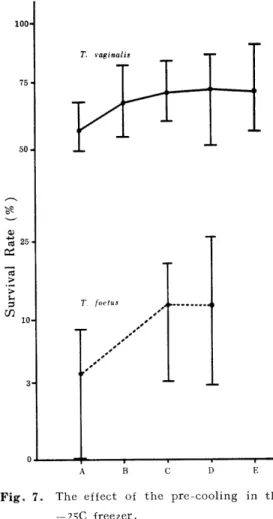
After pre-cooling, the samples were stored in the -75C freezer for 5 days. Then, the samples were thawed rapidly in a 37C water bath and examined for the survival rate of trichomonad. Each group was composed of 10 samples in T. vaginalis and 5 samples in.
T. foetus and the range of survival rate were presented respectively in Fig. 7. In both the species the survival rate of tricho- monadin group C, D and E were higher than that in group A.
Control
100-j |. ^^^
\
s \
I!>i
50
0
*v
V..
\
\
\
\
\ \
">»- »
\\N
2.5 5.0 7.5 10.0
%_~"\
%%%%
(0%
DMSO DMSO DMSO DMSO
^x\
.V
V-.
-20 -30 -40
Temperature ( °C )
Fig. 5. The survival rate ofthesample cooled directly in the -7SC freezer in the presence of DMSO. (T. vaginalis}
100
i*
I50 1
à"g I
0
*
-^
\ ~~~~^<
\ \
\ \
H
2.5% GLY
5.0% GLY
7.5% GLY
10.0% GLY
V \x
~V / \x*~~..
à"s.
OKf---:x *
à" \ A^r'
0 -10 -20 -30 -40
Temperature ( °C )
-SO -60
Fig. 6. The survival rate of the sample cool- ed directly inthe -75C feezer in the presence of GLY. (T. vaginalis)
E xperiment 4. Effect of the concentration of GLY or DMSO.
In this experiment, the effect of [the con- centration of DMSO and GLY for the survival of trichomonad in a frozen state was exam-
ined by the pre-cooling method used in expe- riment 3, D. Ten samples with different concentrations of DMSO or GLY were stored
in the -75C freezer for 5 days, then thawed in a 37C water bath.
T. vaginaiis 100
75
50
"S 25
oi
10
30
T. foetus
#
+
f *
Fig. 7. The effect of the pre-cooling in the -25C freezer.
The following 5 groups, each composed of 10 samples, were compared in the survival rates.
The average and the range of the survivalrates w^ere shown in each result.
A) OC->-7SC freezer*
B) -IOC-S.-75C freezer*
C) -20C->-75C freezer*
D) -20C->1 hour-».-7SC freezer-*
E) -20C->2 hours->-75C freezer:<*
*When the temperature of the sample reached to required degrees (OC in A, -IOC in B and -20C in C) in the -25C freezer, the sample was transfered into the -7SC freezer.
**The sample in the -25C freezer was stored for 1 hour (D) or 2 hours (E), after cooled to -20C, then transfered into the -75C freezer.
14S Akira MI^ATA
leo
75
50 8?
9>
toK
'a
.£; 25
tc
cn3
030
_,,"÷T5¢/uP”1"÷W.-*
DMSO
GLY
CD GD CD CD GD GD
0 0.5 1.0 2.5 5.0 7.5 10.0
Concentration of DMSOand GLY (v/v%)
Fig. 8. The effect of the concentration of
cryo-protective substances (T. vagi- nans'}.
According to the results shown in Fig. 8, DMSO was more cryo-protective than GLY in the same concentration. In the control group without any cryo-protective substance, no motile trichomonad was observed micro- scopically from all of ten samples,
In this experiment the survival rate of trichonmonad in 5.0^ DMSO might be some- what lower than that in 2.5^ or 7.5% DMSO, although the difference was not significant statistically at 95% confidence level. In the
case of T. foetus, the survival rate in every concentration was very low, then no clear result could be obtained.
Experiment 5. Effect of salt concentration.
The effect of salt concentration in the samples was examined comparatively and the result was shown in Fig. 9.
100
eS o
« 50
| I
0
0 0.3 0.6 0.9 1.2 1.5 1.8 2.1 2.1 '4.1 3.0
Salt Concentration ( % )
Fig. 9. The effect of the salt concentration (T. vaginalis).
The experimental procedure was described as follows: The 48-hour cultivation of T.
vaginalis in V-Bouillon was centrifuged at 350xg for 10 minutes. The supernatant was discarded completely and the sediment was suspended separately in different concentra- tions of NaCl solutions with 5.0% DMSO.
After one hour pre-cooling in the -25C freezer, all samples were stored for 24 hours in the -75C freezer. In this experiment, only one sample was prepared for each salt concent rat ion.
According to the result, in T. vaginalis it might be said that the survival rates in the salt concentration of 0.9~1.5% were higher than those in lower salt concentration.
In T. foetus, the survival rate was generally very low in the salt concentrations ranging from 0.3 to 3.0%. The highest survival rate, 30.4%, was obtained in the sample of 0.3%
NaCl, whereas survival rate was less than 0.01# in the sample of 0.9^ NaCl.
According to this result, the author emp- loyed Diamond's Medium for T. foetus and V-Bouillon for T. vaginalis, because the salt
concentration in Diamond's Medium was quite low as compared with that in V-Bouil-
Ion.
Discussion
The conditions for preservation for a long period of T. vaginalis and T. foetus in a -25C freezer and a -75C freezer were studied in the present experiments.
In the preservation at -25C, the cryo- protective action of DMSO and GLY to liv- ing trichomonads was clearly recognized, but the survival rate decreased every day.
The longest survival period was 2 weeks in T. vaginalis and one week in T. foetus.
It could be thought that in the sample fro- zen completely at -25C, trichomonad cells might be still maintained in the unfrozen state without sufficient dehydration and once the state was broken, an intracellular ice-formation might occur to destroy the cells mechanically. The freezing tempera- ture of the cells might be lowered by addi- tion of the cryo-protective substance,and as a result, the unfrozen state of the cells might continue for one or two weeks. According to Levine (1962), 15# of T. foetus sur- vived for a 128-day storage in a -28C fre- ezer. The reason of the difference between
Levine's result and the author's might depend upon the difference of the freezers and trichomonad strains used for experi-
ment. For clear understanding, the freezing process of cells must be observed by a low temperature microscope according to the re- ports of Asahina (1962) and Nei et al.
(1967), which the present author could not use in this experiment.
"When temperature of the samples placed directly in the -75C freezer dropped to
-20~-40C, the survival rate of trichomo-
nads markdly decreased. If the trichomonad cells could safely pass through, this temper- ature zone, they could survive at -75C.
The trichomonads which were transfered into the -75C freezer after pre-cooling in the-25C freezer showed higher survial rates than those placed directly in the -75C fre- ezer. Asahina (1958, 1959) pointed out the importance of the pre-cooling procedure, and in this experiment the pre-cooling method was likewise effective on the survial of T.
vaginalis and T. foetus in the low temper- ature storage.
In comparing cryo-protective effect of DMSO and GLY, it was found that DMSO was more effective on the trichomonad sur- vival in the frozen sample than GLY. The optimum concentration of DMSO was from
2.5^ to 7.5#, and that of GLY was 7.5~
10.0^. In either substance, more than \&%
concentration was somewhat toxic to the trichomonad cell. Joyner et al. (1956) and Fitzgerald et al. (1961) pointed out already that 10# GLY had toxity to T. foetus.
Then the present author used 5^ DMSO for the long period preservation of tricho- monads in the -75C freezer.
In a sample subjected to cool tempera- tures such as -25 or -75C, the salt concent- ration in the solution of a sample became high by dehydration which was caused by the ice crystal-formation in the sample, and the high salt concentration might be injuri- ous to the living trichomonad cells. There- fore, the survival rates of trichomonads in the samples with different percents of NaCl
150 Akira MIYATA
\ \ J T Survivalcell /
\ \ Equilibration of DMSO of GLY /
u -25à" Dehydration by /'SfljEi&v J\ Absorption (^à"Kn*F' ] I
- extracellular VskW*) / \ of water vlj3K"~7
g ice-formation («pfV) £J\ \ C'YrV I
& (1) Super-cooled state -f~>, \l ) \ /
« (2) Liberation of latent heat /^£jjQ ^-A-/ \ /
of crystalization \ |OWP\ \ /
(3) Precooling in -25°C freezer MplQ^ 'à"à"'; \ I
(4) Preservation in -75°C freezer I yy j^"*«>w^ 'à"/.--à" \ I
(5) Thawingin 37°Cwaterbath v-I" ' ^^.-»à""-.. \ |
Intracellular '- fa''-. '' (4)\ SS /
ice-formation '.ff/ \^ ("J^N /
/Destructionofcell >t Cyf ) I
after thawing ^S|V |"^^ I
-75*
) Minutes
Fig. 10. Shematic explanation of the pre-cooling method.
were examined comparatively. From the re- sult it was found that 0.9~1.5^ NaCl con- centration did not do damage to T. vaginalis but did to T. foetus. Levine et al. (1962) observed that for preservation of T. foetus at low temperatures, Diamond's Medium, which did not contain NaCl, was better than CPLM.medium containing 0.9^ NaCl.
The survival rates of T. vaginalis and T. foetus preserved at low temperature were much different. This might be under- stood by the assumption that T. foetus would be more fragile in the frozen sample at -25C and -75C than T. vaginalis. Joy- ner (1954) also pointed out that the surviv- al rate of T. foetus was very low in a
-79C freezer.
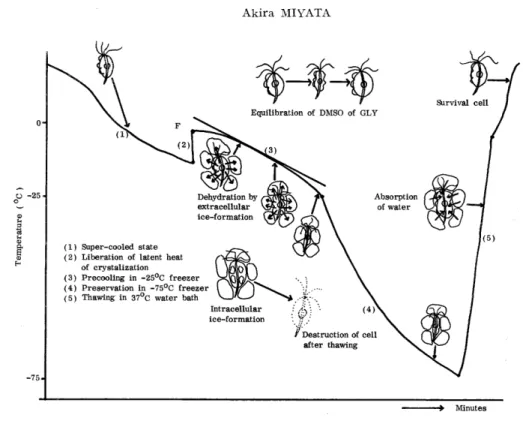
The cooling and thawing procedure of trichomonad in the low temperature preser- vation might be outlined in Fig. 10. The cryo-protective substance such as GLY or
DMSO was mixed in a trichomonad suspen- sion, and allowed to equilibrate for 10~30 minutes at room temperature. After dehy- dration from the cells had progressed the cryo-protective substance penetrated into the cells gradually to equilibrate to the concentration. Fitzgerald et al. (1961) ob- served that GLY equilibration at room temperature was better than that at 4C.
The sample was placed in the -25C freez- er for one hour for pre-cooling. The surviv- al rates of trichomonad did not change during the super-cooled state for several minutes at -25C. When the super-cooled state was broken, the temperature went up by liberation of the latent heat of crystalli- zation. The temperature again slowly drop- ped and the extracellular solution became frozen. But the intracellular solution did not freeze and the dehydration of the cells continued by the extracellular ice-formation.
The trichomonad cell was reduced in size by the dehydration. In this segment of the cooling curve, some researchers already po- inted out that the slow cooling at a rate of IC/min appeared to be appropriate for the dehydration of cells. But if the intracellular ice-crystal was formed in a trichomonad cell, the cell might be destroyed, as many workers already had pointed out. When tri- chomonad cells were dehydrated sufficiently
in the -25C freezer, the sample containing the trichomonads was transfered into the -75C freezer. The temperature of the sam- ple dropped rapidly to -75C. One hour was enough to pre-cool for dehydration at
-25C, After preservation in the -75C freez- er, the sample was thawed rapidly in a 37C water bath. During thawing of the sam- ple the survival trichomonads absorbed wa- ter to regain the original size. Many workers pointed out that the survival rate in the sam- ple thawed rapidly in a 37C water bath was higher than that in the sample warmed slowly at room temperature.
As a conclusion it could be said that the pre-cooling method attempted by the author might be useful for the low temperature preservation of trichomonad and would be applicable to the cases of other protozoa.
Acknowledgement
The author wish to express his deepest thanks to Dr. Toshio Nakabayashi and Dr.
Masuhisa Tsukamoto, Professor and Asoci- ate Professor of the Department, for their guidance in these experiments and also to Dr. Eizo Asahina, Professor of the Institute
of Low Temperature Science, Hokkaido Uni- versity, for his advice.
This paper was reported at the 38th an- nual meeting of the Japanese Society of Par- asitology held on 5-6 April, 1969, in Nagasaki, Japan.
References
1)Asahina, E. & Aoki, K. : A method by which frost-hardy caterpillars survive freezing at a super-low temperature. Low Temperature
Science, Ser. B, 16 : 55-63,1958-
2) Asahina, E. : Frost-resistance in a nema- tode Aphelenchoides ritzemabosi. Low Tempe-
rature Science, Ser. B, 17 : 51-62, 1959.
3) Asahina, E. : A mechanism to prevent the seeding of intra-cellular ice from outside in freezing living cells. Low Temperature Science,
Ser. B, 20 : 45-56, 1962.
4) Coggeshall, L. T. : Preservation of viable malaria parasites in the frozen state. Proc. Soc.
Expl. Biol. Med., 42 : 499-501, 1939.
5) De Jong, D. A. : Micro-organismes et
basses temperatures. Arch. Neerland. Physiol.,
7 : 588-591, 1922.
6) Diamond, L. S. : The establishmentofvar-
ious trichomonads of animals and man in
axenic cultures. J. Parasitology, 43 : 488-490,
1957.
7) Diamond, L. S. : Freeze-preservation of Protozoa. Cryobiology, 1 (2) : 95-102, 1964.
8)Fitzgerald, P. R. & Levine, N. D, : Effect of storage temperature, equilibration time, and buffers on survival of Tritrichomonas foetus in the presence of glycerol at freezing temperatures. J. Protozool., 8 : 21-27, 1961.
152 Akira MI^ATA
9) Fulton, J. D. & Smith, A. U. : Preserva- tion of Entamoeba histolytica at -79°C in the presence of glycerol. Annals of Tropical Medi-
cine and Parasitology, 47 (3) : 240-246, 1953.
10) Gaylord, H. R. : The resistance of embry- onic epithelium, transplantable mouse cancer, and certain organisms to freezing with liquid
air. J. Infect. Dis., 5 : 443-448, 1908.
ll) Hamada, Y. : Biological studies of Tricho- monas vaginalis. I. Bacteria-free culture of T.
vaginalis. Osaka Daigaku Igaku Zassi, 5 (5) :
429-235, 1953.
12) Horsfall, F. L. : A low temperature stor- age cabinet for the preservation of viruses. J.
Bacteriology, 40 : 559-568,1940.
13) Joyner, L. P. & Bennett, G. H. : Obser- vations on the viability of Trichomonas foetus during the process of free ing to -79=C and thawing in presence of glycerol. J. Hyg., 54 :
335- 341, 1956.
14)Levine, N. D. & Marquardt, W. C. :
The effect of glycerol and related compounds on survival of Tritrichomonas foetus at freezing
temperatures. J. Protozool., 2 : 100-107, 1955.
15) Levine, N. D., Andersen, F. L., Lodch,
M. B., Notzold, R. A. & Mehra, K. N.:
Survival of Tritrichomonas foetus stored at -28 and -95°C after freezing in the presence of
glycerol. J. Protocol., 9 (3) : 347-350, 1962.
16) Lovelock, J.E. & Bishop, M.W.H. :Pre-
vention of freezing damage to living cells by dimethyl sulphoxide. Nature, 183 : 1394-1395,
1959.
17) Manwell, R. D. & Jeffery, G. : Preser- vation of avian malaria parasites by low temper-
ature freezing. Proc. Soc. Exp. Biol. Med.,
50 : 222-224, 1942.
18) Manwell, R. D. : The low temperature freez- ing of malaria parasites. Amer. J. Trop. Med.,
23 : 123-131, 1943a.
19) Manwell, R. D. & Edgett, R. : Therelative importance of certain factors in the low temper- ature preservation of malaria parasits. Amer.-
J. Trop. Med. , 23 : 551-557, 1943b.
20) McEntegart, M. G. : The maintenance of stock strains of trichomonads by freezing. J.
Hygine, 52 : 545-550, 1954.
21) Miihlpfordt, H. : Der einfluss tiefer Tem- peraturen auf Protozoen. Ztschr. f.Tropenmed..
u. Parasit., ll (4) : 481-507, 1960,
22) Nei, T. & Okada, J.:Designing of a new cryomicroscope. Low Temperature Science, Ser.-
B, 25 : 149-153, 1967.
23)Polge, C., Smith, A. U. & Parkes, A.
S. : Revival of spermatozoa after vitrification and dehydration at low temperatures. Nature,
164 : 666, 1949.
24) Shorb, M. S. : Storage and survival of trichomonads under various conditions. 2. Pre- servation by freezing of trichomonad culture- Biochemistry and Physiology of Protozoa, III:.
438-439, 1963.
25) Smith, A. U- : Biological Effect of Freez- ing and Supercooling. Monographs of the Phy-
siological Society, 9 : 1-462, 1961. (Protozoa, p. 110-137)
26) Trussell, R. E. : Tritchomonas vaginalis and trichomoniasis. Blackwell Scientific Publica-
tions, Oxford, 1-277, 1947.
27) Weinman, D. & McAllister, J. :Prolonged storage of human pathogenic protozoa with conservation of virulence: observations on th&
storage of helminths and leptospiras. Amer. J.
Hyg., 45 : 102-121, 1947.
寄生性原虫類の低温生物学的研究
1.‑25度および‑75度のフリーザー中におけるトリコモナス類の 凍結条件に関する研究.
宮田彬
長崎大学熱帯医学研究所疫学部門(主任:中林敏夫教授)
摘 要
この実験は,トリコモナス類を‑25度および‑75度フリーザー中で,低温保存するための冷却方法,凍害保 護剤(ジメチル・スルホキサイド(DMSO),およびグリセリン(GLY))の影響,および至適塩濃度につ
いて検討したものである.
得られた成績は,以下の通りである.
1.‑25度のフリーザー中では,トリコモナスは,DMSOやGLYを添加しても,数日間しか生存できなか った.このフリーザー中での最長生存期間はT. vaginalisでは2週間,T. foetusでは1週間であった.し かし生存率は,どちらもきわめて低かった.
2.GLYやDMSOの存在下で,‑75変のフリーザーにトリコモナスを直接冷却し保存した場合は,両方の 種とも1ケ月あるいは,それ以上生存した.しかし生存率は低率であった.
5.あらかじめ材料を‑25度のフリーザーで予備凍結し,‑75度のフリーザーに移して保存する場合には,ト リコモナスの生存率は高くなった.
4.予備凍結法を用い,‑75度フリーザー中で5日間保存後しらべると,2.5〜7.5%DMSOを加えた材料で は,T. vaginalisは,生存率70%以上,T. foetusは10%前後であった.一方GLYを加えた材料ではT. vagi‑
nalisは,生存率20%,T. foetusは,わずかに数パーセントであった.
5. 5%DMSOを加えた材料を予備凍結し,1日間,‑75度フリーザー中に保存後の各塩濃度におけるトリ コモナスの生存率は,T. vaginalisでは塩濃度0.9〜1.5%の場合が,それよりも低い塩濃度よりも高い生存率 をしめした.一方T. foeiusの場合,最も生存率が高かったのは,塩濃度0.3%の場合で,30.4%であった.
6.結論として,予備凍結法は,トリコモナス類の低温保存に有用で,その他の寄生性原虫類の場合にも応用 できるものと考えられる.