Ecological Studies on Japanese Encephalitis Virus
Results of investigations in the Nagasaki area, Japan, in 1968
Kaoru HAYASHI, Kumato MIFUNE, and Akehisa SHICHIJO
Department of Virology* Institute for Tropical Medicine, Nagasaki University (Director : Prof. H. FUKUMI
Yoshito WADA, Jojiro NISHIGAKI, and Nanzaburo OMORI
Department of Medical Zoology, Nagasaki University School of Medicine and
D epartment of Medical Zoology, Institute for Tropical Medicine, Nagasaki University (Director: Prof. N. OMORI)
(Received for Publication January 6, 1970)
Abstract
A serial survey on the ecology of Japanese encephalitis (JE) virus was made in 1968. Virus isolation was negative from 848 hibernated females of Culex tritaeniorhynchus collected in March to early May. In mid May, when newly emerged females appeared, and thereafter, attempts to isolate the virus were continued, but it was July 23 that the first isolation was made. A strain of JE virus was isolated each from C. pseudovishnui in early August and from Aedes vexans nipponii in late July. Eight other species of mosquitoes were negative for JE virus throughout the year. The pigs susceptible to JE virus were exposed in nature to mosquitoes including hibernated females of C. tritaeniorhynchus in spring without detecting the rise in hemagglutination inhibition (HI) antibody in their sera.
Continuing the exposure to mosquitoes, the HI antibody was detected only after early August. The number of human cases was smaller than in any of the previous three years. One of the reasons is considered to be that the number of
vector mosquitoes was smaller at the time of the epizootic in pigs.
This work was supported in part by Research Grant CCOO208 from Public Health Service, National Communicable Disease Center, Atlanta, Georgia, U. S. A.
Contribution No.541 from the Institute for Tropical Medicine, Nagasaki University and No.
186 from the Department of Medical Zoology, Nagasaki University School of Medicine.
Ecological Studies on JE virus; Results of investigation in 1968 213
Introduction In spite of the experimental evidence that Japanese encephalitis (JE) virus can overwinter in infected Culex tritaenior- hynchus females (Mifune, 1965), careful and extensive attempts to isolate the virus from overwintered mosquitoes in the field have been unsuccessful since 1965. However, it is an interesting fact that a few pigs were found positive for hemagglutination inhibition(HI) antibody sensitive to 2-mercaptoethanol (2-ME) against the virus from mid April to early May in 1967(Hayashi et al., 1968). This seems to mean that the pigs were infected in spring when the new genera- tion of C. tritaeniorhynchus had not yet appeared. Thus, it was thought to be
worthwhile to repeat the attempts to isolate the virus from collected mosqui- toes and to detect the HI antibody in susceptible pigs exposed to mosquitoes, in spring around Nagasaki City, including the places where the pigs with HI antibody sensitive to 2-ME had been detected in 1967.
Besides the above, the attempts to isolate the virus from mosquitoes and to detect the HI antibody in the susceptible pigs were continued till late autumn, and the survey for the rising of HI antibody in pig sera was made from early spring to late autumn, to analyse the epidemiological features of JE in the Nagasaki area.
Methods
Mosquitoes were collected from early spring to late autumn by dry ice traps and at pig- and cow-sheds at the five villages of Kobasaki, Koebaru, Nishi- yama, Mogi, and Kaizu at a regular interval of one week, and at the three villages of Nunomaki, Tomachi, and Hongochi at an irregular interval. The methods for the collection of mosquitoes were the same as described by Wada et al. (1967). All the villages are located
around Nagasaki City. Koebaru and
Nishiyama, where the pigs with 2-ME sensitive HI antibody were found in spring in 1967, are located between small hills, and paddy-fields are developed there only to a very small extent. The other villages are as described by Wada et al.
(1967),
Collected mosquitoes were identified and pooled for the isolation of virus.
The procedure for the virus isolation from mosquitoes and the identification of isolated virus are the same as given
by Hayashi et al. (1965).
The HI antibody against JE virus was examined from early spring to late autumn in the sera of pigs slaughtered in the Nagasaki area and also those being susceptible to the virus placed in the three villages of Nishiyama, Mogi, and Kobasaki. The susceptible pigs were sent from Obihiro City in Hokkaido, which
is free from the epidemic of JE through- out the year, and placed on February 29, 1968 in the pig-sheds.
In this paper, the HI antibody sensitive to 2-ME treatment is called 2-ME sensi-
antibody, while the HI antibody in the untreated sera is referred to as total HI antibody. Those antibodies were exami-
ned by the method described by Hayashi et al. (1965, 1966) and Konno et al.
(1967).
R esults Seasonal prevalence of C. tritaeniorhynchus
females
Seasonal prevalence of C. tritaenior- hynchus females collected by dry ice
traps and at animal-sheds are shown in Figs. 1 and 2, respectively. The over- wintered females were firstly collected by a dry ice trap at Kaizu on March 21.
3200 2800 2400
Z 2000 1600 1200 800 400 0
!II
Mogi Kaizu
i
Ii fI!IIIII
/\
/ \
./ \
1 X\ ' /' "'X
^^IV L^A^A- X,
March April May | June
(/>
Jj OJ
£<u
O
II
Cy X
II
I Sep
August September October
July
Fig. 1. Seasonal prevalence of C. tritaeniorhynchus females collected by dry ice traps in the Nagasaki area, 1968.
95°b 600T
!II
-pig shed,Mogi
500h - pig sheQl>Kaizu cow shed, Kaizu à" -
400
300
200
100
IiIIiIIIIIII 1tI 1
:', ,'!
i \
i i
i ',
; '
<>" '
It!
I /
AM
/\
' \
I
II
April May June
March July A ugust September | October
Fig. 2. Seasonal prevalence of C. trUaeniorhynchus females collected at animal-sheds in the Nagasaki area, 1968.
Ecological Studies on JE virus; Results of investigation in 1968 215
The first males, which indicate the emergence of a new generation, were encountered in a swarm at Mogi on May 14. As for the seasonal prevalence, although the patterns are not necessarily the same by village and method as shown
in Fig. 1 and2, the general trend can be said as follows : the number of overwintered females was very small ; newly-emerged females were also small
in number, with the two peaks in mid June and early August. When compared with the breeding numbers of this mospuito in the previous three years, the number in 1968 was fairly smaller throughout the year.
Virus isolation from mosquitoes
Table 1, Virus isolation from mosquitoes by species collected by various methods in the Nagasaki area, from early spring to late autumn, 1668,
Mosquito species
An. lindesayi japonicus An. sinensis An. sineroides
No. of No. of pools
mosqs. I examined I positive
5 ,964 94
A T, subalbatus \ 1,668
Ae, albopictus 39
Ae. vexans nipponii 4,038
C. bitaeniorhynchuB 1?
1 ! 0
58 ! 0
2 | 0
13 i 0
3
29
01
1 ! 0
C . pipiens pollens \ 628 12
C , pseudovishnui 152
C. tritaeniorhynchusj 7,272I 74 : 6
C. whitmorei \ 52 | 2 : 0
Table 2. Seasonal appearance of the positive pools for the virus in Cule% tritaeniorhynckus,
r nxp.nJnnixhnjii. and Aedes vaxans niDDonii shown in Table 1.
C. tritaeniorhynchus
Month No of No. of pools
C. pseudQvishnui
!
No.of ! No.of pools
Ac. vexans nipponii
No.of I No.of pools
mosqs. examined positive
M ar. L |
E !
Apr. M
L E56
308 236 62 186
May M 153
LE
843 648
Tun. M 189
LE
Jul. M
L E
Aug. M
L
Sep.
E M
Oct.
L E
!
282 476 462 772 1,619
163 696
91I
30
1 j 0
5 | 0
3 | 0
1 \ 0
4 0
2 ! 0
8 | 0
8 \ 0
2 ; 0
2 j 0
7 j 0
3 ! 0
6 | 1
10 ! 5
4 \ Q
6 , 0
1 I 0
1 | 0
mosqs. ,examinedjpositive; mosqs. |examined positive
19
26
56 51
112 001
160 616 135 40 144 126 241
28 229 70 535 554 314 63
135 287 361
The signs of E, M, and L mean the early, middle, and late parts of a month.
131i1131213233111 00000000001000000
Table 1 gives the results of the virus isolation from female mosquitoes collected by various methods in the Nagasaki area from early spring to late autumn.
It is shown in Table 1 that the virus was isolated from three species of
mosquitoes, C. tritaeniorhynchus, C.
pseudovishnui, and Ae. vexans nipponii.
The number of positive pools for virus was six out of 74 pools consisting of 7,272 C. tritaeniorhynchus females, one out of five pools of 152 C. pscudovishnui, and one out of29 pools of 4,038v4^. vexans nipponii. The isolated virus was all identified as JE virus by neutralization
and HI tests by using standard antisera.
The other eight species of mosquitoes were negative for JE virus. Thus, it was again confirmed that C. tntaenior- hynchus is the most important mosquito in the epidemiology of JE, at least in the epidemic season.
Table 2 gives the seasonal appearance of the positive pools for the virus in C.
tritaeniorhynchus, C. pseudovishnui, and Ae. vexans nipponii : The 848 females of C. tritaeniorhynchus collected from late March to early May, which were all hibernated ones, were negative for the virus; the virus was isolated from C.
1,280 320
80 20
<10
IIII
Nishiyama
I
J-
1 I,
<D
>*
T3 O .0
1,280
320
82
iO :0
<10
1,280 320 80 20
<10
Mogi
II
II
Kobasaki ii ji i March
I
.0 _
I I
>L- .L
I I I I l I I I l I L_
I
I
-II
-l_
I
I I I I I I I I I I
I /
J /
/
r _.
/April May | June July August II
NN, I
I
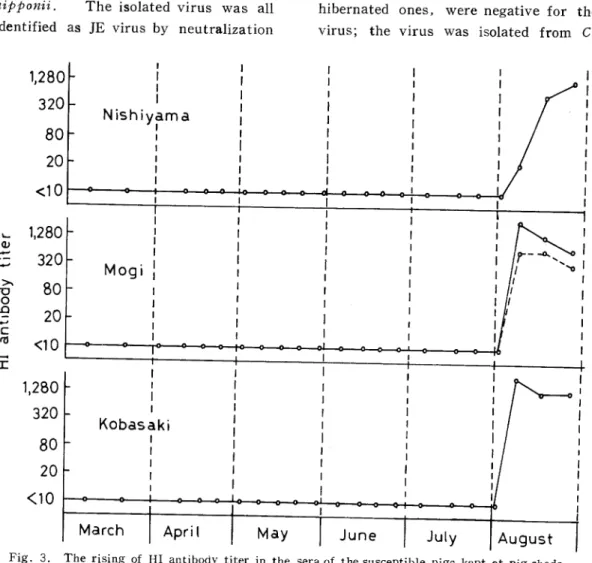
Fig. 3. The rising of HI antibody titer in the seraof the susceptible pigs kept at pig-sheds in the three villages of Nishiyama, Mogi, and Kobasaki in the Nagasaki area, 1968 bohd and dotted lines mean the titers of HI antibody in the sera untreated and treated with 2-ME, respectively.
Ecological Studies on JE virus; Results of investigation in 1968 217 Table 3. HI antibody rising in sera of
pigs slaughtered in the Nagasaki
area, 1968.
No. and % of pigs tested 1 positive
Month
Mar. L
E
Apr. M
L 175 106 127 137 138
May M
L E
Jun. M
L E
Jul. M
L E
Aug. M
L E
Sep. M
L
5.1 3.8 7.1 6.5
sensitive2-ME
0 0 0 0
2.9 3.1 1.8 6.5 2.9 1.4 1.4 4.2 22.2 20.8 96.4 83.3 100.0
95.5
Thesings of E, M, and L mean the early, middle, and late parts of a month.
tritaeniorhynchus from July 23 to August 7, and from C. pseudovishnui and ^.
vexans nipponii on August 6 and July 22 respectively.
H7 antibody in the susceptible pigs The three pigs susceptible to JE virus were kept at pig-sheds and examined for HI antibody. Those pigs, which were sent from a JE-free area of Hokkaido, were placed on February 29, 1968 at pig-sheds in the three villages of Nishi- yama, Mogi, and Kobasaki; Nishiyama is the village where 2-ME sensitive anti- body was detected in pig sera in spring
of 1967. The pigs were exposed to
mosquitoes in nature and were bled
every week for HI antibody. The
results obtained were given in Fig. 3.
However, contrary to the initial expecta- tion of the demonstration of the pig infection in spring, the HI antibody could not be detected until early August,
Pig and human infections
The rising of HI antibody in the sera of pigs slaughtered in the Nagasaki area is given in Table 3. The total HI anti- body was detected in the whole period from late March to late September, but the antibody found till early July was thought to be due to the infection in the previous year, as the 2-ME sensitive antibody was not demonstrated. After mid July, owing to the new infections demonstrated by the appearance of 2-ME sensitive antibody, the possessing rate of total HI antibody increased gradually and reached a level near 100 % in mid August.
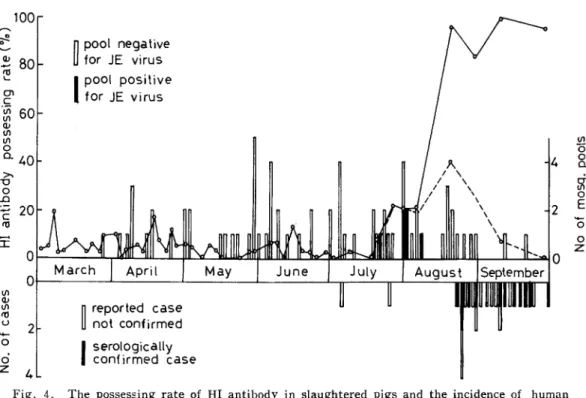
Fig. 4 illustrates the seasonal appear- ances of the HI antibody in slaughtered pigs, of the human encephalitis cases, and of the virus isolated from the pools of C. tritaeniorhynchus females, in the Nagasaki area.
The possessing rste of total HI anti- body in slaughtered pigs increased gradu- ally from July 20 up to August 20 when the rate reached a level near 100 %.
The 2-ME sensitive antibody in the pigs began to appear also on July 20, the possessing rate increased until August 20 and thereafter decreased toward late September.
HI antibody in the pig serum appears from one week after the infection with JE virus (Mifune, 1965), and the anti- bodv issensitive to 2-ME for2to 4weeks
en
~tfui o»t/>
i/io a
>*
TJ JDo
100
80
60
40
20
00
l/>
a*&
TJ
" 2
o d
z A
II
pool negative for JE virus pool positive
for JE virus
March
I /// A
/ \
/ \\
\\\\\\
April May [ June | July |August September
t
-
II
reported case not confirmed serologically confirmed case
oa
sfo
"o o
0
Fig. 4. The possessing rate of HI antibody in slaughtered pigs and the incidence of human encephalitis cases, together with the virus isolation from the pools of C. tritaenior- hynchus females, in the Nagasaki area, 1968. Solid and dotted lines mean total HI antibody and 2-ME sensitive antibody respectively.
(Otsuka et ai., 1967). In the present data, 2-ME sensitive antibody was first- ly detected on July 20. This means that the pig infection in nature was start- ed at least one week prior to July 20, namely on July 13 or slightly before.
On the other hand, the possessing rate of 2-ME sensitive antibody in slaughter- ed pigs was 7.1 % on September 10 and 0 % on September 28, though the posses- sing rates of total HI antibody were 100% or nearly so. From this, it is considered that 2-ME sensitive antibody detected on September 10 may have start- ed to appear, at earliest, on August 20, and the time of infection in nature must be one week before, that is about August 13. In this way, the period
of the pig infection was estimated roughly as one month from July 13 to August 13. The mosquito infection from July 23 to August 7 ocurred within the period of the pig infection. This seems to suggest that the mosquitoes found positive for JE virus were infected from pigs in the viremic state.
The number of reported human enceph- alitis cases was 26, including 12 serolo- gically confirmed cases having appeared from August 24 to September 30. The number of cases was smaller than in any of the previous three years. One of the reasons is considered to be that the number of vector mosquitoes was smaller during the pig epizootic.
Ecological Studies on JE virus; Results of investigation in 1968
Acknowledgement
The authors wish to express the sincere appreciation to Hikari Branch of Takeda Chemical Industry Ltd. for kind supply of pregnant mice.
219
References
1) Hayashi, K., Mifune, K., and Shichijo,
A, : Problems on Overwintering of Japanese
Encephalitis Virus in Japan. Endem. Dis, Bull.
Nagasaki, 7(2) : 99-106, 1965.
2) Hayashi, K., Mifune, K., Motomura,
I., Matsuo, S., Kawasoe, H., and Futatsuki,
K. : Isolation of Japanese Encephalitis Virus
from Mosquitoes Collected in Omura District,
Nagasaki Prefecture, Japan, in 1964. Endem,
Dis, Bull. Nagasaki, 7(3) : 155-164, 1965,
3) Hayashi, K., Mifune, K., Shichijo, A.,
Kawasoe, H., Matsuo, S., Futatsuki, K.,
Omori, N., Wada, Y.t Ito, S., Kawai, S.,
Nishigaki, S., Abe, Y., Makiya, K., and
Kamizono, Y. : Ecological Studies on Japanese Encephalitis Virus. Isolation of Japanese ence-
phalitis virus from mosquitoes collected in Na- gasaki and Kagoshima districts, Japan in 1965.
Endem. Dis Bull. Nagasaki, 8(2): 61-73, 1966, 4) Kawai, S. : Studies on the Follicular De- velopment and Feeding Activity of the Females of Cule% tritaeniorhynchus with Special Reference
to Those in Autumn. Trop, Med., ll(3):145-
169, 1969.
5)Konno, J., Endo, K., and Ishida. N. :
The Nature of Antibody in Swine Naturally In-
fected with Japanese Encephalitis Virus. Proc,
Soc. Exp. Biol. Med., 124 : 73-75, 1967,
6) Mifune, K. : Transmission of Japanese Encephalitis Virus to Susceptible Pigs by Mos- quitoes of Culex trUaeniorhynchus after Experimen- tal Hibernation. Endem, Dis, Bull. Nagasaki, 7(3) : 178-191, 1965,
7) Otsuka, S., Manako,K., Kunihiro, H,,
and Motomura, I. : Studies of the Effect of
2-Mercaptoethanol on Swine Antisera against
Japanese Encephalitis Virus (II). Jap. J. Bac-
teriol., 22(4) : 250-255, 1967 (In Japanese with
English summary),
8) Shichijo, A., Mifune, K, and Hayashi,
K., Wada, Y., Ito, S., Kawai, S., Miyagi,
I., and Oda, T. ; Ecological Studies on Japa-
nese Encephalitis Virus. Survey of virus disse-
mination in Nagasaki area, Japan, in 1967.
Trop. Med., 10(3) : 168-180, 1968,
9) Wada, Y., Kawai, S., Ito, S.f Oda, T,,
Nishigaki, J., Omori, N., Hayashi, K., Mi-
fune, K., andShichijo, A. : Ecology of Vec-
tor Mosquitoes of Japanese Encephalitis, Espe-
cially of Culex trita-eniorhynchus. 1. Results obta-
ined in 1965. Trop. Med., 9(1): 45.57, 1967.
日本脳炎ウイルスの生態学的研究.1968年の調査成績
林薫・三舟求真人・七条明久
長崎大学熱帯医学研究所ウイルス学部(主任:福見秀雄教授)
和田義人・西垣定治郎・大森南三郎
長崎大学医学部医動物学教室(主任:大森南三郎教授の 長崎大学熱帯医学研究所衛生動物学研究室〔主任:大森南三郎教授)
摘 要
前年までに引き続き,1968年に日本脳炎ウイルスの生態学的調査を行なった.3月‑5月上旬に採集した コガタアカイエカ越冬雌成虫848個体からはウイルスは分離されなかった.新生雌成虫が出現し始めた5月中旬 及びそれ以後も分離を試みたが,始めて日本脳炎ウイルスが分離できたのは7月23日であった.シロハシイエ カからは8月上旬に,キンイロヤプカからは7月下旬に,各々1株の日本脳炎ウイルスが分離された.感受性 のの豚を各々1頭ずつ2月下旬に3部落の豚舎に配って,自然に蚊から吸血されるままにして飼育し続けて,HI 抗体が出現する時期を調べたが,抗体が検出されたのは8月上旬以降であった.発生患者数は,過去3年の何 れにおけるよりも少なかった.その理由の1つは,豚で日本脳炎の流行が起っている時期のコガタアカイエカ の数が少なかったことであると考えられる.