Chapter 3
Public Goods and Political Trust in the East Asian Mega-Cities:
An Empirical Study on Beijing, Seoul and Tokyo Tianren GE * and Tianguang MENG
School of Public Management, Tsinghua University, Beijing, China Abstract
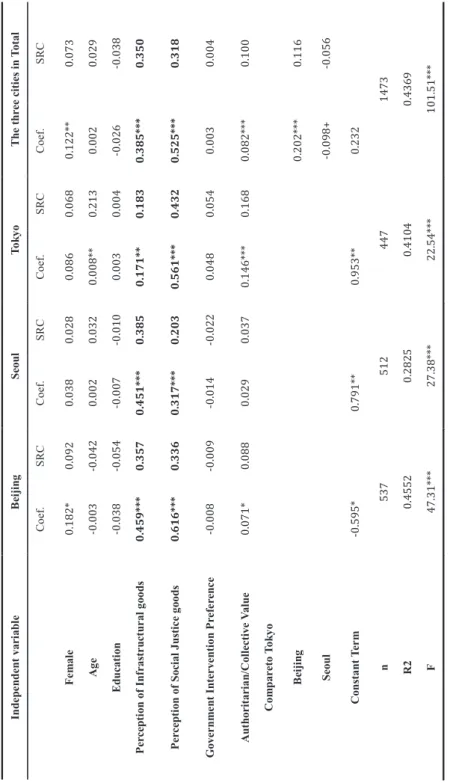
As the foundation of government legitimacy and policy effectiveness, political trust mediates the relationship between the government and society and plays an important role in urban governance. Based on survey data from the three most influential cities in the East Asian region, namely Beijing, Seoul and Tokyo, the paper examines how the provision of public goods affects political trust. We make a distinction between infrastructural goods and social justice goods and find out that (1) public goods provision has a significant effect on political trust; (2) as compared to infrastructural goods, social justice goods plays a more significant role in contributing to political trust. This suggests that government should provide more social justice goods for enhancing political trust in these mega-cities.
Key Words: East Asia, Mega-City, Public Goods, Political Trust.
Introduction
Many researchers are concerned with the issue of governance of mega-cities which play fundamental functions in the global economic network. The global cities have been the “commanding heights” in the global economy (Sassen, 2001). The entrepreneurial government has to provide much better public goods to compete with the others in the global economic change (Harvey, 1989).
However, global economic changes also bring about political and social challenges to these mega-cities. Increasing social inequality resulting from the global economy gives rise to a higher level of distrust towards the municipal governments (Sassen, 2011).
Under these circumstances, Beijing, Seoul and Tokyo governments have taken a series of initiatives to manage the economic competition, social risks and political challenges. The governments increased infrastructural investments in order to promote the economic growth, and initiated distribution or redistribution policies to lower social inequality. The governments provide not
*