The Conceptual Model of Information Management in Infrastructure Lifecycles
Koji Makanae1
1Professor, School of Project Design, Miyagi University, 1-1 Gakuen, Taiwa-cho, Miyagi 9813298, Japan; PH (022) 377-8368; email: [email protected]
ABSTRACT: This paper summarizes the schema of information models in the author’s previous studies, and discusses the management of information and knowledge for infrastructure lifecycles. The information schema for infrastructure lifecycles can be expressed using the abstract-to-concrete information pyramid in the spatiotemporal framework. The information technologies in the pyramid are divided into eight categories. Much information is generated and processed by many individuals throughout an entire lifecycle, and “information management” is a key factor in lifecycle management. The layer structure of information management, which includes data scheme, data management, applications, process, and individuals/organization, is shown. The latter two layers, process and individuals/organization, will become more important in the next decade. The value of the abandoned information is also discussed, including the consideration and the decision by which the information is abandoned are made of human knowledge and wisdom. Further, the model of “swelling of knowledge”
is shown as an information connector in the pyramid schema.
INTRODUCTION
In the past decade, building information models (BIMs) have been focused and developed to model the information of buildings and infrastructure. In accordance with the development of BIMs, the information technologies that support each process in the lifecycles of building and infrastructure have become advanced, especially in three- dimensional design. However, the current BIMs target only the building of physical models, not entire information systems including ideas, concept, and politics. The author discussed the significance and role of information in the infrastructure lifecycle, including the pyramid scheme of construction information and the spatiotemporal model as its expansion (Makanae 2010, 2012). Moreover, the information propagation in highway design was also discussed (Makanae 2014). In this paper, the author summarizes the conceptual information model for infrastructure lifecycle from the previous studies. Then the next stage of information schema, which can support information and knowledge management, is discussed.
PYRAMID SCHEMA OF CONSTRUCTION INFORMATION
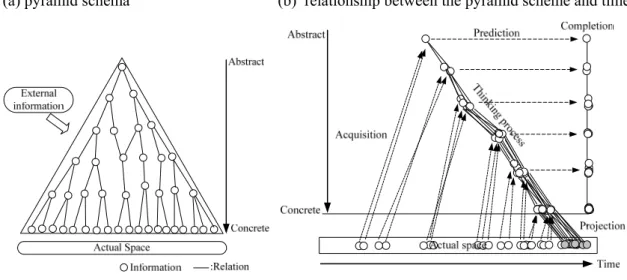
In the initial stages of the construction process, highly abstract information is first defined such as the concept and objective of construction. Then, information turns less abstract in the planning and design phases to more concrete information for projection into actual space. Although there are few studies about information schema in construction, Eastman (1999) represented design information as a cone with abstract and concrete information at the top and on the bottom surface, respectively. In this study, pyramid-schema design information is assumed (FIG.1. (a)).
Information is produced while obtaining various types of external information including actual space information, and abstract information is related to concrete information in the pyramid scheme. In this paper, the pyramid conceptually represents a schema expanding downward from the top regardless of the shape of its base.
The relationship between the pyramid scheme and time is considered here. FIG.1.
(b) shows the relationship in the spatiotemporal framework. Information is related to each other in the thinking and projection processes in the design and construction phases, respectively. In these processes, information is produced while information in actual space is being obtained. The time efficiency of the construction process is represented by the inclination of the entire pyramid.
Abstract information becomes concrete over a few to decades of years although the period varies according to the type and scale of the infrastructure. The natural and social environments around the schema vary during the period and information varies accordingly. Information variations may cause the information pyramid scheme to collapse. Continuity from abstract to concrete information should be ensured in the construction process of a schema.
(a) pyramid schema (b) relationship between the pyramid scheme and time
FIG 1. Pyramid scheme of construction information
As the most abstract information in the pyramid scheme, “policy” is positioned.
The process from abstract to concrete in the information space corresponds to the process of thinking from policy to plan, design and construction plan. Finally, information is projected from information space into actual space, or the schema is constructed. At the completion of a series of structures planned in accordance with a policy, the functions designated in planning as objectives are provided. Then, the infrastructures enter the maintenance phase. Information on structures in actual space obtained by using sensors or conducting inspections alters information in information space. Rebuilding the information schema is required below the point of change at the highest level. The results are projected again into actual space. In planned maintenance, the point of information alteration is determined as planned. The point of information alteration is corrected based on the information obtained in actual space by monitoring.
When the point is actually reached, the information schema is rebuilt as planned and the information is projected into actual space. The process of rebuilding the information schema and projecting information is equivalent to the repair of an infrastructure. The more abstract at the point of information alteration, the greater the scale of repair. This suggests that a life cycle exists for each level of abstractness.
INFORMATION TECHNOLOGIES IN THE INFORMATION PYRAMID
The relationship between the infrastructure-information pyramid and information technology is discussed. FIG.2 shows the relationship between a model obtained by simplifying the multiple connected model based on FIG.1 and information technology.
Information technology here is divided into “acquisition”, “expression and processing”,
“prediction”, “projection (construction)”, “life management”, “operation”,
FIG.2. Infrastructure lifecycles and information technology
“information exchange with people and society” and “information management”.
These components are not fully independent of one another but coordinate with one another to create a more refined system”.
STRUCTURE OF INFORMATION MANAGEMENT
“Information management” is the dominant technology in the hierarchy shown in FIG.2. In this section, we discuss the importance of information management and how to apply it toward infrastructure lifecycles.
As mentioned above, much information is generated during the infrastructure lifecycle. At the design stage, a designer processes the surveyed data comprising terrain, geology, climate, and habitation data, and generates new design information for construction. The generated information is recorded as two/three-dimensional plans in CAD files and documents, including in digital format, in the conventional method. At the construction stage, a contractor processes the design information and generates more detailed design and process information for construction, and receives more feedback from on-site construction. At the maintenance stage, a facility manager processes the design and construction information and generates maintenance information based on the on-site maintenance and facility usage data. “Information management” is a key factor in lifecycle management, and an important subject is the management and maintenance of the long-term digital information of infrastructure lifecycles.
In order to share the information with each organization and individual for the long term, the standardization of information is required. The recent efforts in BIMs, such as industry foundation classes (IFC) developed by buildingSmart, are representative of the attempts to standardize information. Though the concept of BIMs aims to define information models which can support the entire lifecycle, the practical applications currently focus only on three-dimensional design. For the future utilization of BIMs, we have to build the information management system with the goal of not only the standardization of information format, but also the standardization of organizations.
The layer structure of information management is shown in Table 1.
Table. 1. Layer structure of information management
Layer Subject
Layer 1: Individuals/ Organization Individuals (instruction and education) Organization and systems
Layer 2: Process Process of information management Layer 3: Applications Application which supports design,
construction, maintenance, and whole lifecycle)
Layer 4: Data management Data management
(multimedia data and archive format, storage location, naming, data linkage in
spatiotemporal framework)
Layer 5: Data scheme Data and information modeling scheme
We divided information management into five layers. The basement layer (layer 5) targets the “data scheme”, which includes data and information modeling such as IFC.
The next layer (layer 4) is “data management”, which includes multimedia data and archive format for CAD data, documents, images and movies, storage locations, the naming of files, and data linkage among the data of each stage in the spatiotemporal framework. The next layer (layer 3) targets “applications” which support the whole infrastructure process. The current stage of information management will be in layer 5 to 3, but whole lifecycle support in the spatiotemporal framework is not considered.
The upper two levels are important for information management. The second layer (layer 2) is “process” of information management in whole lifecycles. The dominant layer (layer 1) is “individuals/organization”. “Individuals” have important roles in planning information management, and instruction and education for them are very important. “Organization” who manage all of the information in the infrastructure lifecycle is the most dominant element.
In this stage, only a few organizations recognize the importance of information management, but it will become more important in the next decade.
KNOWLEDGE MANAGEMENT IN THE INFORMATION SCHEME
In the proposed pyramid information scheme (FIG.1), the root and generated information must connect to the constructed object in the actual space. However, in real cases, some of the generated information will be abandoned. For example, in the case of highway design, many routes are proposed as candidates after the origin and the destination are defined, but only one route will be selected for construction; the information of unselected routes will be abandoned. The issue is whether the abandoned information has any real value. In the above case, the highway designer was supposed to consider the alignment of each route using his intellect; however, the final route was determined by multiple individuals through the comparison of various factors. This decision was made using human knowledge and wisdom. From this point of view, the abandoned information should be retained so that others can see how and why a decision was made. In the area of knowledge management, the scheme of DIKW pyramid (data-information-knowledge-wisdom) was proposed (Rowley 2007, Wallace 2007). The information scheme in this study targets only data and information; however, knowledge and wisdom should be included in the scheme as well.
The information connection, including definition, is depicted as FIG.3. Each information connector has a swelling of knowledge. In the swelling, the design and definition system are included. Furthermore, the wisdom is expected to be abstracted from the collection of the swelling, which would equal knowledge.
CONCLUSIONS
This paper summarizes the schema of information models from the author’s previous studies and discusses information and knowledge management for infrastructure lifecycles. The conclusions of this paper are described below.
1) The information schema for infrastructure lifecycles can be expressed using abstract-to-concrete information pyramid in the spatiotemporal framework. The information technologies in the pyramid can be divided into eight categories.
2) Much information is processed and generated by many individuals during an entire lifecycle. “Information management” is a key factor in lifecycle
management. The layered structure of information management, which includes data scheme, data management, applications, process, individuals/organization, is shown. The latter two layers, process and individuals/organization, are expected to become more important in the next decade.
3) The value of the abandoned information is discussed, including the consideration and the decision by which the information is abandoned are made of human knowledge and wisdom. The model of knowledge swelling is shown as an information connector in the pyramid schema.
The author has proposed the conceptual model for infrastructure lifecycles; it should be verified and applied to practical cases in the next stage. Furthermore, the method of information and knowledge management should be considered and made sophisticated in future works.
knowledge
selected
selected
Swelling
Swelling
abandoned
abandoned abandoned
selected
abandoned
selected
knowledge
wisdom
wisdom Swelling
Swelling
a) original model b) swelling of knowledge c) abstraction of wisdom from swellings
FIG.3. Knowledge swelling in the information pyramid
ACKNOWLEDGMENTS
This research was supported by JSPS KAKENHI Grant Number 24560569.
REFERENCES
Eastman, C.M. (1999). Building product models: computer environments supporting design and construction, CRC Press LLC.
Makanae, K. (2010). "Analysis of Information Structure in Infrastructure Lifecycle."
Proc. 1st International Conference on Sustainable Urbanization, Hong Kong, Dec.
Makanae, K. (2012). " Development and Analysis of Time-Spatial Information Model for Infrastructure Lifecycle Management", Proc. 14th International Conference on Computing in Civil and Building Engineering, Moscow, Jun.
Makanae, K. (2014). "Optimization of Highway Geometric Design Process for Computer-based Design", Computing in Civil and Building Engineering(ICCCBE2014), 1376-1383, ASCE, Orlando, 2014.
Rowley, J. (2007). "The wisdom hierarchy: representations of the DIKW hierarchy”, Journal of Information and Communication Science, 33 (2): 163–180.
Wallace, D. P. (2007). Knowledge Management: Historical and Cross-Disciplinary Themes”, Libraries Unlimited.