In nineteenth century Vietnam, the court rituals and ceremonies staged in the imperial capital of Hue assumed an essential role in the social integration encouraged by the Nguyen dynasty. Solemn court rituals, such as the worship of ancestors or the Suburban cult revering Heaven and Earth, were indispensable to the effort to demonstrate the legitimacy of dynastic rule to subjects who shared Confucian doctrine. Splendid ceremonies held on auspicious occasions such as the Emperor’s birthday or that of the Empress Dowager demonstrated the empire’s prosperity. At the same time, with attendance of the ambassadors of neighboring countries, these ceremonies visualized a dynastic world order centered on the imperial capital of Hue.
The importance of court rituals and ceremonies was never confined to the cultural or ideological dimensions. They entailed the exchange of various goods or money, in the form of gifts distributed by the ruler or offerings from the subjects. As a sign of allegiance and celebration from subjects to ruler, various goods were forwarded to Hue from throughout the country to support both rituals and ceremonies. In exchange, precious items kept in the state coffers were dispensed to subjects to demonstrate the ruler’s wealth and benevolence. Although studies on the Nguyen dynasty’s court rituals have been done since the French colonial period, their economic meaning has been scarcely examined up to now.1
In this study, I shed new light on the economic aspects of the court rituals and ceremonies performed at Hue in the first half of the nineteenth century in order to understand social and economic integration in Vietnam during the Nguyen dynasty. To this end, I begin the study with a discussion of economic exchanges pertaining to rituals and
1 In the French colonial period, pioneer research concerning court culture of Nguyen dynasty was conducted by intellectuals belonging to the Association des Amis du Vieux Hué (1914–1945). The results of their research were published by the renowned journal of the association, Bulletin des Amis du Vieux Hué. Recently, based on earlier studies of the colonial period, Võ Hương An published elaborate research dealing with court rituals and ceremonies of the Nguyen court under the reign of Khải Định Emperor [Võ Hương An 2016].
Chapter 3
Economic Aspects of Court Rituals and Ceremonies in Nineteenth Century Hue
TAGA Yoshihiro
ceremonies organized annually by the Nguyen court. Following that, I examine the grand ceremonies held on exceptional auspicious occasions from the perspective of economic exchanges. Among other ceremonies, those celebrating the longevity of the Emperor and Dowager Empress will be looked at closely. Last but not least, the distinctive use of products and money in ritual and ceremony will be scrutinized by focusing on various fabrics and decorative coins issued by the Nguyen dynasty for distribution at ceremonies.
1. Economic Exchange on Annual Court Rituals and Ceremonies 1-1
Hue’s court life in the nineteenth century was filled with a variety of rituals and ceremonies in every season. Among them, ancestral worship of the imperial clan had great importance.
In the Nguyen period, in each season, particular days were chosen for rituals at a Confucian shrine named “miếu” 廟 that commemorated the imperial ancestors. The days when rituals for ancestral worship were to be conducted at miếu were designated as “hưởng” 享 (or 饗).
There were five kinds of hưởng days corresponding to each season: “xuân hưởng” 春享 (the eighth day of January in the lunar calendar), “hạ hưởng” 夏享 (the first day of April),
“thu hưởng” 秋饗 (the first day of July), “đông hưởng” 冬饗 (the first day of October), and
“hạp hưởng” 祫饗 (22nd day of December) [Võ Hương An 2015, tập 1: 316]. Based on the imperial chronicle record of ĐNTL, the hưởng ritual of the Nguyen dynasty was first instituted in 1803. The chronicle relates that on each hưởng day, the Emperor himself practiced the ritual at the Thái Miếu 太廟 shrine. Other royal clans conducted it at the Liệt Miếu 列廟 shrine.2 In addition to hưởng days, imperial ancestors were worshipped on the anniversaries of their births and deaths (đản thần 誕辰 and kỵ thần 忌辰) at temples named
“điện” 殿. As will be discussed below, on the occasion of these ancestral worship days, local products were to be delivered from the entire country as an offering to the imperial ancestors enshrined at miếu and điện.
Along with solemn court rituals such as ancestor worship, the Nguyen court organized various ceremonies celebrating auspicious events. These auspicious occasions were collectively called “khánh tết”
慶節 or “Occasion of Celebration” including the
birthday of the Emperor and Empress Dowager as well as seasonal festival days derived from Chinese custom.In nineteenth century Vietnam, the birthdays of the Emperor and Dowager Empress were called “vạn thọ tết” 萬壽節 and “thánh thọ tết” 聖壽節, respectively, becoming a central part of the khánh tết ceremony organized by the imperial court. The ceremony of
2 ĐNTL, I, vol. 20, 18a–b.
vạn thọ tết was first established in 1791, when Nguyễn Phúc Anh, later Emperor Gia Long, waged war against Tây Sơn from his stronghold of Gia Định, located in southern Vietnam.
According to the regulation issued at that time, on the day before his birthday, the Emperor would practice rituals at the Thái Miếu shrine for imperial ancestors and at the Hậu Điện
後殿 temples for his mother. On the very day of the birthday, the Emperor was celebrated
by his subjects at the Phương Điện 方殿 temple. Subsequently, the Emperor organized a court banquet for his subjects who participated in the ceremony.3 With the establishment of a new dynasty, Gia Long invested his mother, Nguyễn Thị Hoàn, as the first Empress Dowager in 1803. Following her investiture, the ceremony of thánh thọ tết was instituted in that same year.4 In the early Nguyen period, in addition to the birthday of the ruling Emperor and Empress Dowager, the birthdays of the Empress and Crown Prince were celebrated as “thiên thu tết”千秋節 and “thiên xuân tết” 千春節. These two events,
however, lost their importance when the second Emperor, Minh Mạng, decided that the positions of Empress and Crown Prince should remain vacant in order to prevent the fragmentation of power inside the royal court.Seasonal festival days of the lunar calendar were also the main occasions of court ceremony. These included New Year’s Day (chính đán tết 正旦節 or nguyên đán tết 元旦
節), the Dragon Boat Festival (đoan dương tết 端陽節) on the fifth of May, the Mid-
Autumn Festival (trung thu tết中秋節) on the 15
th of August, and the Double Ninth Festival (trùng dương tết重陽節) on the ninth of September. As is well known, these
seasonal festivals were originated in ancient China then spreaded to the Sinicized regions, including Vietnam. The official record of the Nguyen dynasty indicates that after building the Gia Định citadel, Nguyễn Phúc Anh established the conduct of ceremonies on New Year’s Day and the Dragon Boat Festival for the first time.5 Various ceremonies held on khánh tết days, New Year’s and Dragon Boat day, as well as the Emperor’s birthday were frequently referred to as the “Three Great Holidays” (tam đại tết 三大節) on which the Nguyen court placed great importance [Woodside 1988: 36].1-2
It should be noted that an indispensable part of the court rituals and ceremonies mentioned above was the offerings of goods or money from the Emperor’s subjects. References to offerings for the annual court ritual first appeared in 1803 concerning the anniversary of the king’s death (hoàng khảo kỵ thần 皇考忌辰). We are lacking information, however,
3 ĐNTL, I, vol. 5, 14a–b.
4 ĐNTL, I, vol. 22, 2b.
5 ĐNTL, I, vol. 4, 32b.
concerning the types and amounts of goods that were offered.6 In the same year, detailed instructions pertaining to offerings for the khánh tết ceremony were established.7 According to those instructions, an offering was to be made on the birthdays of the Empress Dowager, Emperor, and Empress as well as on the two seasonal ceremonies of New Year’s Day and the Dragon Boat Festival. On New Year’s Day and the Dragon Boat Festival, subjects had to make an offering to both the Emperor and Empress Dowager. Goods used for the offerings consisted of a decorated lantern called the Dragon lantern (rồng đèn), betel and areca, as well as polished perfume rice. As Table 1 shows, the value of the offered goods was commuted to cash. Those who made an offering were categorized into a rank according to their social position inside the imperial order. In this hierarchy, the highest rank was occupied by the Imperial Clan Court (Tôn Nhân Phủ 尊人府) which was the organ charged with managing the royal clan, and descendants of the Emperor (Princes, Princesses, Emperor’s grandchildren). The second rank included women serving in the royal court, civil and military officials in Hue, and women holding official ranks (Mệnh Phủ 命婦). In the third and fourth ranks were various units of the royal guard and defense forces of the capital, as well as officials of Gia Định and Bắc Thành whose jurisdiction preceded other regions. The fifth and sixth ranks comprised mainly officials governing the outer regions, and officers or artisans of Đồ Gia 圖家 and Bạch Công 百工, both of which manufactured goods for the state. Next, ranking seventh, was the Duke Diên Tự 延祀 of the Lê dynasty, who was entitled to care for the ancestral tomb of the Lê kings, and officers of the Trường Đà
長舵 units that undertook the government’s rice transportation. The eighth rank
consisted of Công Tính 公姓. According to an explanation provided by Võ Hương An, the term Công Tính referred to members of the Nguyễn clan who originated from the Gia Miêu Ngoại trang嘉苗外庄 of Thanh Hóa province. They were not, however, directly
descended from the lineage of the lords and the Emperor of the Nguyen dynasty [Võ Hương An 2015, tập 1: 102]. After that, the Công Tính branch in the Northern region (ninth rank), and the villages of the Tống Sơn district8 and Trịnh clan (tenth rank) were listed.In 1808, offerings on the day commemorating the deaths of ancestral kings and khánh tết ceremonies were integrated into a contribution called the Ngân Lễ 銀禮, which is tentatively translated as “Silver Rites”.9 Silver Rites, alternatively referred to as “Ritual Silver” (Lễ Ngân 禮銀), was an idiosyncratic practice that was observed in the domain of the Nguyen lords by the eighteenth century, if not earlier.10 The term Ritual Silver first
6 ĐNTL, I, vol. 20, 17b.
7 HĐSL, vol. 72, 24a–25b.
8 Gia Miêu Ngoại trang in the Tống Sơn district was seen as the birthplace of the Nguyen clan.
9 ĐNTL, I, vol. 34, 6b–7a.
10 To my knowledge, there have been no previous studies dealing with this intriguing practice.
Table 1: Amount of Goods to Be Offered at the Khánh Tết Ceremony (1803) Rank Category of those who make offeringOccasion of offeringTo whom offering made Contents of offering (weight) Amount commuted to cash (Unit: Quan
貫) 1Imperial Clan Court (Tôn Nhân Phủ), Princes, Princess, Emperor's grandchildren
Thánh Thọ ceremonyEmpress DowagerDragon lantern (20 cân)40 Vạn Thọ ceremonyEmperorDragon lantern (20 cân)40 Thiên Thu ceremonyEmpressDragon lantern (15 cân)30 New Year’s DayEmpress DowagerBetel and areca10 New Year’s DayEmpressBetel and areca9 Dragon Boat FestivalEmpress DowagerPolished perfume rice10 Dragon Boat FestivalEmpress Polished perfume rice9 2Women serving in royal palace, Civil and military officials in Hue, Women bearing official rank (Mệnh phủ)
Thánh Thọ ceremonyEmpress DowagerDragon lantern (20 cân)40 Vạn Thọ ceremonyEmperorDragon lantern (20 cân)40 Thiên Thu ceremonyEmpressDragon lantern (15 cân)30 New Year’s DayEmpress DowagerBetel and areca10 New Year’s DayEmpressBetel and areca9 Dragon Boat FestivalEmpress DowagerPolished perfume rice10 Dragon Boat FestivalEmpress Polished perfume rice9 3Officers of Thần Sách army, Civil and military officials in Gia Định and Bắc Thành
Thánh Thọ ceremonyEmpress DowagerDragon lantern (15 cân)30 Vạn Thọ ceremonyEmperorDragon lantern (15 cân)30 Thiên thu ceremonyEmpressDragon lantern (13 cân)26 New Year’s DayEmpress DowagerBetel and areca9 New Year’s DayEmpressBetel and areca8 Dragon Boat FestivalEmpress DowagerPolished perfume rice9 Dragon Boat FestivalEmpress Polished perfume rice8
4Officers of Five army, Thần Vũ army, Chấn Vũ army, Elephant army and Navy
Thánh Thọ ceremonyEmpress DowagerDragon lantern (15 cân)30 Vạn Thọ ceremonyEmperorDragon lantern (15 cân)30 Thiên Thu ceremonyEmpressDragon lantern (13 cân)26 New Year’s DayEmpress DowagerBetel and areca9 New Year’s DayEmpressBetel and areca8 Dragon Boat FestivalEmpress DowagerPolished perfume rice9 Dragon Boat FestivalEmpress Polished perfume rice8 5
Officers and soldiers of Tiến phong army, Officers of Đồ Gia, Artisans of Bạch Công, Civil and military officials of Quảng Nam, Quảng Trị, Quảng Bình, Quảng Ngãi, Bình Định, Phú Yên, Bình Hòa, Bình Thuận, Phiên Trấn, Trấn Biên, Vĩnh Trấn, Trấn Định, Nghệ An, Thanh Hóa, Sơn Nam Thượng, Sơn Nam Hạ, Kinh Bắc, Hải Dương, Sơn Tây
Thánh Thọ ceremonyEmpress DowagerDragon lantern (8 cân)16 Vạn Thọ ceremonyEmperorDragon lantern (8 cân)16 Thiên Thu ceremonyEmpressDragon lantern (6 cân)12 New Year’s DayEmpress DowagerBetel and areca7 New Year’s DayEmpressBetel and areca6 Dragon Boat FestivalEmpress DowagerPolished perfume rice7 Dragon Boat FestivalEmpress Polished perfume rice6 6Governors of Thái Nguyên, Hưng Hóa, Yên Quảng, Lạng Sơn, Tuyên Quang and Cao Bằng
Thánh Thọ ceremonyEmpress DowagerDragon lantern (6 cân)12 Vạn Thọ ceremonyEmperorDragon lantern (6 cân)12 Thiên Thu ceremonyEmpressDragon lantern (4 cân)8 New Year’s DayEmpress DowagerBetel and areca6 New Year’s DayEmpressBetel and areca5 Dragon Boat FestivalEmpress DowagerPolished perfume rice6 Dragon Boat FestivalEmpress Polished perfume rice5 7Duke Diên Tự of Lê dynsaty, Officers of Trường Đà units Thánh Thọ ceremonyEmpress DowagerDragon lantern (3 cân)6 Vạn Thọ ceremonyEmperorDragon lantern (3 cân)6 Thiên Thu ceremonyEmpressDragon lantern (2 cân)4 New Year’s DayEmpress DowagerBetel and areca3
New Year’s DayEmpressBetel and areca2 Dragon Boat FestivalEmpress DowagerPolished perfume rice3 Dragon Boat FestivalEmpress Polished perfume rice2 8Công Tính
Thánh Thọ ceremonyEmpress DowagerDragon lantern (1.5 cân)3 Vạn Thọ ceremonyEmperorDragon lantern (1.5 cân)3 Thiên Thu ceremonyEmpressDragon lantern (1 cân)2 New Year’s DayEmpress DowagerBetel and areca1.5 New Year’s DayEmpressBetel and areca1 Dragon Boat FestivalEmpress DowagerPolished perfume rice1.5 Dragon Boat FestivalEmpress Polished perfume rice1 9Prefects (tri phủ), Branches of Công Tính in Bắc Thành region
Thánh Thọ ceremonyEmpress DowagerDragon lantern (1.5 cân)3 Vạn Thọ ceremonyEmperorDragon lantern (1.5 cân)3 Thiên Thu ceremonyEmpressDragon lantern (1 cân)2 New Year’s DayEmpress DowagerBetel and areca1.5 New Year’s DayEmpressBetel and areca1 Dragon Boat FestivalEmpress DowagerPolished perfume rice1.5 Dragon Boat FestivalEmpress Polished perfume rice1 10Local magistrate of circuit (đạo) and district (huyện), Villages of Tống Sơn district, Trịnh clan
Thánh Thọ ceremonyEmpress DowagerDragon lantern (1 cân)2 Vạn Thọ ceremonyEmperorDragon lantern (1 cân)2 Thiên Thu ceremonyEmpressDragon lantern (8 lạng)1 New Year’s DayEmpress DowagerBetel and areca1 New Year’s DayEmpressBetel and areca0.5 Dragon Boat FestivalEmpress DowagerPolished perfume rice1 Dragon Boat FestivalEmpress Polished perfume rice0.5 Source: HĐSL, vol. 72, 24a–25b. *In the table, the term cân and lạng meant a unit of weight used in traditional Vietnam, being equal to 0.6 kg and 38 g respectively.
appeared in Phủ Biên Tập lục or the Miscellaneous Chronicles of the Pacified Frontier written by the prominent northern scholar-official Lê Quý Đon around 1776. In this work, Lê Quý Đon described the Ritual Silver practice as follows:
Every year, on the New Year’s Day and the birthday (of the lord), officials in two regions (Thuận Hóa and Quảng Nam) should contribute “Ritual Silver” (Lễ Ngân
禮銀), amounting to 1 tiền to 2 or 3 hốt. There is also “Betel and areca cash” (Trầu
Tiền 芙錢), amounting to 15 pieces to 5 quan. Local officials collect them. There are some cases in which the commune leader (xã trưởng 社長) collected this money, 1 tiền of silver and 30 pieces of Betel and areca cash per person. The Death Day (of deceased lord) is also like this.11Based on this description, officials serving the Nguyen lords were required to contribute silver and an amount of cash as a substitute for betel and areca, on New Year’s Day as well as on the birthday of ruling lords and the death day of deceased lords.
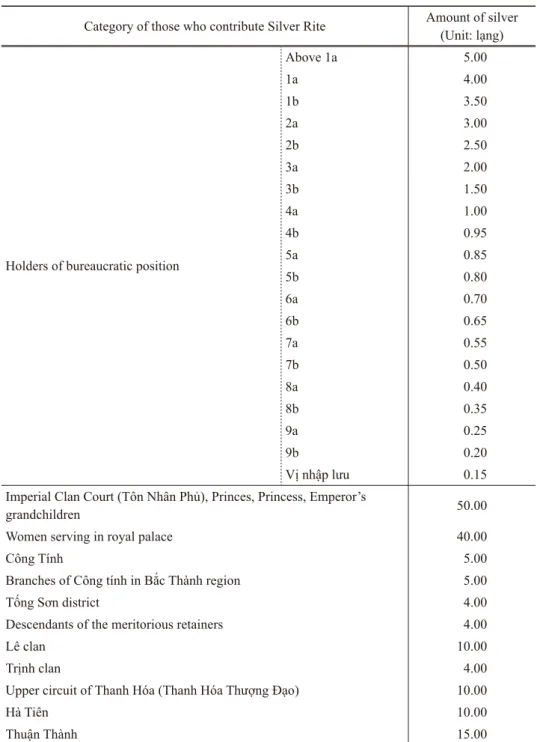
After an interruption caused by a civil war at the end of the eighteenth century, Gia Long resurrected this practice and extended it to the whole country. According to a decree issued in 1808, subjects were required to deliver the Silver Rites yearly on six separate occasions. These included the birthdays of the Empress Dowager, Emperor, Empress, and Crown Prince as well as New Year’s Day, the Dragon Boat Festival, and the death days of the ancestral kings in May and September. Table 2 illustrates the classification of the Silver Rites contributors and the amounts of contributed silver stipulated in 1808.
As shown in the table above, those who held any official position in the dynasty’s bureaucratic system, from high-ranking mandarins in Hue to military officers garrisoned in remote areas, were all required to contribute an amount of silver which varied from 5 lạng from the highest rank above 1a to 0.15 lạng of Vị Nhập Lưu 未入流 for the lowest (below rank 9b). As was the case with the 1803 stipulation, groups such as the Imperial Clan Court, descendants of the Emperor, women serving in the royal palace, the Công Tính people, the Tống Sơn district, descendants of the meritorious retainers, and the Lê and Trịnh clan were also required to contribute. Moreover, it should be noted that Silver Rite contributions were imposed on the Upper Circuit of Thanh Hóa (Thanh Hóa Thượng Đạo 淸化上道), Hà Tiên, and Thuận Thành as well. Of these groups, the Upper Circuit of Thanh Hóa probably referred to the local chiefs who enjoyed autonomous authority within the western highlands of the Thanh Hóa region. The term Hà Tiên meant the Mạc clan that had governed this region for generations. Additionally, Thuận Thành included the Cham kingdom of Panduranga which was under protection of the Nguyen dynasty at that time, an area that extended into today’s Ninh Thuận and Bình Thuận provinces. Although
11 PBTL, vol. 3, 125a.
Table 2: Classification of Silver Rites Contributor and Amounts of Contributed Silver (1808) Category of those who contribute Silver Rite Amount of silver
(Unit: lạng)
Holders of bureaucratic position
Above 1a 5.00
1a 4.00
1b 3.50
2a 3.00
2b 2.50
3a 2.00
3b 1.50
4a 1.00
4b 0.95
5a 0.85
5b 0.80
6a 0.70
6b 0.65
7a 0.55
7b 0.50
8a 0.40
8b 0.35
9a 0.25
9b 0.20
Vị nhập lưu 0.15
Imperial Clan Court (Tôn Nhân Phủ), Princes, Princess, Emperor’s
grandchildren 50.00
Women serving in royal palace 40.00
Công Tính 5.00
Branches of Công tính in Bắc Thành region 5.00
Tống Sơn district 4.00
Descendants of the meritorious retainers 4.00
Lê clan 10.00
Trịnh clan 4.00
Upper circuit of Thanh Hóa (Thanh Hóa Thượng Đạo) 10.00
Hà Tiên 10.00
Thuận Thành 15.00
Source: ĐNTL, I, vol. 34, 6b–7a.
contributions to the Silver Rites were set to begin on New Year’s Day of the next year, a partial or full exemption was given to low ranking officials (below 4a) and military officers for the first three years as remedy for those who less well off financially.12
Considering the frequent contributions of silver demanded every year, the financial burden imposed by the Silver Rites custom was significant. Actually, Emperor Gia Long sometimes decreed exemptions from the Silver Rites. For example, in 1812, an exemption granted to officials below the 4a rank and military commanders was extended for another three years.13 In 1815, soldiers stationed in Cambodia were exempted from silver contributions for three years.14 In 1816, both civil and military officials who still had not received their stipulated salary were exempted from silver contributions for the next five years.15 In 1818, it was decreed that retired officials would be exempt from making contributions of silver.16
The second Emperor Minh Mạng was also concerned about the onerous burden of the Silver Rites contribution. In 1822, Minh Mạng revised the stipulation on the Silver Rites contribution to reduce the amount to 1,190 lạng silver per year, an amount to be provided by royal clan members, Tôn Nhân Phủ, and civil and military officials. For the outer regions, the annual quota of the Silver Rites was abolished permanently. Instead, regional governments were to dispatch officials from each jurisdiction to present a congratulatory document on the Empress Dowager’s birthday. Local products had to be attached to the document on the Emperor’s birthday, New Year’s Day, and the Dragon Boat Festival.17 Finally, to eliminate the financial burden and corruption on the part of officials, all contributions that stemmed from the Silver Rites custom were suspended in 1829.18 From then on, the term “Silver Rites” disappeared completely from the official record.
1-3
Other than the contributions imposed on individual subjects such as the Silver Rites, the Hue court demanded that each region offer local products whenever court rituals and
12 ĐNTL, I, vol. 34, 7a.
13 ĐNTL, I, vol. 45, 2b–3a.
14 ĐNTL, I, vol. 50, 10a.
15 ĐNTL, I, vol. 52, 3a.
16 ĐNTL, I, vol. 58, 1b.
17 ĐNTL, II, vol. 15, 10a–11a.
18 ĐNTL, II, vol. 66, 10b–11b. On the royal edict abolishing the Silver Rites, a description almost identical to the entry of ĐNTL can be found in CBTN. See CBTN, triều Minh Mạng, vol. 29, 146a–b, 16/6/Minh Mạng 10.
ceremonies were implemented. In Sino-Vietnamese sources, these local products were generally termed as “phương vật” 方物. The regulation recorded in HĐSL explained that, on the occasions such as Suburban cult (Giao Tự 郊祀), the Hưởng cult, the birthdays of the Emperor and Empress Dowager, as well as seasonal festivals, each regional governor must personally select suitable products, and then package and seal them. These packaged products were to be delivered to Hue using the post station system. It was required that packaged products should arrive in Hue one or two days prior to the actual day of the ritual or ceremony.19 Table 3 indicates annual quota of phương vật imposed on the regions.
As mentioned above, procuring these phương vật was the personal responsibility of regional governors. To fulfill the quota of phương vật, each governor purchased the necessary items from producers or merchants in his jurisdiction. For the purpose of alleviating the financial burden on the local population, in 1837 an official price was established for 28 items so that the proper price was paid to those who delivered products as phương vật (Table 4).
As Tables 3 and 4 illustrate, the phương vật consisted mainly of fresh fruits such as limes, langsats, oranges, litchis, and pears. It was in 1812 that the delivery of fresh fruits as phương vật was imposed on the three regions of Bắc Thành, Bình Định, and Quảng Nam. At this time, while 4,500 oranges and 4,200 litchis were allocated to Bắc Thành for offerings for New Year’s Day and the xuân hưởng, hạ hưởng, and đông hưởng ritual days, 2,200 langsats were allocated to Quảng Nam and 1,000 limes to Bình Định for offerings for the Dragon Boat Festival and the death day of the imperial ancestor.20 Although the stipulation on the kind or amount of offerings was altered several times, fresh fruits invariably accounted for the largest part of phương vật items through the nineteenth century.21
For regional governers, the delivery of fresh fruit was an assignment requiring meticulous attention. If a package of fruit did not arrive at Hue on the due date, there was no escape from punishment.22 Problems that could occur in the delivery process were not limited to delays in arrival. For instance, on the occasion of the thánh thọ ceremony in the 19th year of Minh Mạng’s reign, a snake was found in the package of oranges dispached from Hải Dương province. Based on the trial convened by the Board of Rites and censors, the Board of Justice proposed that the penalty of beheading and forced labor should be
19 HĐSL, vol. 120, 1a–b.
20 ĐNTL, I, vol. 44, 14b.
21 Other than fresh fruits, beginning in 1815 delivery of mountain animals to Hue was required from the outer regions as sacrifices for the death day ritual of the imperial ancestors at Liệt Miếu (ĐNTL, I, vol. 51, 13b). Minh Mạng, however, abolished this practice immediately after his accession because the procurement of animals would impose difficulties on the local population (ĐNTL, II, vol. 1, 19b–20a).
22 ĐNTL, II, vol. 180, 1a–b.
Table 3: Annual Quotas of Phương Vật Imposed on Regions Region of offeringOccasion of offeringContents of offering Thừa Thiên
Harvest day of spring and autumnNewly harvested rice New Year’s DayLocal products and fruits Dragon Boat FestivalLocal products and fruits Emperors’ birthdayLocal products and fruits Vĩnh Long and Định Tường
New Year’s Day300 pieces of coconut leaves Death anniversary rite at Phụng Tiên Điện奉先殿 (18th day of September and 19th day of December)200 pieces of coconut seeds Death anniversary rite at Hiếu Tư Điện孝子殿 (28th day of December)200 pieces of coconut seeds Death anniversary rite at Long An Điện隆安殿 (27th day of September)200 pieces of coconut seeds Birth anniversary rite for Empress Thuận Thiên順天 (27th day of November)200 pieces of coconut seeds Rite of Tiến Tân薦新200 pieces of coconut seeds Phú Yên
Rite of Hạ Hưởng100–200 pieces of lime (Đại Mông大檬) Rite of Thường Tân嘗新100–200 pieces of lime Birth and Death anniversary rite at Hiếu Tư Điện (23rd day of April and 23rd day of May)600 pieces of lime Birth anniversary rite at Long An Điện (11th day of May)600 pieces of lime Dragon Boat Festival600 pieces of lime Empress Dowager’s birthday600 pieces of lime Bình Định
Rite of Hạ Hưởng200 pieces of lime Rite of Tiến Tân200 pieces of lime Dragon Boat Festival1,000 pieces of lime Empress Dowager’s birthday1,000 pieces of lime Quảng Nam
Rite of Hạ Hưởng100–200 pieces of lime Dragon Boat Festival600 pieces of lime Birth and Death anniversary rite at Hiếu Tư Điện (23rd day of April and 23rd day of May)600 pieces of lime Birth anniversary rite at Long An Điện (11th day of May)600 pieces of lime Rite of Thường Tân8–12 baskets of langsat (Nam Trân 南珍) Emperors’s birthday8 baskets of langsat Death aniversary rite at Hưng Miếu興廟 (14th day of September)4 baskets of langsat Death anniversary rite at Long An Điện (27th day of September)4 baskets of langsat
Quảng Bình
Rite of Hạ Hưởng2 bottles of mulberry liquor (Dâu Cụm Tửu桑椹酒), 30 pieces of watermelon Rite of Tiến Tân100 pieces of watermelon Dragon Boat Festival50 pieces of watermelon Empress Dowager’s birthday150 pieces of watermelon Death anniversary rite at Phụng Tiên Điện (3rd day of February and 19th day of December)10 cân of solomon’s seal powerder , 2 bottles of soybean Death anniversary rite at Hiếu Tư Điện (23rd day of May and 28th day of December)10 cân of solomon’s seal powerder , 2 bottles of soybean, 5 cân of dried abalone (Cửu Khổng Kiền Nhục九孔乾肉) Death anniversary rite at Long An Điện (27th day of September)10 cân of solomon’s seal powerder, 2 bottles of soybean, 5 cân of dried abalone Thanh HóaGrand rite of Nam Giao 南郊300 pieces of orange Rite of Tiến Tân300 pieces of orange Death anniversary rite at Long An Điện (27th day of September)300 pieces of orange Hải DươngRite of Xuân Hưởng400 pieces of orange Birth anniversary rite at Phụng Tiên Điện (27th day of November)300 pieces of orange Death anniversary rite at Hiếu Tư Điện (28th day of December)300 pieces of orange Hà NộiRite of Hạ Hưởng2,000 pieces of litchi Ninh BìnhDeath anniversary rite at Long An Điện (27th day of September)2 bottles of fish sauce made from ragworms (Đại Hoa Hàm大火鹹) Rite of Thường Tân2 bottles of fish sauce made from ragworms Nam ĐịnhDeath anniversary rite at Phụng Tiên Điện (19th day of December)1 bottle of fish sauce made from ragworms Death anniversary rite at Hiếu Tư Điện (28th day of December)1 bottle of fish sauce made from ragworms Cao BằngEmperor’s birthday200 pieces of pear Rite of Tiến Tân100 pieces of pear Tuyên QuangEmperor’s birthday300 pieces of pear Mid-Autumn Festival300 pieces of pear Double Ninth Festival300 pieces of pear Source: HĐSL, vol. 120, 6a–27b.
applied to the subordinate staff and senior officials of the province. Upon receiving this proposal, Minh Mạng reduced the sentence to military service for subordinate staff and demotion for senior officials, with the Empress Dowager’s permission.23
Although the rules relating to offerings made on ritual and ceremonial occasions
23 ĐNTL, II, vol. 196, 38b–49a.
Table 4: Official Price for Items Offered to Hue Court (1837)
Products Amounts Purchase price in cash
Coconut leaves 100 leaves 3 quan
Fish sauce made from ragworms 1 bottle
Lime 100 pieces
Litchi 1,000 pieces
Langsat 4 baskets
Orange 100 pieces 2 quan
Snow Pear (Tuyết Lê 雪梨) 100 pieces 5 quan
Sand Pear (Sa Lê 沙梨) 100 pieces 1 quan
Watermelon 10 pieces 6 tiền
Arrowroot powder (bột Hoàng Tinh黄精粉) 1 cân 5 tiền
Soybean 1 copper bowl 2 tiền 30 đồng
Seeds of Canarium album 1,000 pieces 1 quan
Mulberry liquor 1 official copper bowl 1 tiền 18 đồng
Dried Abalone 5 cân 2 tiền
Marshy Shell 4 packages 8 tiền
Yellow Jujube 1 cân 8 tiền
Black Jujube 1 cân 8 tiền
Red Jujube 1 cân 8 tiền
Grapes 1 cân 8 tiền
Dried Litchi 1 cân 5 tiền
Persimmon Jam 1 cân 4 tiền
Dried Longan 1 cân 3 tiền
Longan 1 cân 8 tiền
Orange of Thanh Hoá 1 cân 3 tiền
Hoelen 10 packages 1 quan
Flatbread 10 pieces 2 tiền
Roasted Potato with sugar 100 pieces 5 tiền
Roasted Rice with sugar 1 cân 30 đồng
Source: ĐNTL, II, vol. 176, 29b–30a.
were gradually simplified through Minh Mạng’s reign, the practice survived through the Nguyen period. Even when Vietnam suffered from the invasion of the Western colonizing powers and a variety of insurgents in the northern region in the late nineteenth century, goods were still delivered from provinces to the Hue court for the annual rituals and ceremonies. For example, in 1876, Trần Đình Đúc, the governor of Hanoi sent liquors made from lotus and chrysanthemum, 20 packages of hoelen, as well as precious stones and teas purchased from Chinese merchants as an offering for the vạn thọ ceremony of Emperor Tự Đức. These goods were conveyed through the post station system and were received by the Board of Rites on time.24 Furthermore there are many records in CBTN that refer to the dispatch of fresh fruit by the provinces from the late 1860s to early 1870s.
Many documents allude, however, to delays of arrivals or difficulties in procuring the necessary fruit due to natural disasters.25
1-4
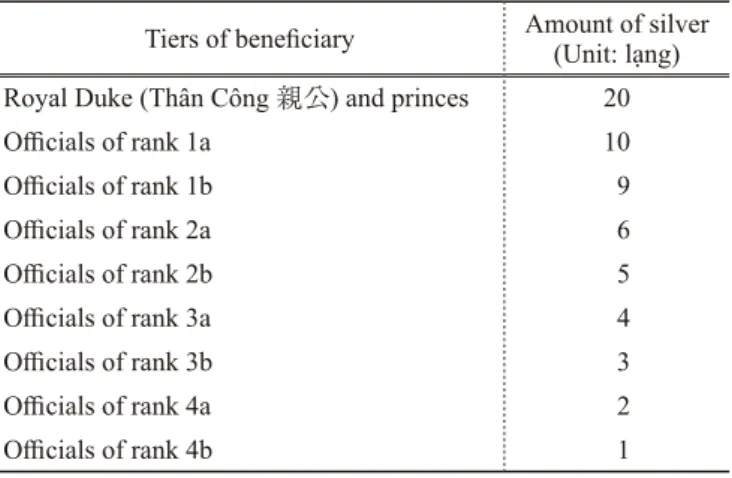
In exchange for offerings received from their subjects, on the occasion of the annual rite or ceremony, Emperors held banquets and distributed precious items to participants. The participants receiving these gifts were usually confined to royal clan members as well as high- and middle-ranking officials of Hue.26 On New Year’s Day, beginning in the seventh year of Gia Long’s reign, silver ingots were distributed to royal clan members and high- ranking officials.27 As Table 5 shows, the amount of distributed silver varied according to the beneficiary’s status, an amount that ranged from 1 to 20 lạng per person.
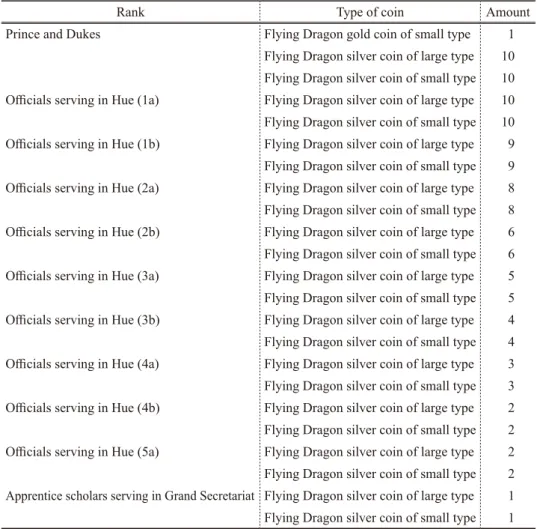
There were also distributions of money or goods on other seasonal festival days. For example, on the Dragon Boat day, royal clan members and officials received bamboo fans, handkerchiefs, tea, and fruit.28 On the Double Ninth day, silver and gold coins were dis- pensed, at least in 1838 and 1843.29 The banquet at which the gifts were distributed was
24 CBTN, triều Tự Đức, vol. 272, 213a–214b, 17/8/Tự Đức 29, Memorial from the Board of Rites.
25 For instance, in 1871, while the governor of Hải Dương province reported that procurement of oranges became impossible because floods and strong winds devastated the producing regions, the governor of Cao Bằng province found it difficult to obtain the required quota of pears because heavy rains in previous months had seriously damaged the pear crop in his jurisdiction (CBTN, triều Tự Đức, vol. 244, 10a–12b, 6/9/Tự Đức 24, Memorial from Board of Rites).
26 Concerning the New Year’s Day banquet, participants had been confined to those holding the rank of 5b rank or higher in the civil service and those military officials holding ranks above 5b.
Subsequently, civil officials of holding rank 6a and military officials holding rank 5a were added to this banquet after the New Year’s Day of the 19th year of Minh Mạng (ĐNTL, II, vol. 188, 1a).
27 HĐSL, vol. 242, 1b.
28 See HĐSL, vol. 242, 2a–b.
29 HĐSL, vol. 242, 5a and 9a–b.
also institutionalized on the vạn thọ ceremony no later than 1803.30 As will be discussed in the following section, at grand ceremonies occasioned by special auspicious events, gift giving dramatically increased. Precious goods including Chinese and European items were lavishly distributed to ceremony participants.
2. Grand Ceremonies on Exceptionally Auspicious Event 2-1
The Nguyen court organized grand ceremonies for exceptionally auspicious occasions to be celebrated on a nationwide basis. These grand ceremonies, which Sino-Vietnamese source referred to as Khánh Điển
慶典, included the new Emperor’s accession, the
Emperor’s mother’s investiture as Empress Dowager, and celebrations of longevity for the Emperor and Empress Dowager. Although it was not staged at Hue, the Emperor’s tour to Hanoi for receiving his investiture as “King of Vietnam” (Việt Nam Quốc Vượng 越南國王) from the Qing Emperor’s delegate was also seen as one of the most important Khánh
Điển.31These grand ceremonies played an important role as a means of social integration in
30 ĐNTL, I, vol. 20, 4a.
31 In the Nguyen period, the Emperor’s tour to Hanoi was known as the Northern Tour (Bắc Tuần 北巡). The significance of this event for the dynasty can be understood by the enormous number of followers that accompanied the Emperor. For example, at the time of the Northern Tour of Emperor Minh Mạng, conducted between the end of 1821 and early 1822, 1,782 officials and 5,150 soldiers accompanied him from Hue to Hanoi [Hoàng Yến 1917: 100].
Table 5: Amount of Silver Distributed on New Year’s Day Tiers of beneficiary Amount of silver
(Unit: lạng) Royal Duke (Thân Công 親公) and princes 20
Officials of rank 1a 10
Officials of rank 1b 9
Officials of rank 2a 6
Officials of rank 2b 5
Officials of rank 3a 4
Officials of rank 3b 3
Officials of rank 4a 2
Officials of rank 4b 1
Source: HĐSL, vol. 242, 1b.
nineteenthcentury Vietnam. They were regarded as a great opportunity to visualize the world order that the Hue court embraced.32 As is well known, the Nguyen dynasty constructed a Vietnamese-centered world order modeled on the Chinese world view, which was supported fundamentally by the distinction between “Hoa” 華 and “Dì” 夷, or
“Civilized” and “Barbarians”. Based on this concept, Civilization spreads radially around the imperial capital to less civilized outer regions beyond its borders. In the Vietnamese version of the Civilized-Barbarians world order conceptualized by the Nguyen dynasty, Hue, the imperial capital, occupied the most civilized position. It was surrounded by administrative units ruled directly by officials appointed by the central government. The outer fringes of this directly ruled sphere, the frontier areas were expanded where indirect rule was dominant. For example, in the northern mountain region, tribal leaders called
“thổ ty”
土司, were permitted hereditary rule by the central authority. Beyond this
indirectly ruled area, the more or less independent polities existed. The Nguyen dynasty claimed suzerainty over these polities and demanded that they pay tribute as a sign of vassalage.33 Among of them, some relatively small and less independent polities were categorized as Tributary Barbarians (Cống Man貢蠻 or Thuộc Man 屬蠻), to which
polities such as Cam Lộ 甘露34, Lạc Hoàn 樂丸, and Mục Đa Hán目多漢
35 belonged. On the other hand, larger and independent kingdoms such as Cambodia (Chân Lạp眞臘),
Luang Phabang (Nam Chưởng 南掌), Vientiane (Vạn Tượng 万象), and Jarais (Thủy Xá水舎 and Hỏa Xá 火舎) were categorized as Tributary States (Thuộc Quốc 屬國).
The grand ceremonies held in Hue were an ideal stage for visualizing the otherwise ambiguous world order of the Nguyen court. Participants in the ceremony included not only imperial family and dynastic officials, but also Thổ Ty leaders of the remote mountain region and delegates from neighboring tributary polities. In the ceremony, they were allowed an audience with the Emperor and participated in the banquet with other court officials. Although we lack records written from the view point of foreign participants, the splendid ceremony that unfolded in Hue arguably left a deep impression upon them.
The importance of the grand ceremonies held at Hue was also significant in economic terms. On the occasion of the grand ceremonies, large amounts of goods or money were distributed to subjects to show the ruler’s benevolence and affluence. The Imperial Record of the Nguyen dynasty did not lack examples to support this point. For instance, when the
32 On the problem of how the world order of the Nguyen dynasty was configured, pioneering discussion can be seen in [Tsuboi 1983; Woodside 1988].
33 Of course, this did not mean that surrounding polities always accepted the claim of suzerainty made by the Nguyen dynasty over them. Rather, in some cases, they interpreted and utilized such claims of the Nguyen dynasty on behalf of their own interests.
34 Cam Lộ is included in today’s north western part of Quảng Bình province of Vietnam.
35 Lạc Hoàn and Mục Đa Hán contains Nakhon Phanom and Mukdahan provinces of modern Thailand.
70th birthday of the Dowager Empress Nhân Tuyên was celebrated in 1837, the number of loyal clan members, officials, and military commanders who received silk products or silver coins as gifts amounted to over 1,000.36 In another case, at the accession of the third Emperor Thiệu Trị in 1841, 40,000 strings of cash were dispensed to royal clan members.37 They received approximately 50,000 strings of cash when the fourth Emperor Tự Đức was enthroned in 1847.38 Further, when Tự Đức’s mother was invested as Từ Dụ Hoàng Thái Hậu, about 40,000 strings of cash as well as gold and silver coins were dispensed to subjects.39
In general, dispensation of goods or money as part of the grand ceremony occurred at court banquets. Compared to banquets held as an annual event, court banquets of grand ceremony included a far larger number of participants. These banquets included senior officials serving in the outer provinces,40 officers of various military units, ambassadors from tributary states, and patriarchs in the capital region.41 As we shall see in the following sections of this paper, those who participated in court banquets received valuable fabrics or decorative coins made of gold, silver, and copper. Other than the dispensing of goods or money, tax exemptions were also given at the grand ceremonies which had a significant economic effect. According to the fiscal record submitted by the Board of Finance (Hộ Bộ
戸部) to the Emperor Tự Đức in 1851, while the amount of exempted land and poll tax that
followed Emperor Thiệu Trị’s accession reached 2,141,859 strings of cash, that amount was further augmented to 2,682,995 strings of cashwhen Tự Đức was enthroned as the exemption was also applied to the inland custom dutyalong with the land and poll tax.422-2
Among various Khánh Điển ceremonies, those celebrating the longevity of the Emperor and Empress Dowager outweighed others for their dispensation scale and variety of
36 HĐSL, vol. 59, 6a–8a.
37 HĐSL, vol. 59, 9a–b.
38 HĐSL, vol. 59, 12a–b.
39 HĐSL, vol. 59, 12b–14a.
40 Provincial officials entitled to attend the court banquet were selected by the Emperor himself based on the list prepared by the Board of Personnel (Lại Bộ 吏部). A list of provincial officials allowed to participate in the court banquet of ngữ tuần tết of Emperor Minh Mạng was found in ĐNTL, II, vol. 208, 6b–7a.
41 At time of the ngữ tuần tết of Emperor Minh Mạng, the number of patriarchs invited to the court banquet reached 999. Of the invited patriarchs, three were over 100 years old, 21 were over 90 years old, 222 were over 80 years old, and 753 were over 70 years old. Participants received gold and silver coins according to their age. See ĐNTL, II, vol. 212, 30b–31a.
42 CBTN, triều Tự Đức, vol. 30, 78a–85a, 3/7/Tự Đức 4, Memorial from Board of Finance.
participants.43 In the Nguyen period, the 40th birthday of the Emperor or Empress Dowager was celebrated extravagantly as the “40 years old anniversary” (tứ tuần tết 四旬節). Since then, the longevity of them should be celebrated every ten years on their birthday: the 50th birthday as “ngữ tuần tết”
五旬節, the 60
th birthday as “lục tuần tết”六旬節, the 70
th birthday as “thất tuần tết” 七旬節, and so on. Although Emperors of the Nguyen dynasty enjoyed relatively long lives, none celebrated his 60th birthday. On the other hand, it was not uncommon for Empress Dowagers to celebrate their 60th or 70th birthdays, reflecting a longer life expectancy for women than men. Table 6 lists the grand ceremonies celebrating the longevity of the Emperor and Empress Dowager implemented in the first half of the nineteenth century.Based on the record of ĐNTL, the Empress Dowager’s (Hiếu Khang) 70th birthday (thất tuần tết) in 1807 was the first grand ceremony celebrating longevity that the Nguyen dynasty organized. On that occasion, to celebrate his mother’s long life, Emperor Gia Long visited the Trường Thọ palace, where the Empress Dowager resided, in company with his subjects, he then solemnly conducted the ritual of celebration. Those who participated in that ritual ranged from the Tôn Nhân Phủ, male descendants of Emperor, to
43 So far few studies have been conducted on the grand ceremony celebrating the longevity of the Emperor and Empress Dowager in the Nguyen period except for Võ Hương An’s work, which described the Tứ tuần đại khánh of the Emperor Khải Định which occurred in 1924 under the French protectorate [Võ Hương An 2016: 137–161].
Table 6: Grand Ceremonies Celebrating the Longevity of the Emperor and Empress Dowager in the First Half of the nineteenth Century
Month / Year Ceremony
July / Gia Long 6 (1807) 70 years old anniversary (thất tuần tết) of Empress Dowager Hiếu Khang
November / Minh Mạng 8 (1827–1828) 60 years old anniversary (lục tuần tết) of Empress Dowager Nhân Tuyên
April / Minh Mạng 11 (1830) 40 years old anniversary (tứ tuần tết) of Emperor Minh Mạng
November / Minh Mạng 18 (1837) 70 years old anniversary (thất tuần tết) of Empress Dowager Nhân Tuyên
April / Minh Mạng 21 (1840) 50 years old anniversary (ngữ tuần tết) of Emperor Minh Mạng
May / Thiệu Trị 6 (1846) 40 years old anniversary (tứ tuần tết) of Emperor Thiệu Trị
May / Tự Đức 2 (1849) 40 years old anniversary (tứ tuần tết) of Empress Dowager Từ Dụ
subordinate officials serving in the Trường Thọ palace. Interestingly, descendants of the Lê and Trịnh clans also participated in this ceremony. After the ceremony finished with a performance of dance and music, Emperor Gia Long hosted a court banquet at the Cần Chính palace for high-ranking officials.44 Following the thất tuần tết of Empress Dowager Hiếu Khang, implementation of the grand ceremony of ngữ tuần tết was discussed on the occasion of Gia Long’s 50th birthday. Gia Long, however, rejected a petition by the grand mandarins to organize a grand ceremony and ordered that the celebration of his 50th birthday would be conducted in the same manner as the ordinary vạn thọ tết.45
In the Gia Long era, a ceremony celebrating the Emperor’s and Empress Dowager’s longevity was still organized on a modest scale. During the reign of the second Emperor Minh Mạng, however, this ceremony began to assume a more important meaning for both dynasty and country. In this respect, 60th birthday (lục tuần tết) of the Empress Dowager Nhân Tuyên was epochal because a large number of Thổ Ty chiefs and delegates of foreign countries participated.46 Beginning ten days before the birthday, Thổ Ty and foreign delegates arrived at Hue, each bearing various goods as offerings. First, 14 representatives of Thổ Ty and native administrators of Phòng Ngự Sứ 防御使 arrived from Bắc Thành, Thanh Hóa, and Ninh Bình regions. Receiving them in an audience, Minh Mạng returned their offerings and presented them with official garments. Subsequently, the delegates from Cambodia arrived with gifts consisting of nutmeg, cardamom, shellac, ivory, rhinoceros horn, deer’s horn, and colored silk. Gifts were also contributed by the polities of Cam Lộ and Lạc Hoàn. Even King Anouvong of Vientiane, at that time taking refuge in Vietnam after losing the war against Siam, sent a gold ring and gem stone as an offering through the governor of Ngệ An. Three days before the birthday, the conduct of the grand ceremony was respectfully reported to Hoàng Nhân Điện where the royal ancestors were worshipped. Intriguingly enough, on the same day, both Minh Mạng and the Empress Dowager Nhân Tuyên enjoyed “Barbarian music” (Man Nhạc 蠻樂) at the Tiên Tho gate.
The performance began with the music of Cam Lộ and Cambodia and finished with music of Vientiane. On the birthday, after the solemn celebratory ritual was carried out, a series of banquets followed. Representatives of Thổ Ty were banqueted with middle ranking officials of the Nguyen court and staffs of the Văn Thư Phòng office at Phu Văn lâu. At another military building, a banquet was prepared for “tributary states” and “tributary barbarians”, including Cambodia, Cam Lộ, and Lạc Hoàn.
Three years after the lục tuần tết of Empress Dowager Nhân Tuyên, a grand ceremony of tứ tuần tết was carried out in 1830 to celebrate the 40th birthday of the
44 ĐNTL, I, vol. 33, 1b–2a.
45 ĐNTL, I, vol. 42, 1a–b.
46 The following description on lục tuần tết grand ceremony of Empress Dowager Nhân Tuyên was all based on the entry of ĐNTL, II, vol. 49, 11a–18b.