Degree Conferral Date
2021‑04‑30
Degree Doctor of Philosophy Degree Referral
Number
38005甲第73号 Copyright
Information
(C) 2021 The Author.
URL http://doi.org/10.15102/1394.00001849
Okinawa Institute of Science and Technology Graduate University
Thesis submitted for the degree
Doctor of Philosophy
Intrinsic Motivation in Creative Activity
by
Shoko Ota
Supervisor: Kenji Doya Co-Supervisor: Greg Stephens
April, 2021
Declaration of Original and Sole Authorship
I, Shoko Ota, declare that this thesis entitled Intrinsic Motivation in Creative Activity and the data presented in it are original and my own work.
I confirm that:
• No part of this work has previously been submitted for a degree at this or any other university.
• References to the work of others have been clearly acknowledged. Quotations from the work of others have been clearly indicated, and attributed to them.
• In cases where others have contributed to part of this work, such contribution has been clearly acknowledged and distinguished from my own work.
• None of this work has been previously published elsewhere, with the exception of the following: (provide list of publications or presentations, or delete this part).
(If the work of any co-authors appears in this thesis, authorization such as a release or signed waiver from all affected co-authors must be obtained prior to publishing the thesis. If so, attach copies of this authorization to your initial and final submitted versions, as a separate document for retention by the Graduate School, and indicate on this page that such authorization has been obtained).
Date: April, 2021 Signature:
iii
Abstract
Intrinsic Motivation in Creative Activity
Intrinsic motivation is a fundamental basis for creativity. However, little is known about which factors are essential in a behavioral environment for creative activity. I propose a hypothesis that intrinsic motivation in creative activity is facilitated by a higher variety of expressions using simpler rules. To examine the hypothesis, I conducted a novel human behavioral experiment with 42 participants using the original game designed based on the Game of Life cellular automata. The simplicity of a rule is controlled by the parameters of state transition function and quantified by the complexity measures formulated in the theory of cellular automata. The variety of expression is quantified by the features of the cell states, such as entropy of local patterns and empowerment.
The degree of intrinsic motivation is measured by subjective enjoyment, playing time, and frequency of touch interaction. The results of two-way ANOVA of the scores of enjoyment for the four rules showed that participants were more intrinsically motivated with a higher variety of expression and a simpler rule, which supports the hypothesis.
Regression analyses revealed that the variety of local patterns was a major factor for subjective enjoyment and also suggested two types of subjects. Subgroup analyses showed that participants had opposite preferences for simple and complex rules. The present results are generally consistent with the hypothesis but point to the necessity of considering individual differences.
v
Acknowledgment
I would first like to thank my supervisor, Professor Kenji Doya, for the great advice, guidance, and support. I would also like to thank the other committee members, including my former committee, Professor Jeff Wickens, Professor Greg Stephens, and Prof. Izumi Fukunaga, and Professor Kenji Matsumoto of Tamagawa University very supportive and encouraged me with crucial advice. I would also like to thank the former supervisor for my master thesis, Prof. Koichi Hori of The University of Tokyo, for his books which inspired me to start this research. Thank you to the OIST members who participated in this experiment, Eri Kanemoto, who helped me attain ethical approval of the human behavioral experiment, and the RUAs, Emi-san, Kikuko-san, and Misuzu-san of the Doya Unit who helped me to experiment. I would also like to thank the former group leader Dr. Eiji Uchibe for teaching me all the basics of Ph.D.
studies. Thank you also to former members of the Doya Unit, Makoto Ito-san and Prof. Junichiro Yoshimoto, for your advice. I would especially like to thank Hiromichi Tsukada-san, who supported and helped me mainly with my personal issues. Thank you, Kazumi Kasahara, Yuzhe Li, Qiong Huang, Jessica Verena Schulze, and Farzana Rahman, for all your advice and fun times, especially when we have lunch or a couple of coffee or tea together. I would also like to thank Tadashi Kozuno, who was my teacher of coding and machine learning. Thank you also to the graduate school members, especially Kozue Higashionna, Midori Morinaga, Rie Ishikawa, and Harry Wilson. I really thank Dr. Darren George at Ganjuu Wellbeing Service at OIST, who always supported me with his life wisdom. I could not have finished this study without your support. My path into research would not have been possible without the support of my mother, who first encouraged and supported my efforts to pursue a career at OIST.
I would also like to thank my family and my friends for all their support. Finally, I would like to thank my lovely daughter Mone who inspires me every day with her creativity which keeps me creative.
vii
Abbreviations
AIC Akaike’s Information Criterion CA Cellular Automata
CCA Canonical Correlation Analysis GOL Game of Life Cellular Automata
IM Intrinsic Motivation RL Reinforcement Learning VIF Variance Inflation Factgor
ix
To my sweet and lovely daughter Mone who inspires and encourages me with her creativity every day
Contents
Declaration of Original and Sole Authorship iii
Abstract v
Acknowledgment vii
Abbreviations ix
Contents xiii
List of Figures xv
List of Tables xvii
1 Introduction 1
1.1 Toward a theory of creativity . . . 1
1.2 Intrinsic reward and intrinsic motivation . . . 3
1.2.1 Intrinsic reward . . . 4
1.2.2 Intrinsic motivation . . . 5
1.3 Intrinsic motivation for creativity . . . 8
2 Experiment: How can we measure the factors of intrinsic motivation in creative activity? 11 2.1 Objectives . . . 11
2.2 Hypothesis: More variety with simpler rules makes people more intrin- sically motivated. . . 12
2.3 Materials and Methods . . . 13
2.3.1 Ethics . . . 13
2.3.2 Task . . . 13
2.3.3 Parameter design of task . . . 13
2.3.4 Procedure . . . 15
2.3.5 Questionnaire . . . 17
2.4 Data analysis . . . 18
2.4.1 Variables for intrinsic motivation . . . 18
2.4.2 Variables for the variety of expression . . . 19 xiii
2.4.3 Variables for the simplicity of the rule . . . 19
3 Results: Factors influencing intrinsic motivation 21 3.1 Participants . . . 21
3.2 Questionnaire: Subjective scores . . . 21
3.2.1 Ranges of subjective scores . . . 21
3.2.2 ANOVA by variety-complexity . . . 23
3.2.3 Subjective enjoyment, variety and complexity . . . 25
3.3 Behavioral measures for intrinsic motivation . . . 26
3.4 Behavioral measures for variety of expression . . . 27
3.5 Behavioral measures for simplicity/complexity of rules . . . 34
3.6 Relationships between subjective and behavioral measures . . . 39
3.7 Canonical Correlation Analysis . . . 40
3.8 Discussion . . . 43
4 Subgroup analysis: Preferences for passive viewing and active control 45 4.1 Existence of subgroups . . . 45
4.2 Intrinsic motivation of subgroups . . . 46
4.3 Discussion . . . 49
5 Conclusion 53
Bibliography 57
Appendices 63
A The life of game cellular automata 63
B Formulas for calculating entropy and empowerment 67
C Documents of experiment 71
D Examples of the patterns with interactions based on the four rules 75
List of Figures
1.1 Interaction among Creativity, Intrinsic Motivation, and Intrinsic Reward
for creativity . . . 9
2.1 Task Interface . . . 14
2.2 Procedure of the experiment . . . 17
3.1 Mean of subjective scores of enjoyment . . . 22
3.2 Result of two-way ANOVA by variety-complexity . . . 23
3.3 Subjective scores of variety of expression . . . 24
3.4 Subjective variety vs. subjective score of intrinsic motivation . . . 24
3.5 Subjective scores of complexity of rules . . . 26
3.6 Subjective complexity vs. subjective score of intrinsic motivation. . . . 27
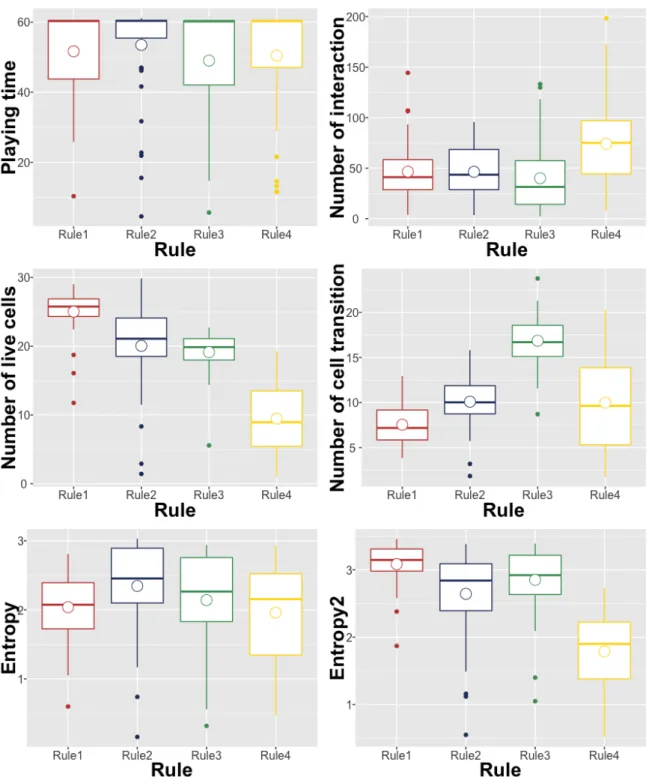
3.7 Mean of playing time; Number of interaction; Number of live cells; Num- ber of cell transitions; Entropy; and Entropy of local patterns(Entropy2) in Session 1 . . . 28
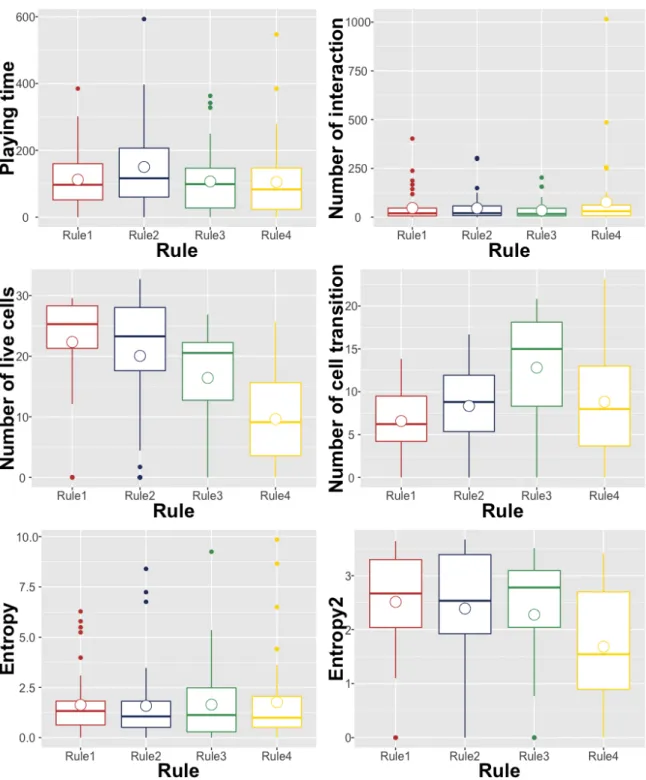
3.8 Mean of playing time; Number of interaction; Number of live cells; Num- ber of cell transitions; Entropy; and Entropy of local patterns(Entropy2) in Session 2 . . . 29
3.9 Timeline of the number of live cells during the sessions . . . 31
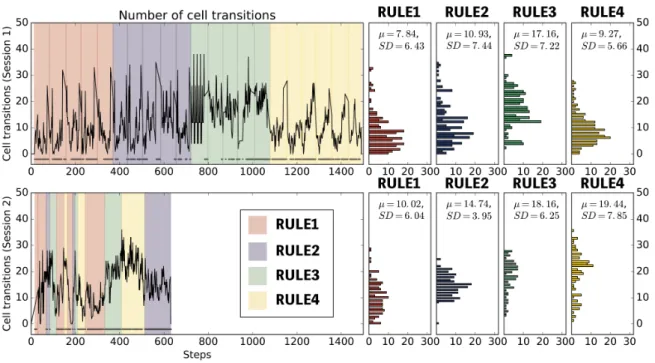
3.10 Timeline of the number of transition cells during the sessions . . . 32
3.11 Entropy of each game in four rules . . . 33
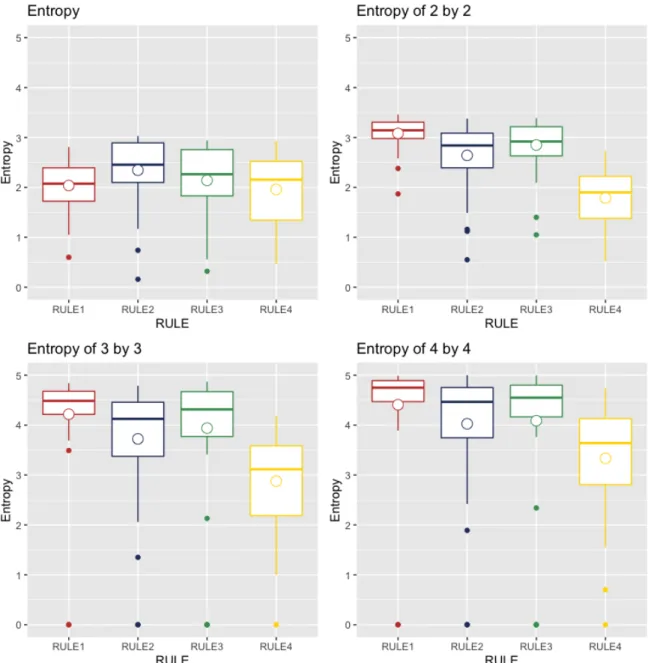
3.12 Mean of entropy with different resolutions in Session 1 . . . 35
3.13 Mean of entropy with different resolutions in Session 2 . . . 36
3.14 Relationships between subjective and behavioral measures in Session 1 37 3.15 Relationships between subjective and behavioral measures in Session 2 38 3.16 Empowerment in four rules . . . 39
3.17 Coefficients of regression result . . . 41
3.18 Plot of subjective scores and entropy of two by two square grid pat- tern(Entropy2) . . . 42
3.19 Cross-loadings of variables by CCA in Session1 and Session 2 . . . 43
4.1 Plot of entropy of two by two grid square(Entropy2) vs. intrinsic moti- vation with individual slopes . . . 46
4.2 Distribution of participants in two measurement . . . 47
4.3 Scatter plot of the slopes of the subjective score for Entropy 2 and subjective scores for Rule 4. . . 47
4.4 P-values by a number of modes in Silverman test. . . 48 xv
4.5 Linear regression results by subgroups . . . 49 4.6 Coefficients of regression result with all variables . . . 50 4.7 Coefficients of regression result of the best model . . . 51 4.8 Normalized mean of subjective scores for the four rules in two groups . 51 5.1 "bit world" designed and created by Tomomi Kasahara . . . 55 A.1 Neighbors in CA: The center cell is sometimes included as part of the
neighbourhood and sometimes not. . . 63 A.2 Two dimensional CA representative configurations with different λ pa-
rameters . . . 64 A.3 Location of the Wolfram classes in lambda space (Langton, 1990). . . 65 C.1 Instruction to be given to participants before starting demos and games. 72 C.2 Questionnaire to distribute after the games. . . 73 D.1 An example of changing patterns during the game with RULE1 . . . . 76 D.2 An example of changing patterns during the game with RULE2 . . . . 77 D.3 An example of changing patterns during the game with RULE3 . . . . 78 D.4 An example of changing patterns during the game with RULE4 . . . . 79
List of Tables
2.1 Rule settings with parameters of cellular automata . . . 15
2.2 Description of the variables measured in the experiment . . . 20
3.1 Result of multiple linear regression . . . 41
4.1 The Silverman test for multimodality of the two distributions . . . 46
4.2 Result of multiple linear regression by group with all variables . . . 50
4.3 Result of multiple linear regression by group of the best fit model . . . 50
B.1 Calculation of empowerment . . . 69
xvii
Chapter 1 Introduction
1.1 Toward a theory of creativity
Creativity is a fundamental ability to solve problems with relevance and novelty that includes any technical, theoretical, social, and practical problems in our daily lives.
Creativity is an essential condition to survive this dynamic world by designing and de- veloping new and useful strategies and tools. Not only educators but also parents have been seeking an optimal environment for nurturing the creativity of children. However, there is still no systematic approach for educating in tandem with children’s creativity.
The fact is that educators and parents have to be highly creative to teach creativity.
How can we be more creative? What is the theory of creativity to explain what humans have achieved? There is a compelling need for a unified theory of creativity that can be practically implemented with an educational method.
Schmidhuber (2010) defined "a theory of creativity, fun and intrinsic motivation"
as:
The simple but general formal theory of fun and intrinsic motivation and creativity is based on the concept of maximizing intrinsic reward for the ac- tive creation or discovery of novel, surprising patterns allowing for improved prediction or data compression.
Children are intuitively keeping the curiosity doors open and they are actively in- teracting with the environment to learn how to discover something new and surprising.
Interestingly, as observed by Jean (1962), children sometimes play as if everything is alive. They interact with every new item they encounter and explore until an exciting event happens. Through playing in this way, children learn how to discover and invent new things.
Creativity depends on contexts such as the environment, time, culture, and personal background (Sternberg, 2006). Among many approaches to understand creativity, the creative cognition (Ward, Smith, and Finke, 1999) is one of the most practical ap- proaches to understand the cognitive process and structures that underlie human cre- ativity. Finke (2014) combined the experimental method and creative exploration by investigating the conditions that promote creative insights. Finke, Ward, and Smith (1992) and Finke (2014) noted that human participants performed more creatively
1
when 1) they have more limitation of the component, 2) they are given a functional or categorical constraint (e.g., an object to sit on) for what they create rather than given a particular product (e.g., a chair), 3) they provide an interpretation to what they create than to what other people create, and 4) they first create a form and then consider the form’s function (function follows form) rather than if they first think of a function and then create the form (form follows function).
In these previous studies, researchers have assessed creativity based on the factors such as the behavior of the subjects, the quality of their products, and the cognition expected behind them. Despite the large body of research done on creativity, however, the assessment of creativity remains an essential challenge (Kaufman and Sternberg, 2010; Amabile, 1996).
On the measure of creativity
How is creativity measured in scientific behavioral experiments? The concept of creativity contains vast and complex factors such as small-c (everyday creativity that is the personal creative activity of a personal nature or problem solving for hobbies and work) vs. big-c (eminent creativity that can impact culture or society) and P-creativity (psychological creativity that is novel and meaningful just to the person or agent) vs.
H-creativity (historical creativity that is creativity recognized as a novel by society) (Boden, 1996).
In this study, I focus on personal or psychological creativity. Personal or psy- chological creativity includes several aspects of creativity ,from cognitive processes to environmental factors. These factors of creativity are fundamentally difficult to capture quantitatively. Another point of consideration is the lack of standardized laboratory tasks that manipulate the factors for "creativity" in the experiment (Kidd and Hayden, 2015). Some tasks require preliminary skills, which are modulated by prior knowledge and experiences. I designed the task as a creative activity without requiring prelimi- nary skill or knowledge. The task outcomes are creative outwork consisted by grid cells so that the target factors can be quantitatively measured.
Psychologists have been developing test theories for measuring creativity. Amabile (1996) proposed the componential theory of individual creativity, which has three in- dividual components, including domain-relevant skills or expertise, creativity-relevant processes or creative thinking, and task motivation. Task motivation is intrinsic mo- tivation to engage in the activity out of curiosity, enjoyment, or a personal sense of challenge. Amabile (2012) added another component outside the individual, which is the surrounding environment, such as the social environment. The theory specifies that creativity requires a confluence of these components. Creativity should be higher when a person is intrinsically motivated with high domain expertise and higher skills in creative thinking, which are helpful in an environment.
Sternberg and Lubart (1991) developed the investment theory of creativity that as- serts creative people are those who are willing and able to metaphorically "buy low" and
"sell high" in the realm of ideas. The theory claims six sources: abilities, knowledge, thinking style, personality attributes, motivation (especially intrinsic motivation), and environment. Creative people see the potential of specific ideas and how to develop said ideas by combining the sources(Sternberg, 2006).
1.2 Intrinsic reward and intrinsic motivation 3 Regardless of the validity of these theories, measuring creativity remains difficult because creativity is something more than the sum of these components or sources.
Moreover, there are also biases in evaluating creativity if the creative products of experimental tasks are assessed by humans, even if they are experts.
There are also measuring theories for statistical consistency, standardization, and minimizing bias (e.g., Classical Test Theory (Crocker and Algina, 1986)). These the- ories work for measuring creativity as a part of intellectual ability or for measuring creative personality, requiring large sample sizes in the thousands or more.
In contrast to these classical creative measurements, what I focus on in this study is the learning environment in which people can be more creative. Here, the learning environment does not include a social environment. In addition, I do not try to measure creativity itself but rather intrinsic motivation and influencing factors as a dominant condition of creativity when engaging in creation.
1.2 Intrinsic reward and intrinsic motivation
Children learn and develop as they play. They play in a playground and learn how to enjoy the power of gravity. At home, some children play with building blocks and learn how to build their ideas. Others play with dolls and learn how to communicate or how to make up a story. Children inherently become creative through doing what they like to do. What motivates them in such cases is called intrinsic motivation. With intrinsic motivation, the learning activity itself is rewarding for learners while learning "for its own sake"(Berlyne, 1966). Decades of investigations by psychologists identified that intrinsic motivation is crucial for children’s autonomous development(Ryan and Deci, 2000a). Intrinsically motivated learning is a fundamental condition for intelligence and creativity(Deci and Flaste, 1996; Boden, 1998).
Recently, investigations of intrinsic motivation are a subject of active research in adaptive robotics and machine learning. Learning algorithms using the concept of intrinsic reward have been successfully applied to an artificial agent for improving learning progress (Oudeyer, Kaplan, and Hafner, 2007). However, both the cognitive mechanisms and the environmental conditions for intrinsic motivation are not well un- derstood, which may be because of the variable nature of intrinsic motivation, especially with the presence of extrinsic motivation.
Even though intrinsic motivation is essential for learning, children begin to consider extrinsic motivation more as they grow increasingly. In many educational environ- ments, children are exposed to extrinsic rewards such as treats, high grades, and prizes rather than intrinsic rewards such as interest, curiosity, and surprise. Providing an environment with the careful use of extrinsic rewards is effective, but its effectiveness is partial and temporary. Despite their convenience, extrinsic rewards are found to be less sustainable or practical, especially in promoting creative activities (Deci and Flaste, 1996; Schmidhuber, 2010). An environment for intrinsically motivated learning is required by understanding how humans are intrinsically motivated.
1.2.1 Intrinsic reward
What is a reward for a human? Adults get a salary for hard work. Children get a good grade for studying. One cannot live without eating and drinking. Some fall in love and desire to have children. A baby’s smile generally provokes joy. These things can be rewarding for humans. They are instinctive and common rewards for welfare, survival, and reproduction. Moreover, humans engage in hobbies such as reading books, watch- ing movies, and playing sports without any manifest reward in return. Some prefer a beautiful view of the ocean and others prefer that of mountains. Some like both. Chil- dren start playing whenever they are free. Some simply like running around. Others like reading picture books or making up a story with a doll through their imagination.
These activities also seem to be rewarding. They have acquired behavior, and each child has a preference and talent for doing them. They are good at finding rewards in playing so that they can learn an ability they seem to lose as they grow up. Reward plays a key role in motivation and learning, whereas; Only conventional elements like water, food, and money have been used as rewards in most experiments.
Types of reward
There are many different ways of characterizing rewards. One way of characteriza- tion is primary and secondary rewards. Primary reward is an inherent reward directly related to survival and reproduction, such as food and mating. Secondary reward is an artificial reward such as money. Another categorization is the distinction between extrinsic reward (e.g., money, score, status) and intrinsic reward (e.g., curiosity, fun, novelty), which are important in learning (Ryan and Deci, 2000a). Reward and reward signals are differentiated when we evaluate an organism receiving a reward given from the external environment, and evaluates it. In this case, a reward is an object or event in the environment and the reward signal is the critic’s signal, which decided whether things are better or worse than the prediction after an action, generated internally by the organism (Mirolli and Baldassarre, 2013). In terms of evaluation with an organ- ism, "liking" (pleasure/ palatability) and "wanting" (appetite/ incentive motivation) are also different types of reward (Berridge, 1996). Most of us want money. However, we do not know whether we like money. Also, the same amount of money is not literally the same value for each person.
Individual differences in reward processing
We have our own preferences for reward, which is not static even on an individ- ual level (Durik and Harackiewicz, 2007; Hidi, 2015). When we are full, food is not a reward anymore. The amount of perceived reward depends on a set of the process of rewarding objects and events that an individual experienced. It also depends on situations and contexts (Nakahara, Itoh, Kawagoe, Takikawa, and Hikosaka, 2004).
Furthermore, when it comes to intrinsic reward, our experiences influence what we perceive as reward signals in the course of learning. Two types of learners, holistics who are global learners and serialists who are step-by-step learners, presumably do not use the same intrinsic reward in their learning processes because their learning strategies are different (Pask and Scott, 1972). Children who have a developmental
1.2 Intrinsic reward and intrinsic motivation 5 disorder may have different sensitivities to a reward stimulus. For example, children with ADHD prefer immediate reward over delayed reward (Tripp and Alsop, 2001) and children with autism have lower sensitivity, especially to social reward in learning (Zeeland, Ashley, Dapretto, Ghahremani, Poldrack, and Bookheimer, 2010).
Reward in learning and motivation
A reward is used as a reinforcer in learning and motivation. A reinforcer is a stimulus that can strengthen specific behaviors. Operant conditioning is learning by reinforcement (Skinner, 1938). In contrast to the Pavlovian conditioned response that is associative learning of stimulus and a reward, operant conditioned response operates in an environment that produces a certain reward to learn associations between instru- mental manipulation and a reward. Reinforcement is a powerful way for associative learning by associating an action and an extrinsic reward. However, associative learn- ing does not consider the internal state of individuals, such as internal feelings, drives, and desires, which are directly related to motivation.
1.2.2 Intrinsic motivation
Intrinsic motivation has been studied mainly in psychology over many decades. In the last several years, intrinsically motivated learning algorithms have received more attention in the fields of reinforcement learning and developmental robotics. Further- more, a biological substrate of intrinsic motivation has just started to be elucidated in neuroscience.
Intrinsic motivation in psychology
Intrinsic motivation is defined as the action humans take for its own sake out of fun or satisfaction through cognition such as curiosity, surprise, or novelty. In an expanded sense, autonomy, competence ,and relatedness can motivate people intrinsically (Ryan and Deci, 2000a). Not only human beings but other animals are also spontaneously willing to explore without an extrinsic reward. For example, mice would keep a manip- ulating instrument (Kish, 1955) and rhesus monkeys would keep manipulating a puzzle to solve(Harlow, Harlow, and Meyer, 1950) without food or other special incentives as a reward. A recent study showed monkeys sacrificing the reward of water in order to get more information about the outcomes of a gamble (Blanchard, Hayden, and Bromberg-Martin, 2015). These activities are called "drives to manipulate" based on classical theories of drives (Skinner, 1938; Hull, 1943). "Drives to explore" is another account of intrinsic, such as spontaneous exploratory behaviors (Montgomery, 1954).
Rhesus monkeys were trained through visual-exploration incentives (Butler, 1953).
There are some theories that explain intrinsic motivation. Reduction of cogni- tive dissonance theory asserts that motivation is more substantial when organisms can reduce the discrepancy between structures of internal cognition and perception of ex- ternal situations. In the theory of optimal incongruity, Hunt (1963, 1965) postulated that a discrepancy between perception and stimulus induced interest.
Challenges to the optimal incongruity theory bring up the concepts of motivation for effectance (White, 1959), competence, and self-determination (Ryan and Deci, 2000b).
Organisms engage in exploratory, playful, and curiosity-driven behaviors autonomously
(White, 1959). Animals and humans tend to seek more robust sensory simulations for sensation ,such as reading detective stories or driving cars at high speeds (Hebb, 1949).
Berlyne (1966) compiled these drives as "collative variables." In his experiment, he observed that it is the most rewarding case when the difference between familiar and new situations is at a middle level of novelty. Lepper and Hodell (1989) considered four factors, challenge, curiosity, control, and fantasy, as sources of intrinsic motivations.
Throughout this long history, the inherent nature of active exploration by organ- isms that is independent of drives to survive is seemingly a key for intrinsic motivation.
The feature does not only be the nature of animals and humans, whose mental states could be highly cognitive or disordered; it seems more like evolutionary, social prob- lems. In conclusion, there are diverse factors related to intrinsic motivation, and it has no standard definition of it.
Computational models of intrinsic motivation
Investigations in computational modeling, robotics, and machine learning (e.g.,reinforcement learning) have proposed various mechanisms that capture certain aspects of intrin-
sic motivations (Schmidhuber, 1991; Thrun, 1995; Saunders and Gero, 2004; Oudeyer et al., 2007; Uchibe and Doya, 2008; Merrick and Maher, 2009; Santucci, Baldassarre, and Mirolli, 2013; Barto, Mirolli, and Baldassarre, 2013). However, there is no in- tegrated definition of intrinsic motivation; Neither is there a concrete framework nor formal computational model, although intrinsic motivation has been focused upon more in the fields such as developmental robotics and reinforcement learning (Barto, Singh, and Chentanez, 2004; Oudeyer et al., 2007). Oudeyer et al. (2007) implemented an intrinsically motivated learning system called IAC (Intelligent Adaptive Curiosity) to the Sony AIBO robot, and AIBO successfully exhibited a developmental progression in learning about its environment from simpler to more complex understanding.
The computational models that I reviewed use collative variables (Berlyne, 1966) as intrinsic motivation measures. Reinforcement learning architecture could be applied these measures for cognitive modeling of intrinsically motivated reinforcement learn- ing, in which these measures are intrinsically generated by action selection systems in a reinforcement learning framework such as Q-learning or Sarsa. Basically, in these measures, temporal difference error is regarded as a reward. The three categories of measures of intrinsic motivation on the concept of Berlyne’s collative variables by ref- erencing Oudeyer and Kaplan’s paper (Oudeyer et al., 2007) is introduced.
Knowledge-based models of intrinsic motivation
Prediction error and novelty are the factors in these models that motivate an agent to gain new knowledge about an environment. Information theory and distributional models are one approach. The probability distribution of particular events occurred ek for discretized spaces are represented by using the entropy definition:
H(E) =− X
ek∈E
P(ek) lnP(ek) (1.1)
A temporal reduction of entropy after event ek happened is defined as Information
1.2 Intrinsic reward and intrinsic motivation 7 gain motivation:
r(ek, t) = C·(H(E, t)−H(E, t+ 1)) (1.2) C is a constant number. It defines the decrease of uncertainty in an agent’s knowledge as rewarding. Another example of reward measurement is empowerment (Capdepuy, Polani, and Nehaniv, 2007), which encourages an agent to maximize the environment’s information with sensory perception. It uses the concept of a channel capacity thorough the series of actions At,At+1,· · · , At+n−1 to the perceptions St+n:
r(At,At+1,· · ·, At+n−1 →St+n) = max
p(~a) I(At,At+1,· · · , At+n−1, St+n) (1.3) wherep(~a)represents the function of probability distribution in the series of actions, and I represents mutual information.
Predictive models that use neural networks or support vector machines to predict future events as predictive models are another approach. Prediction novelty motivation regards the maximum prediction error as rewarding (Barto et al., 2004). Schmidhu- ber (1991) proposed a computational formalization of learning progress motivation.
Oudeyer and Kaplan (2007) used a mechanism that allows a robot to classify similar situations in specific regions within which comparison is meaningful and monitoring the evolution of prediction errors in each region for learning progress. Mohamed and Rezende (2015) have proposed a new approach applying the concept of empowerment for mutual information maximization.
Competence-based models of intrinsic motivation
This model is derived from psychological theories of effectance (White, 1959), com- petence, and self-determination (Deci and Flaste, 1996) or flow (Csikszentmihalyi, 2014). The basic concept of this motivation is a challenge by setting a higher goal. Hi- erarchical deep reinforcement learning is successfully applied to the environment with sparse and delayed rewards by setting sub-goals for intrinsic motivation (Kulkarni, Narasimhan, Saeedi, and Tenenbaum, 2016).
Morphological models of intrinsic motivation
The previous two models essentially use measures of comparison between past and present information. By contrast, morphological models are based on measures com- paring information by simultaneous perception from different stimuli. Synchronicity motivation uses measures of synchronicity based on an information theoretic measure of correlation. A typical example is a situation in which synchronicity is rewarding in the learning of causation and contingency. Recently, it is noted that intrinsic mo- tivation/reward plays a more critical role in reinforcement learning, especially in the presence of extrinsic sparse rewards. With the intrinsic reward, agents can explore the environment to discover novel states (Bellemare, Srinivasan, Ostrovski, Schaul, Sax- ton, and Munos, 2016), maximize their ability to influence the environment (Houthooft, Chen, Duan, Schulman, De Turck, and Abbeel, 2016; Mohamed and Rezende, 2015), or do both, such as in the case of curiosity-driven learning (Pathak, Agrawal, Efros, and Darrell, 2017; Forestier and Oudeyer, 2016).
1.3 Intrinsic motivation for creativity
It is important to note that every child is born to be creative. As the painter Pablo Picasso said, "Every child is an artist. The problem is how to remain an artist once they grow up." This may have two reasons.
First, we lose the variable nature of intrinsic motivation when we are exposed to extrinsic motivation (Deci and Flaste, 1996). Adults are sometimes confused whether they are doing something for its own sake out of fun or cognitive satisfaction such as curiosity or wonder or extrinsic rewards such as a compliment, compensation or prize. Realistically, adults almost inevitably utilize these extrinsic motivations to make constant signs of progress.
Second, adults have obtained many more tools than children, which the former can more easily apply for expression and creation than children. Without these tools, children put a lot of creativity into their expression. The prime example is the use of metaphors. Children create their word expressions to express something they do not know the name or verb; for example, "soy sauce for strawberry" to represent condensed milk, "wear an umbrella" to represent holding an umbrella. Children try to find the analogy between a new element to elements that are already learned and stored in their internal linguistic systems, which are constantly under construction alongside the development of the children’s lexicon. Once a new word element is learned, the system is also updated and modified. This is how children (ages 3-5) learn languages (Imai, Gentner, and Uchida, 1994), and this ability to find and utilize analogy to represent something new with the limitation of the elements essentially corresponds to the claim both by (Schmidhuber, 2010) and Finke (2014). This ability enables us to invent new expressions and products against the restriction of the world, which is one of the essences of creativity. In this sense, interaction with the environment is essential to update the internal systems. Children also seem to prioritize understanding the system itself over memorizing elements.
From another perspective, the so-called "Goldilocks Effect" states that children (even infants) prefer intermediate complexity for absorbing new information efficiently by avoiding events that are too simple or too complex (Kidd, Piantadosi, and Aslin, 2012). This optimization is guided by the desire to maximize the learning opportunity by interacting with the environment through taking into account what is available to the learner’s internal state (Twomey and Westermann, 2018).
I generally support the idea that the desire to maximize learning opportunity leads to the preference for more variety of expression without too much complexity in cre- ations, such as artistic activity. Here, the desire to maximize learning opportunity can be restated as intrinsic motivation. This study claims that the motivation to express something in a richly varied manner by the combinations of simple elements consti- tutes the intrinsic motivation when people are engaging in creative activity. The more elements are learned and available, the more variety of expression can be created. How- ever, there are costs for learning to effectively select methods for various expressions.
This trade-off makes the cycle of creativity (Figure 1.1). Given intrinsic motivation, a learner performs a creative activity with restrict elements. When a variety of expres- sion, such as surprising patterns, is achieved, it produces an intrinsic reward. As more intrinsic reward is obtained and the learner becomes capable of predicting the effects
1.3 Intrinsic motivation for creativity 9
Figure 1.1: Interaction among Creativity, Intrinsic Motivation, and Intrinsic Reward for creativity
the elements, intrinsic motivation is enhanced for further creative activities.
In sum, I propose the hypothesis that intrinsic motivation is facilitated when higher variety of expressions using simpler rules can be obtained in creative activity. The learner generates the information themselves and observes it. To make the expression varied, choosing a simple learning environment to learn and utilize elements is a wise decision.
The goal of this study is to investigate the hypothesis by conducting a human behavioral experiment. To this end, the learning environment will be designed to ma- nipulate both the simplicity/complexity of the learning environment and the variety of expression. The environment will be practically developed as an original computer game based on the framework of the game of life cellular automata. Using this frame- work, the two factors, the simplicity/complexity of the environment as rules and the variety of expression, are manipulated by parameters of state transition function and quantified by the complexity measures formulated in the theory of cellular automata.
The experimental task is designed as an original interactive game with a touch screen.
The task is to draw dynamic patterns on a grid by learning and utilizing the cellular automata system’s rule by interacting with the environment.
The hypothesis is examined with the game by collecting and analyzing behavioral data while participants are engaging in the drawing task of the experiment. In my approach to understand creativity, I avoid measuring the score of "creativity" in any specific context. Instead, I try to focus on the role of intrinsic motivation in the engagement of creative activity, specifically the activity resemblant to drawing in this study. More importantly, the experimental task design can eliminate the potentials of extrinsic motivation related to the task. The task has neither a clear goal (e.g., what to draw) nor scores. The task absolutely does not have a treat.
Everyone has a moment in which they become aware of their creativity. A key question in this study is what is the fundamental intrinsic reward for the creativity?
Although the principles governing intrinsic motivation in creative activity are too com- plicated to integrate into a single model, optimizing learning opportunities and maxi- mizing the variety of expression are important drives as intrinsic motivations in learning and creation. The hypothesis embraces both drives and makes claims regarding the two hypothesized factors of the simplicity/complexity of the learning environment and
the variety of expression. The hypothesis encourages the consideration of both factors together. Rather than examining each factor independently corresponding with the concept of the intermediate complexity theory, the trade-off between these factors may be crucial to maximizing intrinsic reward. It also elucidates learner’s, participants’
in the experiment, "pure" intrinsic rewards by refining extrinsic rewards, which sheds light on understanding mechanisms of intrinsic motivation. The findings of this study can help to design classroom assignments that are intrinsically motivating for children.
Moreover, the results make specific suggestions beyond understanding the mechanisms of intrinsic motivation to the processes that establish conditions that would spark more creativity in general and the values in artworks that tend to impress people. All of this can serve as the basis for modeling creativity with influential factors.
Chapter 2
Experiment: How can we measure the factors of intrinsic motivation in
creative activity?
2.1 Objectives
Humans will spontaneously make an effort to create something new and meaningful even without obtaining extrinsic rewards, which implies that we are intrinsically moti- vated to be creative by nature. Intrinsic motivation is a desire to learn for its own sake (Berlyne, 1966) and a fundamental condition for intelligence and creativity (Csikszent- mihalyi and Csikzentmihaly, 1991; Ryan and Deci, 2000a; Boden, 1998). A large body of literature and practices have already been accumulated regarding the mechanism of intrinsic motivation. Novelty, variety, and prediction errors are hypothesized as critical factors to explain the mechanisms of intrinsic motivation in learning and these factors have been implemented and achieved incredible results by the models using a concept of intrinsic motivation. (Barto et al., 2019; (Oudeyer et al., 2007; Schmidhuber, 1991).
However, few experiments are investigating intrinsic motivation regarding creativity especially when the task, such as drawing, has no clear goals and most of the output from creative tasks do not clear, readily defined goals. Regarding such tasks, what en- vironmental conditions influence intrinsic motivation is still a controversial topic. It is because measuring creativity is so multifaceted that the assessment of creativity in the experiments tends to be too general and veering into intelligence measurement, biased by judges, or too specific in terms of weight of preliminary skills for task completion.
Hence, I set our research question not on creativity itself but the most crucial element of creativity, intrinsic motivation. I designed an experiment for measuring intrinsic mo- tivation in which human subjects engage in a creative activity. I implemented a design of a behavioral experiment to measure intrinsic motivation and its predictive variables with a task resembling a drawing that does not require a prerequisite of specific skills or knowledge. Moreover, I carefully designed the task to be devoid of extrinsic motiva- tions such as points or assessments. Simultaneously, I manipulated a level of predictive variables in our hypothesis to compare different conditions.
The objectives of the study are:
11
1. To investigate what environmental conditions influence intrinsic motivation in creative activity.
2. To understand how the factors fostering intrinsic motivation are different indi- vidually
As I propose in more detail in the next section, I focus on two factors influenc- ing intrinsic motivation in creative activity, which are a variety of expression and simplicity/complexity of environmental rules. Intrinsic motivation is not a single set phenomenon that can be measured by simply asking one general open-ended question.
Instead, intrinsic motivation, especially when engaging in creative activity, is not easy to evaluate uniformly. Psychologists have developed numerous differing methods, such as learning a skill for creation, harnessing a constraint for creation, and creating art- work. The goal of this study is to elucidate a fundamental condition of the learning environment which affects intrinsic motivation.
2.2 Hypothesis: More variety with simpler rules makes people more intrinsically motivated.
To reach the objectives, I focused on two factors of the learning environment: the simplicity/complexity of a rule and the variety of expressions produced by the rule.
With these two factors as variables, a hypothesis has been presented that intrinsic motivation is facilitated when humans can observe a higher variety of expressions using simpler rules. The hypothesis is verified in the human behavioral experiment. The experimental environment was developed as an original computer "creative activity"
game based on a framework of CA (Cellular Automata), particularly the GOL (Game of Life), was introduced in the introduction section.
In the GOL framework, a variety of expressions are manipulated by the state tran- sition function parameters, which are represented as x and y in By/Sx, where By stands for a set of the numbers for birth and Sx stands for a set of the numbers for survival. The complexity of a rule is controlled by a number of cell states, a number of interacting neighbors, and a number of elements in set x and y of By/Sx. More details about the rule settings will be described in Subsection 2.3.3. The hypothesized mechanism of intrinsic motivation was examined by collecting behavioral data during play and answers to the questionnaire after playing. The data were analyzed to eval- uate how the degree of intrinsic motivation depends on each unique condition. In this study, the degree of intrinsic motivation is evaluated in terms of enjoyment, measured by a subjective score in the questionnaire, the length of playing time consumed by participants, and the frequency of interaction during play.
If the hypothesized mechanism of intrinsic motivation is varied, it can help with understanding the fundamental mechanism of intrinsic motivation, and in designing an environment for fostering intrinsic motivation by adjusting the variables.
2.3 Materials and Methods 13
2.3 Materials and Methods
2.3.1 Ethics
All methods were approved by the institutional review board of humans subject re- search of Okinawa Institute of Science and Technology. All participants gave written consent to take part in the experiment.
2.3.2 Task
The task is simple: Draw patterns on eight by eight grids as you like. The significance of the task is that the task does not have either a clear goal as an extrinsic reward or a need for specific preliminary skills. Furthermore, the pattern as an artifact of the task can be interpreted as quantitative data due to its low quality of just 64-bit data per image.
I carefully designed the task so that learning is not done through memorizing num- bers or names and just for solving a specific assignment. I used rules of CA for game settings which manipulate environmental conditions of the environment for the task.
The rule of CA is very simple, and it only requires three parameters to be set, but it is too difficult to figure out the by a three by three grids, can produce 29 i.e., 512 patterns as determined by a rule. Moreover, if a participant find out the parameters during the task or even if the experimenter reveals the parameters, it is still too difficult to control the pattern from 512 possible patterns of intertwining three by three grids on an eight by eight grids and so prevents the participants from simply selecting an arbitrary pattern out of all possible patterns rather than control the dynamics of the world of a cellular automaton.
Figure 2.1 shows the interface of the task. Participants were asked to draw on the grid. To draw the patterns, participants set the initial states of the cells (5 cells at maximum) by touching the cells, and run the cellular automata by touching the start button, then continue to interact by touching cells to understand how it works in order to control and try to make what they want to create.
2.3.3 Parameter design of task
Parameters of the state transition function
To be examined the hypothesis, the framework of GOL cellular automata was applied for rule implementation. Variation of the GOL rules was chosen to manipulate variables in the hypothesis by parameterizing the required number of neighbors to be alive or dead in the next generation as Sx and By, respectively. With these parameters, the rule is stated as follows.
1. Any live cell remains alive with Sxlive neighbors; otherwise, it dies.
2. Any dead cell with By live neighbors becomes alive.
Figure 2.1: Task Interface
The four rules are implemented parameters of a cellular automaton with Moore neighborhood, which has nine neighbors, including the center cell. Rule 1 is stated as
B2/S234, Rule 2 as B3/S234, Rule 3 as B2/S23, and Rule 4 as B3/S34.(Sxstands for a set of the numbers for survival. By stands for a set of the numbers for birth.)
The lambda parameters of each rule is RULE1:0.35, RULE2: 0.41, RULE3:0.22, RULE4:0.35. RULE1 and RULE4 are more complex rules than RULE 2 and
RULE3.The details are described in Appendix A.
Sxstands for a set of numbers for survival. By stands for a set of the numbers for birth. For example, the standard GOL is denotedB3/S23in the formBy/Sx. Bothx and y can be set as multiple variables as long as the number is not over the number of neighbors. The actual parameters of rules which were implemented in the experimental task are described in Table 2.1. Four rules were chosen. Rule 1 is stated as B2/S234, Rule 2 as B3/S234, Rule 3 asB2/S23, and Rule 4 as B3/S34. All rules have a Moore neighborhood that has eight cells as neighbors, excluding a center cell itself.
In the pilot study, I tried to manipulate the simplicity/complexity of rules by chang- ing the number of neighborhoods and the number of states (more than two) in addition to By/Sx. However, participants never clearly saw which neighborhood or how many states each rule has, which caused unnecessary confusion rather than giving participants an impression of the different levels of rule simplicity/complexity. During the inter- views after playing a task in the pilot experiments, participants showed that they did not comprehend the exact numbers of neighborhoods or states but did notice through their interactions how the dynamics of the pattern in each rule worked. Therefore, I applied the same number of neighborhood and two states (colored or not colored) to all rules.
Lambda as the complexity measures of cellular automaton
Defining simplicity/complexity is controversial and context-driven, but the definition of complexity is generally based on the predictability of behaviors on a system (Johnson,
2.3 Materials and Methods 15 Table 2.1: Rule settings with parameters of cellular automata
Rule No. States neighborhood(cells) B/S λ Complexity Variety
Rule 1 2 Moore (9) B2/S234 0.35 complex high
Rule 2 2 Moore (9) B3/S234 0.41 simple low
Rule 3 2 Moore (9) B2/S23 0.22 simple high
Rule 4 2 Moore (9) B3/S34 0.35 complex low
2009) and compression efficiency in terms of computational resources (Kolmogorov, 1965).
The behavior of cellular automata is generally too complex to predict accurately, and there is no common quantitative measurement to define the complexity of its behavior. Langtons’ λ (Langton, 1986) statistically organizes behaviors of rules into four groups of Wolfram classes. According to theλparameter, Rule 1 and Rule 4 of our game are classified into Class IV, which is the most unpredictable because the behavior shows both cyclic and chaotic patterns. Rule 2 is categorized as Class II, which tends to show cyclic patterns that are more predictable than Class IV patterns. Rule 3 is categorized as Class III, which shows chaotic patterns. Class II and Class III behaviors are supposed to be less complex than those in Class IV in terms of predictability and 2. In summary, I classify Rule 1 and Rule 4 as complex rules and Rule 2 and Rule 3 as simple rules by the Wolfram classes.
2.3.4 Procedure
The experiment was conducted individually. A participant was seated at a table where the touch panel screen is set. Before the beginning of the sessions, the participant reads an explanatory instruction on how the game works and how to play it. At the outset of the experiment, the participant was also told that the entire experiment would end within one hour, regardless of their performance. Subsequently, a demo session started, and the initial screen was shown as an eight by eight square of grid cells in a quiescent state. The participant then instructed an experimenter that the experiment consisted of three sessions and one questionnaire (Figure2.2). The first session was for showing demos on how to play with all the given rules. In the subsequent two sessions, the participant played timed games with a rule selection (Session 1 and Session 2). After all sessions were completed, the participant filled out a questionnaire form. Participants were not told the explicit purpose of the study before they had completed all sessions to avoid biases in their performances. After all sessions and the questionnaire were completed, an experimenter briefly shared the purpose of the study with the participants.
Demo session and questionnaire
For the first session, the experimenter showed the participant demos with each rule, starting with the four different initial cell states. The order of the rules to be demonstrated was randomized for each subject. Each rule was assigned a particular
color so that the participant could distinguish which rule is being applied. Watching the demos enabled the participant a general idea of how the game works and how to play it. The participant also filled out a questionnaire about how they evaluated the dynamic patterns in terms of complexity, variety, and enjoyment and were informed that they would answer the same questions after they finished the subsequent two sessions. The data and the questionnaire from the demo session were not used for the analysis. This session aimed to familiarize the participants with the Game of Life and let them understand what activities they were going to play.
Play Session 1
For the first play session, the order of rules to be played was randomly selected and played five times per rule. Each game lasted for one-minute maximum. The participant could end the game before one minute by pressing the end button on a screen and start the next new game by pressing the start button. The procedure in this session was as follows.
1. One rule is randomly selected as the first rule to be applied, and an initial page of the game appears.
2. The participant sets initial cell states by touching cells to change the colors (5 cells at maximum).
3. The participant touches the start button, and the first game begins.
4. The participant observes how the cells form dynamic patterns and interact by changing the color of any cell as they prefer.
5. Each game takes one minute with 15 seconds interval.
6. Each game starts after resetting all states of the previous game to non-color states.
7. Each rule is played for five games.
8. The next rule is set after five games.
This session continues until all rules have been played five times.
Play Session 2
In the second play session, the participant could freely choose the game to play and switch among them for 10 minutes in total. The experimenter instructed the participant to select the rule for the first game by touching a rule number button on the screen. The procedure was the same as steps 2 to 4 for play Session 1. The participant could change the rule by touching the rule button and reset all status of the cells by touching the end button. This session continued until 10 minutes passed or until a participant made no interaction for 5 minutes during the session. In the latter case, the session ended automatically.
After the three sessions were over, the participant was required to answer the ques- tions in the questionnaire. The questionnaire form is attached as Appendix C.
At the end of an experiment, the experimenter told the participant more details about the purpose of the study.
2.3 Materials and Methods 17
Experimenter shows demos of games with all the rules so the participant under- stands how the game works.
The participant plays games with all the rules. Each rule is played for five games.
One game lasts one minute maximum.
Participant plays games with rules of their choosing for 10 minutes.
Participant answers questions which ask how they enjoy each rule.
E X P E R I M E N T P R O C E D U R E D E M O
1. 2.
P L A Y I3.
P L A Y I I4.
Q & AE
P
P P P
Experimenter
Participant
Figure 2.2: Procedure of the experiment
The experiment contains four parts. First, the experimenter demonstrates how to play with the game. In the second and third, participants play in different settings of playing time restrictions. In the end, participants fill out a questionnaire for mainly collecting information on how they enjoy each rule.
2.3.5 Questionnaire
Both the English and Japanese questionnaires were prepared and provided based on the participants’ choices. The questionnaire comprised of questions regarding subjective scores that measure:
1. How much participants enjoyed the rules.
2. How simple/complex participants perceived each rule was.
3. How much variety participants perceived for each rule.
The whole list of questions is included in Appendix C. The Likert scale method of the scale of 1-7 was used for the three qualities above, with 1 being not enjoyable and 7 being very enjoyable, 1 being simplest and 7 being the most complex, and 1 being less varied, and 7 being most varied, respectively. Besides the questions, free comments about the game were also collected. The subjective scores were applied subject-wise standardization for the analyses.
The question for asking intrinsic motivation was "How much did you enjoy the game with each rule?" and participants marked a number as they intuitively evalu- ated. As the feature of intrinsic motivation, I focused on "enjoyment," i.e., how much participants had fun with the task. To find out, I simply asked how much they en- joyed the task. Regarding the simplicity/complexity of the rule they used, the question was, "How did you think each rule was simple or complex?". To measure the variety of expression, I asked, "How did you think the pattern transition with each rule was interesting?".
In the preliminary study, I first used the question: "How did you think the pattern with each rule had more variety?". However, most participants did not understand the question and asked the experimenter the meaning of the varieties of patterns.
Therefore, in realizing that the question may not be straightforward enough, I changed the question to ask how much the participants saw the variety in the patterns with their interest. However, the question did not explicitly ask the variety of expression and had a confound with the measure of intrinsic motivation itself. Accordingly, as described later in Chapter 3, the score of this question was analyzed to see its correlation with the score of intrinsic motivation but was not used for further analyses.
2.4 Data analysis
There is no established quantitative measure of neither "variety of expression" nor
"simplicity/complexity of a rule." To measure the variable for variety, I designed the task with discrete grid patterns as output to quantify the participants’ expression by counting the number of colored grid cells and their distribution. Also, cellular automata rules allow us to control the simplicity/complexity with its λ parameter of complexity.
However, the parameter is simply an index to categorize the rules into four groups, and the numerical value of the parameter does not stand for a variable of rule complexity.
The concept of empowerment is also used to measure rule complexity in terms of changeability and controllability of rules for the analysis. Details of the variables are described in table 2.2.
2.4.1 Variables for intrinsic motivation
Intrinsic motivation inventory (IMI)(Ryan, Mims, and Koestner, 1983) is a multidi- mensional measurement method to assess the subjective experiences of participants in intrinsic motivation. IMI features subscales of participants’ interest/enjoyment, per- ceived competence, effort, value/usefulness, felt pressure and tension, and perceived choice while performing the given activity for assessment. However, the validity of the subscales has yet to be established, and it is recommended to perform appropri- ate factor analyses depending on data sets. Although multiple item subscales tend to perform better than a single scale, fewer items are also reliable if appropriately se- lected. According to its guideline, the interest/enjoyment subscale is only considered the self-report measure of intrinsic motivation.
In this experiment, intrinsic motivation was measured by the scale of enjoyment and perceived behaviors. The task was not long enough for the subject to perceive competence or value/usefulness. The differences between the rules were not significant enough for participants to perceive the difference of choice, effort, and pressure/tension.
Due to these features of the present task, participants were asked only the subscale of interest/enjoyment in the questionnaire.
Since the activity in this experiment was playing a game of cellular automata with different parameters, participants may have an interest in the cellular automaton sys- tem itself. Therefore, I simply asked how much participants "enjoyed" playing with each rule in a questionnaire as the major measurement of intrinsic motivation.
2.4 Data analysis 19 Instead of relying on questionnaires like those from IMI, the degree of intrinsic motivation was also measured by the behaviors such as playing time before boredom sets in and frequency of touch interaction. All measurements were compared between the four rules (Rules 1 to 4) with different complexity and variety of expression.
2.4.2 Variables for the variety of expression
To measure the variable "variety of expression," I measured the number of live cells, the number of cell state transitions, the entropy of the distribution of local patterns ob- served by each participant, and the subjective scores of a variety of expressions. Other possible measures of a variety of expressions include symmetries, particular shapes of patterns, and semantic interpretations. However, the measures based on the distribu- tion of the numbers, such as entropy, are the most fundamental.
2.4.3 Variables for the simplicity of the rule
The simplicity of rules was measured by Langtonns’ lambda parameter as the complex- ity measures defined by cellular automaton. In addition, to measure the categorical simplicity by lambda, empowerment was computed as the amount of control or influ- ence the agent has over the environment. If the rule is easier to control or influence, the rule can be defined as simpler. Subjective scores of rule complexity were also collected in the questionnaire.
Table2.2:Descriptionofthevariablesmeasuredintheexperiment Variables MeasureDescription Intrinsicmotivation SubjectivescoresofenjoymentSubjectivescoresofenjoymentwerecollectedbyasking,"Howmuchdidyouenjoy thegamewitheachrule?".TheLikertscalemethodonascaleof1-7with1being notenjoyableand7beingveryenjoyableareusedinthequestionnaire. PlayingtimeThelengthoftimeinsecondsparticipantusedforeachrule.Themeanofeachgame ineachrulewasusedfortheanalysis. FrequencyoftouchinginteractionThenumberofinteractionsisrepresentedbythefrequencyoftouchbyparticipants duringthegames.Themeanofeachgameineachrulewasusedfortheanalysis. Varietyofexpression NumberoflivecellsThenumberofcellsthatarealiveintransitions.Meanofnumberscountedinevery transitionineachrulewasusedfortheanalysis. AnumberofcellstatetransitionsThenumberofhowmanycellstransittheirstateintransitions.Meanofnumbers countedineverytransitionineachrulewasusedfortheanalysis. EntropyEntropyofthedistributionoflivecells(2statesofaliveordead)iscomputedin eachgame.Themeanofallgamesineachrulewasusedfortheanalysis. Entropyof2by2squaregridpatternEntropyof2by2squaregridpattern(24 =16components)computedineachgame. Themeanofallgamesineachrulewascomputedandusedfortheanalysis. SubjectivescoresofavarietyofexpressionsSubjectivescoresofaofexpressionscollectedbyasking,"Howmuchdidyouthink thepatterntransitionwitheachrulewasinteresting?".TheLikertscalemethodon ascaleof1-7with1beingveryboringand7beingveryinterestingisusedinthe questionnaire. Simplicity/complexityoftherule EmpowermentEmpowermentiscomputedastheamountofcontrolorinfluencestheagent,i.e., participantoftheexperimenthasovertheenvironmentdefinedbytheequation (3.4). SubjectivescoresofrulecomplexitySubjectivescoresofrulecomplexitycollectedbyasking,"Howmuchdidyouthink eachrulewassimpleorcomplex?".TheLikertscalemethodonascaleof1-7with 1beingverysimpleand7beingverycomplexisusedinthequestionnaire.
Chapter 3
Results: Factors influencing intrinsic motivation
3.1 Participants
Forty-two adults ages 20-56 (average 36.6±8.07(s.d.), 29 females and 13 males) were recruited by the Neural Computation Unit at Okinawa Institute of Science and Tech- nology Graduate University (OIST). Recruitment was conducted by email to OIST members and poster/leaflet distributed on campus and the OIST internal website.
The experimenter started the experiment after participants read and signed a consent form to participate in the experiment with the option to drop out of the project at any point. The experiments were conducted during the participants’ working hours without any extra compensation. No incentives for participation in this experiment were given. All participants fulfilled all experiment procedures, and none of the par- ticipants were excluded from the analysis. All participants completed two sessions and a questionnaire.
3.2 Questionnaire: Subjective scores
All participants thoroughly answered all of the questions. Standardized subjective scores were computed within each participant by subtracting the mean and dividing by the unbiased standard deviation. If a subject gave the same score for all four rules, the standardized score was set as zero.
3.2.1 Ranges of subjective scores
Subjective scores of enjoyment are collected using the Likert scale method on a scale of 1 -7 with 1 being not enjoyable and 7 being very enjoyable in the questionnaire. Figure 3.1 shows the mean of scores. As described in the caption of the figure, average scores of 4.63±1.61(s.d.) for all rules are over 3.5, which is the neutral point on the scale 1-7, which identifies that participants generally enjoyed playing the task in the experiment.
As shown in Figure 3.1, the average score of every rule is over 3.5, which also indicates those participants enjoyed the game.
21
Figure 3.1: Mean of subjective scores of enjoyment
LEFT: Subjective score of enjoyment on the scale of 1 - 7. Mean of scores of all participants. The mean of all rules was 4.63±1.61(s.d.) over a neutral point at 3.5.
Overall scores showed that participants enjoyed the task in the experiment. The white dots plot the mean of scores in each rule. In each rule, the mean is 4.71±1.47(s.d.) in Rule 1, 4.73±1.61(s.d.) in Rule 2, 4.81±1.57(s.d.) in Rule 3, and
4.26±1.80(s.d.) in Rule 4. On average, the mean score identifies that participants enjoyed playing the game in every rule. RIGHT: Mean of standardized subjective scores of the LEFT figure. The white dots plot the mean of scores in each rule. In
each rule, the mean is 0.001±0.67(s.d.) in Rule 1, 0.053±0.80(s.d.) in Rule 2, 0.22±0.98(s.d.) in Rule 3, and -0.277±0.98(s.d.) in Rule 4.
3.2 Questionnaire: Subjective scores 23
Figure 3.2: Result of two-way ANOVA by variety-complexity
The measurement of objective variety is represented on the horizontal axis, and a subjective score of enjoyment is represented on the vertical axis. The objective variety of expression was measured by the parameter in this analysis. The subjective enjoyment was measure by the scores from the questionnaire and standardized within
the subjects.
3.2.2 ANOVA by variety-complexity
Figure 3.1 shows the standardized mean of subjective scores. Standardization is applied individually. The scores given by participants who marked identical scores to all rules are standardized as 0 (zero). As shown in the figure, Rule 3 is subjectively evaluated as the most enjoyable rule. Rule 4 is evaluated as the least enjoyable rule, while Rule 3 and Rule 4 have more significant variation with standard deviation, indicating a subtypes of participants favoring different components of intrinsic motivation. This insight leads to deeper analyses in Chapter 4.
The proposed hypothesis is that a learning environment with more variety of ex- pression by simpler rules makes people more intrinsically motivated. For the subjective scores of intrinsic motivation, two-way ANOVA showed a statistical difference both in condition (simple or complex) (F(1, 41)=4.252, p<0.05) and between variety (varied or monotonous) (F(1, 41)=2.786, p<0.1). No interaction was detected between simplicity of rule and variety of expression (F(1, 41)=0.163, p=0.687) (Figure 3.2). For applying two-way ANOVA, I categorized four rules into matrix by two factors, simplicity of rule and variety of expression as described in Table 2.1. This result strongly supports our hypothesis that higher variety with simpler rule intrinsically motivates people.
Figure 3.3: Subjective scores of variety of expression
The white dots plot mean of scores in each rule. LEFT : mean of scores on a scale 1 - 7 (mean and s.d., Rule1: 4.62±1.73(s.d.), Rule2: 4.62±1.63(s.d.),Rule3:
5.05±1.31(s.d.),Rule4: 3.98±2.00(s.d.)). RIGHT: mean of standardized scores by individuals. (mean and s.d., Rule1: 0.02±0.78(s.d.), Rule2: 0.34±0.68(s.d.), Rule3:
0.25±0.76(s.d.), Rule4: -0.31±0.98(s.d.)).
Figure 3.4: Subjective variety vs. subjective score of intrinsic motivation (slope=0.400, R2=0.165, p<0.001.) Both variables are standardized by individuals.
The data from participants who gave the same scores to all rules were standardized as 0 (zero).