On the 2/n Table of the Rhind Mathematical Papyrus
著者 ASAI Teruaki
journal or
publication title
奈良教育大学紀要. 自然科学
volume 60
number 2
page range 1‑13
year 2011‑11‑30
URL http://hdl.handle.net/10105/8154
KeyWords:Rhind Mathematical Papyrus, Ancient Egypt, unit fraction
On the 2 / n Table of the Rhind Mathematical Papyrus
Teruaki ASAI
(Department of Mathematics, Nara University of Education, Nara-630, Japan) (Received May 6, 2011)
Abstract
Rhind Mathematical Papyrus contains a table of 2/n expressed as a sum of unit fractions for odd integers 3 ≤ n ≤ 101. In this article, it is shown how the table has been made.
1 .INTRODUCTION
RMP (= the Rhind Mathematical Papyrus) is an ancient Egyptian mathematical papyrus and dates to about 1650 BC ([2]). It contains an intriguing table of 2/n expressed as a sum of unit fractions for odd integers 3 ≤ n≤ 101.
There are innumerably many people who wanted to solve how the table has been made ([2]). Computer cal- culations were also employed in 1969 ([2]). However, no one has succeeded in understanding the table ([3]).
Recently, Milo Gardener has solved the way to express 2/n for odd composite 3 < n ≤ 101 ([1]). In this article, we discuss the case when n is prime and completely explain how the table is constructed.
The most diffi cult part of the table comes from the fact that several different methods are employed in making the tables. They are the ways to express as follows.
(1) 2 n = 1
a+ 1
na, a= n+1
2 (2) 2
n = 1 a+1
b+ 1
c (a < b < c) (3) 2
n = 1 a+1
b+ 1 c+1
d (a < b < c < d) (4) 2
n = 1 60+1
b+1
c (60< b < c) (5) 2
n = 1 60+1
b+1 c+1
d (60< b < c < d) (6) 2
n = 1 40+1
b+1
c (40< b < c) (7) 2
n = 1 40+1
b+1 c+1
d (40< b < c < d)
As for the fi rst unit fraction 1/a, we assume a < n. We also assume the following conditions.
Condition A: the creator of the RMP table discards the combinations when the denominator(s) are of four digits.
Condition B: the creator of the RMP table chooses among possible candidates the combination for which the largest denominator is the least.
The general methods (1), (2) and (3) are applied successively for prime n ≤ 43. The methods (4), (5), (6) and (7) are applied successively for prime 60 < n < 101 and n ≠ 97. For prime n with 43 < n < 60 and n = 97, the general method (2) is applied.
If we obey Condition A and B, we are able to obtain the expressions in the RMP table. However, there are several exceptions for small n, most notably n = 13. This phenomenon could be explained by the preference for even denominators of the ancient Egyptians ([2]).
As for n = 101, it is also an exception since we can not obtain the combination with a < n. In this case only, a = n is allowed.
We shall find supporting evidences throughout calculations. We note that many of the calculations are of the following type.
Problem: Let m and t be positive integers. Find mutually different divisors x, y, z of m such that t = x + y + z with 0 < x < y < z.
This could be solved as follows if it had solutions.
Answer: First fi nd the largest divisor d of m such that d
< t. Next do the following.
Loop: Express t − d as a sum of mutually different two divisors of m which are smaller than d.
2 .UNIT FRACTION
The fraction 1/n is called a unit fraction, that is a fraction with the numerator being equal to 1. The following lemma is a basic one.
Lemma 2.1. Any fraction (> 0) can be expressed as a sum of unit fractions.
Proof. Let m/n be any fraction with 0 < m < n. Then, there exists a positive integer r such that
r−1< n m ≤ r Then we get
mr−m < n, n ≤mr Hence
0 ≤mr−n < m
If all possibilities are exhausted, then replace d with its next smaller divisor and return to Loop until there exists no smaller divisor.
So the arguments are essentially of elementary nature.
It seems that the complexities of calculations have hindered many people to understand the table.
On the other hand, m
n −1
r= mr−n nr
The right hand side of this expression has a smaller numerator than the original numerator m. So, by the induction we get our required result. □
3 .THE 2/n TABLE OF RMP
For a positive integer n, 1/n is written as n− and 2/3 is written as 3=
. 3=
is a fraction used in ancient Egypt and is used only in the 2/n table in this article.
Table 3.1 is the 2/n Table of RMP. (The plus signs + are inserted for the readability.)
4 .THE CASE WHEN n IS COMPOSITE.
The case when n is composite is described by Milo Table 3.1. 2/nTable of RMP
n 2/n n 2/n
3 3 53 30+318+795
5 3+15 55 30+330
7 4+28 57 38+114
9 6+18 59 36+236+531
11 6+66 61 40+244+488+610 13 8+52+104 63 42+126
15 10+30 65 39+195
17 12+51+68 67 40+335+536 19 12+76+114 69 46+138 21 14+42 71 40+568+710 23 12+276 73 60+219+292+365
25 15+75 75 50+150
27 18+54 77 44+308
29 24+58+174+232 79 60+237+316+790 31 20+124+155 81 54+162
33 22+66 83 60+332+415+498
35 30+42 85 51+255
37 24+111+296 87 58+174
39 26+78 89 60+356+534+890 41 24+246+328 91 70+130
43 42+86+129+301 93 62+186 45 30+90 95 60+380+570 47 30+141+470 97 56+679+776
49 28+196 99 66+198
51 34+102 101 101+202+303+606
Condition A: the creator of the RMP table discards the combinations when the denominator(s) are of four digits.
Condition B: the creator of the RMP table chooses among possible candidates the combination for which the largest denominator is the least.
Condition A is clear because the RMP table does not contain unit fractions with four digits denominators. As for Condition B, it seems not to be imposed on the composite n. If we choose A = p + 1 with p the smallest divisor (> 1) of n, then the denominators of unit fractions are relatively small, but not the smallest in general. So, Condition B is not binding for composite n.
5 .THE CASE WHEN n IS PRIME. (WHY NOT TO
EXPRESS AS A SUM OF TWO UNIT FRACTIONS?) We assume that n is prime. Assume
2 n = 1
a+1 b
with a, b positive integers and a < b. Then we get 2a−n
na = 1 (*) b
So we must have a > n/2. If 2a − n = 1 and b = na, then 2/n is expressed as a sum of two mutually different unit fractions.
More generally, if a < n, then 2a − n < n. Since n is prime, the equation ( *) shows that 2a − n divides a. We enumerate all the possible (n, a, b) with the following conditions by the computer calculations.
(1) n runs through all the odd primes with 3 ≤ n ≤ 101.
(2) a runs through all the integers with n/2 < a < n.
(3) b = 2a − n divides a.
Then we get Table 5.1.
Gardner [1]. However we want to see it more closely. Let n be an odd integer. We assume n = pq (p, q positive integers). For any natural number A, we have
2 pq= 2
A· A pq If A = p + 1, then
2 pq = 2
p+1·p+1 pq = 2
p+1 1 q+ 1
pq
Since p is an odd integer, p + 1 is an even integer. So the right hand of the above expression is a sum of unit fractions. If A = p + q, then
2 pq = 2
p+q·p+q pq = 2
p+q 1 q+1
p
In this case, the right hand side of the above expression is also a sum of unit fractions. These results explain some of entries of the 2/n RMP table. Although n = 95 is composite, 2/95 is expressed as a sum of mutually different three unit fractions in the RMP table. This is probably because the one who created this table has seemingly misunderstood that 95 is prime. However we postpone this argument until later stage.
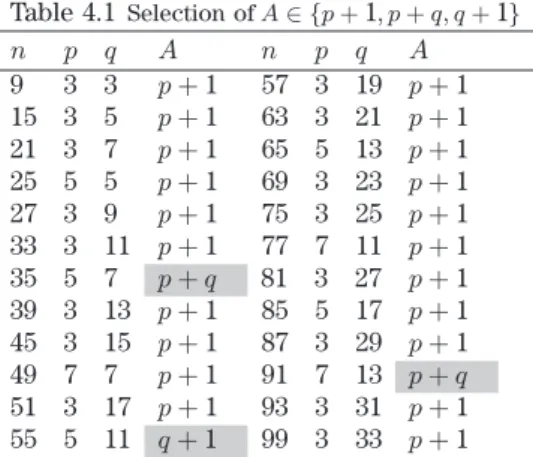
In Table 4.1, we list every n, p, q in the 2/n table in RMP, where p is the smallest divisor (> 1 ) of n.
For almost all the cases, A is chosen to be p + 1 , except n = 35, 55 or 91.
Remark Ancient Egyptians knew the smallest divisor of any composite < 100. This implies that they knew the prime factorization of any integer < 100. However, since the creator of the table RMP seemingly misunderstood that 95 is prime, their knowledge might not be well- founded.
We shall consider the following conditions for prime integers n.
Table 4.1 Selection ofA∈ {p+1, p+q, q+1}
n p q A n p q A
9 3 3 p+1 57 3 19 p+1 15 3 5 p+1 63 3 21 p+1 21 3 7 p+1 65 5 13 p+1 25 5 5 p+1 69 3 23 p+1 27 3 9 p+1 75 3 25 p+1 33 3 11 p+1 77 7 11 p+1 35 5 7 p+q 81 3 27 p+1 39 3 13 p+1 85 5 17 p+1 45 3 15 p+1 87 3 29 p+1 49 7 7 p+1 91 7 13 p+q 51 3 17 p+1 93 3 31 p+1 55 5 11 q+1 99 3 33 p+1
Table 5.1 If selected in the RMP table
n a b n a b
5 3 15 47 24 1128
7 4 28 53 27 1431
11 6 66 59 30 1770
13 7 91 61 31 1891
17 9 153 67 34 2278
19 10 190 71 36 2556
23 12 276 73 37 2701
29 15 435 79 40 3160
31 16 496 83 42 3486
37 19 703 89 45 4005
41 21 861 97 49 4753
43 22 946 101 51 5151
The combinations are colored gray if selected by RMP.
Only the cases for n = 5, 7, 11 and 23 are selected.
By the computations, 2a − n is always 1. Comparing the above table and the 2/n table in RMP, we find that RMP adopted the expressions whose denominators are smaller. In the RMP table, there are no fractions whose denominators are larger than 1000.
For a prime integer n, fi nd a with 2a − n = 1. Then we get the following expression.
2 n= 1
a+ 1 na
The creator of the RMP table have done these cal- culations for n = 5, 7,・・・, 43, but did not attempt to continue, because the denominators b had four digits ever after. Then he must have tried another ways. If he found an expression with smaller denominators, he replaced the old one with the new one. Although n = 13 is an exception, we postpone the arguments until more later stage.
6 .THE WAY TO EXPRESS AS A SUM OF MUTUALLY
DIFFERENT THREE UNIT FRACTIONS IN GENERAL
6 . 1 .General arguments. Let n be a prime integer.
We want to express 2/n as a sum of mutually different three unit fractions:
1 n = 1
a+1 b+1
c (0< a < b < c) (*)
In the RMP table, a is always chosen so that a < n except n = 101. So, we make the assumption a < n. On the other hand,
2 n−1
a= 2a−n na
So, 2a − n > 0. Hence n/2 < a < n. To get an expression ( *), we have to express 2a − n as a sum of mutually different two divisors x, y of na.
2a−n=x+y (x < y)
Since 0 < 2a − n < n and n is prime, x and y should be divisors of a. If y = a, then
y na = 1
n
This shows that 1/n appears as a summand of the right hand side of ( *). But in the RMP table, the right hand side of ( *) does not contain 1/n as a summand except n = 101. So, we may assume y < a. Therefore, we have to consider the following problem.
Problem 6.1. Let n be a prime integer and a an integer with n/2 < a < n. Find all positive integers x, y which
satisfy the following conditions.
(1) 2a − n = x + y (2) 1 ≤ x < y < a (3) x, y are divisors of a.
Although the problem could be solved easily by the computer, we need a way to solve it by hand calculations.
The empirical examinations by the computer reveals that a, x and y are subject to rather restrictive conditions, which we formulate as follows.
Lemma 6.1. Let the assumptions and notations be as in Problem 6.1. Then
(1) x and y have different parities, that is, if x is even (resp. odd), then y is odd (resp. even).
Therefore a is even.
(2) x and y are mutually prime to each other.
(3) x2 < a. In particular, if n ≤ 101 then x < 10.
(4) If n ≤ 101, then y > (2a − n) − 10. In particular if (2a − n) − 10 ≥ 10, then y > 10.
(5) If n ≤ 101, then a is an even integer satisfying the following condition:
1
2(n+3)≤ a < 2 3(n+10) Ifn 20, then 2
3(n+10)≤ n.
≥
Proof. (1) Since n is an odd prime, 2a − n is an odd integer. So x + y = 2a − n is an odd integer. Therefore x and y have different parities. Since a is divisible by x and y, a is an even integer.
(2) Let d be the greatest common divisor of x and y.
Since a is divisible by x and y, a is also divisible by d. On the equation 2a − n = x + y, every term is divisible by d except n. So n is also divisible by d. Since n is prime and d ≤ a < n, we must have d = 1.
(3) Since x and y are mutually prime and a is divisible by x and y, we see that a is divisible by the product xy. Since x < y, we have x2 < xy ≤ a. In particular, if n ≤ 101, then x2 < a < n ≤ 101, yielding x < 10.
(4) Since n ≤ 101, x < 10 by the preceding result. So, 2a
− n = x + y < 10 + y, which yields the required result.
(5) Since y is a divisor of a and y < a, we must have y ≤ a/2. (This is because we may write a = dy with d ≥ 2.) So,
2a−n−10< y ≤a/2= 2a−n−10< a/2
= 3a/2< n+10
Hence, a < 23(n + 10). On the other hand, since x < y, the least possible value of x is one and the least possible value of y is two. So, 2a − n = x + y ≥ 1 + 2 = 3. Hence a ≥ (n + 3)/2. As for the last inequality,
2
3(n+10)≤ n⇐⇒2n+20≤ 3n⇐⇒20≤ n
which completes our proof. □
In the following, we show how to apply Lemma 6.1 for n = 97, 59. These calculations are intended to show that the method applied here could be applied for any positive prime n < 60 and n = 97 in the ancient Egypt.
6 . 2 .The case when n = 97. By lemma 6.1, a is an even integer satisfying the condition 50 ≤ a ≤ 70. Now,
2a−n−10 ≥10⇐⇒2a ≥117
⇐⇒a ≥58.5
= a ≥60 (since a is even) So we discuss the two different cases separately:
(1) the case when 60 ≤ a ≤ 70 (y has two digits by Lemma 6.1)
(2) the case when 50 ≤ a ≤ 58 (x has a single digit by Lemma 6.1)
To consider the case 60 ≤ a ≤ 70, we make Table 6.2.1.
The entries of the tables are fi lled in the following way.
(1) The first and second columns are filled in an obvious say. As for the second column, we note the numbers are increased by 4 consecutively.
(2) In the column of y, we enumerate all divisors of a which are smaller than a and are larger than (2a − n)− 10. (Note that these divisors have two digits and are relatively few in number.)
(3) In the column of x, write down (2a − n)− y.
After fi lling up the table, we list all the combinations for which x is positive and divides a:
a = 60, y = 20, x = 3, a = 66, y = 33, x = 2
Next we consider the case when 50 ≤ a ≤ 58. We again make Table 6.2.2, but in a slightly different way:
The entries of the tables are filled in the following ways.
(1) The first and second columns are filled in an obvious way.
(2) In the column of x, we enumerate all divisors of a which have a single digit.
(3) In the column of y, write down (2a − n)− x. After fi lling up the table, we list all the combinations for which y > x and y is a divisor of a:
a = 50, x = 1, y = 2, a = 56, x = 1, y = 14 a = 54, x = 2, y = 9, a = 56, x = 7, y = 8
Summarizing our results, we get the following com- binations.
Let us choose the combination for which the largest denominator (i.e. na/x) is the least. This is the combination of 4th line of the above table. Then we get
2 97 = 1
56+ 8
97 · 56+ 7 97 · 56= 1
56+ 1 679+ 1
776 This is the expression of the RMP table. So, we may conclude that our method is the same (or similar) one which is adopted in creating the RMP table.
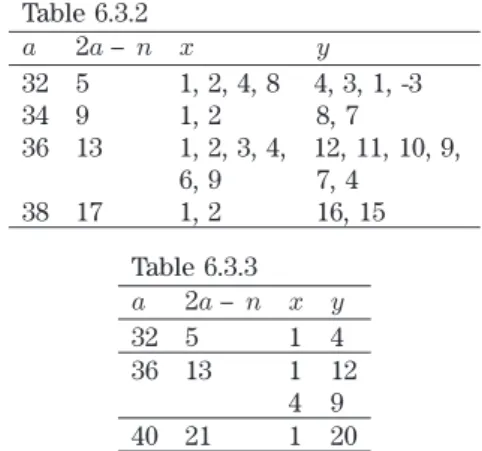
6 . 3 .The case when n = 59. The case when n = 59 is entirely similar to the case when n = 97. We only list Table 6.3.1, 6.3.2 and 6.3.3 which are corresponding to Table 6.2.1, 6.2.2 and 6.2.3 accordingly.
Let us choose the combination for which the largest denominator (i.e. na/x) is the least. This is the combination of 3rd line of Table 6.3.3. Then we get
2 59 = 1
36+ 9
59 · 36+ 4 59 · 36= 1
36+ 1 236+ 1
531 This is the expression of the RMP table. So, we may conclude that our method is the same (or similar) one which is adopted in creating the RMP table.
Table 6.2.1
a 2a−n y x
60 23 15, 20, 30 8, 3, -7
62 27 31 -4
64 31 32 -1
66 35 33 2
68 39 34 5
70 43 35 8
Table 6.2.2
a 2a−n x y
50 3 1, 2, 5 2, 1, -2 52 7 1, 2, 4 6, 5, 3 54 11 1, 2, 3, 6, 9 10, 9, 8, 5, 2 56 15 1, 2, 4, 7, 8 14, 13, 11, 8, 7
58 19 1, 2 18, 17
Table 6.2.3 a 2a−n x y
50 3 1 2
54 11 2 9
56 15 1 14
7 8
60 23 3 20
66 35 2 33
Table 6.3.1
a 2a−n y x
40 21 20 1
42 25 21 4
44 29 22 7
denominators increase. So it seems Condition B is binding.
7 .THE WAY TO EXPRESS AS A SUM OF MUTUALLY
DIFFERENT FOUR UNIT FRACTIONS IN GENERAL
7 . 1 .General argument. Let n be a prime integer. We want to express 2/n as a sum of mutually different four unit fractions.
2 n= 1
a+1 b+1
c+1
d (0< a < b < c < d) (**)
As in the “three unit fractions” case, we assume a < n and get n/2 < a < n. To get an expression (** ), we have to express 2a − n as a sum of mutually different three divisors x, y, z of na.
2a n=x+y+z (x < y < z)
As in the “three unit fractions” case, x, y and z should be divisors of a, and we assume z < a. If x = 1, then the corresponding unit fraction is
1 na
If n is large, then the denominator na tends to be much larger. So we make an additional assumption x > 1.
Remark We have not imposed this assumption in the
“three unit fractions” case, since there was no serious benefi t. x = 1 appears only when n = 13.
Thus, x, y and z are the proper divisors of a (i.e.
divisors other than 1 and a). Therefore we have to consider the following problem.
Problem 7.1. Let n be a prime integer and a an integer with n/2 < a < n. Find all positive integers x, y, z which satisfy the following conditions.
(1) 2a − n = x + y + z (2) 1 < x < y < z < a
(3) x, y, z are proper divisors of a.
6 . 4 .Summary of examples. Although we have tested only two examples, it is clear that hand calculations could be successfully applied to get the results.
So, in any way, hand calculations are suffi cient and the creator of the RMP table was able to apply the similar method.
6 . 5 .Two or three unit fractions, which way to choose. If n is a prime integer ≤ 43, then 2/n is expressed as a sum of mutually different two unit fractions with denominators less than 1000. In the RMP table, much of them are expressed as sums of three unit fractions.
We have to compare the denominators. In Table 6.5.1, we enumerate
(1) Prime integer n with
3< n ≤43, n=5,11,29,43
(For n = 5, 11, there is no expression of 2/n as a sum of mutually different three unit fractions with a < n. For n = 29, 43, 2/n is expressed as a sum of mutually different four unit fractions in the RMP table.)
(2) The denominators a, b when 2/n is expressed as a sum of mutually different two unit fractions with a < n.
(3) The denominators a, b, c when 2/n is expressed as a sum of mutually different three unit fractions with a < n. Except n = 13, we include o n l y t h e c o m b i n a t i o n s t h a t t h e l a r g e s t denominators are the least.
The combinations that are adopted in the RMP table are colored gray.
From the table, it is clear that if n ≠ 7, 13, then we have Condition B (cf. 4). If n is small, then Condition B seems not to be binding. However, if n increases, then the
Table 6.3.2
a 2a−n x y
32 5 1, 2, 4, 8 4, 3, 1, -3
34 9 1, 2 8, 7
36 13 1, 2, 3, 4, 12, 11, 10, 9, 6, 9 7, 4
38 17 1, 2 16, 15
Table 6.3.3 a 2a− n x y
32 5 1 4
36 13 1 12
4 9
40 21 1 20
Table 6.5.1
n a b c
7 4 28
6 14 21
13 7 91 8 52 104 10 26 65 17 9 153
12 51 68 19 10 190
12 76 114
n a b c
23 12 276 16 46 368 31 16 496
20 124 155 37 19 703
24 111 296 41 21 861
24 246 328
7 . 3 .The case whenn = 43. Quite identically as in the case when n = 29, the possibility of a is limited (a = 28, 30, 32, 36, 40 and 42). We only enumerate resulting combinations of a, b, c, d in Table 7.3.1. If we choose the combination that the largest denominator (which is d) should be the least, we get the combination a = 42, b = 86, c
= 129, d = 301, which is the one selected by the RMP table.
7 . 4 .Is it possible to apply our method for the other n ? Our method to get an expression of 2/n as a sum of mutually different four unit fractions is getting increasingly diffi cult as n increases.
If n = 47, we have to consider the following eight cases:
a=28,30, 32, 36, 40, 42, 44, 45 So it is more diffi cult than n = 43.
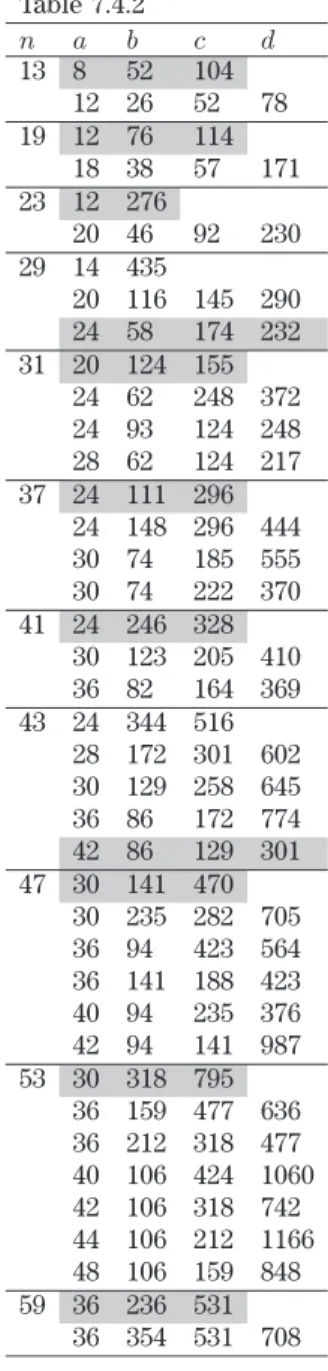
With the help of computer calculations, we enumerate the following in Table 7.4.2.
(1) Prime integers 13 ≤ n < 60 and n ≠ 17. (If n < 13 or n = 17, then there is no expression of 2/n as a sum of mutually different four unit fractions with a < n.)
(2) The denominators in the RMP table, which are colored gray.
(3) The denominators when 2/n is expressed as a sum of mutually different three or four unit fractions with a < n.
(4) For n = 29 and 43, we include denominators of the best expressions with two or three unit fractions in terms of Condition B. (For n = 29, it is a “two unit fractions” case, and for n = 43, it is a “three unit fractions” case.)
Table 7.4.2 shows that the creator of RMP table has done the calculations for
n=29,31,37,41,43,
obtaining better expressions for n = 29, 43 in terms of Condition B and has replaced for n = 29, 43. But he probably didnʼt try our method for n > 43, because if Condition B is upheld, then the selection of the RMP table should be different in the case when n = 47, 53.
Condition B seems to be not binding for small n. In our case, n = 13, 23 is an exception to Condition B.
Our problem implies that a has three mutually different proper divisors. So
Lemma 7.1. Under the assumptions and notation of Problem 7.1, we have
(1) a is not prime.
(2) a is not the product of mutually different prime numbers.
(3) a is not the square nor cube of a prime number.
Remark Under our assumption, a is almost likely to be an even integer.
proof of Remark. Assume that a is odd. If a is divisible by mutually different three prime integers, then a ≥ 3・5・ 7 = 105 > 101. So, this is not the case and a is the following form: a = pSq (p, q odd prime) Since a < n ≤ 101, the possible cases are:
32・5 = 45, 32・7 = 63, 32・11 = 99, 3・52 = 75 So, if we exclude these cases, a is an even integer. □ We also have the following lemma:
Lemma 7.2. Under the assumptions and notation of Problem 7.1, we have
a ≥(n+9)/2
Proof. Since x > 1, we must have x ≥ 2, y ≥ 3, z ≥ 4. So,
2a n=x+y+z ≥2+3+4=9 2a≥ n+ 9
which yields our result. □
In the following, we show how to apply these lemmas to get an expression of 2/n as a sum of mutually different four unit fractions when n = 29, 43.
7 . 2 .The case when n = 29. Since n/2 < a < n, we have 15 ≤ a ≤ 28. Lemma 7.1 and 7.2 exclude some of the possibilities of a, and we can verify a = 20, 24 or 28.
For each a = 20, 24 and 28, to express 2a − n as a sum of mutually different proper divisors of a is simply the matter of routine. So, we only enumerate resulting combinations of a, b, c, d in Table 7.2.1. If we choose the combination that the largest denominator (which is d) should be the least, we get the combination a = 24, b = 58, c = 174, d = 232, which is the one selected by the RMP table.
Table 7.2.1
a b c d
20 116 145 290 24 58 174 232
Table 7.3.1
a b c d
28 172 301 602 30 129 258 645 36 86 172 774 42 86 129 301
divisors of 60.
Proof. The proper divisors of 60 are 2, 3, 4, 5, 6, 10, 12, 15, 20, 30 Our lemma is a result of the following table:
Table 8.1.1 is made by the following rule. For any expression u + v + w with u, v and w being the mutually different proper divisors of 60,
(1) if we can increase u, v or w by one (and u, v, w still being the mutually different proper divisors of 60), increase it and write down on the next line, (for example, if (u, v, w) = (2, 3, 4), then (2, 3, 5) are mutually different proper divisors of 60, so we write the expression 2 + 3 + 5 = 10 in the next line.)
(2) if we canʼt, then reselect the next combination {u, v, w}. (For example, if (u, v, w) = (4, 5, 6), then we can not increase u, v or w by one. So we reselect new combination (2, 4, 10) and write the expression 2 + 4 + 10
= 16 in the next line.) □
Remark 1. The integer interval 5 ≤ t ≤ 27 is maximal with the property that any integer 5 ≤ t ≤ 27 is expressed as a sum of mutually different three proper divisors of 60.
2. The property of the divisors of 60 in the lemma can be easily anticipated. Because the fi rst fi ve divisors 2, 3, 4, 5, 6 of 60 are consecutive integers.
8 .THE WAY TO EXPRESS AS A SUM OF MUTUALLY
DIFFERENT FOUR UNIT FRACTIONS WITHa= 60 8 . 1 .This is possible if63 ≤ n≤ 111. As in 7.1, for prime n > 60, to get an expression
2 n = 1
60+1 b+1
c+1
d (60< b < c < d) we have to get an expression
120 n=x+y+z (1≤ x < y < z <60) where x, y, z are divisors of 60. If x = 1, then the corresponding unit fraction is 1/(60n). Since 60n > 1000, we assume x > 1. Therefore x, y, z are proper divisors of 60.
Lemma 8.1. For an integer t, if 9 ≤ t ≤ 57, then t is expressed as a sum of three mutually different proper
Table 7.4.2
n a b c d
13 8 52 104 12 26 52 78 19 12 76 114
18 38 57 171 23 12 276
20 46 92 230 29 14 435
20 116 145 290 24 58 174 232 31 20 124 155
24 62 248 372 24 93 124 248 28 62 124 217 37 24 111 296
24 148 296 444 30 74 185 555 30 74 222 370 41 24 246 328
30 123 205 410 36 82 164 369 43 24 344 516
28 172 301 602 30 129 258 645 36 86 172 774 42 86 129 301 47 30 141 470
30 235 282 705 36 94 423 564 36 141 188 423 40 94 235 376 42 94 141 987 53 30 318 795
36 159 477 636 36 212 318 477 40 106 424 1060 42 106 318 742 44 106 212 1166 48 106 159 848 59 36 236 531
36 354 531 708
Table 8.1.1
u+v+w u+v+w 2+3+4=9 4+10+20=34 2+3+5=10 5+10+20=35 2+3+6=11 6+10+20=36 2+4+6=12 3+4+30=37 2+5+6=13 3+5+30=38 3+5+6=14 3+6+30=39 4+5+6=15 4+6+30=40 2+4+10=16
2+5+10=17 2+10+30=42 2+6+10=18
3+6+10=19 4+6+10=20 5+6+10=21
4+6+12=22 2+15+30=47 5+6+12=23
3+6+15=24 4+6+15=25 5+6+15=26
3+4+20=27 2+20+30=52 3+5+20=28
3+6+20=29 4+6+20=30 5+6+20=31
2+10+20=32 12+15+30=57 3+10+20=33
5+6+30=41 3+10+30=43 4+10+30=44 5+10+30=45 6+10+30=46 3+15+30=48 4+15+30=49 5+15+30=50 6+15+30=51 3+20+30=53 4+20+30=54 5+20+30=55 6+20+30=56
different three unit fractions with a = 60 in the RMP table. It is quite possible that the “three unit fractions”
case should precede the “four unit fractions” case. So we have to deal with this problem separately.
As for n = 73, 79, 83, 89, the combination for which the largest denominator is the least is the one which is selected in the RMP table. So, if we apply the same method for the remaining n = 67, 71, 97 and if in the resulting expressions, all the largest denominators are of four digits, we may conclude confi dently that our method is the same (or similar) one applied in the creation of the RMP table.
The verifications are straight forward and our anticipation turns out to be true. We only include possible expressions of 120 − n as sums of mutually different three proper divisors of 60 in Table 8.3.1.
9 . THE WAY TO EXPRESS AS A SUM OF MUTUALLY
DIFFERENT THREE UNIT FRACTIONS WITHa= 60 We need:
Lemma 9.1. Let tbe an integer. If 5 ≤ t≤ 27, then t is expressed as a sum of two mutually different proper divisors of 60.
Proof. The proper divisors of 60 are 2, 3, 4, 5, 6, 10, 12, 15, 20, 30 Our lemma is a result of the following table.
The table is made by the following rule. For any expression u+v with u and v being the proper divisors of 60, (1) if we can add one to u or v (and still being the proper divisors of 60), add one to it and write down in the next line,
(2) if we canʼt, then reselect the next combination {u,
v}. □
Lemma 9.2. For an integer 93 ≤ n ≤ 115, we have the Lemma 8.2. Assume that n is an integer > 60. If 63 ≤ n
≤ 111, then we can express 2/n as follows:
2 n= 1
60+1 b+1
c+1
d (60< b < c < d) where b, c, d are integers.
Proof. Now, 2/n − 1/60 = (120 − n)/(60n). Since 63 ≤ n ≤ 111, we have 9 ≤ 120 − n ≤ 57. So our lemma is a result of
Lemma 8.1. □
8 . 2 .The case when n = 73, 79, 83, 89. We can now apply Lemma 8.2 with n = 73, 79, 83, 89 and are able to express 2/n as sums of mutually different four unit fractions with a = 60. If we choose the combination for which the largest denominator is the least, then we can obtain the expressions in the RMP table.
Calculations are the matter of routine and we only include possible expressions of 120 − n as sums of mutually different three proper divisors of 60 in Table 8.2.1.
8 . 3 .The case whenn≠ 73, 79, 83, 89. If 63 ≤ n <
101, then 2/n can be expressed as mutually different four unit fractions with a = 60. If n is prime (or 95), then the corresponding numbers are:
67, 71, 73, 79, 83, 89, 95, 97
In RMP, only for n = 73, 79, 83, 89, 2/n is expressed as a sum of mutually different four unit fractions with a = 60.
As for n = 95, 2/n is expressed as a sum of mutually Table 8.2.1
n 120−n possible expressions 73 47 47=30+15+2
47=30+12+5 47=20+15+12 79 41 41=30+6+5
41=20+15+6 83 37 37=30+5+2
37=30+4+3 37=20+15+2 37=20+12+5 37=15+12+10 89 31 31=20+6+5
31=15+12+4 31=15+10+6
Table 8.3.1
n 120−n possible combinations 67 53 53=30+20+3 71 49 49=30+15+4 97 23 23=15+6+2
23=15+5+3 23=12+6+5
Table 9.1
u+v u+v
2+3=5 5+12=17 2+4=6 6+12=18 2+5=7 4+15=19 2+6=8 5+15=20 3+6=9 6+15=21 4+6=10 2+20=22 5+6=11
2+10=12 3+10=13 4+10=14
5+10=15 12+15=27 6+10=16
3+20=23 4+20=24 5+20=25 6+20=26
10. THE WAY TO EXPRESS AS A SUM OF MUTUALLY
DIFFERENT UNIT FRACTIONS WITHa= 40 For a = 40, we have
2 n−1
a= 2 n− 1
40= 80−n 40n
The numerator 80 − n is an odd integer. If 80 − n is expressed as a sum of divisors of 40, everything would be the same with the case a = 60.
Lemma 10.1. Let t be an odd integer.
(1) If 3 ≤ t ≤ 15, then t is expressed as a sum of two mutually different divisors of 40.
(2) If 11 ≤ t ≤ 19, then t is expressed as a sum of three mutually different divisors of 40.
Remark Here, we are using the divisors, not the proper divisors. Although what are needed are statements for proper divisors, we can not formulate in a simple way.
Proof. The divisors of 40 are
1, 2, 4, 5, 8, 10, 20, 40.
Our lemma is the result of the following tables.
The results are obvious. □
Remark The prime factorization of 60 is given by 22・3・ 5. If we replace the divisor 3 of 60 with 2, then we get the number 40. So, we might expect some resemblance of 40 with 60.
Lemma 10.2. Let n be an odd integer.
(1) If 65 ≤ n ≤ 77, then 2/n is expressed as a sum of mutually different three unit fractions with a = 40.
(2) If 61 ≤ n ≤ 69, then 2/n is expressed as a sum of mutually different four unit fractions with a = 40.
Proof. (1) Since 65 ≤ n ≤ 77, we have 3 ≤ 80 − n ≤ 15. So we get our result by the preceding lemma. (2) is similar.
□ following expression
2 n= 1
60+1 b+1
c (60< b < c) where b and c are integers.
Proof. Now, 2/n − 1/60 = (120 − n)/(60n). Since 93 ≤ n ≤ 115, we have 5 ≤ 120 − n ≤ 27. So our lemma is a result of
Lemma 9.1. □
Let n be a prime integer with 93 ≤ n < 101 or n = 95.
Then n = 95, 97. We list all the denominators when 2/n are expressed as sums of mutually different three unit fractions with a = 60 in Table 9.2.
If n = 97, the largest denominator has four digits. So it is discarded.
If n = 95, then the acceptable combination is unique, that is, a = 60, b = 380, c = 570, which is the one selected by the RMP table.
For n = 95, we list all the denominators in Table 9.3 when 2/n is expressed as mutually different unit fractions with Condition A. The first three lines are derived from the fact that n is composite (n = pq). And the last three lines are derived from the computer calculations. The combination selected by the RMP table is colored gray.
By Table 9,3, it is clear that the creator of the RMP table had not enumerated all the possible combinations.
We remember the method in “The way to express as a sum of mutually different four unit fractions with a = 60”.
We only selected among the candidates with a = 60, although there might be another possibilities without the restriction on a. So it is certain that the creator of the RMP table have selected among the candidates with a fixed a = 60 for n = 95. Moreover it is certain that the creator of the RMP table have misunderstood 95 as a prime integer. If he knew that 95 is composite, he got the more simple combination: a = 60, b = 228 (or a = 57, b = 285).
Table 9.2
n a b c
95 60 285 1140 60 380 570 97 60 291 1940 Table 9.3
a b c
57 285 60 228 50 950
a b c
60 380 570 70 190 665 76 190 380
Table 10.1 u+v 1+2=3 1+4=5 2+5=7 4+5=9 1+10=11 5+8=13 5+10=15
Table 10.2 u+v+w 1+2+8=11 1+4+8=13 2+5+8=15 4+5+8=17 4+5+10=19
11. ARE THERE ANOTHER POSSIBILITY OF “FIXEDa”
OTHER THANa= 60, 40
We assume that n is prime. In expressing 2/n as a sum of mutually different fractions, if we fix a and if we choose the combination of the least largest denominator, it is not guaranteed that we have chosen the least largest denominator without the restriction of a.
For n < 60, the RMP table had almost always chosen the least largest denominator except several small nʼs. So it is extremely unlikely that the creator of the RMP table had chosen another fi xed a other than a = 60, 40.
Since fixed a = 60, 40 exhaust almost all the primes larger than 60, it is natural to think that the ancient Egyptian stopped here.
12. THE CASE WHENn= 101
n = 101 is an exception. We consider the expression:
2 101 = 1
a+1 b+ 1
c (a < b < c) or = 1
a+1 b+ 1
c+1
d (a < b < c < d)
where a, b, c, d are integers. If we enumerate all the possible cases with the condition n/2 < a < n with the help of the computer calculations, we get Table 12.1, which shows that at least one of the denominators has four digits. So, every combinations are discarded.
The ancient Egyptian tried in any way or other way, and always ended up with four digits denominators. So, he divided by 101 on both sides of the following equation:
2=1+ 1 2+1
3+1 6 10. 1 .The way to express as a sum of mutually
different three unit fractions with a = 40. Let n be a prime integer with 65 ≤ n ≤ 77. Then n = 67, 71, 73. For n
= 73, it is already discussed with a fi xed a = 60. So there remain n = 67, 71. For these prime integers, we are able to obtain the expressions of 2/n in exactly the same way as in the RMP table.
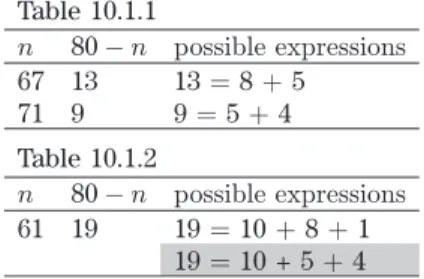
We only include possible expressions of 80 − n as sums of mutually different two divisors of 40 in Table 10.1.1.
10. 2 .The way to express as a sum of mutually diff erent four unit fractions with a = 40. Let n be a prime integer with 61 ≤ n ≤ 69. Then n = 61, 67. For n = 67, it is already discussed in the expression of mutually different three unit fractions with a = 40. So there remains n = 61.
For this case, we are able to obtain the expressions of 2/n in exactly the same way as in the RMP table.
We only include possible expressions of 80 − n as sums of mutually different three divisors of 40 in Table 10.1.2.
10. 3 .Summarizing the way to express as a sum of mutually diff erent unit fractions witha = 40. For n = 67, 71, 61, we may conclude that the creator of the RMP table had considered with a fixed a = 40, because our selections coincide with the selections of RMP. Moreover, his method is certainly the same (or similar) with the one which we adopted here.
In the fi rst place, the creator of the RMP table should have applied the method to express 2/n as a sum of three or four mutually different unit fractions with fi xed a = 60.
He has succeeded with 73, 79, 83, 89. But he has failed with n = 67, 71, 97. He has only ended up with four digits denominators. Probably his original intentions were to work out every prime n with n ≥ 63 (Lemma 8.2). So he searched for another fi xed a, arriving at a = 40.
The final result at this stage was a really successful one for him because he has worked out every prime number larger than 60 except n = 97, 101.
Table 10.1.1
n 80−n possible expressions 67 13 13=8+5 71 9 9=5+4 Table 10.1.2
n 80−n possible expressions 61 19 19=10+8+1
19=10 + 5+4
Table 12.1
a b c d
52 2626 5252 54 909 5454 56 808 1414 60 404 1515 68 202 6868 56 707 2828 5656 60 404 2020 6060 60 505 1010 6060 60 505 1212 3030 60 505 1515 2020 60 606 1010 2020 60 606 1212 1515 63 303 2121 6363 66 303 1111 2222 72 202 1212 7272 72 303 404 7272 72 202 1818 2424 78 202 606 2626 84 202 404 2121
must verify this statement.
To express 2/n as a sum of mutually different unit fractions, we fi rstly have to consider the subtraction:
2 1 2
n−
a= a−n (*) na
If 2a − n is expressed as a sum x + y with x and y being the divisors of a, then we could obtain an expression of 2/n as a sum of three mutually different unit fractions.
This is the method we have employed here. The denominators are a, na/x, na/y. Since a is even and x,y have different parities, at least two denominators are even integers.
If 2a − n is expressed as a sum x+y+z with x, y and z being the divisors of a, then we could obtain an expression of 2/n as a sum of four mutually different unit fractions.
By the remark following Lemma 7.1, a is likely to be even. Assume that a is even. If x, y and z are all even integers, then n is also even, which is a contradiction. So one of x, y and z is an odd integer. The denominators are a, na/x, na/y and na/z. So, at least two denominators are even integers.
We note that the above discussions include the case a
= 60 or 40.
If n is prime, then the expression as a sum of unit fractions tends to have larger denominators as n increases. So the ancient Egyptians preference for even numbers is limited to a very small prime n = 7 or 13.
Compared to the prime cases, the composite cases seems to be more loose as there are smaller denominators.
14. HOW THE 2/n RMP TABLE HAS BEEN CREATED? From our discussion, it is now clear how the RMP table has been created, which is as follows.
(1) For a composite odd integer n, express 2/n as a sum of mutually different unit fractions (by the method of Miro Gardner). Since the creator of the table misunderstood 95 as a prime number, n = 95 is excluded here.
(2) For a prime integer n, choose a positive integer a with 2a − 1 = n. Then write down
With this method, for any positive integer n, 2/n can always be expressed as a sum of mutually different four unit fractions.
13. YET TO EXPLAIN
Our discussion is not perfect. There is a certain ambiguity when n is composite or one of several small primes.
We write n = pq with p (> 1) the smallest divisor of n and we make an expression
2 n = 2
pq = 2 A
A pq
Then we may select A = p + 1, p + q or q + 1. Although A
= p + 1 is selected in the RMP table for almost all cases, there are certain exceptions when A = p + q or q + 1 are selected. These exceptions are listed in Table 13.1.
In his book [2], Gillings discusses on the division by 13 in Chapter 7 and concluded as follows:
“We c o n c l u d e , t h e r e f o r e , t h a t a preference for even numbers might well have been a very important factor in the preparation of the Recto Table as a whole.”
If we rely upon his idea and look up Table 13.1 again, there certainly exist the cases that Gillingsʼs idea is correct. The cases n = 35, 55 fall into this category. The case n = 91 might be decided by Condition B, although Condition B seems to be ignored in the composite n in the RMP table.
Moreover, his idea explains the selections for n = 7, 13 in 6.5.
In 7.4, there was also exceptions (n = 13, 23). In these exceptions, all the denominators of candidates are even numbers. Probably the creator of RMS table was content with the older expressions and did not search for new ones.
If we trust upon Gillingsʼs idea, our method employed here necessarily implies that the denominators obtained by our method have the inclination of being even. We
Table 13.1
p+1 p+q q+1
2/35=21+105 2/35=30+42 2/35=20+140 2/55=33+165 2/55=40+88 2/55=30+330 2/91=52+364 2/91=70+130 2/91=49+637
unit fractions with a fi xed a = 40. The worked out numbers n are:
67, 71
●Express 2/n as a sum of mutually different four unit fractions with a fi xed a = 40. Only the case n
= 61 is worked out.
The result is a real success for the creator of the RMS table. He has done almost all primes n > 60 except n = 97, 101.
Fortunately, the remaining primes n < 60 and n = 97 were worked out with the general “three unit fraction”
strategy. But it still remains n = 101.
Alas, he could not fi nd the answer. So the condition a
= n is allowed.
In each step, we have to obey Condition A and B.
However, Condition B is not binding for small n and we may choose the candidate with more even denominators
REFERENCES [1] Milo Gardner, 1997 letter,
h t t p : / / w w w. m a t h . b u f f a l o . e d u / m a d / A n c i e n t - A f r i c a / gardner1997.html
[2] Richard J. Gillings, Mathematics in the Time of the Pharaohs, Dover, 1982
[3] E d . b y Vi c t o r J . K a t z , T h e M a t h e m a t i c s o f E g y p t , Mesopotamia, China, India, and Islam, Princeton University Press, 2007
2 n = 1
a+ 1 na for any prime 3 < n ≤ 43.
(3) For any prime 3 < n ≤ 43, express 2/n as a sum of mutually different three unit fractions with a < n. If the new expression is better than the old, then replace the old one with the new one. (n = 7, 13 are exceptions.) (4) For any prime 3 < n ≤ 43, express 2/n as a sum of mutually different four unit fractions with a < n. If the new expression is better than the old, then replace the old one with the new one. (n = 13, 23 are exceptions.)
At this stage, the author does believe that the creator of the RMS table did not want to go further in the general method. Because, the prime n > 43 might introduce four digit denominators. So, the creator of the RMS table focused on the “fi xed a” strategy.
(5) Do the following things in order.
●Express 2/n as a sum of mutually different three unit fractions with a fi xed a = 60. Only the case n
= 95 is worked out.
●Express 2/n as a sum of mutually different four unit fractions with a fi xed a = 60. The worked out numbers n are:
73, 79, 83, 89
●Express 2/n as a sum of mutually different three